# The Definitive Guide to Harness Engineering
**作者**: TRAE
**日期**: 2026-04-23T02:47:22.000Z
**来源**: [https://x.com/Trae_ai/status/2047145274200768969](https://x.com/Trae_ai/status/2047145274200768969)
---
> Harness Engineering is simply a more evocative, intuitive way to systematically summarize and name these existing AI practices.
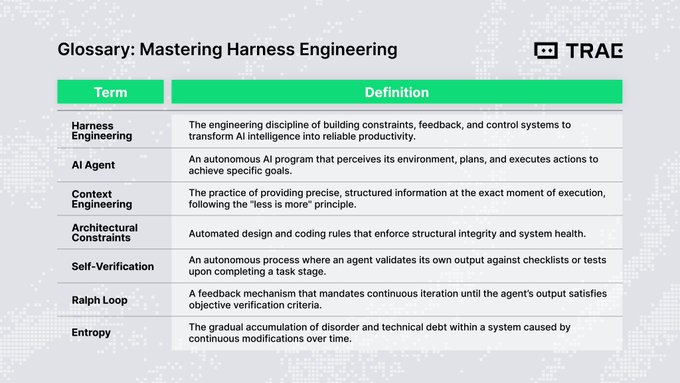
1. What is Harness Engineering?
2026 marks the rise of a new pillar in software engineering: Harness Engineering. Following in the footsteps of Prompt and Context Engineering, the name was introduced by Mitchell Hashimoto, Co-Founder of HashiCorp and gained widespread traction after a pivotal OpenAI report.
At its core lies the "Horse and Reins" metaphor. Think of an AI agent or any complex software system as a powerful but directionless "wild horse". The "Harness" represents the reins used to constrain, guide, and correct its behavior, ensuring it stays on track with stability and reliability.
To put it into a simple equation:
> AI Agent = SOTA Model (Wild Horse) + Harness (Control System) = An Elite Performer
An AI agent is a "wild horse" with limitless potential, and Harness Engineering is the complete system that domesticates it. You aren't changing the horse's DNA (the model itself), you're designing the professional gear and training protocols required to make it work for you.
> 💬 The Harness is essentially every piece of infrastructure other than the LLM that enables an agent to actually deliver results. It isn't about "better prompts" or "more capable models". It's about optimizing the environment and mechanisms the model operates within. It is an engineering philosophy and framework designed to transform raw AI intelligence into reliable, controllable, and scalable productivity.
Let's be clear: Harness Engineering isn't some shiny new toy to trigger your FOMO. It's more of a harnessing framework for AI engineering, designed to tackle one core problem.
The core problem it solves is simple: now that AI has joined your workflow, how do we actually manage this "super intern"?
2. Why Do We Need Harness Engineering?
As AI evolves from simple "answering machines" to autonomous agents capable of planning and executing complex tasks, the role of the engineer is undergoing a fundamental paradigm shift.
Harness Engineering has emerged specifically to tackle the new challenges brought on by this evolution.
## 2.1 Building a more reliable Agent system
To move agents beyond the toy stage and into the realm of production-ready engineering, they must anchor on four core objectives: the R.E.S.T framework.
2.1.1 Reliability
Definition
The system's ability to provide stable, continuous service and complete designated tasks when faced with expected or unexpected inputs, environmental shifts, and internal faults.
Key Requirements
- Fault Recovery: The ability to automatically resume from checkpoints after a task is interrupted
- Operation Idempotency: Ensuring critical write operations can be safely retried without corrupting the system state
- Behavioral Consistency: Ensuring behavior remains predictable under the same set of inputs
2.1.2 Efficiency
Definition
The effective use of compute, storage, and network resources while meeting functional and reliability needs. This directly impacts service cost and scalability.
Key Requirements
- Resource Control: Precise budget management for token consumption, API calls, and compute time
- Low-Latency Response: Providing meaningful feedback quickly in interactive scenarios
- High Throughput: The ability to process more tasks per unit of time in batch scenarios
2.1.3 Security
Definition
Protecting the system and its data from unauthorized access, use, or destruction. For autonomous agents, security is a non-negotiable red line.
Key Requirements
- Least Privilege: Granting only the minimum permissions necessary to complete a specific sub-task
- Sandboxed Execution: Executing all untrusted code or instructions within a strictly isolated sandbox environment
- I/O Filtering: Preventing prompt injection, sensitive data leaks, and the generation of harmful content
2.1.4 Traceability
Definition
Providing sufficient data (logs, metrics, and traces) so that developers and operators can understand the internal state, decision-making process, and behavioral history of the agent.
Key Requirements
- End-to-End Tracing: Maintaining a clear, traceable call chain for every step from the initial request to the final result
- Explainable Decisions: Ensuring every critical decision has a clear attribution record
- Auditable State: Ensuring the complete state of the system at any point in its history can be queried and audited
## 2.2 The Engineering Imperative in the Agent-First Era
2.2.1 Engineering complexity is hitting new heights
As AI capabilities expand, so do our expectations for what we can build. We've moved far beyond "Vibe Coding" (quick demos of Snake or Tetris clones) and transitioned into the realm of serious, production-grade engineering.
2.2.2 From "Executor" to "Architect"
As AI takes over the heavy lifting of writing specific lines of code, the core value of a human engineer moves up the stack to system design. We are no longer laborers laying bricks line-by-line, we are architects drafting the blueprints, defining the rules, and signing off on the final output: a concept we call Spec Coding.

This practice is a powerful proof of concept: when AI becomes the primary engine of productivity, traditional engineering management models no longer work. Instructing an AI via prompts is a "soft constraint," and it simply isn't enough to guarantee quality, reliability, or maintainability.
We need a system of "hard constraints", a robust engineering framework to anchor the agent performance. This is exactly where Harness Engineering comes in.
The core philosophy of Harness Engineering is that when a model hits a wall, we implement an engineered mechanism to ensure that the same class of failure never happens again.
It is a living system. As models continue to iterate, many foundational capabilities will eventually be internalized by the models themselves, allowing certain Harness practices to retire. Simultaneously, as new application scenarios emerge, they will inevitably birth new Harness innovations.
Let's then dive into what Harness Engineering actually looks like.
3. Deconstructing Harness Engineering
Under the hood of current Transformer-based and autoregressive LLM architectures, raw output is inherently stochastic and disordered.
Harness Engineering is the practice of imposing deterministic constraints on that raw compute to enable complex engineering workflows.
To understand the "what," we have to look at how an agent actually functions. A production-ready agent operates on a continuous, four-stage loop: Perception, Planning, Action, and Feedback/Reflection (PPAF).

We deconstruct the agent stack into four core dimensions, each mapped directly to the PPAF cycle. Think of these as the 'harness'—the necessary structure to guide, constrain, and unleash the model's true potential.

To map the capability boundaries and engineering hurdles of different agents, we use a two-dimensional matrix based on the Cognitive Loop and Context Efficiency.
Horizontal Axis: AI Cognitive Loop
- React (Passive Response): Behavior is driven by single external triggers. The agent executes predefined, deterministic tasks but lacks autonomous planning or reflection.
- Proactive Plan & Reflect: The agent pursues long-term goals, autonomously managing multi-step planning, execution, and dynamic adjustments based on outcomes.
Vertical Axis: Context Efficiency
- Inefficient (Manual/Point-fed): Most context is manually provided by humans or pulled through limited, low-efficiency interfaces.
- Efficient (Sandboxed/Automated Injection): The agent operates in a highly integrated environment where context is automatically captured and injected via system-level interfaces like file systems, API gateways, or state engines.
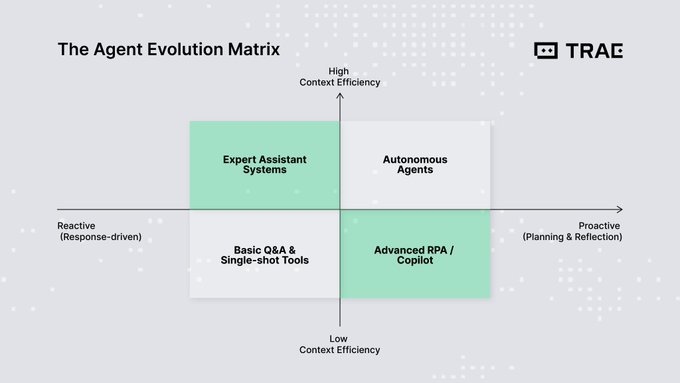
This matrix reveals the core value of Harness Engineering: the maturity of your harness directly determines an agent's ability to leap from the inefficient, passive lower quadrants into the high-efficiency, proactive upper tiers.
4. The Architecture of a Harness System
With the framework established, it's time to move from concept to action. Let's unpack how to build a resilient Harness system layer by layer.
## 4.1 High-Level Abstraction: The Harness as a Managed REPL Container
At the architectural level, a Harness is essentially a REPL (Read-Eval-Print Loop) container equipped with boundary controls, tool routing, and deterministic feedback.
Think of it as a deterministic shell wrapping the non-deterministic "brain" of the LLM. Its job is to manage the entire lifecycle from perception to action to reflection, effectively plugging LLM reasoning into the predictable world of software engineering.
> 💬 The Core Logic of the REPL Harness
> Read: The Harness uses a Context Manager to translate the external world (such as user input or API states) and internal memory into highly structured prompts that the LLM can actually digest. This is how we bring engineering rigor to the "perception" phase.
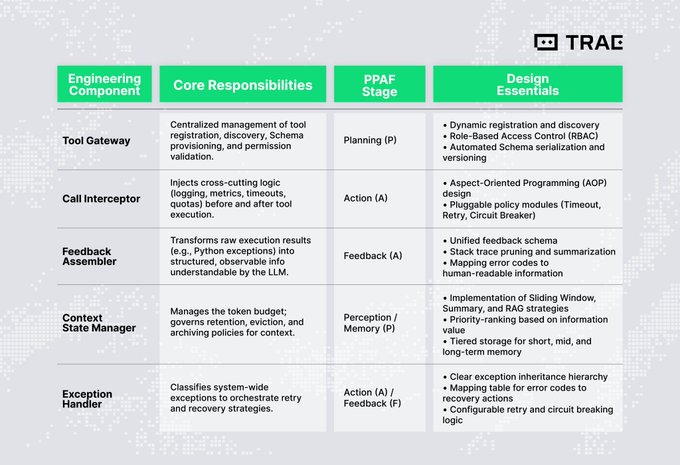
> Eval: When the LLM generates a plan (e.g., a Function Call), the Call Interceptor catches that intent and routes it to the appropriate tool executor. Every execution is strictly monitored for timeouts, resource quotas, and error handling.
> Print: The output of the tool (whether it's successful data or an exception) is captured by the Feedback Assembler. This is then repackaged as a structured "observation" and re-injected into the context, providing the LLM with the raw material for its next round of reflection and planning.
> Loop: This "Read-Eval-Print" cycle repeats continuously until the agent hits its goal or triggers a termination condition. This loop is the fundamental engine driving the PPAF process.
## 4.2 The Underlying Transformation Mechanism: Bridging Infinite State and Finite Tokens
An agent's emergent intelligence relies on its ability to digest massive amounts of state information. However, the underlying Transformer architecture operates on a fundamentally finite, linear token sequence.
Consequently, a central challenge of a Harness is establishing an efficient, reliable, bidirectional mapping between the "infinite" state of the external world and the "finite" token context of the LLM.
4.2.1 Context Management: From "Infinite State" to "Finite Tokens"
An agent's context is the ground truth for its perception, encompassing everything from task goals and interaction history to tool definitions and real-time state. The ability to distill this massive data stream into a finite token window is the ultimate bottleneck for planning quality.
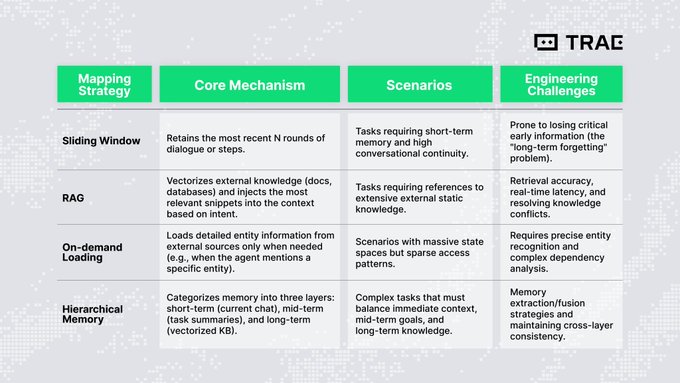
> 💬 Engineering Decisions: Reduction Rules and Injection Boundaries
> At its core, context management is a set of Reduction Rules.
> The Harness must define explicit rules to determine which information to prioritize and which to prune when the token budget is tight. Furthermore, the Injection Boundary is vital. It dictates exactly where external data (such as RAG results) is inserted within the prompt to maximize performance and avoid the "Lost in the Middle" phenomenon.
4.2.2 Function Calling: From "Text Prediction" to "Physical Execution"
Function Calling (FC) serves as the bridge between LLM planning and real-world action. While it seems straightforward, it involves a rigorous, and often fragile lifecycle loop:
- Schema Serialization: The Harness serializes available tools and their parameters (JSON Schema) into a specific text format and injects it into the prompt. This is the only way an LLM understands its "capability boundaries".
- Trigger Generation: Through pattern matching across its vast parameter space, the LLM generates text following a specific syntax (including the tool name and argument values) when it determines a tool is needed for the plan.
- Deterministic Deserialization: The Harness intercepts this text and attempts to deserialize it into a structured request. This is the most brittle stage, as LLM output may violate syntax rules, such as malformed JSON or type mismatches.
- Observation Injection: The Harness executes the call and wraps the result (success or failure) into an "observation" text block, which is re-injected into the prompt to close the loop.
a) Failure Surfaces and Fallback Paths
Given the non-deterministic nature of LLM output, every step of Function Calling is a potential point of failure. A resilient Harness must implement robust fallback paths:
Deserialization Failure
- Retry: Provide the LLM with the specific error (e.g., "Invalid JSON format") to trigger a re-generation.
- Fallback to Text: Request natural language instructions for a traditional parser instead.
Execution Failure
- Interactive Clarification: Request missing parameters directly from the user.
- Reflection and Re-planning: Inject detailed error logs into the context to guide the agent toward an alternative path in the next round.
b) Core Architectural Decision: The State Separation Principle
- You must treat the LLM strictly as a stateless compute unit (a "CPU"). All state requiring cross-turn consistency such as user sessions or task progress must be offloaded to an external Context State Manager or persistence engine (Memory/Disk) controlled by the Harness.
- The Anti-Pattern: Attempting to force the LLM to maintain complex state via prompt engineering leads to chaotic, unpredictable, and untraceable system behavior.
4.2.3 Core Constraints and Design Principles
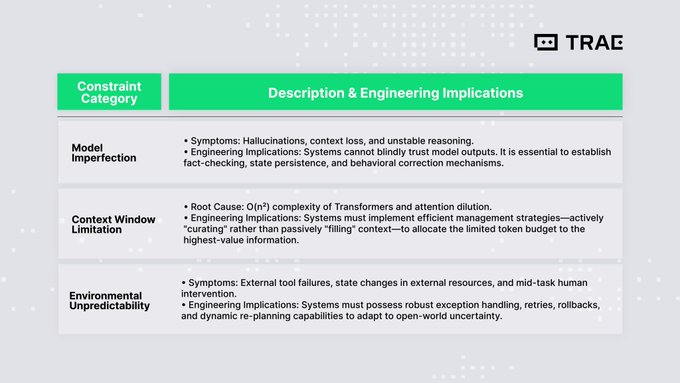
When building a Harness, we must confront three fundamental constraints and address them through six core design principles.
The Three Core Constraints
The Six Design Principles
Design for Failure: Treat exceptions and failures as the norm, not the outlier. Every component must support fault tolerance, retries, and graceful degradation.
Contract-First: Define all interactions through explicit, machine-readable contracts (Schemas, APIs, Events). This is the foundation for modularity and system evolution.
Secure by Default: Security isn't a bolt-on. It should be the starting point. We follow the principles of least privilege, zero trust, and defense-in-depth.
Separation of Concerns (Decision vs. Execution): Decouple "deciding what to do" (planning) from "how to do it" (execution) both logically and physically to increase system flexibility.
Everything is Measurable: Every behavior, decision, and resource used must be quantifiable. Without measurement, there is no path to optimization.
Data-Driven Evolution: Treat every agent run as a learning opportunity. Building a closed loop of data collection, labeling, and feedback is the only way to achieve long-term intelligent growth.
4.2.4 Key Engineering Landmarks
To drive the REPL loop and ground these design principles, a Harness requires several critical components or "Engineering Landmarks" deployed throughout the architecture.
Harness Engineering is just the collective name for how we orchestrate LLMs. Whether it's an SDK, an agent, or a custom plugin, the mission is always the same: stopping the model from making the same mistake twice.
These 'harnesses' aren't static. As models evolve, today's external guardrails will eventually be baked directly into the models themselves.
5. Implementing Harness Engineering
Conceptual frameworks are a great starting point, but for the engineers building platforms and infrastructure, a Harness must be viewed as a living, operational system. To truly understand how it works, we need to examine it through four critical lenses: architectural layering, core mechanisms, operational governance, and data-driven evolution.
## 5.1 Architecture Overview: Control Plane and Data Plane
A production-grade Harness is typically decoupled into a Control Plane and a Data Plane:
- Control Plane (The "What"): Manages the high-level logic, including task scheduling, resource quotas, behavioral planning, and policy enforcement.
- Data Plane (The "How"): Handles the heavy lifting, such as actual agent runtime instances, state and memory storage, and the sandboxed execution environment.
We further abstract this into four functional layers:
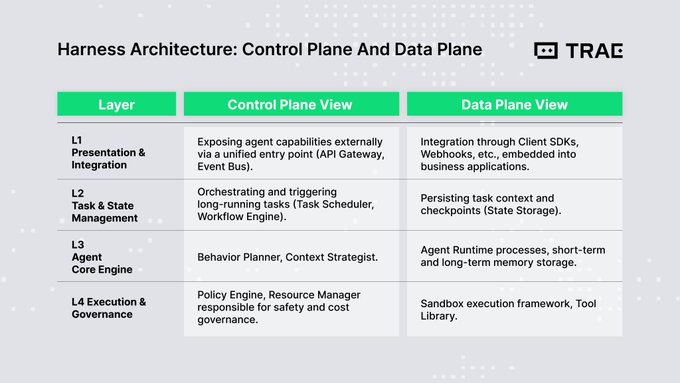
In practice, think of the Harness as "intelligent glue." It sits between your model's API Gateway and your services, using engineering rigor to stitch disparate infrastructure into a cohesive system.
## 5.2 Core Mechanisms: The Loop, Memory, and Token Pipelines
5.2.1 The Agent Core Loop
We abstract agent behavior into a continuous Observe → Think → Act cycle:
- Observe: Perceiving the current state of the world, including user inputs, tool outputs, interaction history, and task progress.
- Think: Using that perception to update goals, decompose tasks, and decide on the next move.
- Act: Executing operations whether internal (updating memory) or external (calling a tool or replying), the results of which feed back into the next observation.
> 💬 Engineering Note: It’s not a simple while (true) loop
> In production, this loop must integrate with workflow engines or state machine frameworks. It needs to support pause/resume functionality, idempotent retries, and concurrent event handling to solve "context anxiety" in long-running tasks.
5.2.2 Tiered Memory & the Token Pipeline
To pack maximum signal into a finite context window, most agents rely on external memory.
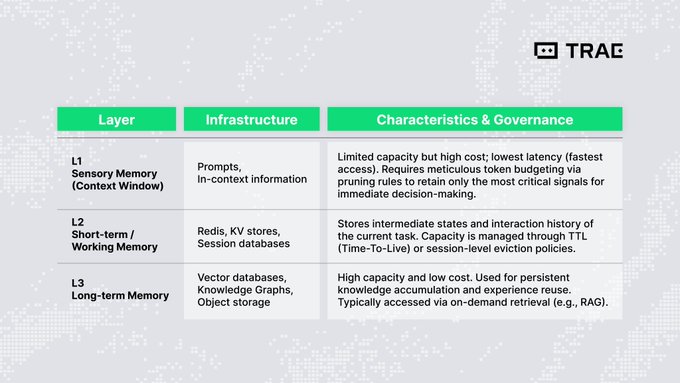
On top of this, the Harness runs a Token Transformation Pipeline to distill multi-source information into a controlled prompt before every call:
Collection: Aggregating user requests, short-term memory, and long-term knowledge retrievals.
Ranking: Scoring information based on recency and semantic relevance.
Compression: Summarizing or structurally refining high-volume, low-density content.
Budgeting: Allocating token limits to different information categories.
Assembly: Piecing together the final prompt using structured templates (e.g., explicit [user_request] or [tool_output] blocks).
> 💬 The Bottom Line: Offload attention management to engineering
> Rather than hoping the model "figures out" what to focus on, use the Token Transformation Pipeline to actively build the context. Save that precious window for the information that actually matters.
5.2.3 Planning Models and Execution Strategies
At the Planner layer, we typically categorize patterns based on the complexity of the task:
> 💬 The Recommendation
> Default to Plan-and-Execute, and layer in re-planning or multi-agent orchestration only as needed.
> For most enterprise scenarios, a structured plan paired with "exception-triggered re-planning" is robust enough.

5.2.4 Runtime and Governance: Sandboxing, Security, and Cost
Sandboxed Execution Frameworks
To let agents "get things done" without wrecking your system, you must provide a secure, isolated runtime.
- Level 1: Process-level Isolation: Uses chroot, Linux namespaces, or seccomp-bpf. It’s fast but shares the kernel; best for trusted internal tools.
- Level 2: Container Isolation: Docker or containerd. This is the mature, industry-standard choice for most tool execution.
- Level 3: MicroVMs: Firecracker. Provides independent virtual kernels, making it ideal for multi-tenant environments or executing untrusted code.
- Level 4: Full VMs: KVM/QEMU. Maximum security at the highest cost; reserved for the most sensitive tasks.
> 💬 The Strategy
> Default to Level 2 (Containers) paired with a hardened kernel and a read-only root filesystem. Introduce Level 3 (MicroVMs) as a bolstered sandbox for untrusted code or high-sensitivity data.
Resource Management and Resilience
Controlling costs and ensuring stability requires a few critical engineering guardrails:
- Budgets and Quotas: Set limits for tokens, API calls, and CPU time across platforms, tenants, or individual tasks.
- Timeout Control: Enforce strict timeouts on all network requests and tool executions to prevent a hanging downstream service from dragging down the entire Agent.
- Retry Strategies: Use retries with backoff for transient, recoverable errors, but fail fast on permanent ones.
- Circuit Breakers: Temporarily trip the circuit if a dependency fails repeatedly to prevent cascading failures.
- Graceful Degradation: If critical capabilities go offline, automatically downshift to a "weak but safe" mode (e.g., moving from "executable code" to "read-only suggestions").
Security and Compliance: The Policy Gateway
Beyond the sandbox, you need a Policy Gateway sitting between the Planner and the Execution layer to validate every action:
- Permissions: RBAC/ABAC checks to verify if an Agent is authorized to access a specific resource.
- Data Filtering: PII and secret detection for both input parameters and return values.
- Injection Defense: Identifying malicious prompt patterns or command stitching before they hit the execution layer.
- Audit Logging: Recording "who did what, when, and the result" for post-mortems and compliance audits.
Metrics and Evolution: Growing Through Data
Finally, you need a robust evaluation suite to ensure your Agent system stays on the right track:
- Task Effectiveness: Success rate, instruction-following rate, and tool-use efficacy.
- Quality of Service (QoS): End-to-end latency, time-to-first-action, and overall error rates.
- Resource Efficiency: Average token consumption and Average tool calls.
- Security and Compliance: Policy denial rates and number of security incidents.
These metrics aren't just vanity metrics or dashboard filler; they are the feedback loop that drives your Harness's evolution. When success rates hit a ceiling, it’s a signal to revisit your planner or context strategy. If error rates or costs spike, you likely need to troubleshoot your sandboxing, resource quotas, or circuit breaker logic.
6. Final Words
Harness Engineering isn't some "silver bullet" to be put on a pedestal. It's an engineering philosophy forged in and built for the real world.
While the industry fixates on the "disruption" and "replacement" of developers by generative AI, this methodology serves as a grounding reminder: the role of the engineer isn't disappearing. It's evolving. We are shifting from being the creators of code to becoming the guardians of the creation process.
Architecting a reliable Harness is ultimately an exercise in balancing chaos and order. We don't expect AI to be perfect any more than we expect humans to be infallible. True engineering wisdom lies in building systems that can learn from failure and navigate uncertainty with resilience.
The ultimate goal of these "reins" was never to restrict, but to enable a safer, more complete release of potential. And perhaps, in the near future, models will begin to outgrow these foundational constraints entirely.
## 相关链接
- [TRAE](https://x.com/Trae_ai)
- [@Trae_ai](https://x.com/Trae_ai)
- [717](https://x.com/Trae_ai/status/2047145274200768969/analytics)
- [Upgrade to Premium](https://x.com/i/premium_sign_up)
- [10:47 AM · Apr 23, 2026](https://x.com/Trae_ai/status/2047145274200768969)
- [717 Views](https://x.com/Trae_ai/status/2047145274200768969/analytics)
- [View quotes](https://x.com/Trae_ai/status/2047145274200768969/quotes)
---
*导出时间: 2026/4/23 12:35:30*