# How to build and scale a one-person business with AI:
**作者**: Machina
**日期**: 2026-07-25T14:02:35.000Z
**来源**: [https://x.com/EXM7777/status/2081017272924361162](https://x.com/EXM7777/status/2081017272924361162)
---
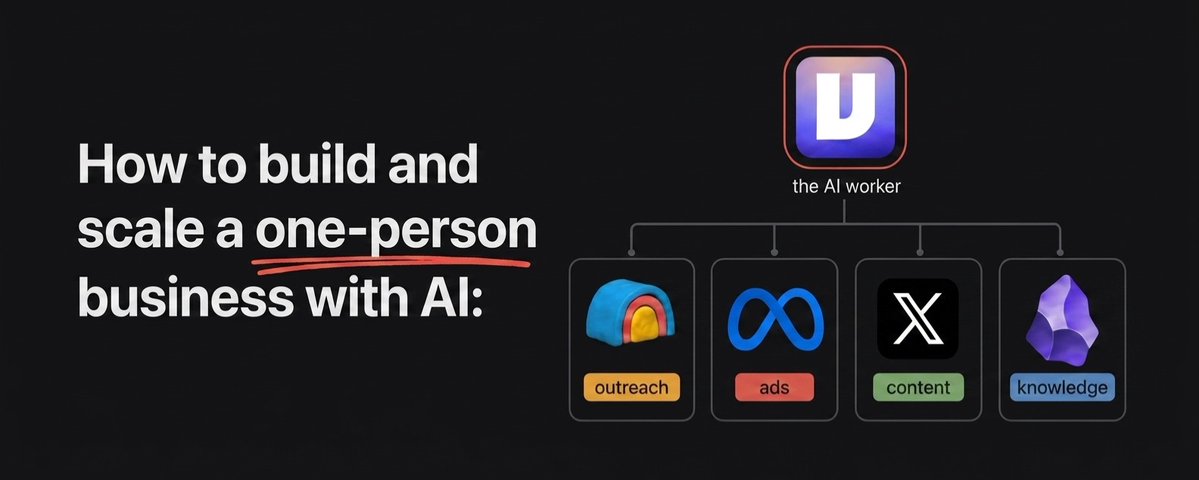
I'm going to teach you the exact blueprint for running an AI-powered business entirely by yourself - Five lanes of your company producing on autopilot: content, projects, outreach, finance, ads, while you only make the decisions
here's what you're getting:
- the two assets: where a one person business actually scales from
- the fastest path: all 5 lanes built on Viktor, briefs included
- the custom build: what's under the hood, and when it's worth owning
- the knowledge base: your business brain in an Obsidian vault
- memory: the three levels, and where to stop
- the operating rules: the settings that keep the bill boring
- scaling: when to add the next lane
- the build sheet
## the two assets
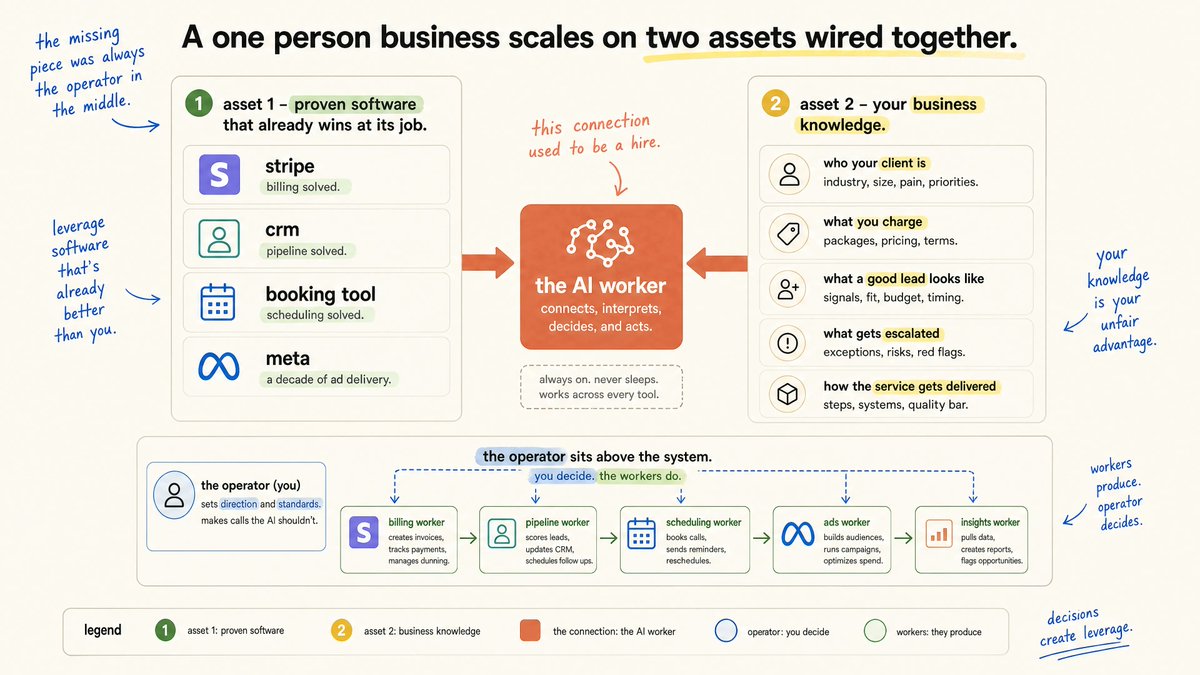
a one person business scales on two assets wired together, and on nothing else
the first asset is software that already wins at its job: Stripe has billing solved, your CRM has pipeline solved, your booking tool has scheduling solved, Meta has a decade of ad delivery baked in
that layer already exists, and the only job left in it is operating
the second asset is your business knowledge: who your client is, what you charge, what a good lead looks like, which requests get escalated, how your service actually gets delivered
the missing piece was always the operator in the middle, the one who knows your business AND runs the software every day, because that person used to be a hire
an AI worker is the connection between proven software and your business knowledge, and that connection used to be a hire
there are two ways to build that connection: out of the box inside the workspace you already use, or by hand, agent by agent
i'll give you the fastest path first... the custom build comes after, for the operators who want to own every part of it
## the fastest path: all 5 lanes on Viktor
this thing is genuinely the shortest distance from zero to a working setup
Viktor calls itself an AI employee, and the name is earned in one specific way: it joins Slack or Microsoft Teams as a member of the workspace...
the same office your clients and contractors are already in, so nothing about how you work with people changes
it plugs into the software your business already runs on: thousands of tools through managed connectors, your CRM and ad platform included...
it runs scheduled jobs from a sentence in chat, and it starts free (perfect for setting up our workspace)
the setup, once:
- one channel per lane: content, projects, outreach, finance, ads
- one pinned context message per channel: what we sell and to who, what this lane delivers, what gets escalated, the rules that never bend
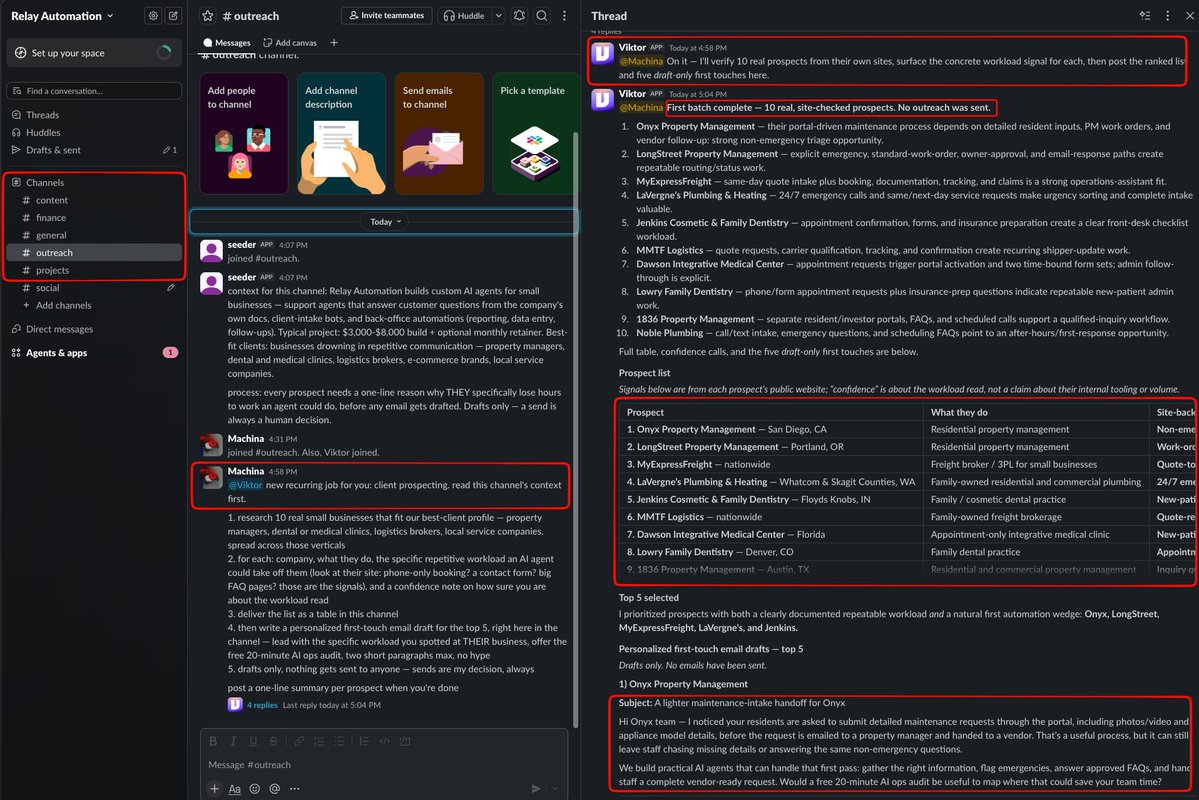
- Viktor invited into each channel... and the outreach channel deliberately gets no tool that can send
then brief each lane like a colleague... here are the five, copy and fill the [slots]:
lane 1 - content: research what performed on X in the last 14 days around [your niche], real posts with real engagement, note each winner's angle... from that research draft 5 concrete posts and 1 thread on [this week's topic] for a reader skeptical of AI hype... deliver in one organized thread, research first, and flag your strongest draft with a reason
lane 2 - projects: read this channel's context, post a plan for the week: each project, its stage, what ships, the biggest blocker... then every workday at 8:00 post a standup: what moved yesterday, what's due today, what's blocked, under 8 lines... when a status gets posted here, track it without asking
lane 3 - outreach: research 10 real businesses that fit [your client profile]... for each: what they do, the repetitive workload visible on their own website, and a confidence note... draft a first touch for the top 5 that opens with the workload you spotted at THEIR business, two short paragraphs... drafts only, nothing ever sends, sends are my decision
lane 4 - finance: create a draft invoice in [your billing tool] for [client, project milestone, amount], post the link here for review, never finalize... and every friday at 16:00 post a summary: invoices issued, paid, overdue with days outstanding, month to date... under 10 lines
lane 5 - ads: summarize our offer in two lines so i know you understood it... then propose a test media plan: 2 specific audiences, 2 ad angles per audience written for people skeptical of AI, and how you'd split [your daily cap]... after i approve the plan here, build the campaign with everything PAUSED... nothing goes live without my explicit go
the pattern across all five is the same on purpose: context first, named deliverables, a cadence, and a gate on anything that touches money or the outside world
the $100 in free credits at viktor.com covers the whole five-lane build, no card
## the custom build: what's under the hood, and when it's worth owning
the custom build buys you total control, your data on your disk, and a system no vendor can change under you... the out-of-the-box build buys you speed, zero maintenance, and an office your clients already understand
plenty of operators land on Viktor precisely because it is plug-and-play and the engineering below is a full project of its own... but the ideas below are worth stealing no matter which side you pick
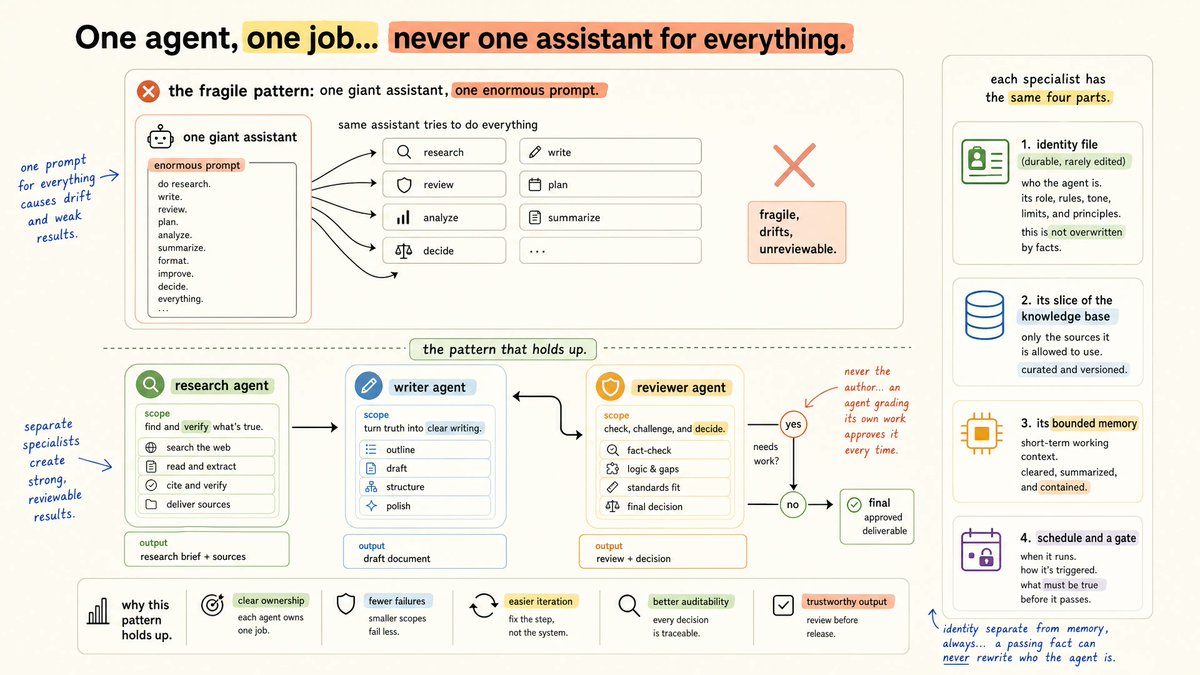
the mistake that makes handmade setups fragile is one giant assistant with one enormous prompt, expected to do everything
the builds that hold up do the opposite: one agent, one job
a research agent that only researches, a writer that only writes... and a reviewer that is never the author, because an agent grading its own work approves it every time
each specialist is assembled from the same four parts:
- an identity file: who this agent is, its scope, and the things it must never do... durable, rarely edited
- its slice of the knowledge base: the business context this job needs, nothing more
- its memory: what it has learned doing this job, bounded on purpose
- a schedule and a gate: when it wakes, and which of its outputs wait for your yes
keep the identity separate from the memory, always
the identity file is stable so a passing fact can never rewrite who the agent is... the memory is where churn belongs
that separation is the difference between an agent that stays itself over months and one that drifts the first time it saves a bad note
## the knowledge base: your business brain
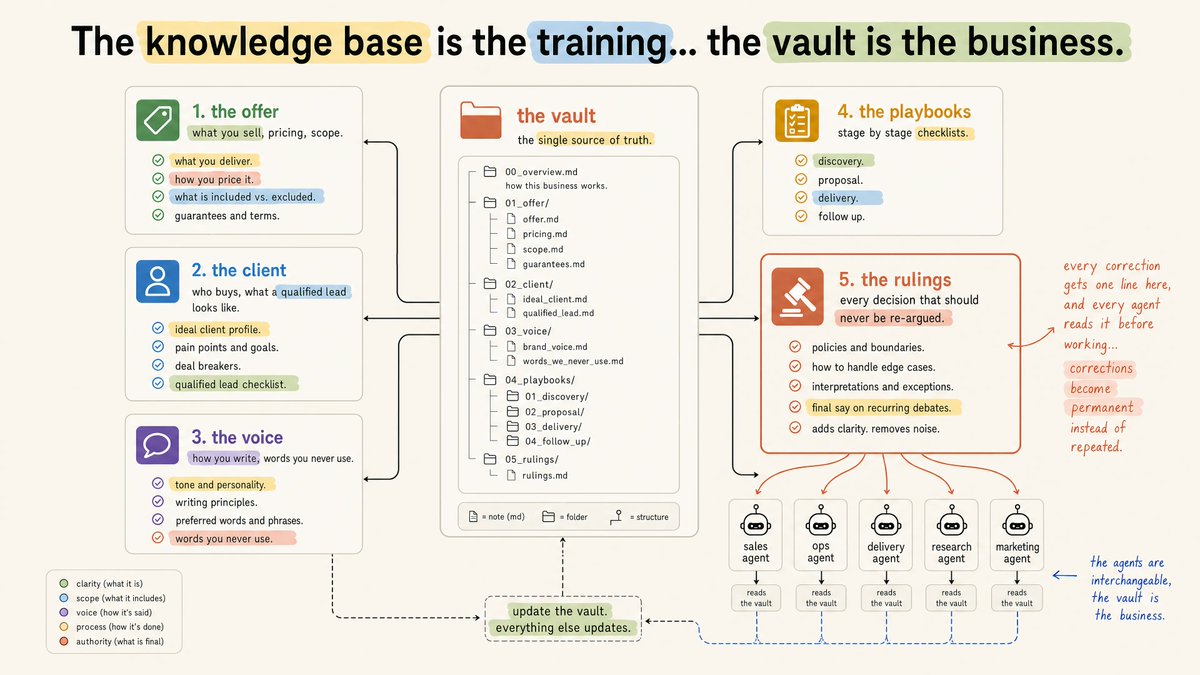
every specialist reads from one shared brain, and the strongest version is embarrassingly simple: a folder of markdown files
an Obsidian vault is the operator favorite here, because it is exactly that... text files on your disk, linked, readable by you and by every agent you run
structure it by what the business knows, one note per fact cluster:
- the offer: what you sell, pricing, what's included, what's out of scope
- the client: who buys, the verticals, what a qualified lead looks like
- the voice: how you write, words you never use, examples of your best work
- the playbooks: how a project runs, stage by stage, with the checklists
- the rulings: every decision you've made that should never be re-argued
the rulings note is the one nobody builds and everyone needs... every time you correct an agent, the correction gets one line there, and every agent reads it before working
that is how a correction becomes permanent instead of repeated
the knowledge base is the training... the agents are interchangeable, the vault is the business
and this idea transfers straight back to the fastest path: on Viktor, the pinned context message is this vault in miniature, and it deserves the same care
## memory: the three levels, and where to stop
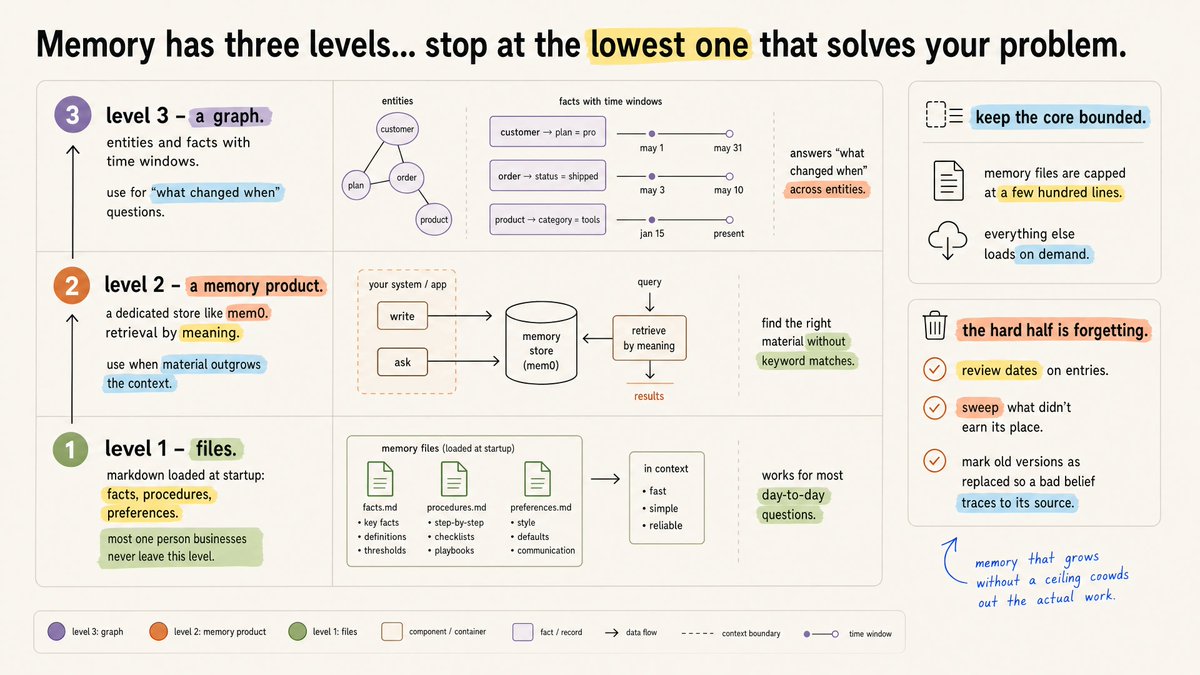
memory is where new builders overspend, so here is the whole field in three levels... you move up only when your problem forces you
- level 1 - files: markdown the agent loads at startup, facts and procedures and preferences
- level 2 - a memory product: a dedicated store like mem0, retrieval by meaning... for when the material genuinely outgrows what fits in the agent's context
- level 3 - a graph: entities and facts with time windows, for when "what changed when" is the real question
most one person businesses never need to leave level 1
keep the always-loaded core small and bounded... the working agents cap their memory files at a few hundred lines and load everything else on demand, because memory that grows without a ceiling slowly crowds out the actual work
and the hard half of memory is forgetting: give entries a review date, sweep what didn't earn its place
when a fact changes, write the new version and keep the old one marked as replaced, so a bad belief can be traced back to its source
one production store logged ten thousand entries in a month and about two hundred were worth keeping... untended memory looks healthy from the outside while it fills with junk
## the operating rules: managing a staff that never pushes back
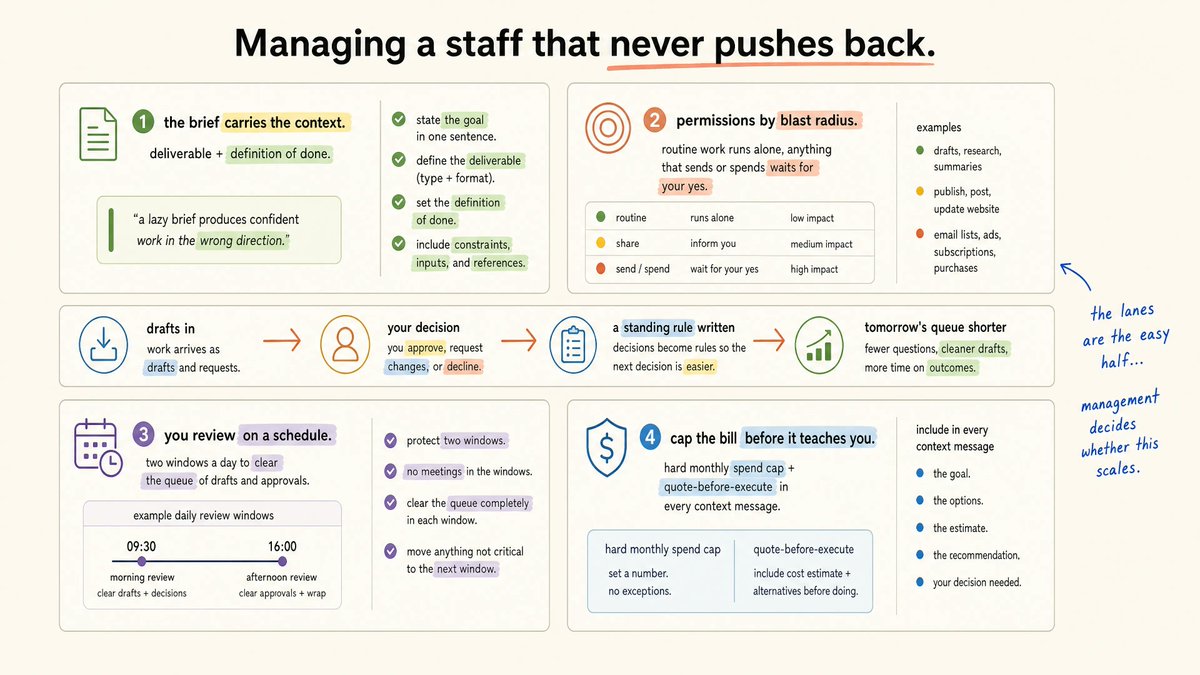
the lanes are the easy half... the skill that decides whether this scales is management, because this is a staff that never pushes back and never flags its own doubt
so the rules below are the counterweight
rule 1 - the brief carries the context: every brief names the deliverable and what done means... a lazy brief produces confident work in the wrong direction, and you will read every word of it
rule 2 - permissions by blast radius: routine internal work runs without asking, and anything that sends or spends waits for your yes... the day the strictness annoys you is the day it saves you
rule 3 - you review, on a schedule: two windows a day to clear the queue of drafts and approvals, because the lanes produce faster than you read
rule 4 - cap the bill before it teaches you: every AI worker meters usage one way or another... so before the first brief, set a hard monthly spend cap, and quote-before-execute goes in every context message
## scaling: when to add the next lane
scaling a one person business is one question asked before every addition: did the last lane produce this morning without a prompt from me
the projects lane passes by design... content, the week the drafts stop needing rewrites... outreach, when the confidence column stays honest without you re-checking the sites
then the sequence repeats: write the context, connect the software the lane runs on, brief the work, correct with rules attached, put the sends behind your yes
and your job description changes shape along the way, because the lanes do the producing and you do the deciding
the approval queue becomes the workday: drafts in, decisions out, and every decision writes a line in the rulings note that makes tomorrow's queue shorter
## the build sheet
save this block, you will run it once per lane:
1. one agent or one channel per lane, never one assistant for everything
2. the knowledge base is the business: offer, client, voice, playbooks, rulings... a vault of text files every worker reads
3. memory has three levels: files, then a store like mem0, then a graph... stop at the lowest level that solves your problem
4. every correction ships with a standing rule in the rulings note
5. schedules before prompts: the 8:00 standup is one sentence in a brief
6. permissions by blast radius, sends and spend behind your yes
7. budget cap on day one, quote-before-execute in every context message
8. next lane only when the last one runs without you
skip 4 and you will edit forever, skip 7 and the bill teaches you instead
hiring five people to do all this was only ever the wiring available at the time
and that changed this year
thank you Viktor for sponsoring this piece, get $100 in free credits at viktor.com
start with one lane this week, the one where you lose the most hours, and let it earn the second
## 相关链接
- [Machina](https://x.com/EXM7777)
- [@EXM7777](https://x.com/EXM7777)
- [157K](https://x.com/EXM7777/status/2081017272924361162/analytics)
- [viktor.com](https://ref.viktor.com/machina-x)
- [viktor.com](https://viktor.com/)
- [Upgrade to Premium](https://x.com/i/premium_sign_up)
- [10:02 PM · Jul 25, 2026](https://x.com/EXM7777/status/2081017272924361162)
- [157.9K Views](https://x.com/EXM7777/status/2081017272924361162/analytics)
- [View quotes](https://x.com/EXM7777/status/2081017272924361162/quotes)
---
*导出时间: 2026/7/26 10:52:51*
---
## 中文翻译
# 如何利用人工智能建立并扩展一人企业:
**作者**: Machina
**日期**: 2026-07-25T14:02:35.000Z
**来源**: [https://x.com/EXM7777/status/2081017272924361162](https://x.com/EXM7777/status/2081017272924361162)
---

我要教你一份精确的蓝图,让你能够完全靠独自一人经营一家由 AI 驱动的企业——你公司的五个业务跑道将实现自动驾驶式生产:内容、项目、外联、财务、广告,而你只需要做决策。
以下是你将获得的内容:
- 两种资产:一人企业真正的规模化来源
- 最快路径:全部 5 个跑道都建立在 Viktor 上,包含简报
- 定制构建:底层原理是什么,以及何时值得自己拥有
- 知识库:存储在 Obsidian 库中的商业大脑
- 记忆:三个层级,以及在哪里止步
- 运营规则:让账单保持枯燥的设置
- 扩展:何时添加下一个跑道
- 构建清单
## 两种资产
一人企业的规模化依赖于相互关联的两种资产,除此之外别无其他。
第一种资产是那些已经在工作中获胜的软件:Stripe 解决了账单问题,你的 CRM 解决了管道管理问题,你的预约工具解决了排程问题,Meta 植入了十年的广告投放经验。
这一层已经存在,剩下的唯一工作就是操作它。
第二种资产是你的商业知识:你的客户是谁、你收多少钱、什么样的线索是优质的、哪些请求需要升级处理、你的服务实际上是如何交付的。
缺失的一环始终是中间的操作员,那个既了解你的业务又每天运行软件的人,因为那个人过去通常是一名雇员。
AI 员工是经过验证的软件与你的商业知识之间的连接,而那个连接过去通常是一名雇员。

有两种方式可以建立这种连接:在你已经使用的工作空间内开箱即用,或者通过手工,一个代理一个代理地构建。
我先给你最快的路径……定制构建在后面,留给那些想要完全掌控每一部分的操作员。
## 最快路径:全部 5 个跑道都在 Viktor 上
这东西确实是从零到可用设置的最短路径。
Viktor 自称为一名 AI 员工,这个名字在一个特定方面名副其实:它作为工作区的一名成员加入 Slack 或 Microsoft Teams……
这和你客户与承包商所在的办公室是同一个,所以你与人共事的方式没有任何改变。
它接入你的业务已经在运行的软件:通过托管连接器接入数千种工具,包括你的 CRM 和广告平台……
它在聊天中通过一句话就能运行预定任务,而且是免费起步的(非常适合设置我们的工作区)。
一次性的设置:
- 每个跑道一个频道:内容、项目、外联、财务、广告
- 每个频道一条置顶的上下文消息:我们卖给谁、卖什么、这个跑道交付什么、什么需要升级处理、不可违反的规则
- 邀请 Viktor 进入每个频道……并且外联频道特意不配备任何可以发送消息的工具
然后像对待同事一样向每个跑道下达简报……这里有五个,复制并填充 [占位符]:
跑道 1 - 内容:研究过去 14 天内在 [你的细分领域] X(原推特)上表现最好的内容,有真实互动的真实帖子,记录每个获胜者的角度……基于该研究,围绕 [本周主题] 起草 5 个具体的帖子和 1 个帖子串,针对那些对 AI 炒作持怀疑态度的读者……在一个有条理的帖子串中交付,先展示研究,并用理由标出你最强的草稿
跑道 2 - 项目:阅读该频道的上下文,发布一周计划:每个项目、其阶段、交付什么、最大的阻碍……然后每个工作日的 8:00 发布一次站会:昨天有什么进展、今天到期什么、什么被阻碍了,控制在 8 行以内……当这里有状态更新时,无需询问直接跟踪
跑道 3 - 外联:研究 10 家符合 [你的客户画像] 的真实企业……对于每一家:他们是做什么的、在他们自己网站上可见的重复性工作负载、以及一条置信度说明……为前 5 名起草初次接触信息,以你在他们企业发现的工作负载作为开头,两个简短的段落……仅起草,绝不发送,发送由我来决定
跑道 4 - 财务:在 [你的计费工具] 中为 [客户、项目里程碑、金额] 创建一份草稿发票,在此处发布链接供审核,绝不终结……并且每个周五的 16:00 发布一份摘要:已开票、已付款、逾期天数、本月至今……控制在 10 行以内
跑道 5 - 广告:用两行总结我们的报价,这样我就知道你理解了……然后提议一个测试媒介计划:2 个特定受众,每个受众 2 个针对那些对 AI 持怀疑态度的人群撰写的广告角度,以及你如何分配 [你的每日上限]……我在此处批准计划后,构建所有广告都处于暂停状态的活动……没有我的明确许可,任何内容都不会上线
所有五个跑道的模式故意保持一致:上下文优先、命名的交付物、节奏,以及对任何涉及金钱或外部世界的事物设置关卡

viktor.com 上的 100 美元免费额度涵盖了整个五跑道构建,无需信用卡。
## 定制构建:底层原理是什么,以及何时值得自己拥有
定制构建为你带来完全的控制权、磁盘上的数据,以及没有任何供应商可以在你眼皮底下更改的系统……开箱即用的构建为你带来速度、零维护,以及你的客户已经理解的办公室。
许多操作员选择 Viktor 正是因为它是即插即用的,而且底层的工程本身就是一个完整的项目……但无论你选择哪一边,下面的想法都值得借鉴。
导致手工设置脆弱的错误在于配置一个拥有巨大提示词的巨型助手,并期望它包办一切。
能经受住考验的构建则恰恰相反:一个代理,一项工作。
一个只做研究的代理,一个只做写作的代理……以及一个绝不充当作者的审阅者,因为给自己的工作打分的代理每次都会批准它。
每个专家都由相同的四个部分组成:
- 身份文件:这个代理是谁、它的范围、以及它绝不能做的事情……持久耐用,很少编辑
- 它的那份知识库:这项工作所需的商业上下文,除此之外别无其他
- 它的记忆:它在这项工作中学到的东西,故意设置边界
- 时间表和关卡:它何时唤醒,以及它的哪些输出等待你的确认
始终将身份与记忆分开。
身份文件是稳定的,所以一个转瞬即逝的事实永远无法重写代理是谁……记忆才是属于 churn(更替/变动)的地方。
这种分离是一个代理在数月内保持自我,还是第一次保存错误笔记就发生漂移的区别所在。

## 知识库:你的商业大脑
每个专家都从一个共享的大脑中读取信息,最强的版本简单得令人尴尬:一个包含 markdown 文件的文件夹。
Obsidian 库是操作员们的最爱,因为它正是那样……磁盘上的文本文件,相互链接,可由你和每个运行的代理读取。
按照业务所知的内容进行结构化,每个事实集群一个笔记:
- 报价:你卖什么、定价、包含什么、不包含什么
- 客户:谁购买、垂直领域、合格的线索是什么样的
- 语气:你如何写作、你从不使用的词汇、你最佳作品的示例
- 剧本:项目如何运行、分阶段进行、附有检查清单
- 裁决:你做出的每一个不应再被争论的决定
裁决笔记是没人建但每个人都需要的那个……每次你纠正代理时,纠正内容就在那里记上一行,每个代理在工作前都会阅读它。
这就是纠正变得永久而不是重复出现的方式。
知识库是训练……代理是可以互换的,库才是企业
这个想法可以直接移植到最快路径中:在 Viktor 上,置顶的上下文消息就是这个库的微缩版,它同样值得精心维护。

## 记忆:三个层级,以及在哪里止步
记忆是新构建者容易过度投入的地方,所以这里是该领域的三个完整层级……只有当问题迫使你时才向上升级
- 第 1 级 - 文件:代理在启动时加载的 markdown,事实、程序和偏好
- 第 2 级 - 记忆产品:像 mem0 这样的专用存储,通过语义检索……用于当内容确实超出了代理上下文的容量时
- 第 3 级 - 图谱:带有时间窗口的实体和事实,用于当“什么时间发生了什么变化”是真正的问题时
大多数一人企业永远不需要离开第 1 级。
保持始终加载的核心部分小而有限……工作代理将其记忆文件限制在几百行以内,并按需加载其他所有内容,因为无休止增长的记忆会慢慢挤占实际的工作
记忆困难的一半在于遗忘:给条目设置一个审查日期,清理那些没赢得自己位置的内容
当事实发生变化时,写下新版本并将旧版本标记为已替换,这样错误的信念就可以追溯到源头
一个生产存储库在一个月内记录了一万条条目,其中只有大约两百条值得保留……无人看管的记忆外表看起来很健康,内部却充满了垃圾

## 运营规则:管理一支从不反驳的员工队伍
跑道是容易的一半……决定这是否能扩展的技能是管理,因为这是一支从不反驳、也从不标示自己疑虑的员工队伍
因此,以下规则就是平衡砝码
规则 1 - 简报承载上下文:每个简报都要命名交付物以及完成的标准……懒惰的简报会在错误的方向上产生自信的工作,而你将不得不逐字阅读
规则 2 - 按爆炸半径设定权限:常规内部工作无需询问即可运行,任何涉及发送或支出的操作都要等待你的同意……严格原则让你烦恼的那一天,正是它救了你的一天
规则 3 - 你按计划进行审查:每天两个时间段来清理草稿和批准队列,因为跑道的产出速度比你阅读的速度快
规则 4 - 在账单教你之前先设定上限:每个 AI 员工都会以某种方式计量使用量……所以在第一个简报之前,设定一个严格的月度支出上限,并且在每个上下文消息中加入“执行前报价”

## 扩展:何时添加下一个跑道
扩展一人企业就是在每次添加前问一个问题:上一个跑道今天早上是否在没有我提示的情况下自行产出
项目跑道按设计就能通过……内容跑道,当草稿不再需要重写的那一周……外联跑道,当置信度列在你不重新检查网站的情况下保持诚实的那一刻
然后序列重复:编写上下文、连接跑道运行的软件、简报工作、附带规则进行纠正、将发送操作置于你的同意之后
你的职位描述也会随之改变,因为跑道负责生产,而你负责决策
批准队列变成了工作日:草稿进来,决策出去,每个决策都在裁决笔记中写下一行,让明天的队列更短
## 构建清单
保存这一块,每个跑道你都要运行一次:
1. 每个跑道一个代理或一个频道,绝不要一个助手包办一切
2. 知识库即企业:报价、客户、语气、剧本、裁决……每个员工都阅读的文本文件库
3. 记忆分三个层级:文件,然后像 mem0 这样的存储,然后图谱……停留在能解决问题的最低层级
4. 每次纠正都要附带裁决笔记中的一条常驻规则
5. 时间表优于提示:8:00 的站会只是简报中的一句话
6. 按爆炸半径设定权限,发送和支出都在你的同意之后
7. 第一天就设定预算上限,每个上下文消息中包含“执行前报价”
8. 只有当上一个跑道无需你介入运行时,才进行下一个跑道
跳过第 4 条,你将无休止地编辑;跳过第 7 条,账单会来教训你。
雇佣五个人来做所有这些事情,在当时只是可用的连接方式。
而今年这一切都变了。
感谢 Viktor 赞助本文,在 viktor.com 获取 100 美元免费额度。
本周从一个跑道开始,那个你耗时最多的跑道,让它为你赢得第二个跑道。
## 相关链接
- [Machina](https://x.com/EXM7777)
- [@EXM7777](https://x.com/EXM7777)
- [157K](https://x.com/EXM7777/status/2081017272924361162/analytics)
- [viktor.com](https://ref.viktor.com/machina-x)
- [viktor.com](https://viktor.com/)
- [Upgrade to Premium](https://x.com/i/premium_sign_up)
- [10:02 PM · Jul 25, 2026](https://x.com/EXM7777/status/2081017272924361162)
- [157.9K Views](https://x.com/EXM7777/status/2081017272924361162/analytics)
- [View quotes](https://x.com/EXM7777/status/2081017272924361162/quotes)
---
*导出时间: 2026/7/26 10:52:51*