# Collaborative Intelligence
**作者**: Aatish Nayak
**日期**: 2021-08-02T14:10:57.000Z
**来源**: [https://x.com/nayakkayak/status/2009660549554913574](https://x.com/nayakkayak/status/2009660549554913574)
---

Today, AI works impressively for individuals but disappointingly for organizations. Closing that gap requires not just more context, but treating agents as social participants in the multiplayer systems they aim to disrupt.
To do this, many have concluded the answer is context graphs: a higher-order representation that stitches together decisions and records across systems. The assumption being that organizational context exists as a coherent structure just waiting to be discovered, like a fossil buried in shale.
In reality, most organizations do not operate from a centralized or intentionally designed logic. Context is not stored anywhere in full, not in databases, not in a clean outline, and certainly not in leadership’s head. It continuously emerges through interaction, with new context forming and decaying every day.
Only through treating context as the messy and unorganized social process it is can AI have any chance of learning it.
This requires agents to be embedded in the same collaboration primitives that humans use to work: email, messaging, calendars, browsers, documents, file systems, and more. They must observe how decisions unfold, learn which conflicts require escalation, and understand when consensus emerges versus when its imposed.
But this is only the beginning. The first wave of AI has mostly focused on individual intelligence. Each of us now have AI assistants that draft, analyze, and execute long range tasks with impressive reliability. For personal productivity, this represents a genuine step change. Inside organizations, however, the gains quickly plateau.
Why? Because in companies work happens between people through collaboration, negotiation, escalation, and shared judgment over time. One highly capable individual, human or AI, inside a misaligned organization does not meaningfully change outcomes. At best, it creates local efficiency. At worst, it entrenches unhealthy power dynamics.
To escape these constraints, we must realize that agents won’t map one to one with human roles. Instead, we must view agents as the renewable source of intelligence they are.
What changes when there is a tireless always-on team of infinite marketers, lawyers, engineers, analysts, and operators? How do organizations and teams reorganize to confront this reality? What novel interfaces must exist to allow each function to interact with a legion of agents?
This is the higher order opportunity for founders and builders. And a moment for deep reflection for enterprise leaders. Realizing this future will require messy experimentation, organizational restructuring, and a willingness to rethink how work gets done.
This is the only way individual intelligence evolves to collaborative intelligence.

Managing teams of agents will look more like Apollo Mission Control than a single command line: shared state and explicit escalation visible to all collaborators involved
## Social lessons from physics, telephones, and git
This evolution is not new. Humans faced it first before AI.
In Sapiens, Yuval Noah Harari argues that humans did not dominate the planet because of superior individual intelligence. Early humans were physically weaker than many animals and not meaningfully smarter than other hominins in isolation. What changed history was species-level cooperation.
Humans learned to collaborate in large groups by inventing shared stories like myths, laws, money, religions, and institutions, which allowed distributed actors to align behavior without central control.
Our history follows a consistent pattern. When new forms of technology emerge, they almost always outpace the collaborative systems needed to make them useful at scale.
Science offers the clearest illustration.
For most of human history, scientific knowledge did not compound reliably. Discoveries circulated only through private letters, books, or patronage networks. Errors persisted, insights were lost, and progress reset rather than accumulated. Almost like the goldfish mind of most AI products today.
The turning point was not a new theory, but the emergence of social systems for knowledge. In the seventeenth century, scientific societies formed, most notably the Royal Society of London. In 1665, Philosophical Transactions became the first scientific journal, establishing the norm that claims should be evaluated by a community rather than asserted by authority.
New claims were evaluated in relation to prior work, assumptions were challenged, and disagreements were resolved publicly within communities that transmitted judgment through apprenticeship as much as publication.

Astronomical observations of Jupiter and Saturn from multiple observers in London and Italy, published in Philosophical Transactions (1666) to reconcile differing measurements into a shared scientific record.
Another notable example was the Cavendish Laboratory at Cambridge. Under figures like J. J. Thomson and later Ernest Rutherford, generations of physicists learned how to reason about uncertainty, design experiments, interpret noisy data, and decide when evidence was sufficient. Knowledge began to compound because judgment became social across many actors.
Mass communication followed the same arc, but with an even clearer coordination bottleneck.
Early telephone systems connected callers point-to-point. If you knew exactly where the wire led, you could speak to the other end. As networks grew, this model collapsed. There was no way to dynamically route calls, prioritize connections, or manage contention. The technology worked, but the system did not.
Switchboards emerged as the social solution. Human operators sat at the center of early telephone networks, manually connecting calls by plugging cables into physical boards. They held context about who was calling, who was available, which connections were urgent, and how to resolve conflicts when multiple calls competed for the same line. Operators enforced norms, mediated errors, and adapted routing in real time.
Telephones scaled once calls were mediated through a shared, human-in-the-loop system rather than isolated endpoints.
The same pattern played out much more recently in software development.
Before Git, collaboration in software was fragile. Version-control systems like CVS and Subversion existed, but they were centralized and brittle. Working on the same codebase required serialized access, social coordination outside the system via email or meetings, and a high degree of trust. Conflicts were expensive, and history was shallow.
Linus Torvalds created Git in 2005 to manage the development of the Linux kernel after existing tools failed to scale. By making branching cheap and local, Git allowed many contributors to work independently without blocking one another. History was a first-class object preserving context about how and why the code evolved. Conflicts became explicit and resolvable rather than silent and destructive.
GitHub extended this further by layering explicit social coordination on top: pull requests, code review, issues, and visible discussion. Decision context accumulated around the code itself rather than disappearing into side channels.
Software development scaled because collaboration became first-class. We’re seeing this play out again as git/github have quickly become the default way AI coding agents are collaborating with humans.
The historical pattern in these and countless others is consistent. Individual capability appears first, and exponential productivity follows only once shared context and cooperative structures emerge.
## Reshaping orgs around collaboration units, instead of roles
To build these future cooperative structures, we must first envision what functions look like when they're no longer bound by human constraints: attention, bandwidth, specialization, and hierarchy.
Today's roles and headcount exist because work must be divided across people with limited time and context. Since agents don't share those constraints, collaborative AI will not simply assist existing roles, it will recombine them.
Instead of an organization designed around roles, it’ll instead be focused on collaboration units, unique to each function.
For example, in legal, the core unit is a shared position. Positions evolve through negotiation across associates, partners, and clients. Today, senior partners carry much of the connective context tracking precedent, posture, and unresolved risk across document turns and matters.
A collaborative legal agent absorbs much of this coordination. It tracks open issues across documents, surfaces conflicts in legal stance, and escalates judgment calls to the appropriate humans. Over time, the function reorganizes. The future legal deal team may consist of an army of agents doing mechanical drafting and internal information gathering, with the core decision-making, risk tolerance, and client relationship building done by a handful of senior partners.
In marketing, the challenge is narrative coherence across product marketing, growth, brand, and sales. Today this coherence is enforced through meetings, reviews, and informal influence.
A collaborative marketing agent participates directly in this work. It spans channels, remembers prior commitments, surfaces narrative drift, and escalates conflicts across teams. Roles shift away from channel ownership toward narrative stewardship and strategic intent. Agents provide continuity; humans provide taste and judgment.
In finance, work revolves around shared assumptions. Forecasts and budgets are collective agreements shaped through review, exception, and approval. Much of finance leadership’s value comes from arbitrating these assumptions across functions.
A collaborative finance agent tracks assumptions across scenarios, surfaces conflicts, routes exceptions, and preserves precedent. Over time, fewer roles focus on reconciliation and explanation, and more focus on risk framing, governance, and trust. Finance becomes less about producing numbers and more about overseeing decisions and balancing risk.
In product, the unit is the roadmap. What you prioritize, when you need it to happen, and how deep you need to invest in each item. Roadmaps evolve, constraints shift, and decisions are revisited as teams learn. Even today, most of the work of an EM, PM, or program manager is just coordinating all the resourcing, constraints, and execution timing of the roadmap.
A collaborative product agent operates as a shared participant in this process and facilitates these evolutions. It tracks unresolved tradeoffs, escalates tensions across roles, recommends resource reallocation, and preserves decision context as teams change. Humans spend less time re-establishing context and more time setting direction and understanding customer problems.
Multiplayer AI does not only make individual roles obsolete, but it redistributes coordination to these shared collaboration units, unique to each function. And eventually, these collaboration units should also intermingle with each other. For example, how should the roadmap change based on legal’s shared position on GDPR, or how should the marketing narrative change based on a planned roadmap release.
## Human escalation as an agent tool
This future won't emerge automatically. For founders and builders, the core challenge is treating collaboration as a first-class product primitive, not an afterthought.
The fastest path to multiplayer AI runs through the collaboration systems organizations already use. Email, messaging, browsers, and documents aren't legacy artifacts to avoid—they're the living infrastructure of work. Today, most entities we interact with on these platforms are still human. Why aren't we all pinging agents about how our day went? Or forwarding long email threads to agents for summaries?
These mediums encode how intent is expressed, how disagreement surfaces, how decisions escalate, and how accountability is recorded. Escalation is already built-in in the form of @ mentions, redlines, comments, suggested edits, notifications, and more.

One of the original drafts of the Declaration of Independence by Thomas Jefferson, with markups and redlines from others. Markups were the original form of escalation/feedback now codified into digital documents in the form of suggestions, comments, and more
In addition to gleaning valuable context, embedding agents into these surfaces also lowers the barrier to adoption. Instead of navigating to a URL or downloading an app, users simply do what they already do. Builders need to integrate aggressively with email clients, the Slack agent platform, and even browsers to access sources that aren't directly available.
(As an aside, this is the bull thesis on Atlassian buying The Browser Company and the Dia browser. Owning the browser layer for enterprise gives you instant access to the entire universe of SaaS tools without relying on messy integration battles.)
But these surfaces are only the starting point. As agents take on this more complex, long-horizon, and multi-team level work, they will need interfaces that go beyond our existing mediums.
Today, most AI interfaces focus on a single person working with a single AI, often only in a linear way. This quickly breaks when you assume you have an infinite factory of knowledge workers at your disposal, who constantly require your attention at different intervals. Moreover, these interfaces must define how agents should participate, escalate, and learn within functional systems and with their AI and human teammates. This is not only a product design problem, but an organizational design problem.
For each function and vertical, the interface will be different. Matter workspaces in legal where agents track open issues and escalate novel risks; assumption dashboards in finance where agents flag conflicts across forecasts; narrative control rooms in marketing where agents detect drift across campaigns & suggest improvements. These interfaces will not just display information, but encode the social structure of work itself with escalation and input built in.
For example, in legal an agent can sit inside a matter workspace: a dedicated interface that tracks open issues, pending decisions, and relevant precedents across all past matters. As the agent reviews a new inbound contract, it flags uncertainty and takes action based on role, risk, and precedent.
Routine deviations from standard language are resolved autonomously by referencing prior agreements. A novel but low-risk issue triggers an input request: the agent surfaces the clause in the workspace, attaches comparable precedents, and notifies an associate to confirm the approach. A material deviation on indemnity escalates directly to a partner, along with the client's risk posture, relevant precedents, and the decision to be made.
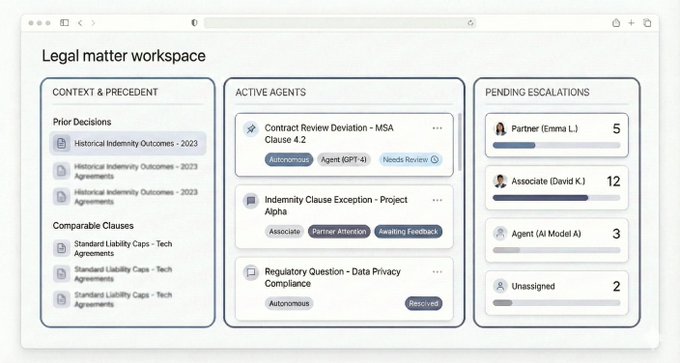
Conceptual design of a multi-player escalation interface with prior precedent, active agents at various stages of progress, and team members with pending decisions. Generalizable to many other functions
Critically, the interface doesn't just route decisions, but it encodes the collaboration itself. Over time, patterns accumulate. Certain classes of issues become autonomous. Others remain partner-owned but with clearer thresholds. The workspace becomes the living memory of the function: not just a place to view information, but a surface that governs how agents and humans collaborate.
The same structure generalizes across functions. In finance, assumptions escalate from analyst to controller to CFO based on materiality and precedent. In marketing, narrative conflicts escalate when brand commitments collide with growth experiments. In product, unresolved tradeoffs escalate when decisions cut across roadmap, reliability, and customer trust.
What changes with multiplayer AI is not that escalation suddenly appears. It is that escalation becomes explicit, legible, and persistent.
This is not a model problem, but a governance and people problem. AI must know who should have access to what, who has authority and who doesn’t, what context is shared vs local, and when to escalate appropriately. Builders must consider these features as foundations of their products instead of after thoughts. If collaboration is accidental, intelligence will remain local. If collaboration is architected, intelligence compounds.
This future will not arrive by accident.
## An organizational reckoning for enterprise leaders
So how does multiplayer AI get this valuable context? And how can enterprise leaders prepare?
Well, most organizations operate on a comforting fiction: that somewhere near the top, there exists a coherent understanding of how the system works. That strategy flows cleanly into execution. That coordination is designed rather than emergent.
In practice, this is rarely true.
In Moving off the Map, Ruthanne Huising shows what happens when employees attempt to map how their organization actually works. Even senior executives often believe someone, somewhere understands the system, who approves what, what data is stored where, and what escalation protocols need to happen. But the map shows that no such person exists.
Thank you to @emollick for first highlighting this before LLMs even appeared:
Organizations feel designed. In practice, they are organic. Work gets done through countless local decisions, informal escalations, side conversations, and judgment calls that aggregate over time.
This creates a second illusion: that context can be fully captured if only it is documented correctly. It cannot.
What leaders can do and must do, is articulate intent via shared stories. Mission, values, operating principles, escalation thresholds, and definitions of authority provide orientation. They define what the organization is trying to be, even if reality diverges in edge cases.
As the models get increasingly better, they will simple just need this intent in plain text, not in a artificially constructed context graph data structure. As long as the intent is clear, proactive escalation can take care of the rest.
For example, here’s an example intent for fraud review:
"Any transaction flagged for fraud review should be approved by the operations team if it follows our standard risk rubric and falls below $50K. Between $50K-$500K, escalate to the Risk Manager with context on why the case is borderline. Above $500K or involving a regulated entity, escalate to the Head of Compliance with full transaction history and comparable precedents."
This kind of intent doesn't prescribe every decision, but it provides clear orientation on authority boundaries, escalation thresholds, and information expectations. Everything else, how principles are applied under pressure, when rules bend, when exceptions are granted, which values win tradeoffs, is learned socially. No document captures it exhaustively, and no diagram ever will.
This distinction matters because it surfaces a deeper dynamic leaders must confront.
Much of modern management is coordination work. Middle managers, program leads, and functional heads spend a large portion of their time maintaining shared context, resolving ambiguity, aligning across silos, and escalating decisions. They act as human switchboards.
Multiplayer AI will reshape this layer directly.
As AI systems begin to track context, surface conflicts, and route decisions, the need for humans to act purely as connective tissue will change. Power that once came from asymmetric access to context becomes more visible. Organizational politics, often built on information control, will be at best upended, and at worst further entrenched.
Leaders who ignore this will struggle. Bloated organizations will be relics of the past, with headcount going towards compute vs compensation. Those who anticipate it can reshape leaner organizations around judgment, legitimacy, and direction.
Enterprise readiness for AI, then, is not about tooling alone. It is about whether leaders are willing to confront how coordination actually works inside their organizations and what will change when that coordination becomes shared with an infinite army of agents.
## 2026 is only the beginning
Individual AI agents are real progress, but the real frontier is cooperative, multiplayer intelligence. To truly unlock these capabilities will take a marriage of increasingly model capability, enterprise integrations, and organizations mandates to happen. In 2026, we will start to see the beginnings of this shift:
Shared workspaces will emerge as the first non-linear interfaces to work with AI. OpenAI, Anthropic, Google, Microsoft, and more will release shared team contexts where models retain state across users and tasks, not just isolated chat windows. As we’re already starting to see in coding IDEs, interfaces to manage legions of agents will emerge for all of knowledge work.
They will also release abstractions for enterprises and developers to build scoped memory, permissioned file system access, and more robust ways to incorporate tools into agents. Rather than static context graphs, we’ll see these active context surfaces that grow as agents participate in real work, escalating ambiguity to humans, capturing rationale, and making that precedent queryable and actionable.
Email, messaging, and systems of record will become execution layers. Google Workspace, Office 365, and others will continue embedding generative AI directly into mail and docs, with agents that draft, summarize, and route context-aware proposals across threads. Slack’s AI platforms will pull agents into channels where they can surface mismatches in narrative or decisions, suggest escalations, and track commitments over time. Microsoft will push Copilot deeper into Outlook and Teams, not just as an assistant but as a participant in group discussions, surfacing relevant context, unresolved issues, and next steps. Other SaaS companies like Salesforce, Workday, and Superhuman will continue to build on their agent platforms, encouraging startups to integrate to take advantage of their distribution.
Continual learning will emerge as a way for models to learn from collaboration. Model labs are already signaling that static training is not enough (see Nested Learning); that the next frontier is systems that learn from their environments, not just from curated datasets. But the most valuable environments are not synthetic benchmarks. They are organizations. Much like a new employee onboarding by participating in real work, future models will learn by operating inside live workflows. Continual learning, in this sense, will not look like autonomous self-improvement. It will look like socialization. And it will be the mechanism by which AI moves from capable participant to institutional actor over time.
Startups will build the missing vertical interfaces that incumbents overlook. We will see agents that live in vertical specific systems, and continuously reconcile changes, open questions, and historical judgments. This will be especially evident in domains like deal desks, underwriting, compliance, legal, and product planning, where “it depends” is the honest answer.
These shifts are not inevitable. They require intentional product choices: treating collaboration as a first-class primitive, anchoring in real workflows instead of side channels, and building governance that makes multiparty agent participation safe and legible.
One intelligent agent can help one person. Collaborative, cooperative, multiplayer intelligence is how AI helps organizations.
And that is the work ahead.
Thank you to @saranormous @ilyaf @saammotamedi @winstonweinberg @nikunj for feedback!
## 相关链接
- [Aatish Nayak](https://x.com/nayakkayak)
- [@nayakkayak](https://x.com/nayakkayak)
- [130K](https://x.com/nayakkayak/status/2009660549554913574/analytics)
- [Moving off the Map](https://gwern.net/doc/economics/2019-huising.pdf)
- [@emollick](https://x.com/@emollick)
- [Aug 2, 2021](https://x.com/emollick/status/1422198237344145410)
- [@saranormous](https://x.com/@saranormous)
- [@ilyaf](https://x.com/@ilyaf)
- [@saammotamedi](https://x.com/@saammotamedi)
- [@winstonweinberg](https://x.com/@winstonweinberg)
- [@nikunj](https://x.com/@nikunj)
- [Upgrade to Premium](https://x.com/i/premium_sign_up)
- [12:16 AM · Jan 10, 2026](https://x.com/nayakkayak/status/2009660549554913574)
---
*导出时间: 2026/1/14 19:41:55*