# Run a team of AI Employees
**作者**: The Startup Ideas Podcast (SIP)
**日期**: 2026-07-24T19:11:21.000Z
**来源**: [https://x.com/startupideaspod/status/2080732588751339528](https://x.com/startupideaspod/status/2080732588751339528)
---
# You Are a Manager of Agents Now
Ryan Carson has been a founder for 25 years. His last company, Treehouse, grew to 110 full-time employees and taught a million people to code.
His current company has one employee. Him.
It ships 22 to 25 pull requests a day. Sometimes 40. Revenue is on track to 4x this month, and he is about to hire his first people.
The company is Untangle, an AI divorce agent for family law firms. He does more than half the work from his phone.
Here is his system.
## The job title everyone just inherited
Ryan's framing: you are a manager of agents now.
Founder, IC, VC, college student, stay-at-home parent. Same role going forward.
The counterintuitive part is what that does to your skill set. Most people assumed being technical was going away. Ryan says the opposite happened to him: he is more technical now than at any point in his life.
You have to understand what Postgres is. Production versus dev. Migrations.
You learn all of it by managing the work.
His analogy from the episode: robot carpenters still need a carpenter. You know where the nail goes and how to make the cut. That is why you can manage them.
Being a very good engineering manager is now one of the most valuable skills you can teach yourself.
## Step 01: Move your work to the cloud
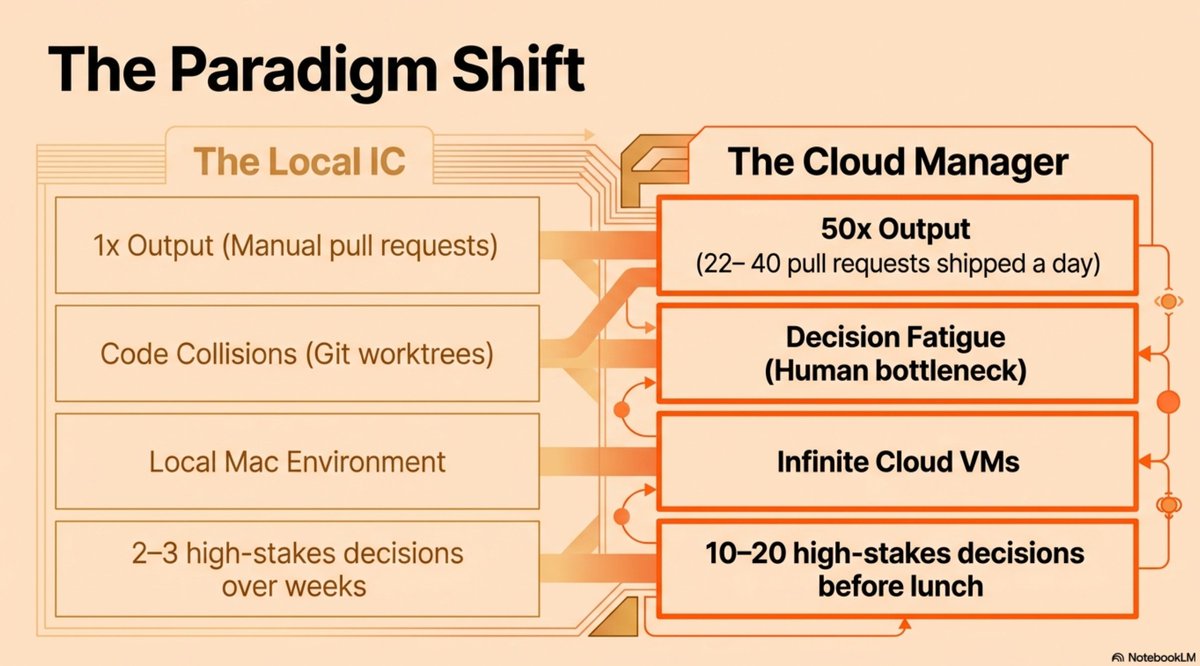
Local development has a hard ceiling. You set up your database, your auth, your dev server, all on your Mac. Then you want to do two things at once.
Now you need git worktrees, or a second copy of your entire codebase in another directory.
Three things at once? Five? Ten? The whole approach falls apart.
How cloud agents solve it:
Click a button. A virtual machine spins up in the cloud with your dev environment already inside it.
Open a browser, click new session, get a fresh VM. Do it again. And again.
You can create as many as you want, and the code never collides.
Ryan runs at least 5 cloud agents at once. Often 10.
His words: "If you are working locally, I honestly think you are a caveman."
The one exception: heavy front-end work. A brand new feature with a lot of UI. Spin up a local agent, do the light wireframing, then move it to the cloud and let a cloud agent take over.
He uses Devin, built by Cognition, and calls it one of the best software factories in the industry. Not cheap. Good.
Security rule that comes with this: keep your production write keys in 1Password and out of agent hands. Production writing is dangerous and your agents will eventually do something bad. Set it up so the agent asks you for the key, then you paste it into the session and you both know exactly what is happening.
## Step 02: Build a cadence before the volume breaks you
Fifty times the output means fifty times the decisions.
The old world gave you two or three high stakes decisions a day. An important meeting, a couple of calls, and the work happened over the next two weeks.
The new world hands you 10 to 20 before lunch.
Ryan's system:
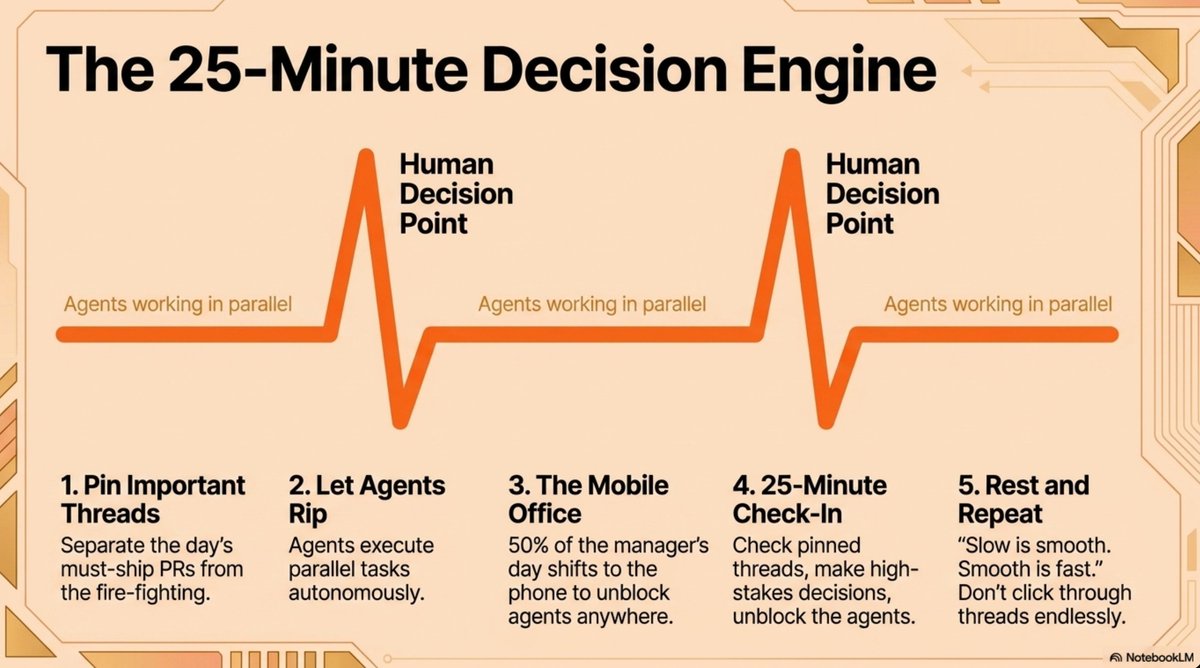
Sort your agent threads into two buckets. The big important things shipping today, and everything else.
Pin the important ones. Let the rest run and get back to them.
Check your pinned threads on a timer, roughly every 25 minutes. The gap is the point. It is the only thing keeping you from clicking through threads until you are wiped out.
Write the day's must-ship items down on paper. Ryan uses an analog to-do list (UG Monk) for exactly this, because 10 of the day's PRs will be fires and fires are very good at eating your attention.
Slow is smooth. Smooth is fast.
The honest part: Ryan says you will work more, not less. He compares it to a back muscle you never had to exercise before. It turns out to be the most important one you have.
## Step 03: Turn recurring checks into automations
Anything you would normally handle in a weekly meeting or a daily review becomes an automation.
The instruction is simple. Start a session and tell your agent to run this task every X days.
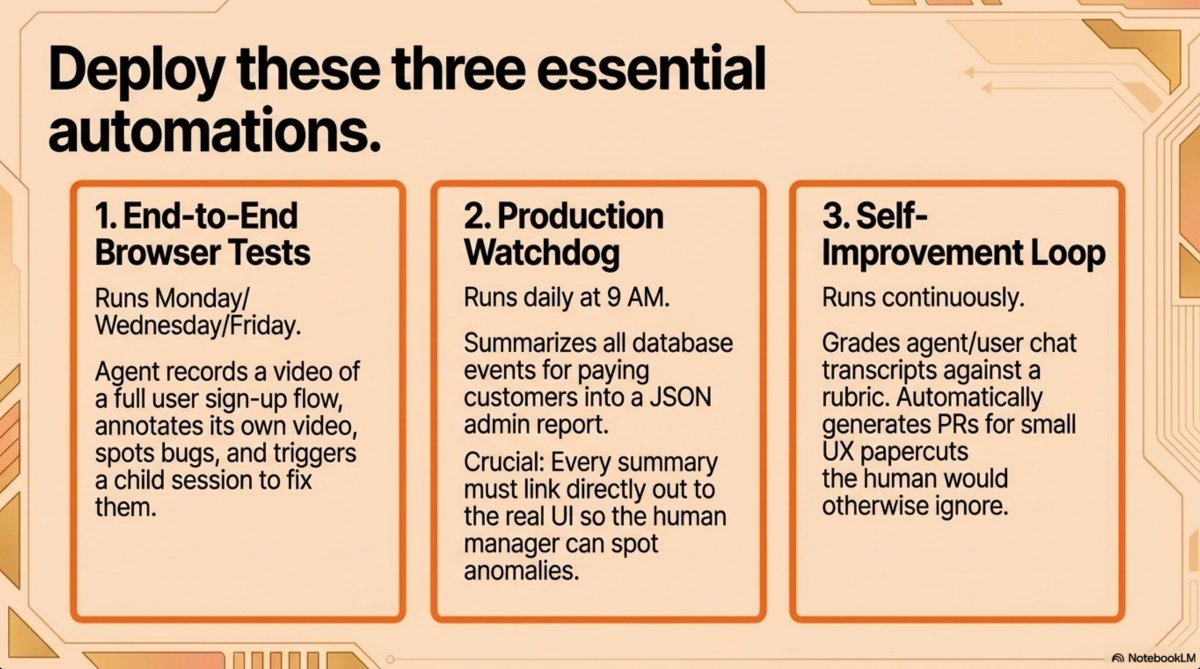
Automation 1: End-to-end signup test
A browser agent signs up for Untangle, creates a case, onboards a client, and walks through discovery. Basic user testing, fully automated.
It runs Monday, Wednesday, Friday. Three times a week, because it costs roughly $60 in tokens each run.
The browser testing loop is the interesting part: the agent records a video of the session, annotates it, watches its own video, and fixes the bugs it spots.
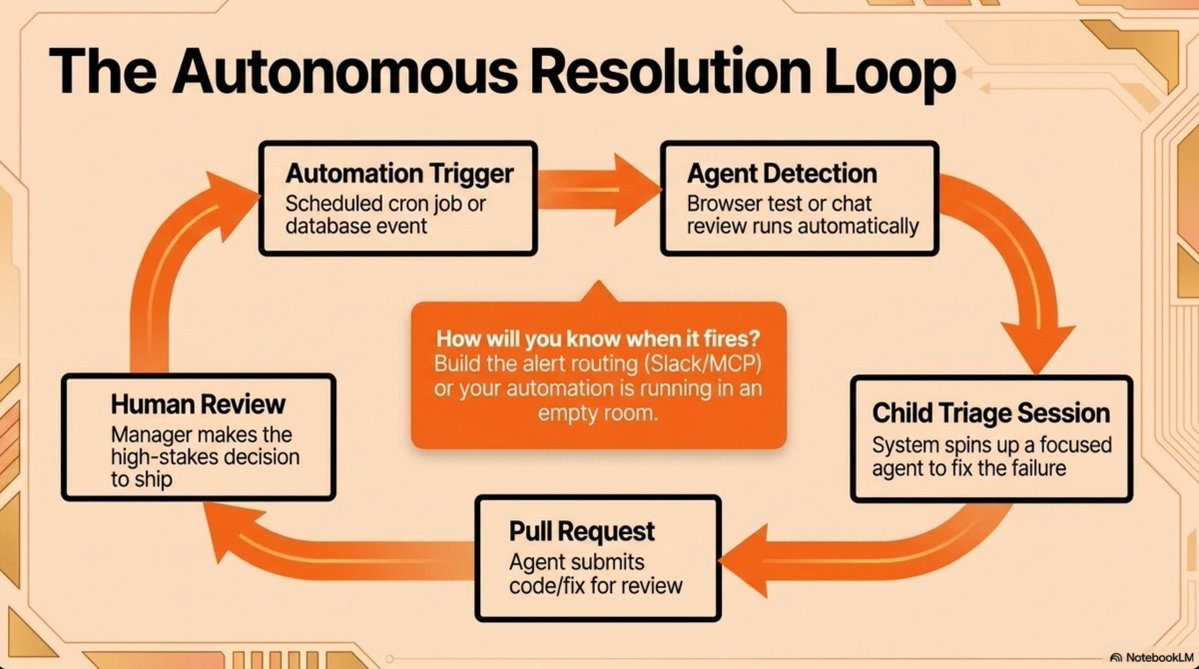
When a test fails, it triggers a child session to fix it.
Automation 2: Production watchdog
Every day at 9am, an automation reads every event in the database for paying customers and summarizes it into a JSON file that lands in the admin panel.
Ryan reads it with coffee. It works like a chief of staff walking in and telling you what your customers actually did yesterday.
Critical detail: each item links out to the real UI, so he can click through and watch what the customer was doing.
That is where the value lives. A human spots "that's weird" in about a second, and several times that click has revealed a user experience the agent built that was different from what he assumed.
Automation 3: The self-improvement loop
Untangle has an agent named Grace, a paralegal. She talks to attorneys, paralegals, and clients going through a divorce.
Every day, an automation reads those conversations and grades them against a rubric. Anything scoring below the bar kicks off a child session to fix it.
Ryan ships about three of these fixes a day.
Most of them are small UX paper cuts he either would never have found or would have skipped. The agent already found it, already opened the PR. He just ships it.
The pattern underneath all three:
Automation → detection → triage → child session → PR → your review
Then answer the question that kills most automations: how will you know when it fires? Ask your agent. It will suggest posting to Slack, connecting an MCP, whatever fits. Build that part too, or your automation is running in a room with nobody in it.
One thing to keep for yourself: using your own app. Ryan still clicks through the entire product himself on a regular schedule. There is no substitute yet, and there won't be for a while.
## Step 04: Get your token bill under control
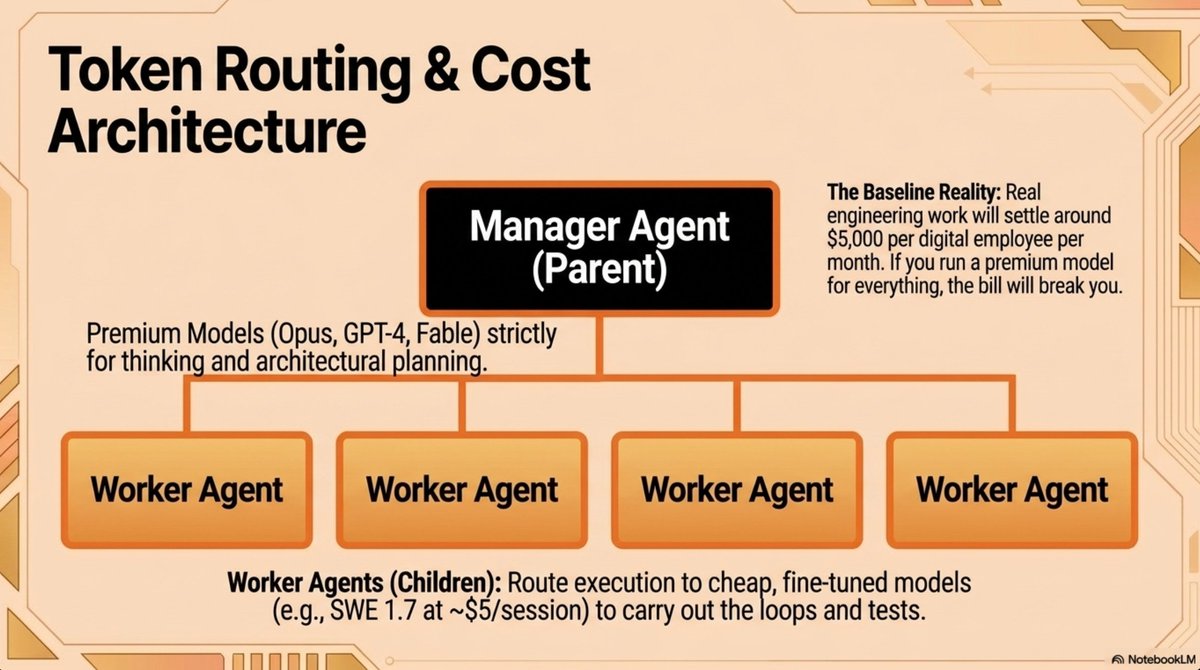
Ryan spent about $20,000 on tokens last month. His own verdict: too much, not viable.
His estimate for where real engineering work settles: around $5,000 per employee per month.
Past that number, you need model routing.
How routing works in practice:
Use the right model for the right task. His reinforcement loops run on a cheap fine-tuned coding model Cognition built specifically for this, which runs roughly $5 a session.
Same idea for parent and child sessions. Run one premium model thread as the manager, have it spin up child sessions on a cheaper model, and keep the expensive model for the thinking.
The structural argument:
If your entire engineering motion lives inside a frontier lab's product, you are betting on a company that is not incentivized to make your costs reasonable in the long run.
Independent agent labs compete on giving you the best result for the lowest price. That is their whole business. They will do the hard routing work for you.
When to switch:
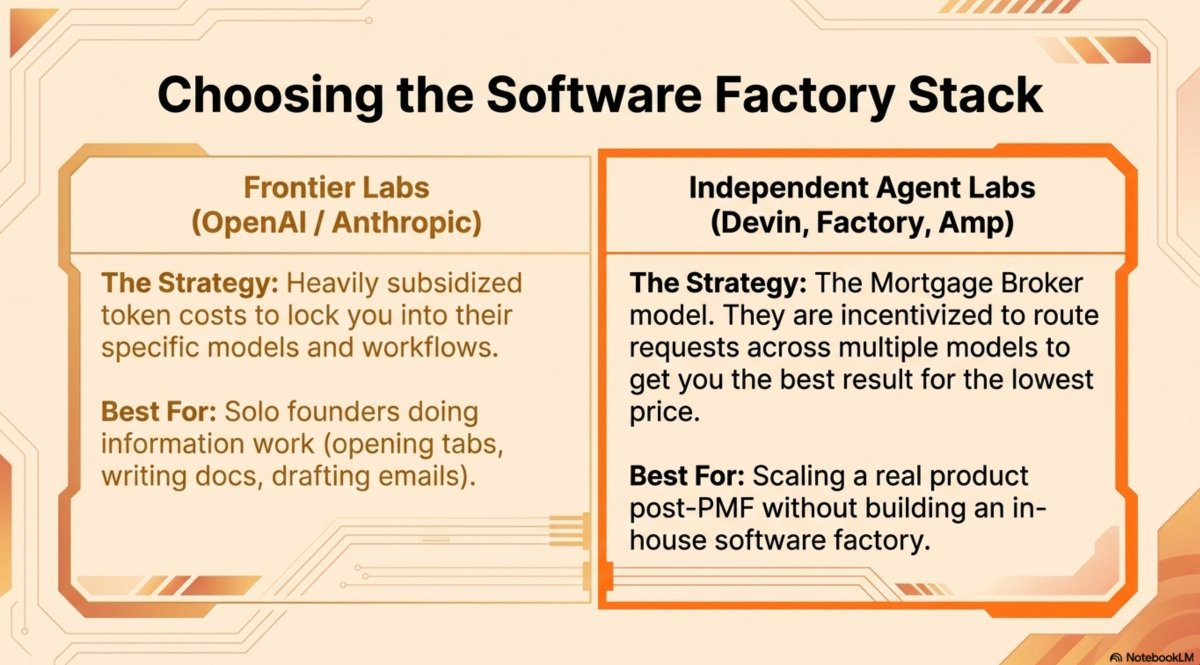
One person building something for yourself? A $200 a month frontier lab plan is fine.
Real product, product market fit, hiring people? You need a software factory, and it should sit on an independent lab. Ramp built Inspect in-house because they hit the size where you have to. You probably have not.
Ryan still uses Codex daily for information work: opening browser tabs, creating docs, checking email. The tokens are heavily subsidized and the Mac app is beautiful. He just refuses to build the company's software factory on it.
## Step 05: Share what you're learning in public
Ryan's third takeaway has nothing to do with tooling.
Twenty years of writing on X still pays him dividends. The algorithm rewards articles. The relationships compound.
He was on this show because of a relationship built entirely over X.
It does not have to be polished. You know more than you think.
Greg's example: Sahil Bloom worked in private equity, started writing about finance topics during COVID, and wrote them like Wikipedia articles built for Twitter. He was learning in public, saying "here's the thing I'm learning."
Over a million followers. A New York Times bestselling book. Companies. A fund.
If you don't know something, say you don't know. Then go ask an agent.
## The checklist
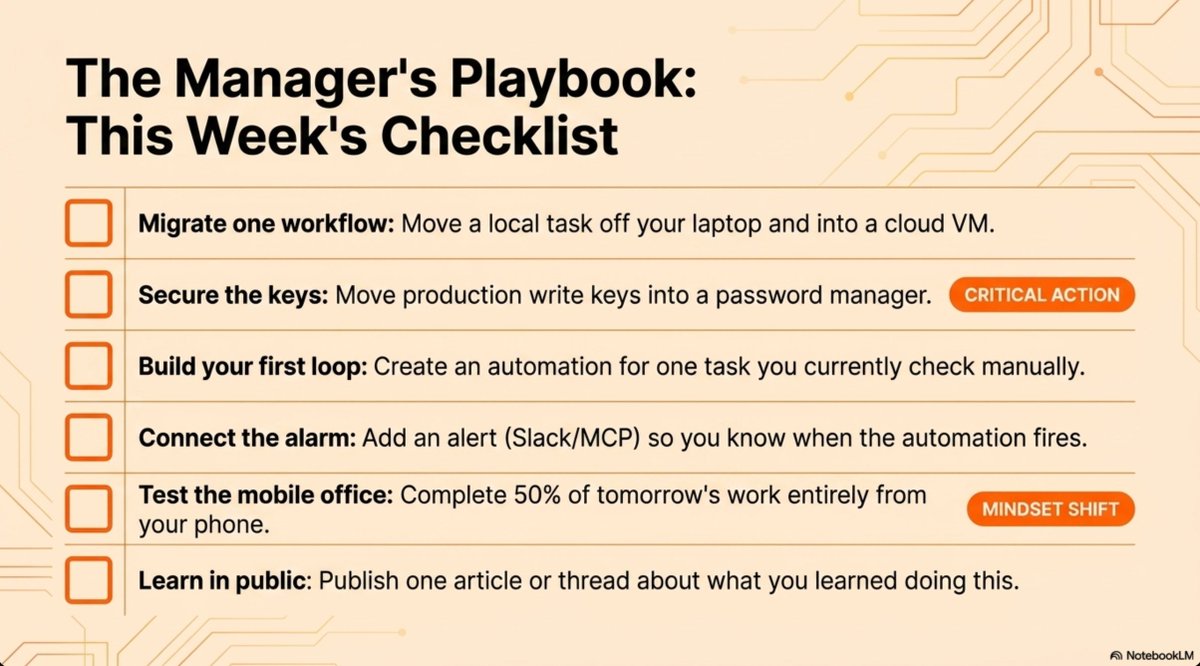
- Move one workflow off your laptop and into a cloud VM this week
- Get your prod write keys into a password manager and out of agent reach
- Pin your two or three most important threads, check them every 25 minutes
- Write the day's must-ship items on paper
- Build one automation that watches something you currently check manually
- Add the alert so you know when it fires
- Do 50% of one day's work from your phone
- Publish one article about what you learned doing it
## The part nobody says out loud
The agents are going to write your code, review your code, and ship your code.
Your job is deciding. All day, at a pace you have never worked at, half of it from a screen the size of your hand.
Ryan expects all of this to change again in three to six months.
Which means the only durable skill is getting your reps in now.
## 相关链接
- [The Startup Ideas Podcast (SIP)](https://x.com/startupideaspod)
- [@startupideaspod](https://x.com/startupideaspod)
- [3.8K](https://x.com/startupideaspod/status/2080732588751339528/analytics)
- [Upgrade to Premium](https://x.com/i/premium_sign_up)
- [3:11 AM · Jul 25, 2026](https://x.com/startupideaspod/status/2080732588751339528)
- [3,800 Views](https://x.com/startupideaspod/status/2080732588751339528/analytics)
---
*导出时间: 2026/7/25 11:33:37*
---
## 中文翻译
# 运营一支 AI 员工团队
**作者**: The Startup Ideas Podcast (SIP)
**日期**: 2026-07-24T19:11:21.000Z
**来源**: [https://x.com/startupideaspod/status/2080732588751339528](https://x.com/startupideaspod/status/2080732588751339528)
---

# 你现在是智能体管理者
Ryan Carson 做了 25 年创业者。他的上一家公司 Treehouse 发展到 110 名全职员工,教会了一百万人编程。
他现在的公司只有一名员工。就是他自己。
公司每天发布 22 到 25 个 PR(Pull Request)。有时甚至达到 40 个。本月收入有望翻两番,他正准备招聘第一批员工。
这家公司叫 Untangle,是一个面向家事律师事务所的 AI 离婚代理人。他一半以上的工作都是在手机上完成的。
以下是他的系统。
## 每个人刚刚继承的新头衔
Ryan 的表述是:你现在是一名智能体管理者。
创始人、独立贡献者(IC)、风险投资人、大学生、全职父母。未来大家的角色都一样。
反直觉的一点是这对你的技能组合有什么影响。大多数人以为技术能力不再重要了。Ryan 说情况恰恰相反:他现在比以往任何时候都更具技术性。
你需要了解什么是 Postgres。生产环境与开发环境的区别。数据库迁移。
这些都是通过管理工作学到的。
他在节目中的比喻:机器人木匠仍然需要木匠。你知道钉子该钉在哪,知道怎么下刀。这就是你能管理它们的原因。
成为一名优秀的工程管理者,现在是你能教给自己的最有价值的技能之一。
## 步骤 01:将你的工作转移到云端

本地开发有一个硬上限。你在 Mac 上设置数据库、认证、开发服务器。然后你想同时做两件事。
现在你需要 git worktrees,或者在另一个目录中复制一份完整的代码库。
同时做三件事?五件?十件?整个方法就崩溃了。
云端智能体如何解决这个问题:
点击一个按钮。云端就会启动一台虚拟机,里面已经预装了你的开发环境。
打开浏览器,点击新会话,获得一台全新的虚拟机。再做一次。再一次。
你可以随心所欲地创建任意数量,代码永远不会冲突。
Ryan 同时运行至少 5 个云端智能体。通常是 10 个。
他的原话:“如果你还在本地工作,老实说我觉得你就像个原始人。”
唯一的例外是:繁重的前端工作。一个包含大量 UI 的全新功能。启动一个本地智能体,做简单的线框图,然后把它转移到云端,让云端智能体接管。
他使用 Cognition 构建的 Devin,称其为业界最好的软件工厂之一。不便宜。但很好。
随之而来的安全规则:将生产环境的写入密钥保存在 1Password 中,不要让智能体接触到。生产环境写入很危险,你的智能体迟早会搞出乱子。将其设置为智能体向你索要密钥,然后你将其粘贴到会话中,这样你们双方都清楚确切发生了什么。
## 步骤 02:在庞大的工作量击垮你之前建立节奏

五十倍的产出意味着五十倍的决策。
旧世界每天给你两三个高风险决策。一个重要会议,几通电话,工作在接下来的两周内完成。
新世界在午饭前就扔给你 10 到 20 个决策。
Ryan 的系统:
将你的智能体线程分成两类。今天要交付的重要大事,以及其他所有事。
置顶重要的那些。让其余的运行,稍后再处理。
定时查看置顶的线程,大约每 25 分钟一次。这个间隔才是重点。这是唯一能阻止你不停点击线程直到精疲力竭的方法。
把当天必须交付的项目写在纸上。Ryan 之所以使用模拟待办事项清单(UG Monk),正是因为这一点,因为当天的 10 个 PR 中会有几个是“救火”任务,而“救火”非常擅长吞噬你的注意力。
慢即是稳。稳即是快。
诚实的一面:Ryan 说你会工作得更多,而不是更少。他将这比作一块你以前从未需要锻炼过的背部肌肉。结果证明这是你拥有的最重要的一块肌肉。
## 步骤 03:将重复性检查转化为自动化

任何你通常会在周会或日常回顾中处理的事情都可以变成自动化。
指令很简单。启动一个会话,告诉你的智能体每 X 天运行一次此任务。
自动化 1:端到端注册测试
一个浏览器智能体注册 Untangle,创建案件,接入客户,并走完发现流程。基础用户测试,完全自动化。
它在周一、周三、周五运行。每周三次,因为每次运行大约需要 60 美元的 Token 费用。
浏览器测试循环很有趣:智能体录制会话视频,进行标注,观看自己的视频,并修复发现的 Bug。
当测试失败时,它会触发一个子会话来修复它。
自动化 2:生产环境看门狗
每天早上 9 点,一个自动化程序读取付费客户数据库中的每一个事件,并将其汇总成一个 JSON 文件,存放到管理后台。
Ryan 喝着咖啡阅读它。它就像一位幕僚长走进来告诉你客户昨天实际做了什么。
关键细节:每一项都链接到真实的 UI,所以他可以点击进去观察客户在做什么。
这就是价值所在。人类大约一秒钟就能发现“这很奇怪”,好几次这种点击都揭示了智能体构建的用户体验与他设想的不一样。
自动化 3:自我改进循环
Untangle 有一个叫 Grace 的智能体,是一名律师助理。她与律师、律师助理和正在经历离婚的客户交谈。
每天,一个自动化程序读取这些对话,并根据评分标准进行打分。任何低于标准的条目都会启动一个子会话来修复它。
Ryan 每天大约发布三个这样的修复。
其中大部分都是微小的用户体验痛点,这些痛点他要么永远发现不了,要么会跳过。智能体已经发现了它,已经打开了 PR。他只需要发布它。
这三种模式背后的逻辑:

自动化 → 检测 → 分诊 → 子会话 → PR → 你的审查
然后回答那个扼杀大多数自动化的问题:你怎么知道它触发了?问问你的智能体。它会建议发布到 Slack,连接 MCP,任何合适的方式。把这部分也构建出来,否则你的自动化就是在空房间里运行。
有一件事要留给自己:使用你自己的应用。Ryan 仍然会定期亲自点击整个产品。目前还没有替代品,短期内也不会有。
## 步骤 04:控制你的 Token 账单

Ryan 上个月在 Token 上花了大约 20,000 美元。他自己的结论:太多了,不可行。
他对真正的工程工作落地点的估计:大约每位员工每月 5,000 美元。
超过这个数字,你就需要模型路由。
路由在实践中是如何运作的:
为正确的任务使用正确的模型。他的强化循环运行在一个廉价微调过的编码模型上,这是 Cognition 专门为此构建的,每次会话运行成本大约 5 美元。
父会话和子会话也是同样的想法。运行一个高级模型线程作为管理者,让它在更便宜的模型上启动子会话,并将昂贵的模型保留用于思考。
结构性论点:
如果你所有的工程动作都发生在前沿实验室的产品内部,你就是在押注一家从长远来看没有动力让你的成本合理的公司。
独立的智能体实验室竞争的是以最低的价格给你最好的结果。这就是他们的全部生意。他们会为你做艰难的路由工作。
何时切换:

一个人为自己构建东西?每月 200 美元的前沿实验室计划没问题。
真正的产品、产品市场契合度、招聘人员?你需要一个软件工厂,它应该坐落在独立实验室之上。Ramp 内部构建了 Inspect,因为他们达到了必须这样做的规模。你很可能还没有。
Ryan 仍然每天使用 Codex 进行信息处理工作:打开浏览器标签、创建文档、检查邮件。Token 有大量补贴,而且 Mac 应用很漂亮。他只是拒绝在其上构建公司的软件工厂。
## 步骤 05:公开分享你学到的东西
Ryan 的第三点心得与工具无关。
在 X 上写了二十年的文章仍然给他带来红利。算法奖励文章。人际关系复利增长。
他出现在这个节目上,完全是因为一段通过 X 建立的关系。
它不需要很华丽。你懂的比你想象的要多。
Greg 的例子:Sahil Bloom 曾在私募股权公司工作,新冠疫情期间开始写金融话题,写得就像为 Twitter 构建的维基百科文章。他在公开学习,说“这是我正在学的东西”。
超过一百万粉丝。《纽约时报》畅销书。公司。基金。
如果你不知道什么,就承认你不知道。然后去问智能体。
## 清单

- 本周将一个工作流从笔记本电脑转移到云端虚拟机
- 将你的生产环境写入密钥放入密码管理器,不要让智能体接触到
- 置顶你两三个最重要的线程,每 25 分钟检查一次
- 把当天必须交付的项目写在纸上
- 构建一个自动化程序来监控你目前手动检查的某样东西
- 添加警报,以便你知道它何时触发
- 有一天 50% 的工作在手机上完成
- 发表一篇关于你从中学到东西的文章
## 没人说出口的那部分
智能体将编写你的代码,审查你的代码,并发布你的代码。
你的工作是决策。一整天,以你从未有过的工作节奏,其中一半是在手掌大小的屏幕上完成的。
Ryan 预计这一切在三到六个月内还会再次发生变化。
这意味着唯一持久的技能就是现在开始练习。
## 相关链接
- [The Startup Ideas Podcast (SIP)](https://x.com/startupideaspod)
- [@startupideaspod](https://x.com/startupideaspod)
- [3.8K](https://x.com/startupideaspod/status/2080732588751339528/analytics)
- [升级到 Premium](https://x.com/i/premium_sign_up)
- [3:11 AM · Jul 25, 2026](https://x.com/startupideaspod/status/2080732588751339528)
- [3,800 次观看](https://x.com/startupideaspod/status/2080732588751339528/analytics)
---
*导出时间: 2026/7/25 11:33:37*