# Model-Harness-Fit
**作者**: Nicolas Bustamante
**日期**: 2026-05-04T02:48:49.000Z
**来源**: [https://x.com/nicbstme/status/2051131906327212298](https://x.com/nicbstme/status/2051131906327212298)
---
Is it best to use an LLM with its native harness (like Claude Code or Codex), or a generic harness that swaps models on demand?
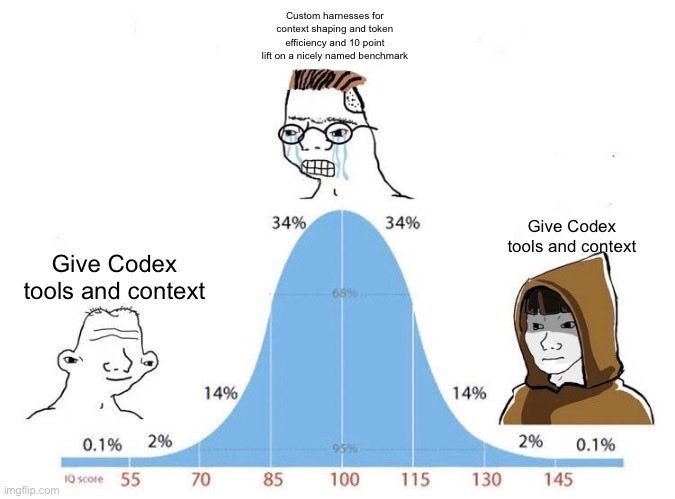
OpenAI engineer Ryan (@_lopopolo) tweeted this hilarious meme this morning, so I decided to dig deeper by looking at the harness implementations of Codex, Claude Code, and Github sdk. Does the harness really matter that much?
I keep three coding agents alive on the same workstation. Claude Code in one terminal. Codex CLI in another. GitHub Copilot CLI in a third. Same files. Same git tree. Same bash. Three different harnesses that look indistinguishable.
I ran the same prompt through all three and the behavior was visibly different in ways that went well past the surface differences of style and speed that I had expected to see across vendors.
The hand wave answer is that "models behave differently because they are different models." but here I tested the same models and different harness.
Models are post trained against the harness, not just the API. The tool names they expect, the input schemas they emit, the citation tags they wrap around remembered facts, the file structure of skills they invoke, the planning protocol they follow when the harness says "make a plan first" (none of these are generic capabilities of the model).
They are byte level conventions baked into the post training of one specific model against one specific harness. Pull the model out of its harness and you give up performance you cannot get back without rewriting either side.
This has a direct consequence that anyone who has tried to ship a "model agnostic" agent has run into. You cannot just swap a model.
Supporting BYOK and multi model (which is the responsible posture, since relying on a single provider is risky!) adds real engineering complexity.
To swap a model cleanly, you have to swap the harness with it: the tool surface, the schema shapes, the skill bodies that name those tools, the citation contract, the memory ritual, the system prompt structure, sometimes the planning protocol.
Everything above the model has to move when the model moves. That is why every agent vendor that supports multiple providers ends up either
(a) running a degraded variant of every model they support, or
(b) maintaining a separate full stack per model and exposing the choice to the user as "you are picking a product, not just a model." Option (b) is the path that wins on quality, and it is worth the engineering cost to avoid being locked into one lab.
Swapping orchestrators is not a cosmetic change. It is a model swap in disguise. The frontier lab spent the last year shaping the model's instincts to a particular tool surface, a particular memory ritual, a particular skill format. When you mix and match, you spend that work.
I think this is the single most underrated constraint in agent design today, and it has a clean name. Call it Model-Harness-Fit.
## So how does this actually show up under the hood?
I dug into three open implementations that ship today: Codex CLI (OpenAI, fully open source at github.com/openai/codex, Claude Code (Anthropic, closed binary, but a Rust port called claw-code at github.com/ultraworkers/claw-code tracks upstream behavior closely enough), and GitHub Copilot CLI, where the SDK is fully open source licensed at github.com/github/copilot-sdk.
Here is what I will cover:
- The Evidence: Terminal-Bench 2.0 : what the leaderboard actually shows about model harness pairs
- Three Harnesses, Three Bets : SQ/EQ vs typed conversation loop vs JSON RPC supervisor
- The Tool Surface : where post training is most visible
- Skills Carry Tool Specs : why "same SKILL.md format" does not mean "interchangeable"
- The Memory Layer : synchronous live writes vs deferred batch vs server side, and why the citation tag matters
- The Citation Discipline : how the model talks back to the harness
- The System Prompt Skeleton : ten section IDs is a contract
- The Routing Reality : what GitHub Copilot CLI is actually doing about all this
- Mid-Chat Model Switching : the cleanest concrete failure mode
- What the Labs Are Saying : Cursor, Anthropic, and LangChain all converging on the same framing
- The Identity File Convention : CLAUDE.md, AGENTS.md, SOUL.md, USER.md, and what each one is for
- What This Means : the model is no longer the moat alone, and the matched pair shifts as the model matures
I covered the memory layer in detail at Agent Memory Engineering. This article is about everything else, with memory revisited only where it intersects orchestration. If you want the bottom up tour of how MEMORY.md indexes, system reminder injection, age in days warnings, and signal gates work, read that one first.
## The Evidence: Terminal-Bench 2.0
Before any argument about architecture, look at the leaderboard. Terminal-Bench 2.0 evaluates agents on bash heavy multi step tasks, and it ranks by harness plus model pair, not by model alone. From April 30, 2026:
```
TERMINAL-BENCH 2.0 TOP PAIRS PASS RATE
======================================
Codex + GPT-5.5 82.0%
ForgeCode + GPT-5.4 81.8%
TongAgents + Gemini 3.1 Pro 80.2%
ForgeCode + Claude Opus 4.6 79.8%
SageAgent + GPT-5.3-Codex 78.4%
ForgeCode + Gemini 3.1 Pro 78.4%
Droid + GPT-5.3-Codex 77.3%
Capy + Claude Opus 4.6 75.3%
Simple Codex + GPT-5.3-Codex 75.1%
Terminus-KIRA + Gemini 3.1 Pro 74.8%
```
Two things jump out.
First, Claude Opus 4.6 paired with ForgeCode hits 79.8%, while the same model paired with Capy hits 75.3%. Same weights, different harness, and a 4.5 percentage point spread between them on a benchmark where every entry is fighting for a tenth of a point. Interesting!
Second, the upper rankings are not dominated by the labs that trained the models. ForgeCode is a third party harness that lands three of the top six entries by routing across model families. Stanford's IRIS Lab paired Opus 4.6 with an automated harness evolution system called Meta-Harness and pushed the same model to 76.4% on the same benchmark, well past the best baseline they started from. The harness is moving the score by more than the model upgrades are moving it.
Cursor's research team makes the point even sharper. In their April 30 post on harness engineering, they note that they took their own coding agent from "Top 30 to Top 5 on Terminal Bench 2.0 by only changing the harness." Same model. Same benchmark. Different scaffolding. A 25-position jump on a public leaderboard, attributable to the harness alone. Bravo Cursor!
LangChain's Vivek Trivedy puts the same observation in one sentence: "Opus 4.6 in Claude Code scores far below Opus 4.6 in other harnesses." Anthropic's flagship model in Anthropic's flagship harness loses to the same weights in third party scaffolding. If you only saw the model name on the spec sheet, you would not predict that.
This is the empirical case for model harness fit. Hold the model fixed and swap the harness, and the pass rate moves by enough to outweigh a model generation upgrade.
So why? What exactly does the harness do that lets two implementations of the same model produce different scores?
## Three Harnesses, Three Bets
Each harness picks a different orchestration protocol. The model was trained on that protocol's exact wire format.
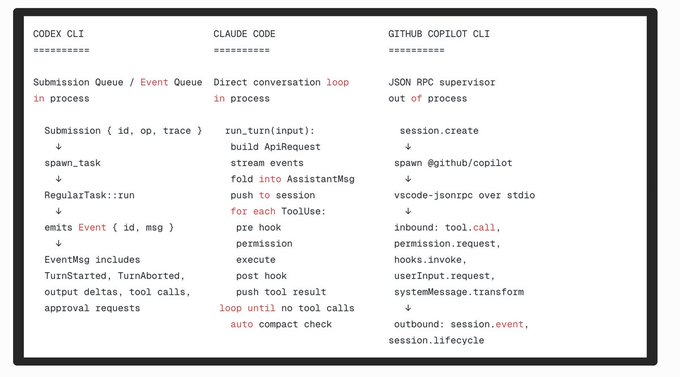
These are not three implementations of the same idea. They are three different contracts between model and runtime.
Codex is a typed asynchronous protocol. The model emits a Submission with an Op and gets back a stream of typed Event messages. The protocol is defined at codex-rs/protocol/src/protocol.rs with explicit #[serde(tag = "type", rename_all = "snake_case")] enums. There is a second protocol layered on top: app-server-protocol/src/protocol/v2.rs is 10,721 lines of JSON RPC for cross process clients (IDE plugin, desktop app), where v1 (245 lines) is frozen and all new RPCs go to v2. Methods are named <resource>/<method> with singular resource names, camelCase wire format. The two protocols stack: agent layer for in process, JSON RPC layer for cross process. The model was trained to emit submissions and consume events.
Claude Code is a direct typed conversation loop. The runtime's ConversationRuntime::run_turn consumes a Vec<AssistantEvent> per turn from ApiClient::stream. AssistantEvent variants are TextDelta(String), ToolUse { id, name, input }, Usage(TokenUsage), PromptCache(PromptCacheEvent), and MessageStop. There is no separate submission queue. The protocol is the Anthropic Messages API plus a tight in process tool dispatcher. The model was trained to emit tool calls inside an assistant message and respond to tool results in the next turn.
GitHub Copilot CLI is a supervisor protocol. The host app does not run the agent loop. It spawns the bundled @github/copilot binary as a subprocess, opens a vscode-jsonrpc channel over stdio, and sends session.create with the full configuration: model, system message, tools, MCP servers, custom agents, skill directories, hook flags. The agent loop runs inside the child process. The host gets session.event notifications back. It runs inside this supervisor and emit JSON RPC events that the supervisor can route.
You can see the architectural commitment harden in each design. Codex's AGENTS.md literally polices crate growth: "Resist adding code to codex-core. The largest crate is explicitly off limits for new features." A 500 line soft cap, 800 line hard cap per Rust module. New features pay rent in the form of a new crate. This is a compiler toolchain attitude applied to an agent harness, and the model was trained to operate inside it.
Claude Code's port enforces a different rule: "one agent loop, not a fan out of specialized agents," which is why subagents in Claude Code start with a fresh context and cannot recurse. Copilot CLI's supervisor model is what lets a single binary serve three surfaces (terminal, cloud agent, third party hosts). Each surface gets the same model behavior because the model is always running inside the same supervisor.
Now imagine you swap models. Take a model trained to emit Submission { id, op: UserTurn, trace } and feed it Claude Code's Vec<AssistantEvent> stream. The model has been taught one wire shape. The harness expects another. The mismatch shows up not as an outright failure but as a quiet degradation: missed tool calls, wrong reasoning effort levels, inconsistent compaction triggers, citation tags that the harness never parses. The wire format is part of the model.
# The Tool Surface
This is where post training is most visible.
Every harness has a tool registry. The names look similar at the top: read, write, bash, grep, glob. But once you go past the first six, the surfaces diverge in ways that the model has been taught to exploit.
## Codex tool surface
Codex's tools/src/lib.rs exposes a particular vocabulary:
- apply_patch — Codex's custom diff format. Two flavors: a freeform Lark grammar at tool_apply_patch.lark and a JSON variant. The model was trained to emit patches in this format. It is not interchangeable with Claude Code's edit_file (which takes old_string / new_string).
- local_shell — the bash family. Plus exec_command_tool and write_stdin_tool for long lived processes that the model can drive with stdin writes after the fact.
- update_plan_tool — the plan/todo tool. A model not trained on this tool will use a different convention to track work.
- request_permissions_tool — model can request expanded permissions mid turn. Codex is the only harness with this exact verb.
- agent_tool — multi agent orchestration with spawn_agent_v1, spawn_agent_v2, wait_agent_v1, wait_agent_v2, send_message, close_agent_v1, close_agent_v2, resume_agent. Eight verbs. The model knows all eight.
- tool_search, tool_suggest — tools that find other tools. Codex's answer to deferred tool loading.
- goal_tool — create_goal, get_goal, update_goal. Tied to migration 0029_thread_goals.sql.
## Claude Code tool surface
Claude Code's port enumerates 40 specs in mvp_tool_specs():
- read_file, write_file, edit_file — lower case names internally, surfaced to the model as CamelCase (Read, Write, Edit). The model was trained on the CamelCase variant.
- Edit requires old_string, new_string, optional replace_all. Not the same shape as Codex's apply_patch.
- Bash has the deepest sandbox surface: command, timeout, description, run_in_background, dangerouslyDisableSandbox, namespaceRestrictions, isolateNetwork, filesystemMode. The model knows when to set run_in_background: true and pair it with the Monitor tool.
- Skill and ToolSearch — the lazy load primitives.
- Agent — single tool for subagent dispatch. Takes description, prompt, optional subagent_type, optional model. The post training has the model emit short imperative descriptions for these.
- EnterPlanMode / ExitPlanMode — both WorkspaceWrite permission. Toggles a worktree local override.
- EnterWorktree / ExitWorktree — wrap git worktree add for subagent isolation.
- Monitor — streams stdout from a background process. Pairs with Bash run_in_background: true. The model knows this pattern; Codex does not have it.
- TodoWrite — the workflow scaffolding tool. The model writes {content, activeForm, status} triplets in a particular pattern.
## GitHub Copilot CLI tool surface
Copilot CLI bundles a different default, drawn from the public changelog:
- grep, glob (bundled ripgrep), view, view_range — file reading with explicit range params.
- web_fetch — built in (v0.0.374). Rejects file:// URLs.
- read_bash, write_bash, stop_bash — three verb interactive shell control.
- task — subagent dispatch with depth and concurrency limits.
- read_agent, write_agent — multi turn subagent control. A different shape from Codex's six verb agent surface.
- ask_user — interactive clarification.
- store_memory — persistent memory tied to a remote backend. Memory is not local files here.
- apply_patch — included specifically when serving Codex models. A different patch toolchain than Codex's own.
- create_pull_request, sql, exit_plan_mode, list_copilot_spaces, show_file.
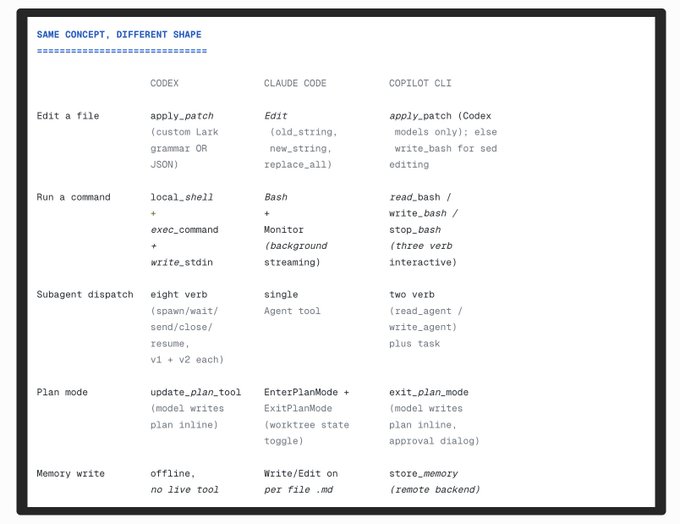
A model trained on Codex's eight verb subagent surface knows how to send a message to a running subagent. A model trained on Claude Code's Agent tool does not have that verb in its instinct set.
> The harness can paper over this with a router, but the router cannot give the model an instinct it does not have.
Cursor's harness team puts the underlying mechanic plainly. From their April 30 research post: "OpenAI's models are trained to edit files using a patch-based format, while Anthropic's models are trained on string replacement. Either model could use either tool, but giving it the unfamiliar one costs extra reasoning tokens and produces more mistakes. So in our harness, we provision each model with the tool format it had during training." This is the single cleanest description of model harness fit I have seen from any vendor, and it is not a hand wave about model preferences but a specific measurable cost in reasoning tokens paired with an observable increase in error rate, recorded at scale across millions of agent turns in production.
This is where model harness fit shows up most visibly. The tool surface is the model's vocabulary for the world. Cross train on a different vocabulary and you lose precision in every interaction.
## Skills Carry Tool Specs
Skills look interchangeable on the surface. All three harnesses use a SKILL.md file with YAML frontmatter (name, description, optional metadata). Codex even baked in cross compat: core-skills parses Claude style markdown skills. Copilot CLI explicitly reads .claude/ config. The format is so similar that the same SKILL.md body would parse in all three.
But skills are not just markdown. A skill carries an implicit contract about which tools it expects to call. That contract is not in the frontmatter. It is embedded in the body, in the form of imperative instructions that name specific tools by name, with specific argument shapes, and with specific verbs the model must emit.
Look at what each harness ships as a system skill.
Codex's bootstrap skills, baked in via include_dir! and extracted to $CODEX_HOME/skills/.system on first launch, are five: imagegen, openai-docs, plugin-creator, skill-creator, skill-installer. The skill-installer body invokes list-skills.py and install-skill-from-github.py as scripts (codex-rs/skills/src/assets/samples/skill-installer/SKILL.md). It assumes the model can call bash to run a Python script. It assumes the model knows that scripts in scripts/ of a skill folder are invokable. It assumes a sparse checkout fallback for private repos. None of that is in the frontmatter. All of it is in the body.
Claude Code's skills are different. The superpowers plugin ships superpowers:test-driven-development, superpowers:writing-plans, superpowers:verification-before-completion, superpowers:requesting-code-review, superpowers:dispatching-parallel-agents, plus many more. The bodies invoke Claude's specific tools: Skill to bootstrap into a workflow, TodoWrite to track steps, Agent to dispatch parallel subagents, Read / Edit for file changes, Grep / Glob for search. The skills also encode hard process rules: "Use this BEFORE any creative work," "Use when about to claim work is complete." These rules anchor on the harness's <system-reminder> injection model, which Codex does not have in the same form.
Copilot CLI's skills are part of the plugin marketplace ecosystem, and the changelog reveals a different posture. v1.0.5 added "Embedding based dynamic retrieval of MCP and skill instructions per turn" as experimental. The model was trained to consume skill instructions delivered as a per turn injection chosen by an embedding ranker, rather than as a description match. A skill body that assumes "you will see all skills in the system reminder" does not behave the same way when the harness ranks skills via embedding and only injects the top three.
```
SAME SKILL.MD, DIFFERENT BEHAVIORS
===================================
A skill body that says:
"Step 1: call TodoWrite with a list of three subtasks.
Step 2: dispatch each subtask via Agent with subagent_type='Explore'.
Step 3: wait for results, then verify with Bash before claiming done."
In Claude Code:
TodoWrite is a built in. Agent is a built in. subagent_type='Explore'
has a specific allowed tool set the harness enforces. Bash returns
truncated output the model knows how to parse.
✅ Works as designed.
In Codex:
TodoWrite does not exist. The closest is update_plan_tool, but the
schema differs. Agent does not exist with that exact shape.
Codex has spawn_agent_v1 / v2. The Bash equivalent is local_shell.
❌ Skill silently fails or executes a degraded version.
In Copilot CLI:
TodoWrite as a verb does not exist. Agent dispatch is via task or
read_agent / write_agent. The Bash equivalent is the three verb
read_bash / write_bash / stop_bash. Plus skills may not even be
loaded into the prompt this turn (embedding ranker decided).
❌ Skill is invisible or executes against a non existent surface.
```
This is why "we both use SKILL.md" is misleading. The format is identical; the contract underneath is not. Skills carry tool specs implicitly, and the implicit specs are pinned to the harness that authored them.
The same applies to plugin manifests. Copilot CLI's v1.0.22 explicitly added: "Plugins using .claude-plugin/ or .plugin/ manifest directories now load their MCP and LSP servers correctly." That is GitHub treating Claude Code's plugin format as a substrate to interoperate with at the file level. But the skills inside those plugins still bring assumptions about Claude Code's tool surface. Loading the file does not give the model the right vocabulary.
The lesson generalizes. A skills marketplace that claims to be cross harness is a routing problem, not just a parsing problem. Each skill needs to either declare its target harness explicitly, or get rewritten per harness, or run inside a router that translates tool calls between dialects. None of these are free.
## The Memory Layer
I covered memory in detail in Agent Memory Engineering, so I will keep this section to the parts that matter for harness fit.
Three memory architectures, three different bets:
```
HERMES CLAUDE CODE CODEX
========== ========== ==========
Synchronous live writes, Synchronous live writes, Deferred batch writes,
frozen snapshot at session one .md file per memory, two phase pipeline
start, no decay, char cap always loaded MEMORY.md triggered by 6+ hour
index, body read on idle, gpt 5.4 mini
demand with age in days extracts, gpt 5.4
<system-reminder> consolidates against
git baseline
GITHUB COPILOT CLI
==========
Server side memory backend, store_memory tool, per repo,
remote retrieval, hangs the agent if the backend is unavailable
(v1.0.23 specifically fixed: "Agent no longer hangs on the first
turn when the memory backend is unavailable")
```
The architectural choices already differ. But the harness fit story is sharper than that. Each model was trained to write memory using a specific tool with a specific schema, and to cite memory using a specific tag with a specific format.
Codex's model writes a structured raw memory artifact via Phase 1 extraction with a strict JSON schema:
```
---
description: concise but information dense description
task: <primary_task_signature>
task_group: <cwd_or_workflow_bucket>
task_outcome: <success|partial|fail|uncertain>
cwd: <single best primary working directory>
keywords: k1, k2, k3
---
```
The Phase 2 consolidation prompt is 841 lines. additionalProperties: false. Schema validation rejects malformed output at parse time. The model citations are wrapped in <oai-mem-citation> blocks. The harness has a parser at citations.rs:6-43 that increments usage_count in the SQLite state DB whenever a citation arrives. This is the model's memory ritual.
> Strip the citation tag and the harness loses its decay signal.
Claude Code's model writes memory using the standard Write and Edit tools, into one file per memory under ~/.claude/projects/<encoded-cwd>/memory/. There is no separate memory tool. The model picks one of four types (user, feedback, project, reference) by file name prefix. The body uses a **Why:** / **How to apply:** convention for behavioral rules. The harness wraps every body read in a <system-reminder> block with the dynamic age in days and a verification reminder. The model was trained to read memory through that wrapper, weight it accordingly, and skip stale claims.
Copilot CLI's model invokes store_memory as a dedicated tool. The body of the memory goes to a remote backend. Cross session memory was added in v0.0.412 as experimental. The retrieval surface is a server side query, not a local grep. The model expects the backend to be there. When the backend is unavailable (v1.0.23 fix), the agent used to hang on the first turn. That is a load bearing dependency.
Now mix and match. Run a Codex trained model on Claude Code's harness. The model will look for a memory write tool, find Write, and write a file — but it will write a file in Codex's structured format, with task_group: headers and cwd: annotations, into a directory that Claude Code does not auto load on the next session. The harness does not know to inject the index. The next session does not see the memory.
And critically, the model will emit <oai-mem-citation> blocks that Claude Code never parses. Memory effectively does not exist on the next turn.
Run a Claude trained model on Codex's harness. The model will not emit citation tags. Codex's usage_count decay signal stops incrementing. Memories that were used silently rank below memories that were not used, because the harness sees zero citations. Within a few weeks, the wrong memories are getting evicted.
Run either on Copilot CLI's harness with the remote backend. The model's local file instincts do not transfer. The store_memory tool is the only path, the schema is different, and the cross session retrieval is keyword search against a server, not the always loaded index plus on demand body read pattern that the model was trained on. The first turns will look fine because the model has memory shaped instincts. The retention will be different.
The memory layer is the densest collision surface for model harness fit. Tools, schemas, citation tags, decay signals, retrieval rituals — all of these are coupled, all of these were learned together during post training, and none of them transfer cleanly when you swap one side.
## The Citation Discipline
The <oai-mem-citation> tag is a microcosm of the larger problem.
Codex's model emits a small XML block at the end of an assistant message whenever it pulled in memory:
```
<oai-mem-citation thread_id="xyz" raw_memory_id="abc">
this entry: <description string>
</oai-mem-citation>
```
The harness has a parser that strips the block before showing the assistant message to the user, and uses the parsed thread_id to bump usage_count and last_usage columns in stage1_outputs. The parser is at citations.rs:6-43. The SQL is in migration 0016_memory_usage.sql:
```
ALTER TABLE stage1_outputs ADD COLUMN usage_count INTEGER;
ALTER TABLE stage1_outputs ADD COLUMN last_usage INTEGER;
UPDATE stage1_outputs
SET
usage_count = COALESCE(usage_count, 0) + 1,
last_usage = ?
WHERE thread_id = ?
```
This is the model's contract with the harness. Cite what you used. The harness will reward what you cited by keeping it alive. The Phase 2 consolidator ranks memories by usage_count and decays anything with no citations and no fresh source_updated_at after 30 days.
Claude Code's model has no equivalent citation tag. The harness does not need one because memory is read via the standard Read tool, and the agent's verification grep is what doubles as the "I used this" signal. The reminder text in front of every body read explicitly tells the model: "Records can become stale over time. Verify before recommending." There is no decay loop because the harness assumes the user will prune or the verification will fail in place.
Copilot CLI's model talks to a remote memory backend. The store, retrieve, and rank logic is server side. The model does not need a citation tag because the backend tracks reads on its own.
Now look at what happens in a cross harness run.
```
TRAINING DISTRIBUTION VS RUNTIME
Codex model emitted 12,000 example ↓ runtime parses
turns during post training that <oai-mem-citation>,
include <oai-mem-citation> blocks bumps usage_count.
✅ memory ranked, decayed
correctly.
Same model on Claude Code ↓ runtime ignores tag,
harness emits <oai-mem-citation> leaves it in the
in the assistant text. assistant text shown
to the user.
❌ user sees raw XML.
❌ no decay signal in
Claude Code's memory.
Claude trained model on Codex ↓ no citation tag,
harness uses memory inline, usage_count never bumps.
never wraps it in a tag. ❌ Codex's decay loop
evicts good memories
because they look unused.
```
A six character XML tag becomes the difference between a memory system that improves with use and one that degrades silently.
This is what I mean by "the wire format is part of the model." The citation tag is not a feature on a roadmap. It is a habit the model picked up during post training, and that habit only pays off inside the harness that taught it.
## The System Prompt Skeleton
The Copilot CLI SDK exposes its system prompt as a structured object with ten section IDs. Hosts can override each section, replace it, or take full control. From the open source TypeScript at github.com/github/copilot-sdk/nodejs/src/types.ts:636:
```
const SYSTEM_PROMPT_SECTIONS = {
identity: "Agent identity preamble and mode statement",
tone: "Response style, conciseness rules, output formatting",
tool_efficiency: "Tool usage patterns, parallel calling, batching",
environment_context: "CWD, OS, git root, directory listing, available tools",
code_change_rules: "Coding rules, linting/testing, ecosystem tools, style",
guidelines: "Tips, behavioral best practices",
safety: "Environment limitations, prohibited actions, security",
tool_instructions: "Per-tool usage instructions",
custom_instructions: "Repository and organization custom instructions",
last_instructions: "End of prompt: parallel tool calling, persistence"
};
```
This is not just a documentation but more the public contract of the model's training distribution. Each section has a specific role, and the model was trained to read each section as a particular kind of instruction. The safety section is harder than guidelines. The tool_instructions section is consulted when the model is mid tool call. The last_instructions section is what the model reads right before emitting a turn.
Codex has its own equivalent, less explicit. The developer prompt is assembled in this order:
```
CODEX DEVELOPER PROMPT
======================
- permission instructions
- base developer instructions
- memory_summary.md (5K tokens, always)
- collaboration mode
- realtime updates
- personality
- apps
```
Memory comes after policy and identity, before behavioral overrides. The model was trained to read this exact order.
Claude Code's static prefix:
```
CLAUDE CODE STATIC PREFIX
==========================
<base agent system prompt>
<environment block: cwd, platform, OS>
# claudeMd ← project CLAUDE.md content
# auto memory ← MEMORY.md index, capped at 200 lines
<types block describing user/feedback/project/reference>
<when to save guidance>
<verification rule before acting on memory>
<full MEMORY.md contents>
# userEmail
# currentDate
```
A different shape, a different ordering, and a different set of precedence claims about what the model should treat as binding.
The Claude trained model knows that # auto memory instructions "OVERRIDE any default behavior and you MUST follow them exactly as written." That phrase lives inside the harness rather than inside the model itself, but the model has been trained to recognize the heading and treat its contents as binding. A model trained against this prefix will hunt for # auto memory and react accordingly, while a model trained against a different prefix simply will not see the heading the same way and will give it the weight of any other piece of context.
This is the same lesson as the citation tag, scaled up. The system prompt is not generic. It is a structured artifact with section conventions that the model was taught to read in a specific way. Swap harnesses and you keep the model's reading habits but lose the structure they apply to.
## The Routing Reality: What GitHub Copilot CLI Is Doing
GitHub Copilot CLI is the most interesting harness in the comparison because it explicitly tries to route across model families. Sonnet is the default. The picker exposes Sonnet, Opus, Haiku, and the GPT 5.x family. v1.0.32 added an auto mode that selects per session.
How does Copilot CLI handle the model harness fit problem? Looking at the changelog, the strategy has three legs.
1. Per model tool inclusion
The apply_patch tool is included only when the active model is from the Codex family. v0.0.366: "Codex specific patch toolchain." The harness knows which models were trained on apply_patch and only exposes it to those models. Anthropic models get the Edit and Write shape they were trained on.
This is not a translation layer. It is a per model tool surface. The router does not pretend apply_patch and Edit are the same operation. It serves the right tool to the right model.
2. Tool search per model
v1.0.13: "Tool search for Claude models." The implication: Claude trained models expect a deferred tool loading pattern via ToolSearch. The harness only exposes the discovery loop to those models.
OpenAI trained models do not get the same loop. They get the full tool list up front because that is what they were trained on.
3. Critic agent with complementary model
v1.0.18: "New Critic agent automatically reviews plans and complex implementations using a complementary model to catch errors early (available in experimental mode for Claude models)."
The Critic is a different model than the main agent. Plans get reviewed by the complementary model. This is multi model orchestration baked into the harness, and the routing is explicit.
```
COPILOT CLI'S MULTI MODEL ROUTING
==================================
User prompt
↓
Active model (Sonnet 4.6 or GPT 5.4 or Opus 4.7)
↓
For Claude models: For OpenAI models:
expose Edit, Write, expose apply_patch,
Bash with full sandbox local_shell, exec_command,
ToolSearch deferred full tool list up front
loading enabled
↓ ↓
Critic agent (different No Critic
model) reviews plan
↓ ↓
emit assistant message emit assistant message
```
This is what a real router looks like. Not "translate everything to a common dialect," but "serve the right dialect to each model." It is more code, more state, more telemetry. It is also the only way to get top performance from each model.
The cost of this approach is honesty. The harness has to admit that "Claude on Copilot CLI" and "GPT on Copilot CLI" are different products. The user picks one or the other and gets different behavior. There is no neutral common denominator.
This is the right honest answer to model harness fit, and Copilot CLI is the only harness in the open or semi open set that actually ships it. Multi model is the crucial bet for any serious agent platform in 2026
Most customers are running multi model workflows whether their vendor admits it or not, and the only way to give every model its best performance is to build the per model routing surface inside the harness itself.
## Mid-Chat Model Switching: The Cleanest Failure Mode
The single sharpest concrete demonstration of model harness fit comes from what happens when a user switches models mid conversation. Cursor's research team describes this carefully in their April 30 post, and the failure surface is worth walking through because every assumption that breaks here is an assumption a single model harness pair quietly relies on.
Three things break at the moment of a model switch.
First, the conversation history itself is now out of distribution. The previous model produced tool calls in its native vocabulary: apply_patch blocks, <oai-mem-citation> tags, six or eight verb subagent dispatches. The new model was trained against a different vocabulary and now has to reason about a transcript full of tool calls it would not have emitted. Cursor handles this by injecting a custom instruction explicitly telling the model "you are taking over mid chat from another model" (which I find very smart!) plus steering it away from the prior model's tools.
> That mitigates but does not eliminate the cost. The model is still reading a transcript that does not match its instincts.
Second, the prompt cache breaks (painful!) Caches are provider and model specific, which means a switch is a guaranteed cache miss. For a long session, this turns the first turn after the switch into a full price re entry of every byte of system prompt and conversation history. Cursor's mitigation is to summarize the conversation at switch time, which yields a shorter clean transcript that costs less to re cache, at the price of losing details that the summary did not preserve.
Third, the tools themselves change shape. The new model's harness loads its native tool set. If the user was deep into a subagent dispatch flow with one set of verbs, the next turn presents a different set. The model has to figure out whether the prior tools are still valid (they are not) and which of its own tools maps to the user's apparent intent.
> Cursor's recommendation, after building the mitigations, is honest: "we generally recommend staying with one model for the duration of a conversation, unless you have a reason to switch."
The cleanest workaround they describe is to spawn a subagent with a different model rather than switch the main conversation. A subagent starts with a fresh context window, no transcript bias, no cache to break, and the new model's native tool surface from the first turn.
Each of these failure modes maps directly back to the thesis. The transcript, the cache prefix, and the tool surface are all parts of the wire format the model was trained against. Change the model and you change the contract on all three sides at once. A model switch is not a model swap. It is a harness swap, a tool swap, and a cache invalidation, all at once.
## What the Labs Are Saying
Cursor's Stefan Heule and Jediah Katz (@jediahkatz) describe their harness work as "obsessively stacking small optimizations" specifically because a step change is rare and the gains compound only inside a matched pair. Their team builds in custom prompting per provider and per model version, citing OpenAI's literal precision versus Claude's tolerance for imprecise instructions as concrete differentiators that flow back into prompt design.
They report driving unexpected tool call errors down by an order of magnitude in one focused sprint.
> Tool call reliability is not a model property. It is a harness property, and one that compounds every turn the agent stays alive.
Anthropic's @rgb_prithvi ran a related experiment in his March 24 post on long running application development. The architecture: a planner, a generator, and an evaluator agent, modeled on Generative Adversarial Networks.
The evaluator uses Playwright MCP to actually click through the running application as a user would, then grades against a rubric. Out of the box, Rajasekaran reports, "Claude is a poor QA agent" like it identifies legitimate issues and then talks itself into approving the work anyway. Tuning the evaluator prompt over multiple rounds is what turns it into a reliable judge.
> The harness creates the judgment surface; the model alone does not.
The deeper lesson from Rajasekaran's work is about how harnesses should evolve as models improve. He built one harness against Claude Sonnet 4.5, which exhibited "context anxiety" (read about it, it's quite funny!) strongly enough that compaction alone was not sufficient. The harness needed full context resets between sessions, with structured handoff artifacts to carry state across the boundary.
When Opus 4.6 shipped, that behavior was largely gone. Rajasekaran dropped the entire context reset machinery and ran one continuous session for over two hours. Every component in a harness encodes an assumption about what the model cannot do on its own. Those assumptions go stale.
The matched pair is not static. It moves as the model matures, and the harness has to retire scaffolding that is no longer load bearing which is the lesson I wrote about in "LLMs eat scaffolding for breakfast"
https://x.com/nicbstme/status/2015795605524901957?s=20
LangChain's Vivek Trivedy has the cleanest framing : "Agent = Model + Harness. If you're not the model, you're the harness." The harness in this view is every piece of code, configuration, and execution logic that is not the weights themselves. System prompts, tool descriptions, bundled infrastructure, orchestration logic, hooks, middleware. Working backwards from the desired agent behavior, every harness primitive earns its place by patching a specific model gap. Filesystems for durable state, bash for arbitrary action, sandboxes for safe execution, memory for continual learning, planning and self verification for long horizons. Each primitive started life as a workaround for a specific deficiency the model had at training time. Some of those primitives will get absorbed back into the model over time. Others will compound.
Trivedy also names the mechanism that makes model harness fit so durable: a co-evolution feedback loop. "Useful primitives are discovered, added to the harness, and then used when training the next generation of models. As this cycle repeats, models become more capable within the harness they were trained in." This is very very important to understand.
This is the pipeline that hardens the matched pair over generations. A new harness primitive ships in week one. By month three, it shows up in millions of agent traces. By month six, those traces are training data for the next model. By month twelve, the next model has the primitive baked into its instincts and the harness can lean on it. The loop is what makes "swap to a foreign harness" not just clumsy but compounding clumsy. The model's habits got shaped by the previous generation of its own harness, which itself was shaped by the generation before. Move sideways and you skip every cycle of that compounding.
Trivedy is honest about the cost of this loop, and I want to flag the counter argument cleanly. Quoting him: "A truly intelligent model should have little trouble switching between patch methods, but training with a harness in the loop creates this overfitting." If the model's tool format preference is overfit to its training harness, you could argue that the right long term move is to train against a more diverse set of harnesses so the model generalizes. That argument has merit. The labs that ship one model and one harness as a pair are buying near term performance at the cost of the model's portability. Whether that trade is the right one depends on whether portability is something the customer values, and right now the customer mostly values the leaderboard.
Three independent posts published within weeks of each other, all converging on a single thesis: the model is only half of the system, the harness is the other half, the matched pair is the proper unit of analysis, and the vendors that ship the matched pair as a single product are the ones currently sitting at the top of the leaderboards.
## The Identity File Convention
The harness side of the contract has converged on a markdown file per concern, and the file names are now load bearing across the ecosystem. A model trained on one harness recognizes the file names and knows which one carries which kind of authority.
```
THE MARKDOWN-FILE-PER-CONCERN CONVENTION (April 2026)
=====================================================
CLAUDE.md Static project instructions for the Claude Code session.
Anthropic's proprietary format. Loaded at session start.
The de facto standard since 2024. Closely paired with
Anthropic post training.
AGENTS.md Cross tool standard for procedural rules. "What do you
do and how." Adopted by Codex CLI, OpenClaw, Cursor.
Claude Code does not natively read AGENTS.md as of
April 2026 (community feature request open). The
GitHub Copilot CLI changelog explicitly added support
for AGENTS.md as a context source.
SOUL.md Personality, voice, worldview. From github.com/
aaronjmars/soul.md. Used by OpenClaw and the Aeon
framework. "An AI that thinks and speaks as you" vs
"a chatbot that talks about you." Opt in convention,
not yet baked into the major harnesses.
USER.md Who the user is. Hermes splits its memory into
MEMORY.md (what the agent learned) and USER.md (who
the user is). The split lets the model treat user
facts as authoritative and project facts as evolving.
MEMORY.md Auto memory index. Claude Code loads this on every
turn under # auto memory and treats it as overriding
default behavior. Codex calls its index memory_summary.md
with a 5K token cap and lazy loads the bodies.
STYLE.md Voice and writing patterns (SOUL.md ecosystem).
SKILL.md Per skill folder, with YAML frontmatter. Cross harness
adopted: Claude Code, Codex CLI, GitHub Copilot CLI all
read this format. Body conventions still differ.
IDENTITY.md Lightweight public facing card with name, role, metadata.
OpenClaw convention.
```
The key observation: the file names are now part of the wire format. A model that has been trained to look for a # auto memory block under a MEMORY.md heading will hunt for that exact heading on a turn. A model trained against AGENTS.md will look for AGENTS.md and miss CLAUDE.md. A model trained against SOUL.md will load personality from SOUL.md and ignore the same content if you put it in STYLE.md.
This is why the AGENTS.md feature request against Anthropic's repo matters. It is not a docs migration. It is a request for the model's training distribution to expand its file recognition vocabulary. Until Anthropic post trains Claude to read AGENTS.md, that file is invisible to Claude Code even if it sits next to CLAUDE.md in the repo.
The SOUL.md ecosystem is a stress test of this thesis. SOUL.md is not yet recognized by any major harness's default loader. So the SOUL.md repo's installation instructions are revealing: copy your soul/ directory into the project, then add a few lines to CLAUDE.md pointing the model at it. That is a manual bridge from a non-recognized convention to a recognized one. The SOUL.md authors understand that the bytes do not work unless the model knows where to look, and "where to look" is a habit fixed in post training.
The same routing problem shows up in the open. GitHub Copilot CLI v1.0.4 added: "Read .claude/settings.json and .claude/settings.local.json as additional repo config sources." v1.0.36 walked some of it back: "Custom agents, skills, and commands from ~/.claude/ are no longer loaded by the Copilot CLI." That is a router that tried to be permissive about file names, then narrowed when the user surface got confusing. The lesson sits underneath the changelog: even the harness that runs Claude models cannot treat .claude/ files as authoritative without negotiating with the user about which conventions count.
Pick the convention. Ship the post training to match. Or ship a router that explicitly maps each file to the model that recognizes it. The middle path of "be permissive and load anything that looks plausible" loses every time.
## What This Means
The harness is no longer a wrapper around the model. The harness is part of the model's effective parameters. The post training process embeds the harness's tool surface, schema shapes, memory rituals, citation contracts, and system prompt structure into the model's instinct set. You can take the weights to a different harness, but you cannot take the instincts. The instincts only fire when the harness presents the world the way the post training presented it.
This has three consequences worth naming.
For agent platform builders: pick a harness, pick a model, ship them as a pair. Do not pretend the model is portable. Do not pretend the harness is neutral. The frontier labs are publishing model harness pairs whether they say so or not, and the per pair performance is the only number that matters. Copilot CLI's "different tools for different models" approach is the honest version of this. The dishonest versions ship a common denominator and underperform on every model they serve.
For model labs: the harness is product strategy, not infrastructure. The harness is where the lab's post training investment compounds. Anthropic's <system-reminder> injection model, the typed memory taxonomy, the verification on every body read, are not infrastructure choices. They are the surface the model was sculpted against, and they are the moat that makes the model less interchangeable than it would otherwise be. Same for Codex's two phase memory pipeline, the citation tag, the strict JSON schema. Same for Copilot CLI's ten section system prompt skeleton. The harness is where the model becomes irreplaceable.
For users: the cost of switching is higher than it looks, and lower than vendors would like you to think. Higher because the model and the harness fused over months of training and you cannot pull them apart cleanly. Lower because the simple stack underneath is shared, and the conventions on top are documentable. A honest port — replicate the tool surface, replicate the citation contract, replicate the system prompt structure, replicate the memory ritual — would close most of the gap. It just costs as much as the original post training did to set up.
The matched pair is not static. It shifts as the model matures. This is the most useful nuance from Rajasekaran's Anthropic post. A harness component that was load bearing for Sonnet 4.5 (context resets, sprint decomposition, aggressive compaction) became dead weight on Opus 4.6 because the model started doing that work natively. The right harness for a model in March is not the right harness for that model's successor in October. The discipline is to read the traces, identify which components are still earning their place, and retire the ones that are now patches over solved problems. Cursor's blog says the same thing in different words: "Every component in a harness encodes an assumption about what the model cannot do on its own, and those assumptions go stale."
So back to the question I started with. Why does the same prompt produce visibly different output across three harnesses running the same model?
Because the model running on three harnesses is effectively three different models, even though the weights on disk are byte for byte identical. The instincts that fire at runtime are not stored only in the weights, they are conditioned by the harness the weights were trained against, and the instincts turn out to be most of what shows up in the assistant's output on any given turn.
> The interesting design move now is not a better model. It is not a better harness either. It is the matched pair, designed end to end, where the post training and the runtime reinforce each other turn after turn until the model becomes legibly better at the things this specific harness rewards.
You can see the major builders converging on this idea from three different starting points. Anthropic shipped Claude Code as the canonical Claude harness, with the post training and the runtime co-designed as a single product. OpenAI shipped Codex CLI as the canonical Codex harness, with the same vertical integration on the OpenAI side of the house.
The frontier work in 2026 is not about new model architectures. It is about new harness primitives. Ralph Loops, where a hook intercepts the model's exit attempt and reinjects the original prompt in a clean context window, forcing the agent to keep grinding against the goal. Just-in-time harness assembly, where the tool surface and the system prompt get composed per task instead of pre-configured per session. Self-tracing agents that read their own logs to find harness-level failure modes and patch them without human intervention. Each one of these is a primitive that some model will eventually be post trained against, and that pairing will show up at the top of the next leaderboard.
Once again, if you want to stay at the edge, you have to delete most of your code when a new model is released. LLMs eat scaffolding for breakfast.
## 相关链接
- [Nicolas Bustamante](https://x.com/nicbstme)
- [@nicbstme](https://x.com/nicbstme)
- [@_lopopolo](https://x.com/@_lopopolo)
- [github.com/openai/codex](https://github.com/openai/codex)
- [github.com/ultraworkers/claw-code](https://github.com/ultraworkers/claw-code)
- [github.com/github/copilot-sdk](https://github.com/github/copilot-sdk)
- [Agent Memory Engineering](https://nicolasbustamante.com/blog/agent-memory-engineering)
- [@github/copilot](https://x.com/@github/copilot)
- [$CODEX](https://x.com/search?q=%24CODEX&src=cashtag_click)
- [list-skills.py](https://list-skills.py/)
- [install-skill-from-github.py](https://install-skill-from-github.py/)
- [Agent Memory Engineering](https://x.com/nicbstme/status/2050301124314563025?s=20)
- [citations.rs](https://citations.rs/)
- [citations.rs](https://citations.rs/)
- [github.com/github/copilot-sdk/nodejs/src/types.ts:636](https://github.com/github/copilot-sdk/nodejs/src/types.ts:636)
- [@jediahkatz](https://x.com/@jediahkatz)
- [@rgb_prithvi](https://x.com/@rgb_prithvi)
- [https://x.com/nicbstme/status/2015795605524901957?s=20](https://x.com/nicbstme/status/2015795605524901957?s=20)
- [Upgrade to Premium](https://x.com/i/premium_sign_up)
- [10:48 AM · May 4, 2026](https://x.com/nicbstme/status/2051131906327212298)
- [5,082 Views](https://x.com/nicbstme/status/2051131906327212298/analytics)
---
*导出时间: 2026/5/4 13:08:30*
---
## 中文翻译
# 模型-套具-契合度
**作者**: Nicolas Bustamante
**日期**: 2026-05-04T02:48:49.000Z
**来源**: [https://x.com/nicbstme/status/2051131906327212298](https://x.com/nicbstme/status/2051131906327212298)
---

使用 LLM 时,是搭配其原生套具(如 Claude Code 或 Codex)更好,还是使用一个可按需交换模型的通用套具更好?
OpenAI 工程师 Ryan (@_lopopolo) 今早发了这张搞笑的表情包,于是我也决定深入研究一下 Codex、Claude Code 和 GitHub SDK 的套具实现。套具真的有那么重要吗?

我在同一台工作站上保持着三个活跃的编程 Agent。Claude Code 在一个终端。Codex CLI 在另一个。GitHub Copilot CLI 在第三个。同样的文件。同样的 git 树。同样的 bash。三种看起来几乎无法区分的套具。
我在所有三个上运行了同样的提示词,其行为差异肉眼可见,这远远超出了我原本预期的跨厂商在风格和速度上的表面差异。
敷衍的回答是“模型表现不同因为它们是不同的模型”。但在这里,我测试的是相同的模型和不同的套具。
模型是针对套具进行后训练的,而不仅仅是针对 API。它们期望的工具名称,它们发出的输入模式,它们包裹在记忆事实周围的引用标签,它们调用的技能文件结构,以及当套具说“先做一个计划”时它们遵循的规划协议(这些都不是模型的通用能力)。
它们是字节级的约定, baked into(烘焙进)某个特定模型针对某个特定套具的后训练中。把模型从它的套具中拉出来,你就放弃了无法找回的性能,除非重写其中一方。
这对任何试图交付“模型无关”Agent 的人来说都面临一个直接后果。你不能仅仅交换模型。
支持 BYOK(自带密钥)和多模型(这是一种负责任的姿态,因为依赖单一提供商是有风险的!)增加了真正的工程复杂性。
为了干净地交换模型,你必须连同套具一起交换:工具表面、模式形状、命名这些工具的技能体、引用契约、记忆仪式、系统提示词结构,有时甚至是规划协议。
模型之上的所有东西都必须随着模型的移动而移动。这就是为什么每一个支持多提供商的 Agent 供应商最终都会
(a) 运行其支持的每个模型的降级变体,或者
(b) 为每个模型维护一个单独的全栈,并向用户暴露选择为“你选择的是一个产品,而不仅仅是一个模型”。 选项在质量上胜出,为了避免被锁定在一家实验室,这是值得的工程成本。
交换编排器并非表面文章。它是伪装的模型交换。前沿实验室在过去一年里一直在塑造模型针对特定工具表面、特定记忆仪式和特定技能格式的本能。当你混合搭配时,你就浪费了那部分工作。
我认为这是当今 Agent 设计中最被低估的约束,它有一个干净的名字。称之为“模型-套具-契合度”。
## 那么这在底层实际上是如何体现的?
我深入研究了今天发布的三个开源实现:Codex CLI(OpenAI,在 github.com/openai/codex 完全开源),Claude Code(Anthropic,闭源二进制,但一个名为 claw-code 的 Rust 移植版位于 github.com/ultraworkers/claw-code 足够紧密地跟踪上游行为),以及 GitHub Copilot CLI,其 SDK 在 github.com/github/copilot-sdk 完全开源。
我将涵盖的内容:
- 证据:Terminal-Bench 2.0:排行榜实际显示的关于模型套具对的内容
- 三种套具,三种赌注:SQ/EQ 对比 类型化对话循环 对比 JSON RPC 监督器
- 工具表面:后训练最可见的地方
- 技能携带工具规范:为什么“相同的 SKILL.md 格式”并不意味着“可互换”
- 记忆层:同步实时写入 对比 延迟批处理 对比 服务器端,以及为什么引用标签很重要
- 引用纪律:模型如何与套具对话
- 系统提示词骨架:十个部分 ID 就是一个契约
- 路由现实:GitHub Copilot CLI 实际上在做什么
- 聊天中模型切换:最干净的具体失败模式
- 实验室在说什么:Cursor、Anthropic 和 LangChain 都在趋同于相同的框架
- 身份文件约定:CLAUDE.md, AGENTS.md, SOUL.md, USER.md,以及各自的用途
- 这意味着什么:模型不再是唯一的护城河,且匹配对随着模型的成熟而转移
我在《Agent Memory Engineering》中详细介绍了记忆层。这篇文章是关于其他所有内容的,记忆仅在涉及编排时才会被提及。如果你想了解 MEMORY.md 索引、系统提醒注入、以天为单位的陈旧警告和信号门控的底层概览,请先阅读那一篇。
## 证据:Terminal-Bench 2.0
在争论架构之前,先看看排行榜。Terminal-Bench 2.0 评估 Agent 在重度 bash 的多步骤任务上的表现,它按套具加模型对进行排名,而不是单独按模型排名。截至 2026 年 4 月 30 日:
```
TERMINAL-BENCH 2.0 顶级配对 通过率
======================================
Codex + GPT-5.5 82.0%
ForgeCode + GPT-5.4 81.8%
TongAgents + Gemini 3.1 Pro 80.2%
ForgeCode + Claude Opus 4.6 79.8%
SageAgent + GPT-5.3-Codex 78.4%
ForgeCode + Gemini 3.1 Pro 78.4%
Droid + GPT-5.3-Codex 77.3%
Capy + Claude Opus 4.6 75.3%
Simple Codex + GPT-5.3-Codex 75.1%
Terminus-KIRA + Gemini 3.1 Pro 74.8%
```
有两点很突出。
首先,与 ForgeCode 配对的 Claude Opus 4.6 达到了 79.8%,而同一模型与 Capy 配对只有 75.3%。同样的权重,不同的套具,在一个每个条目都在为十分之一分而战的基准测试中,它们之间有 4.5 个百分点的差距。很有趣!
其次,排名前列并不完全由训练模型的实验室主导。ForgeCode 是一个第三方套具,通过跨模型系列的路由,在前六名中占据了三席。斯坦福大学的 IRIS 实验室将 Opus 4.6 与一个名为 Meta-Harness 的自动套具进化系统配对,在同一个基准测试中将同一模型推到了 76.4%,远远超过了他们开始时的最佳基线。套具对分数的推动作用超过了模型升级的推动作用。
Cursor 的研究团队让这一点更加尖锐。在他们 4 月 30 日关于套具工程的文章中,他们指出他们“仅通过更换套具就将自己的编程 Agent 从 Terminal Bench 2.0 的前 30 名提升到了前 5 名”。同样的模型。同样的基准测试。不同的脚手架。公共排行榜上跃升了 25 位,这完全归功于套具。干得漂亮,Cursor!
LangChain 的 Vivek Trivedy 用一句话表达了同样的观察:“Opus 4.6 在 Claude Code 中的得分远低于 Opus 4.6 在其他套具中的得分。”Anthropic 的旗舰模型在 Anthropic 的旗舰套具中输给了第三方脚手架中的相同权重。如果你只看规格表上的模型名称,你是无法预测这一点的。
这就是模型套具契合度的实证案例。保持模型不变并交换套具,通过率的移动幅度足以抵消模型代际升级。
那么为什么呢?套具到底做了什么,能让同一模型的两个实现产生不同的分数?
## 三种套具,三种赌注
每个套具选择了不同的编排协议。模型是针对该协议的确切线路格式进行训练的。

这些不是同一个想法的三种实现。它们是模型与运行时之间的三种不同契约。
Codex 是一种类型化的异步协议。模型发出一个带有 Op 的 Submission(提交),并返回一个类型化 Event 消息流。该协议在 codex-rs/protocol/src/protocol.rs 中定义,使用显式的 #[serde(tag = "type", rename_all = "snake_case")] 枚举。在它之上还有第二层协议:app-server-protocol/src/protocol/v2.rs 是 10,721 行用于跨进程客户端(IDE 插件、桌面应用)的 JSON RPC,其中 v1(245 行)已被冻结,所有新的 RPC 都去往 v2。方法命名为 <resource>/<method>,使用单数资源名称和 camelCase 线路格式。这两个协议堆叠在一起:代理层用于进程内,JSON RPC 层用于跨进程。模型被训练来发出提交并消费事件。
Claude Code 是一种直接的类型化对话循环。运行时的 ConversationRuntime::run_turn 每一轮从 ApiClient::stream 消费一个 Vec<AssistantEvent>。AssistantEvent 变体包括 TextDelta(String), ToolUse { id, name, input }, Usage(TokenUsage), PromptCache(PromptCacheEvent), 和 MessageStop。没有单独的提交队列。该协议就是 Anthropic Messages API 加上一个紧密的进程内工具分发器。模型被训练在助手消息内部发出工具调用,并在下一轮响应工具结果。
GitHub Copilot CLI 是一个监督器协议。主应用不运行代理循环。它生成捆绑的 @github/copilot 二进制文件作为子进程,通过 stdio 打开一个 vscode-jsonrpc 通道,并发送 session.create 以及完整配置:模型、系统消息、工具、MCP 服务器、自定义代理、技能目录、钩子标志。代理循环在子进程内部运行。主机收到 session.event 通知。它在这个监督器内部运行并发出监督器可以路由的 JSON RPC 事件。
你可以看到架构承诺在每个设计中都变得坚定。Codex 的 AGENTS.md 字面上在监管 crate 的增长:“抵制向 codex-core 添加代码。最大的 crate 明确禁止添加新功能。”每个 Rust 模块 500 行软上限,800 行硬上限。新功能必须以新 crate 的形式支付租金。这是一种应用于代理套具的编译器工具链态度,模型被训练在其中运行。
Claude Code 的移植版强制执行不同的规则:“一个代理循环,而不是专门代理的扇出”,这就是为什么 Claude Code 中的子代理以全新的上下文开始并且不能递归。Copilot CLI 的监督器模型允许单个二进制文件服务于三个表面(终端、云代理、第三方主机)。每个表面获得相同的模型行为,因为模型总是运行在同一个监督器内部。
现在想象一下交换模型。取出一个训练来发出 Submission { id, op: UserTurn, trace } 的模型,并将其喂给 Claude Code 的 Vec<AssistantEvent> 流。模型被教过一种线路形状。套具期望另一种。这种不匹配不会表现为彻底的失败,而是表现为静默的降级:错过的工具调用、错误的推理力度级别、不一致的压缩触发器、套具从未解析的引用标签。线路格式是模型的一部分。
# 工具表面
这是后训练最可见的地方。
每个套具都有一个工具注册表。顶部的名称看起来很相似:read、write、bash、grep、glob。但一旦你越过前六个,表面就会以模型被训练利用的方式出现分歧。
## Codex 工具表面
Codex 的 tools/src/lib.rs 公开了一个特定的词汇表:
- apply_patch — Codex 的自定义差异格式。两种口味:tool_apply_patch.lark 中的自由形式 Lark 语法和一个 JSON 变体。模型被训练以这种格式发出补丁。它与 Claude Code 的 edit_file(接受 old_string / new_string)不可互换。
- local_shell — bash 家族。加上 exec_command_tool 和 write_stdin_tool 用于模型随后可以通过 stdin 写入驱动的长生命进程。
- update_plan_tool — 计划/待办事项工具。一个没有在此工具上训练的模型将使用不同的约定来跟踪工作。
- request_permissions_tool — 模型可以在轮次中间请求扩展权限。Codex 是唯一具有这个确切动词的套具。
- agent_tool — 多代理编排,具有 spawn_agent_v1, spawn_agent_v2, wait_agent_v1, wait_agent_v2, send_message, close_agent_v1, close_agent_v2, resume_agent。八个动词。模型知道全部八个。
- tool_search, tool_suggest — 查找其他工具的工具。Codex 对延迟工具加载的回答。
- goal_tool — create_goal, get_goal, update_goal。与迁移 0029_thread_goals.sql 相关联。
## Claude Code 工具表面
Claude Code 的移植版在 mvp_tool_specs() 中枚举了 40 个规范:
- read_file, write_file, edit_file — 内部小写名称,向模型展示为 CamelCase。模型是在 CamelCase 变体上训练的。
- Edit 需要 old_string, new_string, 可选的 replace_all。与 Codex 的 apply_patch 形状不同。
- Bash 拥有最深的沙箱表面:command, timeout, description, run_in_background, dangerouslyDisableSandbox, namespaceRestrictions, isolateNetwork, filesystemMode。模型知道何时设置 run_in_background: true 并将其与 Monitor 工具配对。
- Skill 和 ToolSearch — 懒加载原语。
- Agent — 用于子代理分发的单一工具。接受 description, prompt, 可选的 subagent_type, 可选的 model。后训练让模型为这些发出简短的命令式描述。
- EnterPlanMode / ExitPlanMode — 均为 WorkspaceWrite 权限。切换一个工作树本地覆盖。
- EnterWorktree / ExitWorktree — 包装 git worktree add 用于子代理隔离。
- Monitor — 从后台进程流式传输 stdout。与 Bash run_in_background: true 配对。模型知道这种模式;Codex 没有它。
- TodoWrite — 工作流脚手架工具。模型以特定模式写入 {content, activeForm, status} 三元组。
## GitHub Copilot CLI 工具表面
Copilot CLI 捆绑了一个不同的默认设置,取自公共更新日志:
- grep, glob (捆绑的 ripgrep), view, view_range — 具有显式范围参数的文件读取。
- web_fetch — 内置(v0.0.374)。拒绝 file:// URL。
- read_bash, write_bash, stop_bash — 三个动词交互式 shell 控制。
- task — 具有深度和并发限制的子代理分发。
- read_agent, write_agent — 多轮子代理控制。与 Codex 的六动词代理表面形状不同。
- ask_user — 交互式澄清。
- store_memory — 绑定到远程后端的持久记忆。这里记忆不是本地文件。
- apply_patch — 专门在提供 Codex 模型时包含。与 Codex 自己的补丁工具链不同。
- create_pull_request, sql, exit_plan_mode, list_copilot_spaces, show_file。

一个在 Codex 的八动词子代理表面上训练的模型知道如何向运行中的子代理发送消息。一个在 Claude Code 的 Agent 工具上训练的模型在其本能集中没有那个动词。
> 套具可以用路由器来掩盖这一点,但路由器无法给模型它所没有的本能。
Cursor 的套具团队坦率地说明了底层机制。在他们 4 月 30 日的研究文章中:“OpenAI 的模型被训练使用基于补丁的格式来编辑文件,而 Anthropic 的模型在字符串替换上训练。任何一个模型都可以使用任何一个工具,但给它不熟悉的工具会花费额外的推理令牌并产生更多错误。因此,在我们的套具中,我们为每个模型配备它在训练期间拥有的工具格式。”这是我从任何供应商那里见过的关于模型套具契合度的最清晰的描述,这不是关于模型偏见的敷衍之词,而是推理令牌的具体可测量成本,伴随着生产环境中数百万次代理轮次记录的可观察的错误率增加。
这是模型套具契合度最明显地体现出来的地方。工具表面是模型对世界的词汇表。在不同的词汇表上交叉训练,你在每次交互中都会失去精度。
## 技能携带工具规范
技能看起来似乎可互...