# THE DISTRIBUTION ERA
**作者**: Max Altschuler
**日期**: 2026-05-29T14:40:39.000Z
**来源**: [https://x.com/HackItMax/status/2060370743683424498](https://x.com/HackItMax/status/2060370743683424498)
---
The iconic B2B software companies of the next decade will build distribution from day 0. The moat just moved, and we’ve entered the Distribution Era of company building.
The shifting moat of B2B software and AI
The story of enterprise software is the story of an evolving moat. Each era opens with one cost as the binding constraint – capital, deployment, distribution, or building itself – and the companies that own that era recognize and weaponize that constraint for their benefit. They deeply understand the limiting variable of the day and how to unlock it. Then a new technology collapses the binding cost, the moat moves one step further from the product, and a new set of winners emerges.
Across all four eras, two core variables have only moved in one direction: cost to deploy goes down, and time to value goes down. Every era opened with a lower floor and less friction than the one before it. The moat moves because the previous constraints collapse.
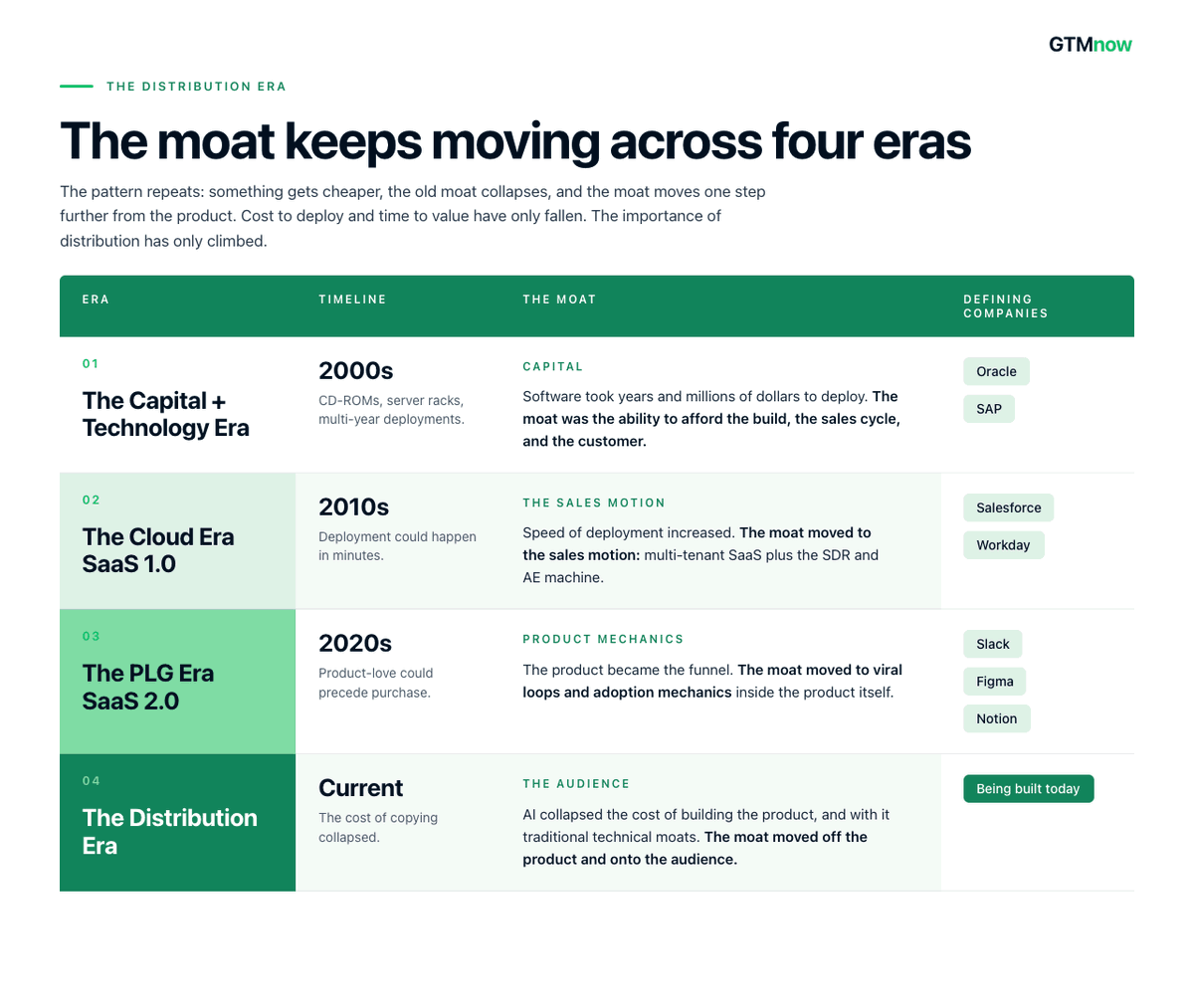
In the Capital + Technology Era, software was a physical thing. Those were the CD-ROM and server rack days, when deployments took 12-24 months and costs were high. The moat was capital itself: only the companies that could afford the multi-year build, sell, and deploy ever got into the customer's hands.
In the Cloud Era / SaaS 1.0., software no longer required millions of dollars upfront and a multi-year deployment to get started. Instead, same-day cloud-based deployment meant companies could sign up online and start using it that day. The moat moved from capital to building product and the sales motion: multi-tenant SaaS, the SDR/AE machine, and the partner ecosystem. Even with deployment costs collapsing, building software stayed exceedingly expensive. The sheer number of engineers required to ship and scale a market-ready product meant SaaS 1.0 winners needed serious capital to build what their GTM machine was selling.
In the PLG Era / SaaS 2.0., the product became the funnel, the onboarding became frictionless, and product love could precede the eventual purchase. Slack reached a $1B valuation before hiring a sales rep. Figma followed the same playbook. The moat moved from sales to product mechanics: viral loops, collaboration-driven adoption, and evangelists. During this same period, software engineers became more productive and efficient, but it still took meaningful time and capital to build an enterprise-ready product.
Now, we’re in the Distribution Era. AI collapsed the cost of building software to near zero. More importantly, it collapsed the cost of copying it. A category leader that once had months to ship a moat-defining feature now has days before a fast-following AI-native team matches it. Product loops still work, but they no longer compound the way they did when no one could copy you. So the moat moved one final step, off the product and onto the audience.
Across all four, two core variables have only moved in one direction: cost to deploy goes down, and time to value goes down. Every era opened with a lower floor and less friction than the one before it. The moat had to move because the previous moat collapsed.
This is where we are now.
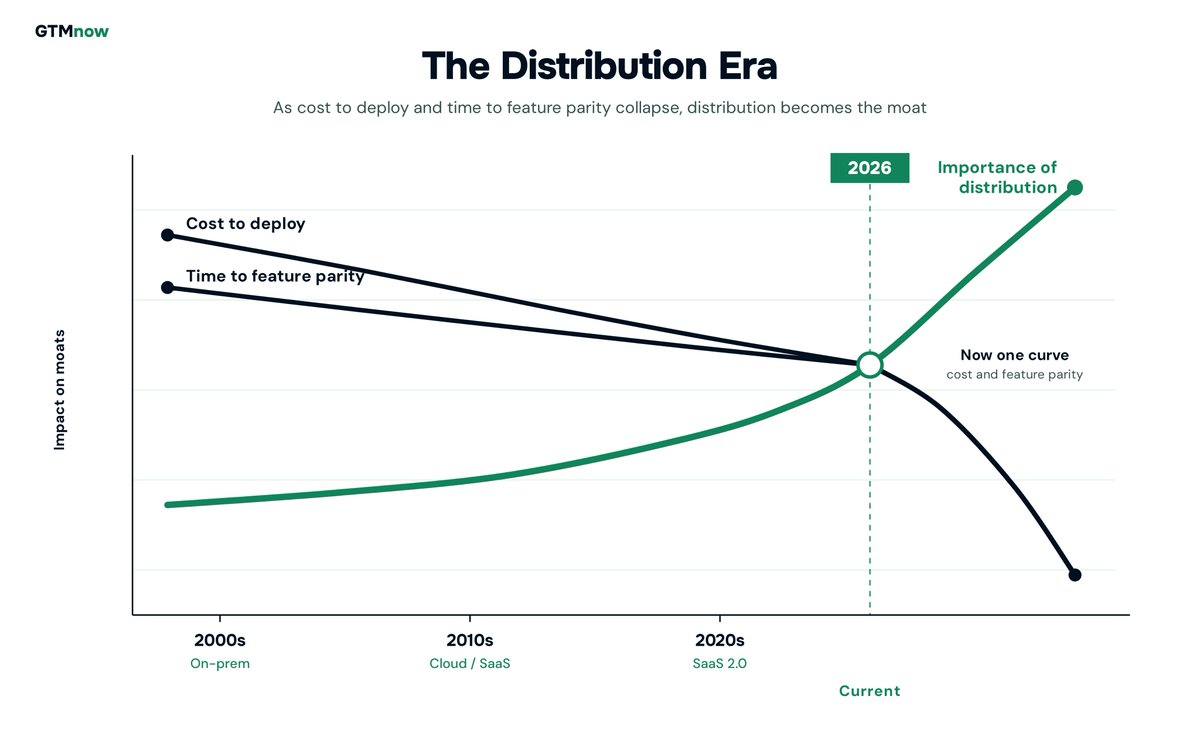
AI is the first wave that meaningfully eroded the cost of building the product itself.
Every other wave collapsed a cost adjacent to the product. None of them collapsed the cost of building the thing. Now, when you ask a CTO/CIO/CEO what percent of code is written by AI, the answer is usually “almost 100%.”
The moat of today is distribution. The pattern is the same across every Distribution Era winner we’ve seen so far: become the default brand in the category before anyone else can. Build the audience, earn the trust, and ship the product into a market that already believes in you.
## Distribution beat product before AI existed
Distribution beating product isn't a new phenomenon. It's been hiding in the case studies of some of the best companies of the last thirty years. Let's take a look at a few examples.
Salesforce vs. Siebel (1999–2005). Siebel had the better CRM, the deeper enterprise relationships, and the bigger sales engine. Salesforce had a thinner product and a strange pitch: No Software. Marc Benioff sent actors in red T-shirts to protest outside Siebel's user conference chanting "death to software," drawing police, crowds, and free coverage in Fortune and the Wall Street Journal. The pricing was key. Siebel required a five-million-dollar minimum to start a conversation, Salesforce sold seats for fifty dollars a month. By 2005, Siebel sold to Oracle for $5.85 billion. Salesforce is worth more than $280 billion today, roughly 50 times Siebel's exit.
HubSpot vs. Marketo (2006–2015). Founded the same year. Marketo had the more sophisticated automation product. HubSpot had a book that named a category. They spent half their marketing energy not on HubSpot but on the inbound movement itself: the conference, the certifications, the free CRM, the blog that came to own every meaningful search term in B2B marketing. By the mid-2010s, "inbound" was synonymous with HubSpot (which they recently re-branded to “unbound”). Marketo, despite the better product, was the specialist tool the experts already knew about.
Notion vs. Evernote (2016–2024). Evernote had a ten-year head start and more than 200 million users. Notion had better architecture and a community. Their ambassador program began with a landing page asking power users to work more closely with the team – 400 applications came in for twenty spots. Ambassadors made templates, recorded YouTube tutorials, answered questions on r/Notion at 3am. Today, Notion has more than 20 million users, over a million community members, and roughly 95% organic traffic.
This story isn’t necessarily new. What is new in the Distribution Era is that this is no longer the exceptional path, it's the only durable one. To be clear, none of this means product doesn't matter – quite the opposite. The product still has to be exceptional. The order simply changed, not the requirement.
## Distribution matters from Day 0
A common misconception is that product-market fit comes before go-to-market, but go-to-market is actually how you get product-market fit. It’s also how you maintain it.
Founders have been told the same sequence for two decades: build the product, find PMF, then figure out GTM. That has changed. It's no longer how you build and scale.
If the product can be copied at today's pace of development and pricing is no longer gated by customer headcount, the durable advantage has to live somewhere that can't be copied or capped. That's the audience and the distribution you build to reach that audience.
Cursor became the fastest B2B company to a billion dollars in ARR with a loyal community of developers who couldn't stop talking about the product - see their GTM deconstructed here. Harvey became the default brand for legal AI by establishing itself across more than half of the AmLaw 100 before its product could do everything a buyer wanted, then backfilling the product behind the brand. Anything, Lovable, Replit, Bolt – same playbook in vibe coding.
Your go-to-market is what builds your moat and what dictates your growth trajectory.
## What this era looks like
The next era of software will be won by the companies that built distribution first. Markets are being won earlier and more convincingly than ever. First-to-scale principles have never been more important in company building than in the AI era, and the gap between first movers and everyone else will only widen from here.
AI keeps opening new planes of possibility, and the winners get crowned earlier than ever. When markets are moving this fast, that early brand recognition compounds more than ever. For example, Harvey and Legora both surged to default-brand status in the legal space, Lovable and Replit are racing to own vibe coding, and OpenEvidence locked in clinical decision support before most of the market knew the category existed. These are leading examples. The next decade will produce dozens more of them, and even more in emerging categories.
We've never seen speed to early revenue like this, and we've never seen the scale like this either. a16z recently shared benchmarks around how the median enterprise AI startup hits $2.1M ARR by month 12 and raises a Series A at 9 months post-revenue. The top quartile hits $5.3M ARR in their first year. What was best-in-class for SaaS startups a decade ago ($1M ARR at 12 months) now sits below the median for AI-native companies.
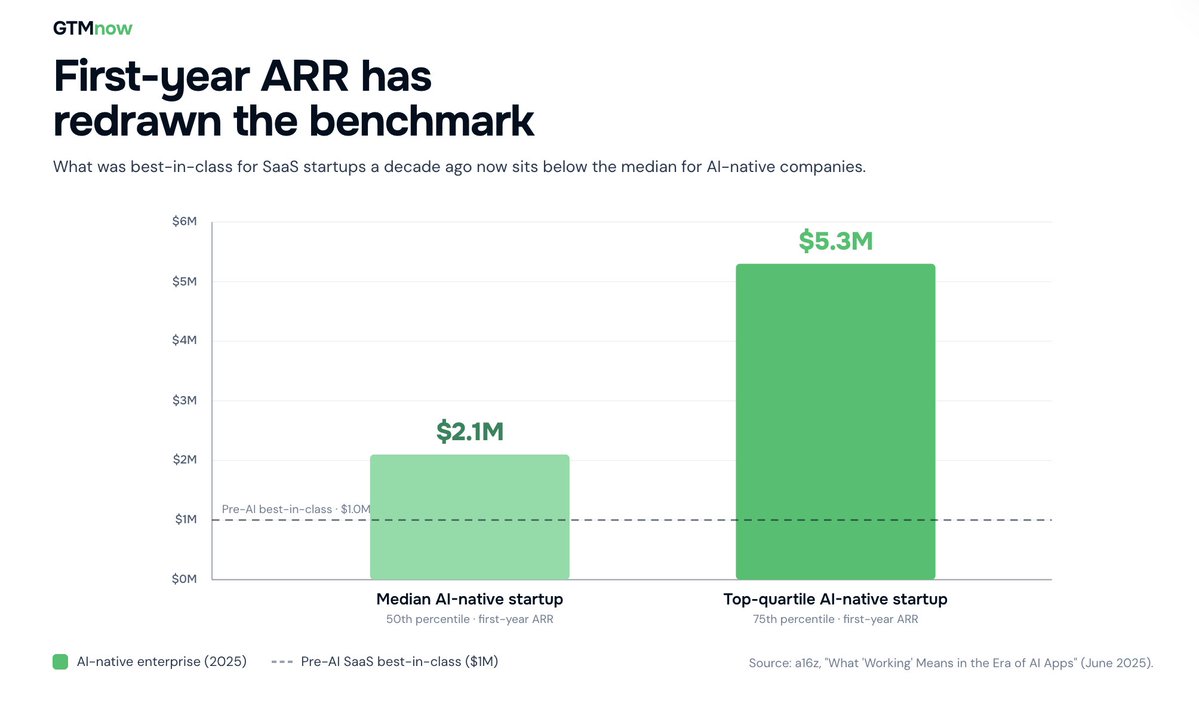
Companies are getting to revenue faster, scaling revenue faster, into a customer base that decides which brand to trust. The founders who win the next decade won't have the luxury of figuring out GTM at Series A. If you do, a competitor will have already locked in the audience your product was going to need. GTM foundations have to be in place at inception.
Founders are well aware of this. High Alpha's recent benchmarks found that GTM execution is the top challenge keeping founders up at night. It’s ranked ahead of product execution, fundraising, and even AI strategy itself. Founders already know that it's the Distribution Era, and it's up to the rest of us in the ecosystem to answer the bell.
Well, what if I build a world-class AI product? Won’t that sell itself? The market will tell you, "No, it’s not enough." Look at where Anthropic is hiring.
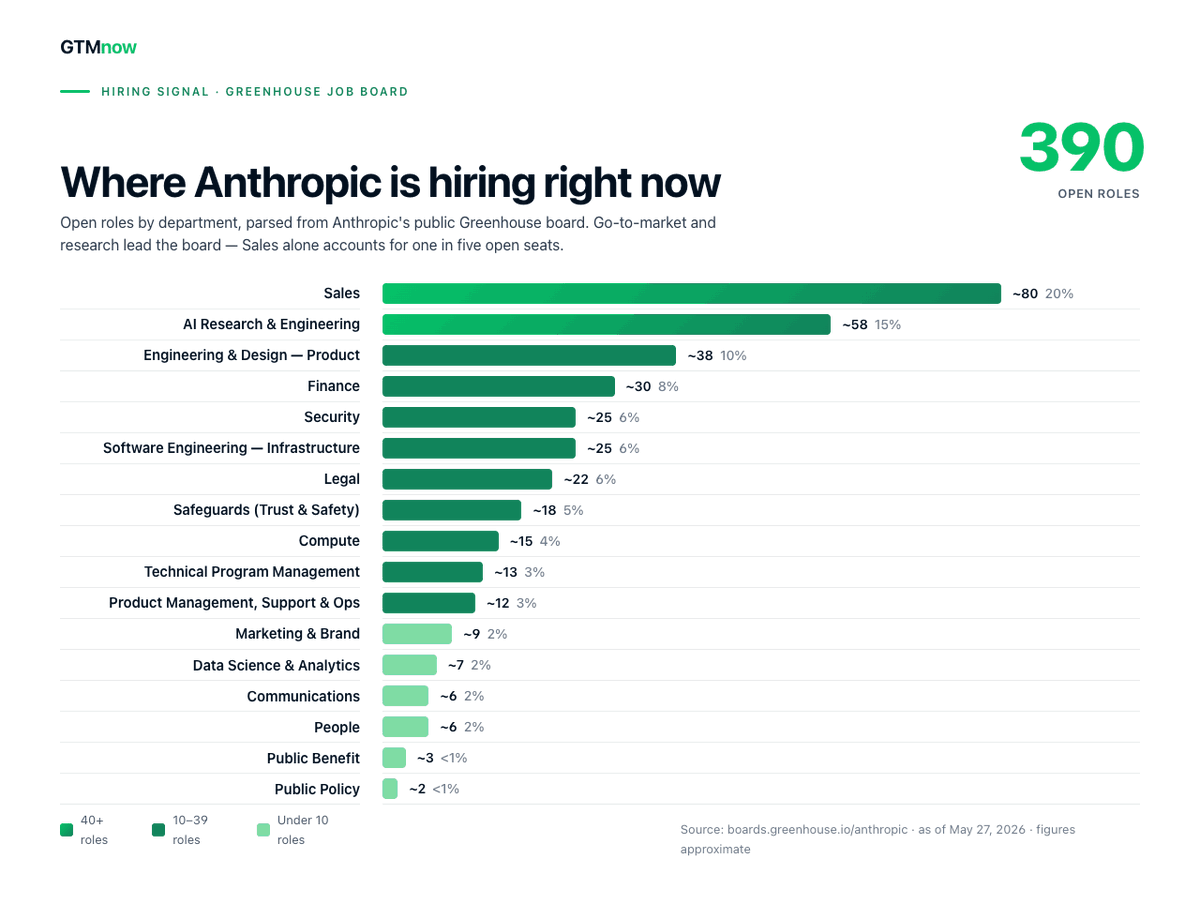
Sales is the single largest department on their job board. It’s bigger than AI research, bigger than product engineering, or any other function. The fastest-growing software company in history is concentrating its hiring around how to sell, not just how to build. The companies with the strongest product positions in the world are also the ones doubling down on GTM. The pattern Anthropic is setting is the one the next generation of category-defining companies will follow.
Pricing is undergoing a big evolution underneath all of this. Seat-based pricing was the right model for a world in which customers scaled by hiring more humans, which is no longer the world we live in. Seat-based pricing caps scale. In year one, a seat-based vendor and a consumption-based vendor look similar inside a customer of comparable size. By year three, the consumption-based vendor is operating without a ceiling that its seat-based peer can't escape. The pricing models that will win the next decade are consumption, outcomes, and credits. Distribution moves alongside pricing, and arguably ahead of it. Every customer action becomes both a billable event and a marketing event. The audience-first company isn't selling to its audience so much as monetizing the audience's behavior.
Finally, the alpha of early adoption has never been wider and will widen further before it narrows. Becoming AI-native in your own GTM today produces the widest disparity of performance we've ever seen between teams that adopt early and teams that don't. The aperture for what's possible in building a GTM engine will also continue to widen. The limiting factor is no longer the GTM technology stack you use, but your imagination and your team's operational execution. This phenomenon has always existed for early adopters of technology, but it's never been this acute. If you're not ahead of it, you're getting left behind faster than ever. The alpha of early adoption is the difference between making a category and being absorbed by one.
Welcome to the Distribution Era. We’re just getting started.
I wrote this piece with @PaulGTM . It’s the belief that we founded @gtmfund on, and it feels more important today than ever.
## 相关链接
- [Max Altschuler](https://x.com/HackItMax)
- [@HackItMax](https://x.com/HackItMax)
- [12K](https://x.com/HackItMax/status/2060370743683424498/analytics)
- [Figma followed the same playbook](https://www.youtube.com/watch?v=k3WniQkzlBE&t=697s)
- [see their GTM deconstructed here](https://gtmnow.com/deconstructing-cursors-growth-playbook-4m-to-2b-arr-in-18-months/)
- [benchmarks](https://a16z.com/revenue-benchmarks-ai-apps/)
- [benchmarks](https://www.highalpha.com/saas-benchmarks)
- [@PaulGTM](https://x.com/@PaulGTM)
- [@gtmfund](https://x.com/@gtmfund)
- [Upgrade to Premium](https://x.com/i/premium_sign_up)
- [10:40 PM · May 29, 2026](https://x.com/HackItMax/status/2060370743683424498)
- [12.7K Views](https://x.com/HackItMax/status/2060370743683424498/analytics)
- [View quotes](https://x.com/HackItMax/status/2060370743683424498/quotes)
---
*导出时间: 2026/5/30 10:39:02*
---
## 中文翻译
# 分销时代
**作者**: Max Altschuler
**日期**: 2026-05-29T14:40:39.000Z
**来源**: [https://x.com/HackItMax/status/2060370743683424498](https://x.com/HackItMax/status/2060370743683424498)
---

未来十年的标志性 B2B 软件公司将从第一天起构建分销体系。护城河已经转移,我们已进入了公司构建的“分销时代”。
B2B 软件与 AI 不断转移的护城河
企业软件的历史就是一部护城河演进的历史。每一个时代都以一种成本作为主要的约束条件开启——无论是资本、部署、分销,还是构建本身——而那个时代的赢家都能识别这种约束,并将其转化为自己的优势。他们深刻理解当时的限制因素以及如何解锁它。然后,一项新技术打破了约束性成本,护城河便向离产品更远的地方移动一步,新一轮的赢家随之涌现。
纵观这四个时代,有两个核心变量始终只朝一个方向发展:部署成本下降,实现价值的时间缩短。每一个时代的开启门槛都比前一个时代更低,摩擦力更小。护城河之所以移动,是因为之前的约束条件已经崩塌。

在 **资本+技术时代**,软件是实体物品。那是 CD-ROM 和服务器机架的时代,部署需要 12-24 个月,成本高昂。那时的护城河就是资本本身:只有那些负担得起多年构建、销售和部署周期的公司,才能将产品送到客户手中。
在 **云时代 / SaaS 1.0**,软件不再需要数百万美元的前期投入和多年的部署周期才能启动。取而代之的是,基于云的同日部署意味着公司可以在线注册并在当天开始使用。护城河从资本转移到了产品构建和销售动作上:多租户 SaaS、SDR(销售开发代表)/AE(客户经理)机器以及合作伙伴生态系统。尽管部署成本崩塌,但构建软件仍然极其昂贵。推出和扩展一个市场就绪的产品所需的庞大工程师数量,意味着 SaaS 1.0 的赢家需要雄厚的资本来构建其 GTM(上市)机器所销售的产品。
在 **PLG 时代 / SaaS 2.0**,产品本身成为了漏斗,入职引导变得无摩擦,对产品的喜爱可以先于购买产生。Slack 在雇佣一名销售代表之前就达到了 10 亿美元的估值。Figma 遵循了同样的剧本。护城河从销售转移到了产品机制:病毒式循环、协作驱动的采用以及布道者。在同一时期,软件工程师变得更高效,但构建一个企业级产品仍然需要大量的时间和资本。
现在,我们进入了 **分销时代**。AI 将构建软件的成本降至接近于零。更重要的是,它将复制的成本也降到了接近于零。曾经拥有数月时间来推出一个定义护城河功能的品类领导者,现在只有几天时间,因为一个快速跟进的 AI 原生团队就会复制它。产品循环仍然有效,但它们不再像过去那样无法被复制时产生复利效应。因此,护城河迈出了最后一步,从产品本身转移到了受众身上。
纵观这四个时代,有两个核心变量始终只朝一个方向发展:部署成本下降,实现价值的时间缩短。每一个时代的开启门槛都比前一个时代更低,摩擦力更小。护城河之所以必须移动,是因为之前的护城河已经崩塌。
这就是我们现在的处境。

AI 是第一波显著侵蚀产品构建成本的浪潮。
其他所有浪潮都只是降低了产品周边的成本。没有任何一波浪潮降低了构建产品本身的成本。现在,当你问 CTO/CIO/CEO 有多少比例的代码是由 AI 编写的,答案通常是“几乎 100%”。
今天的护城河是分销。我们在迄今为止看到的每一位“分销时代”赢家身上都能看到同样的模式:在其他任何人之前成为该品类的默认品牌。建立受众,赢得信任,然后将产品推向一个已经信任你的市场。
## 在 AI 存在之前,分销就曾战胜过产品
分销战胜产品并非新现象。它一直隐藏在过去三十年一些最优秀公司的案例研究中。让我们看几个例子。
**Salesforce vs. Siebel (1999–2005)**。Siebel 拥有更好的 CRM、更深厚的企业关系和更强大的销售引擎。Salesforce 的产品更单薄,但有一个奇怪的口号:No Software(终结软件)。Marc Benioff 派遣身穿红色 T 恤的演员在 Siebel 的用户会议外抗议,高喊“软件去死”,引来了警察、人群以及《财富》和《华尔街日报》的免费报道。定价是关键。Siebel 需要 500 万美元的最低门槛才能开始洽谈,Sales则以每月 50 美元的价格出售席位。到 2005 年,Siebel 以 58.5 亿美元出售给 Oracle。Salesforce 如今的市值超过 2800 亿美元,大约是 Siebel 退出估值的 50 倍。
**HubSpot vs. Marketo (2006–2015)**。同年成立。Marketo 拥有更复杂的自动化产品。HubSpot 有一本定义了品类的书。他们将一半的营销精力不是花在 HubSpot 本身,而是花在“入站营销”运动本身上:大会、认证、免费 CRM、以及最终占据了 B2B 营销中每一个重要搜索词的博客。到 2010 年代中期,“入站”成了 HubSpot 的代名词(他们最近将其重新品牌为“unbound”)。尽管产品更好,Marketo 却成了专家们早已知晓的专业工具。
**Notion vs. Evernote (2016–2024)**。Evernote 领先十年,拥有超过 2 亿用户。Notion 拥有更好的架构和一个社区。他们的大使计划始于一个落地页,请求高级用户与团队更紧密地合作——收到了 400 份申请,争夺 20 个名额。大使们制作模板,录制 YouTube 教程,在凌晨 3 点回答 r/Notion 上的问题。今天,Notion 拥有超过 2000 万用户,超过 100 万社区成员,以及大约 95% 的自然流量。
这个故事未必是新的。“分销时代”的新意在于,这不再是例外路径,而是唯一的持久路径。需要明确的是,这并不代表产品不重要——恰恰相反。产品仍然必须卓越。改变的只是顺序,而非要求。
## 分销从第 0 天起就很重要
一个普遍的误解是,产品市场契合(PMF)先于上市策略(GTM),但实际上,上市策略正是你实现 PMF 的方式。也是你维持 PMF 的方式。
二十年来,创始人们被灌输同样的顺序:先构建产品,寻找 PMF,然后再搞清楚 GTM。这已经改变了。这不再是当今构建和扩张的方式。
如果产品可以按今天的开发速度被复制,且定价不再受限于客户人数,那么持久优势必须存在于一个无法被复制或封顶的地方。那就是受众,以及你为触达该受众而建立的分销渠道。
Cursor 凭借一群对产品赞不绝口的忠实开发者社区,成为了历史上最快达到 10 亿美元 ARR 的 B2B 公司——在此查看他们的 GTM 解构。Harvey 通过在产品能满足买家所有需求之前,就率先占据 AmLaw 100(美国百强律所)中超过半数的份额,确立了法律 AI 的默认品牌地位,然后在品牌背后反补产品功能。Anything、Lovable、Replit、Bolt——在“氛围式编程”领域都是同样的剧本。
你的上市策略就是构建护城河的工具,也是决定你增长轨迹的关键。
## 这个时代是什么样的
软件的下一个时代将由那些率先构建分销的公司赢得。市场正在比以往任何时候都更早、更具说服力地被拿下。在 AI 时代,“先发规模”原则在公司构建中从未如此重要,先行者与其他人之间的差距只会从这里继续扩大。
AI 不断开启新的可能性维度,赢家被加冕的时间前所未有地早。当市场移动得如此之快时,早期的品牌认知会产生前所未有的复利效应。例如,Harvey 和 Legora 都在法律领域跃升为默认品牌,Lovable 和 Replit 正在竞相占据“氛围式编程”领域,OpenEvidence 在市场上大多数人都知道该品类存在之前,就锁定了临床决策支持领域。这些是领先的例子。下一个十年将产生几十个这样的例子,而在新兴品类中甚至更多。
我们从未见过如此快的早期营收速度,也从未见过这样的规模。a16z 最近分享了基准数据,典型的人工智能初创公司在第 12 个月达到 210 万美元 ARR,并在产生营收 9 个月后进行 A 轮融资。前四分之一的公司在第一年就达到了 530 万美元 ARR。十年前对 SaaS 初创公司来说属于顶尖水平的数据(12 个月 100 万美元 ARR),现在甚至低于 AI 原生公司的中位数。

公司更快地实现营收,更快地扩大营收规模,面向的是一个决定信任哪个品牌的客户群体。赢得下一个十年的创始人将没有奢侈的时间在 A 轮融资时才去搞清楚 GTM。如果你这样做,竞争对手已经锁定了你的产品本来需要的受众。GTM 基础必须在创立之初就到位。
创始人们很清楚这一点。High Alpha 最近的基准研究发现,GTM 执行是让创始人夜不能寐的首要挑战。其排名高于产品执行、融资,甚至 AI 战略本身。创始人已经知道现在是“分销时代”,而生态系统中我们其他人需要对此做出响应。
那么,如果我构建了一个世界级的 AI 产品呢?它难道不会自己卖出去吗?市场会告诉你:“不,这还不够。”看看 Anthropic 在哪里招聘。

销售是其招聘板上最大的部门。它比 AI 研究部门、产品工程部门或任何其他职能部门都要大。这家历史上增长最快的软件公司正在围绕如何销售而不仅仅是如何构建来集中招聘。世界上产品定位最强的公司也是那些加倍投入 GTM 的公司。Anthropic 正在确立的模式,将是下一代定义品类的公司所遵循的模式。
在这一切之下,定价模式正在经历巨大的演变。基于席位的定价适合于客户通过雇佣更多人来扩展的世界,而那已不再是我们要生活在其中的世界。基于席位的定价限制了规模的上限。第一年,在一个规模相当的客户眼中,基于席位的供应商和基于用量的供应商看起来很相似。但到了第三年,基于用量的供应商在没有天花板的情况下运营,而其基于席位的同行却无法逃脱。赢得下一个十年的定价模式是基于用量、基于成果和基于积分的。分销与定价并行移动,甚至可能领先于定价。客户的每一个行为都既是计费事件,也是营销事件。受众优先的公司与其说是向受众销售,不如说是将受众的行为变现。
最后,早期采用者的 Alpha(超额收益)从未如此宽泛,并且在收窄之前还会进一步扩大。今天在你的 GTM 中成为 AI 原生,会产生我们从未见过的巨大性能差距,存在于早期采用者和非早期采用者团队之间。构建 GTM 引擎的可能性 aperture(范围)也将继续扩大。限制因素不再是你使用的 GTM 技术栈,而是你的想象力和团队的运营执行力。这种现象对于技术的早期采用者来说一直存在,但从未如此尖锐。如果你不领先于它,你会比以往任何时候都更快地被抛在后面。早期采用的 Alpha 是创造一个品类与被一个品类吞并之间的区别。
欢迎来到分销时代。我们才刚刚开始。
这篇文章是我与 @PaulGTM 合写的。这是我们创立 @gtmfund 的信念,而且这一信念在今天显得比以往任何时候都重要。
## 相关链接
- [Max Altschuler](https://x.com/HackItMax)
- [@HackItMax](https://x.com/HackItMax)
- [12K](https://x.com/HackItMax/status/2060370743683424498/analytics)
- [Figma followed the same playbook](https://www.youtube.com/watch?v=k3WniQkzlBE&t=697s)
- [see their GTM deconstructed here](https://gtmnow.com/deconstructing-cursors-growth-playbook-4m-to-2b-arr-in-18-months/)
- [benchmarks](https://a16z.com/revenue-benchmarks-ai-apps/)
- [benchmarks](https://www.highalpha.com/saas-benchmarks)
- [@PaulGTM](https://x.com/@PaulGTM)
- [@gtmfund](https://x.com/@gtmfund)
- [Upgrade to Premium](https://x.com/i/premium_sign_up)
- [10:40 PM · May 29, 2026](https://x.com/HackItMax/status/2060370743683424498)
- [12.7K Views](https://x.com/HackItMax/status/2060370743683424498/analytics)
- [View quotes](https://x.com/HackItMax/status/2060370743683424498/quotes)
---
*导出时间: 2026/5/30 10:39:02*