# Everyone is talking about Cal AI's delisting. The real story is worse.
**作者**: Lucas Patiri
**日期**: 2026-04-16T16:32:24.000Z
**来源**: [https://x.com/lucaspatiri_/status/2044816187377242223](https://x.com/lucaspatiri_/status/2044816187377242223)
---
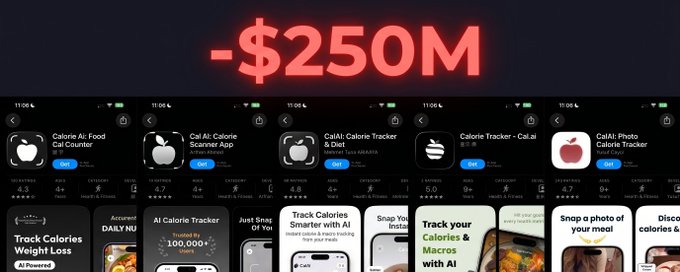
Yesterday Apple pulled Cal AI from the App Store. $50M ARR company, acquired by MyFitnessPal last month (btw for at least 200-250M I guess). Gone overnight because they used in-app payment sheets to bypass IAP.
The response Ive seen all day is split between two takes:
- "Apple is evil, this is anti-competitive"
- "Never bypass IAP, use Apple's 30%, end of story"

Both miss it
The truth is that the workaround Cal AI was using solved a problem apps actually have. That problem didnt go away when Apple pulled them. And there's a completely legal playbook that does everything payment sheets did, without the platform risk.
That playbook is web-to-app funnels. But the reason to run one isn't what most people think. The fee savings are smaller than you'd expect. Its the attribution, the retention flows, the cash flow. Things iOS never lets you touch.
Here's what web-to-app funnels actually are, why they work, and 12 tips to build one.
What a web-to-app funnel actually is.
A web-to-app funnel is a full acquisition and monetization flow that happens on the web, before the user ever opens your app.
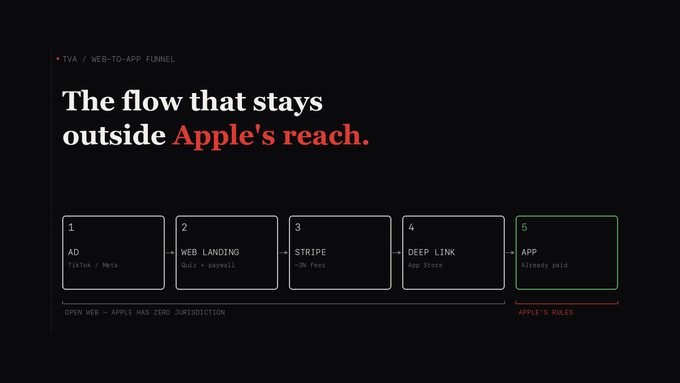
The flow:
1. User sees an ad on TikTok, Meta, or YouTube
2. Ad clicks through to a web landing page, not the App Store
3. On the web the user goes through your onboarding (quiz, personalization, before-after, etc.)
4. At the end they hit a paywall, on the web
5. They pay with Stripe. Apple Pay still works. Card still works
6. After payment they get a deep link to the App Store and an email with login credentials
7. They download the app and open it as a paying user
Revenue never touches Apple. The 30% stays in your pocket. Stripe fees are around 3%.
Why Apple doesnt touch this.
The reason payment sheets got Cal AI killed is that the purchase happened inside the iOS app.
If your user pays on your website before downloading, that revenue is legally outside Apple's control. This is why web-to-app funnels are not a grey area. They are completely clear.
The part nobody wants to hear: the economics are closer than you think. If you're expecting a 27% ARPU lift just from switching to Stripe, you won't get it. Based on multiple studies, the conversion drop almost exactly cancels the fee savings. So why run a web funnel at all? Two reasons that have nothing to do with the 30%.
Attribution. iOS 14.5 broke mobile attribution in 2021 and it hasn't recovered. Web gives you the clean pixel data you need to actually scale paid media.
Retention control. Apple won't let you survey cancellers, offer retention discounts, or run save flows. Stripe lets you save up to 30% of churn.
Cash flow. Apple pays you monthly, with a 30 to 45 day holding window after each purchase. Stripe pays you daily, usually within 2 business days. For apps scaling on paid media this is key
Thats the real LTV lift, not the fee math. Thomas Petit, one of the sharpest app growth consultants out there, puts it clean: "People are going to web-to-app for the wrong reasons." The fees are not the game changer, the control of the customer relationship is.
> Now the 12 tips.
## Tip 1: The paywall belongs on the web, not in the app.
Most apps still put the paywall inside the app. That's a leftover habit from when all paid conversion had to happen inside iOS. It's no longer true.
If your best-performing paywall lives inside the app, clone it to the web and test it as the endpoint of a web-to-app funnel. You'll see conversion shifts immediately.
## Tip 2: Treat the web as the front of your funnel, the app as the product.
The shift is mental. The web is no longer a "marketing site". It's the acquisition AND monetization layer. The app is where the value gets delivered, not where payment happens.
Apps that internalize this shift build separate funnels for web and for App Store traffic. App Store traffic gets the IAP paywall. Web traffic gets the web paywall. Each is optimized for its own economics.
## Tip 3: Your onboarding quiz is the actual paywall.
Cal AI had 30 onboarding screens before a single payment prompt. That flow was not "onboarding", it was conversion infrastructure.
By the time they hit the paywall, they'd invested enough effort that paying felt like finishing the process, not starting a new one.
This works 10x better on the web because you can A/B test every screen on the fly. In the App Store, testing onboarding requires a full app update cycle.
## Tip 4: Collect the email before the paywall, not after.
On the web, ask for email at screen 2 or 3 of the quiz, not at the paywall. Reason: you want a retargeting list of everyone who started the quiz but didnt finish.
Abandoned-quiz email flows recover 10 to 20% of users who bounce. That recovery is impossible with in-app onboarding.
## Tip 5: Test paywall price by country.
On IAP you're locked into Apple's pricing tiers and can only adjust via App Store Connect. On the web you can geo-target prices dynamically and test incremental lift.
Typical wins:
- +15 to 30% price in English-speaking countries (US, UK, AU, CA)
- -30 to 50% price in LATAM and SEA
## Tip 7: The deep link after payment matters more than the paywall.
After payment you need a bulletproof flow to get the user into the app as an already-paid subscriber:
1. Redirect to a thank-you page with a "Get the app" button
2. Button deep-links to your App Store listing
3. Also email them a login magic link
4. First time they open the app, the app checks the web-authed session and unlocks premium
If this flow breaks you lose the customer after they paid. Every payment step must have a fallback (SMS, email, clipboard copy of a code, etc.).
## Tip 8: Attribution is cleaner on the web, use it.
On the web you have cookies, UTMs, pixel events, and full funnel visibility. You can see exactly which ad, creative, and campaign drove each paying subscriber.
This is the single biggest reason creators and performance teams push for web funnels. You can actually measure what's working.
## Tip 9: Run the comparison math explicitly.
For any campaign you run, calculate real CAC / LTV in both flows.
App Store traffic:
- CPI (cost per install)
- Install to subscriber conversion
- IAP revenue (minus Apple's 30%)
- LTV
Web funnel traffic:
- CPC (cost per click)
- Click to subscriber conversion
- Stripe revenue (minus 3%)
- LTV
## Tip 10: Dont migrate, duplicate.
Apps that try to "migrate" from IAP to web funnels usually break their App Store paying base in the process.
The correct move is to run both in parallel. IAP stays intact for App Store organic and ASO traffic. Web funnel becomes the endpoint for all paid media (TikTok, Meta, YouTube). The two co-exist.
Once the web funnel is proven, you can push harder on paid media because unit economics are better. Organic and ASO keep their own lifecycle.
## Tip 11: Your landing page needs to convert like a paywall, not a marketing site.
The biggest mistake in web-to-app funnels is treating the landing page like a product marketing site. "Features, testimonials, FAQ, pricing tiers".
It should look like your best-performing paywall, repurposed. Same hero message, same before-after, same social proof, same urgency. The landing page IS the top of the paywall. Treat it that way.
## Tip 12: Build the web version of your core product, even if it's lite.
This is the unlock nobody talks about. If your app has a web version of the core feature (even a stripped-down one), conversion jumps dramatically.
Why: the user can try the product before committing. They convert on the web, try it for 5 minutes, love it, then download the full app. You've reduced the trial-to-paid friction by eliminating the "install before I know if this is good" barrier.
## Tip 13: The $1M revenue threshold changes the math completely.
Apple's Small Business Program charges 15% instead of 30% for apps under $1M in annual revenue. If that's you, the math flips.
For apps under $1M, web funnels lose money on a per-user basis. Not break even. Lose money.
The web funnel play starts making sense when you cross $1M and Apple's cut jumps to 30%. Before that threshold, IAP plus a great paywall will beat a web funnel every time, even in net terms.
> The correct read for most early-stage apps: stay on IAP, obsess over paywall conversion, build web-to-app infrastructure in parallel, flip the switch when revenue crosses the threshold.
The bigger frame.
Cal AI didn't die because they were greedy or because Apple got mean. Cal AI got down because they picked the wrong vehicle for the right destination.
The destination was: keep more of the revenue from your paying users. That destination is correct. Every mobile founder should care about it.
This was always going to be shut down and it'll get worse the next months. It just took Apple 18 months.
The right vehicle has been available the whole time. Its web-to-app funnels. Not because you keep the 30%, that gain is smaller than the hype suggests. Because you keep the customer. Attribution fires cleanly. Retention flows are in your hands.
Stripe payment sheets were a shortcut to capture the same economics web funnels have given apps for years.
If your app is still running the entire monetization flow inside iOS in 2026, you're not protecting yourself from platform risk. You're volunteering to pay a 30% tax that your competitors have already opted out of. Legally.
Cal AI's mistake was not that they tried to escape the 30%. Their mistake was that they tried to escape it from inside iOS.
> The exit door has always been on the web.
## 相关链接
- [Lucas Patiri](https://x.com/lucaspatiri_)
- [@lucaspatiri_](https://x.com/lucaspatiri_)
- [120K](https://x.com/lucaspatiri_/status/2044816187377242223/analytics)
- [Upgrade to Premium](https://x.com/i/premium_sign_up)
- [12:32 AM · Apr 17, 2026](https://x.com/lucaspatiri_/status/2044816187377242223)
- [120.3K Views](https://x.com/lucaspatiri_/status/2044816187377242223/analytics)
- [View quotes](https://x.com/lucaspatiri_/status/2044816187377242223/quotes)
---
*导出时间: 2026/4/17 15:03:56*