# The problem with hypergrowth AI startups
**作者**: Zach Lloyd
**日期**: 2026-07-22T19:48:19.000Z
**来源**: [https://x.com/zachlloydtweets/status/2080017115138994207](https://x.com/zachlloydtweets/status/2080017115138994207)
---
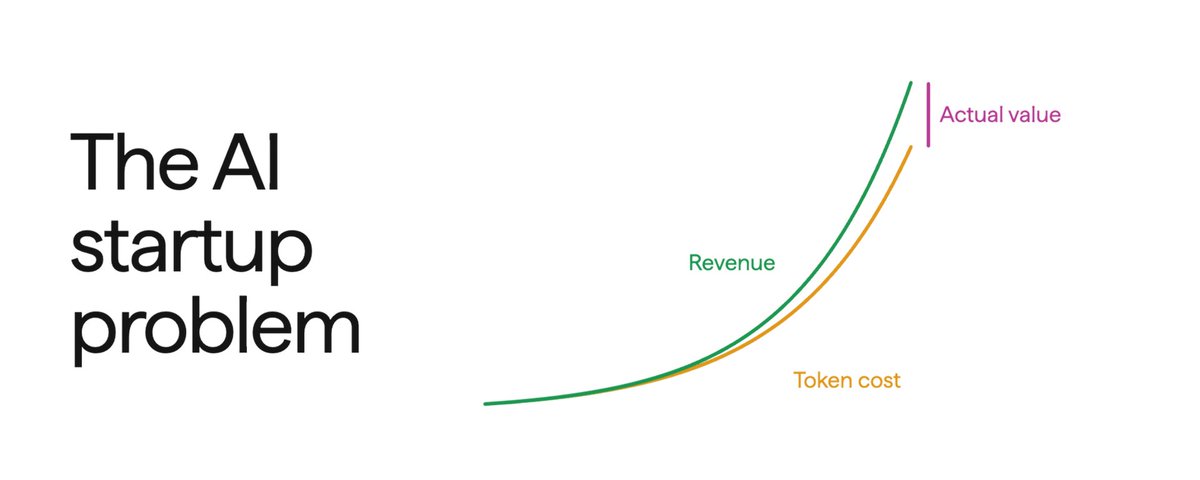
Startups that have had explosive AI-driven revenue growth might be in trouble. This is a consequence of the exact same open-weight model and AI sovereignty dynamics that are driving hype and discussion across twitter right now.
For context, the past couple of years have seen record rates of revenue growth for early stage AI startups. It has become a regular occurrence to hear of companies going 0 → $100M ARR in 12 months or less.
The reason this is happening is because applying intelligence is very useful (duh). Whether in the coding domain, legal, copywriting, etc. – it turns out that having intelligent tokens to bring to bear on a problem creates a ton of economic value. Thus you’ve seen companies like Cursor and Harvey and (remember?) Jasper explode in revenue. Almost every week you hear of a new “fastest ever to $100M ARR.”
But if you look under the hood at most of these companies, they are scaling their revenue by reselling inference at very low (and sometimes negative) margins. So, of the $100M revenue they have, they might be sending $90M to Anthropic, OpenAI, and perhaps some open weight model clouds, like Fireworks or Baseten. Hell, they might even be sending all of it.
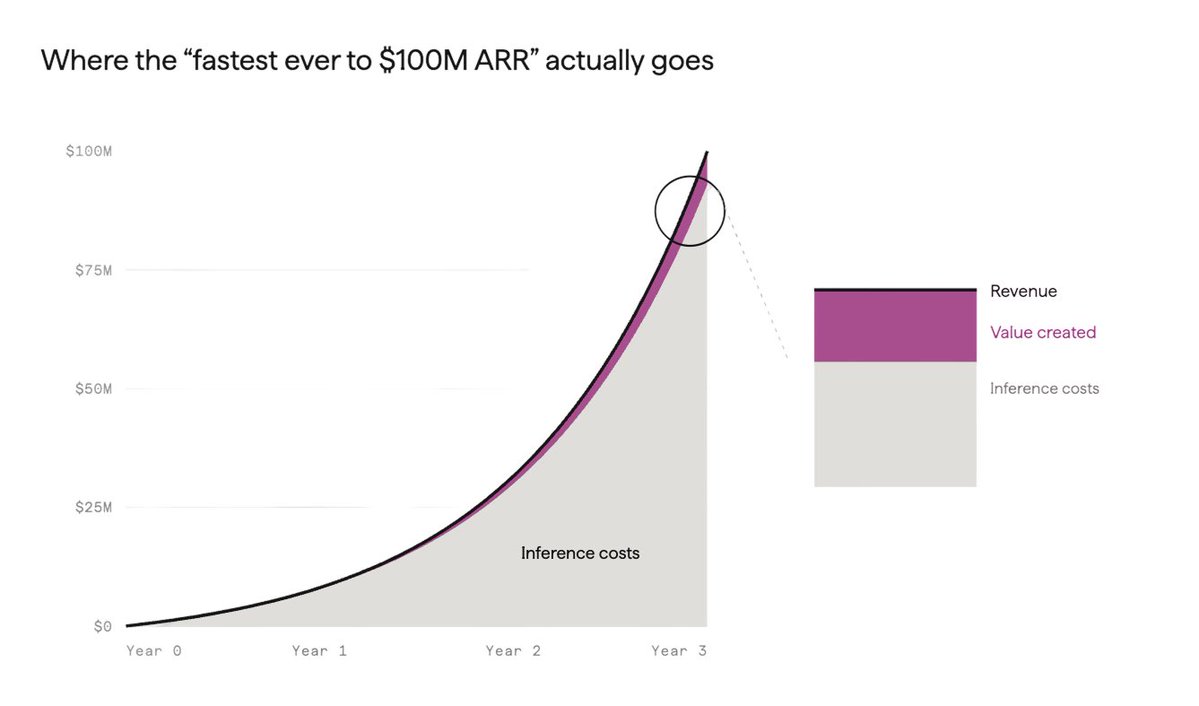
Understandably, VCs seem excited about this growth. It’s hard to get folks to pay you, so if you have a thing that they are paying you for, that’s concrete proof of product-market fit. Or, is it? If your revenue has no margin or negative margin, then the value of the product or service you are providing isn’t adding anything on top of the intelligence you are re-selling. In the worst case, you could find yourself in the dubious business of selling $2 for $1 – that’s an easy business to grow, but not a good business to be in.
This is all fairly obvious: If you want a better measure of the value these companies are creating, you should be looking at their net revenue, not their top-line, which is driven by passing through token costs. VCs should get this, but I think a lot of them have lost the plot.
The story these companies tell to VCs is that if they grow the top line enough now, they can figure out the margins later. They claim that open weight will be good for them because it will drive down token costs while they maintain their prices.
I think the opposite is true. As tokens at any given level of intelligence become commoditized, it’s going to be harder and harder to charge a high price for them. Your AI services are at risk from a competitor offering similar services but taking less margin. So long as the value of what you provide is mostly in a thin offering around the tokens, you are at competitive risk. You can build some moat around brand, scale, etc., but depending on your domain, the switching costs might be low enough that your business isn’t safe.
In addition to the commodification of tokens, there’s another trend that also makes it harder for startups to make money from inference reselling. Most enterprises Warp works with want the ability to bring their own inference (BYO). They prefer this because (1) they often have their own commits to burn down with model providers; (2) they want control of who uses what model and where data is sent, and (3) they may actually have their own fine-tuned models. They want AI sovereignty, and rightfully so.
If you are a startup founder or VC, ask yourself this question - if tomorrow all of your customers demanded to bring their own inference, how much would your platform actually be worth? What would your customers pay for it?
Both of these trends will put downward pressure on revenue growth across AI startups. This wouldn’t be a big deal if we were looking at net revenue for these companies. But since VCs are largely anchored on top-line revenue, it puts any company that scaled revenue by reselling expensive tokens in a very tricky position. If you raised capital at a high valuation off of that rev growth, then you need to maintain it. If your revenue growth is coming from the unique differentiated value of your product or platform, you’re fine. But if it’s largely coming because intelligence itself is valuable, that’s a problem.
In a normal market, the sensible thing to do as COGS drop is to maintain your margin and pass the savings on to your customers; and maybe even take a bit more profit yourself. You as a business don’t lose much by doing that. But if the story you have been telling is all about top line revenue growth, this becomes harder to do. It’s a very bad look for top line revenue growth to decelerate or drop. So if you got that $100M very quickly, and growth starts stalling because token prices drive down prices across the board, that’s a bad spot to be in from a fundraising and momentum standpoint.
I’m watching this closely in the coding space, in particular where many of Warp’s competitors claim to be in the cost-optimization business for their customers. I see our competitors touting model routing and other ROI maximization features that, if effective, would actually cut their top line revenue, because they are primarily token resellers. But I also know what metrics they raised their rounds on. If they move to a model where they are trying to reduce token costs for their customers, it’s going to mess up their growth story. I don’t know how they will navigate this.
At Warp we are increasingly moving out of the token reselling business to align our incentives better with our customers’. As I wrote in my guide to cloud software factories, anyone deploying a cloud software factory to optimize ROI should be looking for a vendor that is not primarily a token reseller. This rules out the model labs, but it also rules out a whole cohort of startups that need token reselling to maintain their growth trajectory for their next round.
At the end of the day, we may end up back in a world where startup growth looks a lot more like it did before AI: high margins, slower top-line growth for companies that really have sticking power. ThisAnd this might not be a bad thing.
## 相关链接
- [Zach Lloyd](https://x.com/zachlloydtweets)
- [@zachlloydtweets](https://x.com/zachlloydtweets)
- [16K](https://x.com/zachlloydtweets/status/2080017115138994207/analytics)
- [open-weight model](https://x.com/moneyacademyKE/status/2078870414067998874)
- [AI sovereignty dynamics](https://x.com/Jason/status/2077671142433632582)
- [guide to cloud software factories](https://www.warp.dev/blog/a-guide-to-cloud-software-factories-for-engineering-leaders)
- [Upgrade to Premium](https://x.com/i/premium_sign_up)
- [3:48 AM · Jul 23, 2026](https://x.com/zachlloydtweets/status/2080017115138994207)
- [16.8K Views](https://x.com/zachlloydtweets/status/2080017115138994207/analytics)
- [View quotes](https://x.com/zachlloydtweets/status/2080017115138994207/quotes)
---
*导出时间: 2026/7/23 12:12:47*
---
## 中文翻译
# 超高速增长的 AI 初创公司面临的危机
**作者**: Zach Lloyd
**日期**: 2026-07-22T19:48:19.000Z
**来源**: [https://x.com/zachlloydtweets/status/2080017115138994207](https://x.com/zachlloydtweets/status/2080017115138994207)
---

那些经历了由 AI 驱动的营收爆炸式增长的初创公司,可能正陷入困境。这正是目前推特上热议和讨论的同一股开放权重模型和 AI 主权动态趋势所带来的后果。
为了提供背景信息,过去几年,早期 AI 初创公司的营收增长率创下了历史新高。经常听到有公司在 12 个月甚至更短的时间内从 0 增长到 1 亿美元 ARR(年度经常性收入)。
发生这种情况的原因是,应用智能非常有用(废话)。无论是在编程领域、法律领域、文案写作领域等等,事实证明,拥有可用于解决问题的智能 Token 能创造巨大的经济价值。因此,你看到像 Cursor、Harvey 和(还记得吗?)Jasper 这样的公司营收爆发。几乎每周你都能听到一个新的“最快达到 1 亿美元 ARR”的故事。
但如果你深入观察这些公司的大多数,他们通过以极低(有时甚至是负值)的利润率转售推理服务来扩大营收。因此,在它们 1 亿美元的营收中,它们可能要向 Anthropic、OpenAI 以及一些开放权重模型云服务(如 Fireworks 或 Baseten)支付 9000 万美元。见鬼,它们甚至可能把所有营收都花在这上面了。

可以理解的是,风投人士似乎对这种增长感到兴奋。让人们愿意付费是很难的,所以如果你有他们愿意付费的东西,这就是产品市场契合度的有力证明。或者,真的是这样吗?如果你的营收没有利润甚至是负利润,那么你提供的产品或服务的价值并没有在你转售的智能之上增加任何东西。在最坏的情况下,你可能会发现自己处于一种以 1 美元的价格出售 2 美元的可疑业务中——这是一项容易增长的业务,但不是一项值得从事的好业务。
这一切都相当明显:如果你想更好地衡量这些公司创造的价值,你应该关注它们的净营收,而不是由转嫁 Token 成本所驱动的营收总额。风投应该明白这一点,但我认为他们中的许多人已经迷失了方向。
这些公司向风投讲述的故事是,如果现在把营收总额做得足够大,以后就可以解决利润率问题。他们声称开放权重对他们有利,因为这会降低 Token 成本,而他们可以维持价格。
我认为事实恰恰相反。随着特定智能水平的 Token 变得商品化,对它们高价收费将变得越来越困难。你的 AI 服务面临着竞争对手的风险,竞争对手可能提供类似的服务但只赚取更少的利润。只要你提供的价值主要是在 Token 之外的一层薄薄的服务,你就面临竞争风险。你可以在品牌、规模等方面建立一些护城河,但根据你的领域,切换成本可能足够低,以至于你的业务并不安全。
除了 Token 的商品化,还有另一个趋势也使得初创公司很难通过转售推理服务赚钱。与 Warp 合作的大多数企业都希望能够自带推理(BYO)。他们更喜欢这种方式,因为 (1) 他们通常有自己的与模型提供商的承诺额度需要消耗;(2) 他们希望控制谁使用什么模型以及数据发送到哪里;(3) 他们甚至可能拥有自己的微调模型。他们想要 AI 主权,这是理所当然的。
如果你是一名初创公司创始人或风投,问自己一个问题——如果明天你的所有客户都要求自带推理,你的平台实际上值多少钱?客户愿意为此支付多少?
这两种趋势都会给整个 AI 初创公司的营收增长带来下行压力。如果我们关注的是这些公司的净营收,这并不是什么大问题。但由于风投在很大程度上锚定于营收总额,这使得任何通过转售昂贵的 Token 来扩大营收的公司都处于非常尴尬的境地。如果你凭借这种营收增长以高估值筹集了资金,那么你就需要维持这种增长。如果你的营收增长来自你产品或平台的独特差异化价值,那你就没问题。但如果它在很大程度上是因为智能本身有价值,那就是个问题了。
在一个正常的市场中,随着销售成本(COGS)的下降,明智的做法是保持你的利润率,并将节省下来的成本让利给你的客户;甚至你自己也可以多留一点利润。作为企业,这样做你不会损失太多。但是,如果你一直讲述的故事全是关于营收总额的增长,那么这就很难做到。营收总额增长减速或下降是非常难看的。所以,如果你很快达到了 1 亿美元,而由于 Token 价格导致整体价格下降,增长开始停滞,从融资和势头的角度来看,这就是一个糟糕的境地。
我正在密切关注编程领域,特别是 Warp 的许多竞争对手声称自己在为客户进行成本优化的领域。我看到我们的竞争对手大肆宣传模型路由和其他最大化 ROI(投资回报率)的功能,如果这些功能有效,实际上会削减他们的营收总额,因为他们主要是 Token 转售商。但我也知道他们是凭借什么指标完成融资的。如果他们转向试图为客户降低 Token 成本的模型,这将打乱他们的增长故事。我不知道他们将如何驾驭这一点。
在 Warp,我们正越来越多地退出 Token 转售业务,以更好地将我们的激励与客户保持一致。正如我在云软件工厂指南中所写的那样,任何部署云软件工厂以优化 ROI 的人,都应该寻找一个主要不是 Token 转售商的供应商。这排除了模型实验室,但也排除了一大群需要通过转售 Token 来维持其下一轮融资增长轨迹的初创公司。
归根结底,我们最终可能会回到一个初创公司增长看起来很像 AI 之前时代的世界:高利润率,对于那些真正有粘性的公司来说,营收总额增长较慢。这可能并不是一件坏事。
## 相关链接
- [Zach Lloyd](https://x.com/zachlloydtweets)
- [@zachlloydtweets](https://x.com/zachlloydtweets)
- [16K](https://x.com/zachlloydtweets/status/2080017115138994207/analytics)
- [open-weight model](https://x.com/moneyacademyKE/status/2078870414067998874)
- [AI sovereignty dynamics](https://x.com/Jason/status/2077671142433632582)
- [guide to cloud software factories](https://www.warp.dev/blog/a-guide-to-cloud-software-factories-for-engineering-leaders)
- [Upgrade to Premium](https://x.com/i/premium_sign_up)
- [3:48 AM · Jul 23, 2026](https://x.com/zachlloydtweets/status/2080017115138994207)
- [16.8K Views](https://x.com/zachlloydtweets/status/2080017115138994207/analytics)
- [View quotes](https://x.com/zachlloydtweets/status/2080017115138994207/quotes)
---
*导出时间: 2026/7/23 12:12:47*