# Closing the Gap in Cancer Care
**作者**: Peter H. Diamandis, MD
**日期**: 2026-10-26T16:33:48.000Z
**来源**: [https://x.com/PeterDiamandis/status/2114757398984581628](https://x.com/PeterDiamandis/status/2114757398984581628)
---

TLDR: When a friend’s loved one gets a cancer diagnosis, the best treatment for their specific tumor may already exist. The hard part is finding it in time. Two companies I’ve gotten to know are closing that gap from opposite ends: an AI navigator that reads your entire medical record against the latest research, and a Swiss group taking genome sequencing to $100 while building “torpedo” molecules that deliver radiation straight to tumor cells.
Being in the longevity field, I regularly get emails from friends asking for advice for loved ones who have cancer. It crushes me not to have an answer. So when I came across two powerful options, I wanted to share them with the world.
Here’s my honest problem with those emails. Every cancer is different. The right answer for one person is wrong for the next, and I’m not that person’s oncologist. What I can do is point people toward tools and science that tilt the odds in their favor. That’s what this blog is about.
## THE GAP BETWEEN WHAT’S POSSIBLE AND WHAT PATIENTS GET
Cancer research is moving exponentially. Cancer care, for most people, is not.
According to CureWise, 1.3 million new papers were published in PubMed last year, more than 3,500 a day. No physician can keep up with that. So most patients are treated according to guidelines written years ago, based on the average patient in a clinical trial.
Steve Brown, the founder of CureWise, and a member of my Abundance community, put it to me bluntly when we spoke last week. He described being placed on a guideline-driven regimen built around drugs that were “30, 40, 50 years old.” Meanwhile, the science behind precision oncology had moved far ahead.
> “In cancer, 18 million people have 18 million different diseases.”
> -Steve Brown, CEO, CureWise
That line, from an interview Steve gave to WeWillCure, is the whole problem in a sentence. We lump unique diseases together and treat them with blunt instruments. The two companies below attack that problem from opposite ends: one helps you find the right treatment, and the other helps you find the cancer earlier and hit it more precisely.
## OPTION 1: CUREWISE, AN AI NAVIGATOR FOR YOUR CANCER
Steve Brown is a physicist and computer scientist (Stanford) who founded Health Hero Network two decades ago and helped invent remote patient monitoring. He holds more than 200 patents in health technology and AI.
In January 2025, the Palisades fire destroyed his home. He’s said since then that the fire saved his life.
For months before that, at age 60, he’d been losing weight, feeling drained and losing his appetite. He pushed for every test: scans, colonoscopy, endoscopy, cardiac workups. His cardiologist called it a fishing expedition and suggested stress. After the fire, displaced to Palm Desert, a bout of severe pain put him in an emergency room with doctors who had no preconceptions. Within days they found an aggressive blood cancer in his bone marrow.
Then Steve did what builders do. He built an AI medical agent and fed it the exact same data his earlier doctors had seen: his history, labs, imaging and notes. In his words, “Within moments it flagged what everyone had missed, and recommended specific tests no human had suggested.”
It got more interesting from there. When he analyzed the DNA of his cancer cells with his AI agents, he found genetic variants suggesting the standard treatment would likely work less well for him. The analysis pointed to an off-label drug combination with strong evidence for his tumor profile. It took persistence and several second opinions to convince his care team, and he describes the result as a rapid and sustained complete response.
CureWise is the tool he built so that nobody else has to code their own swarm of AI agents while fighting for their life. Here’s what it does today:
It unifies your records. It pulls your documents electronically from thousands of US health systems into one medical record. Steve told me this is the single biggest hurdle, because most patients’ data is scattered across institutions.
It runs a virtual tumor board. Hospitals use tumor boards, where specialists from different fields debate a complex case. CureWise uses multiple AI agents that think like different specialists, then looks for where their answers converge.
It matches you to trials and research. It reads your data against the latest research and clinical trials to surface options beyond standard care.
It prepares you for appointments. You walk in with tailored questions and a brief you can share with your doctor.
It costs $49 a month (or $439 a year) after a seven-day free trial. CureWise is clear that it doesn’t replace your doctor; it’s an education and advocacy tool, not medical advice. Dr. Kinsey McCormick, a breast medical oncologist at Swedish, wrote that she used it to support a patient through complex treatment decisions and found it “an exceptionally valuable resource.”
Steve’s next step is a monitoring layer that lets nurses and case managers oversee patients day to day. That’s how a tool like this moves from motivated individual patients into health systems. (Note for disclosure: while I’m a supporter of Curewise, I am not currently a shareholder).
## OPTION 2: SWISS ROCKETS, FROM $100 GENOMES TO “TORPEDO” MOLECULES
Dr. Vladimir Cmiljanovic grew up in Serbia and moved to Switzerland as a teenager. His grandmother died of leukemia. His mother, Mira, died of pancreatic cancer. When he was a child, he promised her he’d cure cancer.
He and his sister, also a medicinal chemist, have spent their careers on that promise. As a student in Basel, he walked into the office of Professor Mike Hall, who discovered the target of rapamycin, better known today as mTOR. That line of research fed into a collaboration with Novartis that helped lead to everolimus (Afinitor), approved for kidney cancer in 2009.
Vlad then spent seven years designing a single molecule that blocks both mTOR and its “twin brother” enzyme, PI3K, which together control a cancer cell’s growth and its sugar supply. He named it bimiralisib, after his mother, Mira. In a 46-patient Phase 2 trial for actinic keratosis (a common precancerous skin condition), a topical gel version cleared 71% of patients in the four-week group and 92% of the mildest lesions, with mostly mild skin reactions (EADV Congress, 2025).
The work I find most exciting is two other things Swiss Rockets is doing.
The first is radioligand therapy, which Vlad calls “torpedo” molecules. A molecule designed to find a protein that appears only on the surface of cancer cells is injected into the bloodstream. First, you attach a diagnostic isotope (gallium-68), so a PET scan lights up every tumor. Then you swap in a killing isotope and send the same molecule back to deliver radiation directly to those cells. Doctors call it theranostics: you treat what you see, and you see what you treat.
The first generation of this approach, using lutetium-177, is already FDA-approved for advanced prostate cancer. Vlad’s wife, Nadja, a nuclear pharmacist, has been a pioneer of the next-generation isotope, terbium-161, which also emits short-range Auger electrons that pack more destructive power into individual cancer cells. In the first human trial of terbium-161 (VIOLET, Peter MacCallum Cancer Centre, published in Lancet Oncology in 2025), 70% of 30 men with metastatic prostate cancer saw their PSA drop by at least half, with minimal severe side effects. Vlad says European regulators have now cleared Swiss Rockets to test it as a first-line therapy for high-risk prostate cancer, with a trial starting within weeks (company-reported).
> “We treat what we see, and we see what we treat.”
The second is cheap, routine genome sequencing. In February, Swiss Rockets signed a definitive agreement to acquire Complete Genomics, a pioneer of next-generation sequencing founded by Dr. Rade Drmanac. The deal has been approved by MGI’s shareholders and by Chinese regulators, with US approval expected this month.
Vlad says the combined company can sequence your complete genome and your complete transcriptome (which genes are active right now) for $100 each, and he’s aiming for $10 within two years. Your genome tells you what risks you inherited, and it only needs to be read once. Your transcriptome is the moving picture: a test you could repeat a couple of times a year to see whether a risky gene is switching on.
At the meeting I hosted, Vlad told the story of one of his investors whose genome revealed six high-risk genes, including BRCA2. A follow-up transcriptome showed prostate cancer pathways massively overexpressed. A standard ultrasound found nothing. A more sensitive micro-ultrasound found a small tumor, biopsy confirmed it, and it was treated while still tiny. It’s one person’s story, told by the company, but it shows the kind of detection they’re aiming for. Swiss Rockets is now taking early sign-ups for this testing through a program it calls Longevity Fingerprint.
(Note for disclosure: while I’m a supporter of SwissRockets, I am not currently a shareholder).
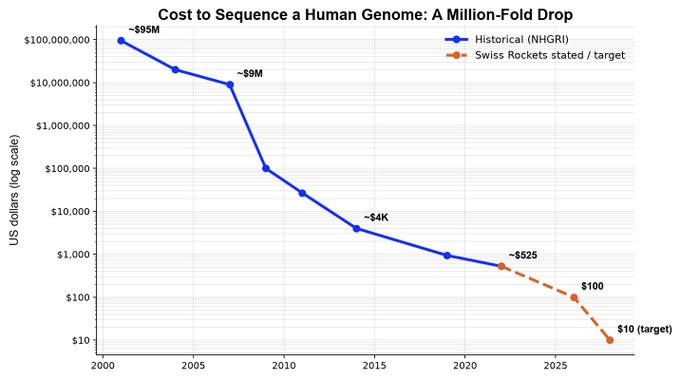
Approximate cost to sequence a human genome. 2001–2022: NHGRI. 2026 and 2028: Swiss Rockets’ stated price and targ
## WHY THIS MATTERS: A MILLION-FOLD DROP
In 2001, sequencing a single human genome cost roughly $100 million, according to the National Human Genome Research Institute. If Swiss Rockets delivers on $100, that’s a million-fold drop in 25 years. Moore’s Law, doubling every two years, delivers a few thousand-fold over the same 25 years. Biology lapped it by a factor of a hundred or more.
When something gets a million times cheaper, it stops being a luxury for the rich and becomes a routine test, like a cholesterol panel. That’s the arc we saw with computing, solar and long-distance calls, and it’s now happening in diagnostics.
Put these two companies side by side and you can see where cancer care is heading. Cheap, repeated molecular monitoring catches disease years earlier. Precision drugs and radioligands hit it where it lives. And AI navigators make sure the patient and their doctor know about all of it.
## WHAT I’D TELL A FRIEND TOMORROW
This is what I’ll say the next time one of those emails lands in my inbox. None of this is medical advice; it’s a list of questions worth asking your oncologist.
Get all of your records in one place. Every scan, pathology report and lab, from every institution.
Ask for genomic profiling of the tumor. Knowing the specific mutations driving a cancer can open up targeted drugs and clinical trials.
Ask about clinical trials, early. Not as a last resort after the standard options fail.
Get a second opinion at a major cancer center, especially for a rare or aggressive cancer.
Use AI to prepare. A tool like CureWise can help you show up with better questions.
For prostate cancer, ask about PSMA PET imaging and radioligand therapy.
Cancer has been with us throughout human history. For the first time, we can read the disease letter by letter, track it as it changes, and aim a therapy at the exact cells that need killing. The question I’m leaving you with is this: if a $100 test could tell you about a cancer years before any scan could see it, would you take it twice a year?
To a future of abundance,
Peter
Subscribe my weekly METATRENDS substack here.
## 相关链接
- [Peter H. Diamandis, MD](https://x.com/PeterDiamandis)
- [@PeterDiamandis](https://x.com/PeterDiamandis)
- [20K](https://x.com/PeterDiamandis/status/2114757398984581628/analytics)
- [CureWise](http://www.curewise.com/)
- [Subscribe my weekly METATRENDS substack here.](https://metatrends.substack.com/p/closing-the-gap-in-cancer-care?r=69w4l3&utm_campaign=post&utm_medium=web&showWelcomeOnShare=true)
- [Upgrade to Plus](https://x.com/i/premium_sign_up)
- [12:33 AM · Oct 27, 2026](https://x.com/PeterDiamandis/status/2114757398984581628)
- [20.9K Views](https://x.com/PeterDiamandis/status/2114757398984581628/analytics)
- [View quotes](https://x.com/PeterDiamandis/status/2114757398984581628/quotes)
---
*导出时间: 2026/10/28 18:48:54*
---
## 中文翻译
# 弥合癌症护理的差距
**作者**: Peter H. Diamandis, MD
**日期**: 2026-10-26T16:33:48.000Z
**来源**: [https://x.com/PeterDiamandis/status/2114757398984581628](https://x.com/PeterDiamandis/status/2114757398984581628)
**阅读**: 20971
**点赞**: 270
**转发**: 35
**回复**: 19
---

TLDR:当朋友的亲人被诊断出癌症时,针对其特定肿瘤的最佳治疗方法可能已经存在。难的是及时找到它。我所了解的两家公司正从两个相反的方向弥合这一差距:一个是AI导航工具,它将你的完整病历与最新研究进行比对;另一个是瑞士团队,将基因组测序降至100美元,同时研发能把辐射直接送达肿瘤细胞的“鱼雷”分子。
身处长寿领域,我经常收到朋友的邮件,请我为他们患癌的亲人提供建议。无法给出答案让我备受煎熬。所以当我发现两个强有力的选择时,我希望能与世界分享。
关于那些邮件,我真正的难处在于:每一种癌症都不同。对一个人正确的答案,对下一个人可能是错的,而我并不是那个人的肿瘤科医生。我能做的,是指引人们走向那些能提高胜算的工具和科学。这就是这篇博客要讲的内容。
## 可能性与患者实际所得之间的鸿沟
癌症研究正在指数级发展。而对大多数人来说,癌症护理并非如此。
据CureWise称,去年PubMed上发表了130万篇新论文,每天超过3500篇。没有任何医生能跟上这个速度。因此,大多数患者都是按照多年前基于临床试验中“平均患者”所制定的指南接受治疗。
CureWise的创始人、我的Abundance社区成员Steve Brown,上周与我们交谈时直言不讳。他描述了自己被安排在一个围绕“30年、40年、50年前”的药物构建的指南驱动方案上的经历。与此同时,精准肿瘤学背后的科学早已遥遥领先。
> “在癌症领域,1800万人患有1800万种不同的疾病。”
> -Steve Brown,CureWise CEO
这句出自Steve接受WeWillCure采访的话,一句话概括了整个问题。我们把独特的疾病混为一谈,用钝器来治疗。下面这两家公司从相反的方向攻克这个问题:一家帮你找到正确的治疗方法,另一家帮你更早发现癌症并进行更精准的打击。
## 选择一:CUREWISE,你的癌症AI导航
Steve Brown是一位物理学家和计算机科学家(斯坦福大学),二十年前创立了Health Hero Network,并参与发明了远程患者监测技术。他拥有200多项健康技术和AI方面的专利。
2025年1月,帕利塞兹大火烧毁了他的家。此后他一直说,那场大火救了他的命。
在那之前的几个月里,60岁的他一直在消瘦、感到疲惫不堪、食欲不振。他要求做所有检查:扫描、结肠镜检查、内窥镜检查、心脏检查。他的心脏病医生说这是大海捞针,建议是压力太大。大火之后,他流离失所来到棕榈泉沙漠地区,一阵剧烈疼痛让他进了急诊室,那里的医生对他没有任何先入之见。几天之内,他们在他的骨髓中发现了一种侵袭性血液癌症。
然后Steve做了建设者会做的事。他构建了一个AI医疗智能体,并输入了他的医生们之前看到的完全相同的数据:他的病史、化验、影像和笔记。用他的话说:“瞬间,它就标记出了所有人都遗漏的东西,并推荐了没有任何人类医生建议过的特定检查。”
之后事情变得更加有趣。当他用AI智能体分析他的癌细胞的DNA时,他发现了一些基因变异,表明标准治疗对他可能效果较差。分析指向了一种对他的肿瘤特征有强有力证据支持的标签外药物组合。经过坚持不懈的努力和几次第二诊疗意见,他说服了他的治疗团队,他将结果描述为快速且持续的完全缓解。
CureWise是他构建的工具,目的是让其他人在与死神搏斗时,不必自己去编写一套AI智能体。以下是它目前的功能:
它统一你的病历。它从数千个美国医疗系统中以电子方式提取你的文件,整合成一份医疗记录。Steve告诉我,这是最大的单一障碍,因为大多数患者的数据分散在不同机构。
它运行虚拟肿瘤委员会。医院使用肿瘤委员会,让不同领域的专家讨论复杂病例。CureWise使用多个AI智能体,像不同的专家一样思考,然后寻找它们答案的交汇点。
它为你匹配试验和研究。它将你的数据与最新研究和临床试验进行比对,以呈现标准治疗之外的选项。
它为你就诊做准备。你可以带着量身定制的问题和一份可以分享给医生的简报走进诊室。
七天的免费试用之后,费用为每月49美元(或每年439美元)。CureWise明确表示,它不会取代你的医生;它是一个教育和倡导工具,而不是医疗建议。瑞典医疗中心的乳腺内科肿瘤学家Kinsey McCormick医生写道,她用它来支持一位患者度过复杂的治疗决策,并发现它是“一个极其宝贵的资源”。
Steve的下一步是建立一个监测层,让护士和病例管理者能够对患者的日常情况进行监督。这就是这类工具从有积极性的个人患者走向医疗体系的方式。(披露说明:虽然我是CureWise的支持者,但我目前不是股东)。
## 选择二:SWISS ROCKETS,从100美元基因组到“鱼雷”分子
Vladimir Cmiljanovic博士在塞尔维亚长大,十几岁时移居瑞士。他的祖母死于白血病。他的母亲Mira死于胰腺癌。他还是个孩子的时候,就向她承诺要治愈癌症。
他和同样身为药物化学家的姐姐,将整个职业生涯都奉献给了这个承诺。在巴塞尔求学期间,他走进了Mike Hall教授的办公室,Hall发现了雷帕霉素的作用靶点,也就是今天广为人知的mTOR。这条研究路线促成了与诺华的合作,进而促成了依维莫司(Afinitor)的诞生,该药于2009年获批用于肾癌。
随后,Vlad花了七年时间设计一种同时阻断mTOR及其“孪生兄弟”酶PI3K的单一分子,这两者共同控制着癌细胞的生长和糖分供应。他以母亲的名字Mira将其命名为bimiralisib。在一项针对光化性角化病(一种常见的癌前皮肤病)的46人二期临床试验中,外用凝胶制剂在四周组中使71%的患者病灶清除,最轻微病变的清除率达92%,且皮肤反应大多轻微(2025年EADV大会)。
而我觉得最令人兴奋的工作是Swiss Rockets正在做的另外两件事。
第一是放射性配体疗法,Vlad称之为“鱼雷”分子。一种被设计用于寻找仅出现在癌细胞表面的蛋白质的分子被注射进血液。首先,你连接一个诊断性同位素(镓-68),这样PET扫描就能照亮每一个肿瘤。然后,你换上杀伤性同位素,让同一个分子再次出击,将辐射直接送达那些细胞。医生称之为诊疗一体化:你治疗你所看到的,你看到你所治疗的。
这种方法的第一代,使用镥-177,已获FDA批准用于晚期前列腺癌。Vlad的妻子Nadja是一位核药剂师,她一直是下一代同位素铽-161的先驱,铽-161还发射短程俄歇电子,能对单个癌细胞造成更大的破坏力。在铽-161的首次人体试验(VIOLET,彼得·麦卡勒姆癌症中心,2025年发表于《柳叶刀·肿瘤学》)中,30名转移性前列腺癌男性患者中70%的PSA下降了一半以上,严重副作用极少。Vlad说,欧洲监管机构现已批准Swiss Rockets将其作为高危前列腺癌的一线疗法进行测试,试验将在数周内开始(公司披露)。
> “我们治疗我们所看到的,我们看到我们所治疗的。”
第二是廉价、常规的基因组测序。今年2月,Swiss Rockets签署了一项最终协议,收购由Rade Drmanac博士创立的下一代测序先驱Complete Genomics。该交易已获MGI股东和中国监管机构批准,预计本月获得美国批准。
Vlad说,合并后的公司可以以每项100美元的价格对你的完整基因组和完整转录组(当前哪些基因处于活跃状态)进行测序,他的目标是在两年内降至10美元。你的基因组告诉你继承了哪些风险,它只需要读取一次。你的转录组则是一幅动态画面:一项你每年可以重复几次的检测,以查看某个风险基因是否正在被激活。
在我主持的一次会议上,Vlad讲述了他一位投资人的故事,此人的基因组显示出六个高风险基因,包括BRCA2。后续的转录组检测显示前列腺癌相关通路大量过表达。标准的超声波检查一无所获。更灵敏的微型超声波发现了一个小肿瘤,活检予以确认,并在它还很小时就得到了治疗。这是由公司讲述的一个人的故事,但它展示了他们所追求的检测类型。Swiss Rockets现在正通过一个名为Longevity Fingerprint的项目接受这项检测的早期注册。
(披露说明:虽然我是SwissRockets的支持者,但我目前不是股东)。

人类基因组测序的大致成本。2001–2022年:NHGRI。2026年和2028年:Swiss Rockets公布的定价和目标
## 为什么这很重要:百万倍的下降
根据美国国家人类基因组研究所的数据,2001年,测序一个人类基因组的成本约为1亿美元。如果Swiss Rockets兑现100美元的承诺,那就是25年内百万倍的降幅。摩尔定律每两年翻一番,在同样的25年内只能带来几千倍的提升。生物学以百倍以上的优势超过了它。
当某样东西便宜一百万倍时,它就不再是富人的奢侈品,而是变成了像胆固醇检测一样的常规检查。这就是我们在计算、太阳能和长途电话上看到的轨迹,如今它正在诊断领域上演。
把这两家公司放在一起,你就能看到癌症护理的发展方向。廉价、重复的分子监测能提前数年发现疾病。精准药物和放射性配体能直击其要害。而AI导航则确保患者及其医生了解这一切。
## 明天我会对朋友说的话
这就是下次再有那样的邮件出现在我的收件箱时,我会说的话。以下均非医疗建议;这是一份值得向你肿瘤科医生提出的问题清单。
把所有的病历集中到一处。来自每个机构的每一次扫描、病理报告和化验。
要求对肿瘤进行基因组分析。了解驱动癌症的特定突变,可能会打开靶向药物和临床试验的大门。
尽早询问临床试验。而不是在标准选项失败后才作为最后手段。
在大型癌症中心获取第二诊疗意见,尤其是对于罕见或侵袭性癌症。
利用AI做准备。像CureWise这样的工具可以帮你带着更好的问题就诊。
对于前列腺癌,询问PSMA PET成像和放射性配体疗法。
癌症伴随着人类走过了整个人类历史。而如今,我们第一次可以逐字阅读这种疾病、追踪它的变化,并将治疗精准对准需要消灭的细胞。我留给你的问题是:如果一项100美元的检测能在任何扫描看到之前数年就告诉你癌症的存在,你愿意每年做两次吗?
致丰裕的未来,
Peter
在此订阅我每周的METATRENDS substack。
## 相关链接
- [Peter H. Diamandis, MD](https://x.com/PeterDiamandis)
- [@PeterDiamandis](https://x.com/PeterDiamandis)
- [20K](https://x.com/PeterDiamandis/status/2114757398984581628/analytics)
- [CureWise](http://www.curewise.com/)
- [在此订阅我每周的METATRENDS substack。](https://metatrends.substack.com/p/closing-the-gap-in-cancer-care?r=69w4l3&utm_campaign=post&utm_medium=web&showWelcomeOnShare=true)
- [Upgrade to Plus](https://x.com/i/premium_sign_up)
- [2026年10月27日 上午12:33](https://x.com/PeterDiamandis/status/2114757398984581628)
- [2.09万次浏览](https://x.com/PeterDiamandis/status/2114757398984581628/analytics)
- [查看引用](https://x.com/PeterDiamandis/status/2114757398984581628/quotes)
---
*导出时间: 2026/10/28 18:48:54*