# The "AI Job Apocalypse" Is a Complete Fantasy
**作者**: David George
**日期**: 2026-05-06T15:48:31.000Z
**来源**: [https://x.com/DavidGeorge83/status/2052052899115749692](https://x.com/DavidGeorge83/status/2052052899115749692)
---

The AI Alarmist, “Permanent Underclass” panic isn’t a convincing story. It isn’t even a new story. It’s the “lump-of-labor” fallacy, with updated branding.
The “lump-of-labor” fallacy claims there is a fixed amount of work to be done. It assumes a zero-sum competition between existing workers, and anyone or anything that may do the same job—whether that’s other workers, machines, or in this case, AI. If there is a fixed amount of useful work that needs doing, then if AI does more, humans must do less.
The problem with that premise is that it defies everything we know about people, markets and economics. Human wants and needs are anything but fixed. Keynes famously predicted almost a century ago that automation would lead to a 15-hour work-week, but of course Keynes was wrong. He was right that automation created a “labor surplus,” but rather than just sit back and enjoy the ride, we found new and different productive endeavors to fill our time.
Of course AI will absolutely eliminate some tasks and compress some roles (and there’s some evidence that that may already be happening). The shape of the labor market will change, as it always does when a transformational technology is unlocked. But the claim that AI will produce economy-wide, permanent unemployment is unhelpful marketing, bad economics and worse history. To the contrary, productivity gains should increase demand for labor, because labor becomes more valuable.
Here is our argument why.
# “Checkmate, humans?” Come on.
We agree with the doomers—and, frankly, anyone with their eyes open—that the price of cognition is collapsing. AI is getting better and better at what, until recently, was considered the exclusive domain of the human brain.
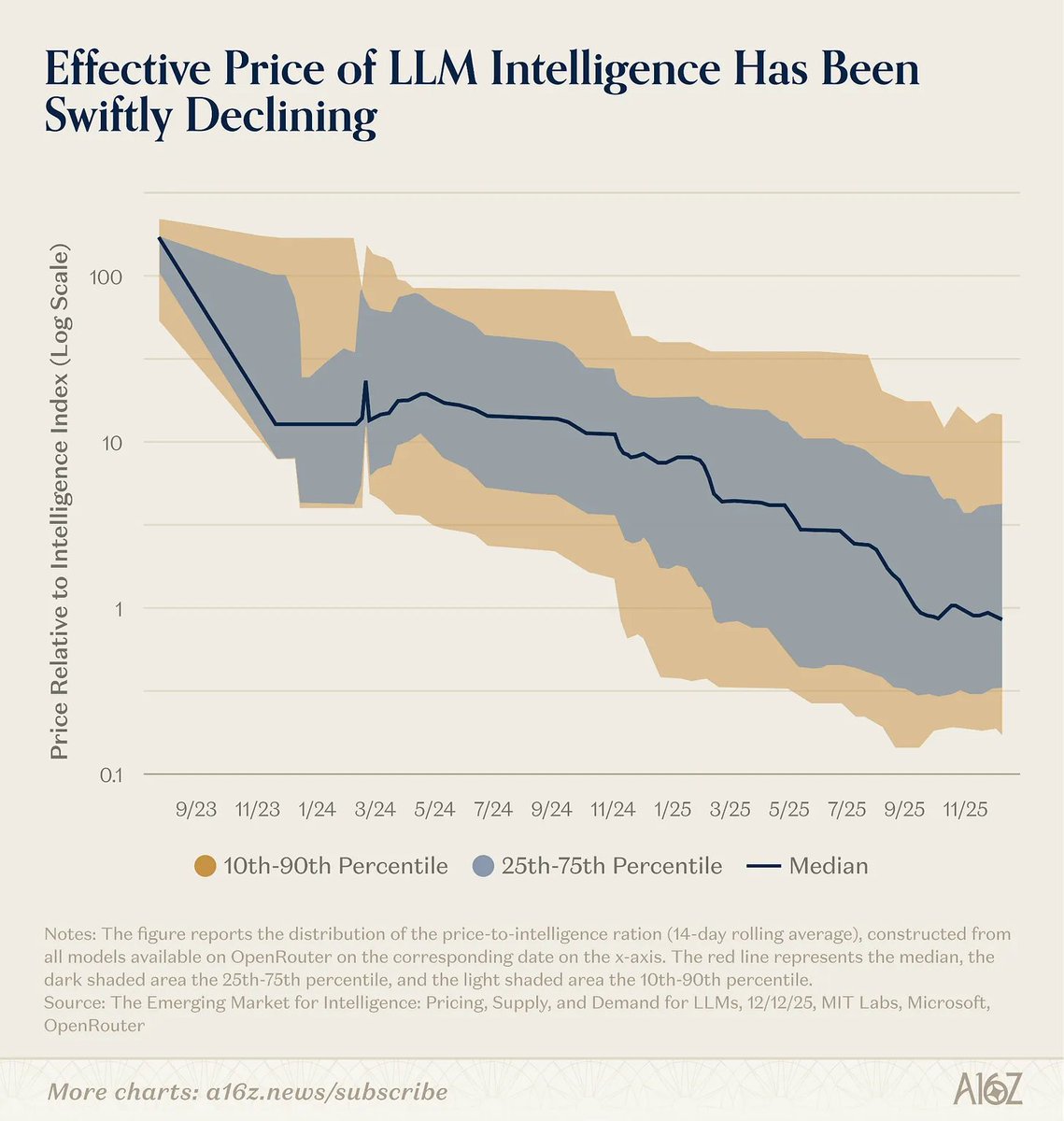
The doomer argument goes, “If AI can do our thinking for us, then humanity’s ‘moat’ evaporates and our terminal value goes to zero.” Checkmate, humans. Apparently, we’ve done all the thinking we’re ever going to need or want, and now that AI will carry an increasingly large share of the cognitive load, humans slide into obsolescence.
Here’s the thing, though: precedent (and intuition) shows that when the cost of a powerful input falls, the economy does not politely stand still. Costs fall, quality rises, speed rises, new products become viable, and demand moves outward. Jevons Paradox reigns supreme. When fossil fuels first made energy cheap and plentiful, we did more than just put whalers and woodchoppers out of business; we invented plastics!
Contra-doomers, there’s every reason to expect that AI will have a similar effect. Now that AI will carry an increasingly large share of the cognitive load, humans are free to tackle even more ambitious frontiers than ever before.
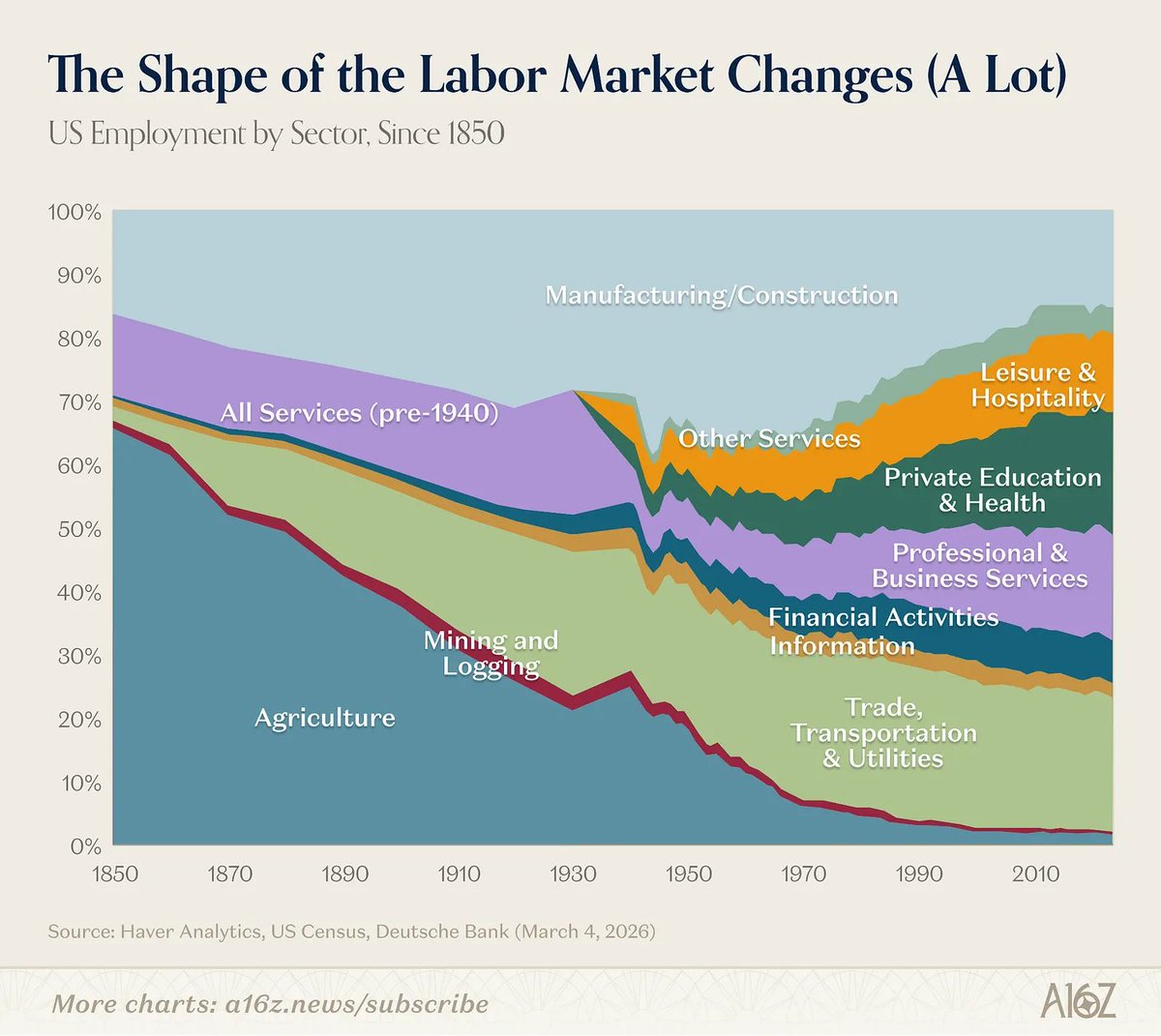
If history is any guide, we can expect that technological transformation will enlarge the size of the pie.
Every “dominant economic sector” has given way to an even larger successor . . . which, in turn, has made the economy only that much larger.
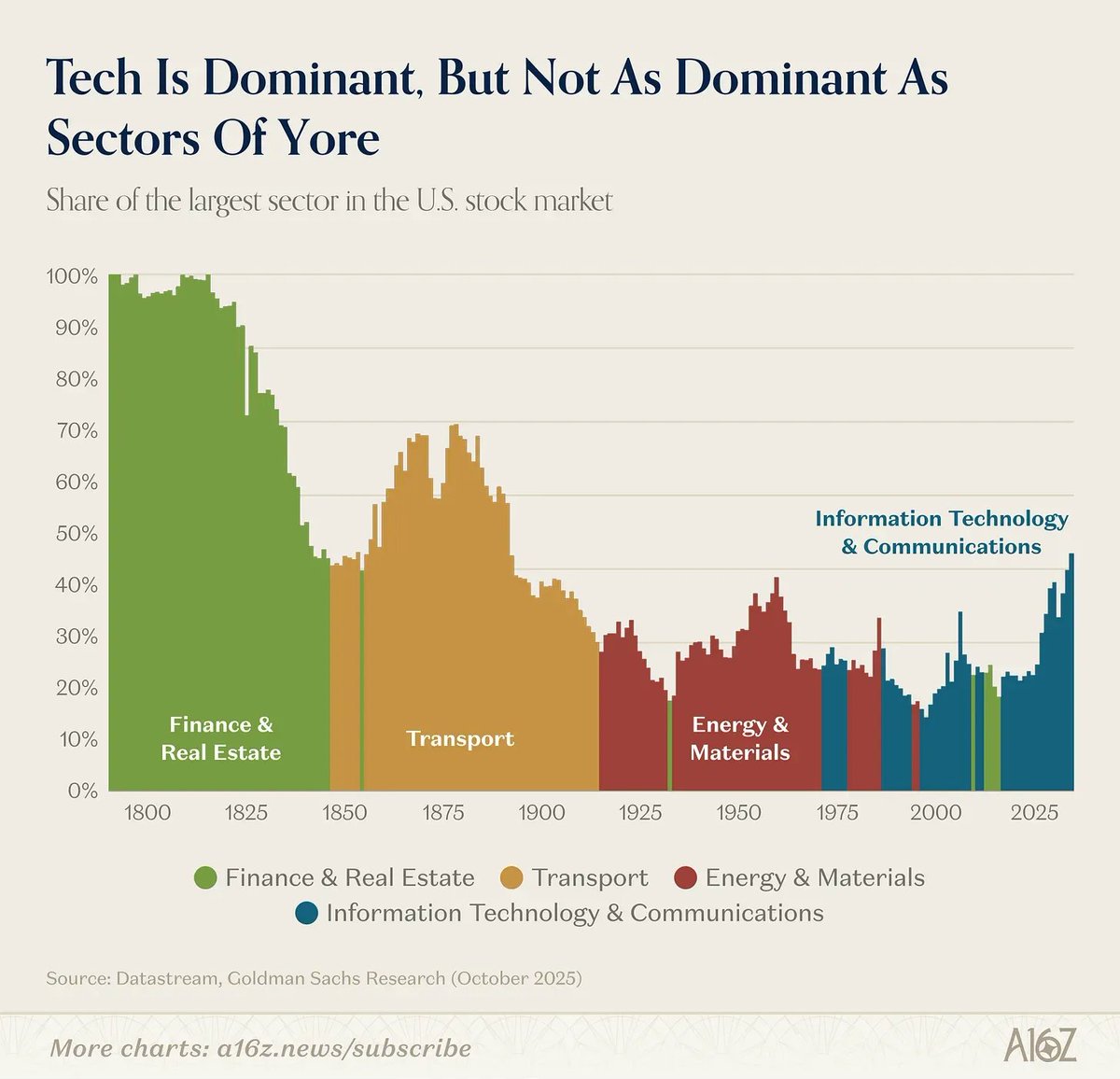
Tech today is bigger than finance, railroads, or industrials ever were, but still smaller as a fraction of the economy or the market as a whole. Far from being negative-sum, productivity gains have been a positive-sum force on steroids. The net result of having delegated so much of our efforts to machines is that the economy and labor market have only gotten bigger, more diverse, and more complex.
Doomers want you to ignore the history of innovation, freeze-frame the collapsing cost of cognition, and call it the whole movie. They see task-substitution and just stop.
“We’re going to 10x our cognitive output, but rather than do more thinking, we’re going to pat our tum-tums and hit lunch early, and so is everyone else,” reflects not only a massive failure of imagination, but of basic observation. Doomers call it “realism,” but it’s just not what happens, ever!
# Luddite Fails
Let’s take a look at what does actually happen, when great leaps forward in productivity ripped through the economy.
## Agriculture
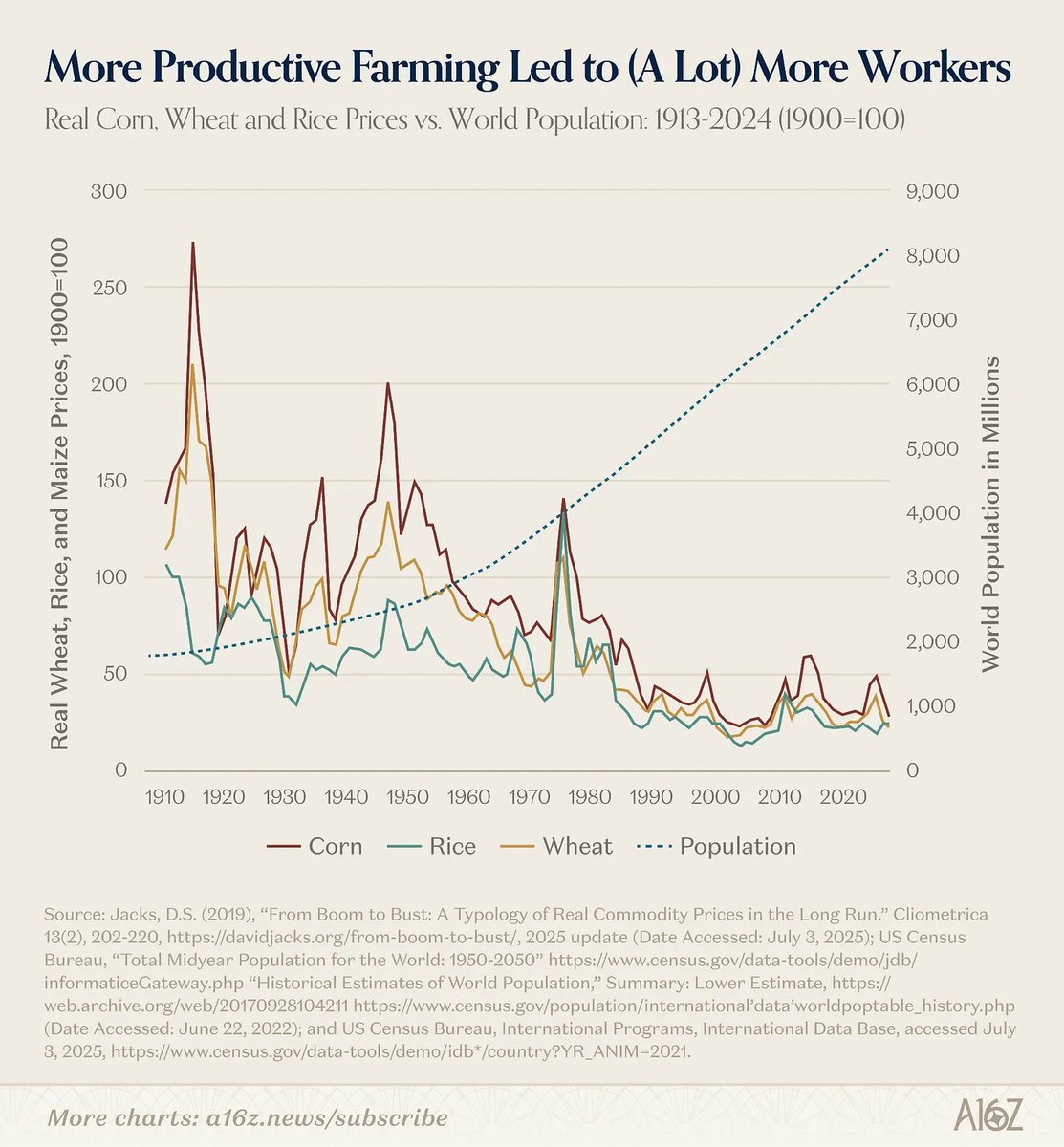
In the early 20th century before widespread adoption of farm mechanization, roughly a third of U.S. employment was in farming. By 2017, it was about 2 percent.
If automation caused permanent unemployment, the tractor should have broken the labor market forever. Instead, farm output almost tripled, which supported a massive increase in population—and far from being permanently unemployed, those workers flowed into previously unimagined industries, factories, stores, offices, hospitals, labs, and eventually services and software.
So, sure, you could say that technology upended the career prospects for the median farmhand, but in doing so, it unlocked a global labor (and resource) surplus, and an entirely new economy.
## Electrification
Electricity tells a similar story.
Electrification did not just swap one power source for another. It replaced shafts and belts with individual motors, forced factories to reorganize around entirely new workflows, and created entirely new categories of consumer and industrial goods.
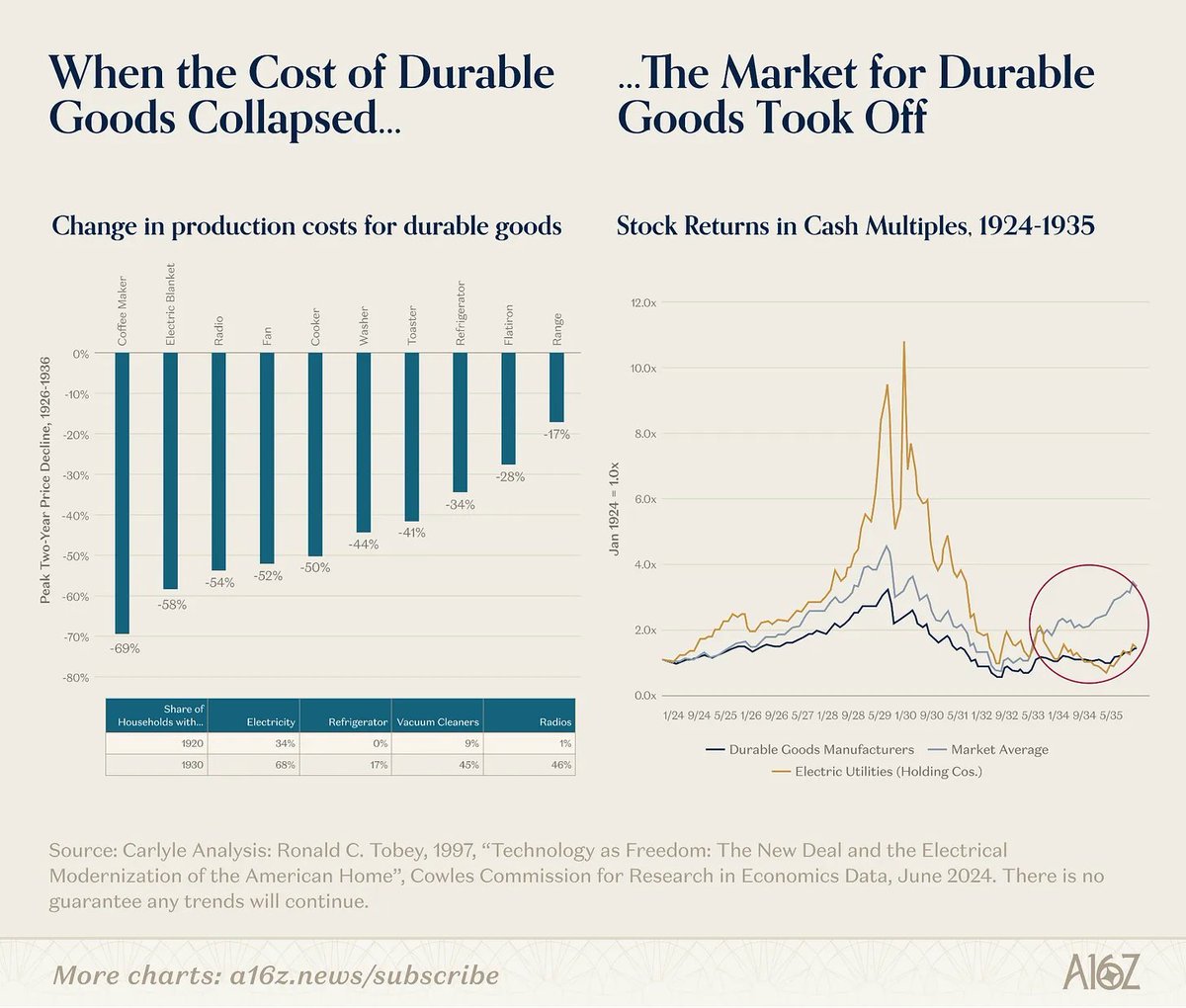
This is exactly what we expect to see during the distinct phases of technological revolutions, as documented by Carlota Perez in Technological Revolutions and Financial Capital: huge upfront investment and financial interest, huge declines in the costs of durable goods, and then a generational run for durable goods manufacturers.
It took time for electricity to work its productive magic. At the turn of the 20th century, only 5 percent of American factories used electricity to power their machines, and fewer than 10 percent of homes had electricity at all.
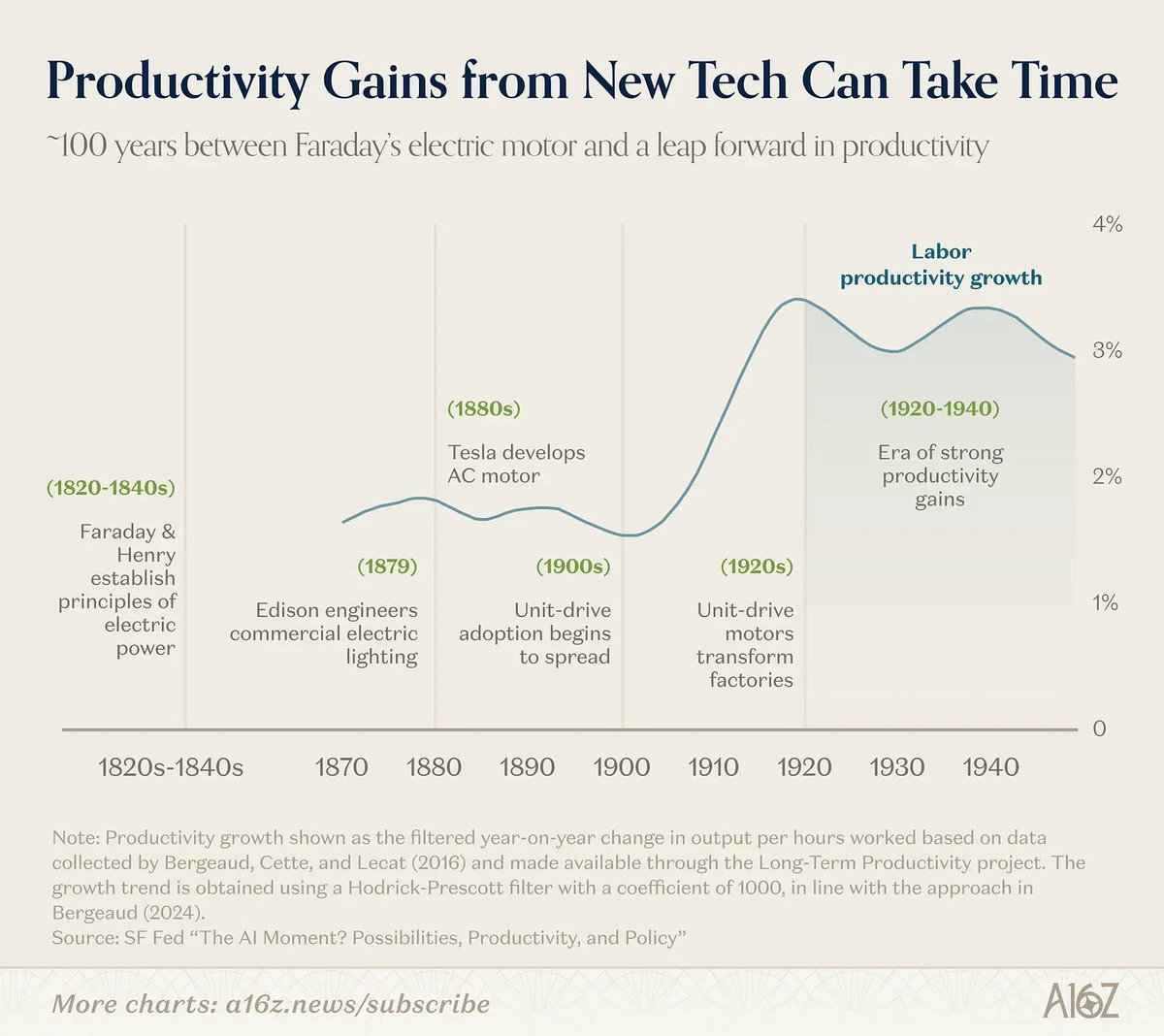
By 1930, electricity supplied almost 80 percent of manufacturing power, and labor productivity growth doubled for decades.
Far from destroying demand for labor, more productivity meant more manufacturing, more salespeople, more lending, and more commercial activity—not to mention the second-order effects of labor-saving devices, like washing machines and cars, both of which pulled more people into higher value endeavors than was previously possible.
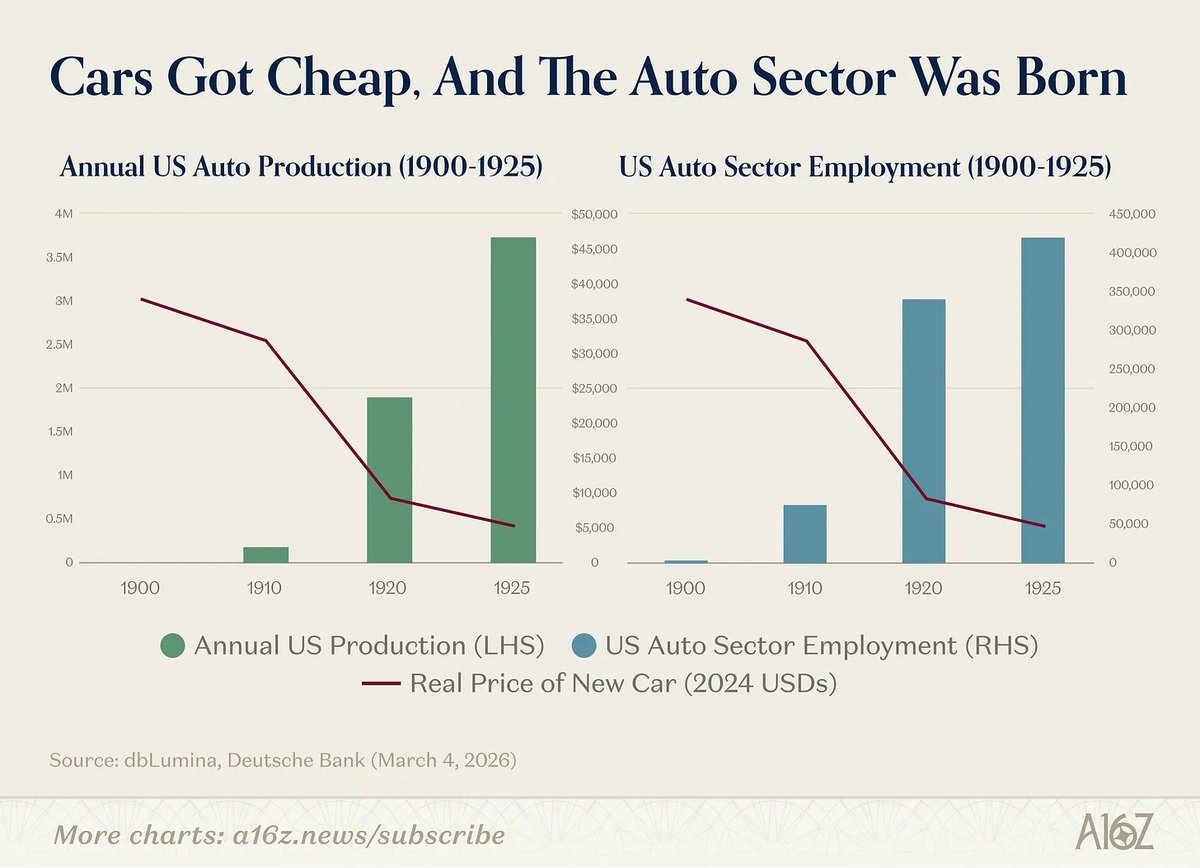
As prices for cars fell, both auto production and employment exploded.
That is what a real general-purpose technology does: it reorganizes the economy and expands the frontier of useful work.
We see this again and again. Did VisiCalc and Excel doom the bookkeepers? Emphatically, no. Vastly more efficient computational technology led to an explosion of bookkeepers, and created an entire industry of FP&A.
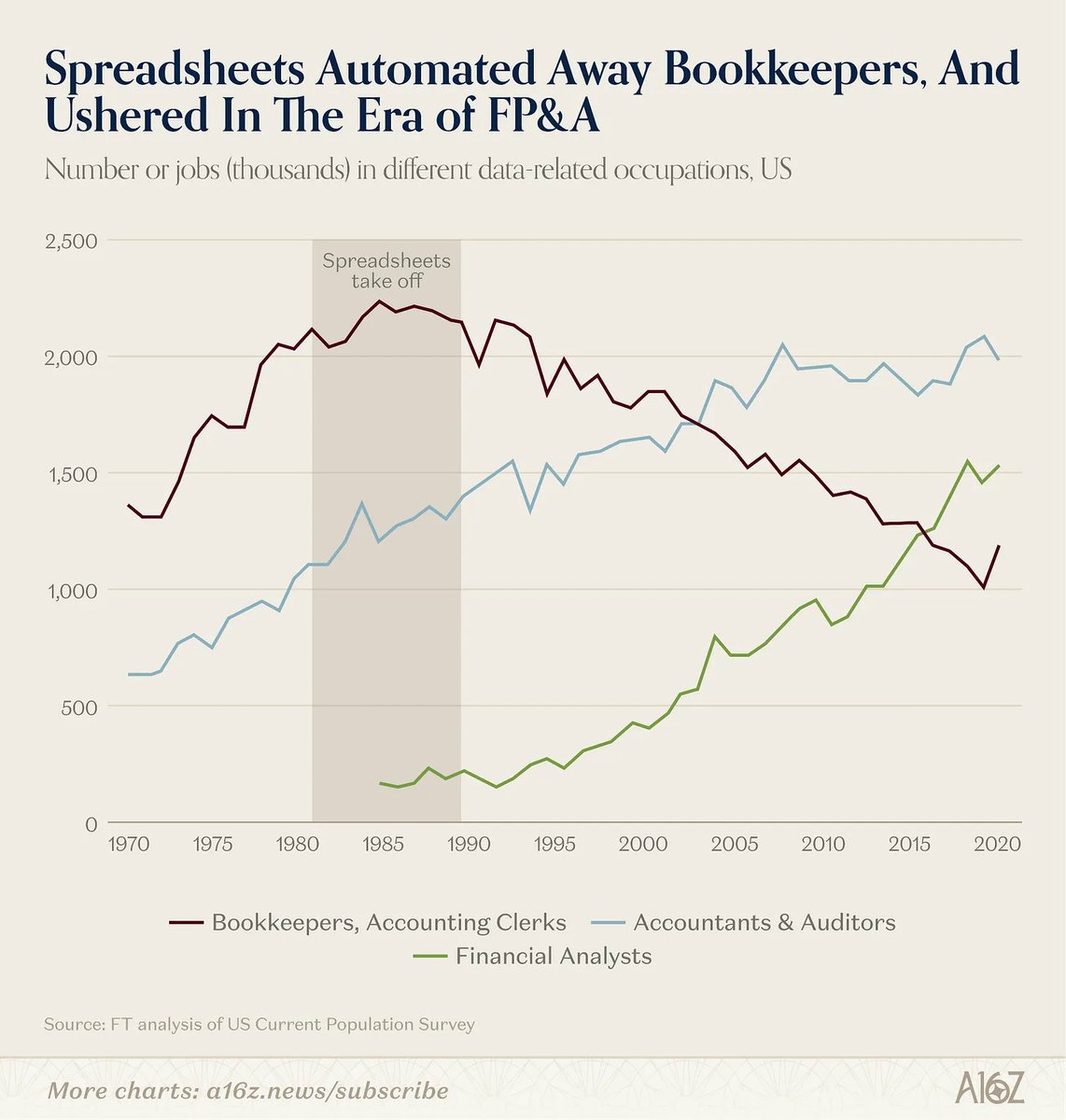
We lost ~1M “bookkeepers” and gained ~1.5M “financial analysts.”
## Those new service-sector jobs
It’s of course not always the case that task-substitution leads to job-growth in some adjacent part of the economy. Sometimes, the productivity surplus materializes as net-new job-growth in an entirely unrelated industry.
But what if AI means that some people will become fantastically wealthy, leaving the rest behind?
Well, at a minimum, those fantastically wealthy people will need to spend their money somewhere, creating whole new service industries from scratch, just like they did before:
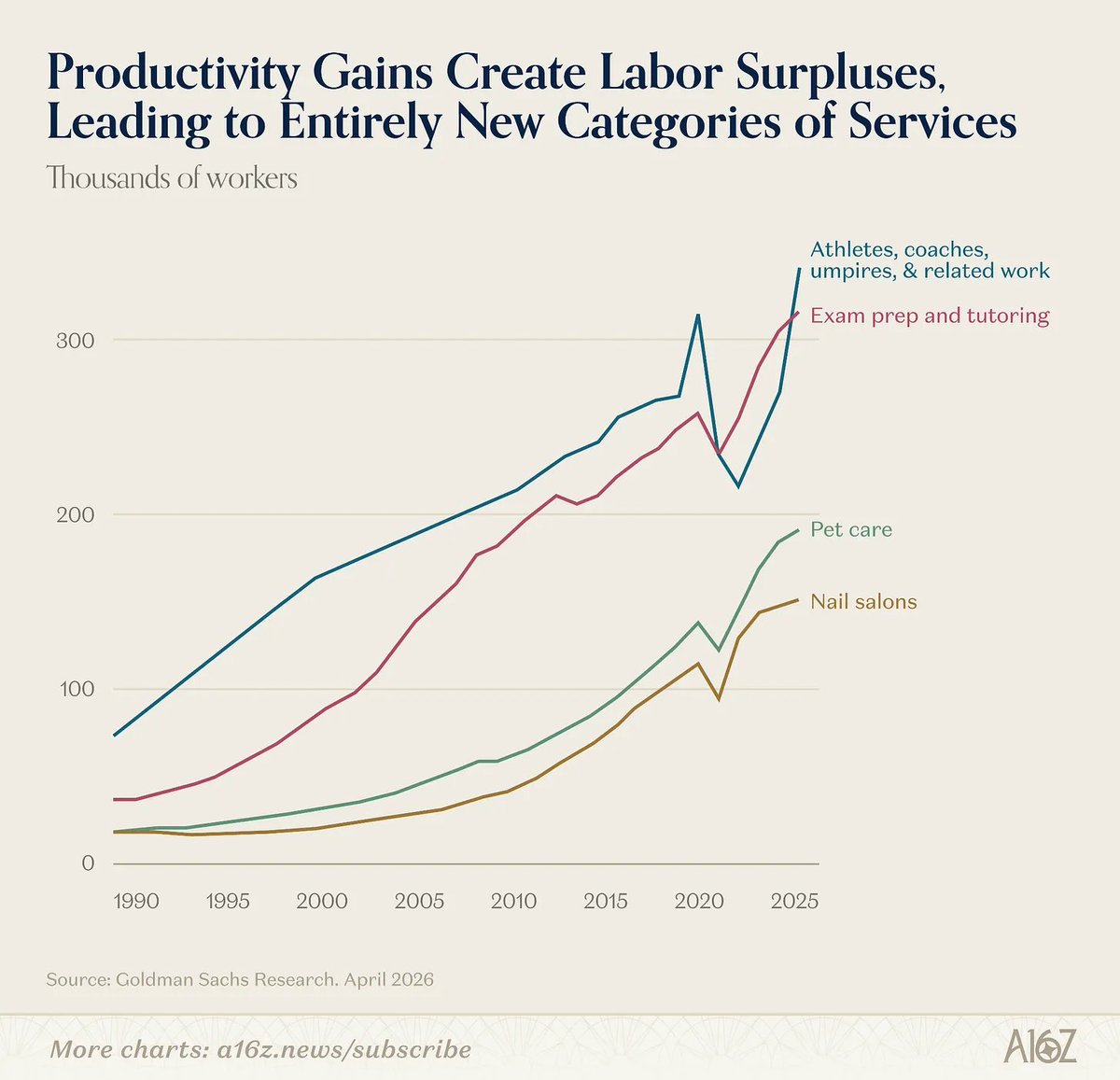
Massive productivity gains and subsequent wealth-creation led to entirely new lines of work that may never have come to fruition without rising incomes and worker availability (even though they were technologically possible, well before the 90s). However one feels about service industries that cater to the wealthy, the net result left everyone better off, as more demand led to a massive ramp in median wages (leading to more “wealthy” people).
Ernie Tedeschi, Stripe’s in-house economist, offers a fascinating “all-in-one” example of a job disrupted, transformed, and remade with technology: travel agents.
Did technology reduce demand for travel agents? Yes, absolutely:
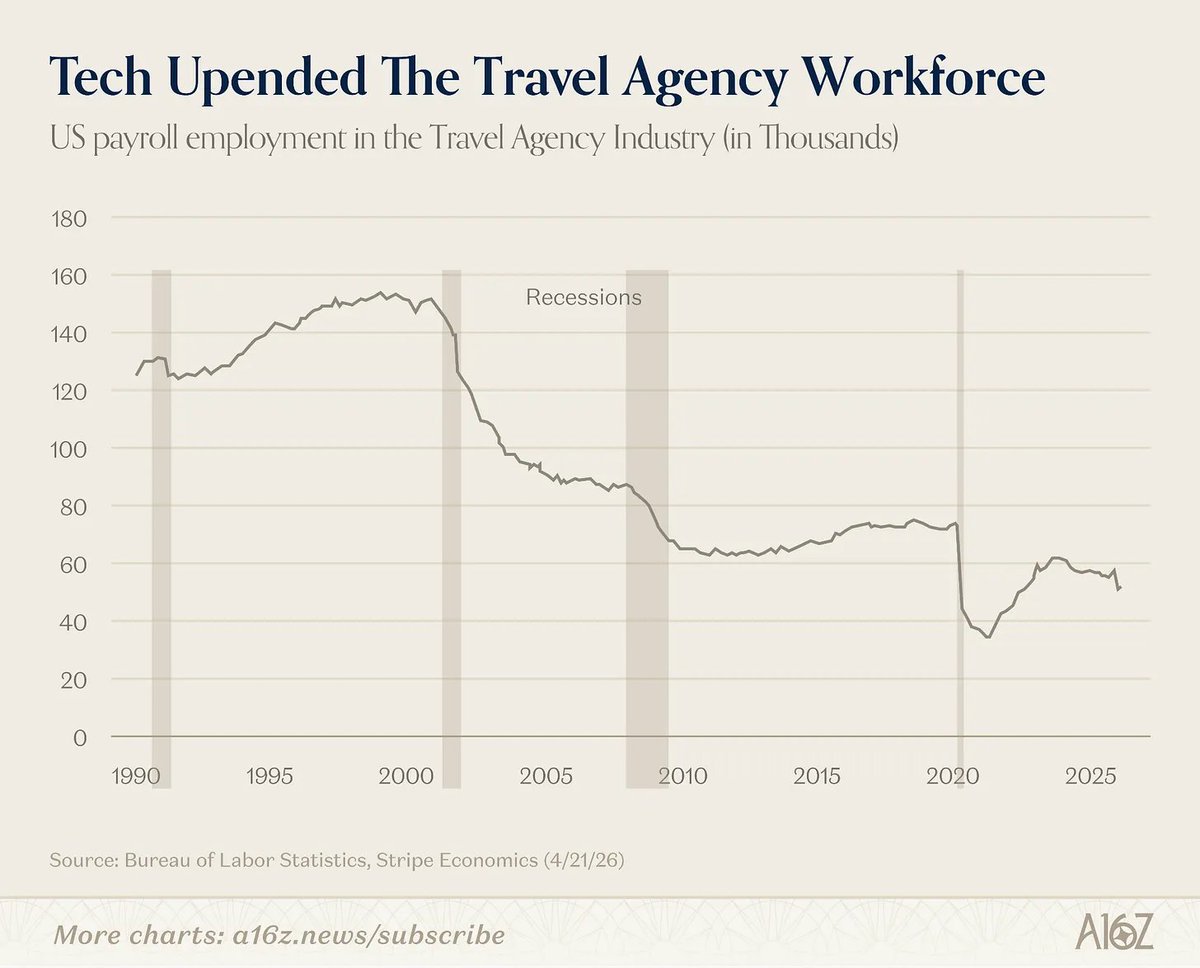
Travel agency payrolls are today about half of what they were at the turn of the century, almost certainly because of technology.
So, does that mean technology was a job-killer? No, again, because travel agents didn’t just end up permanently unemployed. They found work elsewhere in the economy, which overall has about the same employment:population ratio now, as it did in 2000 (when adjusted for aging).
Meanwhile, for the travel agents who did remain in the now tech-enabled industry, increased productivity meant higher wages than before:
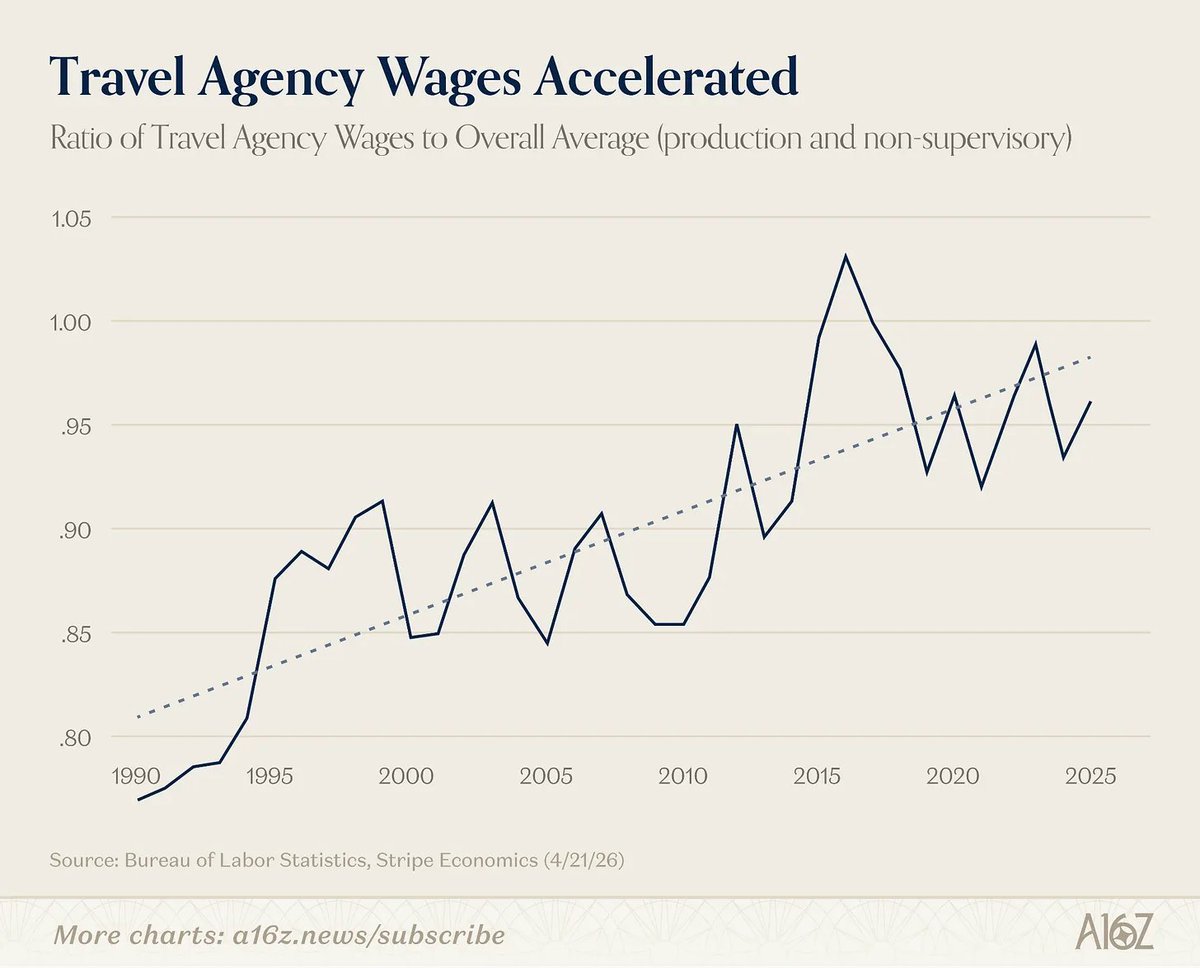
“Average weekly earnings at travel agencies were 87% of overall average weekly earnings back in the heyday of 2000. By 2025, the ratio had reached 99%, meaning travel agency wages had outpaced the rest of the private sector over that span.”
So, even then, while it’s true that tech devastated travel agent employment, in the aggregate, working-age people are just as employed as they were before, and the remaining travel agents are doing better than ever.
# Augmentation > Substitution (and the Jobs that Don’t Yet Exist)
That last point is very important, and reflects yet another way that doomers are only telling one small part of the story.
For some jobs, AI is an existential threat. True. But for others, AI is a force-multiplier—which will make those jobs that much more valuable. For every job at-risk of AI-Substitution, there are other jobs that stand to benefit:
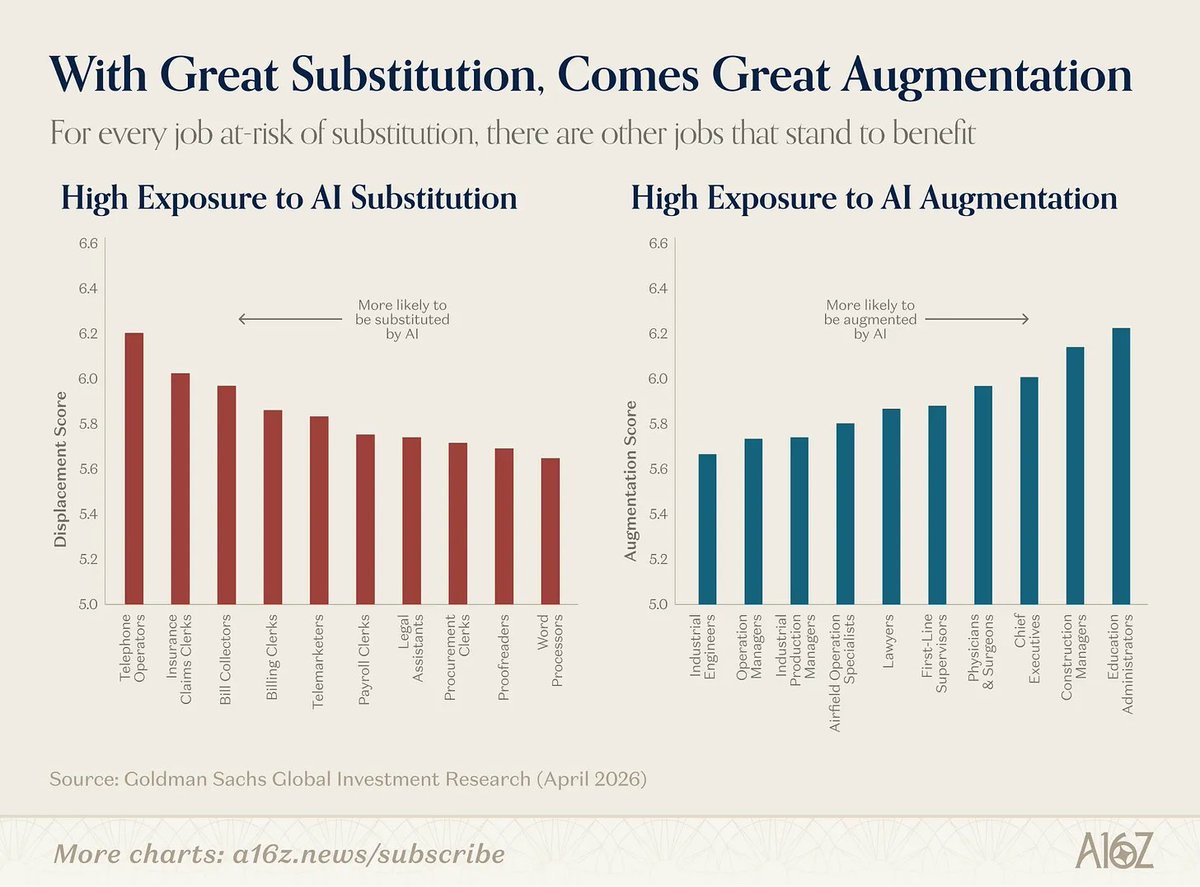
Goldman’s estimated “AI Substitution” effects are more than balanced-out by the effects of “AI Augmentation.”
Management teams also appear to be much more focused on augmentation than substitution, for what it’s worth:
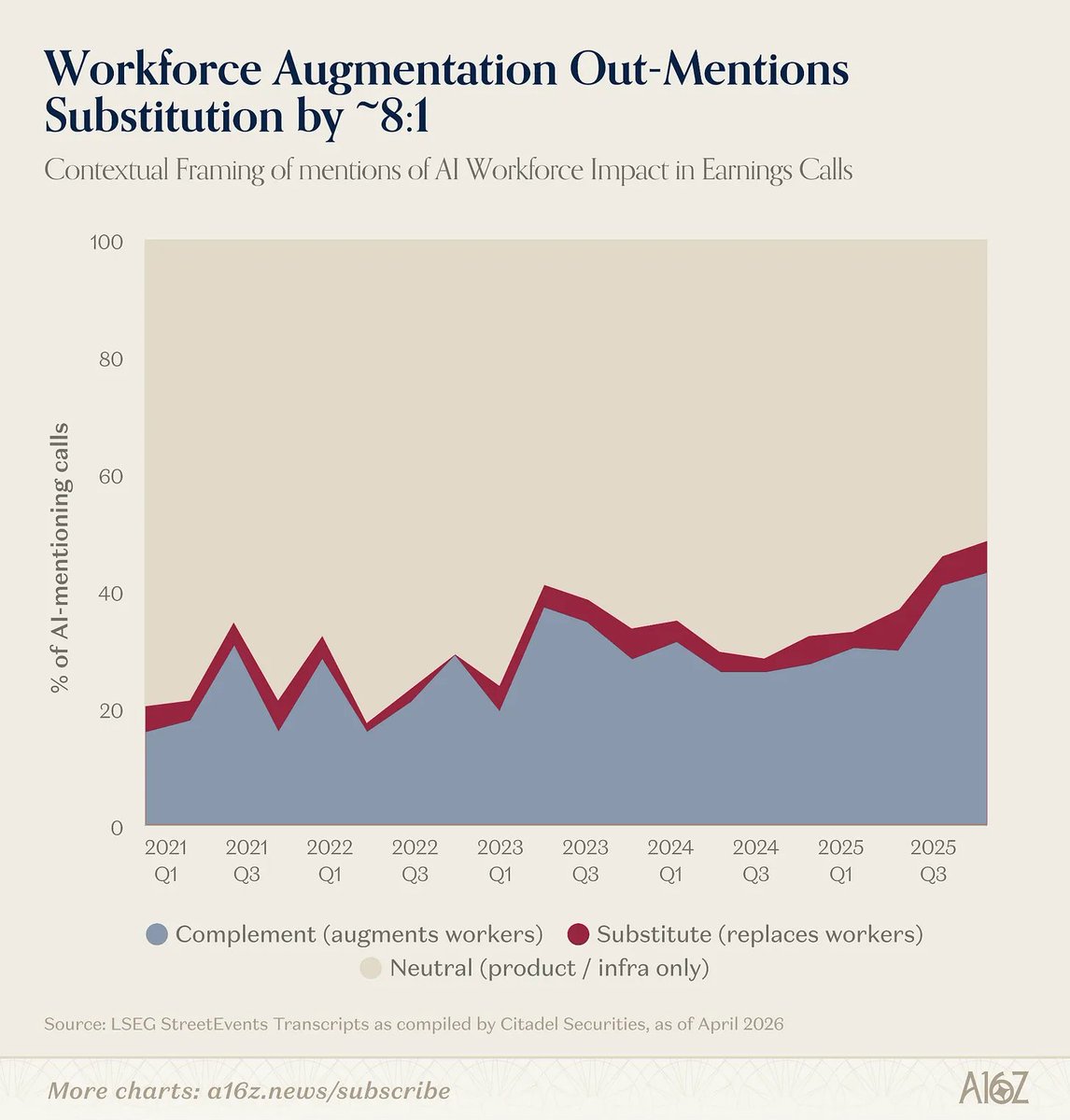
As of now, AI-as-augmentation out-mentions AI-as-substitution on earnings calls by ~8:1.
While Goldman doesn’t even include them on their “augmentation” list, software engineers are probably the perfect example of an AI Augmented role.
AI is a force-multiplier for coding. Not only are git pushes skyrocketing (as are new apps and new business formation), but it appears as though demand for SWE is inflecting upwards:
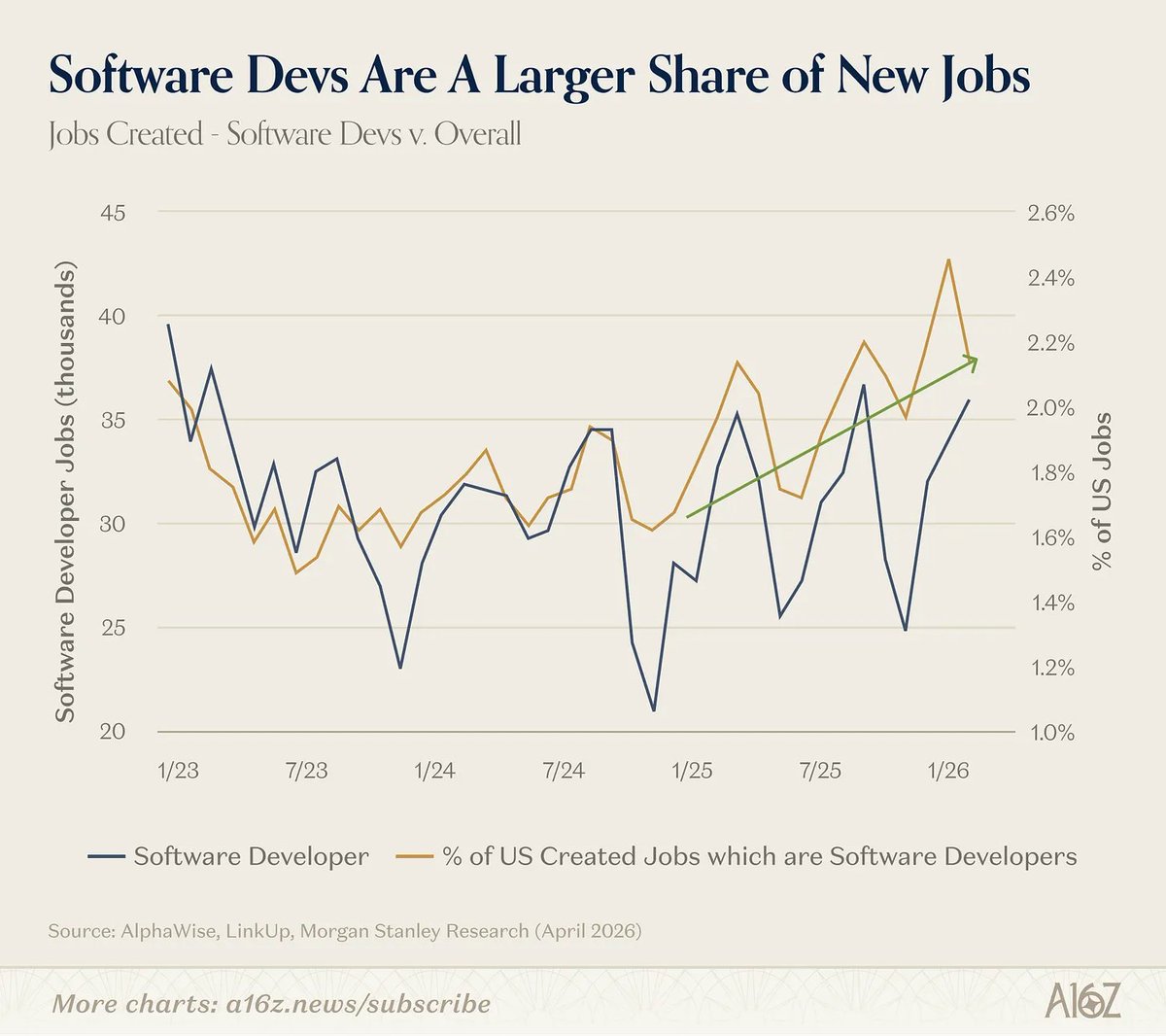
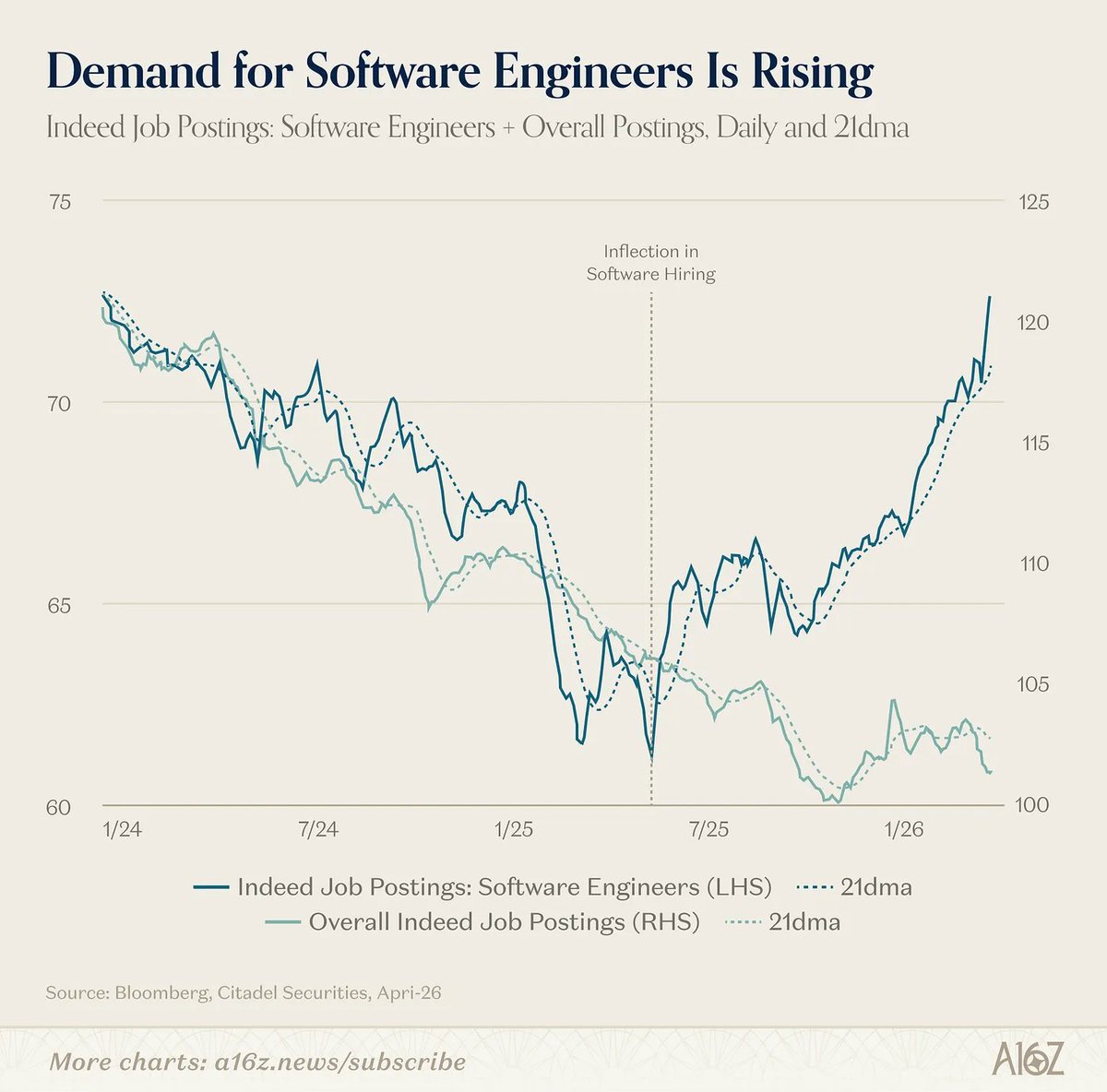
Software Development jobs (both by count, and a percent of the overall job market) have been increasing since the beginning of 2025.
Is that because of AI? Truthfully, it’s probably too soon to tell, but AI most definitely augments the work of software engineering, not to mention that AI is top-of-mind for every executive at every company.
With everyone trying to figure out how to incorporate AI into their businesses, it stands to reason that there would be substantial hiring efforts underway to make that happen, making certain employees more valuable, not less:
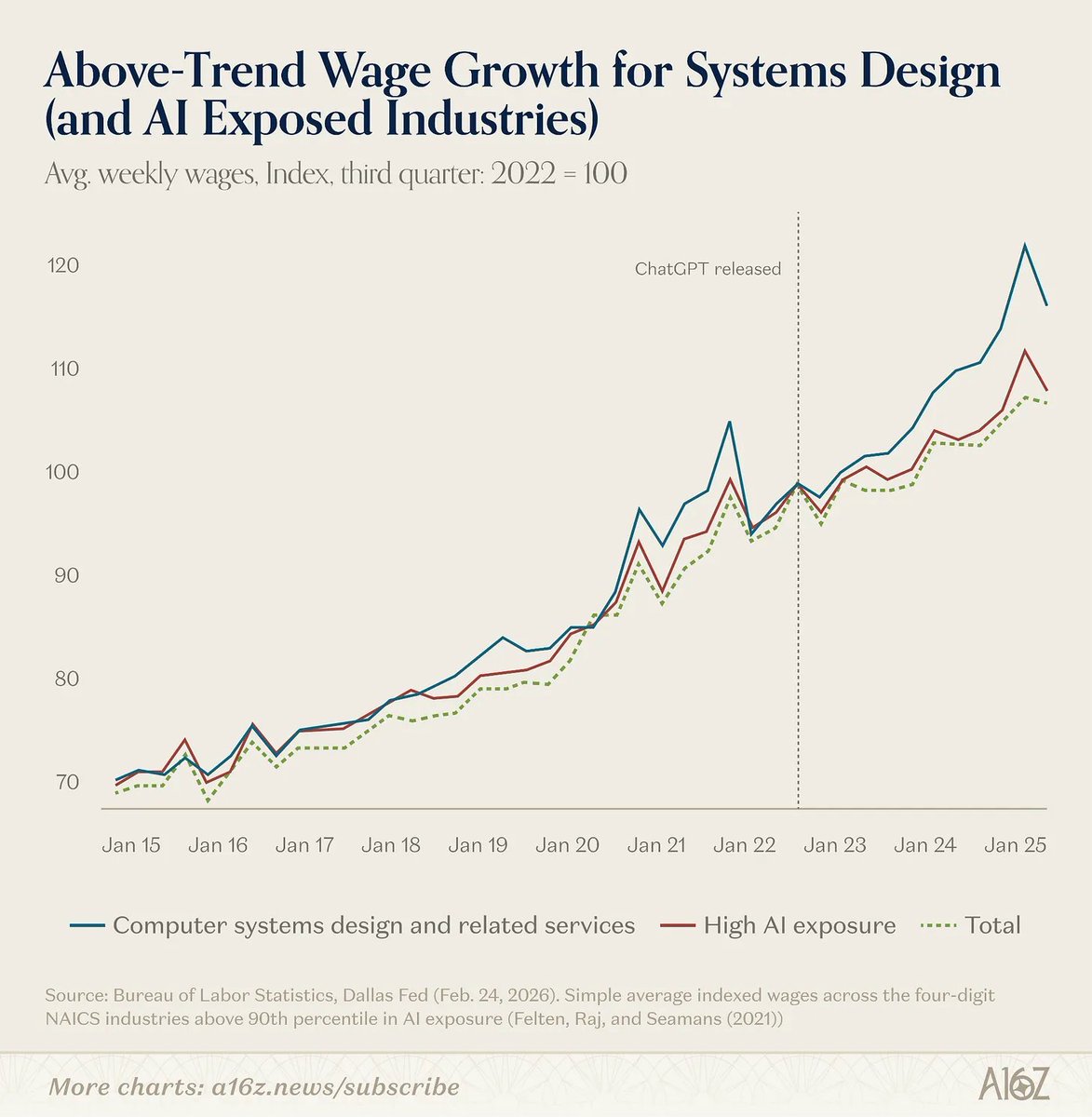
AI-exposure seems to be driving above-trend wage-growth (which is especially true for systems design).
Those gains may be somewhat narrow for now, but it’s still so, so early. As expertise widens, so too will the opportunities. In all events, it’s not the data that the doomers want you to see.
Meanwhile, according to Lenny Rachitsky (of Lenny’s Newsletter, one of the great tech-insider communities), open PM jobs continue to climb (off their rate-driven collapse) and are now more plentiful than they’ve been since 2022:
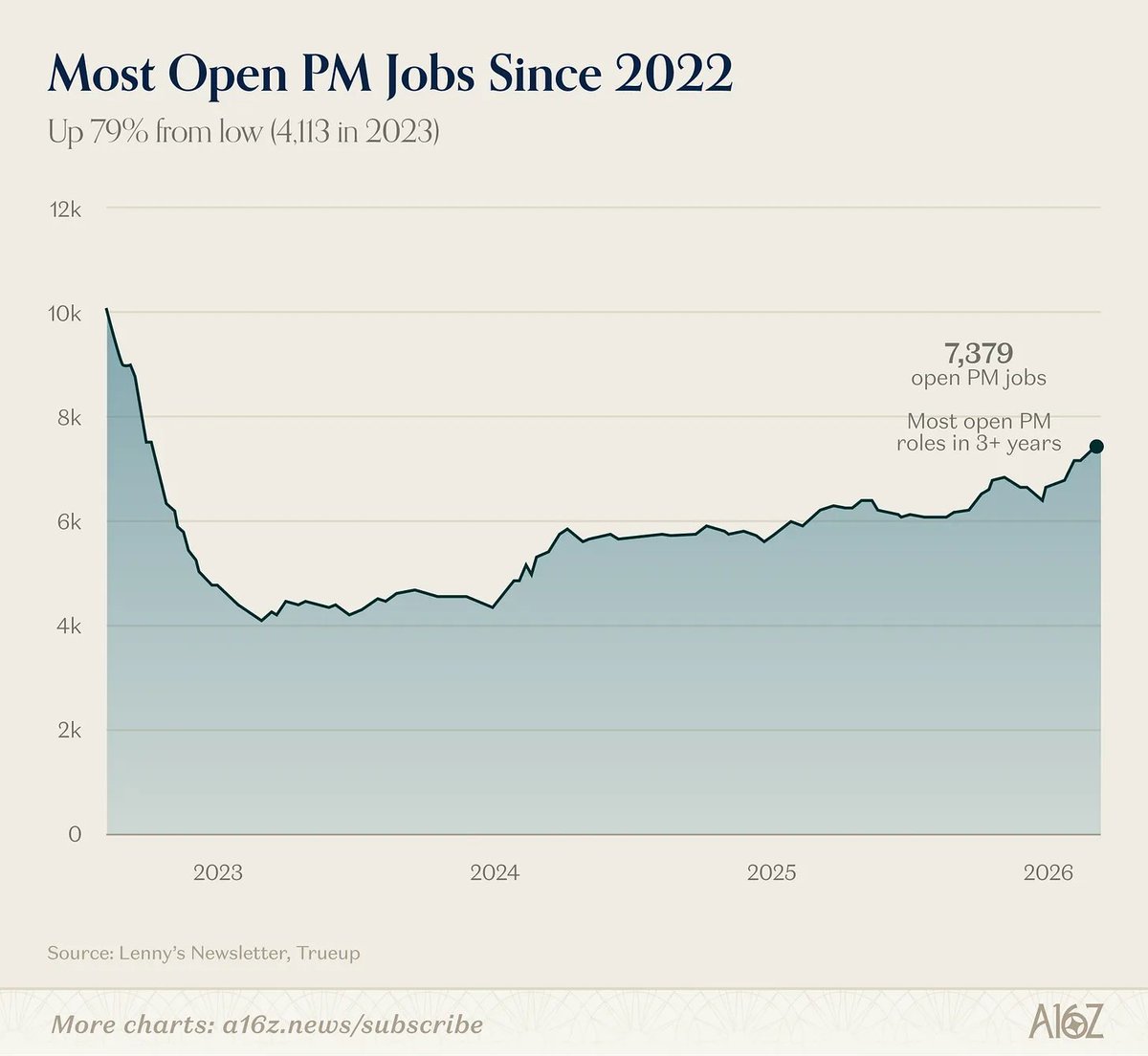
Hiring growth in both software engineers and product managers is a concise example of why the “lump of labor” fallacy is wrong. If AI substituted thinking 1:1, then you might plausibly expect, “PMs need fewer engineers,” or you could argue “engineers need fewer PMs,” but that isn’t what we see. We see demand for both continuing to rebound, because what matters is people are getting more work done.
That’s why the doomer failure is primarily a failure of imagination. They focus on the tasks that get automated away, and ignore a new frontier of demand that will create jobs we haven’t even conceived of yet:
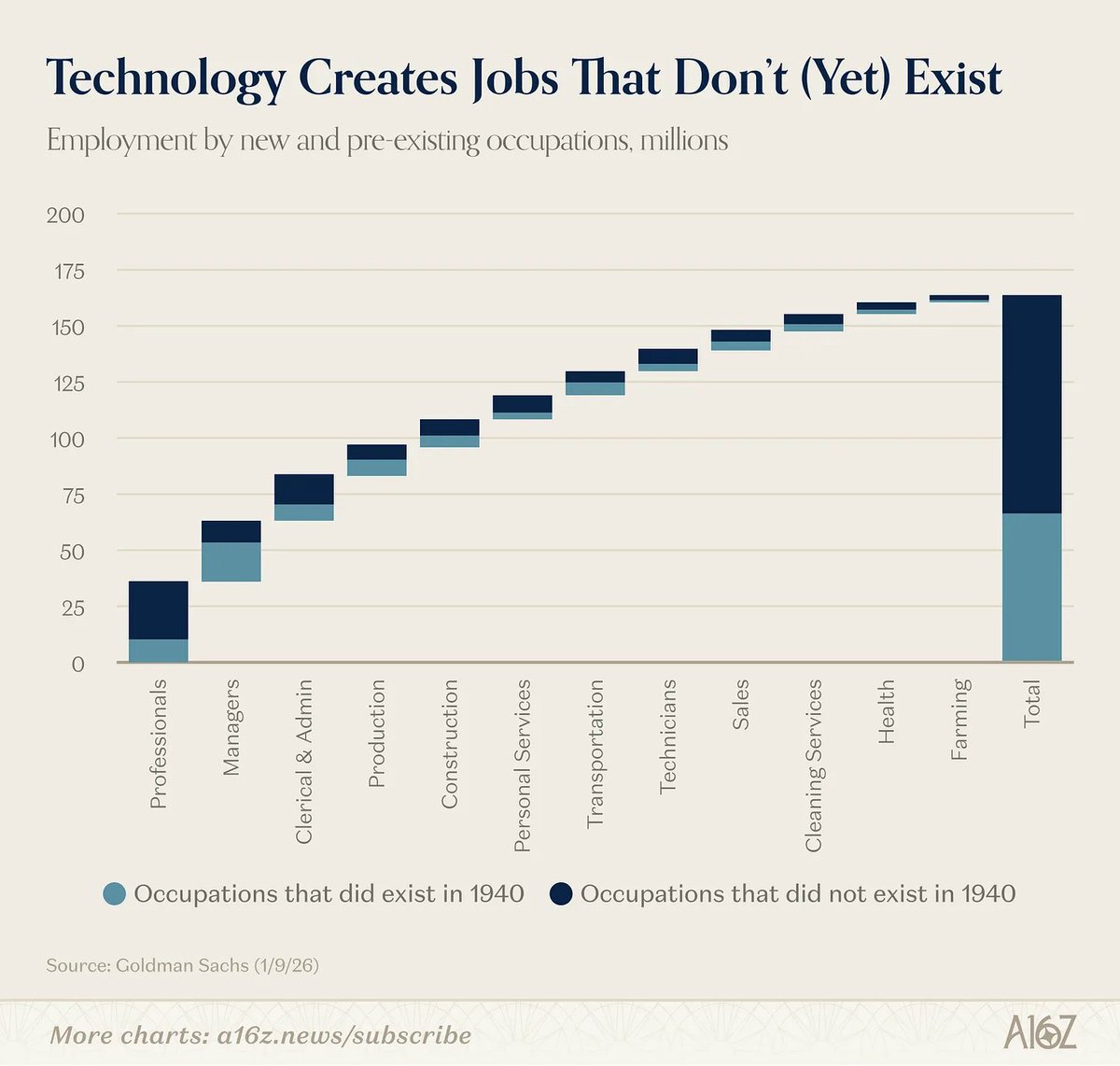
The majority of new jobs created since 1940 didn’t even exist in 1940. And in 2000, it was pretty easy to imagine all the travel agents that would be out of a job, but it was probably much harder to imagine an entire middle-market tech services industry built around “cloud migration,” since, of course, the cloud was more than a decade away.
Continue reading in the a16z Newsletter: https://www.a16z.news/p/the-ai-job-apocalypse-is-a-complete
## 相关链接
- [David George](https://x.com/DavidGeorge83)
- [@DavidGeorge83](https://x.com/DavidGeorge83)
- [283K](https://x.com/DavidGeorge83/status/2052052899115749692/analytics)
- [“lump-of-labor” fallacy](https://www.stlouisfed.org/publications/page-one-economics/2020/11/02/examining-the-lump-of-labor-fallacy-using-a-simple-economic-model)
- [offers a fascinating “all-in-one” example of a job disrupted, transformed, and remade with technology:](https://www.stripeeconomics.com/p/the-decline-of-travel-agents)
- [https://www.a16z.news/p/the-ai-job-apocalypse-is-a-complete](https://www.a16z.news/p/the-ai-job-apocalypse-is-a-complete)
- [Upgrade to Premium](https://x.com/i/premium_sign_up)
- [11:48 PM · May 6, 2026](https://x.com/DavidGeorge83/status/2052052899115749692)
- [283K Views](https://x.com/DavidGeorge83/status/2052052899115749692/analytics)
- [View quotes](https://x.com/DavidGeorge83/status/2052052899115749692/quotes)
---
*导出时间: 2026/5/7 09:06:57*
---
## 中文翻译
# “AI 职业末日”纯属幻想
**作者**: David George
**日期**: 2026-05-06T15:48:31.000Z
**来源**: [https://x.com/DavidGeorge83/status/2052052899115749692](https://x.com/DavidGeorge83/status/2052052899115749692)
---

AI 危言耸听者所宣扬的“永久底层阶级”恐慌,并不是一个令人信服的故事。它甚至不是一个新故事。这只是“劳动总量”谬论的换皮版本。
“劳动总量”谬论声称,工作量是固定的。它假设现有工人与其他任何可能做同样工作的人或事物——无论是其他工人、机器,还是在这个案例中的 AI——之间存在零和竞争。如果需要完成的有用工作量是固定的,那么如果 AI 做得更多,人类就必须做得更少。
这个前提的问题在于,它违背了我们对人类、市场和经济学的一切认知。人类的欲望和需求绝非固定不变。凯恩斯几乎在一个世纪前就曾预言,自动化将导致每周 15 小时的工作制,但当然,凯恩斯错了。他关于自动化创造“劳动力过剩”的看法是对的,但我们并没有只是坐享其成,而是找到了新的、不同的生产性事业来填补我们的时间。
当然,AI 绝对会消除一些任务并压缩一些角色(有证据表明这种情况可能已经发生)。劳动力市场的结构将会发生改变,就像每当一项变革性技术被解锁时那样。但是,声称 AI 将导致经济范围的、永久性的失业,这不仅是一种无益的营销噱头,也是糟糕的经济学,更是糟糕的历史。恰恰相反,生产率的提高应该会增加对劳动力的需求,因为劳动力变得更有价值了。
以下是我们支持这一观点的理由。
# “人类将死?”得了吧。
我们赞同危言耸听者的观点——坦率地说,也赞同任何睁眼看世界的人——即“认知”的成本正在崩塌。在处理直到最近还被认为是人类大脑专属领域的工作方面,AI 正变得越来越好。

危言耸听者的论调是:“如果 AI 能替我们思考,那么人类的‘护城河’就会蒸发,我们的最终价值将归零。”人类被将死了。显然,我们已经完成了我们永远需要或想要的所有思考,现在既然 AI 将承担越来越大的认知负荷,人类就会滑向过时的边缘。
然而,事实是:先例(以及直觉)表明,当一种强大投入要素的成本下降时,经济并不会礼貌地停滞不前。成本下降,质量上升,速度上升,新产品变得可行,需求向外扩张。杰文斯悖论占据主导地位。当化石燃料最初使能源变得廉价且丰富时,我们不仅仅是让捕鲸人和伐木工失业;我们还发明了塑料!
与危言耸听者的看法相反,我们完全有理由预期 AI 将产生类似的影响。现在既然 AI 将承担越来越大的认知负荷,人类就有能力去 tackle 比以往任何时候都更具野心的前沿领域。

如果历史可以作为指南,我们可以预期技术变革将把蛋糕做大。
每一个“主导经济部门”都让位于一个更大的继任者……而这反过来又使经济变得更加庞大。

如今的科技行业比以前的金融、铁路或工业都要大,但在整个经济或市场中所占的比例仍然较小。生产力提升远非零和博弈,而是超级强力的正和力量。我们将如此多的努力委托给机器的最终结果是,经济和劳动力市场变得更大、更多样化、更复杂。
危言耸听者想让你忽略创新的历史,将认知成本下降的瞬间冻结,并宣称这就是整部电影。他们看到了任务替代,然后就想不下去了。
“我们要把认知产出提高 10 倍,但我们不会做更多的思考,而是拍拍肚皮早早去吃午饭,其他人也都一样,”这种观点不仅反映了想象力的巨大失败,也反映了基本观察力的失败。危言耸听者称之为“现实主义”,但这根本不是现实世界中发生过的事情!
# 卢德派的失败
让我们来看看,当生产力的大飞跃席卷经济时,实际发生了什么。
## 农业
在 20 世纪初,在农业机械化广泛普及之前,大约三分之一的美国就业人口从事农业。到 2017 年,这一比例约为 2%。
如果自动化会导致永久性失业,那么拖拉机本应该永远摧毁劳动力市场。相反,农业产量几乎翻了三番,这支撑了人口的巨大增长——而且这些工人远非永久失业,他们流向了以前无法想象的行业:工厂、商店、办公室、医院、实验室,最终流向服务业和软件业。
所以,当然,你可以说技术颠覆了普通农场工人的职业前景,但在此过程中,它释放了全球劳动力(和资源)盈余,并创造了一个全新的经济体。

## 电气化
电气化讲述了一个类似的故事。
电气化不仅仅是用一个电源替换另一个电源。它用独立的电动机取代了轴和皮带,迫使工厂围绕全新的工作流程进行重组,并创造了全新的消费品和工业品类别。

这正是卡尔塔·佩雷斯在《技术革命与金融资本》中记录的,我们在技术革命的不同阶段所预期看到的景象:巨额的前期投资和金融利益、耐用商品成本的巨大下降,然后是耐用商品制造商的一代繁荣期。
电气化发挥其生产魔力需要时间。在 20 世纪初,只有 5% 的美国工厂使用电力来驱动机器,拥有电力的家庭比例不到 10%。

到 1930 年,电力提供了近 80% 的制造业动力,劳动生产率增长翻了一番,并持续了数十年。
远非破坏对劳动力的需求,更高的生产力意味着更多的制造业、更多的销售人员、更多的借贷和更多的商业活动——更不用说节省劳动力的设备的次级效应,比如洗衣机和汽车,这两者都将更多的人引入了以前不可能实现的高价值事业中。

随着汽车价格下降,汽车生产和就业都爆发式增长。
这就是真正的通用技术所做的事情:它重组经济并扩展有用工作的前沿。
我们一次又一次地看到这一点。VisiCalc 和 Excel 毁掉了记账员吗?绝对没有。高效得多的计算技术导致了记账员的激增,并创造了整个 FP&A(财务规划与分析)行业。

我们失去了约 100 万名“记账员”,但增加了约 150 万名“财务分析师”。
## 那些新的服务业工作
当然,任务替代并不总是会导致经济中某个相邻领域的就业增长。有时,生产力盈余体现为一个完全不相关行业的全新净就业增长。
但如果 AI 意味着有些人会变得极其富有,而其他人却被甩在身后呢?
好吧,至少来说,那些极其富有的人总得有个地方花钱,这会从零开始创造全新的服务行业,就像以前一样:

巨大的生产力提升和随之而来的财富创造导致了全新的工作线,如果没有收入增长和劳动力供给(即使这些在 90 年代之前技术上就已经可行),这些工作可能永远不会实现。无论人们对迎合富人的服务业有何看法,最终的结果是让每个人都过得更好,因为更多的需求导致了工资中位数的大幅攀升(从而造就了更多的“富人”)。
Stripe 的内部经济学家 Ernie Tedeschi 提供了一个迷人的“多合一”案例,展示了一个被技术颠覆、转型和重塑的工作:旅行代理。
技术是否减少了对旅行代理的需求?是的,毫无疑问:

如今旅行社的工资单大约是世纪初的一半,几乎可以肯定是因为技术原因。
那么,这是否意味着技术是职业杀手?不,再说一次,因为旅行代理人最终并没有永久失业。他们在经济的其他地方找到了工作,总体而言,目前的就业人口比与 2000 年相当(经老龄化调整后)。
与此同时,对于那些留在这个现已由技术赋能的行业的旅行代理人来说,生产力的提高意味着比以前更高的工资:

“早在 2000 年的全盛时期,旅行社的平均周薪是总体平均周薪的 87%。到 2025 年,这一比例已达到 99%,这意味着在那段时间里,旅行社的工资增长超过了私营部门的其他部分。”
因此,即使在那时,虽然技术确实重创了旅行代理行业的就业,但总体而言,工作年龄人口的就业率与以前一样高,而留任的旅行代理人的处境比以往任何时候都好。
# 增强 > 替代(以及那些尚不存在的工作)
最后一点非常重要,它反映了危言耸听者只讲述了故事一小部分的另一种方式。
对于某些工作来说,AI 是生存威胁。没错。但对于其他工作,AI 是力量倍增器——这将使那些工作变得更有价值。对于每一个面临 AI 替代风险的工作,都有其他工作有望受益:

高盛估计的“AI 替代”效应被“AI 增强”效应所抵消还有余。
管理层似乎也更关注增强而非替代,不管这值多少钱:

截至目前,在财报电话会议中,提及“AI 作为增强”的次数大约是“AI 作为替代”的 8 倍。
虽然高盛甚至没有将软件工程师列入其“增强”名单,但软件工程师可能是 AI 增强角色的完美例子。
AI 是编码的力量倍增器。不仅 git 提交量激增(新应用程序和新公司的创建也是如此),而且对 SWE(软件工程师)的需求似乎正在向上拐点:


自 2025 年初以来,软件开发工作(无论是数量还是占整个就业市场的百分比)一直在增加。
这是因为 AI 吗?说实话,现在下结论可能还为时过早,但 AI 绝对增强了软件工程的工作,更不用说 AI 现在是每家公司每位高管的当务之急。
随着每个人都试图弄清楚如何将 AI 整合到他们的业务中,有理由推断正在进行大量的招聘工作来实现这一目标,这使得某些员工变得更有价值,而不是更不重要:

AI 接触度似乎正在推动高于趋势的工资增长(对于系统设计来说尤其如此)。
这些收益目前可能有些狭窄,但这仍然非常非常早期。随着专业知识的扩展,机会也会扩展。无论如何,这不是危言耸听者想让你看到的数据。
与此同时,据 Lenny Rachitsky(Lenny’s Newsletter 的作者,这是伟大的技术内部人士社区之一)称,开放的 PM 职位继续攀升(摆脱了由利率驱动的崩溃),现在的数量比 2022 年以来任何时候都多:

软件工程师和产品经理招聘的增长是“劳动总量”谬论为何错误的简明例子。如果 AI 以 1:1 的比例替代思考,那么你可能会合理地预期“PM 需要更少的工程师”,或者你可以辩称“工程师需要更少的 PM”,但这并非我们所见。我们看到对两者的需求都在持续反弹,因为重要的是人们完成了更多的工作。
这就是为什么危言耸听者的失败主要是想象力的失败。他们专注于被自动化的任务,而忽略了将创造我们甚至尚未设想到的工作的需求新前沿:

自 1940 年以来创造的大部分新工作在 1940 年时根本不存在。而在 2000 年,很容易想象会有大量旅行代理失业,但可能很难想象围绕“云迁移”建立的整个中端科技服务行业,因为当然,云技术在当时还有十多年之久才能问世。
请继续阅读 a16z 通讯:https://www.a16z.news/p/the-ai-job-apocalypse-is-a-complete
## 相关链接
- [David George](https://x.com/DavidGeorge83)
- [@DavidGeorge83](https://x.com/DavidGeorge83)
- [283K](https://x.com/DavidGeorge83/status/2052052899115749692/analytics)
- [“lump-of-labor” fallacy](https://www.stlouisfed.org/publications/page-one-economics/2020/11/02/examining-the-lump-of-labor-fallacy-using-a-simple-economic-model)
- [offers a fascinating “all-in-one” example of a job disrupted, transformed, and remade with technology:](https://www.stripeeconomics.com/p/the-decline-of-travel-agents)
- [https://www.a16z.news/p/the-ai-job-apocalypse-is-a-complete](https://www.a16z.news/p/the-ai-job-apocalypse-is-a-complete)
- [Upgrade to Premium](https://x.com/i/premium_sign_up)
- [11:48 PM · May 6, 2026](https://x.com/DavidGeorge83/status/2052052899115749692)
- [283K Views](https://x.com/DavidGeorge83/status/2052052899115749692/analytics)
- [View quotes](https://x.com/DavidGeorge83/status/2052052899115749692/quotes)
---
*导出时间: 2026/5/7 09:06:57*