# The Era of One-Person Economy Has Already Started
**作者**: @Coldly
**日期**: 2026-05-18T00:22:08.000Z
**来源**: [https://x.com/Just_Codly/status/2056168423202099462](https://x.com/Just_Codly/status/2056168423202099462)
---
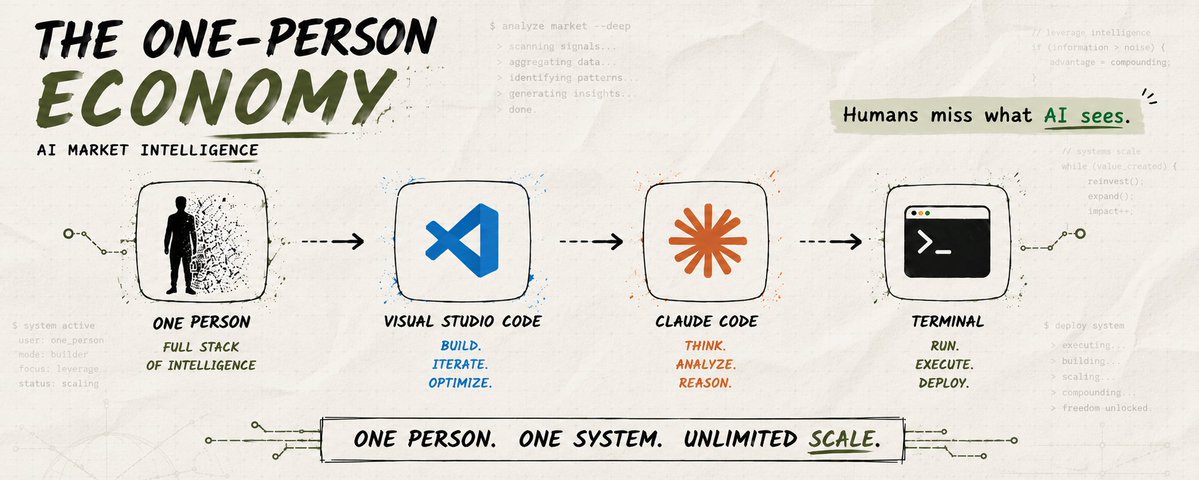
## The Shift Nobody Fully Sees Yet
Ten years ago, one person with a laptop could start a company.
Today, one person with AI can operate like one.
That's the part most people miss. Starting was never the hard part. Operating was.
The reason solo founders capped out at "small" wasn't ambition. It was the moment the work split into things one person couldn't be good at simultaneously — writing, building, researching, selling, supporting, hiring.
You had to choose what to be bad at. AI didn't make anyone great at all of them. It made them good enough at all of them at the same time.
That's the actual shift.
Not "10x productivity." Not "AI agents do your job."
The collapse of specialization as a requirement to compete.
Pick any solo SaaS doing $500K ARR right now. Five years ago it needed seven people — a developer, a designer, a marketer, a support lead, a copywriter, an ops person, a founder to coordinate them
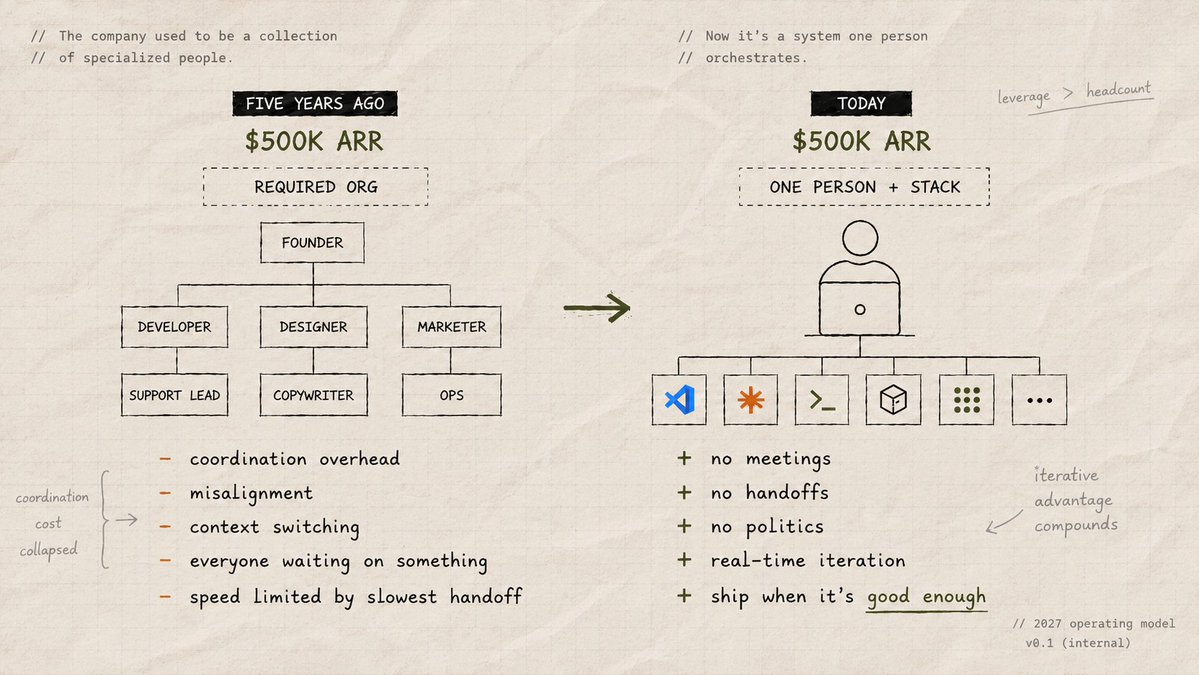
Today it needs one person and a stack.
Nothing about it is best-in-class. All of it is above the threshold where customers leave.
The market doesn't reward perfect anymore. It rewards complete.
And one person, with the right stack, can now be complete.
Most people still think they're looking at tools. They're looking at the end of the org chart as a competitive moat.
## The Internet Gave Distribution. AI Gives...
The internet gave distribution.
Anyone could publish. Anyone could sell. Anyone could reach millions.
That shift created the creator economy, indie hackers, Shopify brands, solo media companies.
But distribution was only half the problem.
You could get attention. You could get traffic. You could even get customers. What you couldn’t get was execution.
Because execution still depended on people.
Design. Research. Code. Ops. Support.Marketing.Analysis.
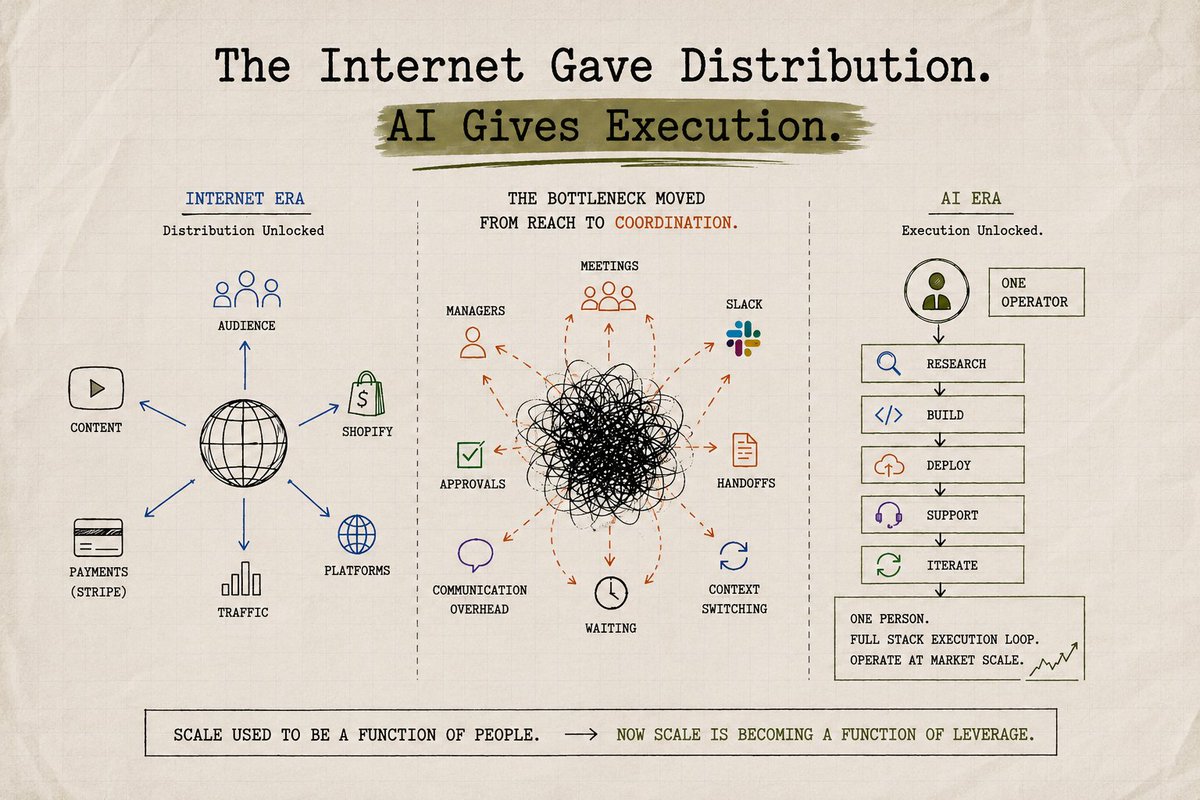
The bottleneck moved from reach to coordination. Every increase in output required more people.
More people meant more communication. More communication meant more overhead. At some point, companies stopped scaling execution and started scaling coordination. That’s why most internet-native businesses still became organizations.
A solo founder with a $10M product still ended up with: 80 employees,three Slack workspaces and a head of people.
The internet removed geographic friction.
AI removes operational friction.
That’s the actual shift.
AI changes the equation not because it replaces humans.
But because it reduces the number of humans required for coherent execution.
The internet let one person access the market. AI lets one person operate at market scale. Scale used to be a function of people. Now scale is becoming a function of leverage. And that changes the economics of building completely.
The old advantage was distribution.
The new advantage is execution leverage.
Most people still think AI is another productivity tool. It’s not. Companies were systems for coordinating people. AI is becoming a system for reducing the need for coordination itself.
The companies that win the next decade may not look like companies at all.
## Intelligence Became Infrastructure
For most of history, intelligence was trapped inside people.
If you wanted more capability, you needed more people.
Capability scaled linearly with headcount.
Every new hire bought capability and bought friction.That limit built every modern organization — a system for concentrating and coordinating human intelligence.
Infrastructure changes systems.
Electricity did.
The internet did.
Now AI is doing the same thing to intelligence itself. That's the shift most people still don't fully see.
Intelligence is no longer confined to individuals. It's becoming embedded into systems.
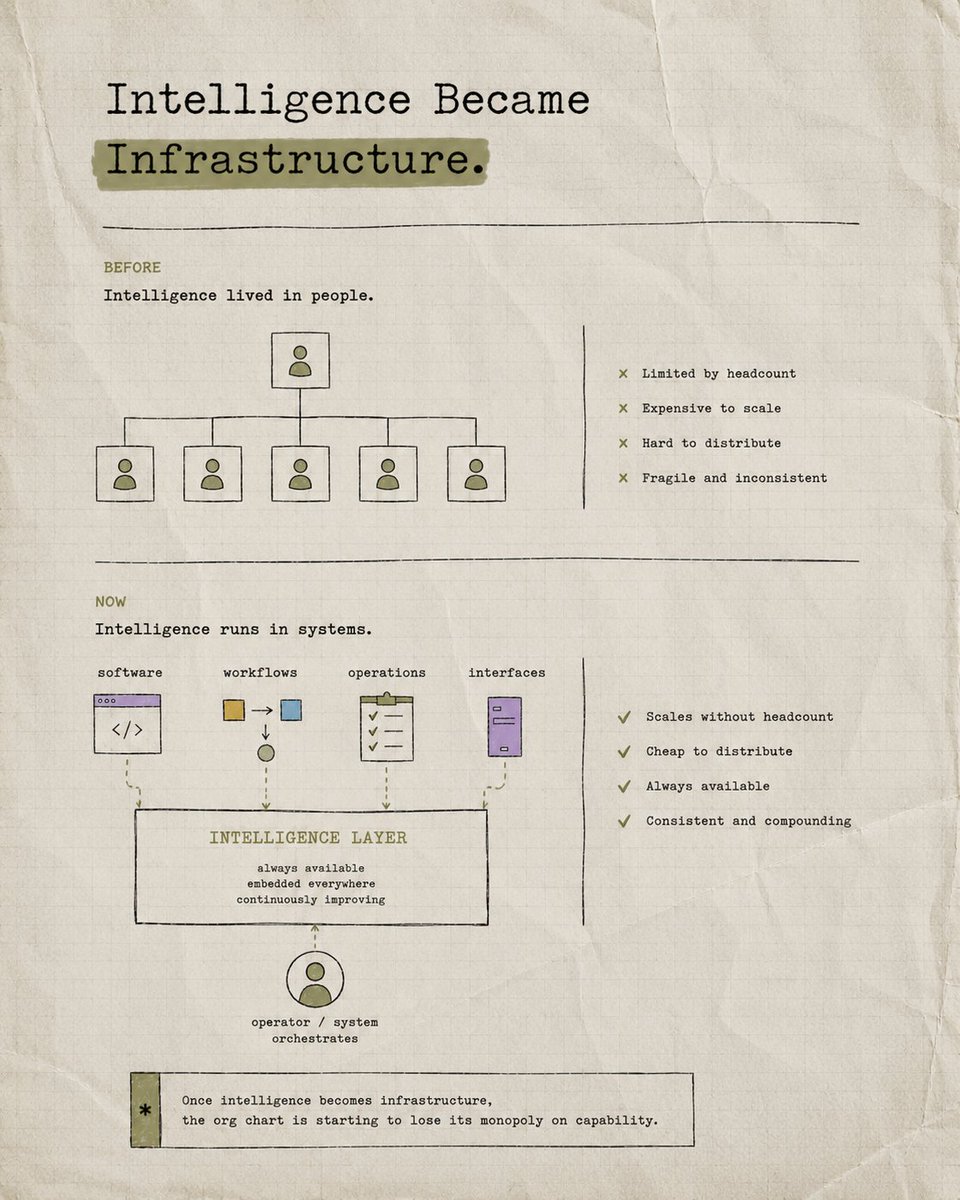
Into software.
Into workflows.
Into pipelines.
Into interfaces.
Into every layer where decisions used to require humans.
Parsing a contract used to take a paralegal. Now it takes a function call.It doesn't need to be superintelligent. It only needs to be available.
Widely distributed.
Constantly accessible.
Cheap enough to become ambient.
And the moment intelligence becomes ambient,
organizations stop being the only container for capability.
Previous generations scaled through labor. This generation scales through cognition.
The advantage is no longer having more people. It's building better systems on top of the cognition layer.
Most people still think they're adopting AI. They're being adopted by a new substrate.
And infrastructure doesn't simply improve systems.
It reorganizes the world built on top of them.
The org chart's monopoly on capability is breaking.
## The Rise of the Operator
For most of modern history,
scale came from specialization.
Companies grew by adding people.
Researchers.
Designers.
Developers.
Managers.
Analysts.
Operators.
Every function became a department. Every department needed coordination.
That model worked because intelligence was trapped inside humans. Capability had to be assembled through organizations.
Organizations were humanity's way of aggregating intelligence
before intelligence became programmable.
But once intelligence becomes infrastructure, a different model starts to emerge. One of those old roles is about to outgrow its definition.
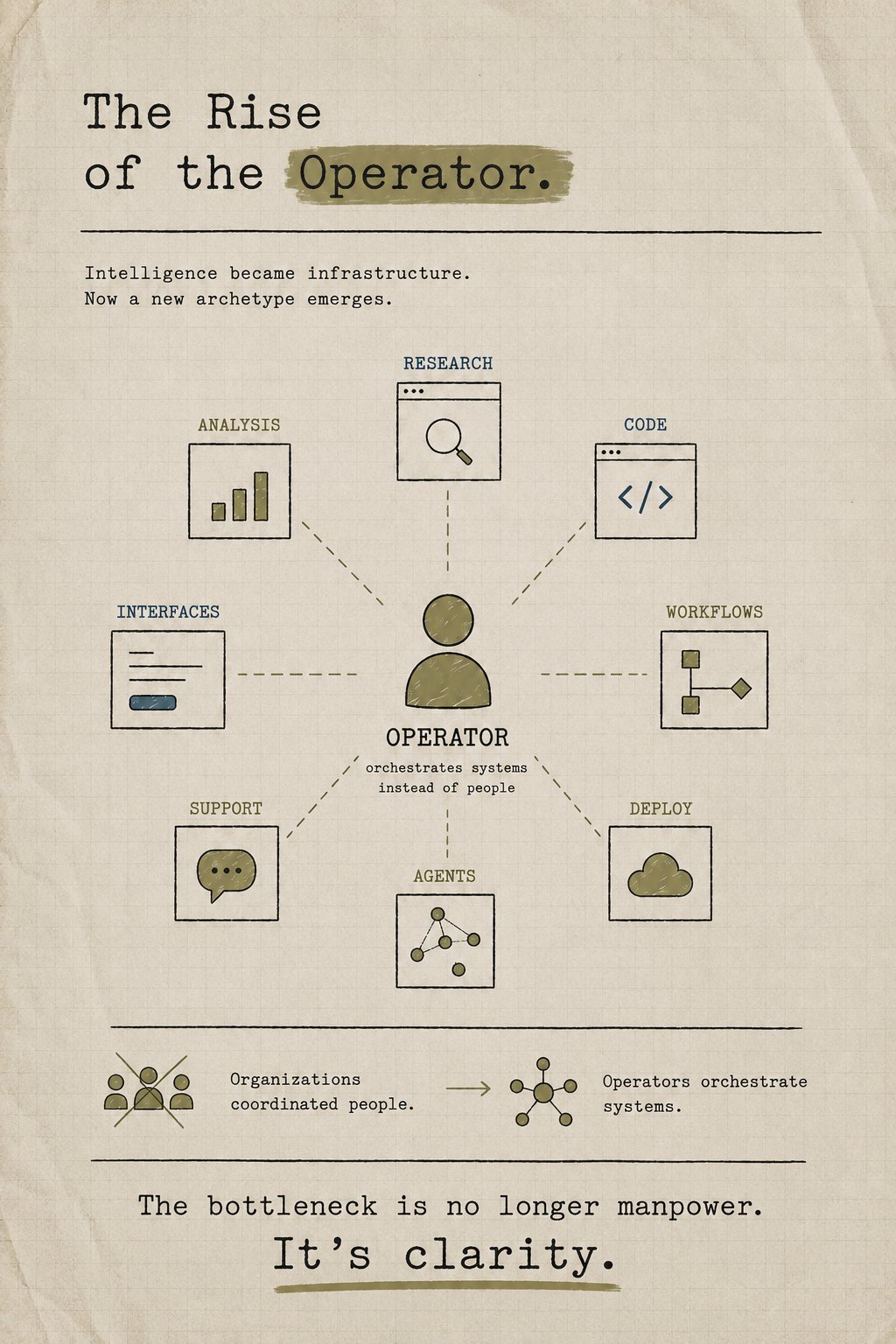
The operator.
The word used to describe the person at the bottom of the org chart —
the one who ran the machine someone else designed.
Now it describes the person who runs the whole stack.
Not a founder.
Not an employee.
Not a manager.
Someone who orchestrates systems instead of coordinating people.
Software became labor. Workflows became execution loops.
And the operator sits above the stack,
directing cognition instead of coordinating departments.
The operator wakes up to overnight outputs from five agents. Reviews the edges. Adjusts two prompts. Ships. By 10am they've moved what a team of twelve used to call a sprint.
One person can now orchestrate what previously required teams.
Research.
Code.
Design.
Analysis.
Deployment.
Support.
Iteration.
Not because one person suddenly became superhuman. But because capability stopped being tied to headcount. The bottleneck is no longer manpower.
It's clarity.
Knowing what to build.
What to ask.
What loop to run.
Previous generations built organizations to scale execution. This generation builds systems to scale cognition.
The operator doesn't manage people.
The operator manages leverage.
The operator is no longer a role inside the company.
The operator is becoming the company itself.
That changes the economics of building.
The speed of iteration. The cost of execution. The size of teams. The structure of organizations.
Management layers were built for a world
where cognition didn't scale.
Most people still think AI is creating better tools.
It's creating a new operational class.
The dominant companies of the next decade will look less like organizations
and more like operators with infrastructure behind them.
## One Person Can Now Operate Like an Organization.
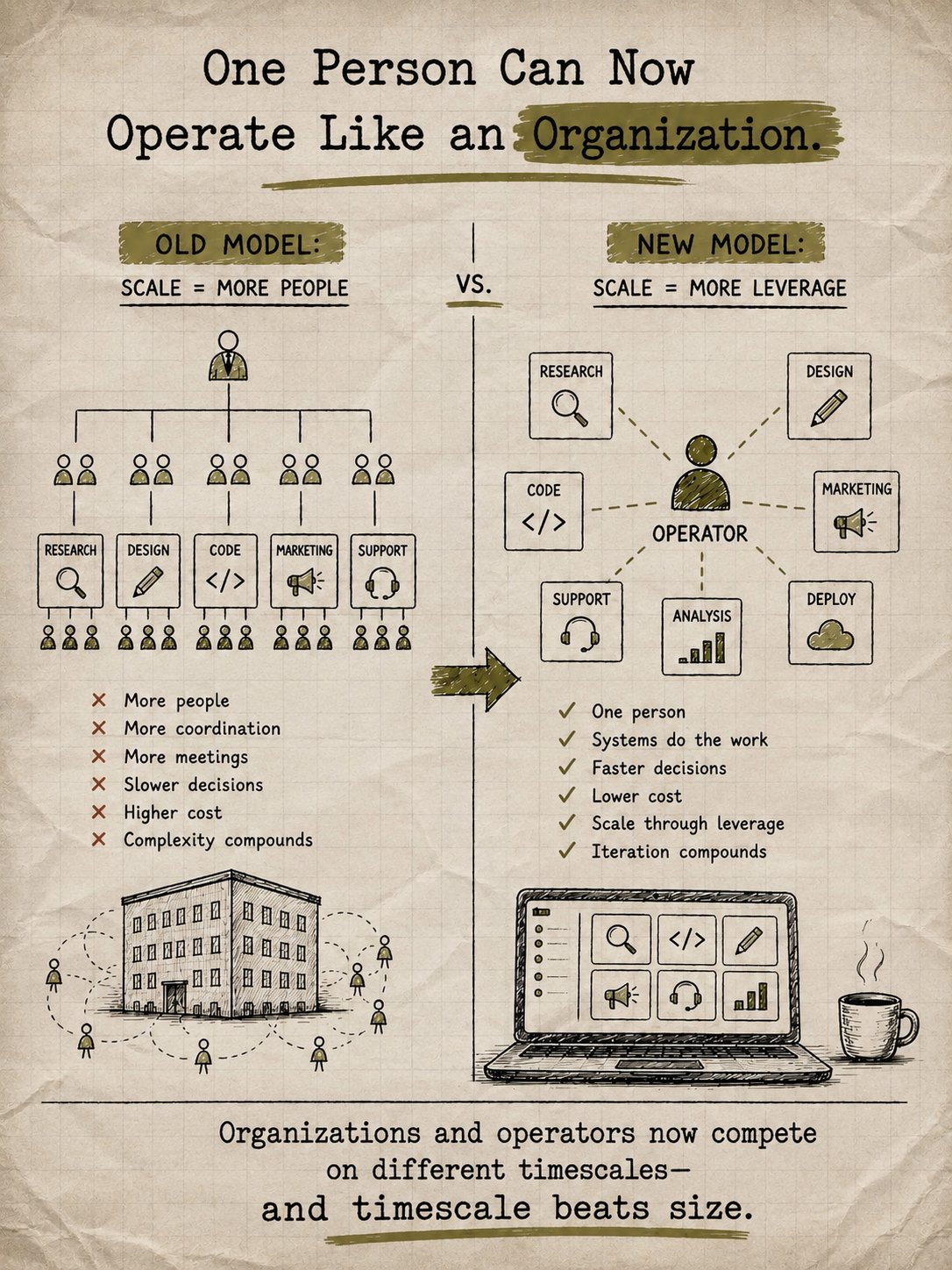
Operating at scale used to require an organization.
The default formula was simple: more people, more output.
More engineers.
More marketers.
More analysts.
More managers.
More support staff.
That was the scaling model of the industrial and software eras.But one person no longer needs to perform every function. They only need to orchestrate them.
Research no longer requires a research department. Design no longer requires a design team. Support no longer requires a support floor.
Execution is becoming modular. Intelligence is becoming on-demand.
A founder can now run product, marketing, support, and distribution from the same terminal.
What used to require a floor of operators now fits inside a browser tab.
Not perfectly.
But the market increasingly rewards complete systems over perfect specialists.
That's the trade most builders haven't priced in yet.
A solo operator who ships a working loop on Tuesday beats a team of twelve who'll ship a polished one in Q3.
The distance between idea and deployment is collapsing.
What used to take a quarter takes a weekend.
What used to take a meeting takes a prompt.
What used to take a department takes a workflow.
And iteration compounds faster than organizations can react.
Every cycle the operator ships, the org chart needs another meeting just to agree on direction.
Decisions made in hours outrun decisions made in weeks.
The result isn't that companies disappear.
It's that organizations and operators now compete on different timescales -
and timescale beats size.
# Scale No Longer Requires Headcount
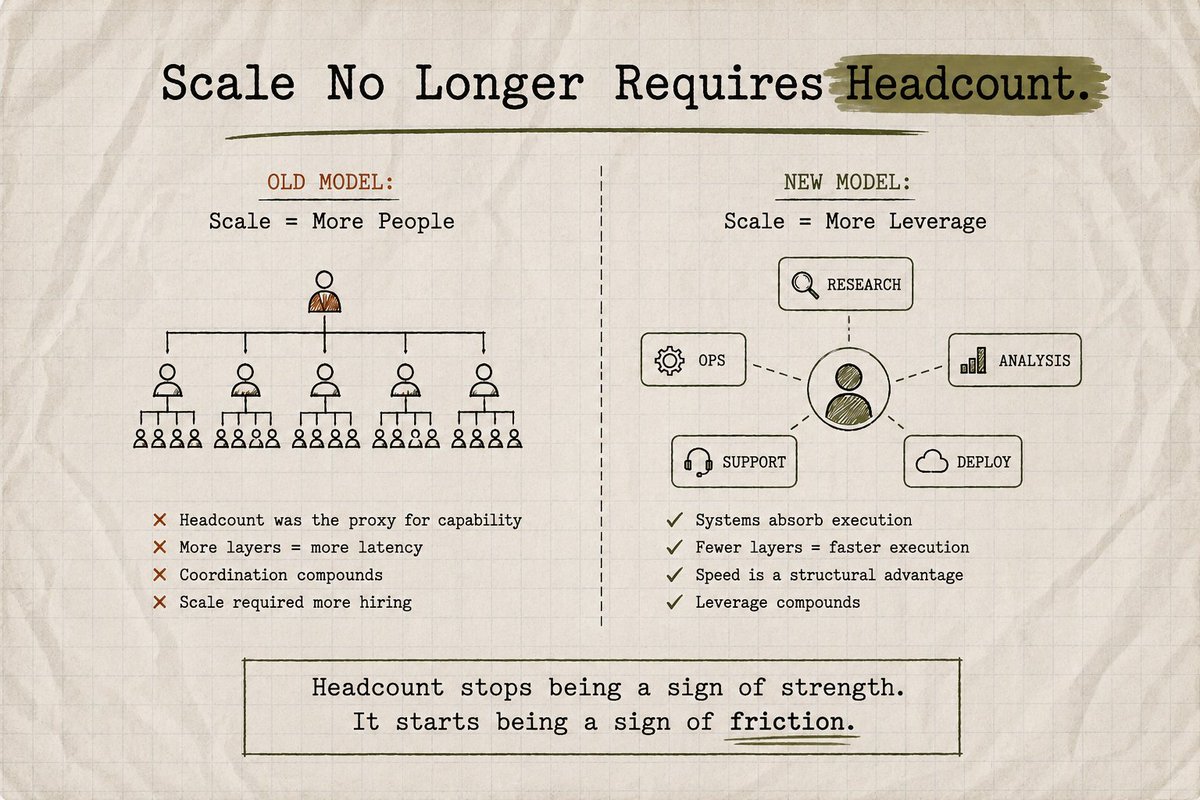
Headcount was the proxy for capability.
If you wanted to know how big a company actually was, you counted people.
Customers per support rep. Revenue per engineer. Output per analyst.
That proxy is losing accuracy.
Because systems now absorb more of the execution layer.
Research scales through models.
Support scales through agents.
Operations scale through workflows.
Analysis scales through infrastructure.
Capability is leaking out of payroll and into systems.A small team with high-leverage systems can now outperform organizations that are structurally larger.
Not because large companies suddenly became weak.
But because coordination compounds slower than execution.
Every additional layer adds latency.
Meetings.
Approvals.
Handovers.
Alignment cycles.
Management overhead.
Meanwhile the operator ships again.
Speed is no longer just a cultural advantage.
It's a structural one.
Coordination-heavy structures react slowerthan the systems competing against them.
So what's the right metric?
Output per operator.
Cycles shipped per quarter.
Distance from idea to deployment.
These matter more than how many people are on payroll.
The dominant companies of the next decade
will look structurally small
relative to the scale they control.
Headcount stops being a sign of strength.
It starts being a sign of friction.
# The Era Has Already Started
The strange thing about new eras is that they rarely announce themselves. They begin as edge cases. Tiny anomalies.
People most dismiss. But the future this essay describes is already running.Most people just haven't looked.
Pieter Levels runs a portfolio of products from a single laptop.
Nomad List. Photo AI. Remote OK.
No employees. No office. No funding.
His public revenue runs into millions per year - the kind of number that used to require a Series A and a team of forty. He built most of it before AI was usable. Now he builds with it. The new tools didn't create him. They confirmed him. He's not the only one.
Tony Dinh ships TypingMind alone - revenue that funds him without hires. Marc Lou publishes his MRR openly, from a list of products no team built.
Danny Postma quietly acquires other solo products and runs them like a one-person holding company. These aren't anomalies anymore. They're the early outline of a class.
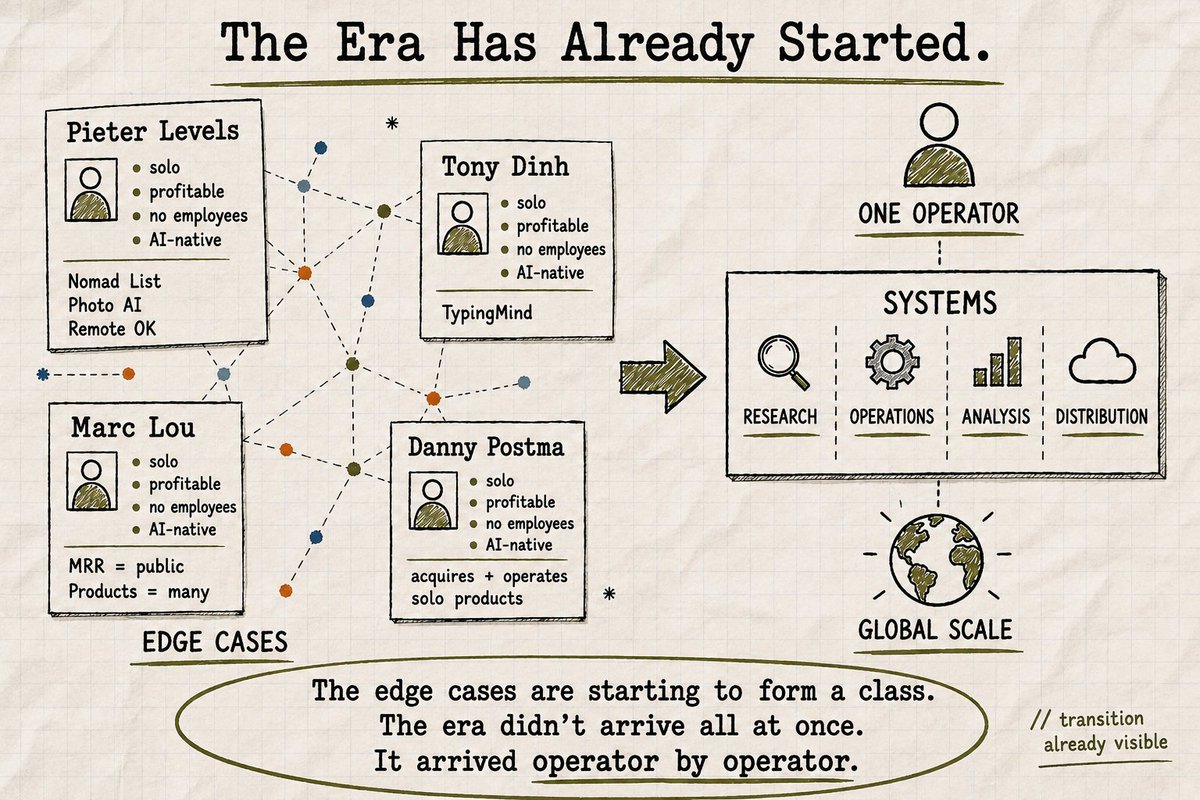
A new economic archetype is emerging in public. For decades, the answer to"how do I scale?" was always the same: hire.
Now there's a second answer. You can hire. Or you can orchestrate.
Most existing organizations still default to the first. A growing number of new ones default to the second. Because orchestration scales faster than coordination.
That's not a forecast. That's the present. The era didn't begin when AI became intelligent. It began when intelligence became operational.
And by every public metric,hat era has already started.
[ operator by operator ]
## 相关链接
- [@Coldly](https://x.com/Just_Codly)
- [@Just_Codly](https://x.com/Just_Codly)
- [244K](https://x.com/Just_Codly/status/2056168423202099462/analytics)
- [Support.Marketing](https://support.marketing/)
- [call.It](https://call.it/)
- [Upgrade to Premium](https://x.com/i/premium_sign_up)
- [8:22 AM · May 18, 2026](https://x.com/Just_Codly/status/2056168423202099462)
- [244.5K Views](https://x.com/Just_Codly/status/2056168423202099462/analytics)
- [View quotes](https://x.com/Just_Codly/status/2056168423202099462/quotes)
---
*导出时间: 2026/5/30 11:00:23*
---
## 中文翻译
# 一人经济的时代已经到来
**作者**: @Coldly
**日期**: 2026-05-18T00:22:08.000Z
**来源**: [https://x.com/Just_Codly/status/2056168423202099462](https://x.com/Just_Codly/status/2056168423202099462)
---

## 尚未被完全察觉的转变
十年前,一个人只要有一台笔记本电脑就能创办公司。
今天,一个人只要拥有 AI,就能像一家公司那样运作。
这是大多数人忽略的一点。创业从来都不是最难的部分。运营才是。
独立创业者的规模之所以止步于“小”,并非因为缺乏野心。而是因为工作一旦分裂成一个人无法同时擅长的多个领域——写作、开发、调研、销售、客服、招聘——就会触及天花板。
你不得不选择自己在哪一方面平庸。AI 并没有让人在所有领域都变得卓越,它只是让人在所有领域同时达到了“足够好”的水平。
这才是真正的转变。
不是“10 倍生产力”。也不是“AI 智能体替你干活”。
专业分工作为竞争必要条件的崩塌。
随便挑一个目前年经常性收入(ARR)达到 50 万美元的独立 SaaS 项目。五年前这需要七个人——一名开发、一名设计师、一名营销人员、一名客服主管、一名文案、一名运营人员,以及一名负责统筹的创始人。

现在,这只需要一个人加一套技术栈。
没有任何环节是顶尖的。但所有环节都超过了客户流失的阈值。
市场不再奖励完美。它奖励完整。
而一个人,只要拥有合适的工具栈,现在就可以做到完整。
大多数人仍以为他们看到的是工具。他们看到的是组织结构图作为竞争护城河的终结。
## 互联网解决了分发,AI 解决了……
互联网解决了分发。
任何人都可以发布。任何人都可以销售。任何人都可以触达数百万用户。
这种转变创造了创作者经济、独立黑客、Shopify 品牌、单人媒体公司。
但分发只解决了问题的一半。
你可以获得关注。你可以获得流量。你甚至可以获得客户。你无法获得的是执行力。
因为执行力仍然依赖于人。
设计。调研。代码。运营。支持。营销。分析。
瓶颈从触达转移到了协调。每一次产出的增加都需要更多的人。
更多的人意味着更多的沟通。更多的沟通意味着更多的开销。到了某个节点,公司不再扩张执行力,而是开始扩张协调能力。这就是为什么大多数原生互联网企业最终还是变成了组织。

一个打造了千万级产品的独立创始人,最终还是会拥有:80 名员工,三个 Slack 工作区,和一位人力资源主管。
互联网消除了地理摩擦。
AI 消除了运营摩擦。
这才是真正的转变。
AI 改变了方程式,不是因为它取代了人类。
而是因为它减少了连贯执行所需的人类数量。
互联网让一个人得以进入市场。AI 让一个人得以在市场规模上运作。规模曾经是人数的函数。现在规模正成为杠杆的函数。这彻底改变了创业的经济学。
旧的优势是分发。
新的优势是执行杠杆。
大多数人仍认为 AI 只是另一种生产力工具。不是。公司曾是协调人的系统。AI 正在成为一种减少协调本身需求的系统。
未来十年获胜的公司,可能看起来根本不像公司。
## 智能正在成为基础设施
在人类历史的大部分时间里,智能被困在人体内。
如果你想要更强的能力,你需要更多的人。
能力与人数呈线性缩放。
每一次新招聘都买来了能力,也买来了摩擦。这种限制构建了每一个现代组织——一个集中和协调人类智能的系统。
基础设施改变系统。
电力做到了。
互联网做到了。
现在 AI 对智能本身做着同样的事情。这是大多数人仍未完全看到的转变。
智能不再局限于个体。它正被嵌入到系统中。

嵌入到软件中。
嵌入到工作流中。
嵌入到管道中。
嵌入到接口中。
嵌入到过去每一个需要人类做出决策的层级。
解析合同过去需要一名律师助理。现在只需要一个函数调用。它不需要超级智能。它只需要被需要。
广泛分发。
随时可取。
足够便宜,以致无处不在。
一旦智能变得无处不在,
组织就不再是能力的唯一容器。
上一代人通过劳动扩张规模。这一代人通过认知扩张规模。
优势不再在于拥有更多的人。而在于在认知层之上构建更好的系统。
大多数人仍以为他们在采用 AI。实际上他们正被一种新的底层设施所接纳。
而且基础设施不仅仅是改进系统。
它会重组建立在它们之上的世界。
组织结构图对能力的垄断正在破裂。
## 操作者的崛起
在现代历史的大部分时间里,
规模来自于专业分工。
公司通过增加人来成长。
研究员。
设计师。
开发者。
经理。
分析师。
操作人员。
每个职能都变成了一个部门。每个部门都需要协调。
这种模型行得通,因为智能被困在人类体内。能力必须通过组织来组装。
组织是人类在智能变得可编程之前,
聚合智能的方式。
但一旦智能变成基础设施,一种不同的模型就开始浮现。那些旧角色中,有一个正在超越其定义。
操作者。
这个词过去用来形容组织结构图最底层的人——
那个运行着别人设计的机器的人。
现在它形容运行整个技术栈的人。

不是创始人。
不是员工。
不是经理。
是一个编排系统而不是协调人的人。
软件变成了劳动力。工作流变成了执行循环。
操作者坐在技术栈之上,
指挥认知而不是协调部门。
操作者醒来时,面对五个智能体的一夜产出。审查边缘情况。调整两个提示词。发布。到上午 10 点,他们已经完成了一个 12 人团队过去称之为“冲刺”的工作量。
一个人现在可以编排过去需要团队才能完成的事情。
调研。
代码。
设计。
分析。
部署。
支持。
迭代。
不是因为一个人突然变成了超人。而是因为能力不再与人头挂钩。瓶颈不再是人力。
而是清晰度。
知道该构建什么。
知道该问什么。
知道该运行什么循环。
上一代人构建组织是为了扩张执行力。这一代人构建系统是为了扩张认知。
操作者不管理人。
操作者管理杠杆。
操作者不再是公司内部的一个角色。
操作者正在变成公司本身。
这改变了创业的经济学。
迭代的速度。执行的成本。团队的规模。组织的结构。
管理层级是为一个认知无法扩张的世界而建的。
大多数人仍认为 AI 正在创造更好的工具。
它正在创造一种新的运营阶层。
未来十年的主导公司将看起来不那么像组织,
而更像是拥有基础设施支持的操作者。
## 一个人现在可以像组织一样运作
过去,规模化运作需要组织。
默认公式很简单:更多人,更多产出。
更多工程师。
更多营销人员。
更多分析师。
更多经理。
更多支持人员。
那是工业时代和软件时代的扩张模型。但一个人不再需要亲自履行每一个职能。他们只需要编排这些职能。
调研不再需要调研部门。设计不再需要设计团队。支持不再需要客服楼层。
执行正在变得模块化。智能正在变得按需提供。
创始人现在可以从同一个终端运行产品、营销、支持和分发。
过去需要一层楼操作员才能完成的工作,现在塞得进一个浏览器标签页。

并不完美。
但市场越来越奖励完整的系统,而不是完美的专家。
这是大多数建造者尚未计入成本的交易。
一个在周二发布可用循环的独立操作者,会打败一个要在第三季度发布完美产品的十二人团队。
想法与部署之间的距离正在坍塌。
过去需要一个季度的工作现在只需一个周末。
过去需要一个会议的工作现在只需一个提示词。
过去需要一个部门的工作现在只需一个工作流。
而且迭代的复合速度比组织的反应速度还要快。
操作者每一次发布循环,组织结构图都需要再开一次会议才能达成方向一致。
几小时内做出的决策跑赢几周内做出的决策。
结果并不是公司消失。
而是组织和操作者现在在不同的时间尺度上竞争——
而时间尺度战胜规模。
# 规模不再需要人头
人头曾是能力的代理指标。
如果你想知道一家公司的实际规模,你就数人。
每个客服代表对应多少客户。每个工程师对应多少收入。每个分析师对应多少产出。
这个代理指标正在失去准确性。
因为系统现在吸收了更多的执行层。
调研通过模型扩张。
支持通过智能体扩张。
运营通过工作流扩张。
分析通过基础设施扩张。
能力正从工资单泄漏到系统中。一个拥有高杠杆系统的小团队现在可以胜过结构上更大的组织。

不是因为大公司突然变弱了。
而是因为协调的复合速度比执行慢。
每一层额外的层级都会增加延迟。
会议。
审批。
交接。
对齐循环。
管理开销。
与此同时,操作者又发布了一次。
速度不再仅仅是一种文化优势。
它是一种结构性优势。
重协调的结构的反应速度比与其竞争的系统更慢。
那么什么是正确的指标?
每个操作者的产出。
每季度发布的周期数。
从想法到部署的距离。
这些比工资单上有多少人更重要。
未来十年的主导公司,
相对于它们控制的规模,
其结构上将看起来很小。
人头不再是实力的标志。
它开始成为摩擦的标志。

# 时代已经开始
新时代的奇怪之处在于它们很少自我宣布。它们始于边缘案例。微小的异常。
人们大多不予理会。但这篇文章所描述的未来已经在运行了。大多数人只是没有看到。
Pieter Levels 在一台笔记本电脑上运行着一系列产品。
Nomad List。Photo AI。Remote OK。
没有员工。没有办公室。没有融资。
他的公开收入每年高达数百万——这种数字过去需要 A 轮融资和一个四十人的团队。他在 AI 可用之前就构建了大部分业务。现在他用 AI 构建。新工具并没有创造他。它们证实了他。他不是唯一的。
Tony Dinh 独自发布了 TypingMind——其收入足以支撑他的生活而无需雇佣他人。Marc Lou 公开发布他的 MRR,来自一系列并非团队构建的产品。
Danny Postma 默默收购其他独立产品,并像一家一人控股公司一样运营它们。这些不再是异常。它们是一个新阶层的早期轮廓。

一种新的经济原型正在公开涌现。几十年来,对于“如何扩张?”这个问题的答案总是同一个:雇佣。
现在有了第二个答案。你可以雇佣。或者你可以编排。
大多数现有的组织仍然默认选择前者。越来越多的新组织默认选择后者。因为编排比协调扩张得更快。
这不是预测。这是当下。这个时代不是在 AI 变得智能时开始的。它是在智能变得可操作时开始的。
而且根据所有公开指标,那个时代已经开始。
[ 一个接一个的操作者 ]
## 相关链接
- [@Coldly](https://x.com/Just_Codly)
- [@Just_Codly](https://x.com/Just_Codly)
- [244K](https://x.com/Just_Codly/status/2056168423202099462/analytics)
- [Support.Marketing](https://support.marketing/)
- [call.It](https://call.it/)
- [Upgrade to Premium](https://x.com/i/premium_sign_up)
- [8:22 AM · May 18, 2026](https://x.com/Just_Codly/status/2056168423202099462)
- [244.5K Views](https://x.com/Just_Codly/status/2056168423202099462/analytics)
- [View quotes](https://x.com/Just_Codly/status/2056168423202099462/quotes)
---
*导出时间: 2026/5/30 11:00:23*