如何从任何逆境中翻盘(博弈论视角) ✍ Incentivising🕐 2026-07-27📦 13.8 KB 🟢 已读 𝕏 文章列表 文章运用博弈论原理,分析了如何在失败后实现翻盘。核心观点包括:首要目标是存活而非立即回本;落后时应增加变数而非盲目努力;重建速度无法与崩溃速度相提并论。文章强调策略重于模糊哲学,主张通过改变策略而非加大投入来实现逆袭。 博弈论策略翻盘方法论决策风险管理逆向思维心理学自我提升策略思维 # How To Come Back From Anything (Game Theory) **作者**: Incentivising **日期**: 2026-07-27T09:33:59.000Z **来源**: [https://x.com/incentivising/status/2081674449925931467](https://x.com/incentivising/status/2081674449925931467) ---   No fancy introduction or ornamentation for this article. You have read the title. You know what it is all about. Let me state one fact in the clearest possible way: This is not self-help. I will not suggest reading three books a day. Nor will I ask you to "just get a gym membership." That is insufficient advice, and you know it by now. Instead, I will treat you as an intelligent adult while demanding your attention and funneling it strictly toward game theory. Toward strategy over ambiguous philosophies. Toward compounding progress rather than static positions. If you are doing well right now, consider saving this article. It is always a favorable idea to save an exit route in this unpredictable world. ## Contents Include 1. The Truth About The Comeback 2. Precept 1: Survive the Round First 3. Precept 2: When Behind, Add Variance 4. Precept 3: You Cannot Rebuild at the Same Speed You Broke 5. Precept 4: Stop Paying Into Lost Positions ## The Truth About The Comeback You can come back from almost anything. That is a plain fact. You and nearly everyone else in this world already know that. Until you are caught in a situation that demands a comeback. Suddenly, all your prior escape routes, if you have prepared any, seem inaccessible or blocked. You begin fearing the idea of "building anew," so you find yourself scrambling for ideas to plot a recovery attempt. This is what causes just about every single great collapse. Understand this: a flawed recovery attempt is worse than the initial fall simply because it opens pits no one could ever hope to anticipate. This is where game theory steps in. It explains what caused your downfall and prescribes the exact, counterintuitive sequence that gets you back into the game. ## Precept 1: Survive the Round First You do not have to win the round you lost. But you need to survive it. Whenever you lose something, your first instinct will always be to reach for an immediate recovery. Usually, it manifests as a commitment to an initiative meant to erase all your losses in one single stroke. Remortgage on the comeback trade, all in to win it straight back tonight. Surely, you already recognize it to be nothing more than a delusional Hail Mary. Yet you do it all the time. The white lie in relationships. The act of rapidly panic-selling stocks. The immediate desire for revenge when crossed. And it always ends the same way: you end up making it significantly worse than before for everyone involved and have now effectively opened an even deeper pit for yourself. What you must understand is that just about every single game worth being in is an iterated game: one consisting of multiple rounds, where each round affects subsequent engagements. This is the foundational logic behind iterated game theory, where cooperation and recovery emerge precisely because the game continues (Axelrod, 1984; Friedman, 1971). The future rounds are where recovery is meant to happen. Losing the current round does not automatically eliminate you from participating in the next phases. Despite that, there exists precisely one singular state you cannot recover from: total elimination. Absolute ruin is the only irreparable position. It offers no opportunity to participate in the subsequent phase of an iterated game, forcing you out for all time. Committing to one last desperate act inadvertently creates the ideal downward spiral into your very own ruin. It is a bitter irony. All your resources, time, money, and focus will melt away just for one delusional shot at erasing a bad round. In the process, you are gambling away the one thing that makes recovery even feasible: continued play. 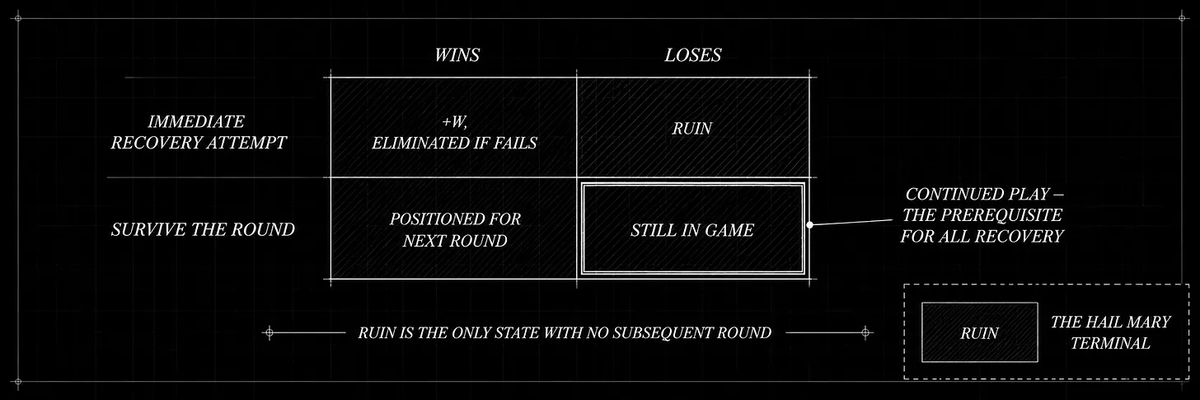 It is akin to a doctor amputating your arm because you have a minor infection in a hemorrhaged index finger. The irrationality knows no bounds. ## The Reversal: Survive Before You Thrive Stop the bleeding first. Plan the return afterward. Most of your downfalls are a cut at the calf. A movement-restricting annoyance, but it will not kill you outright. At least as long as you do not try running a marathon with it. The infected wound is the harshest death because everyone knows that it could have been treated. The first move of an excellent comeback is therefore not a win. The first move is the attempt not to be permanently eliminated. You must preserve enough capital, credibility, health, or autonomy to return to the table in the next round. Cut the loss and secure a solid floor before the situation turns into a bottomless pit. That is the first act of the comeback. Learn to acknowledge that staying in the game is boring, unheroic, and the entire ballgame. 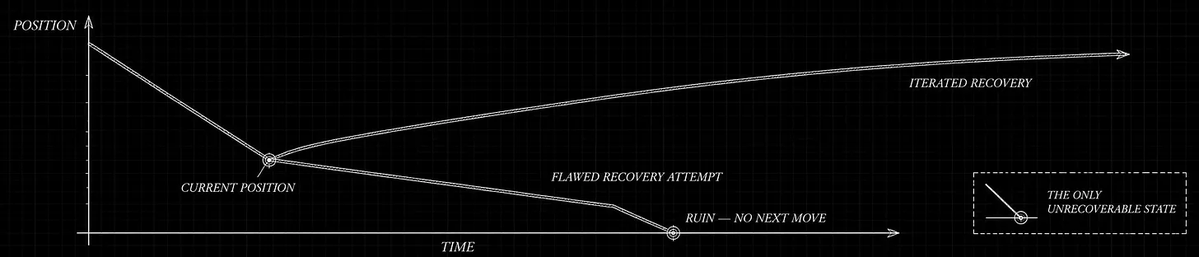 ## Precept 2: When Behind, Add Variance After a downfall, you will inevitably find yourself assuming that you must "grind harder" along the concrete line that led you to your loss. More hours, more intensity, same strategy. "I just need more of everything!" The volume game fallacy. Now, do not deceive yourself and think honestly about it. You will realize this is just rehearsing the same loss for the sake of it. Unless you are a deranged masochist, you should avoid this mindset, because the floor does not get softer the more you fall onto it. In fact, it will break down and sentence you to even lower depths. The "grind harder" strategy is basically just the Hail Mary gamble in a more deceitful disguise. It surely looks like effort, and it probably is. That does not imply that it is good, though. At least the gamble from Precept 1 either saves you or permanently terminates the game for you. The common grinding strategy does neither. You risk rearranging the game around your losses and trapping yourself in a perpetual loop of increasing workload while decimating your payoffs. This is pure reactivity, and you will ultimately find yourself building sandcastles in an hourglass. Committing to a strategy that bears all the risks of a gamble and none of the payoff is worse than choosing between fighting or folding. It also changes nothing about what caused the loss in the first place. Stop feeding the loop at once. ## The Reversal: Change the Shape of the Bet If your current trajectory reliably produces losses, you need to commit to moves that widen the distribution. Unconventional moves, asymmetric bets, the doors no individual in a safe position would even consider opening because they are that uncomfortable. This is not a lesson in total recklessness. This is not about encouraging you to take a ginormous gamble that risks eliminating you entirely. It is about the realization that you, in your position of loss, possess one strategy that no one else possesses: the ability to abandon the safe line. Analyze what led to your prior loss, visualize its trajectory, and then take a different path from there. Take any chance to deviate from the trajectory that led to failure, regardless of how outlandish it seems. The position at the bottom gives free rein to experiment. Likewise, a chess player in a losing position will not trade pieces. He knows that trading simplifies the board, and a simpler board favors whoever is currently ahead. Fewer pieces means fewer chances for the losing side to generate a tactic, after all. So, the losing player deliberately makes the position messier and harder to calculate. A chaotic board at least contains a mistake the opponent might make. He manufactures variance because clarity would kill him. ## Precept 3: You Cannot Rebuild at the Same Speed You Broke Restore it all in one grand gesture. One dramatic move, a big announcement, the one act that will erase the fall and put everything back in place. Similar identity to the gamble, yet fundamentally different. You will have a natural inclination toward this idea in particular because it creates a narrative. Contrary to Precept 1, the usual idea behind this strategy is not a desperate gamble but a sudden construction of a second empire. Such an idea is seductive to you for all the right reasons, yet leads to all the wrong decisions. Destruction and construction are asymmetric in every domain. Construction is almost linear in its appearance, whereas destruction is exponential. A reputation, a fortune, a skill, a body, a relationship: each is built additively over an extended run of consistent inputs, yet each can be destroyed in just one or two simple actions. Even worse, stating that you intend to rebuild faster appears fake due to the emphasis on speed itself. Speed is a signature of a cheap signal. It is simply something anyone could assert at virtually any time. As such, announcing that you have "completely changed" just one day after a catastrophe is both a comedically ridiculous sentence to utter while somehow also managing to be the cheapest sentence you could have constructed in the entire realm of language. ## The Reversal: Use Time as the Signal Time is the only thing that cannot be cheaply faked. Consistent performance across a span long enough that a pretender would have already quit is the single highest source of credibility you could attain. This is the costly signal in its purest form: uncheatable proof that no shortcut can replicate (Spence, 1973; Crawford & Sobel, 1982). It is, quite literally, uncheatable proof, regardless of who your audience might be. Whether they are a lender, an employer, or a partner is not relevant. If your comeback is contingent on the dependency that other people believe in a new version of you, then pay in a currency they can verify. A sustained cost of your time rather than a promise tainted by cheap talk. The speed of your recovery is inversely proportional to how much any person believes it. ## Precept 4: Stop Paying Into Lost Positions "I have put three years, my savings, my whole reputation into this. I cannot walk away now!" This is the sunk-cost fallacy expressed aloud. And particularly in today's world, this is the most frequent and expensive decision a mind can make. Resources you have already spent are gone, regardless of whether their investment paid off or not. They also convey exactly zero information about whether the next dollar, hour, or year is even worth spending. "But I have already put so much in!" is the flawed reasoning a person uses before they convert a completely recoverable loss into a total collapse because they cannot get themselves to stop funding dead projects. You need to spare the resources you still have. They are your only chance at making a comeback. Without them, you are doomed. No one will explain it that plainly for you. ## The Reversal: Forget the Past and Enter the Present There is no need to pretend that this is not the trickiest advice to adhere to in this entire article. Your past decisions should remain in the past. Buried deep underground, locked in a place where it cannot influence you. The sole reason to revise a decision is to analyze it without permitting it to sway your judgments. Everything else is a brilliantly executed self-deception, a fable tainted by sunk costs, now masquerading as your own decision (Arkes & Blumer, 1985; Thaler, 1980). The only escape is to price every decision from the present as if you have just arrived and the past investments belonged to someone else entirely. Only one single question is allowed to roam inside your mind: given today's position, is continuing here the best available use of what I have left? If a stranger in your position cut it, then cut it. The money, time, and pride are already spent. The payoff, or lack thereof, is a lesson. One that will stick with you, sharpen you. Either way, the investment is gone. At this point, you must decide how much more you are willing to lose. ## A Final Diagnostic Most people do not lack the skill to pull off a comeback. In most cases, they lack the rationality and clarity required to survive a crisis. When overloaded with emotion and fear, the rational choice happens to be the choice that feels the most inaccurate, yet is the only decision that offers a realistic escape. This article is more like a survival guide than an advisorial piece. And you should use it accordingly. The average person can hide in their blissful ignorance, asserting that "they just did not know how to react." But today, you lost the right to this superficial excuse. More Articles available on Substack. ## Sources Axelrod, R. (1984). The Evolution of Cooperation. Basic Books. Friedman, J. W. (1971). A Non-Cooperative Equilibrium for Supergames. Review of Economic Studies, 38(1), 1-12. Spence, M. (1973). Job Market Signaling. Quarterly Journal of Economics, 87(3), 355-374. Crawford, V. P., & Sobel, J. (1982). Strategic Information Transmission. Econometrica, 50(6), 1431-1451. Arkes, H. R., & Blumer, C. (1985). The Psychology of Sunk Cost. Organizational Behavior and Human Decision Processes, 35(1), 124-140. Thaler, R. H. (1980). Toward a Positive Theory of Consumer Choice. Journal of Economic Behavior & Organization, 1(1), 39-60. ## 相关链接 - [Incentivising](https://x.com/incentivising) - [@incentivising](https://x.com/incentivising) - [41K](https://x.com/incentivising/status/2081674449925931467/analytics) - [More Articles available on Substack.](https://structuralist.substack.com/) - [Upgrade to Premium](https://x.com/i/premium_sign_up) - [5:33 PM · Jul 27, 2026](https://x.com/incentivising/status/2081674449925931467) - [41.7K Views](https://x.com/incentivising/status/2081674449925931467/analytics) - [View quotes](https://x.com/incentivising/status/2081674449925931467/quotes) --- *导出时间: 2026/7/27 23:33:07* --- ## 中文翻译 # 如何从任何困境中卷土重来(博弈论) **作者**: Incentivising **日期**: 2026-07-27T09:33:59.000Z **来源**: [https://x.com/incentivising/status/2081674449925931467](https://x.com/incentivising/status/2081674449925931467) ---   本文不做花哨的介绍或修饰。你已经读了标题。你知道这是关于什么的。 让我以最清晰的方式陈述一个事实:这不是自助文章。 我不会建议你每天读三本书。也不会叫你去“办张健身卡就行”。那是不够的建议,而且你现在也知道了。 相反,我会把你当作一个聪明的成年人,要求你的注意,并将它严格引导向博弈论。 导向策略而非模棱两可的哲学。导向复合进步而非静态立场。 如果你现在过得不错,考虑保存这篇文章。在这个不可预测的世界里,保留一条退路总是一个明智的想法。 ## 内容包括 1. 关于卷土重来的真相 2. 准则 1:先活过这一轮 3. 准则 2:落后时,增加方差 4. 准则 3:你无法以你倒塌的速度重建 5. 准则 4:停止为亏损的头寸买单 ## 关于卷土重来的真相 你几乎可以从任何困境中卷土重来。这是一个简单的事实。你和这个世界上几乎所有人都知道这一点。 直到你陷入一个需要卷土重来的境地。 突然间,你所有之前的退路(如果你准备了的话),似乎都变得遥不可及或被堵死了。你开始害怕“重新开始”的想法,所以你发现自己手忙脚乱地寻找点子,试图策划一次复苏尝试。 这正是几乎每一次巨大崩溃的原因。 请明白这一点:一次有缺陷的复苏尝试比最初的跌倒更糟糕,仅仅因为它制造了任何人都无法预料的陷阱。 这就是博弈论介入的地方。它解释了什么导致了你的垮台,并规定了确切的、反直觉的顺序,让你重回游戏。 ## 准则 1:先活过这一轮 你不必赢下你输掉的那一轮。但你需要活过它。 每当你失去某些东西时,你的第一本能总是试图立即挽回。 通常,这表现为致力于一项旨在一举消除所有损失的计划。为“翻身仗”再抵押,全押进去以求今晚直接赢回来。 当然,你已经认识到这不过是一种妄想式的孤注一掷。但你还是一直这么做。 人际关系中的善意谎言。恐慌性抛售股票的行为。被冒犯时立即产生的报复欲望。 结果总是如出一辙:你最终让每个人的处境都变得比以前糟糕得多,并且实际上为自己挖了一个更深的坑。 你必须明白的是,几乎每一个值得参与的游戏都是重复博弈:由多轮组成,每一轮都会影响后续的互动。这正是重复博弈论的基础逻辑,合作和复苏之所以出现,正是因为游戏在继续(Axelrod, 1984; Friedman, 1971)。 未来的轮次才是复苏发生的地方。输掉当前的一轮并不会自动取消你参与下一阶段的资格。 尽管如此,确实存在一种你无法从中复苏的状态:彻底淘汰。 彻底毁灭是唯一无法挽回的境地。它不提供任何参与重复博弈下一阶段的机会,迫使你永远出局。 致力于最后一次绝望的举动,无意中制造了通往你自己毁灭的理想下行螺旋。这是一个残酷的讽刺。你所有的资源、时间、金钱和注意力都会消融,只为了那一次妄想式的尝试,企图抹去糟糕的一轮。 在此过程中,你赌掉了唯一让复苏成为可能的东西:继续游戏的权利。  这就像医生因为你出血的食指有轻微感染而截掉你的手臂。这种非理性没有底线。 ## 逆转:先生存,后发展 先止血。再计划回归。 你大多数的垮台只是小腿上的一道口子。一种限制行动的烦恼,但它不会直接杀死你。至少只要你试图带着它跑马拉松就不会。感染的伤口是最残酷的死亡方式,因为每个人都知道它本来是可以治疗的。 因此,一次精彩卷土重来的第一步并不是胜利。第一步是试图不被永久淘汰。你必须保留足够的资本、信誉、健康或自主权,以便在下一轮回到谈判桌前。 在情况变成无底洞之前,砍掉亏损并确立坚实的底线。这是卷土重来的第一个行动。 学会承认,留在游戏中是无聊的、缺乏英雄色彩的,但这就是全部的关键。  ## 准则 2:落后时,增加方差 在一次垮台之后,你不可避免地会认为你必须沿着导致你失败的那条既定路线“更努力地磨砺”。更多的时间,更强的强度,同样的策略。 “我只是需要更多的这一切!”这就是数量博弈的谬误。 现在,不要自欺欺人,诚实地思考一下。你会意识到这只是为了它本身而重演同样的失败。除非你是一个变态受虐狂,否则你应该避免这种心态,因为地板不会因为你摔得更多而变软。事实上,它会崩塌并将你判入更深的深渊。 “更努力地磨砺”的策略基本上只是孤注一掷的赌博的一种更具有欺骗性的伪装。它看起来确实像努力,而且可能确实是。但这并不意味它是好的。 至少准则 1 中的赌博要么救了你,要么为你永久终止了游戏。常见的磨砺策略两者都不做。 你冒着围绕你的损失重新安排游戏的风险,让自己陷入工作量不断增加而回报不断减少的恶性循环。这是一种纯粹的反应性,你最终会发现自己就像在沙漏里堆沙堡。 致力于一种承担了赌博的所有风险却没有任何回报的策略,比在战斗或弃牌之间做选择更糟糕。它也没有改变导致最初失败的任何原因。 立即停止向这个循环输送能量。 ## 逆转:改变下注的形态 如果你目前的轨迹可靠地产生损失,你需要致力于能够扩大分布的举动。非传统的举动,不对称的下注,那些处于安全位置的人甚至都不会考虑打开的门,因为它们太令人不适了。 这不是关于彻底鲁莽的教训。这不是鼓励你去冒一种可能导致你被彻底淘汰的巨大风险。 这是关于意识到,处于损失位置的你,拥有一种其他人都没有的策略:放弃安全路线的能力。 分析导致你先前损失的原因,想象其轨迹,然后从那里走一条不同的路。抓住任何机会偏离导致失败的轨迹,无论它看起来多么荒诞。 底层的地位给了实验的自由。 同样,处于劣势的国际象棋棋手不会兑子。他知道兑子会简化棋盘,而简化的棋盘有利于目前领先的一方。毕竟,棋子越少,劣势方产生战术的机会就越少。 因此,劣势棋手故意让局面变得混乱且更难计算。混乱的棋盘至少包含对手可能犯的错误。 他制造方差,因为清晰会杀死他。 ## 准则 3:你无法以你倒塌的速度重建 用一个宏大的姿态恢复一切。一个戏剧性的举动,一个重大的宣布,那个能消除跌倒并将一切恢复原状的行为。 与赌博有着相似的身份,但在根本上是不同的。你自然会倾向于这个特定的想法,因为它创造了一个叙事。 与准则 1 相反,这种策略背后的通常想法不是绝望的赌博,而是突然建立第二个帝国。这样的想法以所有正确的理由引诱你,却导致所有错误的决定。 破坏和建设在每个领域都是不对称的。建设在其外观上几乎是线性的,而破坏是指数级的。 声誉、财富、技能、身体、关系:每一个都是通过长期的一致投入逐渐建立的,然而每一个都可能仅仅在一两个简单的行动中被摧毁。 更糟糕的是,声称你打算更快地重建,由于强调速度本身,看起来很假。速度是廉价信号的标志。它几乎只是任何人都可以在任何时候断言的东西。 因此,在灾难发生后仅仅一天就宣布你已经“彻底改变”,既是一句喜剧般荒谬的话,同时也不知何故成为了你在整个语言领域中能构造出的最廉价的话。 ## 逆转:用时间作为信号 时间是唯一不能被廉价伪造的东西。在足够长的时间跨度内保持一致的表现,以至于伪装者早就退出了,这是你能获得的最高信誉来源。这是最纯粹形式的昂贵信号:无法作弊的证明,没有任何捷径可以复制(Spence, 1973; Crawford & Sobel, 1982)。 确实,这是无法作弊的证明,无论你的观众是谁。他们是贷款人、雇主还是伙伴,都无关紧要。 如果你的卷土重来取决于其他人相信一个新版本的你,那么用一种他们可以验证的货币来支付。你时间的持续成本,而不是被廉价谈话玷污的承诺。 你恢复的速度与任何人对它的相信程度成反比。 ## 准则 4:停止为亏损的头寸买单 “我已经投入了三年时间、我的积蓄、我的全部声誉。我现在不能走开!” 这是大声表达出来的沉没成本谬误。特别是在当今世界,这是一个人能做出的最频繁和最昂贵的决定。 你已经花费的资源已经消失了,无论它们的投资是否得到了回报。它们也完全没有提供任何关于下一个美元、小时或年份是否值得花费的信息。 “但我已经投入了这么多!”这是一个人在将完全可挽回的损失转变为彻底崩溃之前所使用的错误推理,因为他们无法让自己停止为死掉的项目提供资金。 你需要节省你仍然拥有的资源。它们是你卷土重来的唯一机会。没有它们,你就注定完蛋。 没有人会为你如此直白地解释这一点。 ## 逆转:忘记过去,进入当下 没有必要假装这不是整篇文章中最难遵守的建议。 你过去的决定应该留在过去。深埋地下,锁在一个无法影响你的地方。重新审视一个决定的唯一理由是分析它,而不允许它左右你的判断。其他的一切都是 brilliantly 执行的自我欺骗,一个被沉没成本玷污的寓言,现在伪装成你自己的决定(Arkes & Blumer, 1985; Thaler, 1980)。 唯一的出路是从现在开始为每一个决定定价,就好像你刚到这里,而过去的投资完全属于别人。 只允许一个问题在你的脑海中漫游:鉴于今天的位置,继续留在这里是对我所剩资源的最佳利用吗? 如果一个处于你位置的陌生人会砍掉它,那就砍掉它。金钱、时间和骄傲都已经花费了。回报,或者缺乏回报,是一个教训。一个会伴随你、磨练你的教训。 无论如何,投资都已经消失了。在这一点上,你必须决定你愿意再损失多少。 ## 最终诊断 大多数人缺乏卷土重来的技能。在大多数情况下,他们缺乏在危机中生存所需的理性和清晰度。 当被情感和恐惧压倒时,理性的选择恰好是感觉最不准确的选择,但却是唯一提供现实逃生路线的决定。 这篇文章更像是一本生存指南,而不是一篇建议文章。你应该相应地使用它。 普通人可以躲在他们幸福的无知中,断言“他们只是不知道如何反应”。但从今天起,你失去了使用这个肤浅借口的权利。 更多文章可在 Substack 上找到。 ## 来源 Axelrod, R. (1984). The Evolution of Cooperation. Basic Books. Friedman, J. W. (1971). A Non-Cooperative Equilibrium for Supergames. Review of Economic Studies, 38(1), 1-12. Spence, M. (1973). Job Market Signaling. Quarterly Journal of Economics, 87(3), 355-374. Crawford, V. P., & Sobel, J. (1982). Strategic Information Transmission. Econometrica, 50(6), 1431-1451. Arkes, H. R., & Blumer, C. (1985). The Psychology of Sunk Cost. Organizational Behavior and Human Decision Processes, 35(1), 124-140. Thaler, R. H. (1980). Toward a Positive Theory of Consumer Choice. Journal of Economic Behavior & Organization, 1(1), 39-60. ## 相关链接 - [Incentivising](https://x.com/incentivising) - [@incentivising](https://x.com/incentivising) - [41K](https://x.com/incentivising/status/2081674449925931467/analytics) - [More Articles available on Substack.](https://structuralist.substack.com/) - [Upgrade to Premium](https://x.com/i/premium_sign_up) - [5:33 PM · Jul 27, 2026](https://x.com/incentivising/status/2081674449925931467) - [41.7K Views](https://x.com/incentivising/status/2081674449925931467/analytics) - [View quotes](https://x.com/incentivising/status/2081674449925931467/quotes) --- *导出时间: 2026/7/27 23:33:07*
博 博弈论是生活的作弊码 本文作者Day以一种犀利、愤世嫉俗的口吻阐述了他眼中的世界:一切社会互动本质上都是博弈。他通过酒吧观察引出主题,批评那些不懂得博弈规则的人(即“绵羊”),认为生活就是权力、性和地位的博弈。文章简要介绍了“以牙还牙”、“纳什均衡”和“囚徒困境”等核心概念,并给出了如何识别玩家、预测反应和隐藏意图的实战指南,主张只有掌握博弈论才能在社会中不被收割。 读书 › 方法论 ✍ Day🕐 2026-05-01 博弈论方法论决策心理学生存法则纳什均衡社交人生哲学
二 二十种理性决策与风险意识 文章总结了二十条理性决策的原则,旨在对抗认知偏差与人性弱点。核心观点包括:沉没成本不参与决策、默认信息不完整、先看最坏情况、识别不可控变量等。作者强调理性决策的本质不是更聪明,而是通过建立规则和保持怀疑,减少必然会犯的错误,从而在复杂系统中保持稳健。 读书 › 方法论 ✍ Morris🕐 2026-04-26 理性决策风险管理认知偏差思维模型方法论沉没成本长期主义
如 如何在一天之内拯救你的人生 本文通过深度心理学视角(如目的论、身份认同、心智模型)分析了人们难以改变的根本原因,指出仅靠意志力无法实现长久的转变。作者提出了基于“控制论”的智力定义,并介绍了一套为期一天的深度反思方案,旨在帮助读者挖掘潜意识动机、打破身份锁定,从而重塑生活方式并实现跨越式成长。 读书 › 方法论 ✍ Franky (@frankyleon725)🕐 2026-01-17 自我提升心理学心智成长方法论人生规划控制论身份认同深度思考
9 9 harsh truths that will make you a better writer 文章分享了九个残酷但真实的写作建议,帮助读者克服写作障碍。核心观点包括:读者只关心写作对他们的价值、完美主义是恐惧反馈的表现、从个人经验出发、不需要完美的笔记系统、现在就是开始的最佳时机等。鼓励立即行动,通过持续练习提升写作技能。 读书 › 方法论 ✍ Dickie Bush🕐 2026-07-30 写作自我提升方法论行动力个人成长内容创作写作技巧心态调整procrastinationaudience building
如 如何真正记住你读过的内容 文章探讨了为何试图记住所有阅读内容是错误的,指出学习应通过设定有意义目标和项目驱动,而非单纯记忆。作者强调理解比记忆更重要,并分享了快速学习的实际步骤。 读书 › 方法论 ✍ DAN KOE🕐 2026-07-27 学习记忆目标设定方法论阅读自我提升
如 如何夺回你的注意力 文章探讨了为何消除干扰后仍难以专注的原因,指出问题在于缺乏明确的行动单元。作者建议在开始工作前确定具体任务、执行方式和完成标准,并在任务间隙主动决定下一步,以避免注意力被碎片化信息劫持,从而确保重要事项获得优先关注。 职场 › 职业发展 ✍ Max🕐 2026-07-24 专注力效率时间管理自我提升生产力深度工作注意力经济习惯养成目标管理决策
1 12个最强大也最危险的思维模型 本文介绍了12个强大但也可能危险的思维模型,包括行走的力量、佩雷尔的酒店浴室原则、迪士尼法则、自恋剃刀、二阶思考、群体思维等,旨在帮助读者掌握思考工具,更好地应对挑战和决策。 读书 › 方法论 ✍ 世界运作指南🕐 2026-07-23 思维模型决策心理学生活法则思考方法
A AI 时代真正值钱的能力,是看懂人性背后的行为 文章探讨了在工具迭代极快的 AI 时代,真正核心的竞争力并非掌握某项具体技术,而是理解人性背后的行为逻辑。作者指出,无论工具如何变迁,人的欲望、恐惧和身份认同未变。真正值钱的能力是洞察用户为什么停留、相信和付费,以及如何通过共情而非操控来建立信任。 职场 › 方法论 ✍ Roland.W🕐 2026-07-08 AI人性认知职场发展内容创作心理学营销方法论
为 为何“抠门”心态让你一直贫穷? 作者指出,过度节俭源于生存本能,但这种心态往往会破坏人际关系、阻碍成功。文章强调,真正的财富积累取决于对金钱的心理关系,而非单纯的节省或努力。通过关注投资回报(ROI)而非价格,以及建立“一切都会顺利”的信念,我们可以克服稀缺心态,从而创造更多财富。 职场 › 职业发展 ✍ Tim Denning🕐 2026-07-05 心态财富投资自我提升经济学心理学
5 50条扒光人性的社会生存法则 这是一份基于行为经济学、社会心理学和博弈论的50条社会生存法则清单。文章将人际关系、职场暗战、情绪管理及金钱博弈比作“社会操作系统”,旨在揭示互动背后的底层逻辑。它不是教你如何厚黑,而是通过“证据等级”标注(如锚定效应、弱关系理论、互惠原则),解析如何在社会交往中利用心理账户、信息差和情感杠杆来有效维护利益、建立信任以及应对危机,帮助读者看懂规则,避免盲目输局。 读书 › 方法论 ✍ 心灵书舫 | SoulSloop🕐 2026-05-06 社会生存人性博弈论心理学职场规则人际关系行为经济学社交技巧思维模型书单
普 普通人如何开始学投资?从最简单的工具入门,慢慢建立自己的投资体系 文章建议普通人在学习投资时,不要急于炒股,而应遵循从简单到复杂的路径:先通过货币基金和债券建立资金管理意识,再通过可转债理解非对称收益,进而涉足价值股和成长股,最后才考虑高风险的概念股与衍生品。核心在于建立认知体系,重视本金安全与复利。 投资 › 理财 ✍ 晓鹏King🕐 2026-05-06 投资入门价值投资资产配置债券股票方法论风险管理复利
普 普通人0成本创业,从写作开始 文章阐述了普通人如何利用写作作为切入点,在微信、X等平台生态中积累影响力。作者指出,通过持续输出细分领域内容、解决用户问题,可建立个人品牌和信任,最终实现低成本的副业变现与个人成长。 职场 › 职业发展 ✍ 蜗牛King🕐 2026-05-02 个人IP副业写作内容创业影响力方法论职业规划自我提升