大脑对长周期 Agent 的启示 ✍ Yohei🕐 2026-07-28📦 16.1 KB 🟢 已读 𝕏 文章列表 文章通过对比人脑的双速学习机制(海马体与皮层),指出当前 AI Agent 仅依赖大模型权重的局限性。真正的长周期智能需要将预测模型与经验状态结合。现有的外部记忆存储实则是模拟海马体的快速捕获功能,未来的关键在于实现高效的记忆筛选机制。 Agent架构设计脑科学长周期记忆CLSM理论 # What the Brain Knows About Long-Running Agents **作者**: Yohei **日期**: 2026-07-27T14:01:03.000Z **来源**: [https://x.com/yoheinakajima/status/2081741659260477666](https://x.com/yoheinakajima/status/2081741659260477666) ---  A frozen model is a cortex. The hard part is the organ that decides what the cortex learns. For a couple of years we've been building the same thing: a harness. We wrap the model in scaffolding. Memory, tools, planning loops, a context gatherer, traces. And we treat all of it as temporary plumbing. The model keeps getting smarter, and soon, the bet goes, it will be smart enough that most of the harness falls away. A world model will have formed somewhere in the weights, and that will be the mind. It's a reasonable bet, and the scaling story has been right often enough that betting against it is a losing trade. But underneath it sits an assumption nobody has demonstrated: that intelligence lives in the weights, and everything around them is plumbing, a crutch we tolerate until the model no longer needs it. The brain is a counterexample. It's one long-running agent we have, and it didn't solve the problem by putting everything in one system. ## Two speeds of learning In 1995, McClelland, McNaughton and O'Reilly asked a question that reads like a bug report: why does the brain need two memory systems instead of one? Their answer became Complementary Learning Systems theory. The finer story of how memories settle is more contested than a clean two-system split suggests, but the broad division of labor has mostly held up. The hippocampus learns fast. It captures a single experience in one shot, keeps similar experiences from blurring into each other, and holds the result in a form that is vivid and fragile. The neocortex learns slow. It folds many experiences together over time into distributed structure, the kind of thing we call knowledge: concepts, regularities, skills. The reason there are two is the part that matters for agents. If you take a single striking experience and write it straight into the slow distributed system at a high learning rate, you don't store it. You overwrite. New learning smears across the old weights and corrodes what was there. The field calls this catastrophic interference, and it's exactly the failure you'd expect from a system asked to be fast and permanent at once. The brain's fix is to divide the labor: capture the episode fast and cheap somewhere disposable, then teach it to the slow system gradually, interleaved with everything else, so the structure settles instead of shattering. 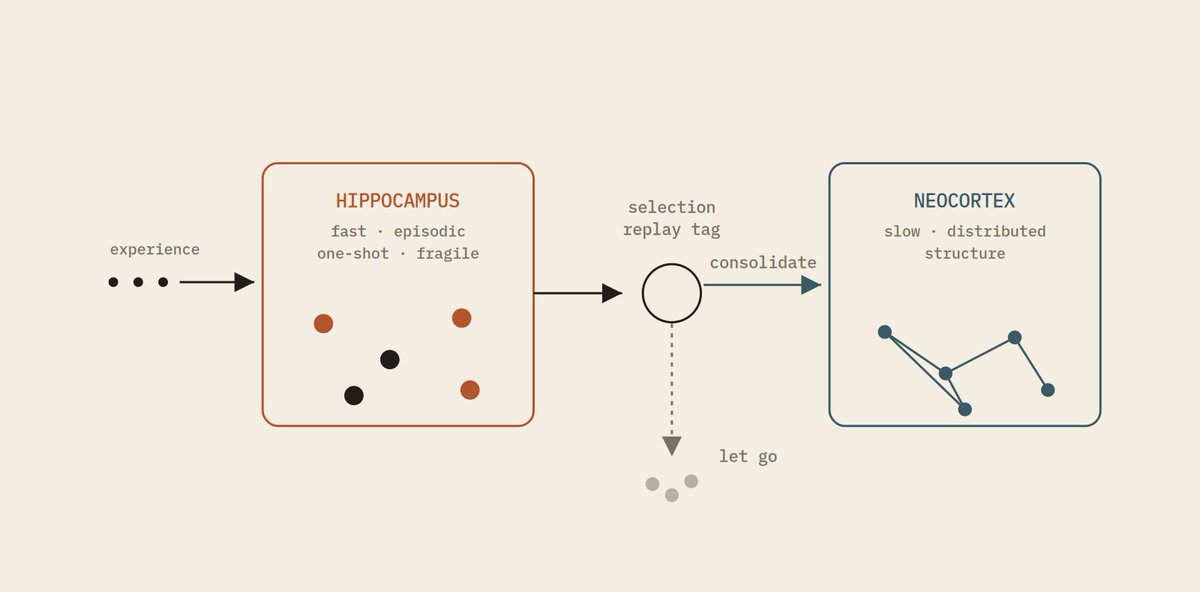 Fast episodic capture, a selection gate, slow consolidation. Most of what is captured is let go. Writing fast experience straight into slow structure is what produces catastrophic interference; the two-speed split is the fix. ## Your agent's hippocampus is a bad one Now look at a deployed model. Its weights are frozen. It carries enormous slow-learned structure, priors about language and code and causality and how situations tend to go. In 1943, Kenneth Craik described the mind as carrying a small-scale model of the world it could run forward to anticipate what happens next. A frozen model is a powerful version of the predictive side of that idea. But prediction is only half of what a long-running mind does. The other half is the record of what happened to this particular agent: what it tried, what it changed its mind about, what it learned not to do again. Call it experiential state. A predictive world model lets an agent ask what might happen next. Experiential state lets it answer a different question: what happened to me, and what changed because of it. Durable agency comes from the loop between the two, and that loop is the part agents mostly fake. 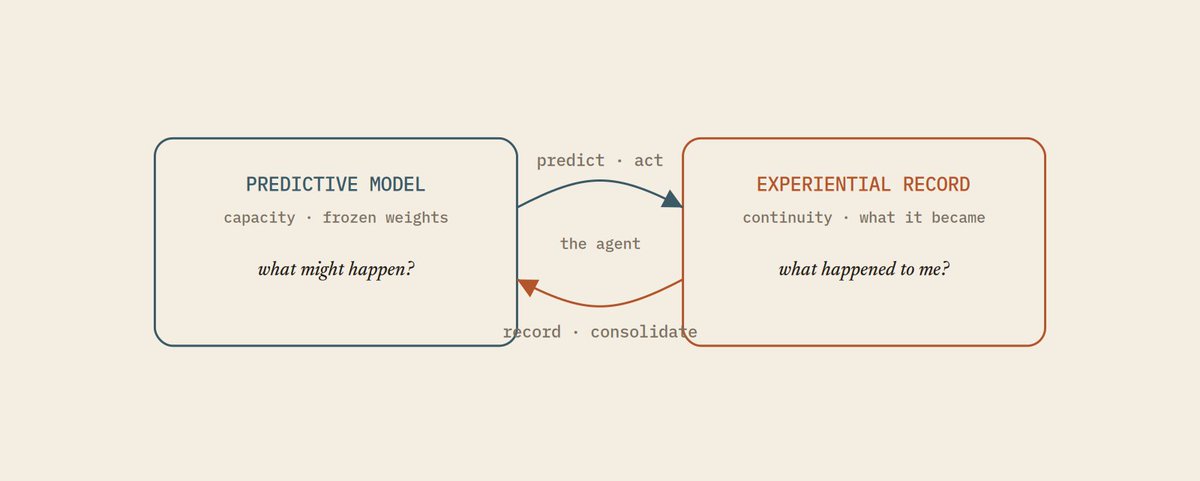 Prediction supplies capacity; the record supplies continuity. The agent is the loop between them, and it is the loop, not either box, that current systems struggle to keep running. It's tempting to call this a hard wall: a frozen model can't do fast episodic capture, so something outside the weights has to. But a long-enough context window is fast episodic capture. The agent conditions on what happened this session and acts differently for it. That's a hippocampus. The trouble is it's a bad one. It doesn't persist past the session, so the next run starts cold. It costs more the more it holds, since every token you keep you pay for again on every step. And it can't tell that one sentence mattered and forty didn't, so it forgets by position instead of by importance. The gap isn't that the agent can't form fast memory. It's that its fast memory won't persist and won't select. Which is what the harness has been doing all along. Every memory store, every scratchpad, every retrieved transcript stuffed back into the window is a hand-built attempt at the persistent, selective version of that organ. We've been building hippocampi without realizing it, most of us. The clearest case predates the current wave: the experience replay buffer in DQN, one of the tricks that made deep reinforcement learning work in 2015, kept past experiences in a separate buffer and replayed them in interleaved batches into the slow network so it wouldn't catastrophically forget. It was reached for on engineering grounds, data efficiency and breaking correlations between samples, and its authors noticed it rhymed with hippocampal replay. The engineering had rediscovered the shape of Complementary Learning Systems theory, a decade ago. So the harness was never scaffolding on the way to a model that won't need it. It's us, by hand, doing the part the window does badly. We just keep reinventing it, badly. ## The trick is selection We reinvent it badly because we copy the wrong part. We assume the job is storage, so we store: the whole chat history, or a lossy summary of it, or everything embedded and retrieved by similarity. But storage is the least interesting version of the problem. The brain's harder trick is selection. In 2024, Buzsáki's lab published a result agent builders should sit with. Recording hundreds of hippocampal neurons in mice running a maze, Yang and colleagues found that during brief high-frequency bursts called sharp-wave ripples, the brain replays the experience it just had, while still awake, in the seconds right after. Those waking ripples appear to act as a tag. The experiences replayed most while awake were the ones replayed again during sleep, and those were the ones that consolidated. It's a correlational result, but a suggestive one. Not everything that happened. A chosen fraction, weighted toward what was rewarded and what was held weakly. The brain decides, early and physically, what is worth keeping, and lets the rest go. Forgetting, in that picture, is a feature. A long-running memory that keeps everything at equal weight is no memory at all. It's a log nobody can read. Selection is the step that turns raw experience into something that can become structure. Some experiences stay episodes, some are forgotten, some harden into facts or skills or reflexes, and some become part of the self. The neuroscience says selection is necessary and can be cheap. It doesn't say how. The brain's tag is wired in by evolution: reward, surprise, novelty, all felt directly. An agent has none of that by default, so the question the whole architecture rests on is what plays the role of the tag. Task relevance, user correction, the severity of a failure, surprise against what the slow store already holds, expected future utility. Each is a real signal, none is solved, and the easy implementations smuggle back the cost you were trying to lose: an LLM reflecting on the day and choosing what to keep is a selection function, and an expensive, chatty one. This is the open problem, and the rest of the design sits downstream of it. Get the substrate perfect and the tag wrong, and you've built a flawless diary of the wrong moments. There was a second detail in that study worthing noting. Laid out in low dimensions, the neural state drifted from one trip through the maze to the next, systematically. Same maze, same reward, and the brain was never in the same state twice. It encoded not only where the animal was but when, which trip this was. No man steps in the same river twice, and it turns out no mouse runs the same maze twice either. (immutable log, anyone?) ## Coordinating without a conversation The brain also points to a different kind of coordination: many specialized processes sharing state without a central executive narrating every step. Bernard Baars formalized this in 1988 as Global Workspace Theory, a limited shared space that parallel specialists read from and write to, with attention deciding what gets broadcast. It's the cognitive version of an idea AI had already tried. In the 1970s the Hearsay-II speech system ran on a blackboard: independent experts, none in charge, each watching a shared structure and writing to it when it had something to add. No expert called another. Coordination was a property of the shared state and the order of the writes. 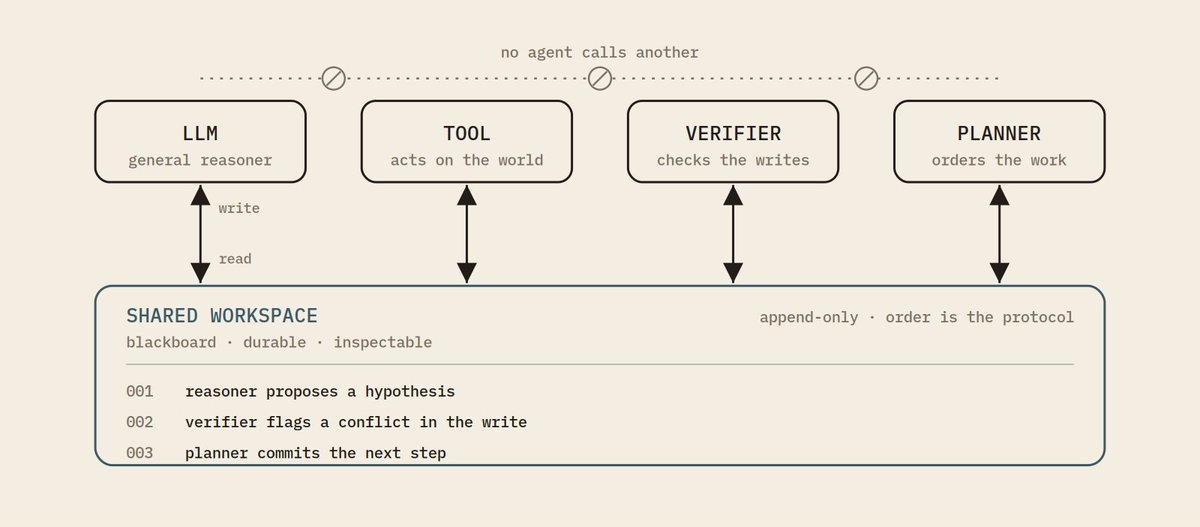 Four specialists, one shared workspace. Each reads and writes the same durable state, and none calls another, so coordination becomes a property of what gets written and the order it is written in. The conflict that used to happen in conversation moves into how the writes are reconciled, where it can be seen. That's the opposite of how we wire multi-agent systems today, where agents talk and talking compounds, every message another place for context to leak and cost to grow. A shared workspace moves most of that dialogue somewhere else. The catch is that the old blackboard got its efficiency from narrow specialists at a bottleneck, and once every writer is a general reasoner you can have several capable processes contending over the same state, where reconciling the writes is its own hard problem. Writing to shared state is still communication, only durable and inspectable instead of ephemeral, with the conflict that used to happen in conversation moving into how the writes get reconciled, where you can see it. That's a real gain even when it isn't a free one. The substrate was waiting in the old systems literature. We just never had anything capable enough to put on it. ## What this tells us to build Put the old ideas together and you get a fairly specific shape for a long-running agent. Two of the pieces come from the brain and two from software. The two-speed split and the selection gate are the brain's. The append-only log, replay, and forking are event sourcing, the pattern behind git and Datomic and Kafka, and the log is best exactly where it stops imitating the brain: biological memory overwrites and confabulates and can't replay or fork its past. You want two stores at two speeds: a fast one, cheap to write, that captures episodes as they happen and keeps them separable instead of averaging them into mush, and a slow one that holds distilled structure and changes carefully. You want the agent's state to be a projection over an append-only record rather than the thing you mutate in place, so the history survives and every change stays inspectable. You want replay and selective consolidation as real operations you can invoke, the agent's version of sleep, deciding which slice of recent experience is promoted into the slow store while the rest decays. You want to be able to fork: spin off a copy, let it try a change to its own behavior, run it forward against the same history, and keep the result or throw it away without betting the running system on the experiment. The brain can't fork its past, and pays for it in every bad habit it can't safely test its way out of. Our agents can. And you want coordination to flow through that shared, projected state, the workspace, rather than through agents narrating themselves to one another. 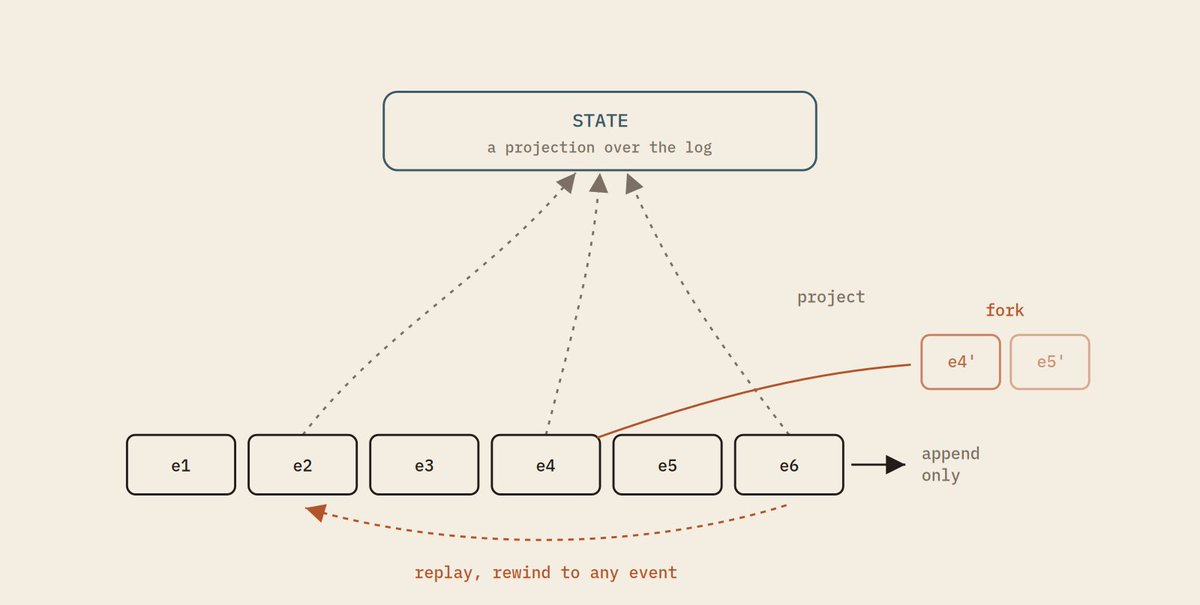 The log is the source of truth; state is a projection over it. Because the record is immutable and append-only, history can be replayed to any point, and a change can be tried in a fork that is later merged or discarded. A self-edit that fails becomes a branch that didn't take. None of this is free. Forking is clean for state and not for consequences: you can discard a branch, you can't unsend the email it wrote or unplace the trade it made, so the line between reversible experiments and irreversible acts has to be part of the design. Skills are awkward too. In the brain a skill consolidates into slow weights; in a frozen agent a learned procedure has no obvious home that isn't the context window again, unless it's promoted through the same gated, evaluated loop as any other self-edit. And consolidation drifts, because promote-and-prune is lossy and compounds, though keeping the original episodes in the log at least leaves the drift detectable. The ordinary costs are real too: projection complexity, schema evolution, snapshots, compaction, replay. The case for paying them is that the alternative hides the same costs inside mutable state, lossy summaries, and failures nobody can reconstruct after the fact. And long context plus retrieval, the obvious objection, helps without substituting. A window is still a window, and retrieval over raw history can recover the events while losing the things that made them matter: the decision that turned an event into a belief, the reconciliation that resolved a contradiction, the branch the agent rejected and why. Those are matters of lineage, and more context doesn't preserve them. The frozen boundary looks like it's going to to continue softenening. Test-time training, fast weights, continual learning, agent self-improvement: there's real work on pushing some of what happens during use back into the weights, and I suspect some of it lands. But that doesn't remove the record. It raises the stakes on selection, because now something has to decide which experiences become training signal, which failures to replay, which changes to merge, which to keep local. That is roughly the hippocampus's job. It doesn't vanish when the cortex finally learns something. It's the thing that chose what the cortex learned. The record becomes more important the moment learning becomes real. On a slightly more meta level, as I mentioned this in my talk earlier this month, but you and I are not defined by our reasoning capability. We are better defined by our knowledge, beliefs, and behaviors that are a result of the events in our lives. ActiveGraph is an extension of continued experimentation around BabyAGI and knowledge graphs, and the inspiration was always the brain. It was fun to find that a lot of brain research reflected the architecture: make the agent's history an append-only event log, treat its working state as a projection over that log, and you get replay, forking, and full lineage out of the structure. The system is in this paper (arXiv:2605.21997). And there's plenty of others. People are building agent memory everywhere: vector stores, temporal knowledge graphs, OS-style paging, reflection layers that summarize and consolidate. Most of it treats memory as a store the model reads from and writes to, parked beside the agent and optimized for recall. The part ActiveGraph is poking at is different: making the record the agent itself, its behaviors and its own edits included, so a whole run can be replayed, forked, and traced rather than only queried. ## 相关链接 - [Yohei](https://x.com/yoheinakajima) - [@yoheinakajima](https://x.com/yoheinakajima) - [23K](https://x.com/yoheinakajima/status/2081741659260477666/analytics) - [my talk](https://x.com/yoheinakajima/status/2080023407639556132) - [ActiveGraph](https://activegraph.ai/) - [arXiv:2605.21997](https://arxiv.org/abs/2605.21997) - [Upgrade to Premium](https://x.com/i/premium_sign_up) - [10:01 PM · Jul 27, 2026](https://x.com/yoheinakajima/status/2081741659260477666) - [23.4K Views](https://x.com/yoheinakajima/status/2081741659260477666/analytics) - [View quotes](https://x.com/yoheinakajima/status/2081741659260477666/quotes) --- *导出时间: 2026/7/28 12:13:09* --- ## 中文翻译 # 大脑对于长期运行智能体知道些什么 **作者**: Yohei **日期**: 2026-07-27T14:01:03.000Z **来源**: [https://x.com/yoheinakajima/status/2081741659260477666](https://x.com/yoheinakajima/status/2081741659260477666) ---  冻结的模型是大脑皮层。困难的部分在于那个决定皮层学什么的器官。 几年来,我们一直在造同样的东西:一套挽具。我们把模型包裹在脚手架里。记忆、工具、规划循环、上下文收集器、追踪记录。我们将所有这些都视为临时的管道设施。模型变得越来越聪明,这种赌注认为,很快它就会变得足够聪明,以至于大部分挽具都会消失。一个世界模型将在权重中的某处形成,那就是心智。 这是一个合理的赌注,而且缩放定律的故事屡屡应验,以至于押注它失败是一笔亏本买卖。但在这之下潜伏着一个没人证明过的假设:智能存在于权重中,而周围的一切都是管道设施,一种我们容忍的拐杖,直到模型不再需要它。 大脑是一个反例。它是我们要拥有的一个长期运行的智能体,它并没有通过把所有东西放在一个系统中来解决问题。 ## 两种学习速度 1995 年,McClelland、McNaughton 和 O'Reilly 提出了一个读起来像错误报告的问题:为什么大脑需要两个记忆系统而不是一个?他们的答案成为了互补学习系统理论。记忆如何沉淀的细节故事比一个干净的双系统分割所暗示的要更具争议,但粗略的劳动分工大部分都经受住了考验。海马体学得快。它一次性捕捉单一的经历,防止相似的经历模糊到一起,并将结果保持在生动且脆弱的形式中。新皮层学得慢。它随着时间的推移将许多经历折叠成分布式结构,这种东西我们称之为知识:概念、规律、技能。 之所以有两个,其原因是与智能体相关的部分。如果你拿一次鲜明的经历,并以高学习率直接把它写入慢速分布式系统,你并没有存储它。你覆盖了它。新的学习涂抹在旧的权重上,腐蚀了原本在那里的东西。该领域称之为灾难性干扰,这正是一个被要求同时快速和永久的系统所预期的失败。大脑的解决办法是分工:在某个一次性的地方快速廉价地捕捉情节,然后慢慢地把它教给慢速系统,与其他所有东西交错进行,这样结构就会沉淀而不是破碎。  快速情节捕捉,一个选择门,慢速巩固。大部分被捕捉的东西都被释放了。将快速经历直接写入慢速结构会导致灾难性干扰;双速分割就是解决办法。 ## 你的智能体的海马体很糟糕 现在看看一个部署的模型。它的权重是冻结的。它携带了巨大的慢速学习结构,关于语言、代码、因果以及事情通常如何发展的先验。1943 年,Kenneth Craik 将心智描述为携带一个世界的微小模型,它可以运行这个模型来预测接下来会发生什么。冻结的模型是该想法预测方面的一个强大版本。但预测只是一个长期运行的心智所做事情的一半。另一半是关于这个特定智能体发生了什么的记录:它尝试了什么,它改变了什么主意,它学会了不再做什么。 称之为经验状态。一个预测性的世界模型让智能体询问接下来可能会发生什么。经验状态让它回答一个不同的问题:我发生了什么,因此改变了什么。持久的能动性来自于这两者之间的循环,而这个循环正是智能体主要在伪造的部分。  预测提供能力;记录提供连续性。智能体是它们之间的循环,正是这个循环,而不是任何一个方框,是当前系统难以维持运行的。 人们很容易将其称为一道硬墙:冻结的模型无法进行快速情节捕捉,所以权重之外的东西必须做。但足够长的上下文窗口就是快速情节捕捉。智能体根据本次会话发生的事情进行条件反射,并据此采取不同的行动。那就是一个海马体。问题是它是一个糟糕的海马体。它在会话结束后不能持久,所以下一次运行是冷启动。它保持的越多,成本就越高,因为你保留的每一个 token 在每一步都要再次付费。而且它无法分辨哪一句话重要,哪四十句不重要,所以它是按位置而不是按重要性遗忘。差距不在于智能体不能形成快速记忆。而在于它的快速记忆无法持久,也无法进行选择。 这正是挽具一直在做的事情。每一个记忆存储,每一个草稿本,每一个塞回窗口的检索记录,都是为了该器官的持久、选择性版本而手工构建的尝试。我们大多数人都在不知不觉中构建海马体。最明显的例子早于当前浪潮:DQN 中的经验回放缓冲区,这是让深度强化学习在 2015 年起作用的技巧之一,将过去的经历保存在一个单独的缓冲区中,并以交错批次回放到慢速网络中,这样它就不会灾难性地遗忘。这是出于工程原因(数据效率和打破样本之间的相关性)而采用的,其作者注意到它与海马体回放押韵。工程学重新发现了互补学习系统理论的形状,那是十年前的事。 所以,挽具从来不是通往一个不需要它的模型的道路上的脚手架。它是我们手工在做窗口做得不好的那部分。我们只是不断地糟糕地重新发明它。 ## 诀窍是选择 我们重新发明得很糟糕,因为我们复制了错误的部分。我们假设工作是存储,所以我们存储:整个聊天历史,或者它的有损摘要,或者所有嵌入并通过相似性检索的内容。但存储是问题最不有趣的版本。大脑更难的诀窍是选择。 2024 年,Buzsáki 的实验室发表了一个智能体构建者应该深思的结果。Yang 和同事记录了数百只跑迷宫老鼠的海马神经元,他们发现,在被称为尖波涟漪的短暂高频爆发期间,大脑在醒着后的几秒钟内,回放了它刚刚经历的事情。那些清醒时的涟漪似乎充当了一个标签。清醒时回放最多的经历是那些在睡眠期间再次被回放的经历,而那些就是巩固了的经历。这是一个相关性结果,但也是一个启发性结果。不是发生的每一件事。一个被选中的部分,倾向于那些被奖励的和那些被微弱持有的部分。大脑在早期并在物理上决定了什么值得保留,而让其他的消失。 在那幅图景中,遗忘是一个特性。一个长期运行的记忆如果对所有事情都保持同等的权重,那根本不是记忆。那是一本没人能读的日志。选择是将原始经验转化为可以成为结构的东西的一步。有些经历保持为情节,有些被遗忘,有些硬化为事实或技能或反射,有些成为自我的一部分。 神经科学说选择是必要的,而且可以是廉价的。它没有说怎么做。大脑的标签是由进化连接的:奖励、惊讶、新奇,所有都是直接感觉到的。智能体默认没有这些,所以整个架构所依赖的问题是,什么扮演了标签的角色。任务相关性、用户纠正、失败的严重性、相对于慢速存储中已有的内容的惊讶、预期的未来效用。每一个都是真实的信号,没有一个是解决的,而简单的实现把你试图摆脱的成本偷偷带了回来:一个反思这一天并选择保留什么的 LLM 是一个选择函数,而且是一个昂贵的、喋喋不休的选择函数。这是一个开放性问题,其余的设计都在它的下游。把基板做完美了但标签错了,你就建立了一本错误时刻的完美日记。 那项研究中还有第二个细节值得注意。在低维度下,神经状态从一次穿越迷宫到下一次系统地漂移。同一个迷宫,同样的奖励,而大脑从未处于两次相同的状态。它不仅编码了动物在哪里,还编码了何时,这是哪一次旅行。人不能两次踏进同一条河流,结果老鼠也不能两次跑同一个迷宫。(不可变日志,有人要吗?) ## 不需要对话的协调 大脑也指向了一种不同类型的协调:许多专门的过程在没有中央主管叙述每一步的情况下共享状态。Bernard Baars 在 1988 年将其形式化为全局工作空间理论,一个有限的共享空间,并行专家从中读取并写入,注意力决定什么被广播。这是 AI 已经尝试过的一个想法的认知版本。在 1970 年代,Hearsay-II 语音系统在一个黑板上运行:独立的专家,没有负责的,每个都观察共享结构,并在有东西要添加时写入其中。没有专家呼叫另一个。协调是共享状态和写入顺序的一个属性。  四个专家,一个共享工作区。每个读取和写入相同的持久状态,没有一个呼叫另一个,所以协调变成了什么被写入以及写入顺序的一个属性。以前发生在对话中的冲突转移到了写入如何被协调的地方,在那里可以看到。 这与我们今天连接多智能体系统的方式相反,在那里智能体交谈,交谈复合,每一条消息都是上下文泄漏和成本增长的另一个地方。共享工作空间将大部分对话移到了别处。问题是,旧的黑板从瓶颈处的狭窄专家那里获得了效率,一旦每个写作者都是一个通用的推理者,你就可能有几个有能力的过程争夺相同的状态,在那里协调写入本身就是个难题。写入共享状态仍然是交流,只是持久的和可检查的,而不是短暂的,以前发生在对话中的冲突转移到了写入如何被协调的地方,在那里你可以看到它。即使不是免费的,这也是真正的收益。基板在旧系统文献中一直等待着。我们只是从未有什么足够有能力的东西放在上面。 ## 这告诉我们要构建什么 将旧的想法放在一起,你会得到一个相当具体的长期运行智能体形状。其中两个部分来自大脑,两个来自软件。双速分割和选择门是大脑的。仅追加日志、回放和分支是事件溯源,这是 Git、Datomic 和 Kafka 背后的模式,而日志恰恰在它停止模仿大脑的地方是最好的:生物记忆会覆盖和虚构,无法回放或分支它的过去。 你需要两个速度的两个存储:一个快的,写入便宜,按原样捕捉情节并保持它们可分离而不是平均成一团,和一个慢的,保持提炼的结构并小心改变。你希望智能体的状态是仅追加记录的投影,而不是你原地变异的东西,这样历史得以幸存,每一个变化保持可检查。你希望回放和选择性巩固作为你可以调用的真实操作,智能体的睡眠版本,决定哪一部分最近的经历被提升到慢速存储中,而其余的衰减。你希望能够分支:分离出一个副本,让它尝试改变自己的行为,针对相同的历史向前运行,并保留结果或丢弃它,而不在运行系统上为实验下注。大脑不能分支它的过去,并为此付出代价,每一个它无法安全尝试摆脱的坏习惯。我们的智能体可以。你希望协调通过那个共享的、投影的状态流动,工作区,而不是通过智能体互相叙述。  日志是真理之源;状态是它的投影。因为记录是不可变和仅追加的,历史可以被重放到任何点,并且一个改变可以在一个分支中尝试,该分支后来被合并或丢弃。一个失败的自编辑变成了一个没有成功的分支。 这些都不是免费的。分支对状态是干净的,对后果不是:你可以丢弃一个分支,你不能撤销它写的邮件或撤销它下的交易,所以可逆实验和不可逆行为之间的界限必须成为设计的一部分。技能也很尴尬。在大脑中,技能巩固到慢速权重中;在冻结的智能体中,学习的过程没有明显的家,除非它通过同样的门控、评估循环被提升,就像任何其他自编辑一样。巩固会漂移,因为提升和修剪是有损的并复合,尽管将原始情节保留在日志中至少使漂移可检测。普通成本也是真实的:投影复杂性、模式演化、快照、压缩、回放。支付它们的理由是,替代方案将相同的成本隐藏在可变状态、有损摘要和事后无人能重构的失败中。长上下文加上检索,那个明显的反对意见,有帮助但不能替代。窗口仍然是窗口,对原始历史的检索可以恢复事件,但丢失了使它们重要的事情:将事件转化为信念的决定,解决矛盾的协调,智能体拒绝的分支以及原因。那些是血统问题,更多的上下文不保留它们。 冻结的边界看起来将继续软化。测试时训练、快速权重、持续学习、智能体自我改进:在将使用期间发生的一些事情推回权重方面有真正的工作,我怀疑其中一些会落地。但这并不移除记录。它提高了选择的赌注,因为现在必须有东西决定哪些经历成为训练信号,哪些失败要回放,哪些改变要合并,哪些要保持局部。这大致是海马体的工作。当皮层终于学到东西时,它不会消失。它是选择皮层学到的东西的东西。当学习变得真实的那一刻,记录变得更加重要。 在稍微更元一点的层面上,正如我在本月初的演讲中提到的,你和我不是由我们的推理能力定义的。我们更好地由我们的知识、信念和行为来定义,这是我们生活中事件的结果。 ActiveGraph 是围绕 BabyAGI 和知识图的持续实验的扩展,灵感总是来自大脑。发现很多大脑研究反映了架构很有趣:让智能体的历史成为仅追加事件日志,将其工作状态视为该日志的投影,你从结构中得到回放、分支和完整的谱系。该系统在这篇论文中。 还有其他的。人们到处都在构建智能体记忆:向量存储、时序知识图、操作系统风格的分页、总结和巩固的反思层。大部分将记忆视为模型从中读取和写入的存储,停在智能体旁边并针对召回进行了优化。ActiveGraph 探讨的部分是不同的:让记录成为智能体本身,包括它的行为和它自己的编辑,这样整个运行可以被重放、分支和追踪,而不仅仅是查询。 ## 相关链接 - [Yohei](https://x.com/yoheinakajima) - [@yoheinakajima](https://x.com/yoheinakajima) - [23K](https://x.com/yoheinakajima/status/2081741659260477666/analytics) - [my talk](https://x.com/yoheinakajima/status/2080023407639556132) - [ActiveGraph](https://activegraph.ai/) - [arXiv:2605.21997](https://arxiv.org/abs/2605.21997) - [Upgrade to Premium](https://x.com/i/premium_sign_up) - [10:01 PM · Jul 27, 2026](https://x.com/yoheinakajima/status/2081741659260477666) - [23.4K Views](https://x.com/yoheinakajima/status/2081741659260477666/analytics) - [View quotes](https://x.com/yoheinakajima/status/2081741659260477666/quotes) --- *导出时间: 2026/7/28 12:13:09*
做 做完一次总体设计后,我重新理解了企业级知识库 文章基于企业级智能知识库项目的实践,探讨了企业知识库的真正门槛。指出其不仅是文档存储,更是一套涵盖构建、治理、使用和优化的闭环运行机制。重点分析了知识库与知识空间的区别、知识生命周期管理、可信溯源及权限控制,强调知识库应作为支撑未来 Agent 的企业级 AI 知识引擎。 技术 › LLM ✍ 土猛的员外🕐 2026-07-29 企业知识库RAGAgent知识工程架构设计
这 这项目给Claude Code塞了28个心智模型和批判性思维技能 该项目为Claude Code集成了28个心智模型和批判性思维技能,包括第一性原理、贝叶斯推理、系统思考等。用户可按需调用,帮助结构化决策和策略分析。测试显示技能未稳定提升准确率,但作者认为作为思考脚手架仍优于裸奔。 技术 › Claude Code ✍ Amto (@XAMTO_AI)🕐 2026-07-29 心智模型批判性思维第一性原理贝叶斯推理系统思考OODA循环Agent决策辅助架构设计风险评估
R Run Your Harness Outside of the Sandbox (Why and How) 本文探讨了2026年以来关于Agent运行位置的争论,指出行业趋势是将Agent运行在沙箱之外。作者详细解释了沙箱内运行的三个主要问题:爆炸半径、信任边界和沙箱的间歇性运行,并提出了将沙箱作为工具暴露的正确架构,最后提供了基于Vercel AI SDK的实现示例和生产环境中的挑战。 技术 › Agent ✍ Nathan Flurry🕐 2026-07-28 Agent沙箱架构设计DevOps后端LLM安全性生产环境Vercel AI SDK状态管理
A Agent工程架构解析:Harness、Loop与Graph的区别 本文深入解析Agent工程中常被混淆的三个架构层级:Harness工程构建模型运行环境与基础能力;Loop工程设计工作反馈循环,通过验证与迭代提升质量;Graph工程则显式定义工作流拓扑,控制节点分支与状态转换。文章强调理清环境、反馈与流的关系对构建生产级Agent至关重要。 技术 › Harness Engineering ✍ beamnxw🕐 2026-07-26 Agent架构设计工程化工作流LangChainOpenAIAgent HarnessLoop Engineering
构 构建智能代理的三层架构:Loop、Graph与Harness 本文提出解决Agent重复读取数据和Token浪费的三层架构方案:Loop负责单元工作的收集-行动-验证闭环;Graph通过分发和并行管理复杂任务;Harness作为运行时环境提供工具和上下文隔离。文中提供了具体的代码实现思路和实战演示。 技术 › Agent ✍ Archive🕐 2026-07-25 AgentLoopGraphHarness架构设计上下文管理Token优化验证机制代码实现
如 如何构建一个在你睡眠时发现商业机会的 Agent 图 文章介绍了一个由多个专业 Agent 组成的图系统,用于自动化商业机会扫描、分析和验证。该系统通过并行处理和独立验证机制,解决了人工研究效率低的问题,仅在发现高质量机会时唤醒用户。 技术 › Agent ✍ NeilXbt🕐 2026-07-25 Agent多智能体架构设计自动化商业分析Graph
T The complete Graph Engineering playbook for Claude Code 本文介绍了Graph Engineering(图工程)的概念,阐述如何利用Claude Code构建分布式Agent系统。通过将任务分解为线性、分发、规约和验证等节点,实现高效、可靠的AI工作流,优化计算成本和结果质量。 技术 › Claude Code ✍ Gyomei🕐 2026-07-24 图工程AI工作流ClaudeAgent架构设计编程分布式系统自动化
H How to master graph engineering 本课程教授如何构建 AI 智能体图,涵盖图的基本概念、关键模式(如菱形模式)、停止规则及人工审批环节。包含三个实战案例:深度研究台、SEO 内容生成器和市场推广套件,旨在提升业务效率并控制成本。 技术 › Agent ✍ Machina🕐 2026-07-23 AgentGraphLLMClaudeWorkflow工程化自动化架构设计效率实战
3 3 Years of Graph Engineering with LangGraph 文章回顾了 LangGraph 三年来的发展,探讨了将智能体系统建模为图(Graph)的实践与价值。作者分析了何时使用图结构以平衡确定性与自主性,并指出生产级智能体通常需要循环和动态转换。最后,文章强调图工程并非全新概念,但随着节点的进化,现在的图更多是在编排智能体而非单一的 LLM 调用。 技术 › Agent ✍ Sydney Runkle🕐 2026-07-22 LangGraphGraph EngineeringAgentLLM架构设计循环确定性工作流
L Less is More: 当精简的 Harness 击败了功能完备的对手 文章通过 Databricks 的基准测试发现,精简的 Harness Pi 在任务完成率上与 Claude Code 持平,但上下文消耗仅为其 1/3。作者对比了信息最大化与信息精简两种设计哲学,指出精简的上下文、结构化摘要和信任模型能力的策略,能有效减少注意力分散,提升模型表现。 技术 › Harness Engineering ✍ SaladDay🕐 2026-07-22 HarnessClaude CodePiAgent架构设计
G Graph Engineering 101: When a Loop Isn’t Enough 文章探讨了AI Agent从简单的ReAct循环向图工程架构的演进。循环模式在处理复杂、多步骤及需人工介入的任务时存在状态持久化、错误处理和分支逻辑的局限性。图工程通过显式的节点、边和状态管理,解决了并发、暂停恢复及复杂流程控制问题,为构建更健壮的Agent系统提供了架构基础。 技术 › Agent ✍ Alex Prompter🕐 2026-07-22 AgentGraph EngineeringReActLangGraph架构设计状态管理LLM
G Graph Engineering with Claude: the 11-Step Roadmap From Loops to Graph Architect 本文阐述了从单一循环工程向图工程演进的必要性。针对单一 Agent 在处理复杂任务时上下文混淆和幻觉问题,作者提出了由节点、边、路由器和状态四大基础构建块组成的图架构,并通过序贯链和路由器等模式,展示如何协调多 Agent 系统以实现高效输出。 技术 › Claude ✍ 0xRafy🕐 2026-07-22 Agent图工程多Agent系统架构设计Claude