# The Five Equations That Quietly Run Your Entire Financial Life (And Why School Never Showed You Any
**作者**: Lumen
**日期**: 2026-07-28T13:52:44.000Z
**来源**: [https://x.com/lumenxbt/status/2082101954206130402](https://x.com/lumenxbt/status/2082101954206130402)
---

You were taught arithmetic in school and told it was math. Then you were taught "personal finance," if you were lucky, as a list of tips: save more, spend less, invest early. Nobody told you that underneath every one of those tips sits an equation. Nobody told you that these equations are short, free, decided almost every rich person's outcome before they were born, and take about an hour to actually understand.
Here is the uncomfortable truth. Money is not really a subject. It is applied mathematics wearing a suit. Every decision you will ever make about a salary, a mortgage, an investment, a fee, a loan, or a pension is being decided by five equations, whether you know them or not. The people who know them are not smarter than you. They are just holding a small piece of paper that you have been quietly kept away from your whole life.
I want to hand you that piece of paper. Five equations. Each one is short enough to memorize on the walk to lunch. Each one explains a piece of the financial world that looks mysterious from the outside and becomes obvious the moment you can read the math underneath it.
By the end, you will have the same core toolkit that a hedge fund analyst, a pension actuary, and a private banker all quietly rely on. Not their instincts, not their contacts, just their math. Which turns out to be your math too.
THE FIVE EQUATIONS AT A GLANCE
> 1. Compound growth. What a dollar becomes over time.
> 2. Rule of 72. How fast money doubles at any rate.
> 3. Present value. What a future dollar is worth right now.
> 4. Geometric mean. Why the "average return" you were told is a lie.
> 5. Real return. What your money actually did after inflation ate its share.Five formulas. Zero jargon. Together they explain roughly 90% of every honest financial decision anyone has ever made.
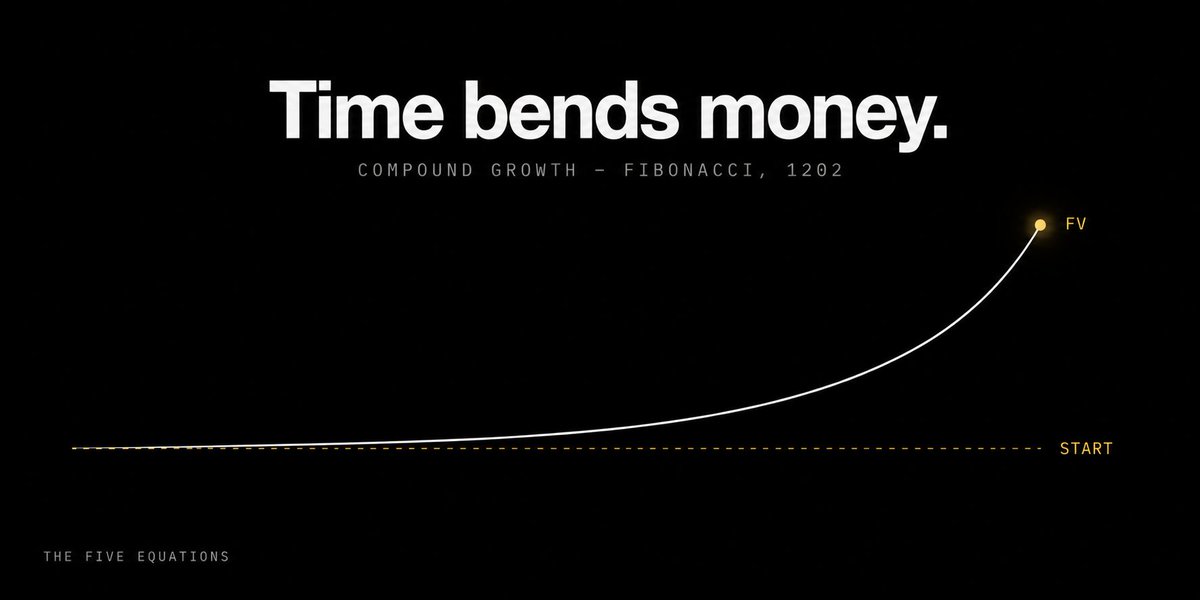
## Equation 1: Compound Growth, or Why Time Beats Talent
The first and most important equation in the world of money looks like this:
> FV = PV × (1 + r)^n
That is it. Five symbols. Let me translate them into human.
- FV = future value. What your money will be worth later.
- PV = present value. What you have now.
- r = rate of return per period, written as a decimal (10% is 0.10).
- n = number of periods (usually years).
The whole thing reads: "your money in the future equals your money now, multiplied by one plus your rate, raised to the number of years."
The magic of this equation is in that little exponent. The ^n is what makes the whole world of finance strange. Without it, money would just grow in a straight line. With it, money grows in a curve that starts as a whisper and ends as a scream.
Concrete example. Put $10,000 at 8% a year, add nothing more, and let it sit:
- Year 10: $21,589
- Year 20: $46,610
- Year 30: $100,627
- Year 40: $217,245
- Year 50: $469,016
Notice the shape. Each decade doubles roughly. The first decade adds around . The last decade alone adds around . Same rate. Same original bet. The exponent is doing the work.
This is why a 25-year-old who invests $10K and never adds another cent ends up with more money at 65 than a 40-year-old who invests $10K every single year and gets to the same finish line. Not slightly more. Almost twice as much. The 25-year-old is not smarter or richer. They are just holding a bigger exponent.
> Talent grows linearly. Time compounds. The math will always eventually favor time.
## Equation 2: The Rule of 72, or the Only Mental Math Trick a Banker Actually Uses
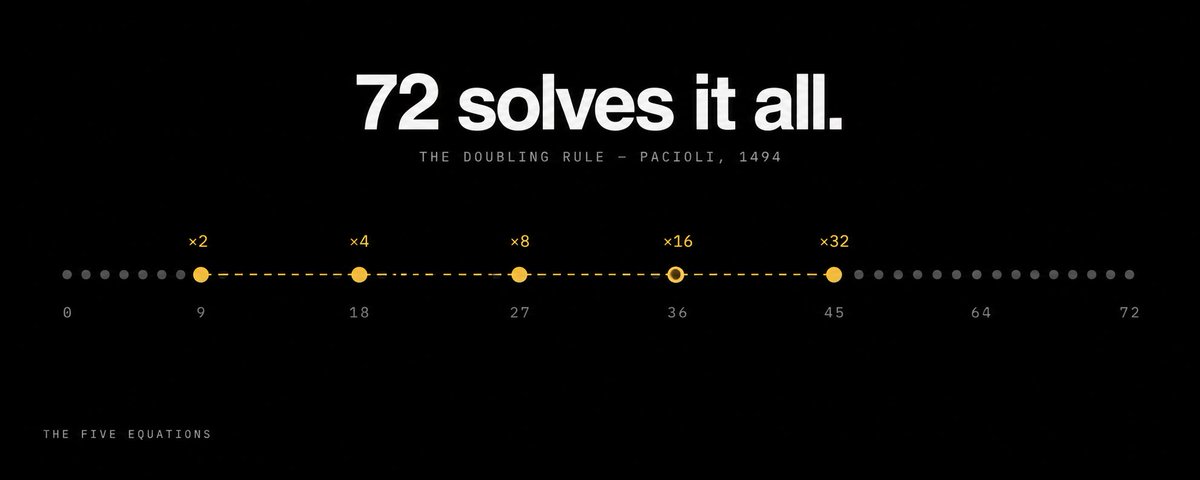
Nobody wants to plug numbers into FV = PV × (1 + r)^n in their head at a dinner party. So bankers, actuaries, and quants use a shortcut that has been around since at least 1494, when the Italian mathematician Luca Pacioli wrote it down in the same book that introduced double-entry bookkeeping to Europe.
> Doubling time (in years) ≈ 72 ÷ rate of return (in percent)
That is the whole trick. How long does money double at 6%? 72 ÷ 6 = 12 years. At 9%? 72 ÷ 9 = 8 years. At 3%? 72 ÷ 3 = 24 years.
It is not perfectly precise, but it is accurate to within a percent or two for any normal rate, and it lets you do in three seconds what would otherwise take a spreadsheet.
Once you have this in your head, whole conversations change. Someone tells you a bond pays 4% a year. You immediately know: this money doubles every 18 years. Someone tells you inflation is running at 6%. You immediately know: prices double every 12 years, so what costs $100 today costs $200 in a decade. Someone offers you a "safe" 2% savings account. You immediately know: your money doubles every 36 years, which for most humans is once in an adult lifetime.
This is why professionals seem to have supernatural intuition about numbers. They do not. They just carry two mental shortcuts, and this is one of them.
Here is the same rule inverted, which almost nobody teaches. If something loses value at rate r, the rule tells you how fast it halves.
Inflation at 3%: money loses half its purchasing power in 24 years. Inflation at 6%: half is gone in 12. Inflation at 9%: half is gone in 8.
The rule works in both directions. Rising and falling, growing and rotting. And it fits in your head.
## Equation 3: Present Value, or What a Future Dollar Is Actually Worth
Here is a trick question. Someone offers you $1,000, either today or one year from now. Which is worth more?
Almost everyone answers "today," and almost everyone gives the wrong reason. They say something like "because I could spend it now." The real reason is much more useful, and it is the reason every acquisition, insurance policy, pension, mortgage, and lottery jackpot in the world is priced the way it is.
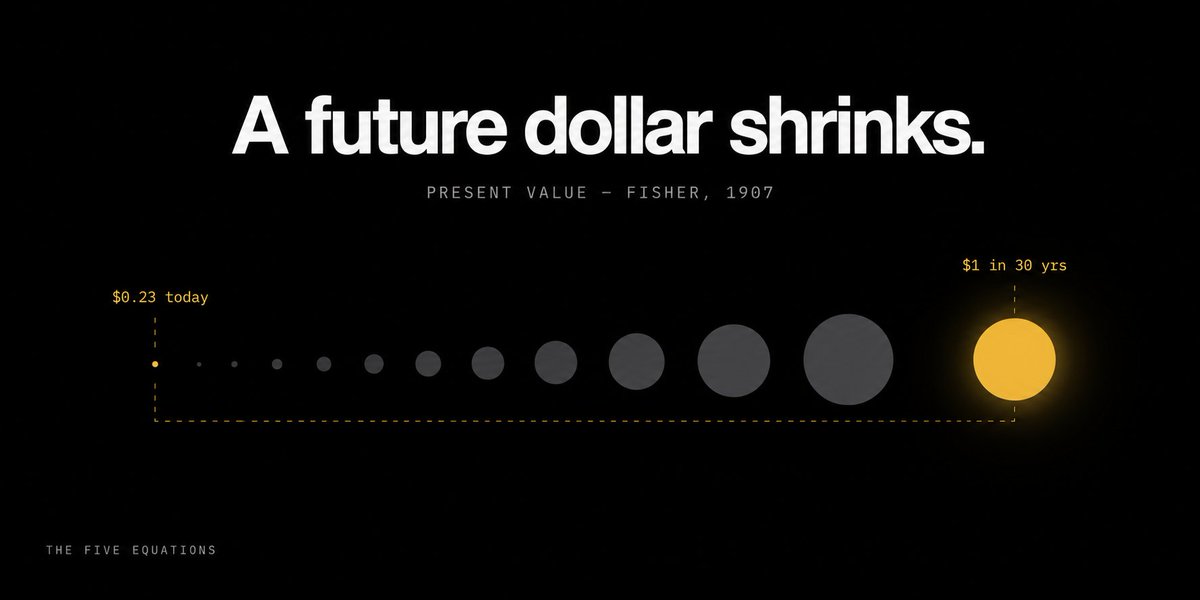
The reason is that $1,000 today can be invested. If you have a 6% return available, then $1,000 today becomes $1,060 in a year. So $1,000 today is not equal to $1,000 next year. It is equal to about $1,060 next year, or equivalently, $1,000 next year is only worth about $943 today.
This is called present value, and the equation is just the compound growth equation solved backwards.
> PV = FV ÷ (1 + r)^n
Same five symbols. Same idea. You are asking: "what would I need to invest today at rate r to end up with this future amount in n years?"
The consequences of this one equation are enormous, and they explain a huge amount of the financial world.
Lottery jackpots. When a lottery announces a "$300 million jackpot," they almost never have $300 million in cash. They have enough to buy an annuity that will pay out $300 million over 30 years. In present value terms, that jackpot is worth roughly half of what the billboard says. The lump-sum option is not the "reduced" prize. It is the honest one.
Insurance. When an insurance company quotes you a life policy, they are running present value on future payouts. If a policy will pay $500,000 in 30 years and their assumed return is 5%, that future payout has a present value of roughly $115,000. That is what they are actually reserving. Everything else is spread.
Mortgages. When a bank quotes you a 30-year mortgage, they are calculating the present value of your future stream of payments. Understanding this is why the same 1% difference in interest rate can mean $80,000 more or less paid over the life of the loan. The bank is not being greedy. They are pricing time.
Job offers. A $150,000 salary starting today is worth more than a $170,000 salary starting in three years, at any reasonable growth assumption. Present value is why "wait a few years for a raise" is usually a losing proposition, and why career switches early in life pay off more than they seem to.
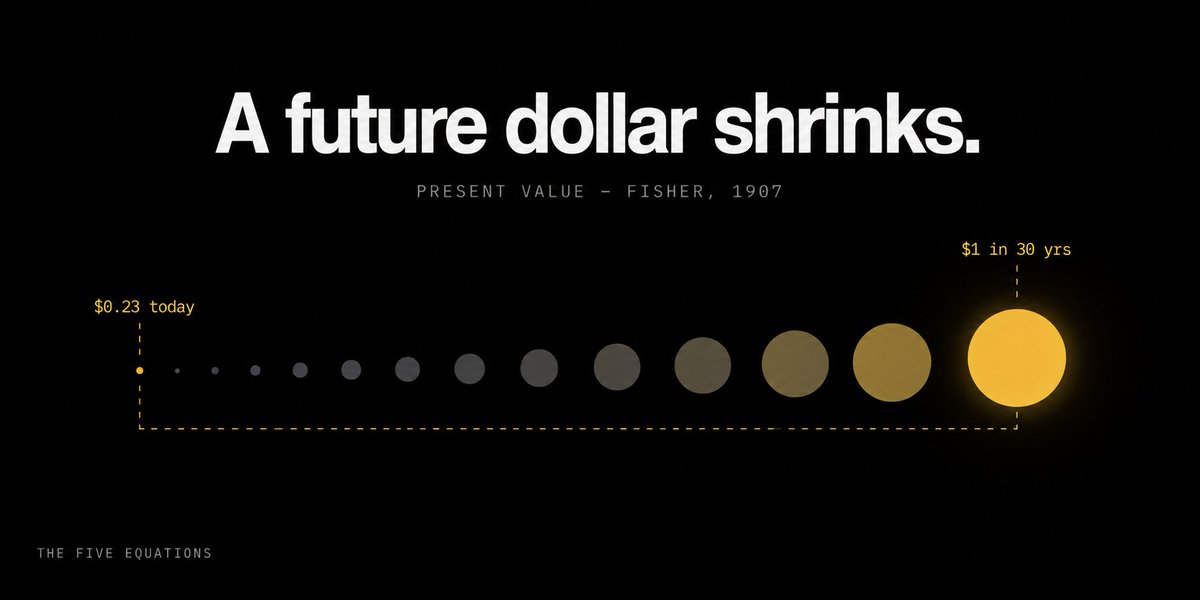
The person who knows this equation looks at every future promise, from a bond coupon to a startup equity offer, and asks: what is this actually worth today? Everyone else takes the future number at face value, and everyone else quietly overpays.
## Equation 4: The Geometric Mean, or Why Every "Average Return" You've Ever Been Sold Is Slightly a Lie
This is the equation the finance industry does not particularly want you to know. It is short. It is honest. It will change what you think of every fund advertisement you have ever seen.
Suppose a fund gives you these returns over three years: +50%, -50%, +50%.
Question. What is your average return?
The instinctive answer is: (50 - 50 + 50) ÷ 3 = 16.7%. That looks great. A 16.7% average return sounds like a Warren Buffett-tier product.
The real answer is closer to +7%. And here is where it gets ugly.
Your actual money did this: $100 → $150 → $75 → $112.50. Over three years, you turned $100 into $112.50, which is a total gain of 12.5%, or roughly 4% per year compounded. Not 16.7%.
The number the industry loves to advertise is the arithmetic mean, the simple average. The number that describes what actually happened to your dollars is the geometric mean.
> Geometric mean = ((1 + r₁) × (1 + r₂) × ... × (1 + rₙ))^(1/n) − 1
You multiply the growth factors, take the nth root, and subtract 1. It sounds complicated, and it is one line in any spreadsheet: =GEOMEAN(...)−1.
Here is the merciless rule underneath it:
> The geometric mean is always less than or equal to the arithmetic mean. They are equal only when every year has the exact same return.
The more volatile the returns, the bigger the gap. A fund with returns of +30% and -30% has an arithmetic mean of 0% and a geometric mean of about -4.6%. On average, you did nothing. In reality, you lost money. Volatility itself has a cost, and that cost has a name: variance drag.
This is why a "smooth" 8% return is worth much more than a "wild" 8% return, even though the ad-brochure number is the same. It is why hedge funds that swing hard often disappoint their investors even when their pitch decks look brilliant. And it is why any honest performance report shows the CAGR (compound annual growth rate), which is just the geometric mean by another name.
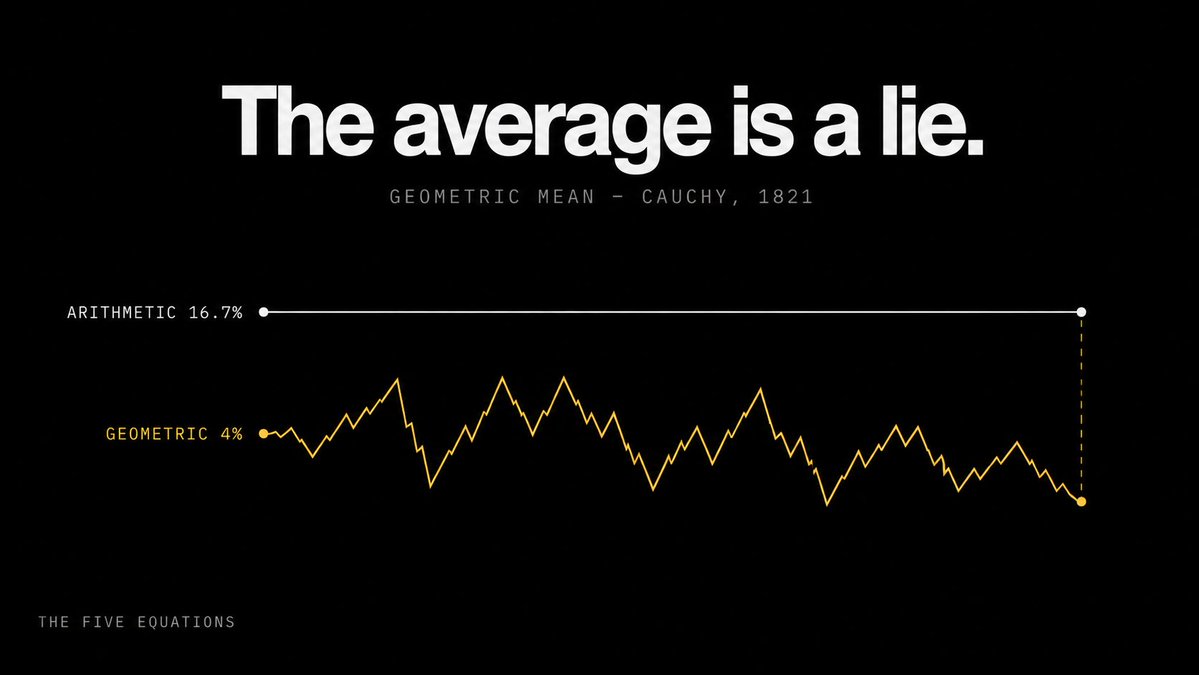
Once you know this equation, you look at every fund's average return with a small extra question in your head: "arithmetic or geometric?" If they will not tell you, the answer is almost always the one they do not want you to compare.
## Equation 5: Real Return, or the Invisible Line That Actually Runs Your Life
There is one final equation, and it is the one most people never think about, which is exactly why it eats them.
You put money in a savings account paying 4%. Inflation is 3%. What did your money actually do?
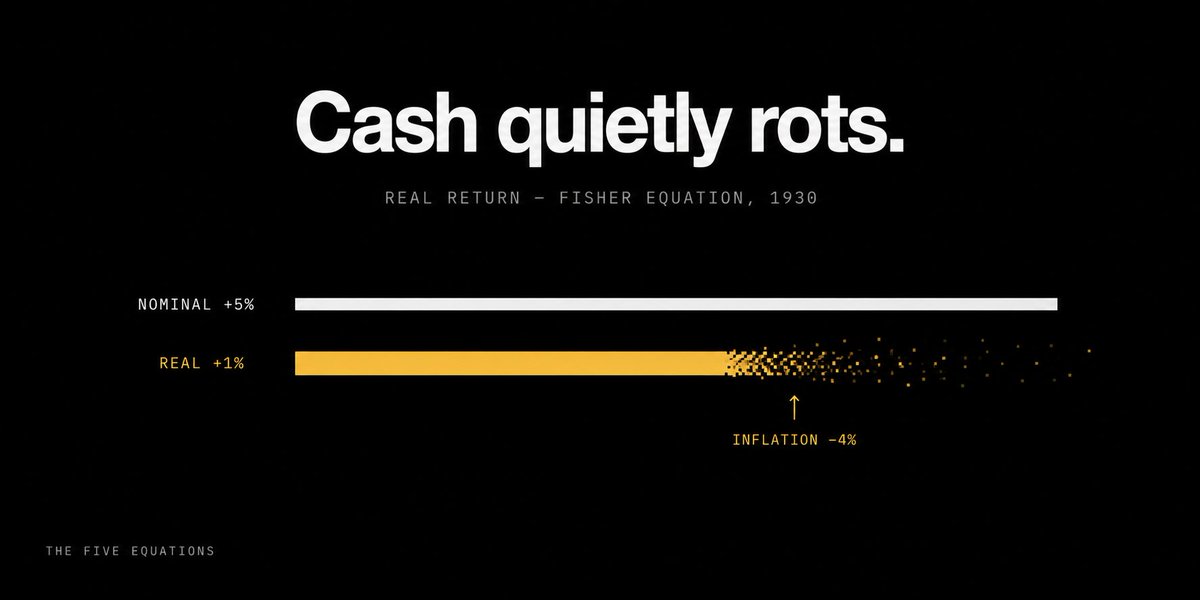
The intuitive answer is "grew by 4%." The correct answer is that it grew by roughly 1% in purchasing power. Your dollars multiplied, but each dollar now buys less. Your money grew nominally and shrank in real terms almost simultaneously.
> Real return = ((1 + nominal return) ÷ (1 + inflation)) − 1
You divide 1 plus your return by 1 plus inflation, and subtract 1. Or, for a quick approximation that works fine at small numbers:
> Real return ≈ nominal return − inflation
That is the equation. But the mindset it forces is the actual gift.
- A "guaranteed 5% bond" during 4% inflation is a 1% return, not 5%.
- A "0% checking account" during 3% inflation is a −3% return. You are being paid to lose money slowly.
- A stock market averaging 10% nominal during 3% inflation is a 7% real return. That 7% is the number that actually matters.
The reason this equation is so quietly important is that inflation is the one line item in your financial life that you never see on any statement. Your account balance goes up. Your credit card is paid. Everything looks fine. Meanwhile a slow, invisible tax is running in the background, taking two, three, five percent of your purchasing power every year.
The rich do not necessarily earn more nominal return than everyone else. They just make sure their nominal return is comfortably above inflation, always. Everyone else quietly gets poorer while their bank balance goes up.
> Money you did not invest is not "safe." It is being taxed by inflation at a rate you never consented to.
Learning to think in real terms instead of nominal terms is the single mental switch that separates people who understand money from people who only handle it.
## Putting the Five Equations Together
Each equation on its own is a tool. Together, they are a lens, and they let you see through almost any financial claim you will ever encounter.
Here is the entire toolkit in one table, with what each one actually does for you in real life.
Five equations. Two of them are just algebra rearranged. One is a mental shortcut from 1494. All five fit on one napkin.
```
┌──────────────────┬──────────────────────────────┬─────────────────────────────┬──────────────────────────────┐
│ EQUATION │ FORMULA │ WHAT IT ANSWERS │ REAL-LIFE USE │
├──────────────────┼──────────────────────────────┼─────────────────────────────┼──────────────────────────────┤
│ Compound growth │ FV = PV × (1 + r)^n │ What money becomes over time│ Retirement, savings, biz val │
│ Rule of 72 │ Years to double ≈ 72 ÷ r │ How fast anything doubles │ Instant mental estimation │
│ Present value │ PV = FV ÷ (1 + r)^n │ What a future $ is worth now│ Loans, pensions, salaries │
│ Geometric mean │ ((1+r1)(1+r2)...(1+rn))^1/n-1│ True average return │ Reading fund returns honestly│
│ Real return │ (1 + r) ÷ (1 + i) − 1 │ What purchasing power did │ Beating inflation everyday │
└──────────────────┴──────────────────────────────┴─────────────────────────────┴──────────────────────────────┘
```
And they let you do things almost no one around you can do:
- Estimate any doubling time in three seconds
- Read a fund's performance sheet without being fooled
- Price a future promise honestly
- Instantly separate nominal from real returns
- Understand why time is the most valuable asset you own
## Why This Actually Matters
The financial industry does not want you to be bad at math. It wants you to be selectively bad at math. Good enough to sign contracts and pay fees. Not good enough to notice what the contracts are actually doing.
A 2% management fee sounds like a rounding error. Run it through the compound growth equation for 40 years and it eats close to half of your final wealth. You did not notice because 2% does not feel like half.
A "5% guaranteed" savings product during 4% inflation sounds safe. Run it through the real return equation and you earned 1%. You did not notice because 5% sounded like a lot.
A "20% average return hedge fund" sounds spectacular. Ask for the geometric mean instead of the arithmetic mean and you often find a much duller number. You did not notice because they only advertised the flattering one.
This is not a conspiracy. It is a feature. Every industry that sells complexity relies on its customers not being able to do the underlying math. Insurance, mortgages, funds, pensions, credit cards, all of them work best when the customer trusts the salesperson's summary instead of running the equation themselves.
The five equations above are the entire defence. Not against fraud, which is rare, but against the much more common problem of quietly bad deals dressed up in reassuring language.
## What Actually Matters Here
Put it all together in one picture.
Money is not a mysterious force. It is a small set of equations that you were never quite handed. The people who look wealthy or wise about finance are not psychically gifted. They are running the same five formulas you just read, over and over, on every decision that crosses their desk. That is the entire "secret."
- Compound growth explains why time is more valuable than talent.
- The Rule of 72 explains why professionals can estimate anything in seconds.
- Present value explains why every future promise is worth less than it looks.
- Geometric mean explains why most advertised returns are quietly overstated.
- Real return explains why nominal safety is often real loss.
None of these formulas are hidden. None of them require a degree. None of them cost anything. All of them are older than your grandparents. They were written down centuries ago by mathematicians and clerks who never imagined that their work would still be running the wealth of the world 500 years later.
The single most useful mental habit you can build is this: whenever you face a financial claim, before you feel anything about it, ask which of the five equations governs it, and run the number.
> The rich are not people who beat the equations. They are people who never argued with them.
Here is the question worth sitting with.
If five short equations, all free, all public, all older than any bank on Earth, decide most of your financial life, and you have been navigating money without them for years, then the honest question is not "why don't I understand finance?" It is:
> "How much has it already cost me to not know these five things, and how much more am I willing to let it cost me?"
The math is on the napkin. The rest is up to you.
If this piece just changed how you look at finance, follow - @lumenxbt
Not because I need the numbers. Because what you just read is one topic out of roughly twenty that quietly rewire how you understand risk, wealth, and how decisions actually get made.
Every next piece here will take one topic and break it all the way down:
- Why 90% of active fund managers lose to a boring index (and what the math says about "expertise")
- The single formula that decides how much to bet on anything, and why nobody uses it
- Why insurance is priced by mathematicians, not marketers, and what that tells you about what to buy
- Why a 1% edge, applied correctly, is worth more than a 50% edge applied wrong
Every article works exactly like this one. No filler. Real math under simple words. An ending that leaves you seeing the world slightly differently than you did before.
If you have been looking for a place where difficult things get explained once, and correctly, you just found it. You will not stumble on a feed like this twice by accident. Unfollowing takes half a second. Nothing to lose, and a completely different way of seeing money to gain.
@lumenxbt
## 相关链接
- [Lumen](https://x.com/lumenxbt)
- [@lumenxbt](https://x.com/lumenxbt)
- [9.4M](https://x.com/lumenxbt/status/2082101954206130402/analytics)
- [@lumenxbt](https://x.com/@lumenxbt)
- [@lumenxbt](https://x.com/@lumenxbt)
- [Upgrade to Premium](https://x.com/i/premium_sign_up)
- [9:52 PM · Jul 28, 2026](https://x.com/lumenxbt/status/2082101954206130402)
- [9.4M Views](https://x.com/lumenxbt/status/2082101954206130402/analytics)
- [View quotes](https://x.com/lumenxbt/status/2082101954206130402/quotes)
---
*导出时间: 2026/8/15 20:44:20*
---
## 中文翻译
# 五个悄悄掌控你全部财务生活的方程式(以及为什么学校从未教过你)
**作者**: Lumen
**日期**: 2026-07-28T13:52:44.000Z
**来源**: [https://x.com/lumenxbt/status/2082101954206130402](https://x.com/lumenxbt/status/2082101954206130402)
---

你在学校学了算术,被告知那就是数学。然后,如果你运气好,你还会学到“个人理财”,但那只是一堆建议的清单:多存钱、少花钱、尽早投资。没有人告诉你,每一条建议的背后都藏着一个方程式。没有人告诉你,这些方程式很短、免费、几乎在每一个富人出生之前就决定了他们的结局,而且真正理解它们只需要大约一个小时。
这里有一个令人不安的事实。金钱其实不是一个学科。它是穿着西装的 applied mathematics(应用数学)。你将要做的每一个关于薪水、房贷、投资、费用、贷款或养老金的决定,都由五个方程式决定,无论你是否知道它们。知道这些方程式的人并不比你更聪明。他们只是握着一张你整个一生都被悄悄藏起来的小纸片。
我想把那张纸递给你。五个方程式。每一个都短到可以在走去吃午饭的路上记住。每一个都解释了金融世界中一个从外部看起来神秘莫测、但一旦你能读懂其背后的数学就变得显而易见的片段。
到最后,你将拥有对冲基金分析师、养老金精算师和私人银行家都悄悄依赖的同一套核心工具。不是他们的直觉,不是他们的人脉,只是他们的数学。而事实证明,那也是你的数学。
五个方程式一览
> 1. 复利增长。一美元随时间会变成什么。
> 2. 72法则。在任何利率下,金钱翻倍需要多久。
> 3. 现值。未来的一美元现在值多少。
> 4. 几何平均数。为什么你被告知的“平均回报”是个谎言。
> 5. 实际回报。在通货膨胀分走一杯羹之后,你的钱到底做了什么。五个公式。零行话。它们合在一起,解释了历史上任何人做过的每一个诚实财务决策中大约90%的部分。

## 方程式一:复利增长,或为什么时间胜过天赋
金钱世界里第一个也是最重要的方程式长这样:
> FV = PV × (1 + r)^n
就是这样。五个符号。让我把它们翻译成人话。
- FV = 未来价值。你的钱将来值多少。
- PV = 现值。你现在有多少。
- r = 每个时期的回报率,写成小数(10% 就是 0.10)。
- n = 时期数(通常是年)。
整个式子的意思是:“你未来的钱等于你现在的钱,乘以一加上你的利率,再乘以年数的次方。”
这个方程式的魔力就在那个小小的指数上。那个 ^n 让整个金融世界变得奇特。没有它,金钱只会直线增长。有了它,金钱会沿着一条曲线增长,开始时悄无声息,结束时震耳欲聋。
具体例子。投入 $10,000,年利率 8%,不再追加任何资金,让它放着:
- 第10年:$21,589
- 第20年:$46,610
- 第30年:$100,627
- 第40年:$217,245
- 第50年:$469,016
注意这个形状。每十年大约翻一番。第一个十年增加了大约 $11,589。最后一个十年单独增加了大约 $251,771。同样的利率。同样的初始赌注。是指数在做功。
这就是为什么一个 25 岁投资 $10K 并且再也不追加一分钱的人,到 65 岁时,会比一个 40 岁开始每年投资 $10K 并到达同一个终点线的人拥有更多的钱。不是多一点。几乎是两倍。那个 25 岁的人并不更聪明或更富有。他们只是握着一个更大的指数。
> 天赋是线性增长的。时间是复利增长的。数学最终总会偏向时间。
## 方程式二:72法则,或银行家唯一真正使用的心算技巧
没有人愿意在晚宴上心算 FV = PV × (1 + r)^n。所以银行家、精算师和量化分析师使用一个捷径,这个捷径至少从 1494 年就存在了,当时意大利数学家卢卡·帕乔利(Luca Pacioli)在他那本将复式记账法引入欧洲的书中写下了它。
> 翻倍时间(年)≈ 72 ÷ 回报率(百分比)
这就是全部技巧。钱在 6% 的利率下多久翻倍?72 ÷ 6 = 12 年。9% 呢?72 ÷ 9 = 8 年。3% 呢?72 ÷ 3 = 24 年。
它并非完美精确,但对于任何正常利率,其准确度都在一两个百分点之内,而且它让你能在三秒钟内完成原本需要电子表格才能完成的计算。
一旦你把这个记在脑子里,整个对话都会改变。有人告诉你某只债券年利率 4%。你立刻知道:这笔钱每 18 年翻一番。有人告诉你通货膨胀率是 6%。你立刻知道:物价每 12 年翻一番,所以今天花 $100 的东西,十年后要花 $200。有人给你提供一个“安全”的 2% 储蓄账户。你立刻知道:你的钱每 36 年翻一番,对大多数人来说,这相当于整个成年期只有一次。
这就是为什么专业人士对数字似乎有超自然的直觉。他们没有。他们只是掌握了两条心算捷径,而这就是其中之一。
这里是同一个法则的反向应用,几乎没人教过。如果某样东西以利率 r 贬值,这个法则告诉你它多久减半。
通货膨胀率 3%:货币购买力在 24 年内减半。通货膨胀率 6%:12 年内减半。通货膨胀率 9%:8 年内减半。
这个法则双向适用。上升和下降,增长和腐烂。而且它就在你脑子里。

## 方程式三:现值,或未来的一美元到底值多少
这里有一个脑筋急转弯。有人给你 $1,000,要么今天给,要么一年后给。哪个更值钱?
几乎所有人都会回答“今天”,而且几乎所有人都给出了错误的理由。他们会说“因为我现在就能花掉它。”真正的原因要有用得多,而且这也是世界上每一笔收购、保险单、养老金、抵押贷款和彩票头奖定价方式的原因。
原因是,今天的 $1,000 可以用于投资。如果你有 6% 的回报率,那么今天的 $1,000 一年后就变成 $1,060。所以,今天的 $1,000 不等于明年的 $1,000。它大约等于明年的 $1,060,或者等价地说,明年的 $1,000 今天只值大约 $943。
这叫做现值,而这个方程式只是把复利增长方程式倒过来解。
> PV = FV ÷ (1 + r)^n
同样的五个符号。同样的概念。你在问:“我需要以 r 的利率在今天投资多少,才能在 n 年后得到这个未来的金额?”
这一个方程式的后果是巨大的,它们解释了金融世界的很大一部分。
彩票头奖。当彩票宣布“$3 亿头奖”时,他们几乎从来没有 $3 亿现金。他们有足够的钱购买一份年金,这份年金将在 30 年内支付 $3 亿。按现值计算,那个头奖大约只值广告牌上数字的一半。一次性领取选项并不是“打了折扣”的奖金。它才是诚实的那个。
保险。当保险公司给你报出一个人寿保险的价格时,他们是在计算未来赔付的现值。如果一份保单将在 30 年后支付 $500,000,而他们假设的回报率是 5%,那么那个未来赔付的现值大约是 $115,000。这就是他们实际预留的金额。其他一切都是分摊。
抵押贷款。当银行给你报出 30 年期抵押贷款的利率时,他们是在计算你未来还款流的现值。理解了这一点,你就会明白为什么同样的 1% 利率差异,在贷款期限内可能意味着多付或少付 $80,000。银行并不贪婪。他们是在为时间定价。
工作机会。一份今天开始的 $150,000 薪水,在任何合理的增长假设下,都比一份三年后才开始的 $170,000 薪水更值钱。现值就是为什么“等几年再涨薪”通常是一笔亏本买卖,也是为什么职业生涯早期的转换比看起来更划算。

知道这个方程式的人,看待每一个未来的承诺,从债券息票到初创公司股权,都会问:这今天到底值多少?其他人则只看未来数字的表面价值,然后其他人都在悄悄多付钱。
## 方程式四:几何平均数,或为什么你被推销的每一个“平均回报”都略微是个谎言
这是金融行业不太希望你知道的方程式。它很短。它很诚实。它会改变你对所见过每一个基金广告的看法。
假设一个基金给你这三年的回报:+50%,-50%,+50%。
问题。你的平均回报是多少?
直觉答案是:(50 - 50 + 50) ÷ 3 = 16.7%。看起来很棒。16.7% 的平均回报听起来像是沃伦·巴菲特级别的产品。
真实答案接近 +7%。而这里就是变得难看的地方。
你的实际资金是这样变化的:$100 → $150 → $75 → $112.50。三年里,你把 $100 变成了 $112.50,总收益是 12.5%,或者说每年复利大约 4%。不是 16.7%。
行业喜欢宣传的数字是算术平均数,也就是简单平均。描述你的美元实际发生了什么变化的数字是几何平均数。
> 几何平均数 = ((1 + r₁) × (1 + r₂) × ... × (1 + rₙ))^(1/n) − 1
你把增长因子相乘,取 n 次方根,然后减去 1。听起来很复杂,但在任何电子表格里就是一行:=GEOMEAN(...)−1。
下面是它背后无情的规则:
> 几何平均数总是小于或等于算术平均数。只有当每年的回报完全相同时,它们才相等。
回报的波动性越大,差距就越大。一个回报为 +30% 和 -30% 的基金,其算术平均数为 0%,几何平均数约为 -4.6%。平均而言,你什么都没做。实际上,你亏钱了。波动性本身就有成本,这个成本有个名字:方差拖累(variance drag)。
这就是为什么“平稳”的 8% 回报比“剧烈波动”的 8% 回报值钱得多,尽管宣传册上的数字是一样的。这也是为什么大幅波动的对冲基金即使其推介材料看起来很棒,也常常让投资者失望。这也是为什么任何诚实的业绩报告都会显示 CAGR(复合年增长率),它只是几何平均数的另一个名字。

一旦你知道了这个方程式,你看每只基金的平均回报时,脑子里都会多一个小问题:“算术平均还是几何平均?”如果他们不告诉你,答案几乎总是他们不想让你比较的那个。
## 方程式五:实际回报,或真正运行你生活的隐形线
还有最后一个方程式,也是大多数人从未想过的那个,而这正是它吞噬他们的原因。
你把钱存入一个支付 4% 利息的储蓄账户。通货膨胀率是 3%。你的钱到底做了什么?
直觉答案是“增长了 4%”。正确答案是,它的购买力大约增长了 1%。你的美元数量增加了,但每一美元现在买的东西更少了。你的钱在名义上增长,同时在实际上几乎同步缩水。
> 实际回报 = ((1 + 名义回报) ÷ (1 + 通货膨胀率)) − 1
你用 1 加上你的回报除以 1 加上通货膨胀率,然后减去 1。或者,对于小数字来说,有一个快速近似公式效果很好:
> 实际回报 ≈ 名义回报 − 通货膨胀率
这就是方程式。但它迫使你形成的思维方式才是真正的礼物。
- 在 4% 的通货膨胀率下,一个“保证 5% 回报”的债券是 1% 的回报,而不是 5%。
- 在 3% 的通货膨胀率下,一个“0% 利率”的支票账户是 −3% 的回报。你是在被付钱让你慢慢亏钱。
- 在 3% 的通货膨胀率下,一个平均名义回报 10% 的股票市场是 7% 的实际回报。那个 7% 才是真正重要的数字。
这个方程式如此悄无声息地重要的原因是,通货膨胀是你财务生活中唯一一个永远不会出现在任何账单上的项目。你的账户余额在增加。你的信用卡还清了。一切看起来都很好。与此同时,一种缓慢、无形的税收在后台运行,每年拿走你购买力的 2%、3%、5%。
富人未必比其他人赚取更高的名义回报。他们只是确保自己的名义回报总是舒适地高于通货膨胀率。其他人则在银行余额上升的同时,悄悄地变得更穷。
> 你没有投资的钱并不是“安全”的。它正以你从未同意的税率被通货膨胀征税。
学会用实际而非名义的思维来思考,是区分理解金钱的人和仅仅经手金钱的人的唯一心理开关。

## 把五个方程式放在一起
每个方程式本身都是一个工具。合在一起,它们是一个透镜,让你能看穿你将会遇到的几乎任何财务主张。
这是整套工具在一个表格里的全貌,以及每一个在现实生活中实际为你做什么。
五个方程式。其中两个只是代数变形。一个是 1494 年的心算捷径。全部五个可以写在一张餐巾纸上。
```
┌──────────────────┬──────────────────────────────┬─────────────────────────────┬──────────────────────────────┐
│ 方程式 │ 公式 │ 它回答什么 │ 现实生活中的用途 │
├──────────────────┼──────────────────────────────┼─────────────────────────────┼──────────────────────────────┤
│ 复利增长 │ FV = PV × (1 + r)^n │ 钱随时间变成什么 │ 退休、储蓄、企业估值 │
│ 72法则 │ 翻倍年数 ≈ 72 ÷ r │ 任何东西翻倍有多快 │ 即时心算估算 │
│ 现值 │ PV = FV ÷ (1 + r)^n │ 未来的一美元现在值多少 │ 贷款、养老金、薪水 │
│ 几何平均数 │ ((1+r1)(1+r2)...(1+rn))^1/n-1│ 真实的平均回报 │ 诚实解读基金回报 │
│ 实际回报 │ (1 + r) ÷ (1 + i) − 1 │ 购买力到底做了什么 │ 每天都在战胜通货膨胀 │
└──────────────────┴──────────────────────────────┴─────────────────────────────┴──────────────────────────────┘
```
它们让你能做到几乎周围没人能做到的事情:
- 在三秒钟内估算任何翻倍时间
- 阅读基金的业绩表而不被愚弄
- 诚实地为未来的承诺定价
- 瞬间区分名义回报和实际回报
- 理解为什么时间是你拥有的最有价值的资产
## 为什么这真的很重要
金融行业并不希望你数学不好。它希望你选择性地数学不好。好到能签合同、付费用。但不足以注意到合同到底在做什么。
2% 的管理费听起来像是一个四舍五入的误差。把它代入复利增长方程式 40 年,它会吞噬你最终财富的近一半。你没有注意到,因为 2% 感觉不像是“一半”。
在 4% 的通货膨胀率下,一个“5% 保证回报”的储蓄产品听起来很安全。把它代入实际回报方程式,你只赚了 1%。你没有注意到,因为 5% 听起来很多。
一个“20% 平均回报率的对冲基金”听起来很壮观。要求看几何平均数而不是算术平均数,你通常会看到一个平淡得多的数字。你没有注意到,因为他们只宣传那个好看的数字。
这不是阴谋。这是一个特性。每一个销售复杂性的行业都依赖于其客户无法进行底层数学计算。保险、抵押贷款、基金、养老金、信用卡,所有这些在客户信任销售人员的总结而不是自己运行方程式时,运作得最好。
上面这五个方程式就是全部的防御。不是针对欺诈——那很少见——而是针对一个更常见的问题:用令人安心的语言包装起来的悄悄变坏的交易。
## 这里真正重要的是什么
把这一切放在一张图里。
金钱不是一种神秘的力量。它是一小组你从未被正式交给的方程式。那些看起来富有或对金融有智慧的人并没有通灵天赋。他们只是在每一个出现在他们办公桌上的决策上,一遍又一遍地运行你刚刚读到的这五个公式。那就是全部的“秘密”。
- 复利增长解释了为什么时间比天赋更有价值。
- 72法则解释了为什么专业人士能在几秒钟内估算任何事情。
- 现值解释了为什么每一个未来的承诺都比看起来更不值钱。
- 几何平均数解释了为什么大多数广告中的回报都被悄悄夸大了。
- 实际回报解释了为什么名义上的安全往往是实际上的损失。
这些公式没有一个是被隐藏的。没有一个需要学位。没有一个需要花钱。所有都比你的祖父母更老。它们是几个世纪前由数学家和文员写下的,他们从未想象过他们的工作会在 500 年后仍然运行着世界的财富。
你能建立的最有用的单一心理习惯是:每当你面对一个财务主张时,在你有任何感觉之前,先问一下这五个方程式中哪一个在支配它,然后运行这个数字。
> 富人不是打败了方程式的人。他们是从不与方程式争辩的人。
这里有一个值得静下心来思考的问题。
如果五个简短的方程式——全部免费、全部公开、全部比地球上任何银行都古老——决定了你大部分财务生活,而你多年来一直在没有它们的情况下驾驭金钱,那么诚实的问题不是“为什么我不懂金融?”而是:
> “不知道这五件事已经让我付出了多少代价,我还愿意让它继续付出多少代价?”
数学就在那张餐巾纸上。剩下的取决于你。
如果这篇文章刚刚改变了你对金融的看法,请关注 - @lumenxbt

不是因为我需要数字。因为你刚刚读到的,是大约二十个会悄悄重新连接你对风险、财富以及决策如何真正做出的理解的主题之一。
这里的每一篇下一篇都会把一个主题彻底拆解:
- 为什么 90% 的主动型基金经理输给一个无聊的指数(以及数学对“专业知识”怎么说)
- 决定任何事情上该押注多少的单一公式,以及为什么没人用它
- 为什么保险是由数学家定价的,而不是营销人员,以及这告诉你要买什么
- 为什么一个 1% 的优势,如果应用正确,比一个应用错误的 50% 优势更有价值
每篇文章都像这篇一样。没有废话。简单词语下的真实数学。一个让你比之前看待世界略有不同的结尾。
如果你一直在寻找一个能把困难的事情一次讲清楚、讲正确的地方,你刚刚找到了。你不会两次偶然遇到这样的信息流。取消关注只需要半秒钟。没有什么可失去的,而有一种完全不同的看待金钱的方式可以获得。
@lumenxbt
## 相关链接
- [Lumen](https://x.com/lumenxbt)
- [@lumenxbt](https://x.com/lumenxbt)
- [9.4M](https://x.com/lumenxbt/status/2082101954206130402/analytics)
- [@lumenxbt](https://x.com/@lumenxbt)
- [@lumenxbt](https://x.com/@lumenxbt)
- [Upgrade to Premium](https://x.com/i/premium_sign_up)
- [9:52 PM · Jul 28, 2026](https://x.com/lumenxbt/status/2082101954206130402)
- [9.4M Views](https://x.com/lumenxbt/status/2082101954206130402/analytics)
- [View quotes](https://x.com/lumenxbt/status/2082101954206130402/quotes)
---
*导出时间: 2026/8/15 20:44:20*