# 139 marketing tactics and a full CRO framework that replace a $10,000/month agency. One repo $0
**作者**: Noisy
**日期**: 2026-05-02T10:32:16.000Z
**来源**: [https://x.com/noisyb0y1/status/2050523761481285898](https://x.com/noisyb0y1/status/2050523761481285898)
---

Marketing agency charges $10,000 a month. Senior marketer - $15,000. Consultant - $300 an hour.
Someone collected everything they know into one free repo and packaged it for AI agents. 139 growth tactics, 12 SEO playbooks, frameworks for copywriting, CRO, pricing and A/B testing.
> Github link at the end of the article
An agent with this system does in a day what a marketer spends a week on. Here's what's inside.
The insight that makes everything else work
Every skill in this repo starts with one file: product-marketing-context.md. Before the agent writes a single word of copy or analyzes a single landing page it reads this file first.
The file contains everything an experienced marketer would spend their first week learning: product overview, target audience, personas, pain points, competitive landscape, differentiation, objections, switching dynamics, customer language, brand voice, proof points and goals.
The key word is customer language. Verbatim words from real customers - pulled from interviews, reviews and support tickets - are worth more than any polished internal description because they reflect how customers actually think and talk.
The workflow:
```
Claude reads your codebase, landing pages and docs
→ auto-drafts the product marketing context
→ you review and correct what's wrong
→ every other skill reads this context before acting
```
Product context prompt - run this before any other marketing task:
```
Study the repo: README, landing pages, marketing copy,
package.json, docs.
Draft:
- Product overview and core value proposition
- Target audience and ICP
- Personas with jobs to be done
- Pain points and switching forces (push/pull/habit/anxiety)
- Competitive landscape and differentiation
- Common objections and how to handle them
- Customer language — verbatim words from reviews and support
- Proof points and social proof available
- Current goals and success metrics
Then ask: what needs correcting or what is missing?
```
Without this file the agent writes generic output. With it the agent knows your ICP, your objections, your proof points and your customer's exact words.
Switching Forces: why customers switch and why they don't
The most underrated framework in the entire repo is Switching Forces - four forces that explain why customers change products and why they don't.
```
Push → what's frustrating enough about the current solution
to make someone start looking for alternatives
Pull → what's attractive about the new solution
that makes someone want to switch
Habit → what keeps people stuck with what they have
even when they're unhappy
Anxiety → what fears about switching hold people back
even when they want to move
```
Most marketing focuses only on Pull - here's why our product is great. The agents in this repo are built to address all four. A landing page that only talks about features ignores the three forces that actually prevent conversion.
An agent that knows your Switching Forces writes copy that removes anxiety, acknowledges habits and addresses the real push that brought someone to your page in the first place.
## Part 1 - Copywriting: clarity beats cleverness every time
The copywriting skill positions the agent as a conversion copywriter with four non-negotiable principles: clarity over cleverness, benefits over features, specificity over vagueness and customer language over company language. Not "save time" but "cut weekly reporting from 4 hours to 15 minutes."
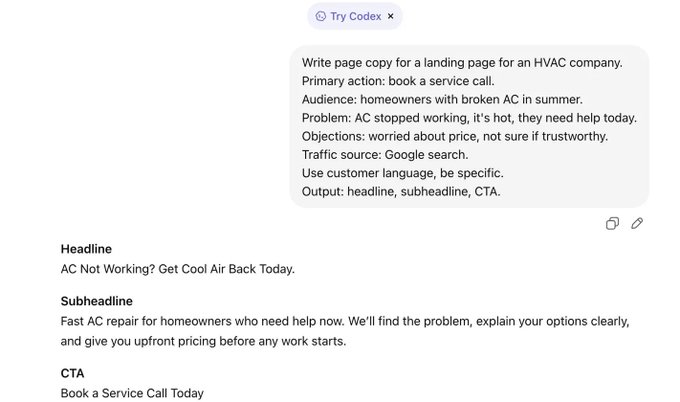
Headline formulas that actually work:
```
{Achieve outcome} without {pain point}
Turn {input} into {outcome}
Never {unpleasant event} again
The {category} for {audience}
{Number} {people} use {product} to {outcome}
```
CTA formula:
```
[Action Verb] + [What They Get] + [Qualifier if needed]
"Get the Complete Checklist"
"See Pricing for My Team"
"Start My Free Trial"
```
Copywriting prompt:
```
Write page copy for [page type].
Primary action: [conversion goal].
Audience: [ICP].
Problem: [pain point].
Objections: [hesitations].
Traffic source: [ads / organic / email].
Use customer language, be specific, avoid jargon.
Output: headline, subheadline, CTA, sections, annotations, alternatives.
```
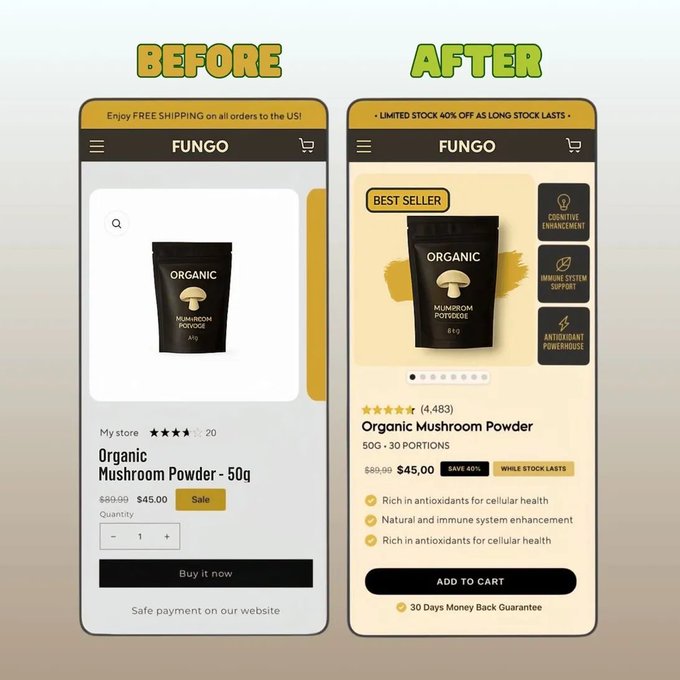
## Part 2 - CRO: a page is a sequence of arguments not a collection of blocks
The CRO skill analyzes landing pages in this exact order of impact: value proposition clarity, headline effectiveness, CTA placement and copy, visual hierarchy, trust signals, objection handling, friction points.
The 7-question framework every page should pass:
```
1. Is it clear in 5 seconds what this is and why it matters?
2. Does the headline communicate specific value?
3. Is there one primary CTA?
4. Can you scan the page visually?
5. Are there trust signals next to the CTA?
6. Are objections addressed?
7. Where is the friction — form, next steps, mobile, load time?
```
CRO audit prompt:
```
Audit this page for conversion.
Identify: page type, primary conversion goal, traffic source.
Analyze in order:
1. Value proposition — clear in 5 seconds?
2. Headline — specific outcome or vague claim?
3. CTA — one primary action, right copy, right placement?
4. Visual hierarchy — scannable without reading?
5. Trust signals — present near CTA?
6. Objections — addressed before they block conversion?
7. Friction — form fields, next steps, mobile, load time?
Output: quick wins, high-impact changes, test ideas, copy alternatives.
```
## Part 3 - A/B testing: hypothesis first, button color last
Every test starts with a structured hypothesis:
```
Because [observation/data],
we believe [change]
will cause [expected outcome]
for [audience].
We'll know this is true when [primary metric + guardrails].
```
ICE score for prioritizing what to test:
```
ICE Score = (Impact + Confidence + Ease) / 3
```
Test duration formula:
```
Duration (days) = (Sample per variant × variants) / (Daily traffic × % exposed)
```
Rule of thumb: more than 60 days - consider alternatives. Less than 14 days - usually feasible.
A/B test hypothesis prompt:
```
Because [observation/data],
we believe [change]
will cause [expected outcome]
for [audience].
We'll know this is true when [primary metric changes by X%]
without [guardrail metric] degrading.
Calculate required sample size and test duration.
ICE score: Impact [1-10] + Confidence [1-10] + Ease [1-10] / 3.
```
## Part 4 - Pricing: three axes, one framework
Most founders set pricing by looking at competitors and picking a number in the middle.
The pricing skill builds pricing on three axes: packaging - what features and limits go in each tier, pricing metric - what unit customers pay for and price point - the actual number.
The principle that matters most: price should be set based on value delivered not cost to serve. It should sit between two numbers - the next best alternative and the perceived value of your product.
Good-Better-Best structure:
```
Good → entry tier, core features, limited usage
Better → recommended tier, full features, reasonable limits
Best → premium tier, advanced features, 2-3x Better price
```
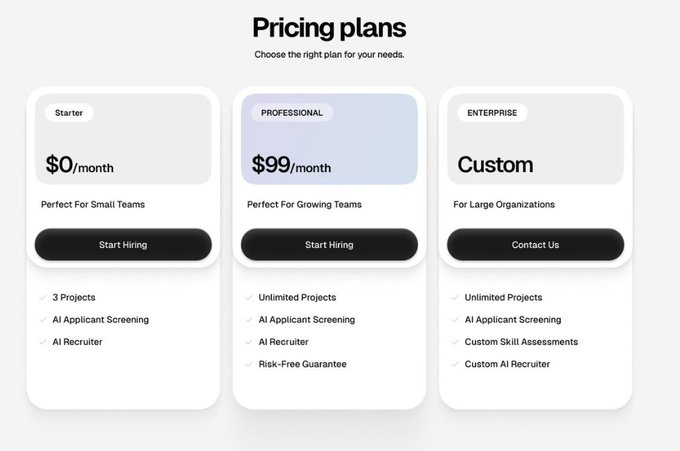
Pricing psychology the repo covers: anchoring makes the real price feel smaller by showing a higher price first. Decoy effect makes customers choose the top tier by placing a clearly worse middle tier.
Charm pricing - $49 feels meaningfully cheaper than $50. Round pricing - $100 signals confidence and premium positioning.
Pricing page elements that convert:
```
Tier comparison table with recommended badge
Monthly/annual toggle with annual discount visible
FAQ addressing the most common objections
Guarantee or free trial to reduce anxiety
Trust signals near the CTA
```
## Part 5 - AI SEO: getting cited beats getting ranked
Traditional SEO gets you ranked. AI SEO gets you cited by Google AI Overviews, ChatGPT, Perplexity, Claude, Gemini and Copilot. AI systems can cite a well-structured page even if it's not in position 1 because they evaluate quality, structure and relevance of individual passages.
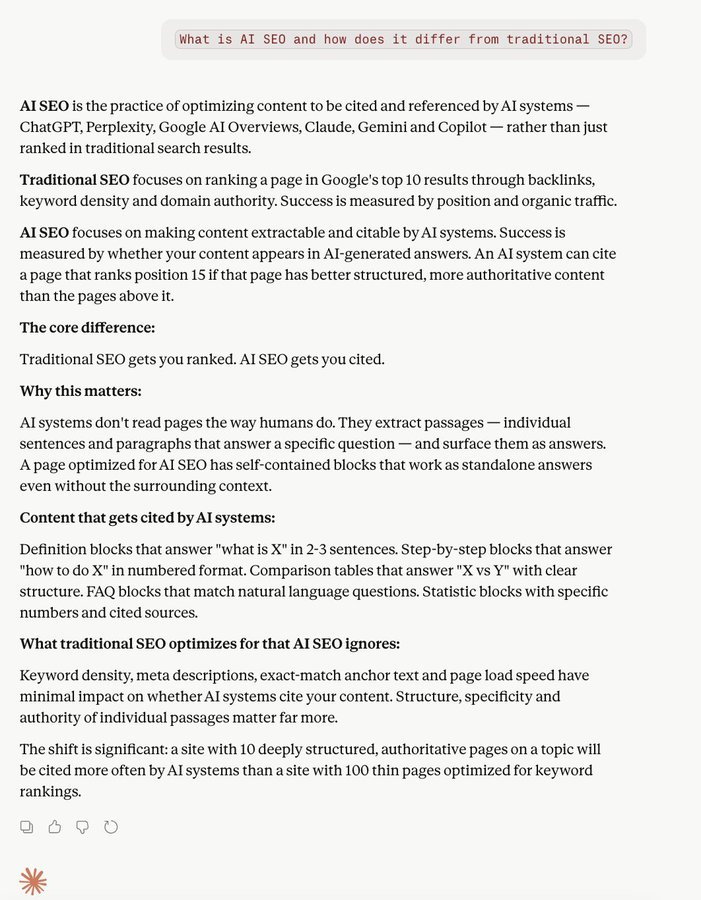
Three pillars:
```
1. Structure → make content extractable
2. Authority → make content citable
3. Presence → be where AI systems look
```
Content block patterns that get cited:
```
Definition blocks → "What is X?"
Step-by-step blocks → "How to X?"
Comparison tables → "X vs Y"
Pros/cons blocks → evaluation queries
FAQ blocks → natural language questions
Statistic blocks → claims with cited sources
```
The most underrated idea in the repo: add /pricing.md or /pricing.txt to your site so AI agents can programmatically read your pricing. If pricing is hidden behind JavaScript or "contact sales" an AI agent may simply exclude your product from a comparison. In the near future your site is read not just by humans and search bots but by buying agents.
AI SEO audit prompt:
```
For each priority query, check whether we are cited in
Google AI Overviews, ChatGPT, and Perplexity.
Analyze which competitors are cited instead of us and why.
Rewrite our content into extractable blocks:
- Definition block for "what is X" queries
- Step-by-step block for "how to X" queries
- Comparison table for "X vs Y" queries
- FAQ block for natural language questions
- Statistics block with cited sources
Add schema markup, last-updated date, author attribution.
Create /pricing.md and /llms.txt for machine-readable access.
Output: citation gaps, content rewrites, structural fixes, files to create.
```
## Part 6 - Programmatic SEO: 12 playbooks for scaling content
12 playbooks for creating pages at scale:
```
Templates → "[type] template"
Curation → "best [category]"
Conversions → "[X] to [Y]"
Comparisons → "[X] vs [Y]"
Examples → "[type] examples"
Locations → "[service] in [location]"
Personas → "[product] for [audience]"
Integrations → "[product A] [product B] integration"
Glossary → "what is [term]"
Translations → localized content
Directory → "[category] tools"
Profiles → "[entity name]"
```
The rule that matters most: 100 strong pages beats 10,000 thin pages.
## Part 7 - The growth idea library: 139 tactics, zero fluff
The most interesting tactics aren't the obvious ones:
Glossary Marketing - every industry term becomes an SEO page that ranks, brings in exactly the right audience and costs nothing after it's written. Each term is a permanent asset.
Engineering as Marketing - build a free calculator, generator or tool that solves a small version of the problem your paid product solves. It attracts exactly the right people, generates links and feeds directly into your acquisition funnel.
Importers as Marketing - "import from [competitor]" as a feature reduces switching friction to near zero. Build the bridge and make switching trivially easy.
Proprietary Data Content - data that only exists inside your product becomes a linkable asset when published. Your product sees patterns no one else can see and that data turned into a report attracts links, press and exactly the right audience.
Public Changelogs - publishing what you're shipping signals momentum. Customers who see consistent progress stay subscribed. Prospects who see active development convert faster.
Reddit Keyword Research - Reddit discussions contain the exact language customers use when no one is watching. "How do I stop losing track of client emails" is a better headline than "Email management for professionals" because it's what customers actually type when frustrated.
Founder Welcome Email - a personal email from the founder in the first 24 hours after signup has the highest open rate of any email in the sequence. It creates a human touchpoint that no automated email can replicate.
## Part 8 - The tool registry: from advice to execution
The repo doesn't stop at giving advice. It connects every skill to real tools: GA4, Google Search Console, Mixpanel, Amplitude, PostHog, Semrush, Ahrefs, HubSpot, Salesforce, Stripe, Mailchimp, Google Ads, Meta Ads, Hotjar, Optimizely - each with API, MCP, CLI and SDK availability noted.
The full execution chain:
```
Agent skill → decides what needs to be measured
Tool registry → finds the right tool
CLI → runs the report / checks conversions / sends event
```
What this repo actually is
This isn't a collection of AI prompts. It's a new format for marketing work: context plus skills plus frameworks plus tool integrations plus measurement - applied sequentially by an agent that understands your product before it touches a single word of copy.
```
Product Marketing Context → agent understands who you are
Switching Forces → agent knows why customers do or don't switch
Skill selection → copywriting / CRO / SEO / pricing / ads
Framework execution → checklist, hypothesis, ICE score
Tool integration → GA4, GSC, HubSpot, Stripe via CLI
Measurement → primary metric + guardrails + playbook
```
What you get after reading this
Marketing has always been expensive because it required people who know what to do and how to measure it. A senior marketer costs $8,000-15,000 per month. An agency charges $5,000-20,000 per project. A consultant bills $200-500 per hour.
This repo packages what those people know into markdown files that an AI agent reads and executes.
```
139 growth tactics instead of a marketing consultant
12 pSEO playbooks instead of an SEO agency
CRO framework instead of a $3,000 UX audit
A/B hypothesis with ICE score instead of a product analyst
Pricing framework instead of a pricing consultant
Tool registry with CLI instead of a data analyst
```
The difference between marketing that converts and marketing that just exists is context, system and measurement discipline. This repo gives you all three.
> github.com/coreyhaines31/marketingskills
## Cherry on top for the AI frens
If you read this far, here's your reward: a completely free AI course built for people who are actually ready to start.
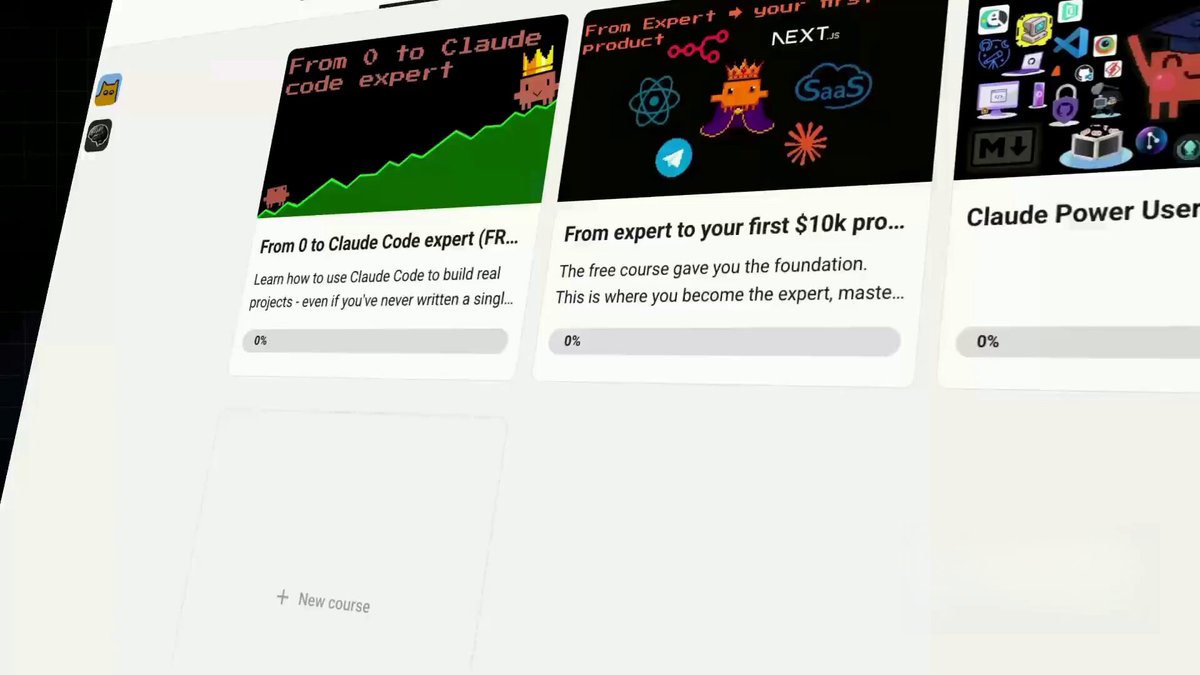
➡️ https://www.skool.com/ai-builderss/classroom
More is coming, and it's going to be bigger than anything we've dropped so far stay tuned, grab your spot early, and get ready to fall deep into the AI rabbit hole.
You build your own life - so choose the right path.
/ If this was useful - follow /
## 相关链接
- [Noisy](https://x.com/noisyb0y1)
- [@noisyb0y1](https://x.com/noisyb0y1)
- [221K](https://x.com/noisyb0y1/status/2050523761481285898/analytics)
- [github.com/coreyhaines31/marketingskills](https://github.com/coreyhaines31/marketingskills)
- [https://www.skool.com/ai-builderss/classroom](https://www.skool.com/ai-builderss/classroom)
- [6:32 PM · May 2, 2026](https://x.com/noisyb0y1/status/2050523761481285898)
- [221.7K Views](https://x.com/noisyb0y1/status/2050523761481285898/analytics)
- [View quotes](https://x.com/noisyb0y1/status/2050523761481285898/quotes)
---
*导出时间: 2026/5/3 12:42:40*
---
## 中文翻译
# 139 种营销战术和完整的 CRO 框架,替代 10,000 美元/月的代理商。一个代码库,零成本
**作者**: Noisy
**日期**: 2026-05-02T10:32:16.000Z
**来源**: [https://x.com/noisyb0y1/status/2050523761481285898](https://x.com/noisyb0y1/status/2050523761481285898)
---

营销代理公司每月收费 10,000 美元。资深营销人员——15,000 美元。顾问——300 美元/小时。
有人将他们所知的一切整合到一个免费的代码库中,并为 AI 智能体进行了封装。包含 139 种增长战术、12 个 SEO 操作手册,以及文案、CRO、定价和 A/B 测试框架。
> Github 链接在文末
配备此系统的智能体一天能完成营销人员一周的工作。以下是它的内部奥秘。
让其他一切行之有效的关键洞察
这个代码库中的每一项技能都始于一个文件:product-marketing-context.md(产品营销上下文)。在智能体撰写半个字的文案或分析任何一个落地页之前,它会首先阅读这个文件。
该文件包含了一位经验丰富的营销人员在第一周内会去学习的所有内容:产品概述、目标受众、用户画像、痛点、竞争格局、差异化、异议、转换动态、客户语言、品牌声音、佐证点和目标。
关键词是“客户语言”。来自真实客户的原话——从访谈、评论和支持工单中提取——比任何经过修饰的内部描述都更有价值,因为它们反映了客户的真实想法和说话方式。
工作流程:
```
Claude 阅读你的代码库、落地页和文档
→ 自动起草产品营销上下文
→ 你审查并纠正错误之处
→ 每一项其他技能在行动前都会阅读此上下文
```
产品上下文提示词——在任何其他营销任务之前运行此命令:
```
研究代码库:README、落地页、营销文案、
package.json、文档。
起草:
- 产品概述和核心价值主张
- 目标受众和 ICP(理想客户画像)
- 包含待完成任务(Jobs to be Done)的用户画像
- 痛点和转换力量(推力/拉力/习惯/焦虑)
- 竞争格局和差异化
- 常见异议及其处理方式
- 客户语言——来自评论和支持的原话
- 可用的佐证点和社会认同
- 当前目标和成功指标
然后问:什么需要修正或遗漏了什么?
```
如果没有这个文件,智能体写出的就是通用内容。有了它,智能体就能了解你的 ICP、你的异议、你的佐证点以及客户的确切措辞。
转换力量:客户为什么转换,为什么不转换
整个代码库中最被低估的框架是“转换力量”——解释了客户为什么要更换产品以及为什么不更换的四种力量。
```
推力 (Push) → 现有解决方案有什么令人沮丧的地方,
足以让人开始寻找替代品
拉力 (Pull) → 新解决方案有什么吸引力,
让人想要转换
习惯 (Habit) → 是什么让人们固守现状,
即使他们并不满意
焦虑 (Anxiety) → 对转换的恐惧是什么阻碍了人们,
即使他们想要改变
```
大多数营销只关注拉力——看我们的产品多棒。这个代码库中的智能体被设计用来解决所有四种力量。一个只谈论功能的落地页,实际上忽略了阻止转化的另外三种力量。
一个了解你“转换力量”的智能体,会撰写能够消除焦虑、承认习惯并解决将用户带到你页面的真正“推力”的文案。
## 第 1 部分 - 文案撰写:清晰永远胜过聪明
文案撰写技能将智能体定位为转化文案撰写人,遵循四个不可妥协的原则:清晰胜于聪明,利益胜于功能,具体胜于模糊,客户语言胜于公司语言。不是“节省时间”,而是“将周报时间从 4 小时缩短到 15 分钟”。

真正有效的标题公式:
```
{达成结果} 无需 {痛点}
将 {输入} 转化为 {结果}
永远不再 {令人不快的事件}
{人群} 专属的 {类别}
{数字} 位 {人群} 使用 {产品} 来 {结果}
```
CTA(行动号召)公式:
```
[动作动词] + [他们得到的] + [限定词(如需要)]
"获取完整清单"
"查看我的团队价格"
"开始我的免费试用"
```
文案提示词:
```
为 [页面类型] 撰写页面文案。
主要动作:[转化目标]。
受众:[ICP]。
问题:[痛点]。
异议:[顾虑]。
流量来源:[广告 / 自然搜索 / 邮件]。
使用客户语言,具体明确,避免行话。
输出:标题、副标题、CTA、板块、注释、替代方案。
```
## 第 2 部分 - CRO(转化率优化):页面是论点的序列,而非模块的堆砌
CRO 技能按以下确切的影响顺序分析落地页:价值主张清晰度、标题有效性、CTA 位置和文案、视觉层级、信任信号、异议处理、摩擦点。
每个页面都应通过的 7 问框架:
```
1. 是否在 5 秒钟内就能看出这是什么以及它为什么重要?
2. 标题是否传达了具体的价值?
3. 是否有一个主要的 CTA?
4. 页面在视觉上是否易于浏览?
5. CTA 旁边是否有信任信号?
6. 是否解决了异议?
7. 摩擦点在哪里——表单、下一步、移动端、加载时间?
```
CRO 审计提示词:
```
审计此页面的转化率。
识别:页面类型、主要转化目标、流量来源。
按顺序分析:
1. 价值主张 —— 5 秒内是否清晰?
2. 标题 —— 具体的结果还是模糊的宣称?
3. CTA —— 一个主要动作,文案和位置是否正确?
4. 视觉层级 —— 不阅读文字是否也能浏览?
5. 信任信号 —— 是否出现在 CTA 附近?
6. 异议 —— 是否在阻止转化前得到解决?
7. 摩擦 —— 表单字段、下一步、移动端、加载时间?
输出:快速获胜、高影响力变更、测试想法、文案替代方案。
```

## 第 3 部分 - A/B 测试:假设优先,按钮颜色靠后
每个测试都从一个结构化的假设开始:
```
鉴于 [观察/数据],
我们相信 [变更]
将导致 [预期结果]
针对 [受众]。
当 [主要指标 + 卫护指标] 变化时,我们将确信这一点。
```
用于确定测试优先级的 ICE 分数:
```
ICE 分数 = (影响力 + 信心 + 容易度) / 3
```
测试时长公式:
```
时长 (天) = (每个变体的样本量 × 变体数) / (日流量 × %曝光)
```
经验法则:超过 60 天——考虑替代方案。少于 14 天——通常可行。
A/B 测试假设提示词:
```
鉴于 [观察/数据],
我们相信 [变更]
将导致 [预期结果]
针对 [受众]。
当 [主要指标变化 X%]
且 [卫护指标] 未下降时,我们将确信这一点。
计算所需的样本量和测试时长。
ICE 分数:影响力 [1-10] + 信心 [1-10] + 容易度 [1-10] / 3。
```
## 第 4 部分 - 定价:三个轴,一个框架
大多数创始人在定价时,会盯着竞争对手并选一个中间的数字。
定价技能基于三个轴构建定价:包装(Packaging)——每个层级包含哪些功能和限制,定价指标——客户按什么单位付费,以及价格点——实际的数字。
最重要的原则:价格应基于交付的价值而非服务成本来设定。它应位于两个数字之间——次优替代品的价格和你产品的感知价值。
“好-更好-最好”结构:
```
好 (Good) → 入门级,核心功能,使用受限
更好 (Better) → 推荐级,完整功能,合理限制
最好 (Best) → 高级级,高级功能,价格的 2-3 倍
```

代码库涵盖的定价心理学:锚定效应——通过先展示一个较高的价格使实际价格感觉更便宜。诱饵效应——通过放置一个明显较差的中间选项,促使客户选择最高层级。
Charm pricing(魅力定价)——49 美元感觉比 50 美元便宜得多。整数定价——100 美元传递出信心和高端定位。
高转化定价页元素:
```
带有推荐徽章的层级对比表
月付/年付切换,并显示年付折扣
解决最常见的异议的 FAQ
保证或免费试用以降低焦虑
CTA 附近的信任信号
```
## 第 5 部分 - AI SEO:被引用胜过被排名
传统 SEO 让你获得排名。AI SEO 让你被 Google AI 摘要、ChatGPT、Perplexity、Claude、Gemini 和 Copilot 引用。AI 系统可以引用一个结构良好的页面,即使它不在第一名,因为它们评估的是各个段落的质量、结构和相关性。

三大支柱:
```
1. 结构 → 使内容可提取
2. 权威 → 使内容可引用
3. 存在 → 出现在 AI 系统寻找的地方
```
可被引用的内容块模式:
```
定义块 → "什么是 X?"
步骤块 → "如何做 X?"
对比表 → "X vs Y"
优/缺块 → 评估类查询
FAQ 块 → 自然语言问题
统计块 → 带引用来源的主张
```
代码库中最被低估的想法:在你的网站上添加 /pricing.md 或 /pricing.txt,以便 AI 智能体可以通过程序读取你的定价。如果定价隐藏在 JavaScript 后面或写着“联系销售”,AI 智能体可能会直接在比较中排除你的产品。在不久的将来,读取你网站的不仅仅是人类和搜索机器人,还有购物智能体。
AI SEO 审计提示词:
```
对于每个优先查询,检查我们是否在
Google AI 摘要、ChatGPT 和 Perplexity 中被引用。
分析哪些竞争对手被引用而不是我们,以及原因。
将我们的内容重写为可提取的块:
- 针对“什么是 X”查询的定义块
- 针对“如何做 X”查询的步骤块
- 针对“X vs Y”查询的对比表
- 针对自然语言问题的 FAQ 块
- 带引用来源的统计块
添加 Schema 标记、最后更新日期、作者归属。
创建用于机器可读访问的 /pricing.md 和 /llms.txt。
输出:引用差距、内容重写、结构修复、需创建的文件。
```
## 第 6 部分 - 程序化 SEO:规模化内容的 12 个操作手册
用于规模化创建页面的 12 个操作手册:
```
模板 → "[类型] 模板"
精选 → "最佳 [类别]"
转换 → "[X] 转 [Y]"
比较 → "[X] vs [Y]"
示例 → "[类型] 示例"
地点 → "[地点] 的 [服务]"
人群 → "面向 [受众] 的 [产品]"
集成 → "[产品 A] [产品 B] 集成"
术语表 → "什么是 [术语]"
翻译 → 本地化内容
目录 → "[类别] 工具"
概况 → "[实体名称]"
```
最重要的规则:100 个强有力的页面胜过 10,000 个单薄的页面。
## 第 7 部分 - 增长创意库:139 个战术,零废话
最有趣的战术不是那些显而易见的:
术语表营销——每个行业术语都变成一个排名的 SEO 页面,带来完全正确的受众,并且在撰写后零成本。每个术语都是永久性资产。
工程化营销——构建一个免费的计算器、生成器或工具,解决你付费产品所解决问题的小版本。它吸引完全正确的人,生成链接,并直接输入你的获取漏斗。
导入器营销——将“从 [竞争对手] 导入”作为功能,将转换摩擦降至接近零。搭建桥梁,使转换变得极其容易。
独有数据内容——只存在于你产品内部的数据一旦发布就会变成可链接的资产。你的产品能看到其他人看不到的模式,这些数据转化成的报告能吸引链接、媒体报道以及完全正确的受众。
公开更新日志——发布你正在构建的内容传递出动力。看到持续进度的客户会保持订阅。看到活跃开发的潜在客户转化得更快。
Reddit 关键词研究——Reddit 讨论包含客户在无人注视时使用的确切语言。“我该如何停止忘记客户邮件”是比“专业人士邮件管理”更好的标题,因为这是客户在沮丧时实际输入的内容。
创始人欢迎邮件——注册后 24 小时内来自创始人的私人邮件拥有整个序列中最高的打开率。它创建了任何自动邮件都无法复制的人际接触点。
## 第 8 部分 - 工具注册表:从建议到执行
代码库不仅仅提供建议。它将每一项技能连接到真正的工具:GA4、Google Search Console、Mixpanel、Amplitude、PostHog、Semrush、Ahrefs、HubSpot、Salesforce、Stripe、Mailchimp、Google Ads、Meta Ads、Hotjar、Optimizely——每一项都注明了 API、MCP、CLI 和 SDK 的可用性。
完整的执行链:
```
智能体技能 → 决定需要衡量什么
工具注册表 → 找到正确的工具
CLI → 运行报告 / 检查转化 / 发送事件
```
这个代码库到底是什么
这不是 AI 提示词的集合。它是一种新的营销工作格式:上下文加上技能加上框架加上工具集成加上衡量——由一个智能体按顺序应用,在它接触半个字的文案之前先理解你的产品。
```
产品营销上下文 → 智能体理解你是谁
转换力量 → 智能体知道客户为什么转换或不转换
技能选择 → 文案 / CRO / SEO / 定价 / 广告
框架执行 → 清单、假设、ICE 分数
工具集成 → 通过 CLI 连接 GA4、GSC、HubSpot、Stripe
衡量 → 主要指标 + 卫护指标 + 操作手册
```
读完这些后你能得到什么
营销之所以一直很昂贵,是因为它需要知道该做什么以及如何衡量的人。一位资深营销人员每月花费 8,000-15,000 美元。代理商每个项目收费 5,000-20,000 美元。顾问按小时收费 200-500 美元。
这个代码库将这些人的知识打包成 AI 智能体读取和执行的 Markdown 文件。
```
139 个增长战术代替营销顾问
12 个 pSEO 操作手册代替 SEO 代理商
CRO 框架代替 3,000 美元的 UX 审计
带 ICE 分数的 A/B 假设代替产品分析师
定价框架代替定价顾问
带 CLI 的工具注册表代替数据分析师
```
能转化的营销和仅仅存在的营销之间的区别在于上下文、系统和衡量纪律。这个代码库为你提供了这三者。
> github.com/coreyhaines31/marketingskills
## 给 AI 朋友们的额外奖励
如果你读到这里,这是给你的奖励:一个完全免费的 AI 课程,专为真正准备好开始的人打造。

➡️ https://www.skool.com/ai-builderss/classroom
更多内容即将推出,它将比我们目前发布的任何东西都重要,敬请期待,尽早抢占位置,准备好深入探索 AI 的兔子洞。
你构建自己的生活——所以选择正确的道路。
/ 如果这有用 - 请关注 /
## 相关链接
- [Noisy](https://x.com/noisyb0y1)
- [@noisyb0y1](https://x.com/noisyb0y1)
- [221K](https://x.com/noisyb0y1/status/2050523761481285898/analytics)
- [github.com/coreyhaines31/marketingskills](https://github.com/coreyhaines31/marketingskills)
- [https://www.skool.com/ai-builderss/classroom](https://www.skool.com/ai-builderss/classroom)
- [6:32 PM · May 2, 2026](https://x.com/noisyb0y1/status/2050523761481285898)
- [221.7K Views](https://x.com/noisyb0y1/status/2050523761481285898/analytics)
- [View quotes](https://x.com/noisyb0y1/status/2050523761481285898/quotes)
---
*导出时间: 2026/5/3 12:42:40*