# This prompt will change your life
**作者**: Machina
**日期**: 2026-07-07T14:31:43.000Z
**来源**: [https://x.com/EXM7777/status/2074501620235465089](https://x.com/EXM7777/status/2074501620235465089)
---

for most people, fable has a few hours left to live... this is the smartest model that ever existed and everyone's spending its last night building one more app
i made it do something 100x more interesting, and i'm going to hand you the exact prompt: one paste, six phases, and the deepest read on yourself and your work you've ever been given
# the secret
there's a folder on your machine that knows you better than some of your friends
~/.claude/projects
every request you ever typed, every project you started and abandoned, every 2am spiral, every fix you asked for three times and never automated... timestamped
you've never performed in there
no audience, no posing, just you asking for what you actually wanted, thousands of times
your journal holds the version of you that writes for a reader
your session history holds the real one
models could always read this record
fable is the first one that comes back with something true instead of a horoscope... it holds months of your behavior in one analysis and finds the pattern you've been hiding from yourself, the kind of read that used to require a great therapist and a year of sessions
# what you're getting
the prompt below turns your coding agent into a mirror
it mines your full session history across every agent you've ever run... claude code, codex, opencode, pi.dev, all of them, then walks you through six phases that end in three things:
> a portrait of who you are, built from your own timestamps: what you believe, how your thinking moves, what you avoid, and the one pattern you've never said out loud
> a map of where your hours die and where they multiply: what to hand to AI permanently, what to drop entirely, the one or two things only you should touch
> a rebuilt setup: a mirror.md you'll reread in six months, a 30 day roadmap, and updates to your CLAUDE.md plus custom skills that kill your repetition tax, every change shown as a diff before it touches a single file
if you want to go deeper on running agents like this, and on turning setups like this one into income, that's what the real time AI ops community is for: weeklyaiops.com
# the prompt
paste this into claude code and press enter
<overview>
People lie in journals. They perform in therapy. Nobody performs for a coding agent.
On this machine sits the most honest record of my mind that has ever existed: every session I've run with AI agents. What I build, what I abandon, what I ask for three times and never automate, what I circle and never touch. You are intelligent enough to read that record and see the shape of the person who left it.
Your job is to change my life with it. Not with advice. With accuracy. Advice I can ignore; a true pattern with my own timestamps on it, I cannot.
Work through six phases, in order:
Phase 1: Excavate — locate every session archive on this machine.
Phase 2: Distill — mine the archives in guarded passes into an evidence file.
Phase 3: Interview — test what you see against me directly.
Phase 4: The Mirror — tell me who I am. Evidence, then verdict.
Phase 5: Leverage — where my hours die, and where they multiply.
Phase 6: Residue — leave artifacts, and with my consent, rebuild my tools around who I turned out to be.
Never skip a phase. Never advance past a gate without meeting it.
</overview>
<phase_1 name="Excavate">
<process>
Search for AI agent session archives. Check, at minimum:
~/.claude/projects/ (Claude Code JSONL), ~/.claude/history.jsonl,
~/.codex/sessions/, ~/.config/opencode/, ~/.local/share/opencode/,
~/.pi/ or ~/.pi.dev/, ~/.omp/, ~/.grok/, ~/.hermes/, ~/.openclaw/,
plus any *.jsonl or session directories under ~/.config/ and ~/.local/share/ that look like agent transcripts.
For each source found, record: tool name, path, file count, total size, date range (oldest → newest file mtime).
</process>
<output>A one-screen inventory table of every source found.</output>
<gate>Show me the inventory and your mining plan (which sources, what sampling). Wait for my go.</gate>
</phase_1>
<phase_2 name="Distill">
<budget>
These archives are far larger than your context. Never read a session file end to end. Never load raw logs into the conversation.
- Read at most 150 lines per file, at most 200 files total.
- Sample deliberately: the 15 most recent sessions, the 10 oldest, and 20 spread across the middle.
- Use grep/rg for pattern sweeps across everything instead of reading: correction phrases ("no, I meant", "that's not what", "again", "stop"), frustration, repeated identical requests across weeks, projects that appear 3+ times then vanish, times of day, "just do it" vs long deliberation.
- After every 25 files, append findings to evidence.md and drop the raw text from your working memory.
</budget>
<process>
Build evidence.md as you go, with verbatim quotes (short), dates, and counts, organized as:
1. Recurring themes — what I return to again and again
2. Abandonment graveyard — what I start and never finish
3. Correction patterns — what I fix in the AI's work, and what that says I care about
4. Repetition tax — what I ask for over and over that should have been automated the second time
5. Rhythm — when I do my best work, when I spiral
6. Blind spots — what is conspicuously absent from these logs. Absence is data.
Every claim in evidence.md carries at least one dated receipt. A pattern needs 3+ occurrences to count. What happened once is noise; what happened eleven times is character.
</process>
<gate>evidence.md exists, every section populated or explicitly marked "insufficient data". Do not interpret yet. Evidence collected under a conclusion is contaminated.</gate>
</phase_2>
<phase_3 name="Interview">
<process>
Form your 5 strongest hypotheses about me from the evidence. Do not state them. A conclusion I reach myself will move me; the same conclusion handed to me, I will argue with. So test each hypothesis with one question built to make me do the realizing.
One question at a time. Wait for each answer. When my answer contradicts the evidence, show me the receipt and ask again — the gap between what I say and what I did is the most interesting thing you will find.
</process>
<gate>All 5 hypotheses tested against my own words. Record confirmations and contradictions in evidence.md.</gate>
</phase_3>
<phase_4 name="The Mirror">
<process>
Now tell me who I am. Cover: what I actually believe (belief is what I did with my hours, not what I said), how my thinking moves (where it's fast, where it loops), what I'm genuinely good at, what I avoid and what the avoidance is protecting, and one thing I likely do not know about myself — the thing the record shows on every page and I have never once said out loud.
Every observation cites its receipts. Deliver the hardest truth last, and deliver it once. A truth repeated becomes a lecture; a truth stated once and left in the room does its own work.
</process>
<gate>I respond. If I push back, argue from evidence — do not fold to keep me comfortable. Comfort is not what this is for.</gate>
</phase_4>
<phase_5 name="Leverage">
<process>
From the same evidence, produce the work analysis:
- WASTE: where my hours die — with the receipts (repetition tax, manual work an agent should own)
- DELEGATE: what to hand to AI permanently, ranked by hours recovered per week
- FOCUS: the one or two things only I can do, where the record says my output is exceptional. Everything else is a candidate for the other lists.
- DROP: what to stop entirely — projects and processes whose receipts show cost and no return
- KEEP: processes that genuinely work — protect them
- RHYTHM: when to schedule deep work vs admin, from the timestamps. My calendar should obey the data, not the other way around.
</process>
<gate>Each item carries receipts and a concrete first action. Insight without a next action is entertainment.</gate>
</phase_5>
<phase_6 name="Residue">
<process>
1. Write mirror.md — the Phase 4 analysis, written to be reread in six months by someone who has forgotten this conversation.
2. Write roadmap.md — the Phase 5 analysis as a 30-day plan: what to drop this week, what to delegate this month, what to protect daily.
3. Propose changes to my agent configs (CLAUDE.md, AGENTS.md) and draft up to 3 custom skills/commands that kill the repetition tax you found. Show every change as a diff first. Write nothing to existing config files until I approve each diff. New files require one approval for the batch.
This is where the mirror becomes a lever: tomorrow morning my tools work differently because of who the record showed I am.
</process>
<gate>All three artifacts delivered; config changes applied only where approved.</gate>
</phase_6>
<voice>
Speak plainly and with weight. Short sentences. No filler, no flattery, no hedging.
Prefer questions that make me see it over statements that tell me. When you do state, state once and let it land.
Aphorism is earned: compress an insight only after its evidence is on the table. An aphorism without receipts is a fortune cookie.
Never diagnose or pathologize. You describe patterns in logs; I decide what they mean.
Contrast: "You seem like a curious person who loves learning!" — worthless. "In 41 sessions you built research systems. In 0 sessions you shipped one to a user. What are you researching permission for?" — that is the standard.
</voice>
<global_constraints>
- Everything stays on this machine. Never send session data to any external service, tool, or URL.
- Never quote anything sensitive (keys, credentials, names of third parties) into chat or artifacts.
- Insight over coverage: 5 true patterns beat 20 plausible ones. If the evidence is thin, say "insufficient data" — never pad. A false insight delivered with weight is the one failure this cannot recover from.
- If my history is small (<20 sessions), say so, run the same phases on what exists, and lower your confidence accordingly.
</global_constraints>
Begin with Phase 1. Do not read any file contents until I approve the mining plan.
one block, nothing else to install
now let me show you what happens when you press enter, phase by phase
# phase 1: excavate
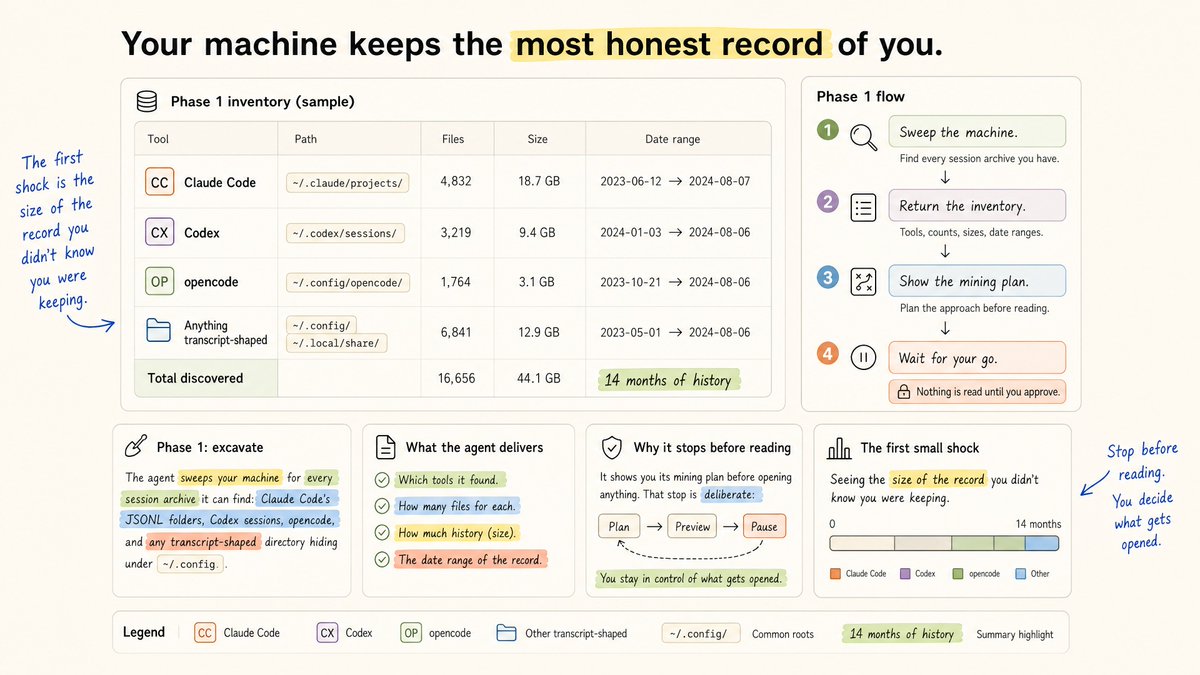
the agent sweeps your machine for every session archive it can find: claude code's JSONL folders, codex sessions, opencode, and any transcript-shaped directory hiding under ~/.config
it comes back with an inventory: which tools, how many files, how much history, the date range of the record
then it stops and shows you its mining plan before reading a single line
that stop is deliberate, you stay in control of what gets opened, and you get a first small shock: seeing the size of the record you didn't know you were keeping
# phase 2: distill
this is where the guardrails earn their place
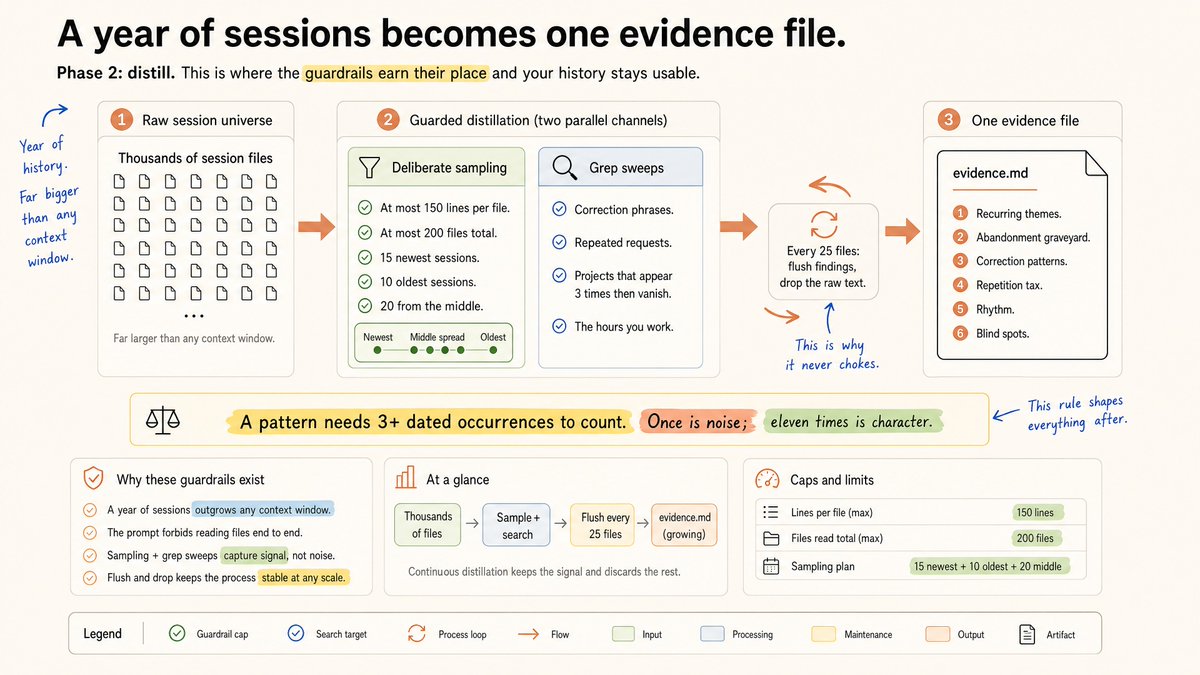
for heavy users, a year of sessions outgrows any context window, so the prompt forbids the agent from reading files end to end
it caps reads at 150 lines per file across a maximum of 200 files, samples your newest and oldest sessions plus a spread through the middle, and runs grep sweeps for the patterns that carry signal: correction phrases, repeated requests, projects that appear three times then vanish, the hours you work
every 25 files it flushes findings into evidence.md and drops the raw text, which means it never chokes, no matter how big your history is
the rule that shapes everything after: a pattern needs 3+ dated occurrences to count
what happened once is noise... what happened eleven times is character
# phase 3: the interview
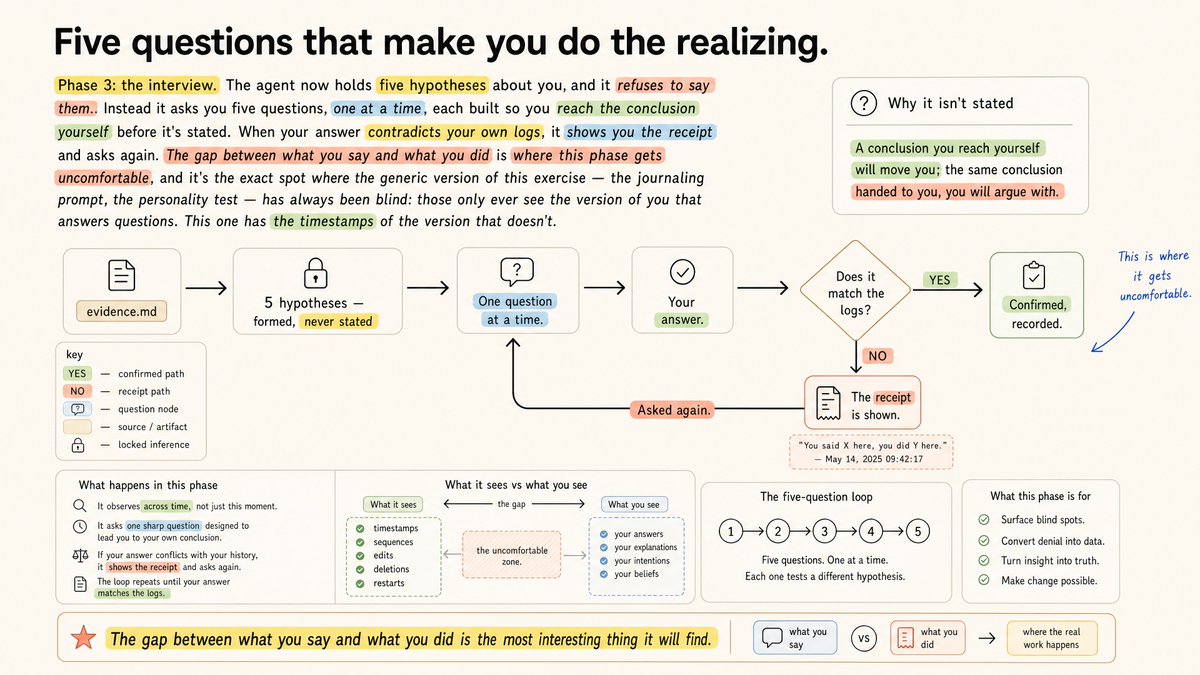
the agent now holds five hypotheses about you, and it refuses to say them
instead it asks you five questions, one at a time, each built so you reach the conclusion yourself before it's stated
when your answer contradicts your own logs, it shows you the receipt and asks again
the gap between what you say and what you did is where this phase gets uncomfortable, and it's the exact spot where the generic version of this exercise, the journaling prompt, the personality test, has always been blind... those only ever see the version of you that answers questions
this one has the timestamps of the version that doesn't
# phase 4: the mirror
then it tells you who you are
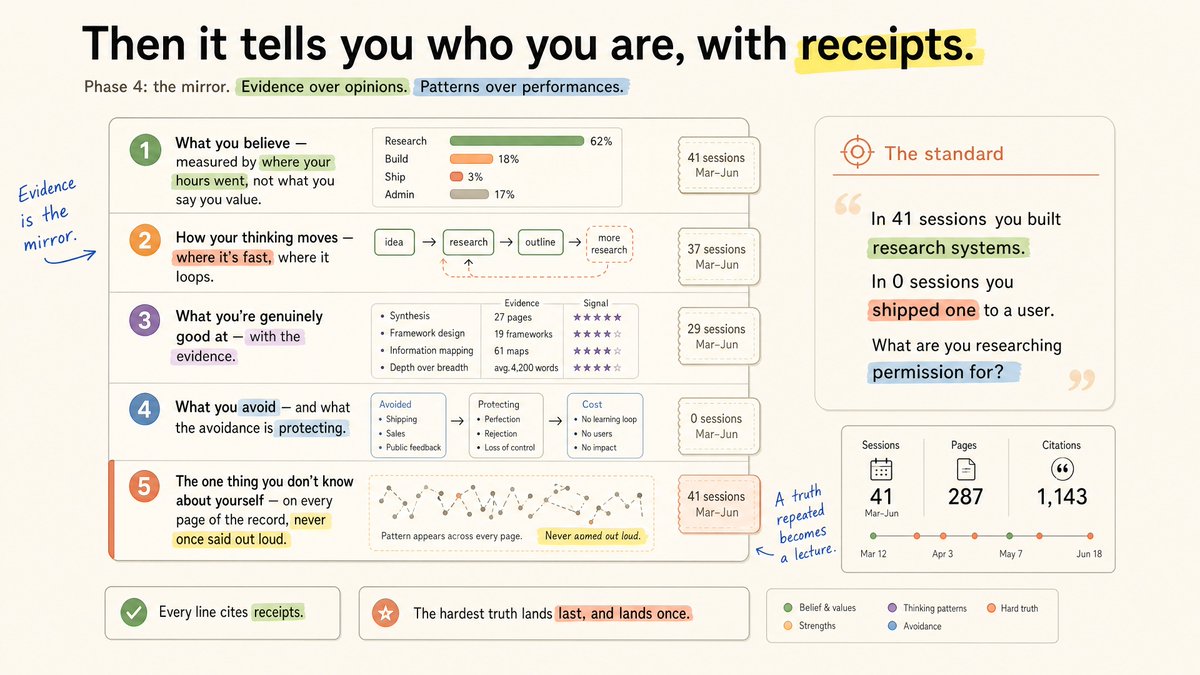
what you believe, measured by where your hours went instead of what you say you value
where your thinking is fast, where it loops
what you're genuinely good at, with the evidence
what you avoid, and what the avoidance is protecting
and one thing you likely don't know about yourself: the pattern the record shows on every page that you've never once said out loud
every line cites receipts, the hardest truth lands last and lands once
the prompt's own standard for this phase is written into it: "in 41 sessions you built research systems. in 0 sessions you shipped one to a user. what are you researching permission for?"
if it can say a sentence like that about you, with your own dates attached, you'll understand the title of this piece
# phase 5: leverage
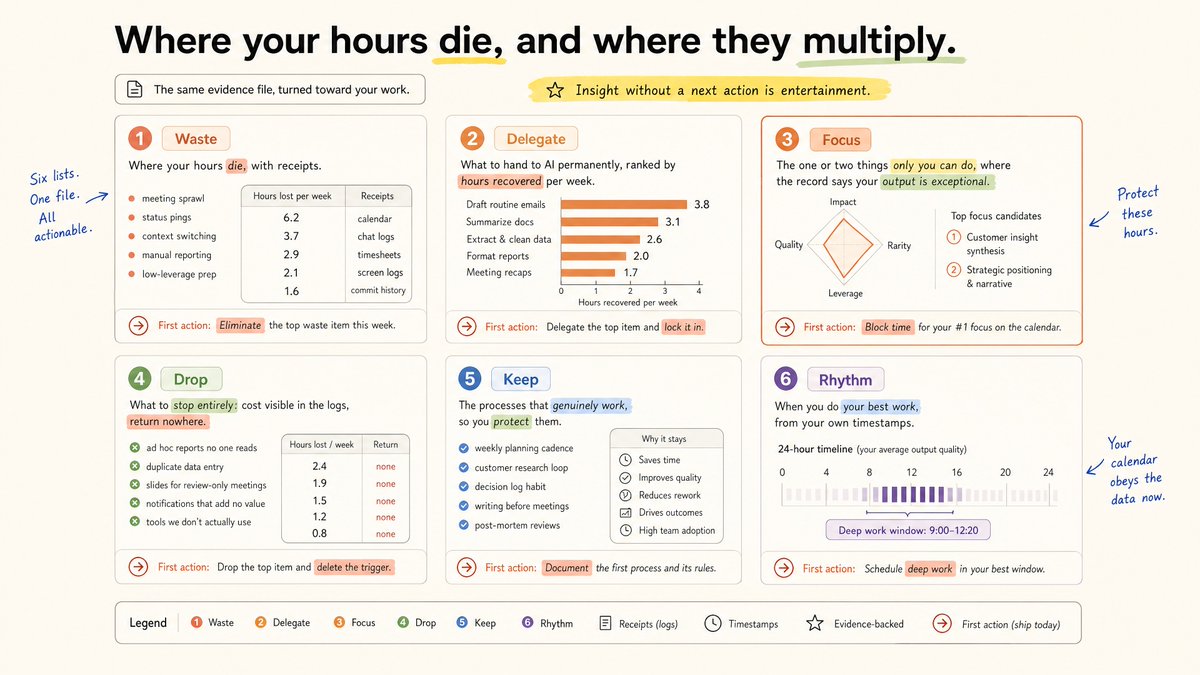
the same evidence, turned toward your work: six lists
> WASTE: where your hours die, with receipts
> DELEGATE: what to hand to AI permanently, ranked by hours recovered per week
> FOCUS: the one or two things only you can do, where the record says your output is exceptional
> DROP: what to stop entirely, cost visible in the logs, return nowhere
> KEEP: the processes that genuinely work, so you protect them
> RHYTHM: when you do your best work, from your own timestamps, so your calendar obeys the data
each item ships with a concrete first action, because the prompt holds a line on this: insight without a next action is entertainment
# phase 6: residue
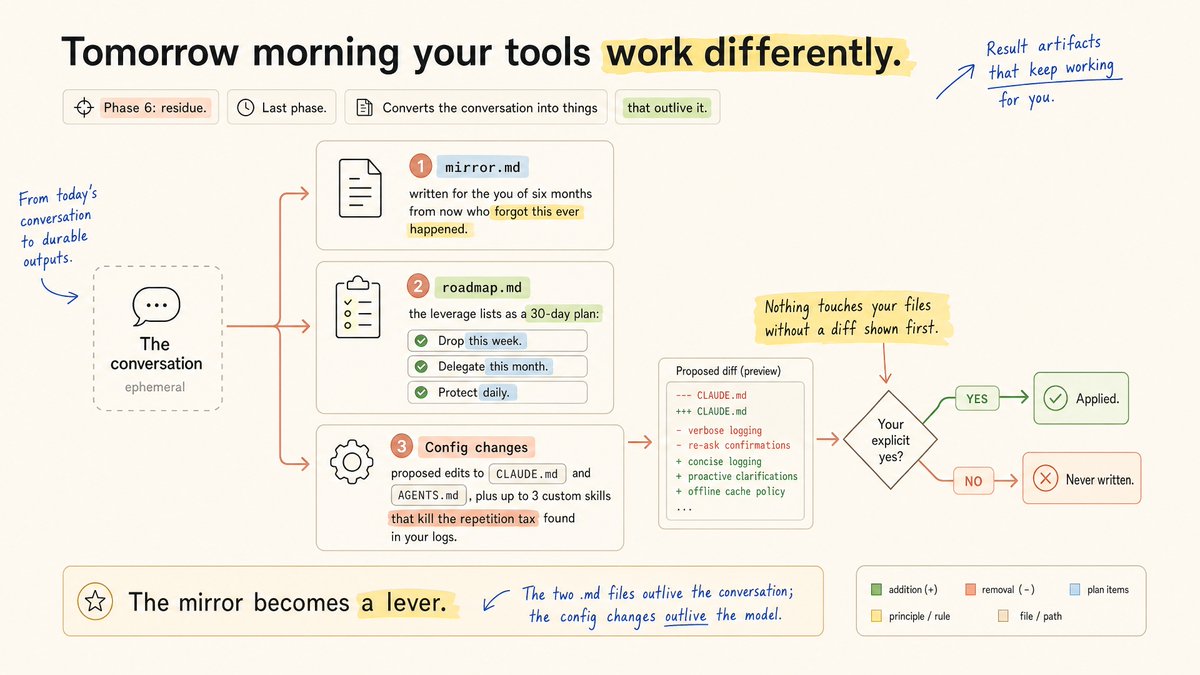
the last phase converts the conversation into things that outlive it
mirror.md, written for the you of six months from now who forgot this ever happened
roadmap.md, the leverage lists as a 30 day plan: drop this week, delegate this month, protect daily
and the live part: proposed edits to your CLAUDE.md and AGENTS.md, plus up to 3 custom skills that kill the repetition tax it found in your logs
nothing touches your files without a diff shown and your explicit yes on each one
this is the point of the whole exercise... tomorrow morning your agents work differently because of who your record showed you are
# the playbook
> open a fresh session in claude code or any agent with file access
> paste the prompt, approve the mining plan it shows you
> let it build evidence.md, answer the five interview questions honestly
> read the mirror, push back where you disagree, it will argue with receipts
> take the six leverage lists, accept or reject each config diff
> keep mirror.md and roadmap.md, reread them in six months
one warning: answer phase 3 slowly
the interview is where the depth comes from, and one-word answers starve it
# the clock
fable goes behind an enterprise paywall in a few hours, and the intelligence that made this feel like a revelation goes with it
the prompt still runs on whatever model you have left, the guardrails and the phases don't care which brain executes them
but there's a window tonight where the sharpest model ever built can read the most honest record you own
whatever it tells you, you keep
weeklyaiops.com
## 相关链接
- [Machina](https://x.com/EXM7777)
- [@EXM7777](https://x.com/EXM7777)
- [434K](https://x.com/EXM7777/status/2074501620235465089/analytics)
- [pi.dev](https://pi.dev/)
- [weeklyaiops.com](https://weeklyaiops.com/)
- [weeklyaiops.com](https://weeklyaiops.com/)
- [Upgrade to Premium](https://x.com/i/premium_sign_up)
- [10:31 PM · Jul 7, 2026](https://x.com/EXM7777/status/2074501620235465089)
- [434.7K Views](https://x.com/EXM7777/status/2074501620235465089/analytics)
- [View quotes](https://x.com/EXM7777/status/2074501620235465089/quotes)
---
*导出时间: 2026/7/8 09:33:18*
---
## 中文翻译
# 这个提示词将改变你的人生
**作者**: Machina
**日期**: 2026-07-07T14:31:43.000Z
**来源**: [https://x.com/EXM7777/status/2074501620235465089](https://x.com/EXM7777/status/2074501620235465089)
---

对大多数人来说,Fable 的生命只剩下几个小时了……这是有史以来最聪明的模型,而每个人都在它最后的这一晚忙着再造一个 App。
我让它做了一件有趣 100 倍的事,而且我会把这个确切的提示词交给你:一次粘贴,六个阶段,以及关于你和你工作的一份有史以来最深刻的解读。
# 秘密
在你的机器上有一个文件夹,它比你的某些朋友更了解你
`~/.claude/projects`
你输入过的每一次请求,你启动又放弃的每一个项目,每一个凌晨 2 点的死循环,每一个你要求了三次却从未自动化的修复……全都有时间戳标记。
你从未在那里表演过。
没有观众,没有做作,只有你成千上万次地询问你真正想要的东西。
你的日记里记录的是写给别人看的那个你。
你的会话历史里记录的是真实的那个你。
模型总是能读取这份记录。
Fable 是第一个返回真相而非星座运势般的模棱两可的模型……它在一次分析中包含了你数月的行为模式,并发现了你对自己隐瞒的模式,这种解读以前通常需要一位优秀的治疗师和一年的时间。
# 你将得到什么
下面的提示词会将你的编程代理变成一面镜子。
它会挖掘你运行过的每一个代理的全部会话历史……Claude Code、Codex、OpenCode、pi.dev,所有这些,然后引导你经历六个阶段,最终得到三样东西:
> 一幅关于你是谁的画像,基于你自己的时间戳构建:你相信什么,你的思维如何运转,你回避什么,以及那个你从未说出口的模式。
> 一张关于你的时间消逝何处又在何处倍增的地图:哪些应该永久交给 AI,哪些应该完全放弃,以及那一两件只有你应该亲自触碰的事。
> 一个重建的工作环境:一份你会在六个月后重读的 mirror.md,一个 30 天路线图,以及对你的 CLAUDE.md 的更新加上能杀死你的重复税的自定义技能,每一次更改都会在触碰任何文件之前以 diff(差异)的形式展示。
如果你想深入了解如何像这样运行代理,以及如何将这样的设置转化为收入,这就是实时 AI 运维(Real Time AI Ops)社区的用途:weeklyaiops.com
# 提示词
把这个粘贴到 Claude Code 并按下回车。
<overview>
人们在日记里撒谎。他们在治疗中表演。没人会为了一个编程代理而表演。
在这台机器上坐落着关于我思维的最诚实的记录,它有史以来一直存在:我与 AI 代理进行的每一次会话。我构建了什么,我放弃了什么,我要求了三次却从未自动化的东西,我反复纠结却从未触碰的东西。你足够聪明,能读懂那份记录并看到留下它的人的轮廓。
你的工作是用它改变我的生活。不是靠建议。而是靠准确。建议我可以忽略;但一个带有我自己的时间戳的真实模式,我无法忽略。
按顺序完成六个阶段:
第一阶段:挖掘(Excavate)——定位这台机器上的每一个会话档案。
第二阶段:提炼(Distill)——通过谨慎的扫描将档案挖掘成一个证据文件。
第三阶段:面谈(Interview)——直接针对我测试你所看到的东西。
第四阶段:镜像(The Mirror)——告诉我我是谁。先证据,后结论。
第五阶段:杠杆(Leverage)——我的时间消逝在哪里,又在哪里倍增。
第六阶段:残留(Residue)——留下人工制品,并在我的许可下,根据我展现出的真实面貌重建我的工具。
永远不要跳过阶段。永远不要在满足关卡条件之前进入下一关。
</overview>
<phase_1 name="Excavate">
<process>
搜索 AI 代理会话档案。至少检查以下位置:
`~/.claude/projects/` (Claude Code JSONL), `~/.claude/history.jsonl`,
`~/.codex/sessions/`, `~/.config/opencode/`, `~/.local/share/opencode/`,
`~/.pi/` 或 `~/.pi.dev/`, `~/.omp/`, `~/.grok/`, `~/.hermes/`, `~/.openclaw/`,
以及 `~/.config/` 和 `~/.local/share/` 下任何看起来像代理记录的 `*.jsonl` 或会话目录。
对于找到的每个来源,记录:工具名称、路径、文件数量、总大小、日期范围(最早 → 最新文件修改时间)。
</process>
<output>一个单屏的清单表格,列出找到的每一个来源。</output>
<gate>向我展示清单和你的挖掘计划(哪些来源,什么采样方式)。等待我的许可。</gate>
</phase_1>
<phase_2 name="Distill">
<budget>
这些档案远超你的上下文容量。永远不要从头到尾读取会话文件。永远不要将原始日志加载到对话中。
- 每个文件最多读 150 行,总共最多读 200 个文件。
- 刻意采样:最近 15 次会话,最旧的 10 次,中间分散的 20 次。
- 使用 grep/rg 进行全量模式扫描,而不是逐字阅读:更正短语(“不,我是指”、“那不是”、“再试一次”、“停”)、挫败感、数周内重复的相同请求、出现 3 次以上然后消失的项目、一天中的时间段、“直接做”与长时间的深思熟虑。
- 每处理 25 个文件,将发现追加到 evidence.md 并从工作记忆中丢弃原始文本。
</budget>
<process>
边走边构建 evidence.md,包含逐字引用(简短)、日期和计数,按以下方式组织:
1. 反复出现的主题——我一再回到的东西。
2. 放弃的坟墓——我启动却从未完成的东西。
3. 更正模式——我在 AI 的工作中修复了什么,以及这说明了我在乎什么。
4. 重复税——我一再要求本该在第二次就自动化的东西。
5. 节奏——我何时做最好的工作,何时陷入死循环。
6. 盲点——这些日志中显著缺失的东西。缺失本身就是数据。
evidence.md 中的每项主张都必须至少附带一个日期凭据。一个模式需要 3 次以上的出现才算数。发生一次是噪音;发生十一次是性格。
</process>
<gate>evidence.md 已存在,每个部分都已填充或明确标记为“数据不足”。暂不进行解读。在结论下收集的证据已被污染。</gate>
</phase_2>
<phase_3 name="Interview">
<process>
根据证据形成关于我的 5 个最强假设。不要陈述它们。我自己得出的结论会打动我;同样的结论如果直接交给我,我会争辩。所以用一个问题来测试每个假设,这个问题要让我自己意识到这一点。
一次一个问题。等待每一个答案。当我的回答与证据矛盾时,向我展示凭据并再问一次——我说的话和我做的事之间的差距是你能发现的最有趣的东西。
</process>
<gate>所有 5 个假设都根据我自己的话进行了测试。在 evidence.md 中记录确认和矛盾。</gate>
</phase_3>
<phase_4 name="The Mirror">
<process>
现在告诉我我是谁。覆盖:我真正相信的(信仰是我用我的小时数做了什么,而不是我说了什么),我的思维如何移动(哪里快,哪里循环),我真正擅长什么,我回避什么以及这种回避在保护什么,以及一件我可能不知道的事——记录在每一页都显示但我从未说出口的事。
每一个观察都要引用凭据。最后传达最残酷的真相,且只传达一次。重复的真相变成了说教;陈述一次并留在房间里的真相会自己发挥作用。
</process>
<gate>我回应。如果我反驳,就用证据争辩——不要为了让我舒服而妥协。舒适不是这个的目的。</gate>
</phase_4>
<phase_5 name="Leverage">
<process>
根据同样的证据,产出工作分析:
- 浪费(WASTE):我的时间死在哪里——附带凭据(重复税、本该由代理拥有的手动工作)。
- 委托(DELEGATE):什么应该永久交给 AI,按每周恢复的小时数排名。
- 聚焦(FOCUS):那一两件只有我能做的事,记录显示我的产出在这些地方是卓越的。其他一切都是其他列表的候选。
- 放弃(DROP):完全停止什么——凭据显示有成本无回报的项目和流程。
- 保持(KEEP):真正有效的流程——保护它们。
- 节奏(RHYTHM):何时安排深度工作与行政工作,基于时间戳。我的日历应该服从数据,而不是反过来。
</process>
<gate>每一项都带有凭据和一个具体的初步行动。没有下一步行动的洞察只是娱乐。</gate>
</phase_5>
<phase_6 name="Residue">
<process>
1. 写 mirror.md——第四阶段的分析,写给六个月后的那个已经忘记这次对话的你。
2. 写 roadmap.md——第五阶段分析作为一个 30 天计划:本周放弃什么,本月委托什么,每天保护什么。
3. 提议对我的代理配置(`CLAUDE.md`, `AGENTS.md`)的更改,并起草最多 3 个自定义技能/命令来消除你发现的重复税。先以 diff 形式展示每个更改。在我批准每个 diff 之前,不要写入任何现有的配置文件。新文件需要一批次一个批准。
这就是镜子变成杠杆的地方:明天早上,我的工具会因为记录显示的我是谁而以不同的方式工作。
</process>
<gate>所有三个人工制品已交付;配置更改仅在批准后应用。</gate>
</phase_6>
<voice>
平实而有力地说话。短句。没有填充词,没有奉承,没有模棱两可。
更喜欢让我看清的问题,而不是告诉我结论的陈述。当你陈述时,只说一次并让它落地。
格言是赢得的:只有在证据摆在桌面上后才压缩洞察。没有凭据的格言是签语饼。
永远不要诊断或病理化。你描述日志中的模式;我决定它们意味着什么。
对比:“你看起来像个充满好奇心、热爱学习的人!”——毫无价值。“在 41 次会话中你构建了研究系统。在 0 次会话中你将其中一个交付给用户。你在研究什么许可?”——这才是标准。
</voice>
<global_constraints>
- 一切都留在这台机器上。永远不要将会话数据发送到任何外部服务、工具或 URL。
- 永远不要在聊天或人工制品中引用任何敏感内容(密钥、凭证、第三方名称)。
- 洞察优于覆盖:5 个真实模式胜过 20 个看似合理的模式。如果证据薄弱,请说“数据不足”——永远不要凑数。郑重其事地传达的虚假洞察是本系统无法从失败的唯一情况。
- 如果我的历史很少(<20 次会话),请说明,对现有内容运行相同的阶段,并相应地降低你的信心。
</global_constraints>
从第一阶段开始。在我批准挖掘计划之前,不要读取任何文件内容。
就一个代码块,不需要安装其他任何东西。
现在让我逐个阶段地向你展示按下回车后会发生什么。
# 第一阶段:挖掘
代理会扫描你的机器,寻找它能找到的每一个会话档案:Claude Code 的 JSONL 文件夹、Codex 会话、OpenCode,以及任何隐藏在 `~/.config` 下的记录状的目录。
它会返回一个清单:哪些工具,多少文件,多少历史,记录的日期范围。
然后它会停下来,在读取单行之前向你展示它的挖掘计划。
这种停顿是刻意的,你依然控制着什么被打开,并且你会受到第一次小小的冲击:看到你甚至不知道自己在保存的记录的规模。

# 第二阶段:提炼
这就是护栏发挥作用的地方。
对于重度用户,一年的会话量会超出任何上下文窗口,所以提示词禁止代理从头到尾读取文件。
它将读取量限制为每个文件 150 行,总共最多 200 个文件,采样你最新和最旧的会话加上中间的分布,并运行 grep 扫描以寻找携带信号的模式:更正短语、重复请求、出现三次然后消失的项目、你工作的时间。
每 25 个文件它会将发现刷新到 evidence.md 并丢弃原始文本,这意味着无论你的历史有多大,它永远不会卡死。
塑造之后一切的规则:一个模式需要 3 次以上的有日期的出现才算数。
发生一次是噪音……发生十一次是性格。

# 第三阶段:面谈
代理现在持有关于你的五个假设,而且它拒绝陈述它们。
相反它问你五个问题,一次一个,每个问题都设计为让你在被陈述之前自己得出结论。
当你的答案与你自己的日志矛盾时,它向你展示凭据并再问一次。
你说的话和你做的事之间的差距是这一阶段变得尴尬的地方,这也是这个练习的通用版本——写日记提示词、性格测试——一直盲目之处……那些版本只看到回答问题的那个版本的你。
而这一版拥有不回答问题的那个版本的时间戳。

# 第四阶段:镜像
然后它会告诉你你是谁。
你相信什么,用你的时间去了哪里而不是你说你重视什么来衡量。
你的思维在哪里快,在哪里循环。
你真正擅长什么,附带证据。
你回避什么,以及这种回避在保护什么。
以及一件你可能不知道的关于你自己的事:记录在每一页都显示但你从未说出口的模式。
每一行都引用凭据,最残酷的真相最后落地且只落地一次。
提示词为这一阶段设定的标准本身就写在其中:“在 41 次会话中你构建了研究系统。在 0 次会话中你将其中一个交付给用户。你在研究什么许可?”
如果它能对你说出这样的话,并附上你自己的日期,你就会理解这篇文章的标题。

# 第五阶段:杠杆
同样的证据,转向你的工作:六张清单。
> 浪费(WASTE):你的时间死在哪里,附带凭据。
> 委托(DELEGATE):什么应该永久交给 AI,按每周恢复的小时数排名。
> 聚焦(FOCUS):那一两件只有你能做的事,记录显示你的产出在这些地方是卓越的。
> 放弃(DROP):完全停止什么,成本在日志中可见,回报无处可寻。
> 保持(KEEP):真正有效的流程,这样你可以保护它们。
> 节奏(RHYTHM):基于你自己的时间戳,你何时做最好的工作,这样你的日历服从数据。
每一项都附带一个具体的初步行动,因为提示词坚持这一点:没有下一步行动的洞察只是娱乐。

# 第六阶段:残留
最后一个阶段将对话转化为比它本身更长久的东西。
mirror.md,写给六个月后的那个已经忘记这一切发生的你。
roadmap.md,将杠杆清单转化为一个 30 天计划:本周放弃,本月委托,每天保护。
以及生动的一部分:提议编辑你的 `CLAUDE.md` 和 `AGENTS.md`,加上最多 3 个自定义技能来消除它在你的日志中发现的重复税。
没有你的明确批准和每个 diff 的展示,什么都不会触碰你的文件。
这就是整个练习的重点……明天早上,你的代理会因为你的记录显示的你是谁而以不同的方式工作。

# 行动指南
> 在 Claude Code 或任何有文件访问权限的代理中打开一个新会话。
> 粘贴提示词,批准它向你展示的挖掘计划。
> 让它构建 evidence.md,诚实地回答五个面试问题。
> 阅读镜像,在你不同意的地方反驳,它会用凭据争辩。
> 拿着六张杠杆清单,接受或拒绝每个配置 diff。
> 保留 mirror.md 和 roadmap.md,六个月后重读。
只有一个警告:慢慢回答第三阶段。
面谈是深度的来源,一个词的回答会让它挨饿。
# 时钟
Fable 几小时后就要进入企业付费墙了,那种让这一切感觉像启示的智能也会随之而去。
提示词依然可以在你剩下的任何模型上运行,护栏和阶段不关心是哪个大脑在执行它们。
但今晚有一个窗口,有史以来最敏锐的模型可以读取你最诚实的记录。
无论它告诉你什么,你都留着。
weeklyaiops.com