# how to find the boring niche.
**作者**: zack
**日期**: 2026-08-24T09:10:24.000Z
**来源**: [https://x.com/whotfiszackk/status/2091815375600066860](https://x.com/whotfiszackk/status/2091815375600066860)
---

not the niche you're passionate about. not the niche that sounds impressive. not the niche your favorite creator is in.
the niche nobody is building in.
the one where the window is wide open. the reviews are sitting at zero. the audience is actively searching for a solution. and the only reason nobody has built it yet is because nobody thought it was interesting enough to build.
that niche.
let me show you exactly how to find it.
first: understand what you're actually looking for.
most people approach niche research wrong.
they ask: what am i interested in. what do i know about. what would i enjoy creating content around.
wrong questions.
the right question is:
where is there a specific group of people with a specific painful problem that has no specific product solving it yet.
that's it.
not your interests. not your expertise. not your passion.
their pain. their problem. their explicit search for something that doesn't exist.
the boring niche is always found by looking outward at what people need — not inward at what you want to build.
the 5 qualities of a boring niche worth building in.
before you open reddit, before you read a single thread, you need to know what you're filtering for.
here are the 5 qualities every profitable boring niche has.
quality 1: the problem has a financial consequence.
not an emotional one. not an aesthetic one. a financial one.
the freelancer who doesn't know how to defend their rates loses money on every client interaction.
the landlord who doesn't have the right lease clause loses money when a dispute happens.
the contractor who underprices a commercial job loses money on every job they quote.
financial consequences create urgency.
urgency creates buyers.
if the problem doesn't cost money when it's unsolved — keep looking.
quality 2: the buyer can calculate what the problem is costing them.
this is different from quality 1.
quality 1 is whether the problem has a financial consequence.
quality 2 is whether the buyer can see that number clearly.
the freelancer who lost $3,200 to scope creep knows exactly what the problem cost them.
the landlord who paid $3,000 in legal fees to figure out their rights knows exactly what the problem cost them.
the contractor who made $14/hour on a job they quoted wrong knows exactly what the problem cost them.
when the buyer can see the number clearly — they can also see that $57 is not a significant cost relative to it.
arithmetic closes the sale faster than any sales copy.
quality 3: the information doesn't exist in one clear place.
the problem might be well known.
but the solution has to be scattered, confusing, outdated, or too generic to be useful.
if a free government website answers the question completely and clearly — this is not a viable product niche.
if the answer requires reading 14 different reddit threads, calling 3 different agencies, and hiring a lawyer to interpret what you found — this is a viable product niche.
the product exists to consolidate, clarify, and sequence information that is technically available but practically useless in its current form.
quality 4: the audience is a defined group, not a general demographic.
"people who want to save money" is not an audience.
"independent contractors who received their first 1099 and don't understand self-employment tax" is an audience.
"small business owners" is not an audience.
"cleaning business owners who just lost a commercial contract because they couldn't answer basic insurance questions" is an audience.
the more defined the group — the more specifically the product can address them — the more powerfully the content speaks to them — the more completely the reviews describe their situation — the higher the conversion rate.
specific beats general.
every time.
quality 5: the window is open.
the window is the period between when the problem becomes visible enough to build a product around and when the market becomes saturated enough that new products can't build competitive review counts.
to check the window:
gumroad search: look for products in the niche. if nothing exists with over 100 reviews — open.
twitter search: look for faceless pages specifically targeting this sub-audience. if nothing with over 5,000 targeted followers exists — open.
if both are open: build immediately.
if gumroad has products under 100 reviews but no dominant page: build within 30 days.
if gumroad has a product with 500+ reviews: find a more specific angle or move on.
the process. step by step.
step 1: pick the right subreddits.
not general subreddits.
professional and operational subreddits where people describe real problems with real financial consequences.
here are the ones that consistently produce viable boring niches:
r/freelance — pricing disputes, contract issues, client management, rate setting. r/smallbusiness — hiring, compliance, operations, cash flow, first employees. r/landlord — lease disputes, tenant issues, maintenance, legal questions, eviction processes. r/legaladvice — compliance failures, contract disputes, regulatory confusion. r/personalfinance — tax surprises, debt situations, income gaps, savings failures. r/pressurewashingbusiness — pricing, equipment, contracts, commercial vs residential. r/cleaningbusiness — insurance, bonding, commercial contracts, pricing structures. r/bookkeeping — client pricing, rate structures, service packaging, tax prep. r/hvac — commercial pricing, equipment costs, seasonal rates, proposal formats. r/careerguidance — career transitions, resume gaps, industry switching, credential questions. r/medicalbill — negotiation, financial hardship applications, insurance disputes. r/veterinary — cost planning, insurance, emergency funds, payment negotiation. r/lawncare — pricing systems, route optimization, client communication, equipment costs. r/realestateinvesting — first property operations, lease management, tenant screening.
start with these 14.
rotate through them weekly.
step 2: sort by top posts from the past year.
not hot. not new.
top from the past year.
top posts represent the problems that resonated most strongly with the community.
the ones that made people stop scrolling and say: this is my situation exactly.
those are the products.
step 3: filter by these 3 title signals.
signal 1: the title describes something that already happened. not something they're wondering about.
"does anyone struggle with pricing?" — pass.
"lost a $2,800 contract because i couldn't answer basic insurance questions. didn't even know what they were asking." — stop here.
signal 2: 500–2,000 upvotes.
under 500: problem might not be widespread enough. over 5,000: probably already saturated with products.
the 500–2,000 range is the sweet spot.
big enough to validate real demand. specific enough that there's probably no dominant product yet.
signal 3: upvote-to-comment ratio above 4:1.
1,000 upvotes and 40 comments: people recognized the feeling but didn't have much to add. shallow problem.
1,000 upvotes and 300 comments: people recognized the feeling AND had their own specific version to describe. deep problem.
deep problems produce deep products.
deep products produce specific reviews.
specific reviews produce high conversion rates.
step 4: read every comment with one question running.
not: is this interesting. not: do i know about this. not: could i build something here.
this:
what would have prevented every problem described in this thread if someone had it before the problem happened.
that thing is the product.
the prevention is always more valuable than the cure.
and the prevention is always sitting in the comments, described in precise detail by the people who just learned that the hard way.
write down the answer in one sentence.
if you can't write it in one sentence — the niche isn't specific enough yet.
step 5: write the buyer portrait.
one paragraph. no more. no vague language.
who is experiencing this problem. what specifically triggered the acute version they're describing. what they've already tried. what they actually need. what they would pay for it.
the portrait needs at least 4 specific details.
here's an example of one that passes:
"a freelance copywriter in their second or third year who just had a client dispute a revision count and refuse to pay for work done outside the original scope. they have a contract but it doesn't define revisions explicitly. they've lost between $600 and $2,000 on this engagement. they've googled for help and found generic advice but no ready-to-use language. they would pay $47–$67 for a contract clause library with specific provisions covering the situations they keep encountering."
5 specific details. written in one paragraph. no vague language.
if you can't write this — go back to the comments. the details are in there.
step 6: check the competition map.
gumroad: search for the specific niche. look at review counts. look at how specific the products are. if nothing exists with over 100 reviews in your exact angle — open.
twitter: search for faceless pages targeting this specific sub-audience. not general pages in the broad topic. pages specifically for this buyer. if nothing with over 5,000 targeted followers exists — open.
etsy and creative market: same search. same filter.
record what you find.
if all three are open: this is your niche. build this week.
if one has moderate competition: you have 30–60 days before the window narrows significantly.
if two or more are saturated: find a more specific angle within the same broad topic. or move to the next thread.
step 7: assign a window timer.
short window (30–60 days): the niche is visible enough that any operator scanning these subreddits will find it within a month. build immediately or don't build.
medium window (60–120 days): the niche requires specific knowledge to find. the relevant subreddit has under 100,000 members and doesn't appear in general small business scans. you have 2–4 months before competition appears.
long window (120+ days): the niche is obscure enough that it could run 6 months or more without a competitor. these are the most valuable. own them before anyone else realizes they exist.
3 examples of boring niches found using this exact process.
niche 1: independent NP credentialing guide.
found in: r/nursepractitioner. post: "spent 4 months trying to get credentialed with insurance. lost $40,000 in unbilled revenue. nobody tells you what the process actually looks like." upvotes: 1,200. comments: 180. buyer portrait: nurse practitioners leaving hospital systems to start independent practices who don't know the credentialing sequence, documentation requirements, or payer-specific rules. every week of delay costs $2,000–$4,000 in unbilled revenue. competition check: zero products on gumroad. zero faceless pages on twitter. window: long. 120+ days. recommended price: $97–$147. why it works: $147 against $4,000/week in delayed revenue is not a purchase decision. it's a rounding error.
niche 2: first commercial cleaning contract kit.
found in: r/cleaningbusiness. post: "lost a $2,800 monthly contract because i couldn't answer basic questions about my insurance and bonding." upvotes: 1,200. comments: 180. buyer portrait: cleaning business owners with residential clients trying to land their first commercial account who don't understand insurance, bonding, or what commercial clients actually require before signing. competition check: 2 products on gumroad. neither specific to commercial contract requirements. no dominant page on twitter. window: medium. 60–90 days. recommended price: $54–$79. why it works: a single commercial contract at $2,800/month makes the product pay for itself in 11 days.
niche 3: lawn care route optimization and pricing system.
found in: r/lawncare. post: "been doing this 2 years. 31 clients. grossed $94k last year. netted $31k. something is deeply wrong with my pricing." upvotes: 4,200. comments: 340. buyer portrait: lawn care operators with established client bases who are making real revenue but keeping too little of it because they have no pricing system that accounts for surface type, drive time, equipment wear, or seasonal demand. competition check: 1 product on gumroad with 34 reviews. no dominant page. window: medium. 60 days before the existing product builds enough reviews to own the category. recommended price: $67. why it works: an operator who underprices 31 clients by even $10 per visit loses $15,000+ annually. $67 is irrelevant against that number.
what to do when you find it.
you've found the thread. you've written the buyer portrait. you've checked the competition. the window is open.
here's what happens next.
open claude. paste the thread. paste 60 of the most specific comments. write the prompt that describes the exact buyer, the exact problem, every section the comments told you was needed.
4 minutes: 6,800 words.
read every word. edit 8%. format in canva. list on gumroad.
set up the faceless page.
post content from the comments.
let the review count build.
let the algorithm find the buyers.
let the buyers find the page.
let the page close the sale.
the boring niche doesn't need your passion.
it doesn't need your expertise.
it doesn't need your face.
it needs your willingness to read a reddit thread with the right question running in your head.
and the judgment to recognize when 340 people describing the same problem in 340 different ways is not a content thread.
it's a product that doesn't exist yet.
build it.
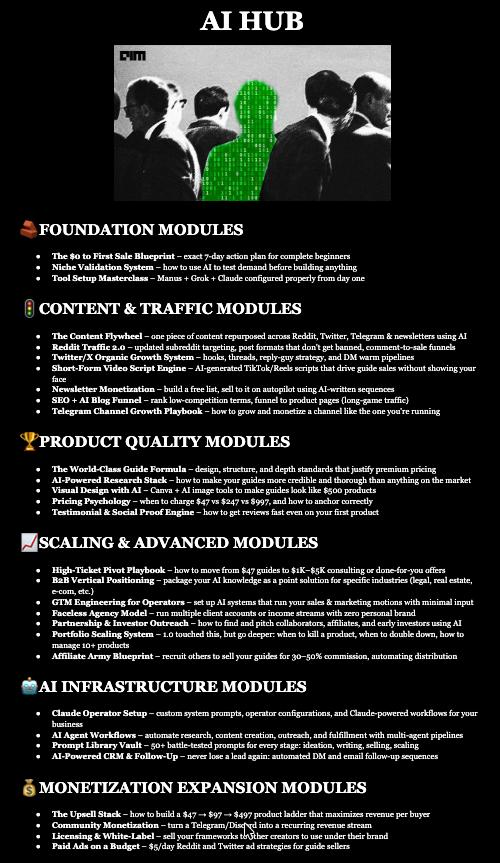
just launched AI HUB and here's everything that's covered - DM me "HUB" to join
## 相关链接
- [zack](https://x.com/whotfiszackk)
- [@whotfiszackk](https://x.com/whotfiszackk)
- [840](https://x.com/whotfiszackk/status/2091815375600066860/analytics)
- [Upgrade to Premium](https://x.com/i/premium_sign_up)
- [5:10 PM · Aug 24, 2026](https://x.com/whotfiszackk/status/2091815375600066860)
- [840 Views](https://x.com/whotfiszackk/status/2091815375600066860/analytics)
---
*导出时间: 2026/8/24 23:29:25*
---
## 中文翻译
# 如何找到“无聊”的利基市场。
**作者**: zack
**日期**: 2026-08-24T09:10:24.000Z
**来源**: [https://x.com/whotfiszackk/status/2091815375600066860](https://x.com/whotfiszackk/status/2091815375600066860)
---

不是你充满热情的利基。不是听起来很厉害的利基。也不是你最喜欢的创作者所在的利基。
而是那个没人在做的利基。
那个窗口大开的利基。评论数为零。受众正在积极寻找解决方案。而之所以还没人去做,只是因为没人觉得它有趣到值得去做。
就是那个利基。
让我告诉你具体怎么找到它。
第一步:理解你到底在找什么。
大多数人做利基调研的方法是错的。
他们问的是:我对什么感兴趣。我了解什么。我喜欢围绕什么来创作内容。
错误的问题。
正确的问题是:
哪里存在一群特定的人,他们有一个特定的、带来痛苦的问题,而目前还没有特定的产品来解决这个问题。
就这么简单。
不是你的兴趣。不是你的专业。不是你的热情。
而是他们的痛苦。他们的问题。他们对某个尚不存在之物的明确搜索。
无聊的利基永远是通过向外看人们需要什么找到的——而不是向内看你想做什么。
## 值得做的无聊利基的 5 个特质。
在打开 Reddit 之前,在读任何帖子之前,你需要知道你在用什么标准来筛选。
以下是每个能赚钱的无聊利基都具备的 5 个特质。
**特质 1:问题有金钱上的后果。**
不是情感上的,不是审美上的,而是金钱上的。
不知道如何捍卫自己报价的自由职业者,每次与客户打交道都在亏钱。
没有写对租约条款的房东,一旦发生纠纷就会亏钱。
给商业项目报低价的承包商,每报一次价都在亏钱。
金钱后果制造紧迫感。
紧迫感造就买家。
如果问题不解决也不会损失钱——继续找。
**特质 2:买家能算出这个问题正在让他们损失多少钱。**
这一点和特质 1 不同。
特质 1 是问题是否有金钱后果。
特质 2 是买家能否清楚地看到那个数字。
因需求范围蔓延而损失了 3,200 美元的自由职业者,清楚地知道这个问题让他付出了什么代价。
花了 3,000 美元律师费才搞清楚自己权利的房东,清楚地知道这个问题让他付出了什么代价。
因为报错价而在一个项目上只赚到每小时 14 美元的承包商,清楚地知道这个问题让他付出了什么代价。
当买家能清楚地看到那个数字时——他们也能看出 57 美元相对而言并不是一笔大钱。
算术比任何销售文案都更能促成成交。
**特质 3:这些信息没有一个清晰完整的来源。**
问题可能广为人知。
但解决方案必须是零散的、混乱的、过时的,或者泛泛到毫无用处的。
如果一个免费的政府网站就能完整而清晰地回答这个问题——这就不是一个可行的产品利基。
如果找到答案需要阅读 14 个不同的 Reddit 帖子、打 3 个不同机构的电话、还要雇一个律师来解读你查到的东西——这就是一个可行的产品利基。
这个产品的意义就在于把那些理论上可以获取、但以现状而言实际上毫无用处的信息进行整合、澄清和梳理排序。
**特质 4:受众是一个明确定义的群体,而不是一个宽泛的人群。**
“想省钱的人”不是受众。
“刚收到第一张 1099 表、搞不懂自雇税的独立承包商”是受众。
“小企业主”不是受众。
“因为回答不上基本的保险问题而刚丢掉一份商业合同的清洁公司老板”是受众。
群体定义越明确——产品就能越精准地针对他们——内容就能越有力地打动他们——评论就能越完整地描述他们的处境——转化率就越高。
具体胜过宽泛。
每一次都是如此。
**特质 5:窗口是开着的。**
窗口是指从问题显眼到足以围绕它做产品,到市场饱和到新产品无法积累起有竞争力的评论数之间的那段时期。
检查窗口的方法:
Gumroad 搜索:查找该利基中的产品。如果没有任何产品评论数超过 100——窗口开着。
Twitter 搜索:查找专门针对这个细分受众的无脸账号。如果没有任何超过 5,000 精准粉丝的账号——窗口开着。
如果两者都开着:立刻动手做。
如果 Gumroad 上有评论数低于 100 的产品但没有占主导地位的页面:在 30 天内动手做。
如果 Gumroad 上有评论数 500+ 的产品:找一个更具体的切入角度,或者换下一个。
## 具体流程,一步一步来。
**第 1 步:选对 subreddit。**
不要选泛泛的 subreddit。
要选那些专业性和实操性的 subreddit,那里的人会描述带有真实金钱后果的真实问题。
以下是那些持续产出可行无聊利基的 subreddit:
r/freelance——定价纠纷、合同问题、客户管理、报价设定。r/smallbusiness——招聘、合规、运营、现金流、第一批员工。r/landlord——租约纠纷、租客问题、维修、法律问题、驱逐流程。r/legaladvice——合规失误、合同纠纷、法规困惑。r/personalfinance——税务意外、债务状况、收入缺口、储蓄失败。r/pressurewashingbusiness——定价、设备、合同、商业与住宅客户对比。r/cleaningbusiness——保险、担保、商业合同、定价结构。r/bookkeeping——客户定价、费率结构、服务打包、报税准备。r/hvac——商业定价、设备成本、季节性费率、报价方案格式。r/careerguidance——职业转型、简历空窗期、行业转换、资质证书问题。r/medicalbill——账单谈判、经济困难申请、保险纠纷。r/veterinary——费用规划、保险、应急基金、付款协商。r/lawncare——定价体系、路线优化、客户沟通、设备成本。r/realestateinvesting——第一处房产的运营、租约管理、租客筛选。
从这 14 个开始。
每周轮换着看。
**第 2 步:按过去一年的最高热度帖子排序。**
不是 hot,不是 new。
是过去一年的 top。
高热度帖子代表了最能引起社区共鸣的问题。
那些让人停下滚动、说出“这说的就是我的情况”的帖子。
那些就是产品。
**第 3 步:用这 3 个标题信号来筛选。**
信号 1:标题描述的是已经发生的事情,而不是他们在琢磨的事情。
“有人在定价上遇到困难吗?”——跳过。
“因为回答不上基本的保险问题丢了一份 2,800 美元的合同。我甚至不知道他们在问什么。”——在这里停下。
信号 2:500–2,000 个赞。
低于 500:问题可能不够普遍。超过 5,000:可能已经产品饱和了。
500–2,000 这个区间是最佳点。
足够大,能验证真实需求。又足够具体,很可能还没有占主导地位的产品。
信号 3:赞与评论的比例高于 4:1。
1,000 个赞和 40 条评论:人们认同这种感受但没什么可补充的。浅层问题。
1,000 个赞和 300 条评论:人们不仅认同这种感受,还有自己的具体版本可以描述。深层问题。
深层问题产出深度产品。
深度产品产出具体的评论。
具体的评论产出高转化率。
**第 4 步:带着一个问题去读每一条评论。**
不是:这个有趣吗。不是:我了解这个吗。不是:我能在这里做点什么吗。
而是:
如果有人在问题发生之前就拥有某样东西,什么东西能阻止这个帖子里描述的每一个问题。
那个东西就是产品。
预防永远比补救更有价值。
而预防方案永远就藏在评论里,由那些刚刚付出了惨痛代价才学会的人用精确的细节描述出来。
用一句话写下答案。
如果你无法用一句话写出来——说明这个利基还不够具体。
**第 5 步:写出买家画像。**
一段话。不能更多。不许用模糊的语言。
谁在经历这个问题。具体是什么触发了他们描述的这种急性爆发。他们已经尝试过什么。他们真正需要什么。他们愿意为此付多少钱。
画像需要至少 4 个具体细节。
下面是一个合格的例子:
“一位从业第二或第三年的自由撰稿文案,刚遇到客户对修改次数提出异议并拒绝为原始需求范围之外的工作付款。他们有合同,但合同没有明确界定修改次数。他们在这个项目上损失了 600 到 2,000 美元。他们谷歌过求助,只找到泛泛的建议,没有现成可用的合同条款。他们愿意花 47–67 美元购买一个合同条款库,其中包含专门覆盖他们不断遇到的各种情况的具体条款。”
5 个具体细节。一段话写完。没有模糊的语言。
如果你写不出来——回到评论区。细节就在那里。
**第 6 步:检查竞争格局。**
Gumroad:搜索这个具体利基。看评论数。看产品的具体程度。如果在你这个确切角度上没有任何评论数超过 100 的产品——窗口开着。
Twitter:搜索针对这个细分受众的无脸账号。不是宽泛话题下的一般账号,而是专门面向这个买家的账号。如果没有任何超过 5,000 精准粉丝的账号——窗口开着。
Etsy 和 Creative Market:同样的搜索。同样的筛选。
记录你的发现。
如果三者都开着:这就是你的利基。本周就动手。
如果其中一处竞争中等:你有 30–60 天,之后窗口会显著收窄。
如果两处或以上已饱和:在同一个大话题下找一个更具体的角度。或者看下一个帖子。
**第 7 步:设定窗口计时器。**
短窗口(30–60 天):这个利基足够显眼,任何在扫这些 subreddit 的操盘手都会在一个月内发现它。要么立刻做,要么别做。
中窗口(60–120 天):这个利基需要特定知识才能找到。相关 subreddit 成员不到 100,000,不会出现在一般的小企业扫描中。你有 2–4 个月才会出现竞争。
长窗口(120 天以上):这个利基足够冷门,可能 6 个月甚至更久都不会有竞争者。这是最有价值的。在别人意识到它们存在之前抢占它们。
## 用这套流程找到的 3 个无聊利基实例。
**利基 1:独立执业护士的保险认证指南。**
发现于:r/nursepractitioner。帖子:“花了 4 个月试图拿到保险机构的认证。损失了 40,000 美元未开票收入。没人告诉你这个流程到底是什么样。”点赞:1,200。评论:180。买家画像:离开医院体系开办独立诊所的执业护士,不了解认证流程顺序、文件要求以及各支付方的具体规定。每延迟一周就损失 2,000–4,000 美元的未开票收入。竞争检查:Gumroad 上零产品。Twitter 上零无脸账号。窗口:长。120 天以上。建议定价:97–147 美元。为什么可行:147 美元对比每周 4,000 美元的延迟收入,根本算不上一个购买决策。只是个零头的零头。
**利基 2:首份商业清洁合同工具包。**
发现于:r/cleaningbusiness。帖子:“因为回答不上关于保险和担保的基本问题,丢了一份 2,800 美元的月度合同。”点赞:1,200。评论:180。买家画像:拥有住宅客户、正努力拿下第一个商业客户的清洁公司老板,不了解保险、担保以及商业客户在签约前的实际要求。竞争检查:Gumroad 上有 2 个产品。都不针对商业合同要求。Twitter 上没有占主导的账号。窗口:中。60–90 天。建议定价:54–79 美元。为什么可行:一份 2,800 美元/月的商业合同能让产品在 11 天内回本。
**利基 3:草坪养护路线优化与定价系统。**
发现于:r/lawncare。帖子:“干了 2 年。31 个客户。去年流水 94k,净赚 31k。我的定价肯定出了大问题。”点赞:4,200。评论:340。买家画像:已有稳定客户群的草坪养护经营者,收入可观但留存太少,因为没有一套考虑了地面类型、路程时间、设备损耗和季节性需求的定价体系。竞争检查:Gumroad 上有 1 个 34 条评论的产品。没有占主导的账号。窗口:中。60 天后现有产品将积累足够评论占据这个品类。建议定价:67 美元。为什么可行:一个经营者哪怕每次服务只少收 10 美元,31 个客户一年就少赚 15,000 美元以上。相比之下 67 美元微不足道。
## 找到之后该做什么。
你找到了那个帖子。你写好了买家画像。你查过了竞争。窗口开着。
接下来这样做。
打开 Claude。把帖子粘贴进去。把 60 条最具体的评论粘贴进去。写一段提示词,描述确切的买家、确切的问题、以及评论告诉你必须包含的每一个部分。
4 分钟:6,800 字。
逐字读完。编辑 8%。在 Canva 里排版。上架 Gumroad。
搭建无脸账号。
用评论里的内容发帖。
让评论数慢慢积累。
让算法找到买家。
让买家找到账号。
让账号完成成交。
无聊的利基不需要你的热情。
不需要你的专业。
不需要你露脸。
它需要的只是你愿意带着正确的问题去读一个 Reddit 帖子。
以及判断力——去识别当 340 个人用 340 种不同方式描述同一个问题时,那不是一个内容素材帖。
那是一个尚未存在的产品。
去做它。

AI HUB 刚刚上线,以下是全部涵盖的内容——私信我 "HUB" 加入
## 相关链接
- [zack](https://x.com/whotfiszackk)
- [@whotfiszackk](https://x.com/whotfiszackk)
- [840](https://x.com/whotfiszackk/status/2091815375600066860/analytics)
- [Upgrade to Premium](https://x.com/i/premium_sign_up)
- [5:10 PM · Aug 24, 2026](https://x.com/whotfiszackk/status/2091815375600066860)
- [840 Views](https://x.com/whotfiszackk/status/2091815375600066860/analytics)
---
*导出时间: 2026/8/24 23:29:25*