# The Math Behind Why Casinos Never Lose (And How Traders Can Copy It)
**作者**: Goshawk Trades
**日期**: 2026-04-21T17:00:23.000Z
**来源**: [https://x.com/GoshawkTrades/status/2046635169239777692](https://x.com/GoshawkTrades/status/2046635169239777692)
---
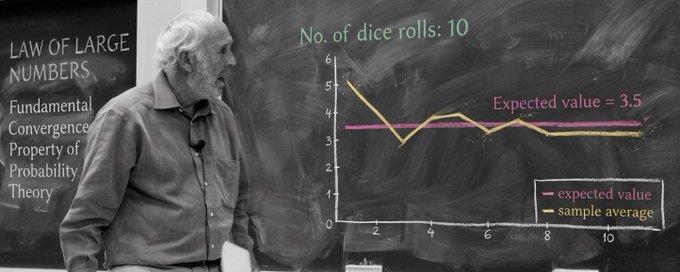
I am going to break down the math that casinos, hedge funds, and the best traders in the world all rely on. I will also show you how to apply it directly to your own trading.
Let's get straight to it.
The most valuable thing I ever heard about trading did not come from a model, a backtest, or a research paper.
It came from Jim Simons. The founder of Renaissance Technologies. The best performing hedge fund in history, averaging 66% annual returns for over 30 years.
He said something in a talk years ago that I did not fully understand until much later:
"Any one anomaly might be a random thing. But if you have enough data, you can tell it's not."

That single sentence is the difference between traders who make money consistently and traders who gamble on every trade.
What he was describing has a name. The Law of Large Numbers.
And it is the same mathematical principle that built a $300 billion casino industry. The same principle behind every systematic strategy generating real edge. The same principle most retail traders violate every single week and do not realize it.
Casinos exist because humans are bad at thinking in probabilities. An entire industry was built by people who recognized that weakness and decided to exploit it. Trading is no different. The edge goes to whoever understands the math and has the discipline to let it play out over a large enough sample.
Most traders do the opposite. They take 20 trades, see a 60% win rate, and think they have edge. They take 5 losses in a row and abandon a strategy that was mathematically sound. They size up on their "best" setup and wipe out months of gains on a single trade.
All three are the same mistake. They are treating a small sample like a large one.
By the end of this article you will understand exactly why a strategy with 10 wins in a row tells you almost nothing, the Law of Large Numbers and why it is the single most important concept in trading, how casinos mathematically guarantee profit despite losing millions of individual bets, why 20 trades is not a backtest and 1,000 is, the exact sample size you need before you can trust any strategy, and how to stop being the player and start being the house.
## I – Why 10 Winning Trades Tells You Nothing
Flip a coin 10 times. You might get 6 heads and 4 tails. Or 7 and 3. Or even 9 and 1.
Does that mean the coin is biased?
Obviously not. You just ran a small sample.

Now flip it 100 times. You will land much closer to 50/50. Flip it 10,000 times and the ratio will be almost indistinguishable from 50%.
The coin did not change. Your sample size did.
This is the foundation of the entire article. And it is the reason most traders have a completely distorted view of their own edge.
A 10-0 backtest is 10 coin flips. It means nothing.
A strategy that has won 7 out of your last 10 trades is not a 70% win rate strategy. You just have 10 data points. That could easily be a 45% win rate strategy having a good run. Or a 60% win rate strategy having a slightly above average stretch. You cannot tell the difference with 10 trades.
The same works in reverse. A 5 trade losing streak on a strategy with a true 55% win rate is completely normal. It will happen roughly every 30 trades. If you abandon the strategy every time you hit one, you will never trade a winning system long enough to make money from it.
The first mistake every trader has to unlearn is this: your recent results are not your edge. Your edge only becomes visible over hundreds of trades. Anything less is noise.
## II – What the Law of Large Numbers Actually Says
The Law of Large Numbers is simple.
As your sample size grows, the average of your samples gets closer and closer to the true average of the underlying distribution.
In plain English: the more trades you take, the more your actual statistics converge toward your real edge.
Nassim Taleb explained it in one line that is worth memorising:
"You can produce certainty with uncertainty."
Every single trade is uncertain. Every single coin flip is uncertain. Every single hand of blackjack is uncertain.
But the average of thousands of uncertain events is extremely certain. That is the magic of the law. Individual outcomes are random. Aggregates are stable.
Here is the math that makes it work.
The standard deviation of your sample mean shrinks by the square root of N, where N is your number of trades.
σ(sample mean) = σ / √N
This is the same √N relationship that makes signal combination work in quantitative trading. Here it runs in reverse: your uncertainty about your strategy's true edge shrinks as you add more trades.
A few things fall out of this math that most traders get wrong:
- 100 trades gives you 10x the statistical confidence of 1 trade. Not 100x.
- To double your confidence, you need 4x the trades. Not 2x.
- After 1,000 trades, your observed win rate is within a few percentage points of your true win rate. Before that, you are guessing.
This is why a 10-0 run tells you nothing and a 550-450 run tells you almost everything.
## III – How Casinos Turn This Into $60 Billion
In 2025, US casinos made nearly $79 billion in profit.
They did not do this by winning every hand. They did not do this by picking the right "trades". They did it by understanding the Law of Large Numbers better than their customers.
Look at the house edge on the main casino games:

These edges are tiny. On any single hand of blackjack, the player has close to a 50/50 shot. The casino can and does lose to individual players all the time.

But the casino is not playing one hand. They are playing millions of hands a year across thousands of tables.
With an edge of 0.5% on blackjack and a few billion hands played globally per year, the math becomes inevitable.
This is the mental model every systematic trader needs to internalize.
Your per trade expectancy is your house edge. It does not need to be huge.
The casino has three things working in their favor that most retail traders do not:
Volume. They take millions of bets a year. A retail trader might take 200.
Execution. The dealer never deviates from the system. Ever.
Bankroll management. They never allow a bet so much on a single hand that a bad streak puts them out of business.
Retail traders break all three of these constantly. They take 20 trades and think they've run the sample. They deviate from their rules the moment the market feels scary. They risk 50% of their account on their "highest conviction" setup.
That is not trading. That is sitting on the wrong side of the casino table.
If you want help automating your strategies so the math works in your favor, Link in my bio.
## IV – The Four Ways Traders Violate the Law Every Week
The patterns are almost universal. Every trader who struggles to become profitable is making at least one of these mistakes:
1. Trusting a backtest with 20 trades. Twenty trades is noise. If your backtest has less than 100 trades, you do not have a backtest. You have a guess.
2. Abandoning a strategy after 5 losses. A strategy with a 55% win rate will hit a 5 trade losing streak roughly every 30 trades or so. If you quit every time, you never survive long enough to collect the edge.
3. Revenge trading after variance. Emotion is what breaks the sample. One bad session triggers three trades outside the system and now your 500 trade sample is contaminated with 503 trades that are not from the same strategy.
4. Judging a strategy by a single month. A month is maybe 20-40 trades for most retail systems. That is not enough data to tell you anything about your edge. Judge over quarters and years, not weeks.
All four of these are the same mistake wearing different costumes. You are treating a small sample like a large one.
## V – The Math: How Much Sample Size You Actually Need
Here are rough thresholds based on the √N standard error math:
- Under 30 trades: pure noise. No conclusions allowed.
- 100 trades: minimum for detecting a basic edge. Still noisy.
- 500 trades: reasonable confidence in your real win rate and expectancy.
- 1,000+ trades: Proper grade conviction. This is the number desks actually want before putting real capital on a strategy.
But here is the part most LLN explainers leave out.
Markets are not coin flips.
Coin flips have a well behaved distribution. Thin tails. No surprises. The √N math works cleanly.
Market returns have fat tails. That means extreme events happen far more often than a normal distribution predicts. Taleb has spent his career hammering on this point:

"For fat tailed distributions you don't drop at square root of N. You need 10 to the 13 times more observations to get the same stability as a Gaussian."
In practical terms: the sample sizes above are the floor, not the ceiling. A strategy that trades through one major regime shift or one black swan event might need thousands of trades before you truly know its edge.
This is why the best systematic traders are paranoid about out of sample testing. Why they care about how a strategy performs across different market regimes.
The Law of Large Numbers works. But in markets, it works slower than the textbook suggests.
## VI – How to Build Strategies That Have the Law on Your Side
This is how you stop being the player and start being the house.
1. Build strategies that generate frequent, small edges.
A strategy with 1,000 trades a year and 0.3R expectancy is far better than a strategy with 30 trades a year and 3R expectancy. The first one gets to compound its edge thousands of times.
2. Backtest over years, hundreds of trades minimum, out of sample.
If your strategy only works on one year of data, it is unlikely to work. Test across regimes. Test across market conditions.
3. Size positions so you survive the variance.
The fastest way to invalidate the Law of Large Numbers is to blow up before it kicks in. A strategy with positive expectancy is still going to have losing streaks.
4. Automate execution.
This is the one that ties everything together. Humans cannot sit through 50 losses in a row without intervening, even when the math says to. Every deviation contaminates your sample. Automation removes the emotional layer entirely. The code executes the 51st trade the same way it executed the first, which is exactly what the math requires.
This is why I am a strong advocate for automating systematic strategies. Not because algorithms are smarter. Because algorithms are consistent. And consistency is what the Law of Large Numbers actually needs to work.
5. Judge the process, not individual outcomes.
This was the core lesson of the poker article and it applies here at the mathematical level. A good decision can lose. A bad decision can win. Neither tells you about your edge over a small sample. Evaluate whether you followed the system. Let the sample size take care of the rest.
## Closing Thoughts
Go back to the Simons quote.
"Any one anomaly might be a random thing. But if you have enough data, you can tell it's not."
That is the whole game.
Stop trying to be right on the next trade. Start building systems that are right over 10,000 trades.
Stop judging your strategy by last week. Start judging it by the math.
The casino does not care if it loses a hand. It does not care if it loses a night. It knows the math is on its side, and it has the volume and discipline to let that math play out.
That is every systematic trader's job.
Thanks for reading.
– Mounir
## 相关链接
- [Goshawk Trades](https://x.com/GoshawkTrades)
- [@GoshawkTrades](https://x.com/GoshawkTrades)
- [52K](https://x.com/GoshawkTrades/status/2046635169239777692/analytics)
- [Upgrade to Premium](https://x.com/i/premium_sign_up)
- [1:00 AM · Apr 22, 2026](https://x.com/GoshawkTrades/status/2046635169239777692)
- [52.6K Views](https://x.com/GoshawkTrades/status/2046635169239777692/analytics)
- [View quotes](https://x.com/GoshawkTrades/status/2046635169239777692/quotes)
---
*导出时间: 2026/4/22 11:05:47*