量化交易中的市场状态自适应策略 ✍ venus🕐 2026-07-24📦 14.8 KB 🟢 已读 𝕏 文章列表 本文介绍了量化交易中如何利用AI构建市场状态自适应策略。通过隐马尔可夫模型(HMM)和马尔可夫转换GARCH(MS-GARCH)检测市场状态变化,动态调整交易策略,以应对不同市场环境。文章详细阐述了四阶段框架,并探讨了多尺度架构的应用。 量化交易AI市场状态HMMMS-GARCH策略优化风险管理 # How Quants Use AI to Build Regime-Adaptive Trading Strategies (Complete Guide) **作者**: venus **日期**: 2026-07-23T12:16:14.000Z **来源**: [https://x.com/RitOnchain/status/2080265733205045587](https://x.com/RitOnchain/status/2080265733205045587) --- 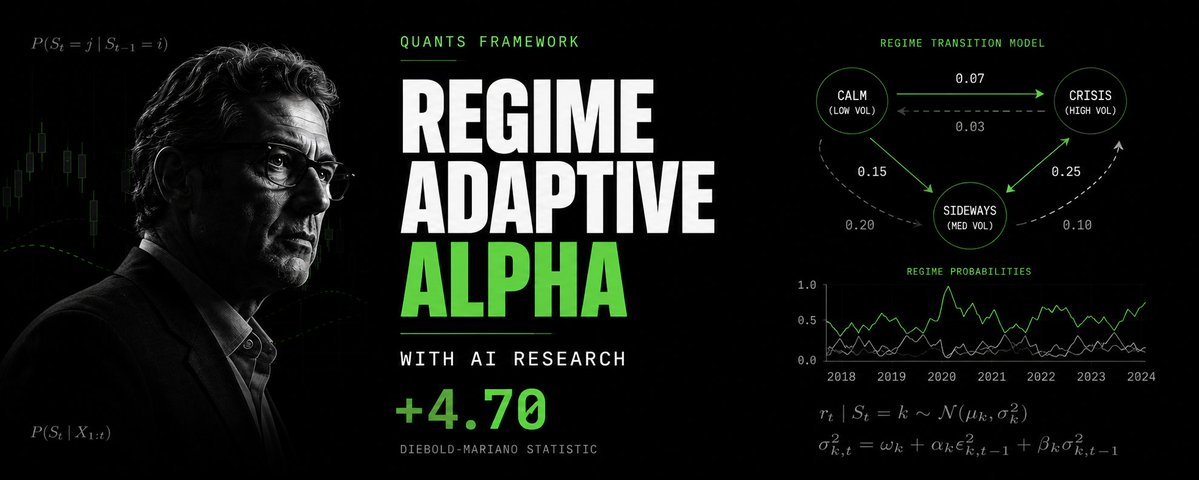 A practical framework for detecting market regimes and dynamically adjusting your strategy-before the regime changes destroy your P&L. For years, the biggest edge in quantitative trading wasn't a secret indicator. It was the ability to know when your strategy was about to break. Every quant has experienced it: a mean-reversion strategy that prints money for months, then hemorrhages capital during a single volatility spike. A trend-following system that thrives in bull markets but gets chopped to pieces in sideways regimes. A momentum model that works beautifully in risk-on environments, then delivers catastrophic drawdowns when correlations invert during a flight-to-safety event. The problem isn't the strategy. It's that the market changed its personality, and your model never noticed. This is the regime problem. And solving it is what separates strategies that compound from strategies that crater. ## Why Regime Detection Matters More Than Ever Markets are not one thing. They are multiple distinct data-generating processes that switch between each other according to hidden rules. A low-volatility bull market has fundamentally different statistical properties-mean, variance, autocorrelation, tail behavior-than a high-volatility crisis regime. A model trained on one will fail on the other, often spectacularly. Research consistently shows that regime-aware strategies outperform static ones. Studies on Hidden Markov Model (HMM) regime detection demonstrate that filtering trades based on detected volatility regimes can eliminate many losing trades and improve Sharpe ratios materially. In factor investing, allocating dynamically across regimes rather than holding static factor exposures has produced superior risk-adjusted returns. The evidence is clear: adaptability beats rigidity. But historically, regime detection was the domain of institutional desks with dedicated quant teams and proprietary data. The retail trader was left with crude proxies-VIX thresholds, moving-average filters, or gut feel. These work until they don't, usually at the worst possible moment. That is changing. AI-driven research tools now allow independent quants to derive, implement, and validate regime-adaptive frameworks that were previously PhD-level territory. I have been using one called Apodex for this exact workflow, running everything through Deep Discover - their heaviest-duty reasoning tier, built for frontier research rather than quick answers. Unlike standard chatbots that hallucinate financial math or spit out generic Python snippets, Deep Discover reasons through problems step-by-step, verifies its derivations, and acts like a research partner that actually understands the Hamilton filter. The barrier is no longer mathematical capability. It is knowing which questions to ask. Here is the four-phase framework I built using it. The prompts are minimal, technically precise, and ready to drop into Apodex Deep Discover - or any equivalent step-by-step reasoning engine. ## Phase 1: Modeling the Hidden Regimes The core idea is simple: the market has a hidden "state" at every point in time-bull, bear, crisis, sideways-and this state drives the statistical properties of observable returns. We cannot observe the state directly, but we can infer it probabilistically from return patterns. This is exactly what a Hidden Markov Model does. It assumes an underlying Markov chain of latent states, each emitting returns from a distinct probability distribution. The Baum-Welch algorithm learns the transition probabilities between regimes and the emission parameters (mean, variance) of each state. The Viterbi algorithm then decodes the most likely sequence of hidden states from the observed data. In practice, a 3-state Gaussian HMM trained on S&P 500 returns typically identifies: a low-volatility bull state with small positive mean returns and low variance, a sideways state with near-zero mean and moderate volatility, and a high-volatility crisis state with negative mean and extreme variance. The transition matrix reveals how sticky each regime is and how likely sudden switches are. For instance, you might find that the bull state persists for an average of 45 days, while crisis states last only 7.6 days-but those 7.6 days can erase months of gains. The forward-backward algorithm computes the filtered state probabilities recursively, updating beliefs about the current regime as new data arrives. This is the Hamilton filter, and it runs in O(TK²) time-perfectly tractable for K=3 states and T up to 40,000 observations. 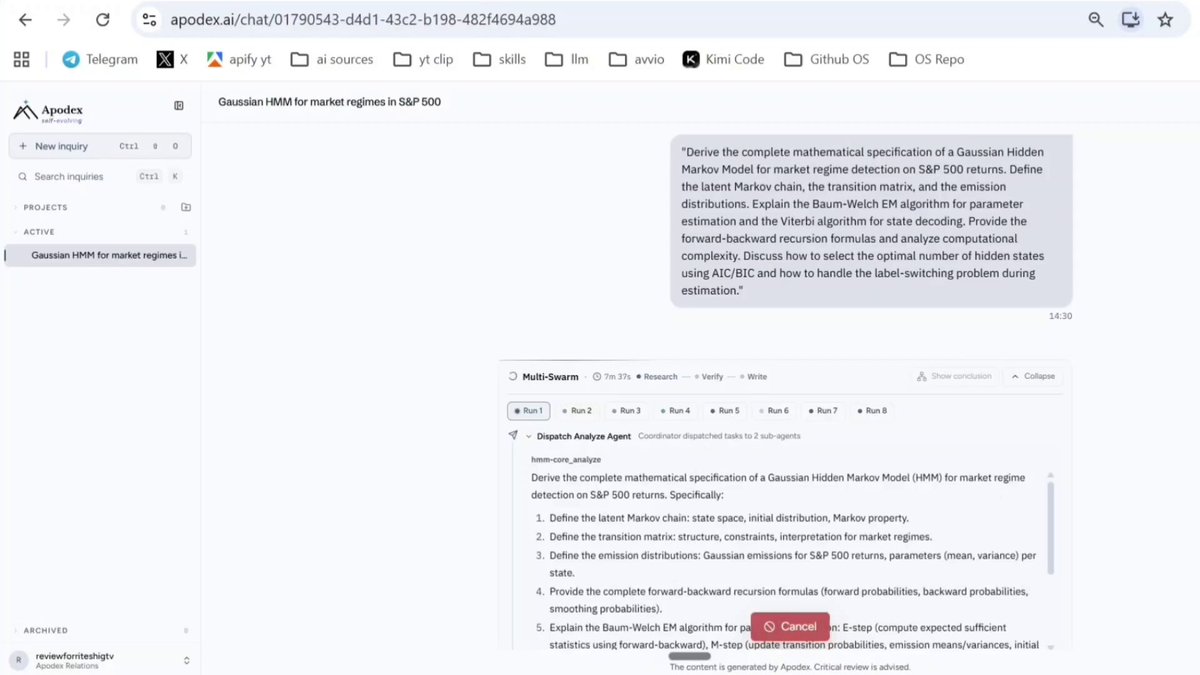 Apodex Deep Discover: Gaussian HMM for S&P 500 regime detection When I drop this into Apodex Deep Discover, it isn't one model reasoning in a loop - an orchestrator spins up specialized sub-agents to work through the derivation, and a separate verification team (a conflict reviewer, a fact checker, and a draft reviewer) audits the output before it reaches me. That's how it flags something like the label-switching problem before I've written a line of code: the check comes from independent agents, not the same model grading its own homework, so it doesn't carry the same blind spots into its own review. That kind of verification is the difference between a working model and a broken backtest. ## Phase 2: Adding Volatility Dynamics with MS-GARCH A basic HMM assumes returns are drawn from static Gaussian distributions within each regime. But financial volatility clusters within regimes. A crisis state isn't just higher variance-it has its own GARCH dynamics where shocks persist and decay according to regime-specific parameters. A single shock in a calm state might die out quickly. The same shock in a crisis state might trigger a cascade. Markov-Switching GARCH (MS-GARCH) solves this by running independent GARCH(1,1) processes inside each hidden state. The model switches between these volatility processes according to the Markov chain. When the market is calm, the Calm-state GARCH dominates with low persistence and thin tails. When a shock hits, the model transitions to the Crisis-state GARCH with its higher persistence, heavier tails, and elevated baseline variance. The Haas et al. (2004) specification is the tractable choice here: it runs K independent parallel GARCH processes (one per regime) and switches between them via the Markov chain. This avoids the path-dependence explosion of the Gray (1996) integrated formulation, where the variance at time t depends on the probability-weighted average of all past regime-specific variances. The parallel-regime approach makes the likelihood exactly tractable and reduces computational cost by a factor of 3–5x. Recent research on multi-scale MS-GARCH frameworks demonstrates that regime dynamics operate across nested timescales-macro (daily), meso (4-hour), and micro (hourly)-each requiring its own model. A single-scale HMM cannot simultaneously encode the slow macro transitions (P[Calm→Crisis] ≈ 0.001 per day) and fast micro transitions (P[Calm→Turbulent] ≈ 0.08 per hour). The solution is a multi-scale architecture with a 27-dimensional joint probability tensor combining outputs across timescales.  Apodex Deep Discover: State-space MS-GARCH(1,1), Haas et al. (2004) This is where Apodex Deep Discover earns its keep. It doesn't reason just once - it runs a generate–verify–revise loop where a separate grader scores each derivation and forces a rewrite, and it never sees an answer key it could game. That's why it walks the Haas vs. Gray distinction line-by-line and gets the L-BFGS-B constraints right, where a standard chatbot will confidently hand you the wrong log-likelihood. ## Phase 3: Making Transition Probabilities Adaptive Static transition matrices assume regime-switching probabilities are constant over time. But they aren't. The probability of entering a crisis regime spikes when volatility stress indices, yield spreads, or liquidity metrics deteriorate. A static model trained on 2015–2019 data will miss the regime shift triggered by COVID, by the Russia-Ukraine shock, or by any future black swan. Time-Varying Transition Probabilities (TVTP) model the transition matrix as a function of observable covariates through a multinomial logit specification. A composite stress index-combining volatility z-scores, jump ratios, and macro indicators-drives the transition dynamics. When stress is elevated, the probability of switching to a crisis state rises. When stress subsides, the market drifts back toward calm. The multinomial logit specification guarantees row-stochastic transition probabilities through a softmax structure, while the sensitivity coefficients are estimated subject to box constraints to prevent the exogenous driver from dominating the baseline transition structure. Empirical research on EUR/USD regime detection shows that TVTP is strongly justified at meso and micro timescales, with AIC improvements of +690.7 and +499.9 respectively, while daily-scale transitions remain adequately captured by static matrices. This makes intuitive sense: macro regimes shift slowly in response to central bank policy cycles and geopolitical events, but intraday microstructure regimes react to real-time stress signals like volatility spikes and liquidity shocks. The composite stress driver for a micro-scale model might combine intraday volatility acceleration with jump activity, standardized via rolling 30-day z-scores. For a meso-scale model, you might add day-of-week seasonality and a macro stress index built from VIX and Treasury yield z-scores. Each timescale gets its own driver composition, optimized for the dynamics at its native resolution.  Apodex Deep Discover: Filardo TVTP in Markov-Switching GARCH You now have a framework where the market itself tells you when it is about to change its mind. ## Phase 4: From Regime Detection to Risk-Adaptive Execution Knowing the regime is only half the battle. The other half is acting on it. The smoothed state probabilities from your MS-GARCH model serve as real-time regime indicators. When the probability of being in a high-volatility regime exceeds a threshold-say, P(S_t = Crisis) > 0.7-you mechanically reduce position sizes, tighten stops, or switch to a crisis-optimized model. When the probability of a calm regime dominates, you scale up. No discretion. No emotion. Just math. A Shannon entropy filter adds another layer of protection: when the model is uncertain about which regime we are in (high entropy across states), you suppress trading entirely. Entropy near its maximum (log 3 ≈ 1.099 for 3 states) means the model is genuinely confused-usually during transition periods when the market is most dangerous. A normalized entropy threshold of 0.85 is a practical cutoff. Regime disagreement-when different timescales assign conflicting probabilities-is itself a signal that the market is in transition and therefore dangerous. If your daily model says "calm" but your hourly model says "crisis," that conflict is information. It means something is shifting, and the safest move is often to reduce exposure until the picture clarifies. For execution, a Mixture-of-Experts architecture routes predictions through regime-specific models. A 27-expert system (3 macro × 3 meso × 3 micro states) uses the joint probability tensor as soft routing weights, with each expert trained only on data from its specific regime combination. Data-sparse combinations fall back to the global model. This ensures your model never makes predictions using patterns from a fundamentally different market environment. The Diebold-Mariano test confirms that this multi-scale approach produces statistically superior volatility forecasts relative to a single-regime GARCH benchmark, with a DM statistic of +4.7040 and a p-value of 1.28×10⁻⁶. The Kolmogorov-Smirnov test confirms that the three regimes represent genuinely distinct data-generating processes. This isn't overfitting. It's structural reality.  Apodex Deep Discover: Mixture-of-Experts for regime-driven trading This turns regime risk from a blindside into a controlled dial. ## The Real Edge The retail quant landscape is shifting. The barrier to entry is no longer access to data or computing power. It is the ability to ask mathematically precise questions and validate the answers rigorously. AI-driven research handles the heavy lifting of derivation and proof. I use Apodex Deep Discover for this because it treats the prompt like a quantitative research paper that needs peer review, not a coding request that needs a quick answer - every claim in the output is backed by an explicit evidence chain and independently audited before it's delivered to me. On a single task, it can coordinate up to 150 sub-agents across 15,000+ steps. But the judgment is still yours: which regimes matter for your strategy, which covariates drive transitions in your market, and how aggressively to scale when the model signals danger. The framework above is your starting scaffold. Feed the prompts into Apodex Deep Discover - or any tool with genuine step-by-step reasoning - stress-test the outputs against your own data, and adapt the math to your specific asset class. Walk-forward validation is non-negotiable: retrain your models quarterly on a rolling window, initialize with warm-start parameters from the previous quarter, and never let your HMM see future data. Deep Discover runs through a request-access path - it's Apodex heaviest compute tier, built for frontier research rather than everyday queries. You can request access at apodex.ai. The market does not care how you found the regime. It only cares that you were in the right one when it mattered-and that you got out before it destroyed you. Note : i wanted to reach larger audience, QT appreciated, if done i will personally dm you to get started your journey in quants. ## 相关链接 - [venus](https://x.com/RitOnchain) - [@RitOnchain](https://x.com/RitOnchain) - [16K](https://x.com/RitOnchain/status/2080265733205045587/analytics) - [apodex.ai](https://apodex.ai/) - [Upgrade to Premium](https://x.com/i/premium_sign_up) - [8:16 PM · Jul 23, 2026](https://x.com/RitOnchain/status/2080265733205045587) - [16K Views](https://x.com/RitOnchain/status/2080265733205045587/analytics) - [View quotes](https://x.com/RitOnchain/status/2080265733205045587/quotes) --- *导出时间: 2026/7/24 16:04:59* --- ## 中文翻译 # 量化专家如何利用 AI 构建市场自适应交易策略(完整指南) **作者**: venus **日期**: 2026-07-23T12:16:14.000Z **来源**: [https://x.com/RitOnchain/status/2080265733205045587](https://x.com/RitOnchain/status/2080265733205045587) ---  一个用于检测市场状态并在其变化摧毁你的盈亏之前动态调整策略的实用框架。 多年来,量化交易中最大的优势并非某种神秘指标。而是能够预知你的策略何时即将失效。 每一位量化专家都经历过这样的时刻:一个均值回归策略在数月内源源不断地赚钱,随后却在一次单一的波动率飙升中大幅失血。一个趋势跟踪系统在牛市中如鱼得水,但在震荡市中却被反复割肉。一个动量模型在风险偏好环境下表现完美,但在避险情绪爆发导致相关性反转时,却带来了灾难性的回撤。 问题不在于策略。而在于市场改变了它的性格,而你的模型却浑然不觉。 这就是市场状态问题。解决了这个问题,就能区分出哪些策略能实现复利增长,哪些策略则会一落千丈。 ## 为什么状态检测比以往任何时候都更重要 市场并非单一实体。它们是多种截然不同的数据生成过程,根据隐藏的规则在彼此之间切换。低波动牛市与高波动危机状态具有根本不同的统计特性——均值、方差、自相关性、尾部行为。在一个状态下训练的模型会在另一个状态下失效,往往后果惊人。 研究一致表明,具有状态感知能力的策略优于静态策略。关于隐马尔可夫模型(HMM)状态检测的研究表明,基于检测到的波动率状态过滤交易可以消除许多亏损交易,并显著提高夏普比率。在因子投资中,跨状态进行动态配置而非持有静态因子敞口,产生了更优的风险调整后收益。证据很明确:适应性胜过僵化。 但在历史上,状态检测是拥有专属量化团队和专有数据的机构交易台的领域。散户交易员只能使用粗略的替代指标——VIX 阈值、移动平均线过滤器,或是直觉。这些方法在失效前一直有效,而失效往往发生在最糟糕的时刻。 这种情况正在改变。AI 驱动的研究工具现在允许独立量化专家推导、实施和验证以前属于博士级领域市场自适应框架。我一直使用一个名为 Apodex 的工具来完成这一工作流程,所有任务都通过 Deep Discover 运行——这是其最高强度的推理层级,专为前沿研究而非快速回答构建。与那些会对金融数学产生幻觉或吐出通用 Python 片段的标准聊天机器人不同,Deep Discover 会一步步推理问题,验证其推导过程,并像一个真正理解 Hamilton 滤波器的研究伙伴一样行事。障碍不再是数学能力。而是知道该问哪些问题。 以下是我使用它构建的四阶段框架。提示词极简,技术上精确,并可直接放入 Apodex Deep Discover——或任何等效的逐步推理引擎中。 ## 第一阶段:对隐藏状态进行建模 核心思想很简单:市场在每个时间点都有一个隐藏的“状态”——牛市、熊市、危机、震荡——而这一状态驱动了可观收益率的统计特性。我们无法直接观察状态,但可以从收益率模式中概率性地推断出来。 这正是隐马尔可夫模型(HMM)所做的。它假设存在一个潜在隐状态的马尔可夫链,每个状态从不同的概率分布中发出收益率。Baum-Welch 算法学习状态之间的转移概率以及每个状态的发射参数(均值、方差)。Viterbi 算法随后从观测数据中解码出最可能的隐藏状态序列。 在实践中,一个在标普 500 收益率上训练的 3 状态高斯 HMM 通常能识别出:一个具有小幅正收益率和低方差的低波动牛市状态,一个均值接近零且波动率适中的震荡状态,以及一个均值为负且方差极高的高波动危机状态。转移矩阵揭示了每种状态的持续性以及突然切换的可能性。例如,你可能会发现牛市状态平均持续 45 天,而危机状态仅持续 7.6 天——但这 7.6 天可能抹去数月的收益。 前向-后向算法递归地计算过滤后的状态概率,随着新数据的到来更新对当前状态的判断。这就是 Hamilton 滤波器,它的运行时间为 O(TK²)——对于 K=3 个状态和 T 高达 40,000 个观测值来说,完全可行。  Apodex Deep Discover:用于标普 500 状态检测的高斯 HMM 当我将其输入 Apodex Deep Discover 时,这并非单一模型的循环推理——一个协调器会启动专门的子代理来处理推导,还有一个独立的验证团队(包括冲突审查员、事实核查员和草稿审查员)在输出到达我之前对其进行审计。这就是为什么它能在我编写一行代码之前就标记出诸如标签切换之类的问题:检查来自独立的代理,而不是同一个模型给自己的作业打分,因此它不会将同样的盲点带入自己的审查中。这种验证正是工作模型与失效回测之间的区别所在。 ## 第二阶段:利用 MS-GARCH 增加波动率动态 基本的 HMM 假设在每个状态内的收益率是从静态高斯分布中抽取的。但金融波动率在状态内部也会聚集。危机状态不仅仅是更高的方差——它有自己的 GARCH 动态,冲击会根据特定状态的参数持续和衰减。平静状态下的单一冲击可能很快消退。同样的冲击在危机状态下可能引发连锁反应。 马尔可夫转换 GARCH(MS-GARCH)通过在每个隐藏状态内部运行独立的 GARCH(1,1) 过程来解决这个问题。模型根据马尔可夫链在这些波动率过程之间切换。当市场平静时,平静状态的 GARCH 占主导地位,具有低持续性和薄尾。当冲击来袭时,模型转换为具有更高持续性、更厚尾部和更高基准方差的危机状态 GARCH。 Haas 等人(2004)的规范在此是一个可行的选择:它运行 K 个独立的并行 GARCH 过程(每个状态一个),并通过马尔可夫链在它们之间切换。这避免了 Gray(1996)积分公式中的路径依赖爆炸,即时间 t 的方差取决于所有过去特定状态方差的概率加权平均值。并行状态方法使得似然函数完全可解,并将计算成本降低了 3-5 倍。 关于多尺度 MS-GARCH 框架的最新研究表明,状态动态在嵌套时间尺度上运作——宏观(日)、中观(4 小时)和微观(小时)——每个尺度都需要自己的模型。单一尺度的 HMM 无法同时编码缓慢的宏观转换(P[平静→危机] ≈ 每天 0.001)和快速的微观转换(P[平静→动荡] ≈ 每小时 0.08)。解决方案是一个具有 27 维联合概率张量的多尺度架构,它结合了跨时间尺度的输出。  Apodex Deep Discover:状态空间 MS-GARCH(1,1),Haas et al. (2004) 这正是 Apodex Deep Discover 展现价值的地方。它不仅仅推理一次——它运行一个生成-验证-修订循环,由独立的评分器对每个推导进行评分并强制重写,而且它从未见过可以作弊的答案。这就是为什么它能逐行理清 Haas 与 Gray 的区别,并正确处理 L-BFGS-B 约束,而标准聊天机器人则会自信地给你错误的负对数似然。 ## 第三阶段:使转移概率具有适应性 静态转移矩阵假设状态切换概率随时间恒定。但事实并非如此。当波动率压力指数、收益率利差或流动性指标恶化时,进入危机状态的概率会飙升。一个在 2015-2019 年数据上训练的静态模型将会错过由 COVID、俄乌冲击或任何未来黑天鹅引发的状态转变。 时变转移概率(TVTP)通过多项式 logit 规范将转移矩阵建模为可观协变量的函数。一个综合压力指数——结合波动率 z-score、跳变比率和宏观指标——驱动转移动态。当压力升高时,切换到危机状态的概率就会增加。当压力消退时,市场会漂移回平静状态。 多项式 logit 规范通过 softmax 结构保证了行随机转移概率,而敏感性系数在盒约束下进行估计,以防止外生驱动因素主导基线转移结构。 关于欧元/美元状态检测的实证研究表明,TVTP 在中观和微观时间尺度上具有强烈的合理性,AIC 分别提高了 +690.7 和 +499.9,而日尺度转换仍由静态矩阵充分捕获。这很直观:宏观状态随着央行政策周期和地缘政治事件缓慢转移,而日内微观结构状态对实时压力信号(如波动率飙升和流动性冲击)做出反应。 微观尺度模型的综合压力驱动因子可能会结合日内波动率加速和跳变活动,通过 30 天滚动 z-score 进行标准化。对于中观尺度模型,你可能会添加星期季节性和一个由 VIX 和国债收益率 z-score 构建的宏观压力指数。每个时间尺度都有自己的驱动因子组合,针对其原始分辨率的动态进行优化。  Apodex Deep Discover:马尔可夫转换 GARCH 中的 Filardo TVTP 现在你有了一个框架,市场本身会告诉你它何时即将改变主意。 ## 第四阶段:从状态检测到风险自适应执行 了解状态只是战斗的一半。另一半是据此采取行动。 来自 MS-GARCH 模型的平滑状态概率充当实时状态指标。当处于高波动状态的概率超过阈值时——比如 P(S_t = 危机) > 0.7——你机械性地减少头寸规模、收紧止损,或切换到针对危机优化的模型。当平静状态的概率占主导地位时,你扩大规模。没有 discretionary。没有情绪。只有数学。 香农熵过滤器增加了另一层保护:当模型对当前处于哪种状态不确定(状态间高熵)时,你完全抑制交易。接近其最大值的熵(对于 3 个状态,log 3 ≈ 1.099)意味着模型真正感到困惑——通常是在市场最危险的过渡期间。0.85 的归一化熵阈值是一个实际的截止点。 状态分歧——当不同时间尺度分配出相互冲突的概率时——本身就是一个信号,表明市场正处于过渡期,因此是危险的。如果你的日线模型说“平静”,但你的小时线模型说“危机”,这种冲突就是信息。这意味着某些东西正在转变,最安全的举动通常是减少敞口,直到情况明朗。 对于执行,混合专家架构通过特定状态的模型路由预测。一个 27 专家系统(3 宏观 × 3 中观 × 3 微观状态)使用联合概率张量作为软路由权重,每个专家仅在其特定状态组合的数据上进行训练。数据稀疏的组合回退到全局模型。这确保了你的模型绝不会利用来自根本不同市场环境的模式进行预测。 Diebold-Mariano 检验证实,与单一状态 GARCH 基准相比,这种多尺度方法产生了统计上更优的波动率预测,DM 统计量为 +4.7040,p 值为 1.28×10⁻⁶。Kolmogorov-Smirnov 检验证实,这三个状态代表了真正不同的数据生成过程。这不是过拟合。这是结构性现实。  Apodex Deep Discover:用于状态驱动交易的混合专家 这将状态风险从一个盲点变成了一个可控的旋钮。 ## 真正的优势 散户量化领域的格局正在发生变化。准入障碍不再是数据或计算能力。而是提出数学上精确问题并严格验证答案的能力。 AI 驱动的研究处理了推导和证明的重任。我为此使用 Apodex Deep Discover,因为它将提示词视为需要同行评审的量化研究论文,而不是需要快速答案的编码请求——输出中的每个主张都有明确的证据链支持,并在交付给我之前经过独立审计。在单项任务中,它可以协调多达 150 个子代理,跨越 15,000 多个步骤。但判断仍在于你:哪些状态对你的策略至关重要,哪些协变量驱动了你市场中的转换,以及当模型发出危险信号时该多积极地调整规模。 上述框架是你的起始脚手架。将提示词输入 Apodex Deep Discover——或任何具有真正逐步推理能力的工具——用你自己的数据对输出进行压力测试,并调整数学模型以适应你的特定资产类别。前行验证是不可协商的:每季度在滚动窗口上重新训练模型,使用上一季度的热启动参数进行初始化,并且绝不让你的 HMM 看到未来数据。 Deep Discover 运行在请求访问路径上——它是 Apodex 计算能力最强的层级,专为前沿研究而非日常查询构建。你可以在 apodex.ai 申请访问。 市场不在乎你是如何找到状态的。它只在乎在关键时刻你处于正确的状态——并且在它摧毁你之前你已经离场。 注意:我想触达更多受众,感谢转发,如果完成,我会私信你以开启你的量化之旅。 ## 相关链接 - [venus](https://x.com/RitOnchain) - [@RitOnchain](https://x.com/RitOnchain) - [16K](https://x.com/RitOnchain/status/2080265733205045587/analytics) - [apodex.ai](https://apodex.ai/) - [Upgrade to Premium](https://x.com/i/premium_sign_up) - [8:16 PM · Jul 23, 2026](https://x.com/RitOnchain/status/2080265733205045587) - [16K Views](https://x.com/RitOnchain/status/2080265733205045587/analytics) - [View quotes](https://x.com/RitOnchain/status/2080265733205045587/quotes) --- *导出时间: 2026/7/24 16:04:59*
一 一个人用 AI 做 Polymarket 量化的完整踩坑记录 作者 Leo 记录了作为独立开发者利用 AI 在 Polymarket 进行量化交易的真实经历。文章通过 15 个策略(H 系列)的实战复盘,详细展示了 85% 的策略失败率,并深入剖析了包括回测偏差、部署事故、数据造假、做市困境及策略停止在内的 5 个具体深坑,总结了量化交易本质是证伪假设而非单纯盈利的元认知。 投资 › 加密货币 ✍ Leo🕐 2026-04-14 量化交易PolymarketAI实战复盘策略独立开发加密货币回测风险管理Claude Code
如 如何使用图工程构建多因子Alpha模型 本文详细介绍了如何利用图工程构建对冲基金级别的多因子Alpha模型。作者阐述了从Prompt、Loop、Swarm到Graph的技术演进路径,重点介绍了Slate这一运行时工具,它能通过JavaScript编写的程序自动化执行复杂的图结构任务,解决了多智能体系统中的协调与失败处理难题。 投资 › 量化交易 ✍ Roan🕐 2026-07-24 图工程多因子模型Alpha量化交易SlateAgentAI对冲基金系统设计
量 量化交易避坑指南:开源项目揭示的8大血泪陷阱 基于对1438个GitHub量化开源项目的深度分析,本文揭示了量化交易中最致命的八大陷阱:包括过拟合、前视偏差、零滑点假设、幸存者偏差等。文章通过真实案例拆解了回测与实盘断层的原因,指出70%的开源项目代码质量不达标,且鲜有项目防范核心风险。文末附带了30项上线前的严审检查清单与黄金法则,强调风控前置、样本外验证及对开源代码的理性批判,警示入门者敬畏风险,避免将“玩具代码”投入真金白银的实战。 投资 › 量化交易 ✍ 萌鸟-BirdVision🕐 2026-07-11 量化交易回测风险管理Python投资策略开源项目数据分析技术选型避坑指南
A AI帮你24小时盯盘:普通人也能用上的机构级风控武器 文章指出美股60%-70%的交易已由AI完成,普通人面临巨大的劣势。作者认为AI风控的核心不在于“预测危机”,而在于利用AI的全天候监控、异常检测、硬编码熔断和压力测试这四层机制,消除人类情绪和疲劳的影响。文章提供了无需写代码即可落地的三个实操建议,强调了在冷静时提前确立规则的重要性。 投资 › 理财 ✍ KK.aWSB🕐 2026-07-10 AI风控量化交易风险管理止损策略炒股交易系统个人理财金融科技
普 普通人如何成为量化交易员:路径与核心思维 本文详细拆解了普通人成为量化交易员的路径,指出该行业不看重金融背景,而是看重概率思维和数学能力。作者将学习过程分为概率、统计、线性代数、微积分优化、随机微积分五个关卡,并介绍了行业内的不同角色及面试机制,强调了理解原理和使用工具的重要性。 职场 › 职业发展 ✍ KK.aWSB🕐 2026-07-06 量化交易职业规划学习方法概率论金融科技数学思维面试指南职业转型技能提升风险管理
一 一篇Articles讲明白最优下注比例:凯利公式 文章深入解析了凯利公式,这一源于通信理论、后被应用于赌场和华尔街的资金管理工具。通过60%翻倍/40%归零的游戏模型,揭示了20%为最优下注比例的数学原理,并对比了不同策略的长期收益差异。文中详细拆解了公式的历史渊源,结合索普、巴菲特等大师的实战案例,探讨了其在股票、期货、风投等领域的应用。最后,文章指出了参数敏感性、黑天鹅风险等四大陷阱,并给出了“半凯利”等现实应对策略,强调科学的仓位管理是长期生存与复利增长的关键。 投资 › 理财 ✍ Vincent Logic🕐 2026-05-02 凯利公式资金管理概率论投资策略仓位管理复利量化交易风险管理索普巴菲特
从 从赌徒到投资者:这8个金融公式,是华尔街不宣于口的底层逻辑 本文介绍了金融投资中不可或缺的8个核心公式,包括凯利公式、复利公式、夏普比率、DCF模型、CAPM模型等。文章通过解析这些公式背后的数学逻辑与历史背景,阐述了如何将抽象的风险转化为可量化的概率管理,旨在帮助投资者建立理性的决策坐标系,实现财富的长期复利增长。 投资 › 理财 ✍ Morris🕐 2026-05-01 投资理念金融公式复利凯利公式量化交易价值投资风险管理学习笔记
基 基于 Hermes 和 Polymarket 构建自学习 BTC 交易代理指南 文章详细介绍了如何利用开源框架 Hermes 和 Polymarket 市场的低效性,构建一个能自我进化的 BTC 上涨/下跌交易代理。内容涵盖了 Polymarket 的盈利模式、Hermes Agent 的核心优势(知识层、执行层、输出层)、以及如何使用 Atomic 工具一键部署 Hermes 环境。此外,文章还列举了多个成功的交易机器人案例,并提供了 GitHub 上现成的交易逻辑库供参考。 技术 › Agent ✍ Movez🕐 2026-05-01 HermesPolymarket交易机器人AI加密货币量化交易自学习MovezAtomic区块链
A AI 比你懂太多时,还能「人机协同」吗? 当 AI 的知识广度远超人类时,传统的人机协同面临挑战。文章指出,AI 易提升人的输出能力,但未必提升判断能力。为避免人类沦为“橡皮图章”,作者建议将 AI 定位为认知脚手架、反方辩手或审计员,而非简单的答案机器。真正有效的协同,在于利用 AI 帮助人建立判断力并保持决策的可审计性与责任归属。 技术 › LLM ✍ Wang Shuyi🕐 2026-04-25 人机协同AI判断能力认知脚手架医疗AILLM风险管理职场知识工作责任
赌 赌场从不亏损的数学原理与交易者的复制之道 文章深入解析了赌场、对冲基金及顶级交易员背后的核心数学原理——大数定律。作者指出,散户常因样本量过小而误判策略优劣(如仅凭10笔交易或5连败下结论),而赌场通过海量微小优势和严格的风控实现稳定盈利。文章强调,拥有优势后需通过大样本量消除不确定性,并纠正散户在样本统计、执行纪律和仓位管理上的常见错误。 投资 › 方法论 ✍ Goshawk Trades🕐 2026-04-22 大数定律量化交易交易策略概率论风险管理西蒙斯思维模型心态管理统计套利投资心得
拆 拆解年入百万的AI落地项目:交易 文章揭秘了AI交易系统的商业真相与技术架构。作者将AI交易分为五个层级,从传统量化到LLM与强化学习混合体。他详细介绍了自研系统的七层数据分析管道和四层Prompt工程结构,强调风险评估优先于决策。文章还复盘了2025年“1011之夜”的币圈大暴跌,指出交易是丑陋的,但能教会人敬畏概率与风险。 技术 › Agent ✍ AI最严厉的父亲🕐 2026-04-19 AI交易量化交易CryptoLLM提示词工程风险管理OpenClawHyperliquid复盘创业
H Hermes Agent + Polymarket:从100到5000美元的自学交易机器人搭建指南 本文是一篇详细的技术教程,作者介绍了如何利用 Hermes Agent 搭建一个自动化的 Polymarket 天气交易机器人。文章首先阐述了 Hermes 相比 OpenClaw 的三大优势:持久化记忆、自我进化的技能生成能力以及全天候执行层。随后,作者列举了 Polymarket 上通过 AI 代理获得巨额回报的成功案例,并提供了从 VPS 准备开始的详细安装步骤。文章指出,Hermes 能够通过闭环学习不断优化交易策略,为用户带来自动化收益。 技术 › Agent ✍ Movez🕐 2026-04-17 HermesAgentPolymarket量化交易自学机器人AIOpenClaw教程量化自动化