# I'm Shipping 2 Mobile Apps Per Month. Here's the FULL System.
**作者**: Prajwal Tomar
**日期**: 2026-04-23T09:34:13.000Z
**来源**: [https://x.com/PrajwalTomar_/status/2047247661552763087](https://x.com/PrajwalTomar_/status/2047247661552763087)
---
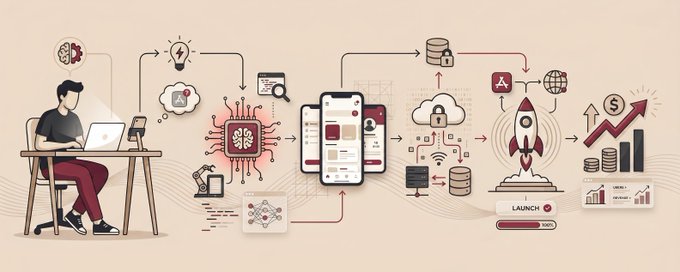
I've been building mobile apps for clients for the past year. This month I launched my own AI app studio.
It's called @ignytstudio. The plan is simple. Build two mobile apps per month using AI. Ship them to revenue via organic TikTok, Instagram, influencer marketing, and spark ads. If an app works, scale it. If it doesn't, kill it and move on. Two weeks of work. Minimal risk.
I genuinely believe B2C mobile apps are the most underrated opportunity in 2026. And I think most builders are looking in the wrong direction.
Here's why.
Everyone is building SaaS right now. The problem is that a single update from Anthropic, OpenAI, or Perplexity can make your entire product irrelevant overnight. You spend six months building an AI writing tool and then Claude ships a feature that does the same thing natively. Your users leave. Your revenue goes to zero. I've watched this happen to multiple companies this year alone.
Mobile apps don't have this problem.
You build a simple, focused app. You market it on TikTok with organic content and UGC creators. If the app gets traction, you scale with paid ads. If it hits real numbers, you can exit for a multiple of revenue. If it flops, you spent two weeks on it. Not six months. Not your life savings.
Thanks to Rork Max, building these apps is now faster than ever. The barrier to shipping a real, functional, App Store-ready mobile app has never been lower.
This article is the exact system I use. Refined after building 10+ mobile apps for clients and myself. This is the workflow I'm running for Pact, the first @ignytstudio app. An accountability alarm clock that I'm building and shipping to revenue in public.
## Step 1: Finding an Idea Worth Building
This is where most people waste weeks.
I used to do this manually. Scrolling Twitter for hours. Checking Sensor Tower. Reading Reddit threads. Browsing the App Store charts hoping something would click. It worked but it was slow and inconsistent.
Then I started using Perplexity Computer.
I gave it one task. Find me an untapped mobile app market with proven revenue, low competition, and a distribution angle that works on TikTok.
It came back in under 15 minutes with a full market analysis.
Here's what it found.
Alarmy, a simple alarm app, is doing $500K per month with 500K downloads per month. Sensor Tower verified. Wayk, another alarm app, launched in February 2026 and hit $45K revenue in its first 45 days. It reached number 15 in Health and Fitness on the App Store. Cal AI, a food scanning app, was pulling around $2M per month before MyFitnessPal acquired it. WrestleAI, built by an 18 year old using Rork, is doing $20K to $30K per month. The founder turned down a $300K exit offer.
The pattern was clear. Simple iOS apps plus TikTok distribution equals real money. And nobody had built a social accountability alarm.
That's where Pact came from. Not from a brainstorm session. Not from a shower thought. From data.
Perplexity Computer didn't just find the idea. It researched competitors, pulled revenue estimates from Sensor Tower, analyzed App Store rankings, and identified the gap in the market. All in one automated session. What would have taken me days of manual research took 15 minutes.
## Step 2: Locking In the Design System
This is the step that separates apps that look professional from apps that look like they were built by AI in five minutes. And almost every beginner skips it.
The mistake is jumping straight into Rork Max and prompting it to build screens. Without a design system, every screen Rork generates will look slightly different. Different spacing. Different font weights. Different color shades. Your app ends up looking like five different people designed it.
Here's what I do instead.
I spend 30 to 45 minutes scrolling Dribbble and Pinterest. Not to copy anything. To find a direction. Designers have already done the hard work of figuring out what looks good. There are thousands of polished mobile app designs sitting on these platforms for free. Your job is to take inspiration from what already works.
I look for two to three reference apps that match the vibe I want. For Pact, I looked at alarm apps and social fitness apps. I screenshotted the screens I liked most. The onboarding flow from one app. The dashboard layout from another. The color energy from a third.
Then I build the design system. This is a document that defines everything visual about my app before a single screen is designed. Primary colors and secondary colors. Font families and sizes for headings and body text. Spacing rules. Border radius. Button styles. Icon style. Everything.
Once this is locked in, I feed it to Rork Max as context before building a single screen. Now Rork has guardrails. Every screen it generates follows the same visual language. The result looks like a real app, not a hackathon project.
## Step 3: The UI Development Plan
This is where most App Store rejections happen and most builders don't even realize it.
Apple doesn't just reject apps for bugs. They reject apps because the user experience is broken. If a user opens your app and can't figure out how to complete the main task within the first 30 seconds, you have a problem. If the navigation doesn't make sense or the flow has dead ends, Apple will flag it in review.
Bad UX is the number one reason simple apps get rejected. Not technical issues.
Before I build any frontend screens, I create what I call a UI Development Plan. This is a document that maps the entire user journey from the moment someone opens the app to the moment they complete the core action.
For Pact, the journey is: open the app, set an alarm, invite friends to a pact, and wake up together. Every screen in between is mapped out. Every transition. Every state. What the user sees, what actions they can take, and where each action leads.
This document becomes the blueprint for the entire frontend.
Then I build inside Rork Max, screen by screen, following the plan. I don't let Rork guess what comes next. It has the full journey in front of it. Every screen connects naturally to the next. No dead ends. No confusing navigation. No screens that feel disconnected.
The frontend should be 100% complete before you touch any backend code. This is critical. If you try to build the UI and backend at the same time, Rork loses context and the quality of both drops. Frontend first. Always.
## Step 4: Building the Backend With a Task Breakdown
Once the frontend is polished, it's time to add the real functionality. Authentication. Database. Push notifications. Subscriptions. Real-time features. This is the part that scares most people.
The trick is a task breakdown file.
This is a markdown file I call task-breakdown .md. I create it before writing any backend code. It lists every backend feature I need to build, organized into phases with dependencies.
Phase 1 is always authentication. Phase 2 depends on phase 1. Phase 3 depends on phase 2. Each phase has specific tasks with clear acceptance criteria. What should happen when this feature is done. What the user should see. What edge cases to handle.
Here's why this matters.
Without a task breakdown, Rork Max guesses what to build next. It might skip a dependency. It might add features you never asked for. It hallucinates random functionality. Your app breaks in weird ways and you spend hours debugging things that shouldn't exist.
With a task breakdown, Rork follows a structured plan. It builds one phase at a time. You review and approve each phase before moving on. The AI stays focused because it has structure and context.
I've used this approach to ship the entire backend of Pact without any major errors. There were small bugs along the way, but Rork fixed them on its own during the same session. The task breakdown file is what makes one-shot backend implementations possible.
This is the exact process I covered inside the Pro community. The full video walkthrough shows every prompt, every phase approval, and every file I use for the backend.
## Step 5: Deploy to the App Store
Rork Max has made this part almost trivially easy.
It used to take a full day to prepare an App Store submission. Screenshots for every device size. App description with the right keywords. Privacy policy. App icon in seven different resolutions. Category selection. Age ratings. Review notes.
Now Rork Max handles most of it with a few clicks. It generates your App Store screenshots automatically. It writes the description. It creates the app icon. It handles the metadata. It submits directly to TestFlight and the App Store through a cloud-based Mac fleet, so you don't even need a Mac or Xcode installed.
You just need your Apple Developer account ready. That's $99 per year. Sign in with your Apple ID inside Rork Max, push the build, submit for review, and wait for approval. The entire deployment process takes about 30 minutes.
## Step 6: Distribution (The Real Challenge)
I'm going to be honest here. This is the part I haven't fully figured out yet.
Building the app is the easy part now. The hard part is getting it in front of people. Most indie developers build a great app, put it on the App Store, and wait for downloads that never come. The App Store is not a distribution channel. It's a storefront. Nobody walks into a storefront they don't know exists.
Here's the distribution strategy I'm building for IgnytStudio. I haven't executed all of this yet, but the playbook is based on what's actually working for indie app developers right now. And I'm going to be documenting every step as I figure it out in public. The wins and the failures.
Organic TikTok (primary channel)
This is the number one growth lever for simple mobile apps in 2026. The strategy is called TikTok farming.
The idea is to create multiple TikTok accounts across dedicated phones, each posting 2 to 3 videos per day showcasing your app. Not ads. Native-feeling content that looks like a real person discovered your app. The kind of videos that make someone think "I need this" without being told to download it.
The playbook that's working right now, based on what developers like Alex Nguyen have shared publicly:
Each phone gets a fresh factory reset with US locale signals. Fresh Gmail and Apple ID per device. A dedicated residential VPN to match the target country. You warm up each account for 1 to 2 days before posting, just scrolling the For You Page, liking content in your niche, following relevant accounts. This makes the algorithm treat your account as a real user, not a bot.
Then you start posting. Short, hook-driven videos. "POV you finally found an alarm app that actually makes you wake up." "My friend bet me $50 I couldn't wake up at 5am for 30 days. This app made it too easy." Relatable, slightly controversial, and always showing the app in action.
Alex Nguyen has built this into a system that generates 15 million views and 40K downloads per month. He's public about the entire process. His app is doing $24K per month in revenue from organic TikTok alone.
I need 3 to 5 dedicated iPhones to run this for Pact. That's my next purchase.
UGC Creators
Real people using your app and posting about it. This builds trust faster than any polished ad. In 2026, UGC creators for app promotion typically charge $150 to $300 per video at the entry level. You can also structure performance-based deals where creators earn $1 per 1,000 views. If a video flops, you don't pay much. If it goes viral, the creator gets rewarded and you get downloads.
The key is finding creators who already make content in your niche. For Pact, that means fitness creators, productivity TikTokers, "that girl" morning routine creators. People whose audience already cares about waking up early and building accountability.
AI Influencers
This is still experimental and I haven't launched this yet. The concept is AI-generated personas that post content at scale across TikTok and Instagram. It's part of the longer-term distribution system that I'll be testing and documenting as I go.
Paid Ads
Once organic content proves the app converts, meaning real users are downloading and subscribing from TikTok, then I'll layer on paid Meta ads and TikTok ads to scale. Not before. Paid ads without organic validation is how you burn money fast.
I'm not going to pretend I have distribution all figured out. This is genuinely the hardest part of shipping mobile apps. But I'm building IgnytStudio in public specifically because I want to document the messy process of figuring this out. If Pact hits $10K per month in revenue, you'll see exactly how. If it flops, you'll see that too.
## Why This System Works
The whole point is speed and repeatability.
Idea discovery with Perplexity Computer: 15 minutes instead of days. Design system: 30 to 45 minutes on Dribbble instead of $3K to $10K on a designer. Frontend: one focused session in Rork Max with the UI Development Plan. Backend: one focused session with a task breakdown file. Deployment: 30 minutes with Rork's built-in App Store tools.
From zero to a live app on the App Store in about two weeks. If the app gets traction, scale it. If it doesn't, the cost was two weeks of your time.
Compare that to SaaS. Six months of building. Thousands in infrastructure. A launch that might get 50 signups on Product Hunt. And the constant threat of a platform update making your entire product obsolete overnight.
I'm not saying SaaS is dead. I'm saying the risk-reward ratio for simple, focused mobile apps in 2026 is dramatically better than most people realize.
The tools exist. Rork Max builds native iOS apps from prompts. Perplexity Computer does market research in minutes. TikTok is a free distribution machine if you know how to use it.
The playbook exists. Developers are already doing $20K to $500K per month with simple apps.
The only thing missing is execution.
If you want to see how I'm building Pact step by step, from the Perplexity Computer research session to the Rork Max builds to the TikTok distribution experiments, I'm documenting the entire journey inside my free community. 2,300+ builders already in. Every workflow. Every prompt. Every mistake.
FREE to join.
Join here → https://www.skool.com/aimvpbuilders/about
## 相关链接
- [Prajwal Tomar](https://x.com/PrajwalTomar_)
- [@PrajwalTomar_](https://x.com/PrajwalTomar_)
- [17K](https://x.com/PrajwalTomar_/status/2047247661552763087/analytics)
- [@ignytstudio](https://x.com/@ignytstudio)
- [@ignytstudio](https://x.com/@ignytstudio)
- [$500K](https://x.com/search?q=%24500K&src=cashtag_click)
- [$45K](https://x.com/search?q=%2445K&src=cashtag_click)
- [$2M](https://x.com/search?q=%242M&src=cashtag_click)
- [$20K](https://x.com/search?q=%2420K&src=cashtag_click)
- [$30K](https://x.com/search?q=%2430K&src=cashtag_click)
- [$300K](https://x.com/search?q=%24300K&src=cashtag_click)
- [Pro community](https://www.skool.com/ai-mvp-builders/about)
- [$24K](https://x.com/search?q=%2424K&src=cashtag_click)
- [$10K](https://x.com/search?q=%2410K&src=cashtag_click)
- [$3K](https://x.com/search?q=%243K&src=cashtag_click)
- [$10K](https://x.com/search?q=%2410K&src=cashtag_click)
- [$20K](https://x.com/search?q=%2420K&src=cashtag_click)
- [$500K](https://x.com/search?q=%24500K&src=cashtag_click)
- [https://www.skool.com/aimvpbuilders/about](https://www.skool.com/aimvpbuilders/about)
- [Upgrade to Premium](https://x.com/i/premium_sign_up)
- [5:34 PM · Apr 23, 2026](https://x.com/PrajwalTomar_/status/2047247661552763087)
- [17.7K Views](https://x.com/PrajwalTomar_/status/2047247661552763087/analytics)
- [View quotes](https://x.com/PrajwalTomar_/status/2047247661552763087/quotes)
---
*导出时间: 2026/4/24 16:53:46*