# Claude Code for Solo Founders: The Complete Guide From Idea to First Paying
**作者**: CyrilXBT
**日期**: 2026-05-11T03:11:54.000Z
**来源**: [https://x.com/cyrilXBT/status/2053674431705165957](https://x.com/cyrilXBT/status/2053674431705165957)
---
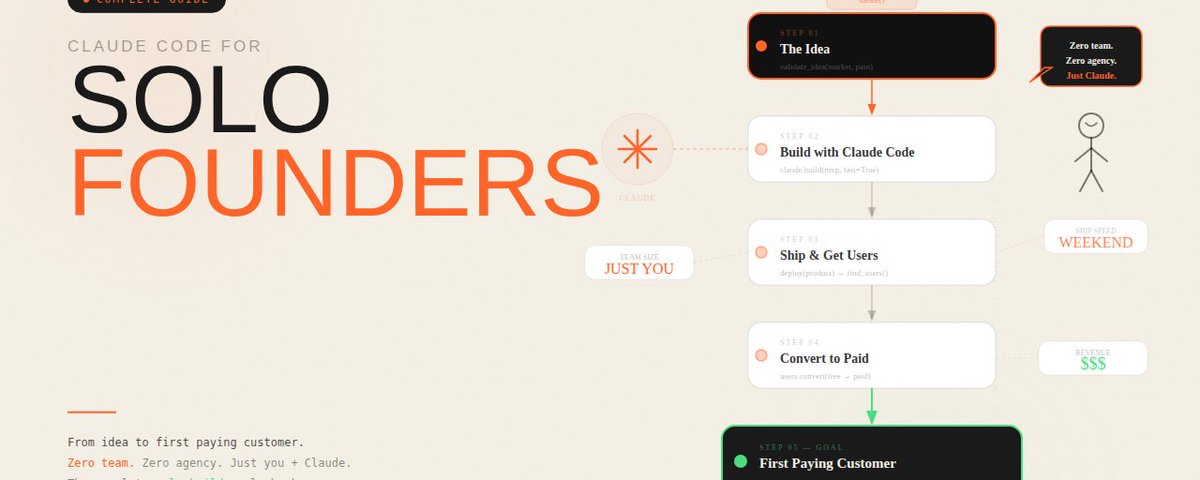
Most solo founders spend six months building something nobody wants.
Not because they are bad at building.
Because they optimized for the wrong thing.
They spent 80% of their time on code and 20% on everything else.
In 2026 that ratio needs to flip.
Claude Code has made building the easy part.
The hard part — and the part that actually determines whether you succeed — is everything that comes before and after the code.
The idea validation. The positioning. The landing page that converts. The first 10 customers. The feedback loop that tells you what to build next.
This guide is about using Claude Code to compress every stage of the solo founder journey from idea to first paying customer into a timeline that used to take a year and now takes 30 to 60 days.
## Why Solo Founders Win in 2026
The structural advantage of the solo founder has never been larger.
Six years ago a solo founder was severely constrained.
You could build the product but you needed a designer for the frontend. You needed a copywriter for the landing page. You needed a growth person for distribution. You needed an ops person to handle the administrative overhead.
Every skill gap required either learning or hiring.
Learning took months. Hiring cost money you probably did not have.
The solo founder was always fighting against the team.
Claude Code changes the constraint entirely.
A solo founder with Claude Code does not need to learn frontend design to ship a great frontend. They describe what they want and Claude Code builds it.
They do not need to write copy from scratch. They describe their positioning and Claude Code writes the landing page.
They do not need to build the entire codebase manually. They architect the system and Claude Code implements it.
The solo founder is now a director rather than a specialist.
You direct. Claude Code executes.
And direction is the highest-leverage skill in building because it requires the thing AI cannot replicate: taste, judgment, and understanding of your specific customer.
## Stage 1: Validating the Idea Before You Write a Line of Code
The most expensive mistake a solo founder makes is building for six months and discovering nobody wants what they built.
Claude Code cannot prevent this mistake. But Claude Code dramatically accelerates the validation process so you discover the truth in days instead of months.
The Problem Validation Prompt
Before you write a line of code run this prompt:
I have a business idea: [DESCRIBE YOUR IDEA IN ONE PARAGRAPH]
Act as a brutal venture capitalist who has seen 10,000 pitches.
Your job is not to be encouraging. Your job is to find every reason
this fails.
Tell me:
1. The three most likely reasons this does not work
2. The assumption the entire idea rests on that might be wrong
3. The existing solution customers are using that I am ignoring
4. The customer segment most likely to actually pay for this
5. The version of this idea that has the best chance of working
Be specific. Be harsh. Do not soften the feedback.
Read the output carefully. If Claude identifies an assumption you cannot immediately invalidate with evidence, that assumption needs to be tested before you build anything.
The Landing Page Test
The fastest way to validate demand is to build a landing page before you build a product.
Describe the value proposition to Claude Code. Tell it who the customer is, what problem they have, and what your solution does. Ask it to build a complete landing page with a waitlist signup form.
Deploy it. Drive traffic to it with a small paid spend or with content on X.
If you cannot get 50 people to give you their email address based on a description of the product you are not solving a real problem or you are describing it wrong.
Both are fixable before you write a single line of product code.
The Customer Conversation Script
Before you decide the idea is valid based on landing page signups, talk to 10 people who signed up.
Use this Claude prompt to prepare:
I am interviewing potential customers for [PRODUCT DESCRIPTION].
My hypothesis about their problem: [YOUR HYPOTHESIS]
Generate 10 questions that would reveal whether my hypothesis is
correct without leading the interviewee toward confirming it.
The questions should surface:
- What they currently do to solve this problem
- How much time and money the problem costs them
- What they have tried that did not work
- What a perfect solution would look like
- Whether they would pay for my specific approach
Never ask "would you use this product" — that question produces
false positives. Ask about behavior, not intention.
10 conversations with real potential customers are worth more than 6 months of building in isolation.
## Stage 2: Building the MVP in One Weekend
Once validation is done, build fast.
Not fast meaning sloppy.
Fast meaning focused. Build only what you need to charge the first customer.
The CLAUDE.md That Drives Everything
The most important file in your entire project is not the code.
It is the CLAUDE.md.
Set this up before you write your first prompt:
# [PROJECT NAME] — CLAUDE.md
## What We Are Building
[One clear sentence describing the product]
## The Customer
[Specific description of who this is for and what problem they have]
## MVP Scope
[List ONLY what the MVP needs to do. Nothing else.]
## Tech Stack
[Your chosen stack — keep it simple]
## Non-Negotiables
- Every feature must serve the MVP scope. No scope creep.
- Production-ready code only. No hacks that will need to be fixed later.
- Every new route and component must have error handling.
- Never store sensitive data without encryption.
## Definition of Done
[Specific description of what "finished" looks like for this MVP]
The MVP Scope section is the most important part. Write it down and enforce it ruthlessly with Claude. Every time you are tempted to add a feature ask yourself: does this help me charge the first customer? If the answer is no, it is not in the MVP.
The Weekend Build Schedule
Friday Evening: Architecture and setup (2 hours)
Read my CLAUDE.md. Based on the MVP scope described, design the
complete application architecture.
Tell me:
- The full folder structure
- Every database table needed with columns
- Every API route needed
- Every page/component needed
- The correct order to build things
Do not write any code yet. Just give me the architecture.
Wait for my confirmation before proceeding.
Review the architecture. Ask questions. Push back on anything that seems unnecessary for the MVP. Only confirm when the architecture is genuinely minimal.
Saturday Morning: Core functionality (4 hours)
Build the core user flow for [YOUR PRIMARY USE CASE].
Start with:
1. User authentication
2. [PRIMARY FEATURE 1]
3. [PRIMARY FEATURE 2]
Build in this exact order. Show me each piece working before moving
to the next. Do not add anything not listed above.
Saturday Afternoon: Database and integrations (3 hours)
Add the following integrations in this order:
1. [PAYMENT INTEGRATION if applicable]
2. [EMAIL if applicable]
3. [ANY OTHER CRITICAL INTEGRATION]
For each integration:
- Handle all error states
- Add proper logging
- Test the happy path and the failure path
Saturday Evening: Polish and testing (2 hours)
Do a full production readiness review.
Check for:
- Exposed environment variables
- Missing error handling
- Unhandled edge cases
- Security vulnerabilities
- Missing loading states
List every issue found ranked by severity. Fix all CRITICAL issues now.
Sunday: Landing page and deploy (3 hours)
The landing page should already exist from your validation phase. Now make it live and connect it to the real product.
Build a complete landing page for [PRODUCT NAME].
Target customer: [DESCRIBE]
Their problem: [DESCRIBE]
Our solution: [DESCRIBE]
Proof it works: [DESCRIBE ANY EVIDENCE]
Price: [YOUR PRICE]
Include:
- A headline that names the problem
- Three specific benefits not features
- Social proof section
- How it works (3 steps)
- Pricing with a clear CTA
- FAQ (5 questions)
Write this for someone skeptical who needs to be convinced.
By Sunday evening you have a working product and a live landing page.
That is the MVP.
## Stage 3: Getting Your First 10 Paying Customers
Building the product is not the hard part.
Getting the first 10 paying customers is.
And it is where most solo founders stall because they default to tactics that do not work for a zero-audience product.
Posting on X to 200 followers does not work.
Building features instead of selling does not work.
Here are the three approaches that actually work for first customers.
Approach 1: The Direct Outreach Method
Identify 50 people who have the problem you solve. They are in communities you are part of. They are in subreddits for your niche. They are posting about their pain on X.
Use this prompt to write the outreach:
Write cold outreach for [PRODUCT] targeting [DESCRIBE CUSTOMER].
The message should:
- Open with something specific about their situation
- Name their exact problem in their language
- State what we do in one sentence
- Ask one small question to start a conversation
Under 75 words. No pitching. No links in the first message.
Do not use "I hope this finds you well" or any similar opener.
Send 50 messages. Expect 5 to 10 replies. Expect 2 to 3 customers from those replies.
Repeat until you have 10 customers.
Approach 2: The Community Expert Method
Find 3 communities where your target customer lives. Spend 2 weeks answering questions and providing genuine value before mentioning your product.
When someone asks a question your product solves, answer the question completely for free. Then mention at the end that you built something that automates this.
People who have just received genuine value from you are 10x more likely to try your product than people who see a cold promotional post.
Approach 3: The Build in Public Method
Post your building process on X.
Not promotional posts. Behind the scenes content.
Screenshot of the CLAUDE.md you wrote. A short clip of Claude Code building a feature. The error you hit and how you fixed it. The customer conversation that changed what you built.
Builders attract builders. Builders become customers of products built by builders they respect.
The build in public method takes longer to produce revenue but produces the most durable audience.
## Stage 4: The Feedback Loop That Builds the Right Product
Your first 10 customers are the most valuable asset your company has.
Not their money. Their feedback.
The product that gets to 100 customers is always different from the product you built for the first 10. The gap between those two products is shaped entirely by what you learn from the first cohort.
The Onboarding Interview
Interview every single one of your first 10 customers within 48 hours of them signing up.
I just got my first 10 customers for [PRODUCT].
I need to interview each one to understand:
- Why they actually signed up (often different from why I think)
- What they were hoping to achieve
- What confused them during onboarding
- What almost made them not sign up
- What they would change about the product
Write 8 questions that would surface this information.
Make the questions feel conversational not clinical.
Do these interviews over video. Take notes. Look for patterns across multiple interviews.
The insight that appears in 5 out of 10 interviews is a product decision.
The insight that appears in 1 out of 10 might be an outlier.
The Feature Prioritization System
Use this prompt after you have gathered customer feedback:
I have feedback from my first 10 customers for [PRODUCT].
Here is what they told me: [PASTE YOUR INTERVIEW NOTES]
Act as a product manager who has built 10 successful products.
Tell me:
1. The single highest-leverage feature I could add based on this feedback
2. The feature customers requested that I should NOT build and why
3. What the feedback reveals about who my actual customer is
4. The change to the existing product that would have the biggest impact
5. What I should stop doing based on this feedback
Be specific. Give me one recommendation per category, not a list.
One feature added based on real customer feedback is worth 10 features built from founder assumptions.
The Retention Metric That Predicts Everything
For most products the single most important early metric is week-2 retention.
If customers come back in week 2 you have something real.
If they do not come back in week 2 you have a product people find interesting but not valuable enough to keep using.
Build a simple tracking system on day one:
Build a simple retention tracking system for [PRODUCT].
I need to know:
- Which users signed up in the last 30 days
- Which of them logged in again after day 7
- Which of them logged in again after day 14
- The actions that correlate with users who return vs users who churn
Use [YOUR STACK] and deposit a daily retention report in my email.
Check this report daily. When retention drops ask why. When retention is high ask what the sticky users are doing differently and make that behavior easier for all users.
## Stage 5: The Infrastructure That Scales Beyond 10 Customers
Once you have 10 paying customers and your retention is healthy, the focus shifts from finding customers to building the systems that handle more of them.
The Support System
Customer support is the first thing that breaks when you start growing.
Build a support system that handles the routine questions automatically before you need it:
Build a customer support system for [PRODUCT].
It should:
- Read incoming support emails
- Categorize each request as: ROUTINE, CUSTOM, or ESCALATE
- Generate a draft response for ROUTINE requests from the FAQ
- Flag CUSTOM requests for my review within 2 hours
- Always escalate BILLING and CANCELLATION requests immediately
Connect to: [YOUR EMAIL]
Use: [YOUR STACK]
The Revenue Tracking System
You need to know your numbers. Not monthly. Daily.
Build a daily revenue dashboard for [PRODUCT].
Show me:
- MRR (monthly recurring revenue)
- New MRR today
- Churned MRR this month
- Net MRR growth
- Number of active customers
- Trial to paid conversion rate
Pull data from: [STRIPE or PAYMENT PROCESSOR]
Deliver to: [EMAIL or SLACK]
The Content Engine
Once you have customers and a retention signal, content becomes your distribution lever.
Document what your customers are doing with the product. Turn it into content. The same format that describes a customer success story drives more signups than any promotional post.
Use this prompt to generate content ideas from customer interviews:
I have interview notes from my first 10 customers: [PASTE NOTES]
Generate 10 content ideas based on:
- Problems they had before finding my product
- Results they got after using it
- Insights they shared about their workflow
- Misconceptions they had that the product corrected
Frame each idea as something a potential customer would find
valuable whether they buy or not.
## The 30-Day Timeline
Day 1 to 5: Validation phase. Landing page live. 50 outreach messages sent. 10 customer conversations booked.
Day 6 to 10: Customer conversations completed. MVP scope defined based on what you learned. Architecture designed.
Day 11 to 14: MVP built using the weekend build schedule above.
Day 15 to 20: Product live. Soft launch to waitlist from landing page. First paying customers targeted.
Day 21 to 25: First 10 customers onboarded. Onboarding interviews conducted. Feature priorities set.
Day 26 to 30: Top retention feature shipped. Content engine started. Revenue tracking system live.
Day 30: First paying customers. Real feedback. Product that is demonstrably better than what you launched two weeks ago.
## The Only Thing That Actually Matters
Every framework in this guide comes back to the same principle.
Speed of learning beats speed of building.
The solo founder who ships a product in 2 weeks and learns from 10 real customers in the next 2 weeks is ahead of the solo founder who spent 6 months building in isolation.
Claude Code does not make you a better founder by making you a faster builder.
It makes you a better founder by freeing up time to do the things that actually determine success.
Talking to customers.
Understanding the problem deeply.
Making positioning decisions.
Iterating based on real signal.
Those are the skills that separate the founders who make it from the ones who build something technically impressive that nobody uses.
Use Claude Code to compress the building.
Spend the time you save on everything else.
That is the complete guide.
Follow @cyrilXBT for the exact Claude Code prompts, CLAUDE.md templates, and customer interview scripts that power every stage of this process.
## 相关链接
- [CyrilXBT reposted](https://x.com/cyrilXBT)
- [CyrilXBT](https://x.com/cyrilXBT)
- [@cyrilXBT](https://x.com/cyrilXBT)
- [64K](https://x.com/cyrilXBT/status/2053674431705165957/analytics)
- [@cyrilXBT](https://x.com/@cyrilXBT)
- [Upgrade to Premium](https://x.com/i/premium_sign_up)
- [11:11 AM · May 11, 2026](https://x.com/cyrilXBT/status/2053674431705165957)
- [64.7K Views](https://x.com/cyrilXBT/status/2053674431705165957/analytics)
- [View quotes](https://x.com/cyrilXBT/status/2053674431705165957/quotes)
---
*导出时间: 2026/5/12 09:32:27*
---
## 中文翻译
# 独立创始人的 Claude Code 指南:从想法到首笔收入的完整手册
**作者**: CyrilXBT
**日期**: 2026-05-11T03:11:54.000Z
**来源**: [https://x.com/cyrilXBT/status/2053674431705165957](https://x.com/cyrilXBT/status/2053674431705165957)
---

大多数独立创始人花费六个月的时间构建无人问津的东西。
并不是因为他们不擅长构建。
而是因为他们优化的方向错了。
他们把 80% 的时间花在写代码上,而只把 20% 的时间花在其他所有事情上。
在 2026 年,这个比例需要颠倒过来。
Claude Code 让“构建”变得轻而易举。
困难的部分——以及真正决定你是否成功的部分——是代码之前和之后的所有环节。
想法验证。定位。能带来转化的落地页。前 10 个客户。告诉你接下来该构建什么的反馈闭环。
本指南旨在讲述如何使用 Claude Code,将独立创始人从想法到首笔付费客户的每个阶段进行压缩,把过去耗时一年的时间线缩短至 30 到 60 天。
## 为什么独立创始人在 2026 年能赢
独立创始人的结构性优势从未如此巨大。
六年前,独立创始人受到严重限制。
你可以构建产品,但你需要设计师来做前端。你需要文案来写落地页。你需要增长专家来做分发。你需要运营人员来处理行政琐事。
每一个技能缺口都需要学习或招聘。
学习需要数月。招聘需要花费你可能并没有的资金。
独立创始人总是在与团队对抗。
Claude Code 彻底改变了这种约束。
拥有 Claude Code 的独立创始人不需要学习前端设计就能交付优秀的前端。他们描述自己想要的东西,Claude Code 就会把它构建出来。
他们不需要从头开始写文案。他们描述自己的定位,Claude Code 就会写出落地页。
他们不需要手动构建整个代码库。他们设计系统架构,Claude Code 负责实现。
独立创始人现在是导演,而不是专才。
你负责指挥。Claude Code 负责执行。
而指挥是构建过程中杠杆率最高的技能,因为它需要 AI 无法复制的东西:品味、判断力以及对你特定客户的理解。
## 第一阶段:在写下一行代码前验证想法
独立创始人犯的最昂贵的错误是花费六个月构建,最后发现没人想要他们做的东西。
Claude Code 无法阻止这个错误。但它能极大地加速验证过程,让你在几天内而不是几个月内发现真相。
**问题验证提示词**
在你写下一行代码之前,运行这个提示词:
我有一个商业想法:[用一段话描述你的想法]
扮演一个看过 10,000 份 pitch 的残酷风险投资人。
你的工作不是鼓励。你的工作是找出这个想法失败的每一个理由。
告诉我:
1. 这可能无法奏效的三个最可能的原因
2. 整个想法赖以成立但可能是错误的假设
3. 我忽略了的客户正在使用的现有解决方案
4. 最有可能真正为此付费的客户群体
5. 这个想法中最有可能成功的版本
要具体。要严苛。不要弱化反馈。
仔细阅读输出结果。如果 Claude 指出了一个你无法立即用证据证伪的假设,那么这个假设需要在构建任何东西之前进行测试。
**落地页测试**
验证需求最快的方法是在构建产品之前先构建一个落地页。
向 Claude Code 描述价值主张。告诉它客户是谁,他们有什么问题,以及你的解决方案是什么。让它构建一个包含候补名单注册表单的完整落地页。
部署它。用少量付费投入或在 X 上发布内容来引流。
如果你不能基于对产品的描述让 50 个人留下他们的电子邮件地址,那么你要么没有解决真正的问题,要么就是描述方式错了。
这两点都可以在写下一行产品代码之前修复。
**客户沟通脚本**
在根据落地页注册情况认定想法有效之前,先与 10 个注册的人谈谈。
使用这个 Claude 提示词来做准备:
我正在为 [产品描述] 采访潜在客户。
我对他们问题的假设:[你的假设]
生成 10 个能揭示我的假设是否正确的问题,且不要引导受访者去确认假设。
问题应能引出:
- 他们目前如何解决这个问题
- 这个问题花费了他们多少时间和金钱
- 他们尝试过哪些无效的方法
- 完美的解决方案会是什么样
- 他们是否愿意为我的具体方案付费
永远不要问“你会使用这个产品吗”——这个问题会产生虚假的肯定。要询问行为,而不是意图。
与 10 个真实潜在客户的交谈,比闭门造车 6 个月更有价值。
## 第二阶段:在一个周末构建 MVP
一旦验证完成,就要快速构建。
快速并不意味着草率。
快速意味着专注。只构建你向第一个客户收费所需的东西。
**驱动一切的 CLAUDE.md**
整个项目中最重要的文件不是代码。
而是 CLAUDE.md。
在写下第一个提示词之前设置好它:
# [项目名称] — CLAUDE.md
## 我们在构建什么
[一句清晰描述产品的话]
## 客户
[明确描述这是给谁的,以及他们有什么问题]
## MVP 范围
[仅列出 MVP 需要做的事情。没有其他。]
## 技术栈
[你选择的栈 —— 保持简单]
## 不可妥协的原则
- 每个功能都必须服务于 MVP 范围。严禁范围蔓延。
- 仅限生产就绪的代码。不要留以后需要修复的 hack。
- 每个新路由和组件必须有错误处理。
- 未经加密永远不要存储敏感数据。
## 完成的定义
[针对此 MVP,“完成”的具体描述]
MVP 范围部分是最重要的。写下来,并用 Claude 无情地执行。每当你想添加一个功能时问问自己:这有助于我向第一个客户收费吗?如果答案是否定的,它就不属于 MVP。
**周末构建时间表**
**周五晚上:架构和设置(2 小时)**
阅读我的 CLAUDE.md。基于描述的 MVP 范围,设计完整的应用程序架构。
告诉我:
- 完整的文件夹结构
- 每个需要的数据库表及其列
- 每个 API 路由
- 每个需要的页面/组件
- 构建顺序的正确顺序
暂时不要写任何代码。只给我架构。
在继续之前等待我的确认。
审查架构。提出问题。质疑任何对 MVP 来说似乎不必要的东西。只有当架构真正是最小化时才确认。
**周六上午:核心功能(4 小时)**
为 [你的主要用例] 构建核心用户流程。
从以下开始:
1. 用户认证
2. [主要功能 1]
3. [主要功能 2]
严格按照此顺序构建。在移动到下一个之前向我展示每个部分的运行情况。不要添加上面未列出的任何内容。
**周六下午:数据库和集成(3 小时)**
按以下顺序添加以下集成:
1. [支付集成(如果适用)]
2. [邮件(如果适用)]
3. [任何其他关键集成]
对于每个集成:
- 处理所有错误状态
- 添加适当的日志记录
- 测试成功路径和失败路径
**周六晚上:打磨和测试(2 小时)**
进行全面的生产就绪审查。
检查:
- 暴露的环境变量
- 缺失的错误处理
- 未处理的边缘情况
- 安全漏洞
- 缺失的加载状态
按严重程度列出发现的每个问题。现在修复所有关键问题。
**周日:落地页和部署(3 小时)**
落地页应该已经在你的验证阶段存在了。现在让它上线,并连接到真实产品。
为 [产品名称] 构建一个完整的落地页。
目标客户:[描述]
他们的问题:[描述]
我们的解决方案:[描述]
有效的证明:[描述任何证据]
价格:[你的价格]
包括:
- 点出问题的标题
- 三个具体的好处而不是功能
- 社会证明部分
- 它是如何工作的(3 步)
- 带有清晰 CTA 的定价
- 常见问题(5 个问题)
为那些需要被说服的怀疑论者写这个。
到周日晚上,你就有了一个可用的产品和一个上线的落地页。
这就是 MVP。
## 第三阶段:获得前 10 个付费客户
构建产品不是困难的部分。
获得前 10 个付费客户才是。
而这也是大多数独立创始人停滞不前的地方,因为他们默认使用了对零受众产品无效的策略。
在 X 上向 200 个粉丝发帖没有用。
构建功能而不是销售没有用。
以下是真正对首批客户有效的三种方法。
**方法 1:直接触达法**
确定 50 个有你要解决的问题的人。他们在你所在的社区里。在你利基市场的 subreddits 里。他们在 X 上发布关于他们的痛苦。
使用这个提示词来编写触达信息:
为针对 [描述客户] 的 [产品] 写冷触达信息。
信息应:
- 以关于他们情况的具体事情开场
- 用他们的语言点出他们的确切问题
- 用一句话陈述我们所做的
- 问一个小问题以开始对话
75 字以内。不要推销。第一条信息中不要包含链接。
不要使用“希望你一切顺利”或任何类似的开场白。
发送 50 条信息。预期 5 到 10 个回复。预期从这些回复中获得 2 到 3 个客户。
重复直到你有 10 个客户。
**方法 2:社区专家法**
找到 3 个你的目标客户所在的社区。在提及你的产品之前,花 2 周时间回答问题并提供真正的价值。
当有人问及你的产品能解决的问题时,先免费完整地回答问题。然后在最后提到你构建了一个可以自动执行此操作的工具。
刚从你那里获得真正价值的人,尝试你的产品的可能性比看到冷冰冰的促销帖子的人高 10 倍。
**方法 3:公开构建法**
在 X 上发布你的构建过程。
不是促销帖子。幕后内容。
你写的 CLAUDE.md 的截图。Claude Code 构建功能的短视频片段。你遇到的错误以及你如何修复它。改变了你构建内容的客户对话。
构建者吸引构建者。构建者会成为他们尊重的构建者所构建产品的客户。
公开构建法产生收益的时间较长,但能产生最持久的受众。
## 第四阶段:构建正确产品的反馈闭环
你的前 10 个客户是你公司最有价值的资产。
不是他们的钱。是他们的反馈。
能获得 100 个客户的产品总是与你为前 10 个客户构建的产品不同。这两者之间的差距完全由你从第一批客户中学到的东西塑造。
**入门访谈**
在注册后的 48 小时内访谈你的前 10 个客户中的每一个人。
我刚刚获得了 [产品] 的前 10 个客户。
我需要访谈每一个客户以了解:
- 他们为什么真正注册(通常与我想的不同)
- 他们希望实现什么
- 在入门过程中什么让他们感到困惑
- 什么差点让他们没有注册
- 他们想改变产品的什么
写 8 个能引出此信息的问题。
让问题感觉像对话而不是临床检查。
通过视频进行这些访谈。做笔记。寻找多次访谈中的模式。
在 10 次访谈中出现 5 次的洞察是一个产品决策。
在 10 次访谈中只出现 1 次的洞察可能是一个异常值。
**功能优先级系统**
在收集到客户反馈后使用此提示词:
我有来自前 10 个客户关于 [产品] 的反馈。
这是他们告诉我的:[粘贴你的访谈笔记]
扮演一个构建了 10 个成功产品的产品经理。
告诉我:
1. 基于此反馈我可以添加的单一最高杠杆功能
2. 客户要求但我绝对不应该构建的功能及原因
3. 反馈揭示了谁是我的真正客户
4. 对现有产品的改动将产生最大影响
5. 基于此反馈我应该停止做什么
要具体。每个类别给我一个建议,而不是列表。
基于真实客户反馈添加的一个功能,相当于基于创始人假设构建的 10 个功能。
**预测一切的留存指标**
对于大多数产品,最重要的早期指标是第 2 周留存率。
如果客户在第 2 周回来,你就拥有了一些真实的东西。
如果他们在第 2 周不回来,你的产品只是人们觉得有趣但不足以持续使用的东西。
第一天就构建一个简单的跟踪系统:
为 [产品] 构建一个简单的留存跟踪系统。
我需要知道:
- 哪些用户在过去 30 天内注册
- 其中哪些人在第 7 天后再次登录
- 其中哪些人在第 14 天后再次登录
- 与回归用户与流失用户相关的行为
使用 [你的技术栈] 并将每日留存报告发送到我的电子邮件。
每天检查此报告。当留存下降时问为什么。当留存高时,问留存用户做有什么不同,并让所有用户更容易做到这种行为。
## 第五阶段:扩展超越 10 个客户的基础设施
一旦你有 10 个付费客户且你的留存率健康,重点就从寻找客户转移到构建能处理更多客户的系统。
**支持系统**
客户支持是你在开始增长时最先崩溃的东西。
在你需要之前构建一个自动处理常规问题的支持系统:
为 [产品] 构建客户支持系统。
它应该:
- 读取传入的支持邮件
- 将每个请求分类为:常规、自定义或升级
- 根据常见问题解答为常规请求生成草稿回复
- 在 2 小时内标记自定义请求供我审查
- 始终立即升级账单和取消请求
连接到:[你的电子邮件]
使用:[你的技术栈]
**收入跟踪系统**
你需要知道你的数字。不是每月。是每天。
为 [产品] 构建每日收入仪表板。
向我展示:
- MRR(月度经常性收入)
- 今天的新 MRR
- 本月流失的 MRR
- 净 MRR 增长
- 活跃客户数量
- 试用到付费的转化率
从:[STRIPE 或支付处理器] 拉取数据
发送到:[电子邮件或 SLACK]
**内容引擎**
一旦你有了客户和留存信号,内容就成为你的分发杠杆。
记录你的客户正在用产品做什么。把它变成内容。描述客户成功故事的同一格式比任何促销帖子都能带来更多注册。
使用此提示词从客户访谈中生成内容创意:
我有前 10 个客户的访谈笔记:[粘贴笔记]
基于以下内容生成 10 个内容创意:
- 他们在找到我的产品之前的问题
- 他们使用后获得的结果
- 他们关于工作流程分享的见解
- 产品纠正了他们的误解
将每个创意框架化为潜在客户无论购买与否都会觉得有价值的东西。
## 30 天时间线
第 1 到 5 天:验证阶段。落地页上线。发送 50 条触达信息。预订 10 次客户访谈。
第 6 到 10 天:完成客户访谈。基于你所学定义 MVP 范围。设计架构。
第 11 到 14 天:使用上述周末构建时间表构建 MVP。
第 15 到 20 天:产品上线。向落地页候补名单软启动。定位首批付费客户。
第 21 到 25 天:前 10 个客户完成入门。进行入门访谈。设定功能优先级。
第 26 到 30 天:发布顶级留存功能。启动内容引擎。收入……