# How We Run LinkedIn for 24 People with Claude Code
**作者**: Michel Lieben
**日期**: 2026-04-26T20:16:36.000Z
**来源**: [https://x.com/MichLieben/status/2048496489329266968](https://x.com/MichLieben/status/2048496489329266968)
---

We added $151K in MRR in 87 days with 20+ people posting on LinkedIn every week. None of them hired a ghostwriter. None of them took a writing course. And yet each one sounds unmistakably like themselves.
That is the part most people miss when they try to scale content. Content is not a creative discipline, it is an engineering one. The agency that sounds like 24 different humans at scale did not find 24 gifted writers.
We deployed a Claude Code pipeline with 27 skills, one folder per person, and a grading rubric that refuses to ship anything under a /38. This is how the machine works, and this is the playbook to build your own.
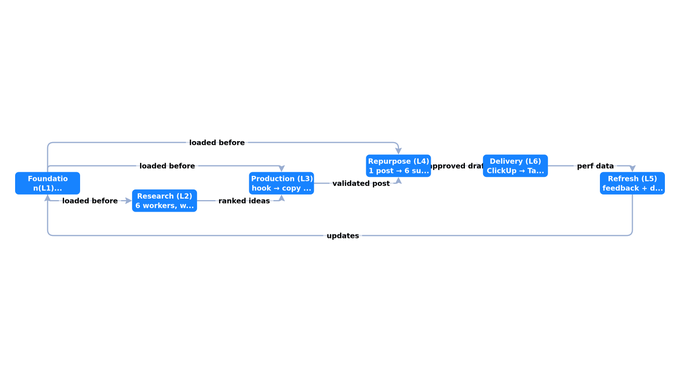
The whole thing runs in eight stages through one terminal. Foundation gets set once per human. Research fires every week. Ideation produces a ranked batch every Monday. Hooks, copy, and grading form the production line. Delivery routes through ClickUp and Taplio. A refresh loop keeps the entire system from decaying. Every post that ships passes through every stage, and nothing is optional.
## Layer 1: The Foundation (built once per person)
Every AI content engine I have seen runs into the same wall. Every post starts sounding identical. The voice drifts toward whatever the base model considers good business writing, which is to say, nothing in particular. Readers unfollow.
A foundation layer fixes it. One folder per human, loaded before every generation, anchoring the model to one specific voice. Inside that folder:
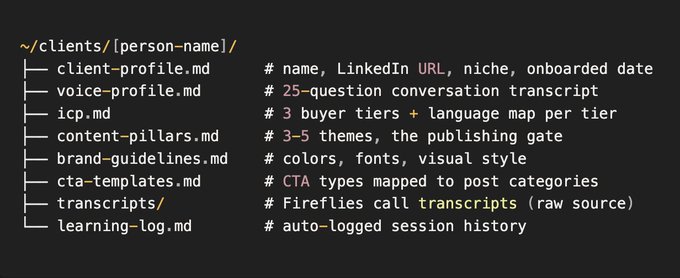
The voice profile is the highest-leverage file in that list. We build it from a 25-question spoken conversation, not a form.
- How does the person describe what they do at a dinner?
- What words do they refuse to use?
- What phrases do they reach for when explaining something technical to a non-technical buyer?
The transcript becomes the ground truth, and every draft is compared against it.
The ICP doc splits into three buyer tiers, each with its own language map. A VP of Sales talks differently than an SDR. A CFO doesn't sound like a founder. The doc captures those differences so a post can land native to one tier instead of averaging across three.
The content pillars file is the final gate. Three to five themes, and if a draft does not deposit into one of them, the system rejects the idea before it becomes a draft.
Skip this layer and you ship generic AI copy by month two. Build it properly and the foundation gets stronger every month the system runs.
## Layer 2: The Research Layer (runs weekly, six workers in parallel)
Coming up with ideas is easy. Coming up with ideas that actually land with each of your three buyer tiers is the hard part. The research layer runs six workers every week and produces a ranked idea batch every Monday morning.
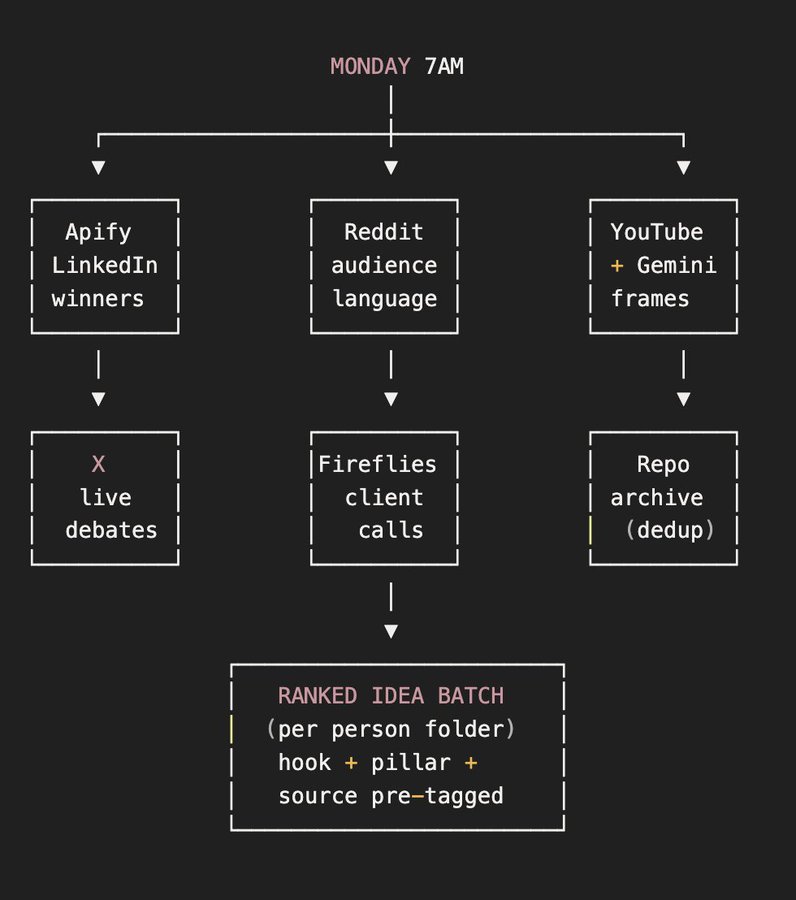
1. Apify browses LinkedIn for what is performing in the niche right now: which formats get saved, which hooks earn comments, which pillars are gaining traction.
2. Reddit mines the communities our buyers actually live in for raw, unedited audience language.
3. YouTube feeds through Gemini for multimodal video analysis, turning long-form video into pillar-mapped frameworks worth adapting.
4. X surfaces the live debates our ICP is having this week and the angle that would be contrarian for us to take.
Fireflies.ai transcripts are the highest-signal source in the entire stack. Clients describe their problems in their own language during diagnostic calls, and that language becomes hooks unedited.
A repurposing archive indexes everything we have already produced so nothing gets accidentally repeated.
A seventh skill, reverse engineering, runs on-demand. It scrapes top-performing niche posts, extracts the structural frameworks behind virality, and maps reusable templates back into the hook and copy skills.
By Monday morning each person's folder has a ranked idea batch waiting. Each idea arrives with a pre-generated hook, the pillar tagged, and the source cited. We don't argue about what to post.
## Layer 3: The Production Line (hook → copy → grade)
Once an idea passes the foundation gate, it enters a four-skill production line where each skill does exactly one job and hands off cleanly to the next.
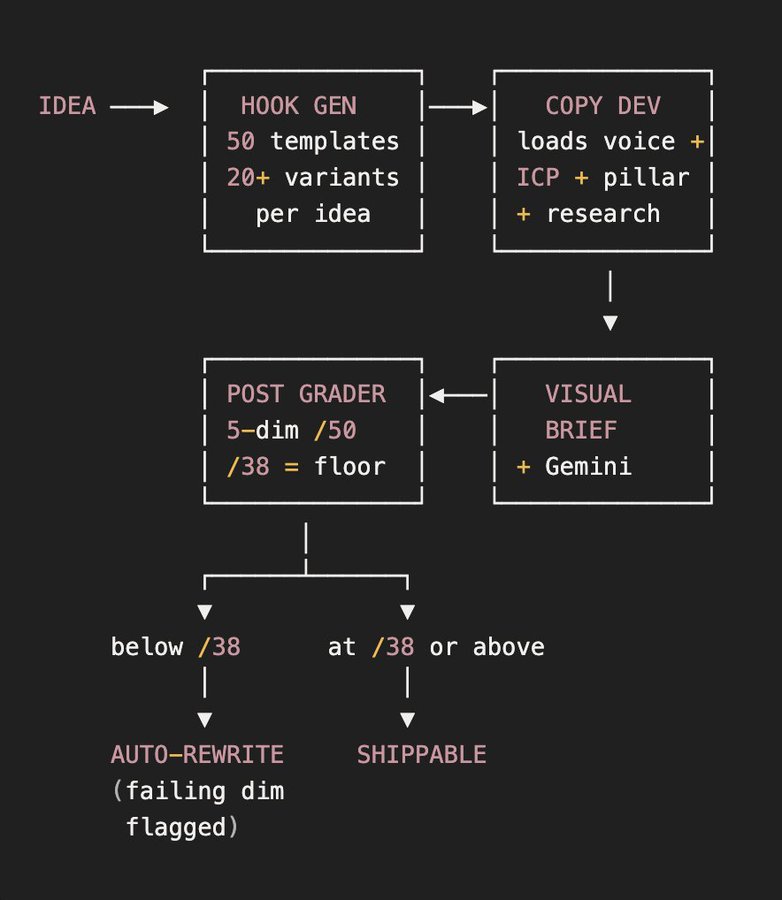
- Hook generator. 50 templates organized by emotional trigger across Desire, Curiosity, and Fear. Each idea produces 20+ hook variations. The library was reverse-engineered from the top-performing hooks in our LinkedIn corpus and the wider industry. Underperforming templates get deprecated. New patterns from outside the corpus get folded in. The library evolve
- Copy developer. Takes the winning hook and writes a full draft in the person's documented voice. It loads the voice profile, the active ICP tier, the matched content pillar, and the raw research snippets pulled earlier. The output reads native to the human about to edit it.
- Visual brief generator. Produces a structured layout plus text instructions for the designer, with reference images and exact copy placement. The designer follows the brief instead of guessing from a vague Slack message. Gemini handles first-pass visuals; Figma and Canva sit above it for human refinement.
- Post grader. Scores every draft on a five-dimension rubric: hook strength, voice fit, specificity of claims, scannability, and pillar relevance. Each dimension scores out of ten, so /50 is the ceiling. /38 is the floor. Anything below a 38 auto-rewrites with the failing dimension flagged. Nothing ships under a 38.
Two specialty skills sit alongside the line for resource-giveaway posts. The lead magnet writer writes the post itself. The lead magnet builder builds the actual resource the post is promising. PDF, template, or playbook.
The grader is what keeps the output honest. AI drafts; the human sharpens. The voice profile is the guardrail in between.
## Layer 4: Repurpose (one post, many formats)
One validated LinkedIn post is raw material. A finished product is what you build from it across surfaces. Most teams either ignore that leverage or copy-paste the same post across channels and wonder why it flops everywhere except the original.
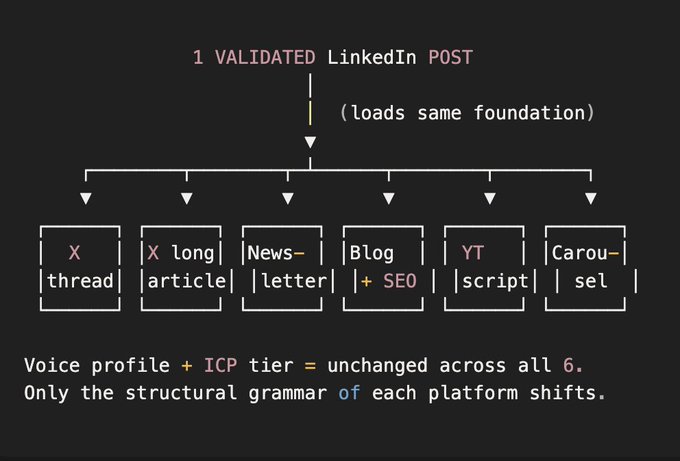
> Repurpose Flywheel: 1 validated post → 6 surfaces
The whole point is restructuring. Copy-pasting doesn't work. A LinkedIn post that performed well = one validated idea. The repurpose skill rebuilds it into an X thread, an X long-form article with a cover placard, a newsletter, a blog post with SEO headings, a YouTube video script, and a carousel of sequential visual slides. Each destination gets its own rebuild with native formatting, native opening patterns, and a CTA that fits how people consume that surface.
The repurpose skill loads the same foundation files. Voice profile and ICP tier carry over unchanged. The only thing that shifts is the structural grammar of the destination platform.
## Layer 5: Refresh + Maintain
Every AI system decays without maintenance. Voice drift, stale pillars, and shifting research sources all compound silently if no one is watching. Five mechanisms run on different cadences to keep the system honest.
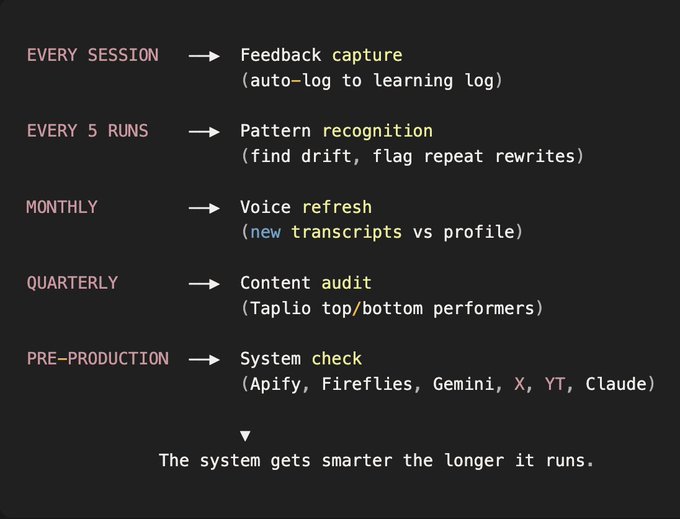
- Feedback capture runs every session and auto-logs what ran, what the human kept verbatim, what the human rewrote, and what the grader rejected. Writes to the learning log. Nothing manual.
- Pattern recognition runs every five sessions, reading the full learning log to identify repeat rewrites and drift patterns, then outputting recommendations back to the client folder.
- Voice refresh runs monthly by pulling new transcripts and comparing the current voice profile against recent spoken language, flagging drift in voice, ICP language, pillars, and CTAs.
- Content audit runs quarterly by pulling top and bottom performers from Taplio, cross-referencing against the learning log, and flagging pillars producing below their expected engagement range.
- System check runs before every production round, testing every API dependency across Apify, Fireflies, Gemini, Reddit, YouTube, and Claude in a quick sanity pass so a long production run never fails halfway through.
The system gets smarter the longer it runs.
## Layer 6: Delivery
The final layer is where finished posts leave the terminal and meet the human who is going to publish them.
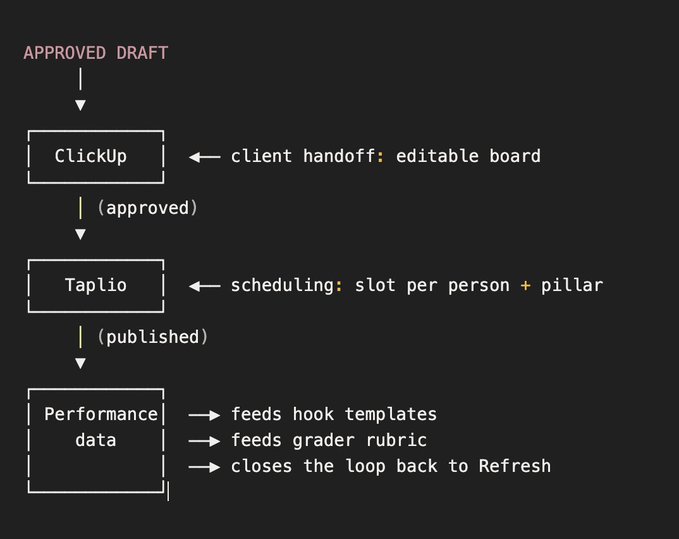
- ClickUp is the client-handoff surface. Every approved draft, visual brief, and grader scorecard lands in the client's ClickUp board, where the human can edit, approve, or kick back.
- Taplio is the scheduling layer. Approved posts queue into Taplio with the right time slot per person and per pillar.
- Performance data is fed back into Claude for the next cycle. Top performers train the hook templates. Underperformers feed the rubric. The loop closes.
One terminal. 27 skills. Each does one job.
## The Linear Flow
That is the architecture in six layers. The runtime flow across them is one line:

## 5 Plays Worth Running
If you build nothing else, build these five.
Play 1: Foundation to first post in 48 hours.
Day 1: run the 25-question voice conversation, build the ICP doc with three buyer tiers, write the content pillars doc with three to five themes.
Day 2: run ideation, pick a hook, run the copy developer, grade, human-edit, publish. A new client goes from zero to a published, in-voice post in 48 hours.
Play 2: Transcript to content pipeline. Pick one Fireflies client call. Feed the transcript into the ideation skill. Extract five content-worthy moments: an objection, a win, a framework, a phrase, a tension. Develop each into a full draft with three hook variants. Five posts from one call.
Play 3: Post grader feedback loop. Score every post on the five dimensions before publishing. Anything below a 38 goes back for a rewrite with the failing dimension flagged. Log every rejection and every revision into the learning log. Review every five sessions and let pattern recognition surface repeat failures.
Play 4: Six-source parallel research. Cron the six research workers to run every Sunday night. Monday morning a ranked idea batch lands in each person's folder, pre-tagged with pillar, hook, and source. The team picks from the top instead of brainstorming cold.
Play 5: Repurpose flywheel. Wait one week after a LinkedIn post to measure engagement. If it clears the bar, tag it 'validated.' Run the repurpose skill and rebuild it into X thread, X article, newsletter, blog, YouTube script, and carousel. Each destination gets a native rebuild, not a copy-paste.
## Claude Code, Cowork, or Chat: Pick the Surface That Matches Your Ceiling
Claude Chat is best for single-draft brainstorming and one-off outputs. Memory starts fresh every conversation. No automation. Not designed for multi-client work.
Claude Cowork sits in the middle. Plug-ins, project knowledge, and Cowork-level config make it good for an individual marketer running one brand. You can apply this entire system inside Cowork too. Memory persists across sessions. Multi-client gets painful fast because each new client requires reconfiguration.
Claude Code is where multi-client teams become feasible in one workspace. Every file gets read every run, learning logs compound over time, skills chain, parallel agents spawn on demand, and any API is callable from inside the pipeline. One folder per client, swap by name, same 27 skills, different voices. The cost is terminal comfort and some setup time before the first output ships.
Pick the surface that matches your ceiling. Most teams underestimate the ceiling they need.
## The Three Skills You Will Run Most Often
If you are auditing whether the system is earning its keep, watch these three.
1. Weekly-idea-session fires every Monday morning and produces the ranked idea batch gated by voice, ICP, and pillar fit.
2. Copy-developer takes a hook plus idea plus context and outputs a platform-ready draft in the person's documented voice.
3. Post-grader scores every draft on the five-dimension rubric and decides what actually ships.
Everything else is scaffolding for these three. If these three are clean, the system is working.
## 相关链接
- [Michel Lieben](https://x.com/MichLieben)
- [@MichLieben](https://x.com/MichLieben)
- [3.1K](https://x.com/MichLieben/status/2048496489329266968/analytics)
- [$151K](https://x.com/search?q=%24151K&src=cashtag_click)
- [Fireflies.ai](http://fireflies.ai/)
- [Upgrade to Premium](https://x.com/i/premium_sign_up)
- [4:16 AM · Apr 27, 2026](https://x.com/MichLieben/status/2048496489329266968)
- [3,181 Views](https://x.com/MichLieben/status/2048496489329266968/analytics)
---
*导出时间: 2026/4/27 09:20:27*