# OpenAI Will Eventually Build an OS
**作者**: CHOI
**日期**: 2026-04-27T17:03:47.000Z
**来源**: [https://x.com/arrakis_ai/status/2048810350821478545](https://x.com/arrakis_ai/status/2048810350821478545)
---
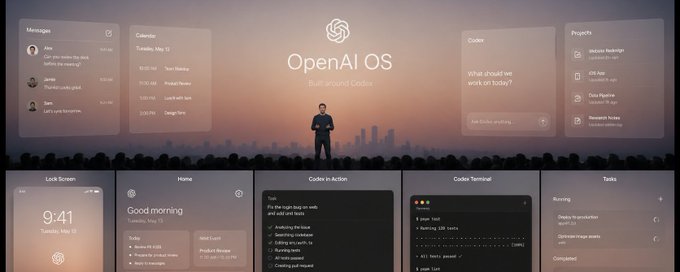
I think OpenAI will eventually build an operating system.
Codex is becoming increasingly popular, and OpenAI is expanding it into something far larger than a coding assistant. It is becoming a space where multiple agents can work at once, where real work can be delegated, and where documents, slides, spreadsheets, dashboards, browser workflows, images, and deployment all begin to converge.
On the surface, Codex can look like a super app for developers. But the more important question is not how many features OpenAI is adding to Codex. The real question is what kind of market OpenAI is preparing for inside Codex.
At first, Codex looked like a coding tool. Recent updates point in a different direction. Multiple agents can work in parallel. Files can be created and edited. Documents can be revised. Browsers can be inspected. Images can be generated. Apps can be deployed. It looks like a bundle of developer features, but underneath that, I see a deeper shift in how software is created, executed, and distributed.
Something similar is happening inside ChatGPT. Apps in ChatGPT already showed that users can call external apps directly inside a conversation, receive interactive app experiences, and discover or install apps through an app directory. With the Apps SDK, OpenAI gave developers a way to build app experiences that live inside ChatGPT. In other words, apps are no longer only destinations outside the browser. They are starting to enter the conversation itself.
That matters because the user's starting point is changing. Until now, the default flow was to open a browser, search, visit a website, install an app, log in, and then complete the task. In the next interface, the user may simply say, "Do this for me" inside ChatGPT. ChatGPT can call the right app, Codex can create a missing function, or an external app can render directly inside the conversation.
This does not mean the browser disappears. It means the browser may no longer be the front-facing canvas that directs the user's attention. It may become infrastructure in the background, used by agents to fetch information, render functionality, and connect services.
The meaning of the app store also changes. In the smartphone era, an app store was where finished apps were listed, discovered, downloaded, reviewed, and monetized. In the AI era, users may create the productivity tool they need in the moment, run it immediately, and distribute it if it proves useful. Buying a domain, choosing a server, configuring deployment, and waiting for app review could all become compressed or invisible.
When those steps shrink, people stop "visiting" a specific website or app just to use a function. They begin calling the function into their own conversation and workflow. This is where something like a Codex Store starts to make sense: an environment where users build apps with Codex, deploy them directly, and let others run them with visible permissions and safety boundaries.
This is why Codex's deployment direction matters. If Codex can deploy web apps to services like Cloudflare, Netlify, Render, and Vercel, that is not just a convenience feature. It is a sign that creation and distribution are being pulled into the same workspace. The user creates, tests, fixes, deploys, and updates software in one loop. At that point, Codex is no longer just a coding tool. It starts to feel like a software publishing environment.
Vibe coding is pushing this shift even faster. The difficulty of building websites, games, internal tools, and utilities is falling quickly. The next bottleneck is no longer just making the thing. It is deploying it, securing it, managing keys, handling payments, showing permissions, updating dependencies, and deciding whether the generated app is safe enough to run.
Google is attacking this bottleneck through its own strengths. Gemini, Google AI Studio, Firebase, and Firebase Studio point toward a world where a user can go from idea to app to deployment through Google's cloud infrastructure. That is a powerful strategy. Google starts from infrastructure, hosting, and distribution.
OpenAI starts from a different place. It starts from the conversation, the user's intention, the user's context, and the execution of agents. If ChatGPT manages context, Codex creates apps and automations, and the Apps SDK renders external apps inside ChatGPT, the traditional app store becomes less central. Users call apps from the flow of work. If the app does not exist, they create it. If it works, they distribute it.
This is where the market question becomes clear. If OpenAI remains only a company that provides powerful AI models, then it risks becoming a feature inside platforms controlled by Apple, Google, Microsoft, Samsung, browsers, and app stores. The next market will be decided by who owns the entry point, where user context accumulates, which apps are executed, and who controls payment, identity, permissions, and distribution.
From Sam Altman's point of view, this is a strategic fork. OpenAI can remain a model supplier, or it can try to own the next entrance to personal computing.
In the smartphone era, Apple and Google created the market by controlling the app store. Developers built apps. Users installed them. Apple and Google controlled distribution, payment, permissions, and trust. In the AI era, that structure can change. It is not enough to generate apps. The more AI-generated apps appear, the more important review, sandboxing, trust, permissions, key management, payment, and updates become.
That is why the software transition is also an operating system transition. Apps do not disappear. But the way apps are conceived, created, executed, distributed, reviewed, and permissioned changes. If OpenAI wants to own this market, a model alone is not enough. It needs the user interface, the execution environment, the distribution layer, identity, payment, security, memory, and eventually the device.
The meaning of an app changes as well. In the smartphone era, an app was a finished product. You searched for it, installed it, and operated within the functions it provided. In the AI era, an app can become more fluid. A user might say, "Create a dashboard that analyzes this report," "Turn this material into a presentation webpage," "Build a family travel budget calculator," or "Make this game idea playable as a web game." The app is generated and executed in context.
An app becomes less like a fixed product and more like an executable unit made from a user's intent, data, permissions, model, and interface. It can be created today, revised tomorrow, shared next week, and later converted into an automation.
This is also how I read Codex's image generation, editing, and GIF creation features. If a user can generate the assets they need inside a frontend or UI workflow without leaving the tool, the boundaries between planning, design, development, and deployment become weaker. PDF viewers, HTML viewers, embedded browsers, UI annotation, file preview, image generation, and deployment can look like small updates when viewed separately. Taken together, they pull the full software lifecycle into OpenAI's environment.
Computer Use is important in a different way. It is less about Codex today and more about what an OpenAI OS would need tomorrow. An AI OS cannot replace every existing app overnight. Banking apps, enterprise systems, shopping sites, hospital booking systems, accounting tools, and government services will continue to exist. Computer Use gives AI a way to operate existing software through the screen, mouse, and keyboard. In a future OpenAI OS, it could become the compatibility layer between the legacy software world and the agentic AI world.
This is why the hardware story matters. OpenAI has already formalized its work with Jony Ive, LoveFrom, and io, and the io Products team later joined OpenAI. Reports have also suggested that OpenAI is preparing its own smartphone to compete with the iPhone, with MediaTek, Qualcomm, Luxshare, and a possible 2028 timeline being discussed. Whether or not those reports become the final product roadmap, the strategic logic is clear. If OpenAI wants to own the user interface, the sensors, and the most personal data layer, it eventually has to confront hardware and OS.
An AI phone is not interesting because it runs ChatGPT well. It becomes interesting when the user's location, voice, gaze, routines, work habits, conversation history, and content preferences accumulate inside one system, and agents use that context to call apps, make payments, book services, and recommend actions.
Even ordering morning coffee could become a different kind of interaction. The user would not open a cafe app, choose a branch, and manually pay. The AI could consider the user's first meeting location, commute route, sleep quality, and caffeine sensitivity, then place the order at the right time. At that point, apps are no longer destinations the user opens. They become functional pieces the OS calls and assembles in the background.
Recommendation also changes. YouTube, Netflix, music, news, documents, calendars, and notes are currently recommended inside separate platforms. A personal AI OS could recommend across the user's full context. It could suggest the video you need now, the explanation that helps you understand a document, the automation that saves your week, or the learning path that fits your habits.
This is the age of the hyper-personalized OS. It is also the age of the hyper-biased OS. A system that hears everything, remembers everything, and adapts everything to you is extremely convenient. It can also trap you inside a narrower worldview. Today's social media algorithms bias users inside individual platforms. A personal OS can shape search, content, work, consumption, learning, and relationships at once.
As AI-generated content explodes, people will become more tired of information overload and overstimulating content. In a world flooded with generated material, people care less about what can be made and more about what can be trusted. The next platform advantage may come from trust: provenance, copyright, labeling, review, transparency, and recommendation standards.
This may also raise the value of offline experience. If digital spaces become crowded with AI content and social media trust declines, people may place more value on physical gatherings, offline entertainment, experiential activities, and real communities. The future AI OS may not compete only by increasing screen time. It may compete by helping users navigate and enhance real-world experiences.
Identity becomes central in this future. If OpenAI directly controls the OS and the device, World ID becomes strategically relevant in a different way. When AI agents can pay, install apps, send messages, submit documents, and agree to contracts on behalf of a user, the system must prove that the action came from a real person and that the person delegated that authority.
Passwords and SMS codes are not enough for that kind of delegated world. A proof-of-personhood system such as World ID, which combines iris-based human verification with zero-knowledge proofs, could become part of the future identity stack. World ID may look separate today, but if OpenAI builds its own device and OS, the value changes. Biometric verification, agent delegation, payment approval, token usage, and app execution permissions could all become connected inside the device.
In an agent-driven world, the question is not simply whether an account is logged in. The deeper question is what a real human has authorized an AI to do. Iris-based verification has serious privacy and regulatory risks, but the strategic point remains. The value of an AI phone may not be camera resolution or screen size. It may be the ability to bind context, identity, payment, token usage, and agent permissions into one trusted system.
Pricing may also change. If an AI-native phone emerges, the center of the phone bill may move from data to tokens. Today's smartphone plans are built around network access and data usage. An AI-native phone's core cost may come from inference, agent execution, memory retrieval, tool use, instant app generation, image generation, and video generation.
Users may end up paying less for gigabytes and more for token usage, action credits, agent runs, and context storage. In a more distant future, if satellite or space-based networks make physical connectivity nearly free, the cost users feel may shift from connection to intelligence. The phone bill becomes a token bill. The monthly plan depends on how deeply the user runs a personal AI OS, how much context they keep, how many agents they run in parallel, and how many apps they create and execute.
This is why I think OpenAI will eventually build an OS. Not because Codex is growing quickly. Not because ChatGPT has more features. The market itself is pushing in that direction. If AI remains a feature inside someone else's app, it remains part of someone else's platform. If AI is going to complete the user's work directly, it has to become the platform.
Codex is where this shift first appears in software work. Computer Use is where legacy software gets absorbed. Hardware is where OpenAI tries to own the user interface and the personal data layer. Together, these point toward a new operating environment.
It may not be called iOS or Android. It may begin as a workspace inside ChatGPT, a development environment inside Codex, or an execution environment that combines Computer Use with the Apps SDK. But when users delegate intent, AI creates apps, operates existing apps, deploys results, manages permissions, handles payments, remembers context, and runs across a personal device, the system has moved beyond the category of an app.
At that point, it is an operating system.
## 相关链接
- [CHOI](https://x.com/arrakis_ai)
- [@arrakis_ai](https://x.com/arrakis_ai)
- [4.5K](https://x.com/arrakis_ai/status/2048810350821478545/analytics)
- [Upgrade to Premium](https://x.com/i/premium_sign_up)
- [1:03 AM · Apr 28, 2026](https://x.com/arrakis_ai/status/2048810350821478545)
- [4,591 Views](https://x.com/arrakis_ai/status/2048810350821478545/analytics)
- [View quotes](https://x.com/arrakis_ai/status/2048810350821478545/quotes)
---
*导出时间: 2026/4/28 20:44:23*