# Deep Dive: Where Value Accrues in the AI Stack
**作者**: Chamath Palihapitiya
**日期**: 2026-05-01T18:03:59.000Z
**来源**: [https://x.com/chamath/status/2050275051761705133](https://x.com/chamath/status/2050275051761705133)
---
How should we think about AI in 2026?
Well, the first generation of internet companies had a map. It was called the OSI stack, a conceptual framework that demarcated where one layer of computing ended and the next began. Get the boundaries right, and great companies get built on top of them. Intel. Cisco. Broadcom. Oracle.
The question now is what the conceptual stack for AI looks like.
There will be a stack we will one day look back on and use to explain every company that mattered in this era. The opportunity is to draw it now, while the boundaries are still being set and the fulcrum assets are still being claimed.
So we set out to map it.
Where does it start? Where does it end? Where does it fork? Which layers compound value, and which get commoditized? Who owns the fulcrum assets that pivot the rest of the stack? We spent the first quarter of 2026 answering these questions. This deep dive is the map.
The Six Layers
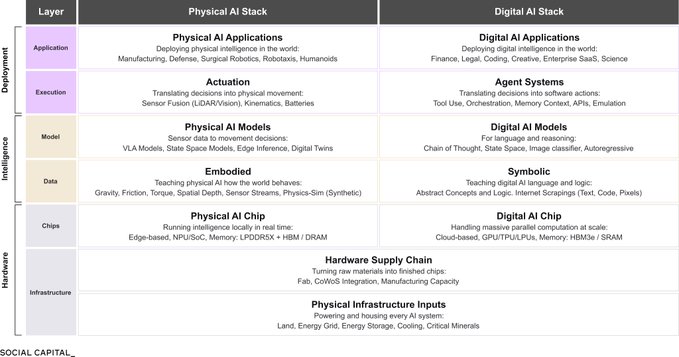
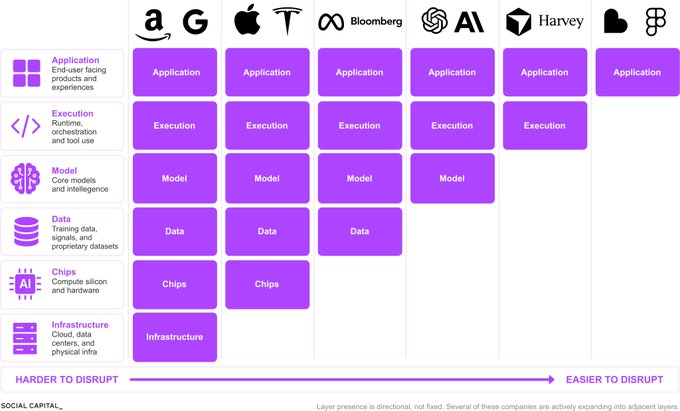
The stack we drew has six layers, from the bottom up: infrastructure, chips, data, models, execution, and application. Each layer has its own fulcrum assets, single points every unit of value above them has to cross. The companies that sit on the non-obvious ones are the ones the next forty years of computing will be built on top of.
The Foundation Is Concentrated
Starting from the bottom, the foundation is power, cooling, and critical minerals. Infrastructure is the most concentrated layer in the stack, and the concentration is global.
ASML in the Netherlands makes the machine that prints every advanced chip in the world. Four companies in Japan supply the film that no chip can ship without. A single mine in North Carolina sits underneath every wafer in production. The most American piece of the AI stack, NVIDIA’s CUDA, runs on top of all of it.
Rockefeller had 90% of refining by 1880, Cisco had 85% of routing by 2000, and the same pattern is forming now.
The Stack Forks
At the chips is where the stack forks.
On one side is software AI. The price of running a model has dropped 1,500x in six years, and intelligence is becoming free. The bet here is what I like to borrow from Elon and call “the machine that makes the machines.” Above models sit the agents and applications people will use every day. The question is who builds the system that produces them.
On the other side is physical AI: anything that has to operate in the physical world. Two things stand out: energy storage and actuation. The greatest robot in the world is dead the moment its battery runs out, and a robot that cannot move is as useful as an inanimate brick. The question is who owns the supply chains beneath them.
These two forks compound on very different curves. A handful of names already sit on the boundaries that matter.
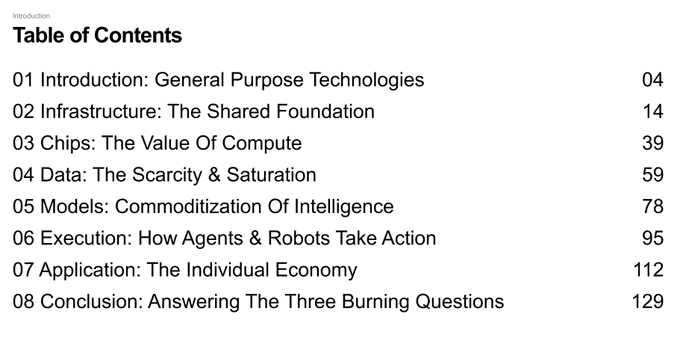
The 138-page Deep Dive on my Substack is the full map of our AI stack research. Here is what you will find:
- The six-layer framework and what each layer covers
- The fulcrum assets at each layer
- The foreign chokepoints underneath the American software stack
- The collapse in model prices and what it means above the silicon layer
- The fork into software AI and physical AI
- The companies already positioned at each fulcrum asset
Every era of computing has been won by the people who got the stack right. This is the clearest view we have of where AI is going.
Read it here: https://chamath.substack.com/p/the-ai-stack
## 相关链接
- [Chamath Palihapitiya](https://x.com/chamath)
- [@chamath](https://x.com/chamath)
- [86K](https://x.com/chamath/status/2050275051761705133/analytics)
- [https://chamath.substack.com/p/the-ai-stack](https://chamath.substack.com/p/the-ai-stack)
- [2:03 AM · May 2, 2026](https://x.com/chamath/status/2050275051761705133)
- [86.3K Views](https://x.com/chamath/status/2050275051761705133/analytics)
- [View quotes](https://x.com/chamath/status/2050275051761705133/quotes)
---
*导出时间: 2026/5/2 09:56:05*
---
## 中文翻译
# 深度解析:价值在 AI 技术栈中的归属
**作者**: Chamath Palihapitiya
**日期**: 2026-05-01T18:03:59.000Z
**来源**: [https://x.com/chamath/status/2050275051761705133](https://x.com/chamath/status/2050275051761705133)
---

在 2026 年,我们该如何看待 AI?
好吧,第一代互联网公司有一张地图。它被称为 OSI 模型(开放式系统互联通信参考模型),这是一个概念框架,界定了计算层在哪里结束,下一层从哪里开始。只要边界划分正确,伟大的公司就能在此基础上建立起来。英特尔、思科、博通、甲骨文。
现在的问题是,AI 的概念栈看起来是什么样子的。
未来会有这样一个技术栈,我们回首往事时会用它来解释这个时代所有重要的公司。现在的机会在于描绘它,此时边界仍在设定中,核心资产也正被争夺。
因此我们着手绘制它。
它从哪里开始?在哪里结束?在哪里分叉?哪些层会复合价值,哪些层会被 commoditized(商品化)?谁拥有那些撬动栈其余部分的支点资产?我们在 2026 年第一季度花时间回答了这些问题。这篇深度分析就是那张地图。
六个层级
我们绘制的栈有六个层级,从下往上分别是:基础设施、芯片、数据、模型、执行和应用。每一层都有自己的支点资产,即其上的每一单位价值都必须经过的单一节点。那些占据非显眼位置的公司,正是未来四十年计算架构的基石。

基础是集中的
从底部开始,基础是电力、冷却和关键矿产。基础设施是栈中最集中的层级,而且这种集中是全球性的。
荷兰的 ASML 制造了生产世界上所有先进芯片的机器。日本四家公司供应着没有任何芯片可以发货所需的薄膜。北卡罗来纳州的一座单一矿山支撑着所有正在生产的晶圆。AI 栈中最具美国色彩的部分——英伟达的 CUDA,运行在所有这些之上。
到 1880 年,洛克菲勒控制了 90% 的炼油业务;到 2000 年,思科占据了 85% 的路由器市场;同样的模式正在形成。
技术栈的分叉
在芯片这一层,技术栈出现了分叉。
一方面是软件 AI。运行模型的成本在六年内下降了 1500 倍,智能正在变得免费。这里的赌注在于我喜欢借用埃隆·马斯克的话称之为“制造机器的机器”。在模型之上,是人们每天使用的代理和应用。问题在于,谁来构建生产它们的系统?
另一方面是物理 AI:任何必须在物理世界中进行操作的事物。有两点非常突出:储能和致动。世界上再伟大的机器人,一旦电池耗尽就等于废铁;无法移动的机器人,其用处就像一块没有生命的砖头。问题在于,谁掌握着其下的供应链。
这两个分叉在非常不同的曲线上复合。少数几个名字已经占据了重要的边界位置。

我在 Substack 上发布的这篇 138 页的深度分析是我们 AI 技术栈研究的完整地图。以下是您将看到的内容:
- 六层框架以及每一层涵盖的内容
- 每一层的支点资产
- 美国软件栈之下的外国瓶颈
- 模型价格的暴跌及其在硅层之上的意义
- 分叉为软件 AI 和物理 AI
- 已经在每个支点资产上布局的公司

每一个计算时代的赢家,都是那些搞对了技术栈的人。这是我们对 AI 发展方向最清晰的认知。
在此阅读: https://chamath.substack.com/p/the-ai-stack
## 相关链接
- [Chamath Palihapitiya](https://x.com/chamath)
- [@chamath](https://x.com/chamath)
- [86K](https://x.com/chamath/status/2050275051761705133/analytics)
- [https://chamath.substack.com/p/the-ai-stack](https://chamath.substack.com/p/the-ai-stack)
- [2:03 AM · May 2, 2026](https://x.com/chamath/status/2050275051761705133)
- [86.3K Views](https://x.com/chamath/status/2050275051761705133/analytics)
- [View quotes](https://x.com/chamath/status/2050275051761705133/quotes)
---
*导出时间: 2026/5/2 09:56:05*