# Claude Second Brain & Folder Workflow: The Complete Guide
**作者**: Bober_smart
**日期**: 2026-07-19T10:11:11.000Z
**来源**: [https://x.com/Bober_smart/status/2078784709253841039](https://x.com/Bober_smart/status/2078784709253841039)
---
## Build your AI-native second brain using simple Markdown folders and a CLAUDE.md index file map
"Second brain" sounds a bit pretentious, but at the end of the day, it is just a handful of text files stashed in a few folders, managed by a single index file that guides the AI on where to look. No Obsidian, no complex databases, no bloated apps, just plain Markdown sitting on your drive.
In this walkthrough, we will build this architecture from the ground up: organizing the directory structure, writing your roadmap (the CLAUDE.md file), setting naming conventions, and explaining exactly how the agent parses it all. By the time you are done, you will have a robust system you can replicate and start populating immediately.
The Short Answer
A "second brain" is nothing more than a collection of flat .md files organized in simple folders, with a single CLAUDE.md file in the root serving as your index. It acts as a compass, informing the agent where information resides, how files are structured, and the protocols for reading them. The golden rule: one topic per file. The CLAUDE.md is the map the agent follows to navigate your knowledge. You do not need a dedicated note-taking app.
What You will Need
An AI agent that can read project directories (like Claude Code or similar).
Any text editor. These are standard .md files; they work with everything.
Five minutes. That is enough time to set up the folders. You can fill them in as you go, there is no need to front-load all your data.
Note: There are no installation scripts or complex configurations involved. This is a file structure and an index, not a software product.
The Principle: Flat Files Over Apps
The instinct to download Obsidian or build a fancy Notion database is usually a trap. Apps impose their own proprietary formats, storage logic, and interfaces, which often create friction for an AI. An agent works best when it can read a simple text file on your disk directly, without any middle layers.
That is why the foundation here is flat Markdown files. "Flat" means plain text with standard formatting (headers, bullet points), no nested databases and no proprietary links. It is accessible anywhere, readable by both humans and AI. This is not a sacrifice for the sake of simplicity, it is a strategic advantage: the cleaner the format, the fewer walls stand between your knowledge and the agent.
The Skeleton: Semantic Folders
The layout relies on semantic organization, grouping folders based on their content. Here is the basic structure:
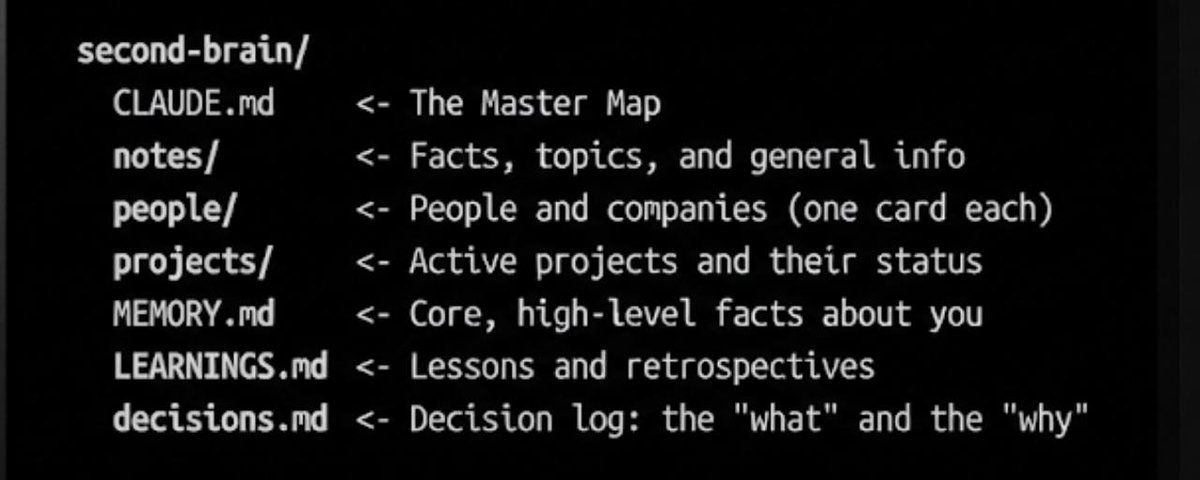
These three core folders cover almost every use case:
notes/: Facts and topic-specific entries. If you learn something, distill it here. One file per topic.
people/: Cards for contacts or companies: who they are, meeting summaries, key details. One file per person.
projects/: Project status: what you are currently working on, where you paused, and the next steps.
Additionally, use the root-level files for metadata about your workflow: MEMORY.md (long-term, core info), LEARNINGS.md (lessons learned), and decisions.md (an audit log of your choices).
CLAUDE.md, The Map
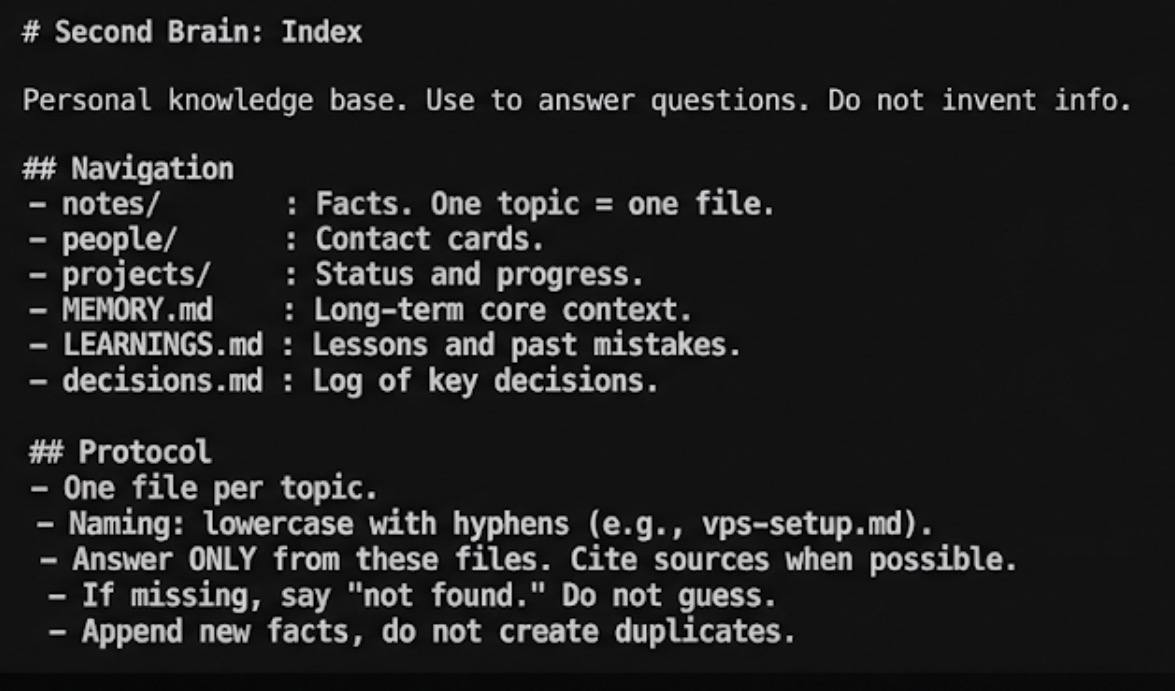
This is the brain's nervous system. Folders are just storage; to make them actionable, you need a map. The CLAUDE.md file in the root tells the agent how to interpret your structure.
Why CLAUDE.md? If you use Claude Code, it loads this file into the system prompt automatically on startup. You do not have to prompt the agent to "read the map", it already knows the rules of engagement before your first question.
Example of your map file:
Pro-Tip: Leveraging @-Connections
For a more advanced setup, you can prime the agent: your CLAUDE.md can directly reference core files using @ paths. By adding @MEMORY.md or @decisions.md to the map, the agent keeps that high-level context in its active memory at all times. Use this sparingly, only for what truly needs to be in focus consistently.
Naming Rules: Discipline is Everything
The "one file = one topic" rule is where most systems succeed or fail.
One File = One Topic. Avoid "dumping" several unrelated points into notes.md. If it is about "Tax Policy," create tax-policy.md.
Topic as Name. Name the file for what it contains. Use ivan-petrov.md instead of note-12.md.
Unified Style. Stick to lowercase and hyphens to avoid ambiguity.
## How the Agent Reads It
When you initiate a session, the agent ingests CLAUDE.md. When you ask a question, it uses the map to locate the correct file, parses it, and synthesizes an answer, complete with a citation. If the info is not there, it reports a failure rather than hallucinating. Your only responsibility is maintaining a clean structure; the agent handles the retrieval.
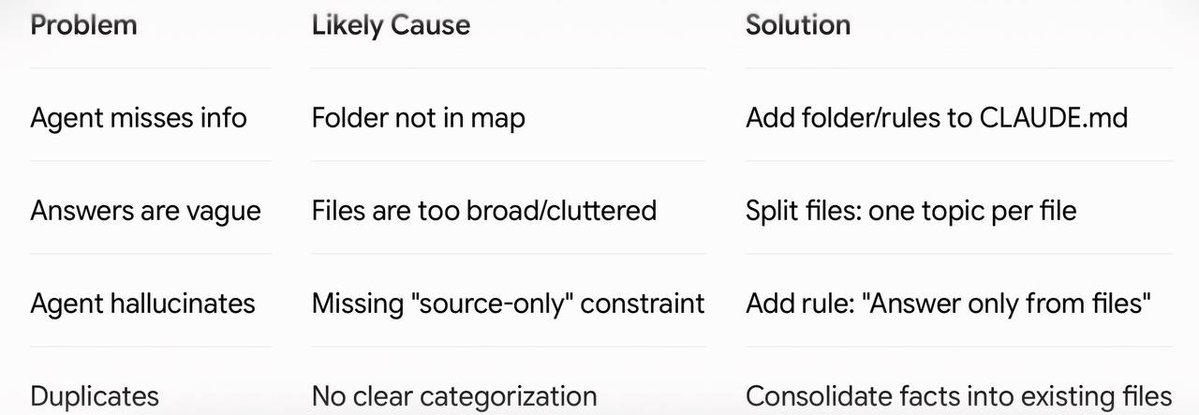
Common Pitfalls
## FAQ
Must the map be called CLAUDE.md? If you use Claude Code, yes, it is automatic. For other agents, use a README.md or an equivalent root-level index.
How many folders should I start with? Keep it simple. Stick to three primary folders and your root-level files. Expand only when a topic becomes large enough to warrant its own directory.
Do I have to move all my old notes? No. Build the skeleton now and migrate or create new content as you go.
The Bottom Line
Your second brain is simply a mix of flat .md files, a strict "one topic = one file" discipline, and a CLAUDE.md map to guide the agent. Forget the complex software, just keep your text files organized on your disk. Invest your time in the map; a clear CLAUDE.md is the difference between a disorganized mess and a functional AI assistant.
## 相关链接
- [Bober_smart](https://x.com/Bober_smart)
- [@Bober_smart](https://x.com/Bober_smart)
- [498K](https://x.com/Bober_smart/status/2078784709253841039/analytics)
- [CLAUDE.md](https://claude.md/)
- [CLAUDE.md](https://claude.md/)
- [CLAUDE.md](https://claude.md/)
- [CLAUDE.md](https://claude.md/)
- [MEMORY.md](https://memory.md/)
- [LEARNINGS.md](https://learnings.md/)
- [decisions.md](https://decisions.md/)
- [CLAUDE.md](https://claude.md/)
- [CLAUDE.md](https://claude.md/)
- [CLAUDE.md](https://claude.md/)
- [CLAUDE.md](https://claude.md/)
- [@MEMORY](https://t.me/MEMORY)
- [@decisions](https://t.me/decisions)
- [notes.md](https://notes.md/)
- [tax-policy.md](https://tax-policy.md/)
- [ivan-petrov.md](https://ivan-petrov.md/)
- [note-12.md](https://note-12.md/)
- [CLAUDE.md](https://claude.md/)
- [CLAUDE.md](https://claude.md/)
- [README.md](https://readme.md/)
- [CLAUDE.md](https://claude.md/)
- [CLAUDE.md](https://claude.md/)
- [Upgrade to Premium](https://x.com/i/premium_sign_up)
- [6:11 PM · Jul 19, 2026](https://x.com/Bober_smart/status/2078784709253841039)
- [498.8K Views](https://x.com/Bober_smart/status/2078784709253841039/analytics)
- [View quotes](https://x.com/Bober_smart/status/2078784709253841039/quotes)
---
*导出时间: 2026/7/23 11:45:17*
---
## 中文翻译
# Claude 第二大脑与文件夹工作流:完全指南
**作者**: Bober_smart
**日期**: 2026-07-19T10:11:11.000Z
**来源**: [https://x.com/Bober_smart/status/2078784709253841039](https://x.com/Bober_smart/status/2078784709253841039)
---

## 使用简单的 Markdown 文件夹和 CLAUDE.md 索引文件地图构建你的 AI 原生第二大脑
“第二大脑”听起来有点自命不凡,但归根结底,它不过是藏在几个文件夹里的一把文本文件,由一个单一的索引文件管理,指引 AI 去哪里查找。不需要 Obsidian,不需要复杂的数据库,不需要臃肿的应用程序,只是静躺在你的驱动器上的普通 Markdown 文件。
在本教程中,我们将从零开始构建这个架构:组织目录结构、编写路线图(CLAUDE.md 文件)、设置命名约定,并准确解释代理如何解析所有内容。当你完成后,你将拥有一个可以立即复制并开始填充的强大系统。
简而言之
“第二大脑”不过是在简单文件夹中组织的扁平 .md 文件集合,根目录下有一个 CLAUDE.md 文件作为你的索引。它就像一个指南针,告诉代理信息在哪里、文件是如何结构化的,以及读取它们的协议。黄金法则:一个文件对应一个主题。CLAUDE.md 是代理遵循的地图,用于浏览你的知识。你不需要专门的笔记应用程序。
你需要什么
一个可以读取项目目录的 AI 代理(如 Claude Code 或类似工具)。
任何文本编辑器。这些是标准的 .md 文件,适用于所有环境。
五分钟。这足以设置好文件夹。你可以随用随填,不需要预先加载所有数据。
注意:这里不涉及安装脚本或复杂的配置。这是一个文件结构和一个索引,而不是软件产品。
原则:扁平文件优于应用程序
下载 Obsidian 或构建花哨的 Notion 数据库的本能通常是一个陷阱。应用程序会强加它们自己的专有格式、存储逻辑和界面,这往往会给 AI 带来摩擦。当代理可以直接读取磁盘上的简单文本文件而没有任何中间层时,它的工作效果最好。
这就是为什么这里的基础是扁平 Markdown 文件。“扁平”意味着带有标准格式(标题、项目符号)的纯文本,没有嵌套数据库,没有专有链接。它可以在任何地方访问,可以被人类和 AI 读取。这不是为了简单而做出的牺牲,这是一个战略优势:格式越干净,你的知识和代理之间的障碍就越少。
骨架:语义文件夹
布局依赖于语义组织,即根据内容对文件夹进行分组。这是基本结构:

这三个核心文件夹几乎涵盖了所有用例:
notes/:事实和特定主题的条目。如果你学到了什么,将其提炼到这里。每个主题一个文件。
people/:联系人或公司的卡片:他们是谁、会议摘要、关键细节。每个人一个文件。
projects/:项目状态:你目前正在进行的工作、你暂停的地方以及后续步骤。
此外,使用根目录级别的文件来存储关于你工作流的元数据:MEMORY.md(长期的、核心信息)、LEARNINGS.md(经验教训)和 decisions.md(你选择的审计日志)。
CLAUDE.md,地图
这是大脑的神经系统。文件夹只是存储;要让它们可执行,你需要一张地图。根目录中的 CLAUDE.md 文件告诉代理如何解释你的结构。
为什么叫 CLAUDE.md?如果你使用 Claude Code,它会在启动时自动将此文件加载到系统提示中。你不需要提示代理“读取地图”,它在你的第一个问题之前就已经知道互动规则。
地图文件示例:

专业提示:利用 @ 连接
对于更高级的设置,你可以预加载代理:你的 CLAUDE.md 可以使用 @ 路径直接引用核心文件。通过将 @MEMORY.md 或 @decisions.md 添加到地图中,代理可以随时将高层上下文保存在其活动内存中。请谨慎使用,仅针对那些真正需要持续关注的内容。
命名规则:纪律就是一切
“一个文件 = 一个主题”的规则是大多数系统成功或失败的关键。
一个文件 = 一个主题。避免将几个不相关的观点“倾倒”到 notes.md 中。如果它是关于“税收政策”的,请创建 tax-policy.md。
主题即名称。根据文件内容命名文件。使用 ivan-petrov.md 而不是 note-12.md。
统一风格。坚持使用小写和连字符以避免歧义。
## 代理如何读取它
当你启动会话时,代理会摄入 CLAUDE.md。当你提问时,它使用地图来定位正确的文件,解析它,并综合出一个答案,并附上引用。如果信息不存在,它会报告失败而不是产生幻觉。你唯一的职责是保持一个干净的结构;代理负责检索。
常见陷阱

## 常见问题
地图必须命名为 CLAUDE.md 吗?如果你使用 Claude Code,是的,它是自动的。对于其他代理,请使用 README.md 或等效的根级索引。
我应该从多少个文件夹开始?保持简单。坚持使用三个主要文件夹和你的根级文件。只有当一个主题变得足够大以至于需要自己的目录时,再进行扩展。
我必须移动所有旧笔记吗?不需要。现在构建骨架,然后随用随迁或创建新内容。
底线
你的第二大脑只是扁平 .md 文件的混合,严格的“一个主题 = 一个文件”的纪律,以及一个指导代理的 CLAUDE.md 地图。忘记复杂的软件吧,只需在磁盘上整理好你的文本文件。把你的时间投入到地图上;一个清晰的 CLAUDE.md 是混乱的烂摊子和功能性 AI 助手之间的区别所在。
## 相关链接
- [Bober_smart](https://x.com/Bober_smart)
- [@Bober_smart](https://x.com/Bober_smart)
- [498K](https://x.com/Bober_smart/status/2078784709253841039/analytics)
- [CLAUDE.md](https://claude.md/)
- [CLAUDE.md](https://claude.md/)
- [CLAUDE.md](https://claude.md/)
- [CLAUDE.md](https://claude.md/)
- [MEMORY.md](https://memory.md/)
- [LEARNINGS.md](https://learnings.md/)
- [decisions.md](https://decisions.md/)
- [CLAUDE.md](https://claude.md/)
- [CLAUDE.md](https://claude.md/)
- [CLAUDE.md](https://claude.md/)
- [CLAUDE.md](https://claude.md/)
- [@MEMORY](https://t.me/MEMORY)
- [@decisions](https://t.me/decisions)
- [notes.md](https://notes.md/)
- [tax-policy.md](https://tax-policy.md/)
- [ivan-petrov.md](https://ivan-petrov.md/)
- [note-12.md](https://note-12.md/)
- [CLAUDE.md](https://claude.md/)
- [CLAUDE.md](https://claude.md/)
- [README.md](https://readme.md/)
- [CLAUDE.md](https://claude.md/)
- [CLAUDE.md](https://claude.md/)
- [Upgrade to Premium](https://x.com/i/premium_sign_up)
- [6:11 PM · Jul 19, 2026](https://x.com/Bober_smart/status/2078784709253841039)
- [498.8K Views](https://x.com/Bober_smart/status/2078784709253841039/analytics)
- [View quotes](https://x.com/Bober_smart/status/2078784709253841039/quotes)
---
*导出时间: 2026/7/23 11:45:17*