Hermes Agent Masterclass: 安装、配置与基础命令 ✍ tonbi🕐 2026-07-29📦 20.8 KB 🟢 已读 𝕏 文章列表 本文介绍了开源 AI Agent Hermes 的安装与基础配置。Hermes 由 Nous Research 开发,支持多种模型和终端运行,具有会话复用和技能积累的独特设计。文章详细讲解了在 Windows、macOS 和 Linux 上的安装步骤、设置向导流程以及如何配置推理提供商。 HermesAgentAI安装教程CLI工具与效率开源 # Hermes Agent Masterclass: 1. Install, Setup, & Basic Commands **作者**: tonbi **日期**: 2026-07-28T18:30:38.000Z **来源**: [https://x.com/tonbistudio/status/2082171890798616967](https://x.com/tonbistudio/status/2082171890798616967) ---  Welcome the to X version of my Hermes Agent Masterclass. These articles will include a full text guide, notes, and slides along with the original videos. The content itself is the same as the videos posted on YouTube, but I understand some people want to take their time with this information, and would prefer a written format, so I have designed these text guides with slides/images along with the original video for the X audience. Enjoy! *(视频内容)* # Module 1 — Hermes Agent From Zero Full episode guide · 26 min 1 s ## Why Hermes & When To Pick It Before you install anything: what Hermes actually is, the one design decision that makes it different, and an honest answer on when not to use it. > Where this module lands: by the end of Module 1 you'll have Hermes installed, configured with a working AI provider, you'll know the ~20 commands you'll use daily, and you'll have finished a real task — an actual report, not a toy example. 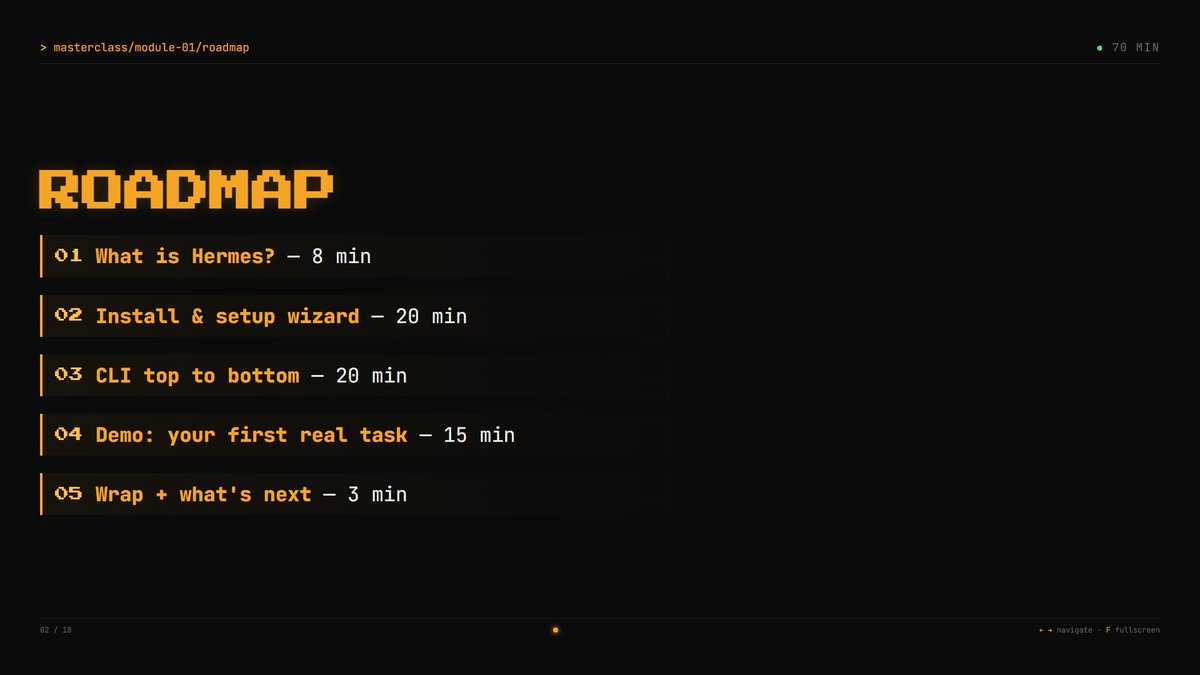 Slide 2 ## What Hermes is Hermes is an open-source AI agent built by Nous Research — the lab behind the Hermes model family. That's the part worth pausing on. Most agents are built by tool companies. This one is built by the people who train the models. Slide 4 adds that Nous uses this same tool to generate training data for the Hermes family, and that the project is MIT licensed. Where it runs: - In your terminal (the CLI) - On your phone — via the gateway: Telegram, Discord, Slack and other messaging platforms - As a desktop app It's model-agnostic. Claude, GPT, Grok, Kimi, Gemini, or any local model. Hermes doesn't care — you pick. Where the project is at: 200,000+ GitHub stars, ~2,000 contributors, now on version 18, with new versions shipping roughly weekly. 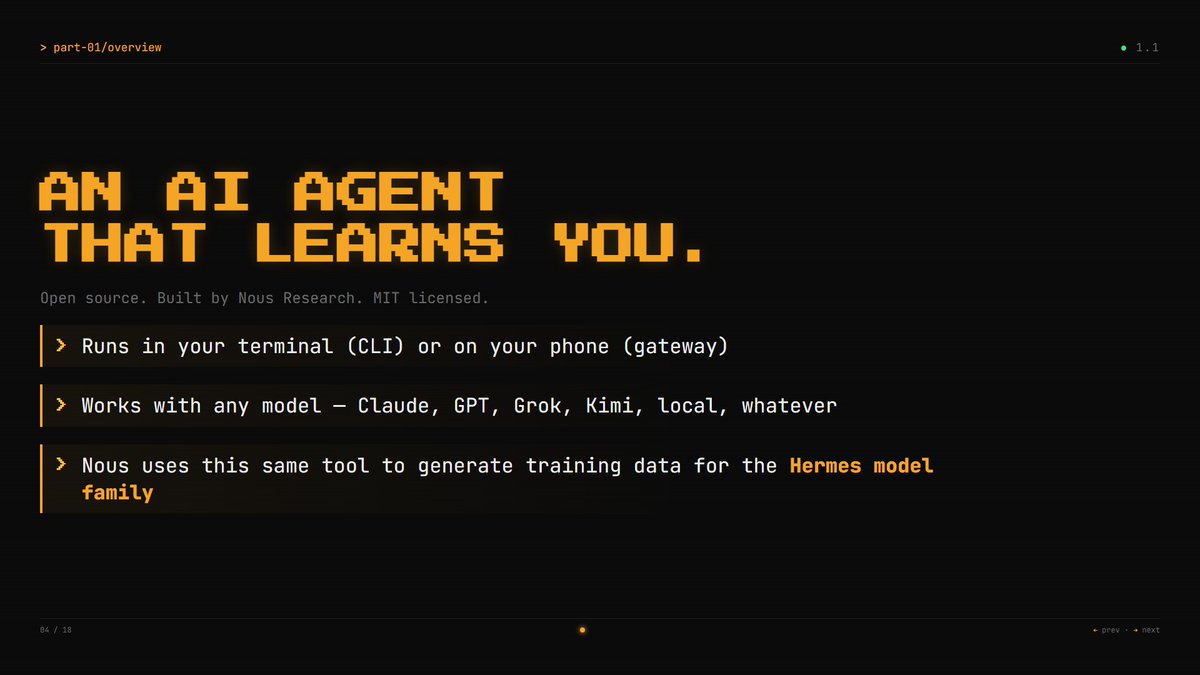 Slide 4 ## The bet: compounding value This is the design decision everything else hangs off. Most agents are stateless. Every ChatGPT session starts blank. Every Claude conversation starts blank. They never get better at your work. Hermes is built so every session feeds the next: 1. You give it a task 2. It records a trajectory — every tool call, every decision, every result 3. It distills that into a reusable skill 4. Next time it's faster, more accurate, and costs fewer tokens The practical consequence: a Hermes install you've had for three months is genuinely better than one you set up yesterday. That's why it's worth installing once and keeping. 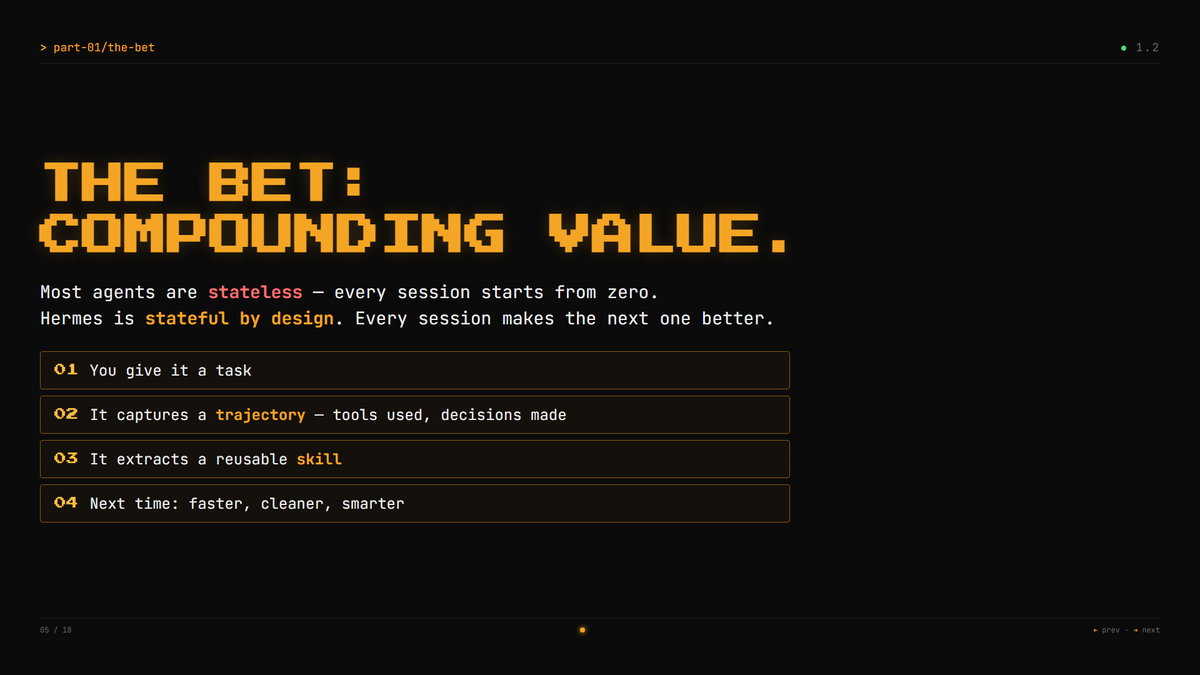 ## When to pick Hermes — and when not to Pick it if: - You want model freedom. Start on Claude or Grok, end up running local. Hermes rolls with it. - Privacy or cost matters. Local model support is first-class, not an afterthought. Don't if: - You just want a chatbot. Use ChatGPT. You don't need a full agent. 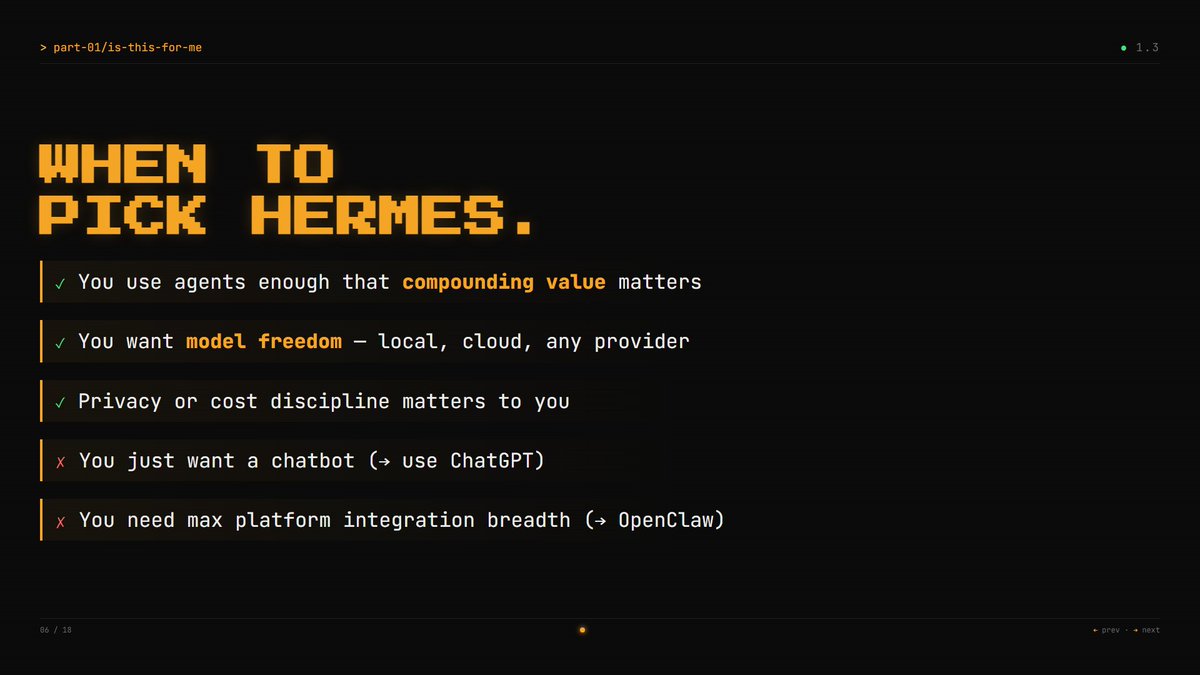 A note on this recording The original Module 1 was recorded in April. This is the July 2026 update — much is unchanged, but some of it reflects how Hermes has moved since (the install path and the default provider in particular). ## Install & First Run One command, a wizard that asks about nine things, and a working agent in your terminal. This lesson is the whole install — start to first hermes chat. > Follow along: everything you need is on this page. The install one-liner, every wizard choice made in the video, and the three commands that launch Hermes once it's in. You shouldn't have to scrub the video for a single string. ## Where the install comes from Everything starts at the GitHub repo: NousResearch/hermes-agent Scroll down the README and you'll find every install option. Supported platforms: Linux, macOS, WSL, Termux — and, recently, a native Windows version. That last one is new and it's the path taken in this video: no WSL2 required. 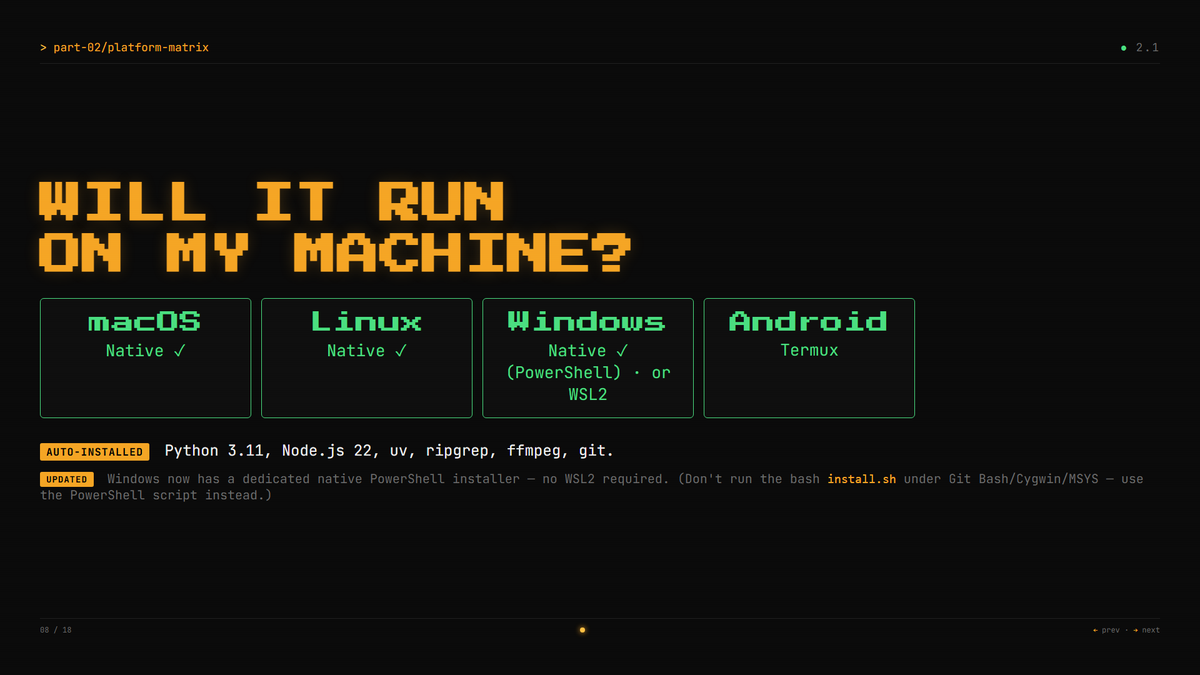 ## The one command On Windows, open PowerShell and run: iex (irm https://hermes-agent.nousresearch.com/install.ps1) On macOS / Linux / WSL2: curl -fsSL https://hermes-agent.nousresearch.com/install.sh | bash That's it. The installer pulls the dependencies it needs and takes a couple of minutes before handing off to the setup wizard. The dependency list — Python 3.11, Node.js 22, uv, ripgrep, ffmpeg, git — is from the deck. The video shows the install running but never enumerates them. Two things worth knowing before you run it: - Want the desktop app too? Append --include-desktop to the install command. Same one-liner, no separate download. - If hermes isn't found afterwards, your shell hasn't picked up the new binary yet. Run source ~/.bashrc, or just open a new terminal. This bites people constantly — it's not a failed install. The deck stamps the version at recording time as v0.18.2 — it's not stated in the video. 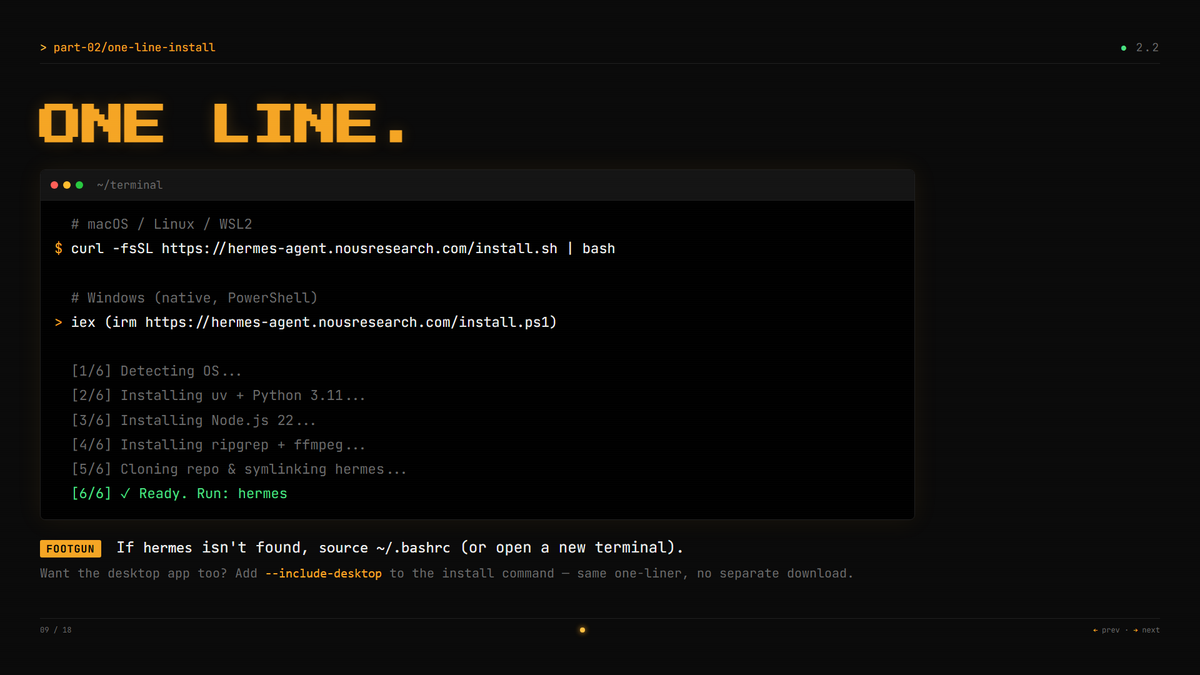 ## The setup wizard The wizard fires automatically when the install finishes. First it may offer to migrate an existing OpenClaw install. In the video that's declined — a clean slate. Take the migration only if you actually have an OpenClaw setup you care about. Then it asks how you want to set up: 1. Quick setup — creates a free Nous Portal account and logs you in. Takes about 30 seconds. But understand what you get: a blank slate, everything off except the bare minimum. Only do this if you're already proficient with agents and know exactly what you want to turn on. 2. Full setup — walks every section and lets you make each call yourself. 3. Blank slate — An agent starting with the minimum needed tools and skills. The video chooses option 2, full setup, and that's what the rest of this lesson follows. It's slower, but you see everything Hermes can be configured to do, which is the point on your first install. > Reference — not shown in the video: the deck also documents a one-shot fast path, hermes setup --portal, which OAuths into Nous Portal, sets the provider and switches the Tool Gateway on in a single step. It isn't demonstrated here. Also useful later: hermes setup model|terminal|gateway|tools|agent jumps straight to one section, and a bare hermes setup on an already-configured install shows your current values as defaults — press Enter to keep each one. 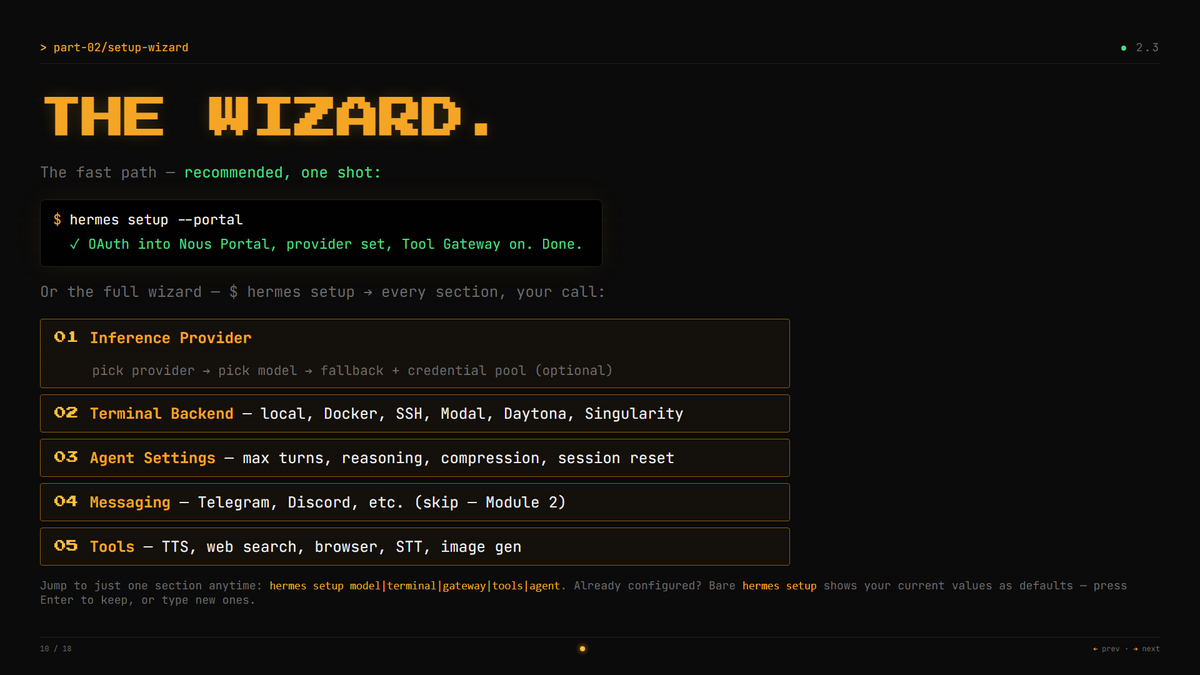 ## Section by section 1 · Inference provider. You need a model to have an agent at all, so this is first. Nous Portal is the default. The list also has OpenRouter (very popular), local models (Module 5 covers those), and OAuth options for OpenAI Codex and Grok — plus a lot more. The video picks Nous Portal. OAuth pops open in your browser; you can create a free account with a Google login and hit connect. There's a free tier — the creator's is a Plus account. Back in the terminal: "Login successful." 2 · Model. The video picks item 26, GLM 5.2 — "pretty good model." Don't agonise here. This is changeable afterwards in seconds, both from the CLI and mid-conversation. 3 · Tool Gateway. This comes bundled with the Nous subscription, and you choose which tools to enable. Example given: image generation, where the default is FAL and you can switch to GPT Images or Grok Imagine. All of it is adjustable — the tools module goes deeper. 4 · Terminal backend. Most people want local, which means Hermes runs directly on your machine. There's also a Docker backend, covered in Module 2. Keep the default. 5 · Messaging platforms. The full list is shown, all left unconfigured here. This is Module 2 territory — that's where you wire up Telegram and talk to Hermes from your phone. 6 · Tool configuration for the CLI. Shows the tools allowed by default; you can add or remove. Example: with an XAI OAuth or API key you can turn on X/Twitter search. Not set up here. The advice is to leave this mostly at defaults for now. 7 · Browser automation (new). Pick local browser — recommended and free. The computer-use component installs itself. 8 · Text-to-speech. The Nous subscription includes TTS and that's the default. Also on the list: Microsoft Edge TTS (free, genuinely good quality), ElevenLabs, and XAI TTS. Keep the defaults. 9 · Web search & extract. The Nous subscription bundles a package. Free options: Firecrawl (self-hosted), DuckDuckGo, Brave Search. Tavily is marked paid but has a free tier with generous limits. Keep the defaults for now — Lesson 1.3 comes back and adds Tavily by hand when the demo actually needs web search. And that's the wizard. 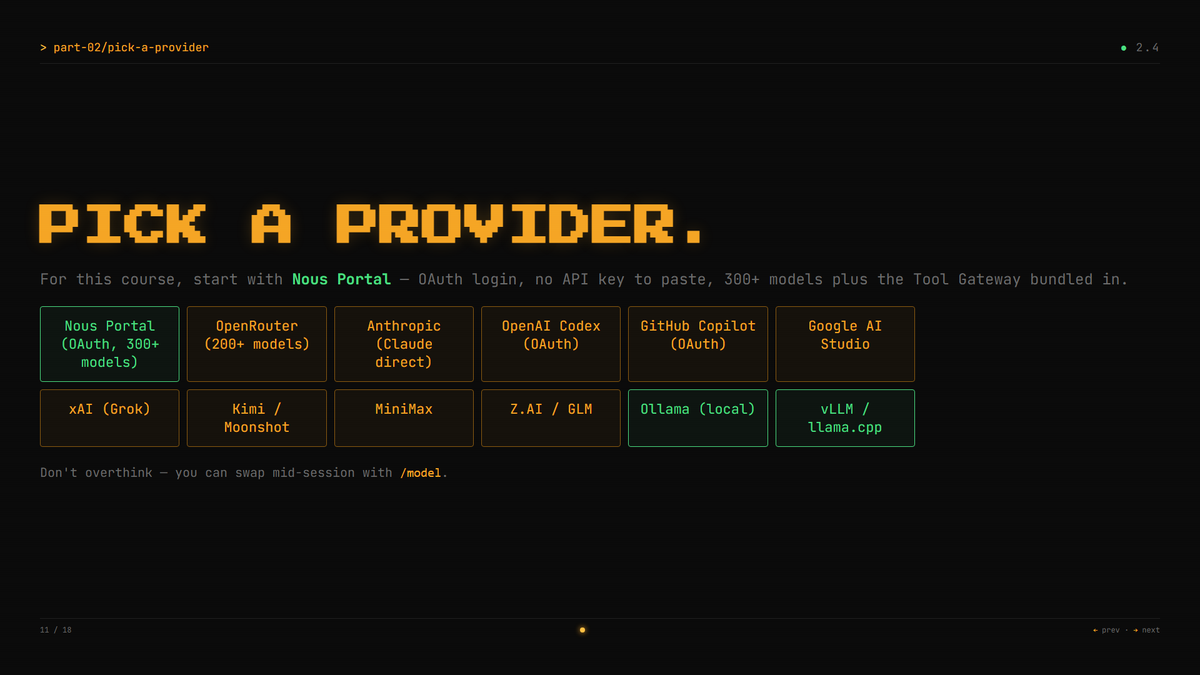 ## First run ``` hermes chat ``` The chat opens in your terminal. This is the TUI — terminal user interface — and that's the term used throughout the masterclass. You get the iconic Hermes banner, your current model, your available tools and skills, and your context window. That's a working agent. ## Two things added since the original video Both are one command each. ``` hermes dashboard ``` Opens a web dashboard in your browser. First launch takes a moment. Inside: sessions, files, models, cron jobs — basically the whole config, editable. If you'd rather not change settings from the terminal, you don't have to. ``` hermes desktop ``` Auto-installs and opens the desktop app. If you've used Codex, it'll feel familiar: your sessions down one side, configuration in settings. There's a separate complete guide to the Hermes desktop app if you want the full tour. ## Driving It: CLI, Slash Commands, File Layout + Demo Hermes is installed. Now: the commands you'll use every day, where Hermes keeps everything on disk, and a real task — competitor research with live web search, start to finish. > This is the reference lesson. Every command below is copy-pasteable. Two lists worth committing to muscle memory — the CLI commands you type at your shell, and the slash commands you type inside a session. They are different things and it's worth keeping them straight. The CLI commands These are typed at your normal shell prompt, not inside the chat. hermes # start the chat TUI (same as `hermes chat`) hermes gateway # start the messaging gateway — needed to connect Telegram hermes doctor # check for any issues hermes model # show / switch model & provider hermes status # the whole configuration hermes insights # tokens, cost, activity hermes sessions browse # curses picker to resume a past session hermes skills browse # discover + install skills hermes skills search <query> hermes config show # show current configuration hermes update # pull the latest version A few notes from watching them run: Reload your shell first. If hermes doesn't resolve, that's why — same footgun as the install. Reload and it works. hermes model opens the configure picker, so you can see every provider and switch between them easily. Escape out if you're just looking. hermes status is the one you'll lean on most. It shows everything: where your project is, what model you're using, what provider, and — critically — which API keys and auth providers are set and which aren't. On a fresh install most of it reads not configured, which is exactly what you'd expect. You'll use this again later in this lesson to confirm Tavily took. hermes insights on a brand-new install says "no sessions found." Nothing's wrong — there's just no history yet. hermes skills browse shows 50 skills loaded out of the box: Canvas, DuckDuckGo search, Honcho, and more. All official, so nothing to vet. hermes skills search <query> is the better tool once you know roughly what you want: hermes skills search email That surfaces everything email-related along with a trust label on each result. Some are official, some are community, and some are third-party-but-trusted — the Anthropic skills show up here, with cold emailing, React email, and business email among them. hermes update pulls the latest. A new version actually landed during filming, and it updated cleanly — dependencies first, then the new commits. New releases ship roughly weekly, so this one comes around often. 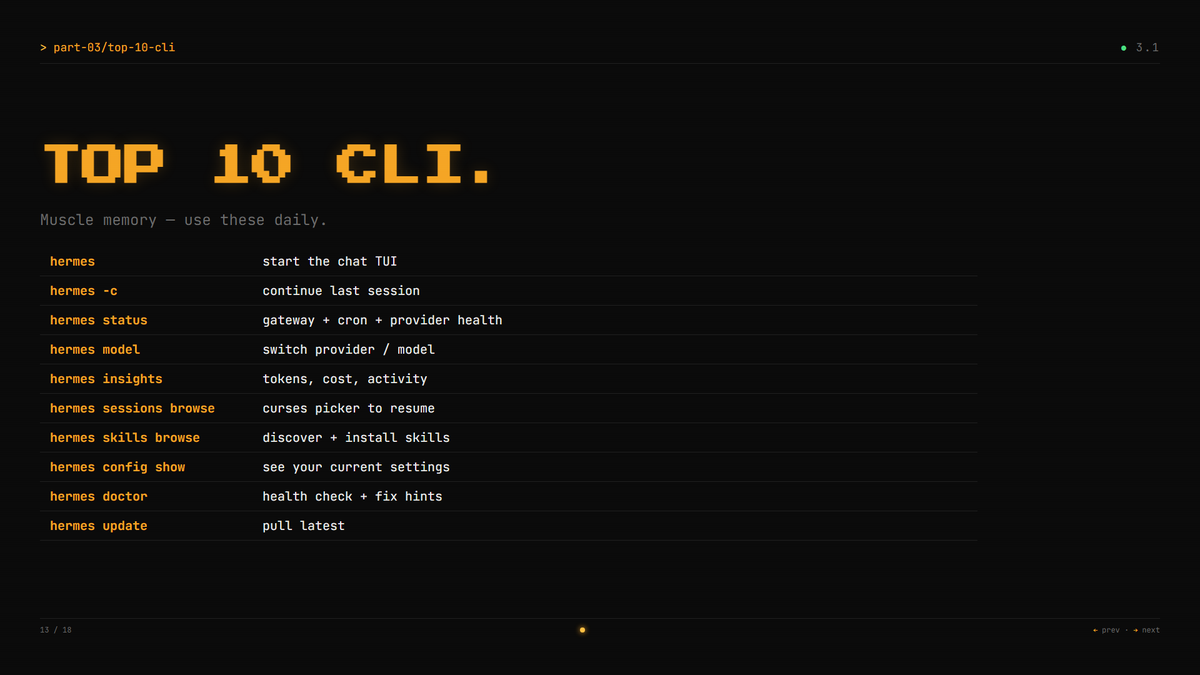 > Reference — on the slide, not demonstrated: hermes -c continues your last session without going through the picker. ## Slash commands Back into the chat with hermes chat. (To leave, it's /exit.) If you've used Claude Code or Codex, this terminal interface will feel immediately familiar — same shape of thing. /new start a fresh conversation / session /model <name> swap the model mid-session /background <prompt> run a task in the background and keep chatting (alias: /btw) /queue <prompt> add a prompt to the next-turn queue /compress manually compact a long context window /skills browse or invoke a skill /yolo toggle command approvals /help every slash command, tool, and installed skill /model is the one to internalise. You can swap models mid-session without restarting and without rebooting your configuration — the conversation just continues. The demo switches like this: /model z-ai/GLM 5.1 Worth noting the video fumbles this first — typing z-ai/GLM 1 gets a "model switched" that isn't the model wanted, and it takes a second attempt with the full z-ai/GLM 5.1 to land. Type the whole model name. When it lands, the new model introduces itself as GLM 5.1 and mentions priority routing through OpenAI and Anthropic — which would be faster if you had those providers configured, and isn't a problem if you don't. /background (spoken in the video as "slash BTW", after its /btw alias) fires a task off in the background so you can carry on with a side question while it works. /queue is its companion — while Hermes is busy, queue up what you want next instead of waiting. /help is the escape hatch and it's a long list — every slash command, every tool, and every installed skill, including the skill commands you can invoke right there in the session. When you're hunting for a capability and can't remember what it's called, start here. 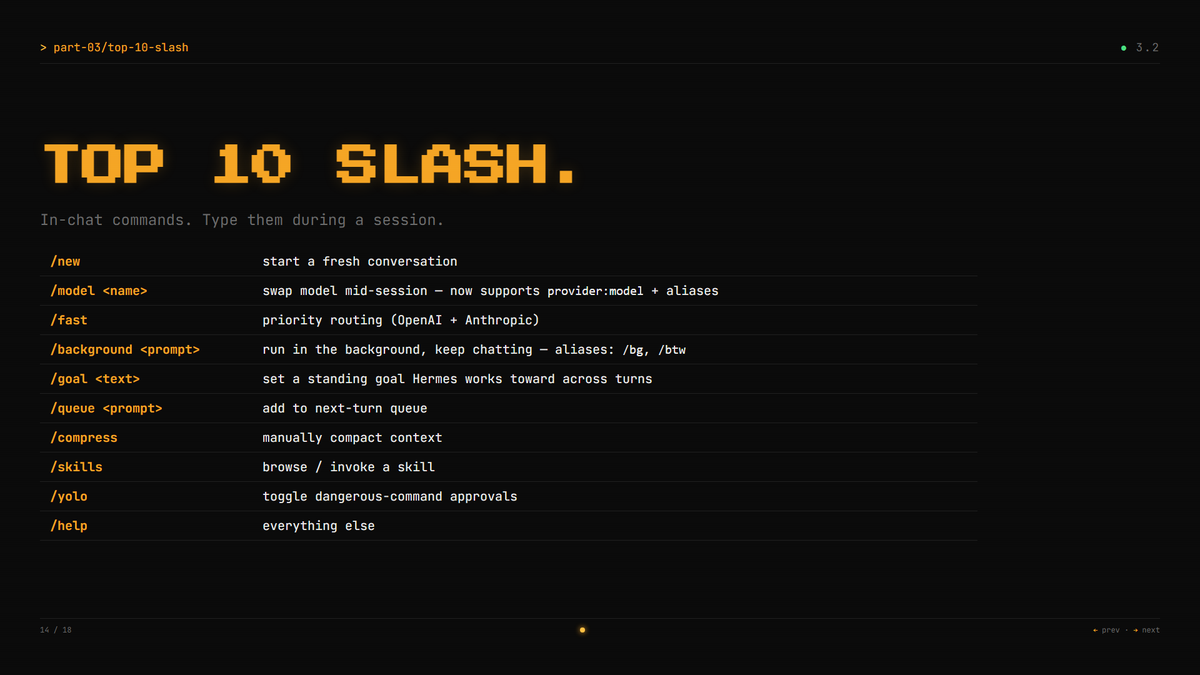 > Reference — on the slide, not demonstrated: /goal <text> sets a standing goal Hermes works toward across turns, and /fast forces priority routing through OpenAI + Anthropic. Neither is shown in this video. /bg is listed as another alias for /background. ## Where stuff lives Everything Hermes stores lives in one directory: ~/.hermes/ On Windows you reach it through your Linux distro in the file explorer — under Linux, then your distro (the creator's says Debian; yours might say Ubuntu), then home → your username → .hermes. ~/.hermes/ ├── config.yaml # your settings — editable ├── .env # your secrets — editable ├── memories/ # memory files (Module 4) ├── sessions/ # every past conversation ├── skills/ # the skills that ship with Hermes ├── logs/ # agent log + error log └── cron/ # scheduled jobs The main config file is your settings and you can edit it by hand. .env is where secrets go — API keys, passwords, that class of thing. sessions/ holds every past conversation. skills/ is the bundled set. logs/ has both the agent log and the error log. The rule that matters: you can edit the top files, .env, and memories by hand. Do not touch sessions/ or cron/ by hand — ask your agent to do it instead. Edit those directly and you can break things. You may never need to open this directory. But know it's there, because the day you need to change something the fast way, this is where it is. 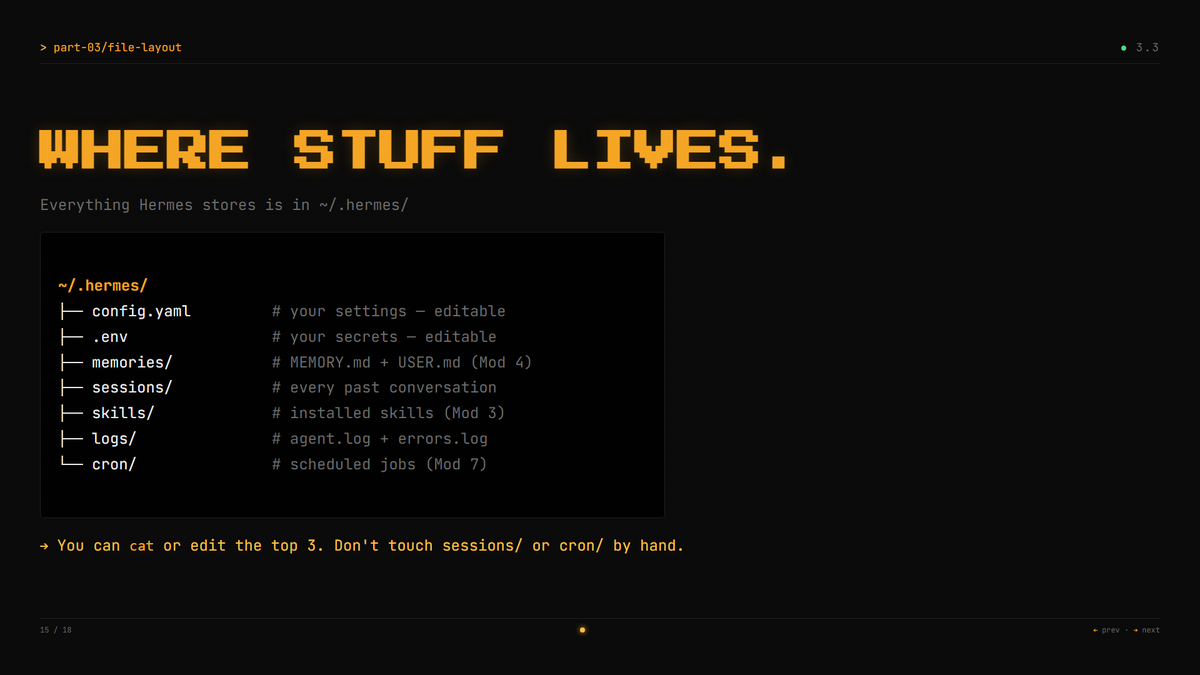 ## Your first real task The demo is a genuine business idea, not a toy: an AI service that generates personalized children's books and illustrations in an art style the customer chooses, with story themes to match. The question is whether the market's already taken. That needs exactly one capability the install doesn't have yet: web search. Setting up Tavily DuckDuckGo is available for free and would work here. The video uses Tavily instead, partly to show a second option: 1. Go to tavily.com and sign up. No credit card required. 2. You get 1,000 free credits — plenty for this. 3. Copy your API key. Then add it to Hermes: hermes setup Choose quick setup, then "configure missing items only" — which lists everything you haven't set. Find the Tavily API key, space to toggle it, enter to confirm, then paste your key. Confirm it took: hermes status Tavily shows as set — web search is live. (Web search options get a much deeper look later in the course.) ## The prompt Back into hermes chat, and the actual prompt used, verbatim: I had an idea to start a business that uses AI in the style the customer requests, as well as story themes etc. Please do a thorough research into other companies and competitors who may provide this service, and report back to me with their names, and try to identify any market gaps that exist. The agent initializes, prepares its web search, and starts working. Watch the activity feed — every tool call is visible as it happens. The report comes back quickly. 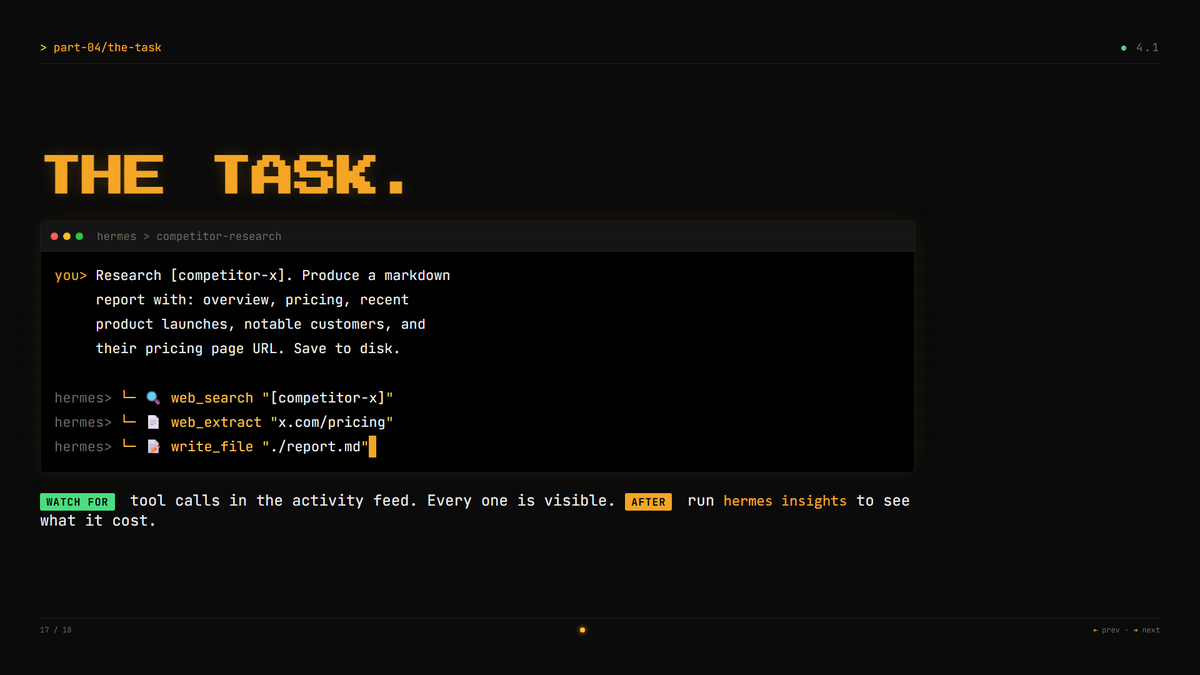 > Note on the slide above: it shows a generic template prompt — "Research [competitor-x]. Produce a markdown report with: overview, pricing, recent product launches, notable customers, and their pricing page URL. Save to disk." — which is a useful shape to steal for your own research tasks. It isn't the prompt used in the video, and no file is written to disk in this episode; the report comes back in-chat. ## What came back A breakdown of the competitive landscape in three tiers: - Traditional personalized-book companies — the pre-AI incumbents. Wonderbly and ISeeMe land here. - AI-powered direct competitors — companies doing exactly the described thing, AI for both story and illustration generation. There are a lot of them. The honest read on camera: "this might be a saturated market." - Indirect / visual — adjacent players. Then the part that actually earns its keep — market gaps: - Custom art-style selection. Most competitors let you customize the character but lock you into one illustration style. Few let the customer choose or define the actual art style. - Older age groups. Almost everyone targets ages 2–7. - Bilingual, audio-first, culturally specific, and author/creator tools — all underserved. The creator's take on the biggest white space: custom art-style control, combined with therapeutic or niche story themes, for older age groups. That's a real competitor report off one prompt and one quick search. Point your own agent at your own competition and see what it finds. ## Module 1 complete You now have Hermes installed, a provider configured, the top CLI and slash commands, your first real artifact — the competitor report — and a memory file that has just started learning about you. That's a lot. And it's the setup-heavy part done. 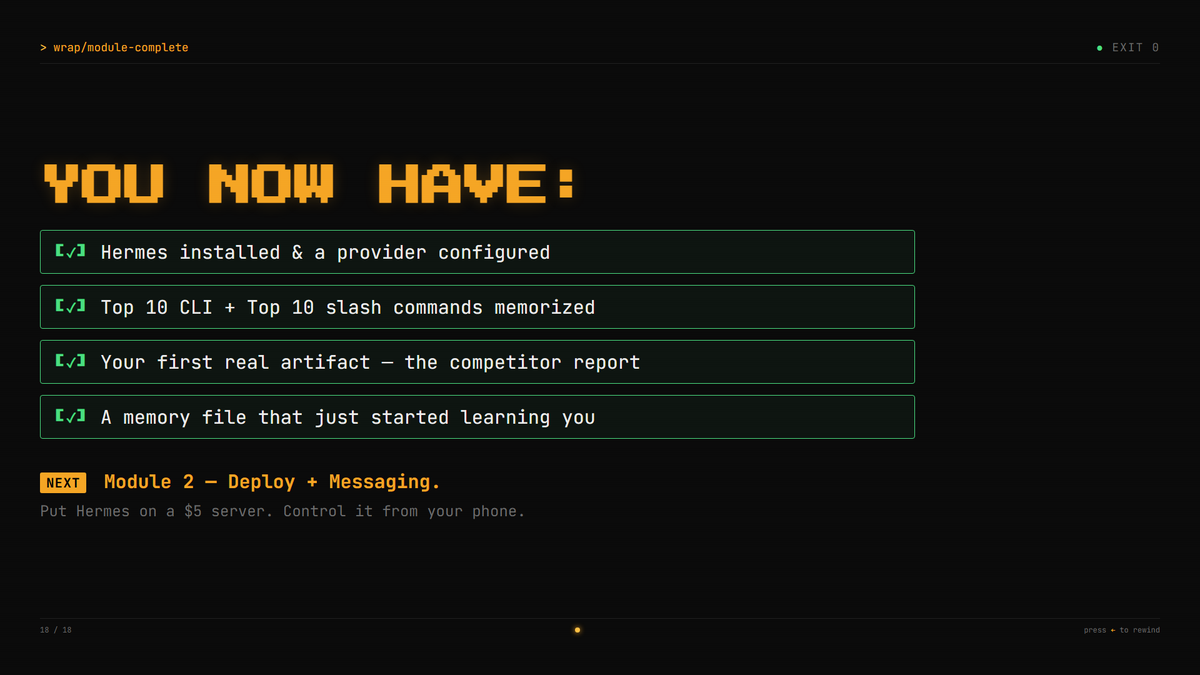 > One thing that'll confuse you on rewatch: the on-screen model labels drift across this recording. The wizard selects GLM 5.2, the TUI header reads MiMo v2 / MiMo v2 Pro, and the /model demo switches to Z.AI GLM 5.1. Don't read anything into it — the commands are what matter, and the model is a one-line change either way. Next up: Module 2, Deploying and Gateway ## 相关链接 - [tonbi](https://x.com/tonbistudio) - [@tonbistudio](https://x.com/tonbistudio) - [5.6K](https://x.com/tonbistudio/status/2082171890798616967/analytics) - [Nous Research](https://nousresearch.com/) - [NousResearch/hermes-agent](https://github.com/NousResearch/hermes-agent) - [https://hermes-agent.nousresearch.com/install.ps1](https://hermes-agent.nousresearch.com/install.ps1) - [https://hermes-agent.nousresearch.com/install.sh](https://hermes-agent.nousresearch.com/install.sh) - [Tavily](https://tavily.com/) - [tavily.com](https://tavily.com/) - [Z.AI](https://z.ai/) - [Upgrade to Premium](https://x.com/i/premium_sign_up) - [2:30 AM · Jul 29, 2026](https://x.com/tonbistudio/status/2082171890798616967) - [5,624 Views](https://x.com/tonbistudio/status/2082171890798616967/analytics) - [View quotes](https://x.com/tonbistudio/status/2082171890798616967/quotes) --- *导出时间: 2026/7/29 09:05:41* --- ## 中文翻译 # Hermes Agent 大师课:1. 安装、配置与基础命令 **作者**: tonbi **日期**: 2026-07-28T18:30:38.000Z **来源**: [https://x.com/tonbistudio/status/2082171890798616967](https://x.com/tonbistudio/status/2082171890798616967) ---  欢迎来到我的 Hermes Agent 大师课的 X 版本。这些文章将包含完整的文字指南、注释和幻灯片,以及原始视频。内容本身与 YouTube 上发布的视频相同,但我理解有些人希望花时间仔细阅读这些信息,并且更喜欢文字格式,因此我为 X 平台的观众设计了这些附带幻灯片/图片的文字指南以及原始视频。请享用! *(视频内容)* # 模块 1 — 从零开始掌握 Hermes Agent 完整剧集指南 · 26 分 1 秒 ## 为什么选择 Hermes 以及何时选择它 在安装任何东西之前:了解 Hermes 到底是什么,那个让它与众不同的设计决策,以及关于何时不应使用它的诚实回答。 > 本模块的定位:在模块 1 结束时,你将安装好 Hermes,配置好可用的 AI 提供商,了解你每天会使用的约 20 个命令,并完成一项真正的任务 —— 一份实际的报告,而不是一个玩具示例。  幻灯片 2 ## Hermes 是什么 Hermes 是由 Nous Research 构建的开源 AI Agent —— 即 Hermes 模型系列背后的实验室。 这是值得暂停思考的一点。大多数 Agent 是由工具公司构建的。而这一个是由训练模型的人构建的。 幻灯片 4 补充说,Nous 使用这个相同的工具为 Hermes 系列生成训练数据,并且该项目采用 MIT 许可证。 运行位置: - 在你的终端(CLI)中 - 在你的手机上 —— 通过网关:Telegram、Discord、Slack 和其他消息平台 - 作为桌面应用程序 它是模型无关的。Claude、GPT、Grok、Kimi、Gemini 或任何本地模型。Hermes 不在乎 —— 由你选择。 项目现状:在 GitHub 上获得超过 200,000 星,约 2,000 名贡献者,目前为第 18 版,新版本大约每周发布一次。  幻灯片 4 ## 赌注:复利价值 这是其他所有设计决策所依据的核心决策。 大多数 Agent 是无状态的。每个 ChatGPT 会话都从零开始。每个 Claude 对话都从零开始。它们在你的工作上从未变得更好。 Hermes 的构建使得每个会话都为下一个会话提供支持: 1. 你给它一个任务 2. 它记录一个轨迹 —— 每个工具调用、每个决策、每个结果 3. 它将其提炼为可重用的技能 4. 下一次它更快、更准确,并且消耗更少的 token 实际后果:一个你已经使用了三个月的 Hermes 安装版本确实比你昨天设置的版本更好。这就是为什么值得一次性安装并保留它。  ## 何时选择 Hermes —— 以及何时不选择 选择它,如果: - 你想要模型自由。从 Claude 或 Grok 开始,最终运行本地模型。Hermes 都能适应。 - 隐私或成本很重要。本地模型支持是一等公民,而不是事后补充。 不要选择,如果: - 你只是想要一个聊天机器人。使用 ChatGPT。你不需要一个完整的 Agent。  关于本录制视频的说明 最初的模块 1 是在 4 月录制的。这是 2026 年 7 月的更新 —— 大部分内容未变,但其中一些反映了 Hermes 自此以来的发展(特别是安装路径和默认提供商)。 ## 安装与首次运行 一个命令,一个询问大约九个问题的向导,以及一个在你的终端中工作的 Agent。本课程涵盖整个安装过程 —— 从开始到第一次 hermes chat。 > 跟随操作:你需要的一切都在这个页面上。安装的一行命令,视频中在向导中做出的每一个选择,以及启动 Hermes 的三个命令。你不应该在视频中为了查找一个字符串而反复拖动进度条。 ## 安装来源从何而来 一切都始于 GitHub 仓库: NousResearch/hermes-agent 向下滚动 README,你会找到所有的安装选项。支持的平台:Linux、macOS、WSL、Termux —— 以及最近发布的原生 Windows 版本。最后一个是新的,也是本视频中采用的路径:不需要 WSL2。  ## 那一个命令 在 Windows 上,打开 PowerShell 并运行: iex (irm https://hermes-agent.nousresearch.com/install.ps1) 在 macOS / Linux / WSL2 上: curl -fsSL https://hermes-agent.nousresearch.com/install.sh | bash 就是这样。安装程序会拉取它需要的依赖项,几分钟后再交给设置向导。 依赖项列表 —— Python 3.11、Node.js 22、uv、ripgrep、ffmpeg、git —— 来自演示文稿。视频显示了安装运行过程,但没有详细列举它们。 在运行它之前有两件值得知道的事情: - 还想要桌面应用程序吗?在安装命令后附加 --include-desktop。同样的单行命令,不需要单独下载。 - 如果之后找不到 hermes,说明你的 shell 还没有识别新的二进制文件。运行 source ~/.bashrc,或者直接打开一个新的终端。这经常困扰人们 —— 这并不是安装失败。 演示文稿将录制时的版本标记为 v0.18.2 —— 视频中没有说明这一点。  ## 设置向导 向导在安装完成后自动启动。 首先,它可能会提供迁移现有的 OpenClaw 安装。在视频中,这被拒绝了 —— 一张白纸。只有在你真正有一个你关心的 OpenClaw 设置时,才进行迁移。 然后它询问你想如何设置: 1. 快速设置 —— 创建一个免费的 Nous Portal 帐户并登录。大约需要 30 秒。但要明白你得到的是什么:一张白纸,除了最基本的功能外,其他都关闭了。只有当你已经对 Agent 很熟练并且确切知道你想开启什么时,才这样做。 2. 完整设置 —— 逐步介绍每个部分,并让你自己做出每个决定。 3. 白纸 —— 一个以最少必要工具和技能开始的 Agent。 视频选择了选项 2,完整设置,这也是本课程其余部分遵循的内容。虽然慢一些,但你会看到 Hermes 可以配置做的所有事情,这也是第一次安装的重点。 > 参考 —— 视频中未显示:演示文稿还记录了一次性的快速路径,hermes setup --portal,它会 OAuth 登录 Nous Portal,设置提供商并在一步中打开工具网关。这里没有演示。后面也有用:hermes setup model|terminal|gateway|tools|agent 直接跳转到一个部分,而在已配置的安装上运行 bare hermes setup 会将你当前的值显示为默认值 —— 按回车键保留每一个。  ## 逐节设置 1 · 推理提供商。你需要一个模型才能拥有 Agent,所以这是第一步。Nous Portal 是默认选项。列表中还有 OpenRouter(非常受欢迎)、本地模型(模块 5 涵盖了这些),以及 OpenAI Codex 和 Grok 的 OAuth 选项 —— 还有更多。视频选择了 Nous Portal。OAuth 会在你的浏览器中弹出;你可以使用 Google 登录创建一个免费帐户并点击连接。有一个免费层级 —— 创建者的是一个 Plus 帐户。回到终端:“登录成功。” 2 · 模型。视频选择了项目 26,GLM 5.2 —— “相当不错的模型”。不要在这里纠结。这可以在几秒钟内更改,既可以通过 CLI,也可以在对话中途进行。 3 · 工具网关。这随附在 Nous 订阅中,你选择要启用哪些工具。给出的示例:图像生成,默认是 FAL,你可以切换到 GPT Images 或 Grok Imagine。所有这些都是可调整的 —— 工具模块会更深入地探讨。 4 · 终端后端。大多数人都想要本地,这意味着 Hermes 直接在你的机器上运行。还有一个 Docker 后端,在模块 2 中涵盖。保留默认值。 5 · 消息平台。显示了完整列表,这里都未配置。这是模块 2 的领域 —— 那里你会连接 Telegram 并从你的手机与 Hermes 对话。 6 · CLI 的工具配置。显示默认允许的工具;你可以添加或删除。示例:使用 XAI OAuth 或 API 密钥,你可以打开 X/Twitter 搜索。这里没有设置。建议是暂时主要保留默认值。 7 · 浏览器自动化(新增)。选择本地浏览器 —— 推荐且免费。计算机使用组件会自动安装。 8 · 文本转语音。Nous 订阅包括 TTS,这是默认选项。列表中还有:Microsoft Edge TTS(免费,质量确实很好)、ElevenLabs 和 XAI TTS。保留默认值。 9 · 网络搜索和提取。Nous 订阅捆绑了一个包。免费选项:Firecrawl(自托管)、DuckDuckGo、Brave Search。Tavily 被标记为付费,但有一个限制很宽松的免费层级。暂时保留默认值 —— 第 1.3 课会回来,当演示实际需要网络搜索时手动添加 Tavily。 向导到此结束。  ## 首次运行 ``` hermes chat ``` 聊天在你的终端中打开。这是 TUI —— 终端用户界面 —— 也是整个大师课中使用的术语。你会看到标志性的 Hermes 横幅、你当前的模型、你可用的工具和技能,以及你的上下文窗口。 这就是一个工作的 Agent。 ## 原始视频之后添加的两个功能 两者都各是一个命令。 ``` hermes dashboard ``` 在你的浏览器中打开一个 Web 仪表板。首次启动需要一点时间。内部:会话、文件、模型、cron 作业 —— 基本上是整个配置,可编辑。如果你不想从终端更改设置,你不必这样做。 ``` hermes desktop ``` 自动安装并打开桌面应用程序。如果你使用过 Codex,你会觉得很熟悉:一边是你的会话,另一边是设置中的配置。有一份关于 Hermes 桌面应用程序的单独完整指南,如果你想要全面了解的话。 ## 驾驭它:CLI、斜杠命令、文件布局 + 演示 Hermes 已安装。现在:你每天都会使用的命令,Hermes 在磁盘上保存所有内容的位置,以及一个真正的任务 —— 使用实时网络搜索进行竞争对手研究,从头到尾。 > 这是参考课程。下面的每个命令都可以复制粘贴。有两个列表值得记住肌肉记忆 —— 你在 shell 中输入的 CLI 命令,和你在会话中输入的斜杠命令。它们是不同的东西,值得把它们区分清楚。 CLI 命令 这些是在你的普通 shell 提示符下输入的,而不是在聊天内部。 hermes # 启动聊天 TUI(与 `hermes chat` 相同) hermes gateway # 启动消息网关 —— 连接 Telegram 所需 hermes doctor # 检查任何问题 hermes model # 显示 / 切换模型和提供商 hermes status # 完整的配置 hermes insights # tokens、成本、活动 hermes sessions browse # curses 选择器以恢复过去的会话 hermes skills browse # 发现 + 安装技能 hermes skills search <query> hermes config show # 显示当前配置 hermes update # 拉取最新版本 从观看它们运行中得出的几点说明: 首先重新加载你的 shell。如果 hermes 无法解析,这就是原因 —— 与安装相同的陷阱。重新加载它就可以工作了。 hermes model 打开配置选择器,因此你可以轻松查看每个提供商并在它们之间切换。如果你只是在查看,请按 Esc 退出。 hermes status 是你最依赖的一个。它显示一切:你的项目在哪里,你在使用什么模型,什么提供商,以及 —— 关键的是 —— 设置了哪些 API 密钥和身份验证提供商,哪些没有。在全新安装上,大部分内容显示为未配置,这正是你所期望的。你将在本课程的稍后再次使用它来确认 Tavily 是否生效。 在全新安装上 hermes insights 显示“未找到会话”。没有问题 —— 只是还没有历史记录。 hermes skills browse 显示开箱即加载的 50 个技能:Canvas、DuckDuckGo 搜索、Honcho 等。都是官方的,所以不需要审查。 一旦你大致知道你想要什么,hermes skills search <query> 是更好的工具: hermes skills search email 这将显示所有与电子邮件相关的内容,以及每个结果上的信任标签。一些是官方的,一些是社区的,一些是第三方但受信任的 —— Anthropic 技能显示在这里,其中包括冷启动电子邮件、React 电子邮件和商业电子邮件。 hermes update 拉取最新版本。在拍摄期间实际上发布了一个新版本,并且它干净地更新了 —— 先是依赖项,然后是新的提交。新版本大约每周发布一次,所以这个命令经常出现。  > 参考 —— 在幻灯片上,未演示:hermes -c 在不通过选择器的情况下继续你的上一次会话。 ## 斜杠命令 使用 hermes chat 回到聊天中。(要离开,输入 /exit。) 如果你使用过 Claude Code 或 Codex,这个终端界面会让你感到非常熟悉 —— 形状相同。 /new 开始一个新的对话 / 会话 /model <name> 在会话中途交换模型 /background <prompt> 在后台运行任务并继续聊天(别名:/btw) /queue <prompt> 将提示添加到下一轮队列 /compress 手动压缩长上下文窗口 /skills 浏览或调用技能 /yolo 切换命令批准 /help 每个斜杠命令、工具和已安装的技能 /model 是值得内化的命令。你可以在会话中途交换模型,而无需重启配置 —— 对话只是继续。演示像这样切换: /model z-ai/GLM 5.1 值得注意的是视频首先在这里搞砸了 —— 输入 z-ai/GLM 1 得到了“模型已切换”,但那不是想要的模型,第二次尝试完整的 z-ai/GLM 5.1 才成功。输入完整的模型名称。当成功时,新模型会自我介绍为 GLM 5.1 并提到通过 OpenAI 和 Anthropic 的优先路由 —— 如果你配置了那些提供商,这会更快,如果没有配置,这也不是问题。 /background(在视频中读作“slash BTW”,取自其 /btw 别名)在后台触发任务,因此你可以在它工作时继续处理侧面问题。/queue 是它的伴侣 —— 当 Hermes 忙碌时,将你想要的内容排队,而不是等待。 /help 是逃生舱口,它是一个很长的列表 —— 每个斜杠命令、每个工具和每个已安装的技能,包括你可以直接在会话中调用的技能命令。当你正在寻找一项功能而不记得它叫什么时,从这里开始。  > 参考 —— 在幻灯片上,未演示:/goal <text> 设置一个 Hermes 跨轮次努力实现的长期目标,/fast 强制通过 OpenAI + Anthropic 进行优先路由。本视频中均未显示。/bg 被列为 /background 的另一个别名。 ## 东西保存在哪里 Hermes 存储的所有内容都位于一个目录中:~/.hermes/ 在 Windows 上,你通过文件资源管理器中的 Linux 发行版访问它 —— 在 Linux 下,然后是你的发行版(创建者说是 Debian;你的可能是 Ubuntu),然后是 home → 你的用户名 → .hermes。 ~/.hermes/ ├── config.yaml # 你的设置 —— 可编辑 ├── .env # 你的机密信息 —— 可编辑 ├── memories/ # 记忆文件(模块 4) ├── sessions/ # 每个过去的对话 ├── skills/ # 随 Hermes 附带的技能 ├── logs/ # agent 日志 + 错误日志 └── cron/ # 计划任务 主配置文件是你的设置,你可以手动编辑它。.env 是存放机密信息的地方 —— API 密钥、密码,这类东西。sessions/ 保存每个过去的对话。skills/ 是捆绑的集合。logs/ 包含 agent 日志和错误日志。 重要的规则:你可以手动编辑顶部文件、.env 和 memories。不要手动触碰 sessions/ 或 cron/ —— 请让你的 agent 代替你去做。直接编辑这些可能会破坏东西。 你可能永远不需要打开这个目录。但要知道它在那里,因为当你需要以快速方式更改某事的那一天,这就是它的位置。  ## 你的第一个真正的任务 演示是一个真正的商业想法,而不是玩具:一个 AI 服务,根据客户选择的艺术风格生成个性化的儿童书籍和插图,并匹配故事主题。问题是市场是否已经被占据。 这只需要安装尚未提供的一项功能:网络搜索。 设置 Tavily DuckDuckGo 可免费使用,在这里可以工作。视频使用 Tavily 代替,部分是为了展示第二个选项: 1. 转到 tavily.com 并注册。不需要信用卡。 2. 你获得 1,000 个免费积分 —— 对此来说足够了。 3. 复制你的 API 密钥。 然后将其添加到 Hermes: hermes setup 选择快速设置,然后“仅配置缺失的项目” —— 这会列出你尚未设置的所有内容。找到 Tavily API 密钥,空格键切换它,回车键确认,然后粘贴你的密钥。 确认它已生效: hermes status Tavily 显示为已设置 —— 网络搜索已激活。(网络搜索选项将在后面的课程中进行更深入的探讨。) ## 提示词 回到 hermes chat,实际使用的提示词,逐字记录如下: I had an idea to start a business that uses AI in the style the customer requests, as well as story themes etc. Please do a thorough research into other companies and competitors who may provide this service, and report back to me with their names, and try to identify any market gaps that exist. Agent 初始化,准备其网络搜索,并开始工作。观察活动信息流 —— 每个工具调用都在发生时可见。报告很快返回。 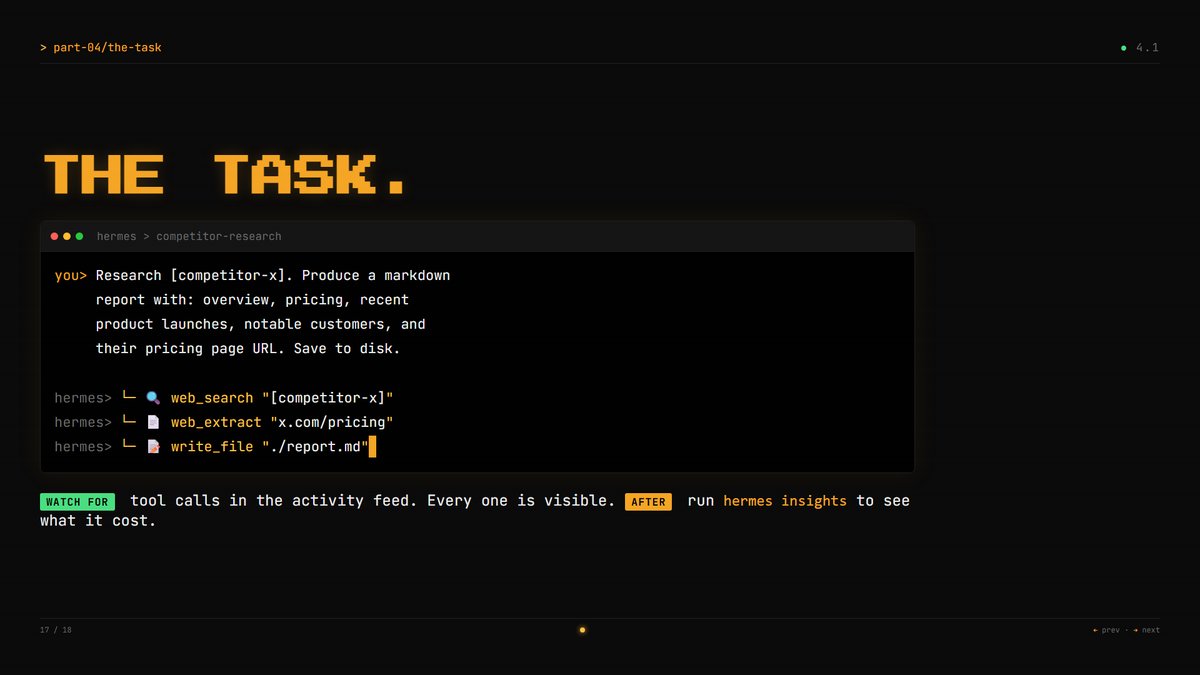 > 关于上面幻灯片的说明:它显示了一个通用模板提示词 —— “研究 [competitor-x]。生成包含以下内容的 markdown 报告:概述、定价、最近的产品发布、知名客户及其定价页面 URL。保存到磁盘。” —— 这是有用的形状,可以为你的研究任务借鉴。它不是视频中使用的提示词,并且本集中没有文件写入磁盘;报告在聊天中返回。 ## 返回了什么 分为三个层次的竞争格局细分: - 传统个性化书籍公司 —— AI 时代之前的在位者。Wonderbly 和 ISeeMe 属于这里。 - AI 驱动的直接竞争对手 —— 做完全描述的事情的公司,AI 用于故事和插图生成。有很多。镜头下的诚实看法:“这可能是一个饱和的市场。” - 间接 / 视觉 —— 相邻的参与者。 然后是真正发挥作用的部分 —— 市场空白: - 自定义艺术风格选择。大多数竞争对手允许你自定义角色,但将你锁定在一种插图风格中。很少有允许客户选择或定义实际的艺术风格。 - 较大年龄组。几乎每个人都针对 2–7 岁的年龄段。 - 双语、音频优先、文化特定以及作者/创作者工具 —— 都服务不足。 创作者对最大空白空间的看法:针对较大年龄组的自定义艺术风格控制,结合治疗或小众故事主题。 这是一个通过一个提示词和一个快速搜索得出的真正的竞争对手报告。让你自己的 Agent 指向你自己的竞争,看看它能找到什么。 ## 模块 1 完成 你现在安装了 Hermes,配置了提供商,掌握了主要的 CLI 和斜杠命令,你的第一个真正的产物 —— 竞争对手报告 —— 以及一个刚刚开始了解你的记忆文件。 这已经很多了。并且是设置繁重的部分完成了。  > 重看时会让你感到困惑的一件事:屏幕上的模型标签在这个录制过程中发生了漂移。向导选择了 GLM 5.2,TUI 标题读作 MiMo v2 / MiMo v2 Pro,而 /model 演示切换到了 Z.AI GLM 5.1。不要过度解读 —— 命令才是重要的,而且无论哪种方式,模型都是一行更改。 接下来:模块 2,部署和网关 ## 相关链接 - [tonbi](https://x.com/tonbistudio) - [@tonbistudio](https://x.com/tonbistudio) - [5.6K](https://x.com/tonbistudio/status/2082171890798616967/analytics) - [Nous Research](https://nousresearch.com/) - [NousResearch/hermes-agent](https://github.com/NousResearch/hermes-agent) - [https://hermes-agent.nousresearch.com/install.ps1](https://hermes-agent.nousresearch.com/install.ps1) - [https://hermes-agent.nousresearch.com/install.sh](https://hermes-agent.nousresearch.com/install.sh) - [Tavily](https://tavily.com/) - [tavily.com](https://tavily.com/) - [Z.AI](https://z.ai/) - [Upgrade to Premium](https://x.com/i/premium_sign_up) - [2:30 AM · Jul 29, 2026](https://x.com/tonbistudio/status/2082171890798616967) - [5,624 Views](https://x.com/tonbistudio/status/2082171890798616967/analytics) - [View quotes](https://x.com/tonbistudio/status/2082171890798616967/quotes) --- *导出时间: 2026/7/29 09:05:41*
H Hermes 原生 Windows 版本发布体验 本文介绍了 AI Agent 工具 Hermes 发布的原生 Windows 版本(Early Beta)。作者详细记录了通过一行 PowerShell 命令完成安装的过程,该版本自动解决了 Python、Node.js 等环境依赖问题。文章还分享了实际体验、TUI 界面使用、开机自启配置以及编辑器设置等注意事项,并对比了原生版本与 WSL2 版本的适用场景。 技术 › Hermes ✍ loveabit🕐 2026-05-12 HermesWindowsAgent安装教程OpenClawWSLWindows Terminal工具与效率CLIAI
L LLM 工具链与环境配置讨论 文章截图展示了一场关于大型语言模型(LLM)开发工具的讨论。主要涉及开源 CLI 工具的选择、本地开发环境的重要性、模型代理设计差异,以及在不同电脑环境下进行 AI 开发的常见问题(如闲鱼二手机器、环境报错等)。参与者认为统一的训练环境对模型兼容性至关重要,并指出新手只要教程得当上手并不难。 技术 › LLM ✍ 未知🕐 2025-12-30 LLMCLI开源环境配置Agent开发工具AI
2 29k star的AI克隆任意网站开源skill 介绍了一个获得29k star的开源AI工具,能像素级还原任意网站。其成功关键在于将大任务拆解为小任务、使用详细的规格文件作为“合同”、正确识别页面交互逻辑,并通过git worktree实现并行工作,最终与原站进行视觉对比。 技术 › Agent ✍ AIGCLINK🕐 2026-07-22 AI开源网站克隆Agent自动化Git视觉对比
H Hermes Agent 管理层详解:Profiles、Dashboard 与 API 文章介绍了 Hermes Agent 的管理层,包括 Profiles(运行时边界)、Dashboard(控制台)和 API Server(集成点)。Profiles 允许创建独立的代理实例,Dashboard 提供可视化管理界面,API Server 则支持通过 OpenAI 兼容接口进行集成。这些工具共同管理多个代理,提升操作效率。 技术 › Hermes ✍ Tony Simons🕐 2026-07-19 AgentHermesDashboardAPIProfilesOpenAI多代理管理CLI
开 开源发布灵剪 lingjian-video 作者开源了灵剪(lingjian-video)项目,这是一种可以逐关审核的AI短视频生成工具。它将脚本、分镜、配音等流程自动化,但允许用户在每个环节对候选内容进行审核和决策。项目支持4种首发风格,基于Apache-2.0协议开源,并可用作Agent Skill。 技术 › Skill ✍ 爆裂队长NEXT🕐 2026-07-19 开源灵剪视频生成AIAgent自动化审核Apache-2.0工具
用 用 Skills 给 AI Agent 注入设计品味 介绍了开源技能库 emilkowalski/skills,它能为 AI 编程 Agent 注入设计品味,解决 AI 生成 UI 动画和交互时缺乏质感的问题。文章详解了其核心功能、安装方法、实操流程,并对比了 Taste-Skill、Hallmark 等类似工具的差异。 技术 › 前端 ✍ sitin🕐 2026-07-15 AI设计前端Agent工具Claude CodeCursor开源交互UI
开 开源个 Skill|解决 X 转国内赛道的内容审查违规难题 文章介绍了一个开源的 AI Skill 工具 media-publish-check,旨在帮助创作者解决从海外平台(如 X)转至国内自媒体平台(抖音、小红书等)时遇到的内容审查和违规限流问题。该工具整合了大量平台规则和违禁词库,支持发布前的内容自审和优化,降低违规风险。 技术 › Skill ✍ Sherry小水🕐 2026-07-15 AI内容审查开源自媒体AgentSkill内容风控工具
O Own Your Agent Stack 文章强调企业应拥有自主的 Agent 技术栈,以避免依赖单一供应商。通过自主控制模型、数据、云和运行环境,企业能更好地保护数据和降低成本。作者提供了基于 GitHub 的快速搭建指南,并主张通过自主学习和改进来保持竞争优势。 技术 › Agent ✍ Ashpreet Bedi🕐 2026-07-15 Agent自主可控开源技术栈AIAgentOS数据主权云计算DevOps模型独立性
耗 耗时 7 天,我们开源了腾讯 WorkBuddy 实战蓝皮书 作者苍何联合团队经过 7 天努力,正式开源了腾讯 WorkBuddy 实战蓝皮书。该书包含使用手册、实战案例、进阶系统及岗位路线图,旨在填补 WorkBuddy 详细教程的空白,帮助用户通过 AI 提升办公效率。 技术 › Hermes ✍ 苍何🕐 2026-07-13 WorkBuddy实战指南开源AI办公腾讯提效教程案例HermesAgent
A AI Native CLI:一种基于 Skill 的新商业模式 文章探讨了在 AI 时代,基于 Skill 的获客与变现困境。作者指出 Skill 因复制成本低难以单独作为商业模式,而开发外部 App 又面临流量转化损耗。解决方案是采用“AI Native CLI”——一种面向 AI 的命令行接口。它允许在同一容器内通过用户登录鉴权,实现从免费 Skill 到付费解决方案的无缝转化,从而构建完整的商业闭环。 技术 › Agent ✍ 卡颂🕐 2026-07-10 AI商业模式AgentSkillCLI变现SaaS产品设计
免 免费开源:烧了1亿Token的产品原型生成 Skill 本文介绍了一款开源的产品经理原型生成 Skill。作者为了解决现有 AI 原型工具“修改即重绘”的痛点,消耗约 1 亿 Token 开发了该 Skill。它遵循专业的产品流程(IA推导、设计规划、Figma 输出),通过硬性约束规则确保设计的可控性与去 AI 味,支持 Codex、Cursor 等环境。 技术 › Skill ✍ 老王霸 AI Lab🕐 2026-07-09 CodexAgent开源原型设计Figma工具与效率
多 多模型整合指南:用 Hermes Desktop 统一管理 ChatGPT、Grok 与 DeepSeek 本文介绍如何使用 Hermes Desktop 将 ChatGPT、Grok、DeepSeek 和 MiniMax 等多个 AI 模型接入同一个桌面应用。文章详细讲解了通过图形界面一键配置模型账号、连接 Telegram/Discord 消息通道、以及设置 10 个实用的自动化工作流(如每日简报、竞品监控)的步骤,旨在无需编程即可实现多模型协同与自动化任务处理。 技术 › Hermes ✍ Wei🕐 2026-07-03 HermesAgentDeepSeekChatGPTGrok工作流教程自动化工具与效率多模型