# The Paper-Writing System I'd Hand Every New PhD Student on Day One
**作者**: Prof Lennart Nacke, PhD
**日期**: 2026-01-22T07:04:04.000Z
**来源**: [https://x.com/acagamic/status/2021617206958735696](https://x.com/acagamic/status/2021617206958735696)
---
I've published 150+ papers and I still dread opening a blank document.
Every single time.
Sitting down to write still feels like dragging yourself through wet concrete. You open the document. You stare at the blank page. Your brain, the same brain that designed a study and ran a lab meeting this morning, locks up. Two hours later, you’ve produced a paragraph you’ll probably delete tomorrow.
You know this feeling. The Sunday afternoon dread when you promised yourself you’d finish that discussion section sooner. The guilt when a co-author emails asking for your draft and you haven’t even started. The quiet panic at 11 PM the night before a deadline, realizing you’ve rewritten the same introduction four times and none of them feel like they work. You start wondering if you’ve lost the ability to write altogether. Maybe you never had it.
Meanwhile, some colleague who seems to have a secret portal to a parallel dimension where time moves slower just submitted three papers this semester. Same deadlines. Same teaching load. Same committee obligations.
Not going to lie, I had a moment like that in the early 2020s when Juho Hamari outpublished me as the most published researcher in the field of gamification. I felt like I was already operating at the peak of my capabilities, but I watched his research team take over the field with dozens of journal publications that outcited my work. Well done. In hindsight, I shouldn’t have compared myself to them (I was in a different situation with a very different teaching load), but it is often unavoidable when you feel like their CVs keep growing while yours sits stuck at in progress.
You assumed they had more discipline. More talent. More protected writing time (this is the academic equivalent of a unicorn sighting; you’ve heard legends, but you’ve never actually seen one in the wild).
They don’t. They have a system. That word matters.
The reality is this. You’re not bad at writing. You’re bad at how you write. Let that sink in for a moment. It’s a tough pill to swallow.
Writing productivity runs on systems. Most academics have never built one. They treat writing like a single task, one giant cognitive monolith you power through with enough discipline and so much coffee your hands are jittery. Writing is actually six different cognitive processes crammed into one activity:
Deciding what to say (content). Choosing whether to include a specific study in your literature review, or deciding which of your three experiments to present first.
Figuring out how to say it (language). Struggling between “participants demonstrated improved performance” vs. “performance improved” vs. “we observed performance gains.”
Remembering who you’re saying it to (audience). Deciding whether to define “gamification” for a general social science journal or assume readers know the term in a specialized HCI venue.
Tracking what you’ve already said (coherence). Realizing mid-paragraph that you already mentioned this limitation two pages ago, or checking if you’ve already cited Nacke et al. (2023) earlier.
Planning what comes next (structure). Figuring out whether your next paragraph should address the second research question or first discuss the implications of your current finding.
Judging whether any of it is good (evaluation). Stopping mid-sentence to wonder “Is this too obvious?” or “Does this sound too informal?” or “Should I delete this entire section?”
The problem is doing all six simultaneously while drafting. You’re running Chrome with 59 tabs open and wondering why your laptop sounds like a jet engine.
Most people think writing is hard because they don’t have enough willpower.
But the real problem is that writing asks your brain to do too many things at the same time.
I’ve supervised 30+ PhDs. Reviewed hundreds of papers. Written grants that got funded and grants that got rejected. The pattern is always the same. Researchers who struggle with writing aren’t lazy. They’re running their brain’s software on the wrong operating system.
Here’s the shell script that will fix it for you:
A complete system for academic writing that works with your brain’s architecture. Six protocols. Each one targets a specific cognitive bottleneck. Each one removes a decision you don’t need to make.
I just spent a full week writing this massive guide you are reading on how to write better research papers. I'm not going to lie, the irony of agonizing over a piece about writing faster was not lost on me. So, this will be a longer read. All I ask is that you try one protocol with your next paper. Then try another.
Let’s get this show on the road.
> AI Research Stack members this week get: a paper-writing Notion dashboard with the complete Inverted Assembly Line workflow, all AI revision prompts, and a pre-submission checklist. Join them.
1. Start with what you know, end with what you’re promising
Here’s how most junior researchers write a paper. They open a blank document and start with the title, then the introduction, then trudge linearly toward the conclusion. This is like trying to write the movie trailer before you’ve filmed the movie.
This is cognitively backwards.
The introduction requires the highest cognitive load of any section. You’re framing the problem, positioning your contribution, making promises to the reader, all before you’ve fully articulated what you found. You’re asking your brain to do the hardest work first, with the least material to work with.
This is like Tolkien trying to write the Scouring of the Shire before he’s even gotten the hobbits out of the Green Dragon. Your brain doesn’t have the material yet.
Resequence your writing to match cognitive load:
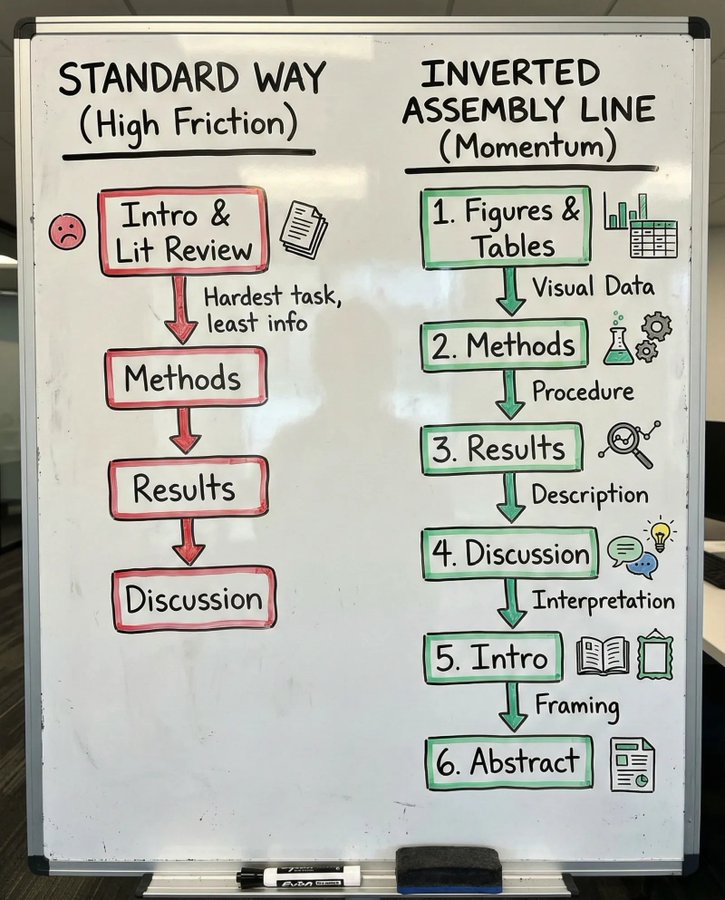
A sketch of the inverted assembly line.
Figures & Tables. Visual thinking. Low language load. You know your data, so just arrange it.
Methods. Procedural recall. You did this, so describe it like a recipe.
Results. Descriptive reporting. Narrate your figures. No interpretation yet.
Discussion. Interpretive thinking. Connect your results to existing findings in the field.
Introduction. Rhetorical framing. Now you know what you’re actually promising. Focus on the contribution.
Abstract & Title. Compression and marketing. Requires knowing the whole.
Each step uses material generated by previous steps. You’re writing so that you will gain momentum. You’re riding a bike downhill instead of pushing it uphill with a flat tire.
Think of it like building a LEGO Death Star. You don’t start with the intimidating final form on the box cover. You start with bag 1, the small structural pieces you can actually see and touch.
Imagine you’re writing a paper on how gamification affects student motivation, because that’s a topic that was once super hot (bear with me, fellow non-techies).
You start with Figures & Tables. You create a bar chart showing motivation scores across conditions. Now you can see your main effect.
You move to Methods. You describe your 123 participants, your gamification intervention, your validated motivation scale. Easy. You did this work. You’re just documenting it here.
You write Results. You narrate your figures: “Participants in the gamified condition reported significantly higher intrinsic motivation (M = 4.2, SD = 0.8) than in the control condition (M = 3.1, SD = 0.9), t(245) = 3.42, p < .001.” The figure tells you what to say.
You draft the Discussion. Now you’re interpreting it all. “These results align with Self-Determination Theory, suggesting that well-designed gamification satisfies competence needs.” Your results section hands you the claims to explain, you just have to find the citations next.
Finally, you write the Introduction. Now you know exactly what promise you’re making: “This study demonstrates that gamification can increase intrinsic motivation when designed around competence feedback.” You’re not guessing what the paper will argue. You already know.
The Abstract writes itself. You compress what you’ve already written into 150 words. At CHI, it’s a simple formula that I’ll explain below.
Notice what happened here. Each section gave you the raw material for the next. You never faced a blank page asking, “What should I say?” The previous section already answered that question. And to make it easier for premium subscribers to The AI Research Stack, I have included a Worksheet in this week's Notion drop.
Start with what you know (methods, data). End with what requires synthesis (framing, positioning). Never write the introduction first. Save that delicious bit when you have your data all mapped out into a story.
2. Write badly first → edit later
Your brain has two modes that are neurologically incompatible. Generative mode and evaluative mode.
This distinction comes from Flower and Hayes’ Cognitive Process Theory of Writing, the most cited model of how writers actually think. Their research, based on think-aloud protocols with experienced writers, revealed that writing involves three recursive processes: planning (generating ideas), translating (turning ideas into text), and reviewing (evaluating and revising). The critical insight was that these processes compete for the same cognitive resources.
Generative mode (what Flower and Hayes call “translating” combined with idea generation) is expansive, associative, fast. Your brain retrieves information from long-term memory, makes loose connections, follows tangents. Working memory stays open. You’re exploring possibility space without filtering.
Evaluative mode (what they call “reviewing”) is contractive, critical, slow. Your brain compares output against internal standards, checks for coherence, judges quality. Working memory narrows. You’re applying constraints and making decisions.
The problem is that both modes require working memory, and working memory is severely limited. Trying to generate and evaluate simultaneously creates what cognitive scientists call task-switching costs. Each switch burns mental energy and breaks flow.
Years ago, I worked on a paper where I spent three hours on an introduction paragraph, and I think I wrote about nine different versions of it. I deleted most of them, patched some parts of them back together, and then the final version was eerily close to the first version. But I felt like I had burned an entire morning judging each sentence before I gave them a bit of room to breathe.
Most people try to write in both modes simultaneously. They generate a sentence, then immediately evaluate it, then edit it, then generate the next one. This is like trying to drive with one foot on the gas and one on the brake.
Create a Zero Draft using this strict protocol:
Open a distraction-free writing tool (I like iA Writer and Bear, or turn off your monitor).
Set a timer for 25–45 minutes.
Write as fast as you possibly can without stopping.
Do not fix typos. Do not check references. Do not re-read.
Use placeholders liberally: [REF], [STATS], [TRANSITION], [FIX THIS].
You’re shovelling sand into a box so you can build castles later. You cannot shape sand while quarrying it. Your inner critic will scream. Let it scream. It gets its turn later. (Think of it like putting Reviewer 2 in timeout while you build the sandcastle.)
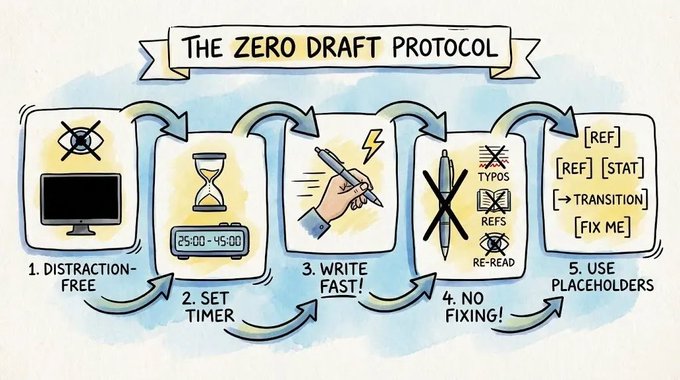
The Zero Draft Protocol
The Zero Draft gives you raw material. Raw material is infinitely easier to edit than a blank page. Even the Chicago Bulls needed to show up to practice before Phil Jackson could turn them into champions.
3. Let templates make the structural decisions for you
Every decision you make while writing burns mental fuel. What should this paragraph do? How should I structure this section? What comes next?
Most decisions about structure can be offloaded to proven templates that do the cognitive work for you. The core problem is decision fatigue. Every structural choice consumes limited cognitive resources. When you’re constantly making these micro-decisions while writing, you’re burning mental energy that could be spent on the actual intellectual work. Templates solve this by turning structural choices into a fill-in-the-blanks process, so you can analyze data, develop your argument, and articulate your insights. Instead of reinventing how to organize an abstract or discussion section each time, you follow a proven pattern to free up working memory for the substantive thinking that actually matters.
These frameworks turn the art of writing into an assembly-line process. You focus on the data. The structure does the thinking for you.
Seven templates follow. One for each major component of a paper. (Stick with me. This is where the real time savings happen.)
## 3.1 The CHI abstract formula (Context → Problem → Solution → Findings → Contribution)
At CHI, our field's premier venue, abstracts follow a simple formula. Five slots. Fill them in order.
Context (1–2 sentences). Establish the lay of the land. Orient the reader in the general research area.
Problem (1 sentence). Establish the niche. State what is missing, unknown, or broken in the current state of the art.
Solution (1–2 sentences). Occupy the niche. Explain your method and how you addressed the problem by building, observing, or studying something.
Key Findings (2–3 sentences). Provide the evidence and specific outcomes. This is usually the meat of your abstract (unless you’re writing a method paper). Quantify where possible.
Contribution/Impact (1 sentence). The “So what?” Tie your findings to the broader HCI community.
Don’t reinvent the wheel. Just fill the slots. The abstract writes itself.
Example (the meat in this one is the solution/method):
> (Context) Biofeedback provides a unique opportunity to intensify tabletop gameplay. It permits new play styles through digital integration while keeping the tactile appeal of physical components. (Problem) However, integrating biofeedback systems, like heart rate (HR), into game design needs to be better understood in the literature and still needs to be explored in practice. (Solution) To bridge this gap, we employed a Research through Design (RtD) approach. This included (1) gathering insights from enthusiast board game designers (n = 10), (2) conducting two participatory design workshops (n = 20), (3) prototyping game mechanics with experts (n = 5), and (4) developing the game prototype artifact One Pulse: Treasure Hunter’s. (Key Findings) We identify practical design implementation for incorporating biofeedback, particularly related to heart rate, into tabletop games. (Contribution/Impact) Thus, we contribute to the field by presenting design trade-offs for incorporating HR into board games, offering valuable insights for HCI researchers and game designers.
Source: Tu, J., Kukshinov, E., Hadi Mogavi, R., Wang, D. M., & Nacke, L. E. (2025). Designing biofeedback board games: The impact of heart rate on player experience. In Proceedings of the 2025 CHI Conference on Human Factors in Computing Systems (Article 466). ACM. https://doi.org/10.1145/3706598.3713543
## 3.2 The CARS introduction formula (Territory → Problem → Contribution)
CARS stands for “Creating a Research Space.” John Swales developed it through genre analysis of research article introductions across disciplines. He studied what successful papers actually do, then named the pattern so writers could see it and reuse it. The core insight is descriptive. He found out how published introductions already work.
The model frames an introduction as three rhetorical moves that funnel from broad context to your specific niche.
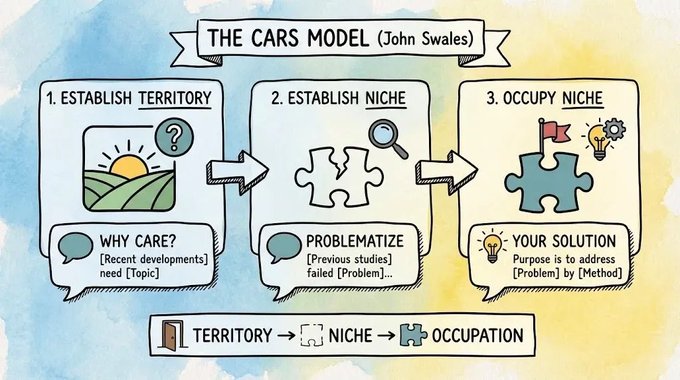
The CARS (Creating a Research Space) model.
CARS gives you a checklist that forces logic: Importance, gap to problem, your response. That structure makes it easier for reviewers to see your contribution fast, because they can locate the problem and the payoff without hunting. It stops vague introductions that summarize a topic without earning the reader’s attention first.
Move 1 (Establish Territory).
Ask: Why should anyone care?
- Template: “Recent developments in [Field] have heightened the need for [Topic].”
Move 2 (Establish Niche).
Problematize the current state.
- Template: “Previous studies have failed to address [Problem]…” or “Little is known about [Variable]…”
Move 3 (Occupy Niche).
State your specific solution.
- Template: “The purpose of this study is to address this problem by [Method/Action].”
Territory → Niche → Occupation. That’s the algorithm. Don’t freestyle your introduction like you’re in a jazz ensemble.
Use these three moves to organize what goes in each paragraph. Draft one or two sentences per move first, then expand with evidence and citations where they strengthen the niche claim. If your niche feels weak (“no one has studied X”), tighten the scope first. By that I mean narrow the population, method, setting, measure, or time window until the problem becomes specific and defensible.
Example (from Tu et al., 2025):
> (Move 1 — Territory) Board games have begun incorporating digital elements, often called “hybrid digital games,” combining non-digital and digital components to introduce new game experiences. These hybrid board games often use companion applications on tablets or phones to manage tasks like storytelling, automated actions, or progress tracking [53]. Alternatively, so-called affective games use players’ physiological signals, or biofeedback, to directly influence the experience [75]. […] Digitally incorporated biofeedback, such as heart rate (HR), has been studied in Human-Computer Interaction as a tool to understand and improve the player experience in games [23, 45, 67, 126].
> (Move 2 — Niche) However, the integration of HR into board games, particularly in multiplayer contexts, remains largely unexplored. While HR mechanics have been studied in digital single-player settings, there is a striking lack of established methods or frameworks for embedding biometric data into analog multiplayer experiences. From a design perspective, this challenge encompasses not only the task of “getting the design right” but “making the right design” [18]. […]
> (Move 3 — Occupy) To understand HR integration in board games, we employ a Research through Design process [133] because it allows for iterative user testing, the creation of tangible prototypes, and the generation of reusable design assets […] We implemented three key research phases: (1) gather preliminary insights from enthusiast board game designers, (2) participatory design workshops, and (3) prototyping game mechanics with board game experts using a game prototype artifact called One Pulse: Treasure Hunter’s. […]
AI Research Stack premium members get a printable one-page CARS template this week that walks you through all three moves with fill-in-the-blank prompts. It’s the reference sheet I keep next to my keyboard when drafting introductions.
3.2.1 Alternative problem-first introduction structure
CARS works. But some papers need a different rhythm. They need to extend the idea behind CARS. Here’s an alternative that builds on CARS, but works especially well when your research problem is urgent or your field context is unfamiliar to readers. Remember that a research problem is not the same as a research gap.
- A research problem answers the “So What?” question. It’s a real-world pain, a condition that causes instability, cost, or harm. If you don’t solve this, people get sick or stay sick. Systems break. Money gets lost. Real problems transcend academic papers. They exist in the world, whether or not anyone writes about them.
- A research gap is different. It’s a void in the literature that blocks us from solving the problem right now. You find gaps in papers, usually buried in limitations or future research sections. Researchers write them down. Gaps are concrete and easier to access than the larger problem they relate to.
Thus, here’s where most people go wrong. They read the literature, summarize what’s been studied, list what hasn’t been studied, and call that a research gap. That’s not a research problem. You are merely listing unstudied variables. Nobody cares about unstudied variables unless you connect them to a real pain.
The connection between problem and gap is where you excel as a researcher.
In practice, you often work backwards. You find the gap first (because gaps are easier to spot in papers), then you work toward the problem it connects to. You ask: “Why does this gap matter? What real-world pain does it leave unsolved?”
In the paper, you present it the other way around. You start with the problem (the pain out there), then you show the gap (why this problem remains unsolved), then you present your solution (the bridge). This is the problem-first structure.
Each part does rhetorical work:
- The problem makes them care.
- The gap proves you’re the expert who has read the literature.
- The solution shows you can actually fix this.
Step 1: Start with the topic or problem. Lead with the issue itself. No throat-clearing about the field. Drop the reader directly into what’s broken, missing, or unresolved.
Step 2: Argue for the importance of the field. Now zoom out. Why does this domain matter? What’s at stake if we don’t solve this problem? This earns the reader’s attention before you ask them to follow your research journey.
Step 3: State your research questions, purpose, or hypothesis. Be explicit. “This study investigates whether…” or “We hypothesize that…” or “The objectives of this research are to…” Readers need a clear destination.
Step 4: Summarize the research gap. Connect the gap directly to the problem you opened with. The gap justifies the research. If readers don’t see why existing work fails to solve the problem, they won’t see why your study matters.
Step 5: Intersperse relevant background. Weave in social, political, historical, or scientific context that situates your work. This contextual grounding prepares readers for the deeper literature dive that follows.
This structure works well when your audience needs persuading before they’ll invest in your literature review. CARS often implicitly assumes readers already care about the territory. The problem-first structure makes them care by leading with the stakes.
3.2.2 Theoretical framework and literature review
Once your introduction lands, you have two paths: (1) Present a theoretical framework, or (2) move directly into a literature review. Sometimes you do both and combine these sections.
Theoretical framework (optional section or subsection):
A theoretical framework section does three things in sequence:
Discuss theories relevant to your article. Survey the theoretical landscape. What lenses could someone use to understand this phenomenon?
Introduce the specific theories you used. Narrow from survey to selection. Why these theories and not others?
Articulate your theoretical contributions. What does your study add to or challenge about these theories?
This section can stand alone or fold into your introduction. Use it when your contribution is partly theoretical, when your method depends on a theoretical lens (like grounded theory or phenomenology), or when your audience might not share your theoretical assumptions.
Literature Review/Related Work (often a separate section):
The introduction motivates. The literature review situates. Different jobs, which is why I like to write them as different sections (which works in my field, human-computer interaction, but in fields like psychology, this is often not done this way).
A literature review provides an overview of the research areas that contribute knowledge to your study. Structure it to cover:
Historical and contextual analysis. How did this research area develop? What were the turning points?
Key concepts and definitions. What terms do readers need to understand your study? Define them here, not buried in your methods.
Critical debates and frictions. Where do researchers disagree? These frictions often point to the gaps your study addresses.
Comparison of key studies. Don’t just list papers. Compare them. What did Study A find that Study B contradicted? What methods did each use? Systematic comparison shows you’ve done the work.
Gaps in existing research. Make the literature gaps explicit. “No study has examined X in the context of Y.” “Existing work assumes Z, but this assumption has not been tested.”
How your study addresses these gaps. End the literature review by circling back to your contribution. The reader should finish this section understanding exactly how your research fits into, and advances, the existing conversation.
Only then do you move to methods. At this point, readers understand what you did (introduction), why it matters theoretically (framework), and how it relates to everything else (literature review). Now they’re ready to learn how you did it.
## 3.3 Why listing what you did isn’t enough
A methods section that can’t be attacked isn’t doing its job. A bare list of methods is like telling someone you ‘made dinner’ without mentioning you microwaved a Hot Pocket. Technically true. Yummy to some. Completely useless to your wife, who likes salads.
“We recruited 30 participants. We used a Likert scale. We ran a t-test.” That’s a list. And lists fail the most basic test of scientific writing: Could a skeptical reader disprove your claim?
This is Karl Popper’s falsifiability criterion at work. In The Logic of Scientific Discovery, Popper argued that science progresses by proposing claims that could be proven wrong, then subjecting them to rigorous tests. A claim you can’t test isn’t science. Your methods section exists to show readers exactly how they could replicate your study and (if your findings are wrong) debunk your point.
A bare list fails this test because it hides the reasoning. Why that sample size? Why that measure? Why that analysis? Without answers, a skeptical reader (most often that’s Reviewer 2) can’t evaluate whether your choices were defensible. The list looks like science but doesn’t function like science.
3.3.1 What a methods section actually covers
Before we get to structure, let’s be clear about content. A complete methods section addresses four areas:
Materials. Equipment, participants, samples, stimuli, software, apparatus. Everything you used. Readers need to know what they would need to replicate your study.
Procedures. Study preparation, protocols, data collection. This is the recipe: what you did, in what order, under what conditions. If you ran interviews, how long were they? If you used surveys, when and how did participants complete them? If you observed behaviour, what was the setting? Mixed methods studies describe each approach.
Analysis. Statistical tests (for quantitative work) or analytical frameworks (for qualitative work). Which tests did you run and why? Which coding approach did you use? Thematic analysis, grounded theory, content analysis? Name the approach and justify the choice.
Methodological issues. Problems encountered during execution. Equipment failures, participant attrition, unexpected confounds, deviations from protocol. Don’t bury these. Acknowledging issues builds credibility. Hiding them invites rejection.
Each of these four areas needs the same rhetorical treatment. You don’t just list what you did. You explain why you did it that way. And the way you explain it is identical across all four areas.
3.3.2 The three-move loop for each methodological choice
The fix is a three-move loop: Contextualize → Describe → Justify.
Run this loop for every major choice in your methods section. That means you execute the loop when you describe your materials (why these participants? why this equipment?). You execute it again for your procedures (why this protocol? why this order?). You execute it again for your analysis (why this statistical test? why this coding framework?). And you execute it again for any methodological issues (why did you deviate from the original plan? why does that deviation not invalidate the results?).
Four areas. One loop per area. Here’s what the loop looks like:
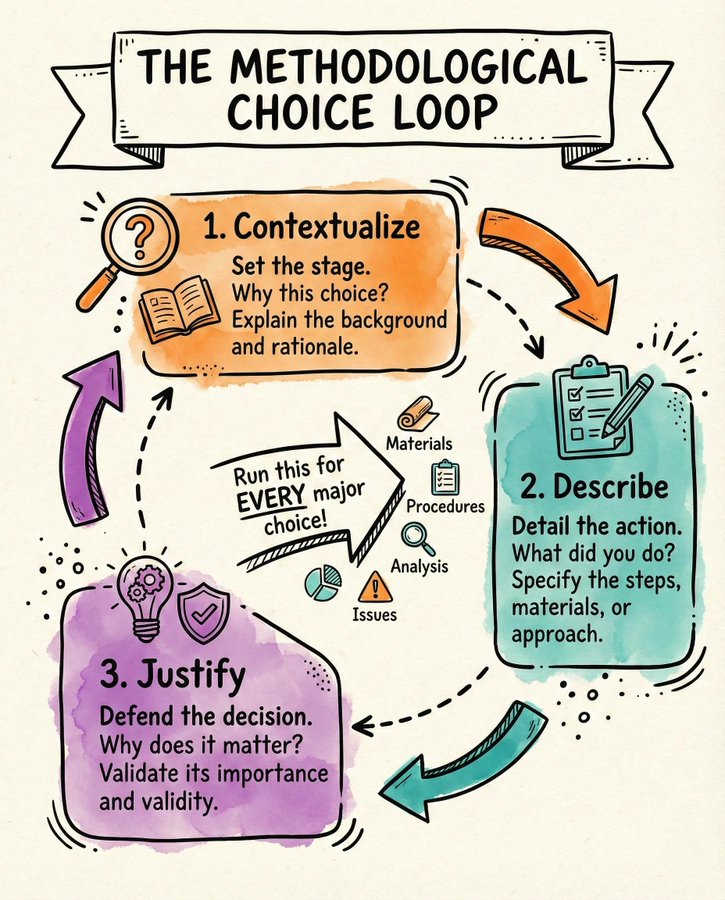
The Methdological Choice Loop
Example (from Tu et al., 2025, who described this out of sequence):
> (Contextualize) The first phase of this study (RP1) focuses on gathering initial data on attitudes towards digital integration from board game designers (n = 10). These participants are primarily analog board game designers, known for their frequent enjoyment of traditional, non-digital board games. […]
> (Describe) We conducted interviews both offline and online to accommodate remote participants. Interview questions explored how integrating physiological indicators, interactive displays, and accurate measurement technologies can enhance immersion, social interaction, and strategic complexity in social deception board games. The focus of the interviews was on attitudes toward designing mechanics that use HR data, shared or individual displays, and spatial dynamics to heighten tension, deception, and player engagement. A semi-structured interview (average 28:54 minutes) allowed us to collect new exploratory data relevant to our design philosophy.
> (Justify) We deliberately chose this demographic for the first phase to gain insights into the perception of digital integration from the perspective of players who primarily engage with non-digital games. […]
AI Research Stack premium members get the Contextualize → Describe → Justify cheat sheet as a printable PDF. One page. Four methods areas. The loop printed clearly so you can run it without hunting through this article.
## 3.4 Walk readers through your data one finding at a time
Results sections fail when they become data dumps. (Sorry for any hardcore psychologist in the room, I know some of you are still purists.) Table after table, statistic after statistic, with no orienting thread. Readers lose track of which hypothesis each analysis addresses. Reviewers skim, miss the connection between your numbers and your claims, and remain unclear how this supports the argument.
The problem is cognitive. By the time readers reach your results, they’ve processed your introduction, literature review, and methods. Working memory is nearly full. Now you’re asking them to absorb dense statistical output and remember which research question each test addresses and translate numbers into meaning. That’s too many demands at once. Make it easy for them instead.
3.4.1 What a results section actually covers
Before we get to structure, let’s be clear about content. A results section is pure description. You report what you found. No interpretation yet. That comes in the discussion. Within that constraint, results sections typically cover four content areas:
Significant findings in plain words. Open with the headline. State your main results in accessible language before diving into statistics. Readers need orientation before detail.
Adjustments and exclusions. Data rarely arrives clean. Report any exclusions (outliers removed, participants dropped, missing data handled) and adjustments (transformations, recoding, combining variables). This belongs early because it affects how readers interpret everything that follows.
Qualitative results (if applicable). Participant observations, interview excerpts, thematic patterns. These provide texture and evidence for your interpretive claims. Select only the participant quotes that do rhetorical work.
Quantitative results with tables and figures. Descriptive statistics (means, standard deviations, frequencies) and inferential statistics (tests, effect sizes, confidence intervals). Tables and figures carry the heavy lifting here.
One critical rule: Never duplicate information across tables and figures. A table shows exact numbers. A figure shows patterns, trends, or relationships. If you have both, they should complement each other. A bar chart that simply visualizes the same numbers already in a table wastes space and insults the reviewers (also can get you desk-rejected).
Results sections are figure-heavy by design. Your figures and tables are the evidence. The prose narrates them, points to what matters, and connects them to your research questions. Think of the prose as a tour guide walking readers through an exhibit of figures.
3.4.2 The Remind → Describe → Explain loop for each finding
Now that you know what goes in a results section, here’s how to structure each finding so readers can follow without getting lost.
The Remind → Describe → Explain pattern does the cognitive work for the reader. You reactivate the relevant hypothesis before presenting data. You report the statistics cleanly. Then you translate the numbers into plain English (without interpretation mind you) before moving on. Each finding becomes a self-contained unit that readers can follow without flipping back to your research questions.
This structure also protects you during review. When Reviewer 2 asks “How does this analysis address RQ3?”, the answer is already in the text, because you explicitly linked the result to the question before presenting it. (Now, mind you, Reviewer 2 has opinions. Strong ones. They will find your Results section at 1 AM on a Sunday and write 1,200 angry words about your sample size. Be ready.)
Step 1 (Remind). Remind the reader of the research question (or hypothesis).
- Template: “To determine if [Variable A] affects [Variable B]…”
Step 2 (Describe). State the statistical result.
- Template: “We found a significant correlation (p < .05) as shown in Table 1.”
Step 3 (Explain). Translate the math into English. (No deep theory yet, no inferences.)
- Template: “As predicted, participants who [Action A] were more likely to [Outcome B].”
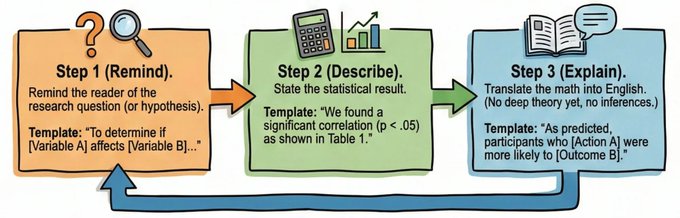
Remind → Describe → Explain Loop in the Results section.
Remind → Describe → Explain. Each finding gets this treatment. The reader never gets lost. Think of it like giving directions. First, remind the reader where they’re going (“We’re testing if X affects Y”). Then, show them the numbers (“We found this result”). Finally, explain what those numbers mean in plain language (“This means people who did A were more likely to do B”). When you follow this pattern for every result, your reader can easily follow along without getting confused or having to flip back to earlier pages.
Example (from Tondello et al., 2016):
> (Remind) Our analysis included the following measures, as reported in the Methodology section: scale reliability, distribution of the user types scores, scale correlation with personality traits, and scale correlation with game design elements.
> (Describe) “Table 6 presents the bivariate correlations coefficients and significance levels between each Hexad user type and each of the Big Five model personality traits, measured by Kendall’s τ. […] The Free Spirit type is positively correlated with openness, supporting hypothesis H2, and also positively correlated with extraversion and negatively with neuroticism.”
> (Explain) “H2: supported. The Free Spirit user type was positively correlated with openness to experience.”
Source: Tondello, G. F., Wehbe, R. R., Diamond, L., Busch, M., Marczewski, A., & Nacke, L. E. (2016). The Gamification User Types Hexad Scale. In Proceedings of the 2016 Annual Symposium on Computer-Human Interaction in Play (pp. 229–243). ACM. https://doi.org/10.1145/2967934.2968082
AI Research Stack premium members get all three structural templates this week: CARS for introductions, the methods loop, and this Remind → Describe → Explain pattern for results. Each one is a single-page PDF reference sheet you can print and keep at your desk.
## 3.5 How to widen from findings to field-level impact
This is where most writers struggle. The introduction funnels from broad to narrow. The discussion does the reverse: Open narrow (your findings) and widen out to the broad field.
Your results don’t mean anything in isolation. A statistically significant effect size tells readers what happened but not why it matters. The discussion is where you answer the “So What?” question by connecting your specific findings to the broader conversation in your field. Without this connection, reviewers see a technically competent study that doesn’t advance knowledge. They’ll see a limited contribution and reject your paper.
Most graduate training emphasizes doing research (that’s why you know how to collect the data). The interpretive move, asking “what does this mean for the field?”, requires a different skill set (that most professors just don’t teach you). You need to hold your findings in one hand and the entire literature in the other, then explain where the two connect. Bazinga. That demands deep familiarity with your field’s open questions, not just the papers you cited in your lit review. Many grad students haven’t read widely enough to see those connections yet. They know their study. They don’t yet know the field. That’s why you should run reading circles or give grad students reading assignments. AI summaries don’t cut it for this knowledge.
Here’s an easy way to unstick yourself. Imagine your related work authors are guests at a dinner party, and your study just arrived. What would they say to each other?
Nacke (2019) is holding a wine glass while he is nibbling on some fancy cheese, nodding vigorously with his mouth full (that old slob). Hamari (2019, 2020, 2021) is having a whiskey about it. Tu (2025) is shaking their head. Mogavi (2021) is chill and trying to get everyone to calm down and see the nuance. Your results just walked into this conversation looking like Vanilla Ice, the rapper not the ice cream flavour.
Write that fun conversation. Each exchange becomes a paragraph in your discussion. This way of thinking reimagines your study as part of a bigger conversation with other researchers. The dinner party metaphor make you think of earlier research papers as people you’re talking to, who have their own ideas.
3.5.1 What a discussion section actually covers
Before we get to structure, let’s be clear about content. A discussion section does the interpretive work that your results section deliberately avoided. Results describe what you found. Discussion explains what it means. Within that frame, discussion sections cover five content areas in sequence:
Summary of key points. This is a cognitive reset. By the time readers reach your discussion, they’ve processed your entire paper. Working memory is strained. You open by briefly restating your main findings, not to rehash statistics, but to get everyone back on the same page. Think of it as saying: “Here’s what we found. Now let’s talk about what it means.”
Interpretation of results. This is the heavy lifting you couldn’t do in the results section. What do your findings actually mean? Why did participants behave the way they did? What mechanisms explain the patterns you observed? This is where you move from description to explanation. Don’t rush it. This is the meaty, juicy core of your discussion.
Comparison with existing literature. Now you situate your findings in the field. How do your results relate to what others have found? Do they support, contradict, or extend prior work? This is where the dinner party metaphor comes alive. Each comparison is a conversational exchange between your study and someone else’s.
Contribution to the research question. This is your exclamation mark. After interpreting and comparing, you state clearly what your study contributes. You can foreshadow this at the beginning of the discussion, but you place the full statement here, at the end of the interpretive work, so it lands with impact. This is the “so what” that ties everything together.
Limitations (and successes). What went right and what went wrong? Be your own red team. Acknowledge the boundaries of your claims. This honest accounting builds credibility and helps readers calibrate how much weight to give your findings.
These five areas form the interpretive core of your discussion. What comes next, the conclusion, may be a separate section or a final subsection within the discussion. That varies by field and venue.
3.5.1 Conclusion: separate section or final subsection
The conclusion serves a different function than the discussion. Discussion interprets. Conclusion synthesizes impact. Some readers scan the conclusion first, looking for the bottom line. Your conclusion must deliver that bottom line clearly.
A complete conclusion covers four elements:
Main contributions to the field. Remind the reader what this research adds to the broader conversation. This echoes the contribution statement from your discussion, but frames it for someone who might be reading the conclusion in isolation.
Significance of achievements. Don’t just state what you contributed. Explain why it matters. What changes because this research exists? What can people do now that they couldn’t do before?
Recommendations. Lean out of the window a little. What should practitioners, designers, policymakers, or other researchers do with this knowledge? Don’t just deposit findings. Tell readers what to do with them. Keep recommendations grounded and actionable.
Future areas for investigation. What questions remain? What should the next study examine?
A note on field variation: In HCI and many SIGCHI venues, future work typically appears before the conclusion, often as its own subsection (e.g., “Limitations and Future Work”). The conclusion then wraps up with contributions, significance, and a final recommendation. In other fields, future work folds into the conclusion itself. Know your venue’s conventions.
Ending options: A strong conclusion can end two ways. It can close with a grounded recommendation (“Designers should prioritize X over Y”). Or it can close with a forward-looking statement about what future research must address (“Understanding mechanism Z remains the critical next step”). Either works. Choose based on what your study best supports.
3.5.2 The structural template for discussion sections
This template maps directly onto the five content areas above. Use it as a checklist.
Part 1: Summary and Positioning (1–2 paragraphs)
Open with a brief summary of your key findings (cognitive reset), then immediately position your work against prior literature. This part does three jobs at once: it reminds readers what you found, shows how your findings relate to existing work, and previews your contribution.
- Template: “We set out to [Goal]. Our findings indicate [Main Finding]. This [extends/supports/contradicts] prior work on [Framework/Taxonomy], which [What Prior Work Did].”
- Do not rehash statistics. Summarize meaning. The summary is implicit in shorter papers but should be explicit in longer ones where readers may have lost the thread.
Part 2: Interpretation and Implications (the core)
This is where the heavy lifting happens. You interpret your findings, compare them to existing literature, and explain what they mean for specific audiences.
- In shorter papers (late-breaking work, short papers): 2–4 paragraphs doing interpretation + comparison + contribution. No subsections needed.
- In longer papers (full papers, journal articles, taxonomy papers): this part fans out into thematic subsections. Each subsection is labelled “Implications for [Audience/Domain]” and walks through what your results mean for that stakeholder group.
- Structure per subsection: Interpret the finding → Compare with prior literature (support or contradict) → Explain what this means for that audience.
Part 3: Contribution (1 paragraph, or woven into Part 2)
After the interpretive work, state your contribution explicitly. This is your exclamation mark. You can foreshadow it in Part 1, but the full statement lands here, at the end of interpretation, so it carries weight.
- Template: “Taken together, these findings contribute [Specific Contribution] to the field of [Domain].”
- In some papers, the contribution is woven into the final implications subsection rather than stated separately. Either works.
Part 4: Limitations (1 subsection)
Be your own red team. Acknowledge what went right and what went wrong.
- Template: “These findings should be interpreted with caution due to [Limitation]. This was mitigated by [Defence], but future work should [Address].”
Part 5: Conclusion (separate section or final paragraphs)
Synthesize impact for readers who may scan here first. Cover contributions, significance, recommendations, and (in some fields) future work.
- Template: “This research contributes [What] to [Field]. These findings suggest that [Broad Implication]. [Practitioners/Designers/Researchers] should [Recommendation].”
The underlying logic: Summary → Interpretation → Comparison → Contribution → Limitations → Conclusion. That’s the reverse hourglass. You open narrow (your findings), widen through interpretation and comparison, land the contribution, acknowledge boundaries, and close with impact.
Example (from Hadan et al., 2025):
(Part 1 — Summary and Positioning: Comparison + Contribution Preview)
> “Our research extends prior literature by categorizing AI incidents across the four stages of the AI lifecycle (Ng et al., 2022), which offers a more detailed and actionable perspective on their occurrence. We also empirically synthesized the relationships between incident types, contextual factors, and their occurrence frequency in real-world contexts. This approach supports more targeted prevention strategies compared to studies that either did not address AI incidents within the lifecycle (e.g., Zeng et al., 2024), only distinguished pre- and post-deployment incidents (e.g., Slattery et al., 2024; Yampolskiy, 2016), or ignored the contextual factors (e.g., Shelby et al., 2023; Zeng et al., 2024).”
Notice: The summary of findings is implicit (“categorizing AI incidents,” “empirically synthesized relationships”). The bulk of this paragraph does comparison and contribution positioning. This is typical of taxonomy papers where the contribution is the classification.
(Part 2 — Interpretation and Implications: Four Thematic Subsections) The paper fans out into four “Implications for…” subsections. Each interprets findings, compares to prior work, and explains what it means for a specific audience:
> 5.3 Implications for raising public awareness: “Prior studies have emphasized the importance of educating users about manipulative tactics (Hadan et al., 2024)… Our findings indicate that AI can be used to exacerbate the creation of hyperpersonalization and emotional manipulation… Thus, improving people’s AI literacy for them to effectively recognize and resist the AI-driven manipulation and harmful outcomes become essential.”
(Interpretation: AI exacerbates manipulation. Comparison: Prior work on user education. Audience takeaway: AI literacy is essential.)
> 5.4 Implications for future AI incident reporting: “Our findings emphasize the critical need for standardized, comprehensive AI incident reporting frameworks to ensure more consistent and transparent documentation of AI incidents and contextual factors that contributed to the incidents.”
(Interpretation: Current reporting is inconsistent. Audience takeaway: Standardized frameworks needed.)
> 5.5 Implications for future AI incident detection and prevention: “Our analysis revealed that AI developers and adopting organizations and government entities were identified as the primary responsible entities in more than half of incidents we analyzed… These incidents highlight the need for improved methods to detect and prevent AI incidents and for establishing baseline standards for AI development and deployment.”
(Interpretation: Developers and organizations are primary responsible entities. Audience takeaway: Better detection methods and baseline standards.)
> 5.6 Implications for future AI incident governance and regulation: “Our findings suggest the insufficiency of existing organizational and governmental AI governance systems, as over half of the incidents (n = 117, 58%) we analyzed were due to organizational issues among AI developers and adopting organizations and government entities…”
(Interpretation: Current governance is insufficient. Audience takeaway: Proactive governance measures needed.)
(Part 3 — Contribution)
> In this paper, the contribution is woven into the implications subsections and restated in the conclusion rather than appearing as a standalone paragraph.
(Part 4 — Limitations)
> “While our research offers valuable insights into AI privacy and ethical incidents, we acknowledge several limitations that may guide future work. First, our analysis focuses exclusively on incidents reported on the AIAAIC repository from 2023 and 2024. As AI technologies evolve, the incidents and the associated contextual factors may change.”
(Part 5 — Conclusion)
> “Our research builds on and extends existing work by offering a more comprehensive and detailed AI incident taxonomy. This taxonomy captures cases previously hypothesized in the literature and novel incident types and contributing factors that existing frameworks fail to address… As AI continues to shape global policies, economies, and societal norms, the urgency to establish proactive, enforceable governance measures cannot be overstated.”
(Section 3 — Limitations)
> “While our research offers valuable insights into AI privacy and ethical incidents, we acknowledge several limitations that may guide future work. First, our analysis focuses exclusively on incidents reported on the AIAAIC repository from 2023 and 2024. As AI technologies evolve, the incidents and the associated contextual factors may change. […]”
(Contribution restated. Significance explained. Ends with a recommendation framed as urgency.)
Source: Hadan, H., Hadi Mogavi, R., Zhang-Kennedy, L., & Nacke, L. E. (2025). Who is responsible when AI fails? Mapping causes, entities, and consequences of AI privacy and ethical incidents. International Journal of Human–Computer Interaction. https://doi.org/10.1080/10447318.2025.2549073
Premium AI Research Stack members get these five templates pre-built in a Notion workspace. One click to duplicate.
4. Use AI to critique your writing, not to write for you
When ChatGPT came out, I initially resisted it as a tool for academic work, but I quickly changed my mind as more LLMs and AI tools came out and I saw them make huge improvements in extremely short periods of time. As I understood prompt engineering better, I was hooked. I got a feel for what it hallucinates and learned how to operate it better by providing proper context. That’s when I really got a hang of how the right prompting structures influence the LLM output that I get.
Let me be clear here. We do not use AI to write our papers start to finish. It hallucinates citations (outside of NotebookLM or more recently OpenScholar, try out the demo), often produces generic prose, and still lacks your intellectual fingerprint. But we include it in every writing process and we always refine our prompts and workflows (or create new skills in Claude Code/Co-Work). AI is extremely useful for offloading specific cognitive tasks that drain you. Frame it this way: AI is your intellectual sparring partner, but it’s not your ghostwriter. Muhammad Ali had a sparring partner. He still threw the punches in the ring.
One of my favourite prompts assigns the AI a persona of a senior academic editor and runs it through three phases on your pasted draft. First, it summarizes your paper’s core argument in three sentences (claim, evidence, contribution) so you can confirm the AI actually understood what you wrote. Second, it identifies up to five structural problems, ranked by severity, with each one named, located by section and paragraph, explained in terms of how it breaks the argument, and paired with a one-sentence fix. Third, it recommends any section-level restructuring (moves, merges, or cuts). The constraints keep the AI locked on architecture only: no grammar, no word choice, no rewrites. The output format is standardized so you get a scannable diagnostic report, not a wall of prose. The whole design forces the AI to work like a structural X-ray of your paper, catching misaligned research questions, missing logical steps, redundant sections, and scope drift before you waste hours polishing sentences that might get cut anyway.
Here is the full prompt (AI Research Stack Members can also download the full skill file at the very bottom of this article and get installation instructions in Notion):
Three examples of how I have used AI in the past:
Reverse Outlining. Paste your draft and ask: “Extract the logical outline of this argument. Where is the reasoning weak?” This offloads the zooming out cognition work that’s hard to do when you’re deep in the text. (AI Research Stack Members get the full prompt below.)
Red Team Review. Paste your methods section and ask: “Act as a skeptical Reviewer 2. Identify three methodological concerns.” Better to find holes now than in your rejection letter. (AI Research Stack Members get the full prompt below.)
Clarity Editing. For clunky paragraphs: “Act as an academic editor. Improve clarity, coherence, and conciseness without changing meaning. Let every word earn its place.” This is polishing. You’re offloading the micro-level optimization. (AI Research Stack Members get the full prompt below.)
Of course, there are a whole bunch more approaches like my personalization prompts that get rid of many AI writing quirks that current models have. I’ll share some for premium subscribers of my newsletter this week.
Frame it this way. AI is always your intellectual sparring partner It evaluates your thinking under stress so your working memory doesn’t have to hold everything at once.
5. Fix the big problems before you polish the small ones
When you revise, you face a decision at every sentence: what should I fix? Most people fix whatever catches their eye. A typo here, a weak word there.
This is inefficient. You might polish a paragraph that gets cut when you realize the section doesn’t work. Fixing typos before fixing structure is like polishing the silverware while your house is on fire. Admirable attention to detail, Sheldon. Completely wrong priority.
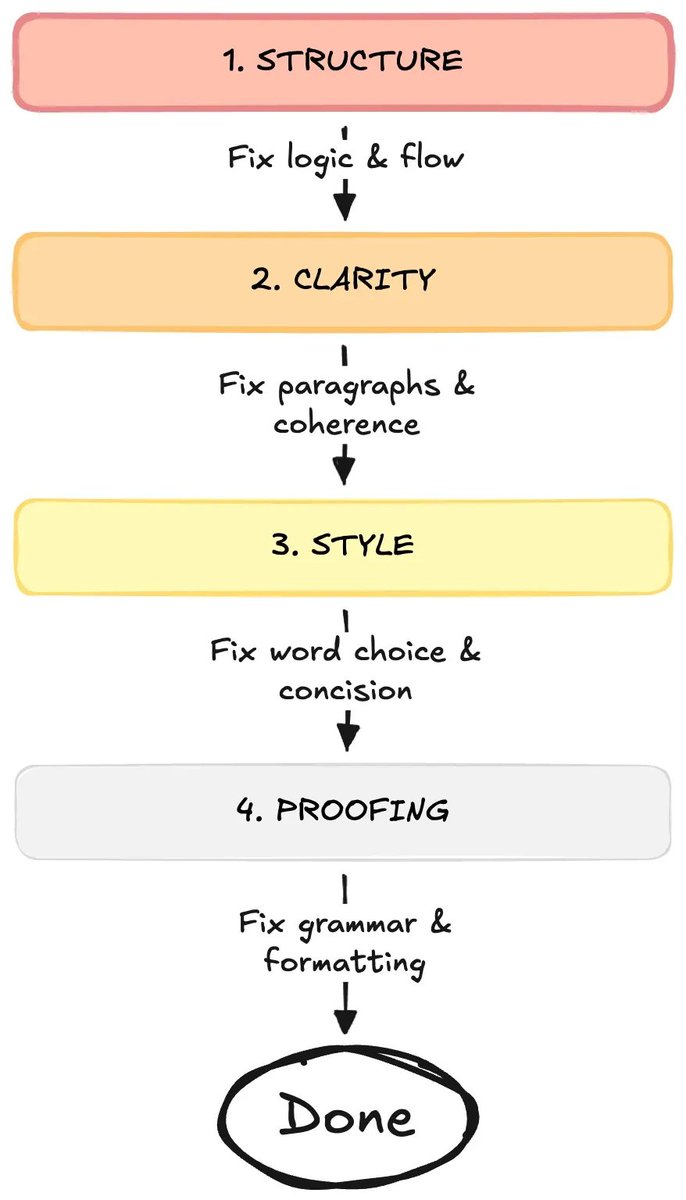
Revision Structure
Always revise in this order:
Structure. Is the argument logical? Does the paper flow broad → narrow → broad? If structure is broken, sentence-level fixes are wasted work.
Clarity. Does each paragraph have one job? Do topic sentences actually summarize? Is there fat to cut?
Style. Kill weasel words (seems, perhaps, might). Kill zombie nouns (conduct an analysis → analyze). Tighten prose.
Proofing. Grammar, spelling, formatting. Last, because everything above might change.
When you’re fixing your research paper, start with the biggest problems first and work your way down to the smallest ones. Think of it like fixing a house. If the whole building is tilted, you need to fix the foundation before you paint the walls. Structure is like the foundation of your paper because it affects every single part. If your main argument doesn’t make sense or your sections are in the wrong order, nothing else matters yet. Once the structure is solid, move on to clarity so that each paragraph is easy to understand. Then work on style, which means choosing better words and making sentences flow smoothly. Finally, fix typos and grammar mistakes at the very end. These small errors only affect one or two words, so save them for last. If you fix typos first and then realize you need to delete that whole paragraph, you’ve wasted your time. Always work from big to small, and you’ll save yourself hours of unnecessary editing.
6. The complete system
Five protocols that reduce cognitive load at every stage:
Inverted Assembly Line: Write sections in cognitive-load order (Figures → Methods → Results → Discussion → Introduction → Abstract), not document order.
Zero Draft: Separate generation from evaluation completely. Write fast and messy first. Edit later.
Structural Templates: Use proven formulas for each section so you focus on content, not organization.
- Abstract: Context → Problem → Solution → Findings → Contribution
- Introduction: Territory → Niche → Occupy (CARS)
- Methods: Contextualize → Describe → Justify
- Results: Remind → Describe → Explain
- Discussion: Answer → Implications → Limitations → Conclusion
AI Sparring: Offload critique, outlining, and clarity editing to AI. Keep the actual writing human.
Hierarchical Revision: Fix problems in order of impact. Structure first, then clarity, then style, then proofing.
Each protocol removes a specific cognitive bottleneck. Together, they turn writing from a willpower battle into a systematic process.
Your brain is a supercomputer running sophisticated cognition. Stop asking it to juggle and start giving it sequential, well-scoped tasks.
That’s how you write better papers in less time.
The protocols above are the complete system. Premium AI Research Stack members get the Notion page that runs it, plus this week’s 7 AI prompts for every revision stage. Add to that three printable structural PDF templates (CARS Introduction, Methods Loop, Results Pattern) as cheat sheets to print out and keep at your desk.
The original version of this post is available here.
## 相关链接
- [Prof Lennart Nacke, PhD](https://x.com/acagamic)
- [@acagamic](https://x.com/acagamic)
- [78K](https://x.com/acagamic/status/2021617206958735696/analytics)
- [Jan 22](https://x.com/acagamic/status/2014232581253034245)
- [@acagamic](https://x.com/acagamic)
- [1.2K](https://x.com/acagamic/status/2014232581253034245/analytics)
- [AI Research Stack members this week get: a paper-writing Notion dashboard with the complete Inverted Assembly Line workflow, all AI revision prompts, and a pre-submission checklist. Join them.](https://lennartnacke.com/#/portal/signup)
- [Jan 20](https://x.com/acagamic/status/2013636023327105447)
- [621K](https://x.com/acagamic/status/2013636023327105447/analytics)
- [The AI Research Stack](https://lennartnacke.com/#/portal/signup)
- [Nov 15, 2025](https://x.com/acagamic/status/1989392144701034887)
- [11K](https://x.com/acagamic/status/1989392144701034887/analytics)
- [Flower and Hayes’ Cognitive Process Theory of Writing](https://doi.org/10.58680/ccc198115885)
- [Dec 7, 2025](https://x.com/acagamic/status/1997639986284498946)
- [3.8K](https://x.com/acagamic/status/1997639986284498946/analytics)
- [iA Writer](https://ia.net/writer)
- [Bear](https://bear.app/)
- [Oct 29, 2025](https://x.com/acagamic/status/1983367950724894929)
- [9.3K](https://x.com/acagamic/status/1983367950724894929/analytics)
- [Jul 7, 2025](https://x.com/acagamic/status/1941904997471641676)
- [108K](https://x.com/acagamic/status/1941904997471641676/analytics)
- [CHI](https://chi2026.acm.org/)
- [Nov 23, 2025](https://x.com/acagamic/status/1992472193125753194)
- [30K](https://x.com/acagamic/status/1992472193125753194/analytics)
- [Jan 6](https://x.com/acagamic/status/2008342782356963374)
- [6.2K](https://x.com/acagamic/status/2008342782356963374/analytics)
- [Feb 4](https://x.com/acagamic/status/2018944429919183102)
- [17K](https://x.com/acagamic/status/2018944429919183102/analytics)
- [https://doi.org/10.1145/3706598.3713543](https://doi.org/10.1145/3706598.3713543)
- [Sep 19, 2024](https://x.com/acagamic/status/1836691752113287344)
- [355K](https://x.com/acagamic/status/1836691752113287344/analytics)
- [CARS](https://archive.org/details/genreanalysiseng0000swal)
- [John Swales developed it through genre analysis](https://archive.org/details/genreanalysiseng0000swal)
- [Apr 7, 2023](https://x.com/acagamic/status/1644012896454582278)
- [9.3K](https://x.com/acagamic/status/1644012896454582278/analytics)
- [Tu et al., 2025](https://doi.org/10.1145/3706598.3713543)
- [126](https://dl.acm.org/doi/10.1145/3706598.3713543#Bib0126)
- [133](https://dl.acm.org/doi/10.1145/3706598.3713543#Bib0133)
- [AI Research Stack premium members](https://lennartnacke.com/#/portal/signup)
- [Feb 2](https://x.com/acagamic/status/2018035887196811506)
- [25K](https://x.com/acagamic/status/2018035887196811506/analytics)
- [Sep 23, 2025](https://x.com/acagamic/status/1970503493367873829)
- [3.9K](https://x.com/acagamic/status/1970503493367873829/analytics)
- [Aug 2, 2025](https://x.com/acagamic/status/1951327072846254096)
- [12K](https://x.com/acagamic/status/1951327072846254096/analytics)
- [Aug 27, 2024](https://x.com/acagamic/status/1828402158967910502)
- [19K](https://x.com/acagamic/status/1828402158967910502/analytics)
- [Jun 30, 2025](https://x.com/acagamic/status/1939609866911518890)
- [4.3K](https://x.com/acagamic/status/1939609866911518890/analytics)
- [The Logic of Scientific Discovery](https://books.google.com/books/about/The_Logic_of_Scientific_Discovery.html?id=Yq6xeupNStMC)
- [Apr 27, 2025](https://x.com/acagamic/status/1916401946040434755)
- [5.9K](https://x.com/acagamic/status/1916401946040434755/analytics)
- [Nov 13, 2024](https://x.com/acagamic/status/1856687220205461896)
- [98K](https://x.com/acagamic/status/1856687220205461896/analytics)
- [Tu et al., 2025](https://doi.org/10.1145/3706598.3713543)
- [AI Research Stack premium members](https://lennartnacke.com/#/portal/signup)
- [Tondello et al., 2016](https://doi.org/10.1145/2967934.2968082)
- [https://doi.org/10.1145/2967934.2968082](https://doi.org/10.1145/2967934.2968082)
- [AI Research Stack premium members](https://lennartnacke.com/#/portal/signup)
- [May 27, 2025](https://x.com/acagamic/status/1927246285662232661)
- [20K](https://x.com/acagamic/status/1927246285662232661/analytics)
- [Sep 2, 2025](https://x.com/acagamic/status/1962893309841731827)
- [4.2K](https://x.com/acagamic/status/1962893309841731827/analytics)
- [Sep 15, 2025](https://x.com/acagamic/status/1967362747689218334)
- [26K](https://x.com/acagamic/status/1967362747689218334/analytics)
- [Aug 5, 2023](https://x.com/acagamic/status/1687629516611674112)
- [121K](https://x.com/acagamic/status/1687629516611674112/analytics)
- [Oct 17, 2025](https://x.com/acagamic/status/1978853500256915501)
- [@acagamic](https://x.com/acagamic)
- [910](https://x.com/acagamic/status/1978853500256915501/analytics)
- [Hadan et al., 2025](https://doi.org/10.1080/10447318.2025.2549073)
- [https://doi.org/10.1080/10447318.2025.2549073](https://doi.org/10.1080/10447318.2025.2549073)
- [Premium AI Research Stack members](https://lennartnacke.com/#/portal/signup)
- [One click to duplicate.](https://lennartnacke.com/#/portal/signup)
- [NotebookLM](https://notebooklm.google.com/)
- [OpenScholar](https://www.nature.com/articles/s41586-025-10072-4)
- [demo](https://openscilm.allen.ai/)
- [AI Research Stack Members](https://lennartnacke.com/#/portal/signup)
- [skill](https://support.claude.com/en/articles/12512180-using-skills-in-claude)
- [AI Research Stack Members](https://lennartnacke.com/#/portal/signup)
- [AI Research Stack Members](https://lennartnacke.com/#/portal/signup)
- [AI Research Stack Members](https://lennartnacke.com/#/portal/signup)
- [premium subscribers of my newsletter](https://lennartnacke.com/#/portal/signup)
- [Premium AI Research Stack members](https://lennartnacke.com/#/portal/signup)
- [available here](https://lennartnacke.com/reviewer-2-cant-touch-a-paper-structured-like-this/#4-use-ai-to-critique-your-writing-not-to-write-for-you)
- [Upgrade to Premium](https://x.com/i/premium_sign_up)
- [12:07 AM · Feb 12, 2026](https://x.com/acagamic/status/2021617206958735696)
- [78.4K Views](https://x.com/acagamic/status/2021617206958735696/analytics)
- [View quotes](https://x.com/acagamic/status/2021617206958735696/quotes)
---
*导出时间: 2026/2/12 20:41:53*
---
## 中文翻译
# 我会在每位博士生入学第一天就交给他们的论文写作系统
**作者**: Prof Lennart Nacke, PhD
**日期**: 2026-01-22T07:04:04.000Z
**来源**: [https://x.com/acagamic/status/2021617206958735696](https://x.com/acagamic/status/2021617206958735696)
---

我已经发表了150多篇论文,但每次打开空白文档时依然感到恐惧。
每一次都是如此。
坐下来写作的感觉,仍然像拖着自己穿过湿漉漉的水泥。你打开文档,盯着空白页面。你的大脑——就是今天早上刚设计好一项研究、主持完实验室例会的那个大脑——卡住了。两个小时后,你写出了一个明天可能就会删掉的段落。
你熟悉这种感觉。周日下午的绝望——你曾发誓会更早完成那个讨论章节。当合著者发邮件索要你的草稿而你甚至还没开始时的愧疚。截稿日期前一晚11点的暗自恐慌——意识到你把同一个引言重写了四遍,每一遍都不对劲。你开始怀疑自己是否已经完全丧失了写作能力。也许你从来没有过。
与此同时,某个似乎拥有通往平行时空的秘密传送门、那里时间流逝得更慢的同事,这学期刚提交了三篇论文。同样的截止日期。同样的教学负担。同样的委员会职责。
不撒谎,在2020年代初,当Juho Hamari超越我成为游戏化领域发表论文最多的研究者时,我也经历过这样的时刻。我觉得自己已经在能力巅峰运转了,但我眼睁睁看着他的研究团队用数十篇引用量超过我工作的期刊论文占领了整个领域。干得漂亮。事后看来,我不该拿自己和他们比较(我的处境不同,教学负担也大不相同),但当你感觉别人的履历不断增长而你的却卡在“进行中”时,这种比较往往难以避免。
你以为他们有更强的自律。更高的天赋。更多受保护的写作时间(这相当于学术界的独角兽目击事件;你听过传说,但从未在野外真正见过一只)。
他们没有。他们有一个系统。这个词很重要。
现实是这样的。你并不是不擅长写作。你是不擅长你的写作方式。好好琢磨一下这句话。这很难接受。
写作生产力依靠系统运转。大多数学者从未建立过系统。他们把写作当作单一任务,一个巨大的认知整体,靠着足够的自律和多得让双手发抖的咖啡硬撑过去。实际上,写作是把六种不同的认知过程塞进了一个活动中:
决定说什么(内容)。选择是否将某项具体研究纳入你的文献综述,或者决定先呈现三个实验中的哪一个。
弄清楚怎么说(语言)。在“参与者表现出绩效提升”与“绩效提升了”与“我们观察到绩效提升”之间纠结。
记住你在对谁说(受众)。决定是为一本综合性社会科学期刊定义“游戏化”,还是假定专业人机交互(HCI)场所的读者已了解这个术语。
追踪你已经说了什么(连贯性)。在段落中间发现你在两页前已经提到过这个局限性,或者检查你是否已经引用过Nacke等人(2023)。
规划接下来说什么(结构)。琢磨下一段应该回应第二个研究问题,还是先讨论当前发现的影响。
判断这一切是否够好(评估)。在句子中间停下来想“这是不是太明显了?”或“这听起来是不是太不正式?”或“我是不是该删掉这整个部分?”
问题在于起草时同时做这六件事。你就像开着59个标签页的Chrome,还在纳闷为什么笔记本电脑听起来像喷气发动机。
大多数人认为写作难是因为他们意志力不够。
但真正的问题在于,写作要求你的大脑同时做太多事情。
我指导过30多名博士生。审阅过数百篇论文。写过获得资助和被拒的基金申请。规律总是一样的。写作有困难的研究者并不懒惰。他们是在错误的操作系统上运行大脑软件。
这是能为你解决问题的shell脚本:
一套与大脑架构协同工作的完整学术写作系统。六个协议。每一个都针对特定的认知瓶颈。每一个都消除一个你不需要做的决定。
我刚刚花了整整一周写下你正在读的这篇关于如何更好地撰写研究论文的详尽指南。不撒谎,为一篇关于如何更快写作的文章苦苦挣扎,其中的讽刺我自己也心知肚明。所以,这会是一篇较长的阅读。我只要求你在下一篇论文中尝试一个协议。然后再试另一个。
让我们开始吧。
> AI Research Stack成员本周将获得:一个包含完整“倒置流水线”工作流的论文写作Notion仪表板、全部AI修改提示词,以及一份投稿前检查清单。加入他们。
1. 从你所知的东西开始,以你承诺的东西结束
以下是大多数学术新人写论文的方式。他们打开空白文档,从标题开始,然后是引言,然后一步一步线性地走向结论。这就像在还没拍摄电影之前就试图写电影预告片。
这在认知上是本末倒置的。
引言是所有章节中认知负荷最高的。你在框定问题、定位你的贡献、向读者做出承诺——而这一切都发生在你完全阐明自己的发现之前。你在要求大脑用最少的材料先做最困难的工作。
这就像托尔金还没把霍比特人带出“绿龙客栈”就试图写“夏尔平乱”。你的大脑还没有素材。
按照认知负荷重新排列你的写作顺序:

倒序写作流水线的示意图。
图表部分。视觉化思考。语言负担低。你了解自己的数据,所以只需将其排列好。
方法部分。程序性回忆。这些工作是你做的,所以像写菜谱一样描述它。
结果部分。描述性报告。叙述你的图表。此时不做任何解释。
讨论部分。解释性思考。将你的结果与该领域已有的研究发现联系起来。
引言部分。修辞框架。此时你已经知道自己真正承诺的是什么。聚焦于你的贡献。
摘要与标题。压缩与推销。这需要你了解全文。
每一步都使用上一步生成的材料。这样写作能让你不断积累动力。你是在骑自行车下坡,而不是推着一辆瘪了胎的自行车上坡。
把它想象成拼装乐高死星。你不会从包装盒封面上那个令人生畏的最终形态开始。你从第 1 号袋开始,从那些你真正看得见、摸得着的小结构件开始。
假设你正在写一篇关于游戏化如何影响学生动机的论文,因为这个话题曾经超级火爆(非技术领域的读者们,请容忍我一下)。
你从图表部分开始。你创建了一张柱状图,展示不同条件下的动机得分。现在你能看到你的主效应了。
接着写方法部分。你描述你的 123 名参与者、你的游戏化干预措施、你使用的经过验证的动机量表。很简单。这些工作是你做的,你只是在这里把它记录下来。
然后写结果部分。你叙述你的图表:“游戏化条件下参与者报告的内生动机(M = 4.2,SD = 0.8)显著高于控制条件(M = 3.1,SD = 0.9),t(245) = 3.42,p < .001。”图表告诉你该说什么。
接着起草讨论部分。现在你要进行整体解读。“这些结果与自我决定理论相一致,表明设计良好的游戏化能够满足胜任感需求。”结果部分已经把需要解释的论点交给了你,你接下来只需找到相应的引文即可。
最后,你写引言。此时你确切地知道自己做出的承诺是什么:“本研究证明,当围绕胜任感反馈进行设计时,游戏化可以提高内生动机。”你不是在猜测这篇论文会论证什么。你已经知道了。
摘要自然而然就写出来了。你把已经写好的内容压缩成 150 个词。在 CHI,这是一个简单的公式,我会在下文解释。
注意这里发生了什么。每个部分都为下一个部分提供了原材料。你从未面对一张空白页自问:“我该写什么?”上一个部分已经回答了这个问题。为了让 The AI Research Stack 的付费订户更轻松,我在本周的 Notion 更新中附带了一份工作表。
从你知道的东西开始(方法、数据)。以需要综合的东西结束(框架、定位)。永远不要先写引言。把这份美妙的享受留到你把数据全部梳理成一个故事之后。
2. 先写烂,再修改
你的大脑有两种在神经层面上互不兼容的模式。生成模式和评估模式。
这一区分来自 Flower 和 Hayes 的写作认知过程理论,这是关于写作者实际如何思考的被引用最多的模型。他们基于对经验丰富的写作者进行出声思维协议的研究发现,写作涉及三个递归过程:计划(产生想法)、转译(把想法变成文字)和审阅(评估和修改)。关键洞见在于,这些过程争夺同样的认知资源。
生成模式(Flower 和 Hayes 所称的“转译”加上想法生成)是扩展性的、联想式的、快速的。你的大脑从长期记忆中提取信息,建立松散的联系,顺着岔路走。工作记忆保持开放。你在不加过滤地探索可能性空间。
评估模式(他们所称的“审阅”)是收缩性的、批判性的、缓慢的。你的大脑将输出与内在标准进行比较,检查连贯性,评判质量。工作记忆收窄。你在施加约束并做决定。
问题在于,两种模式都需要工作记忆,而工作记忆极为有限。试图同时生成和评估会造成认知科学家所说的任务切换成本。每次切换都会消耗心理能量并打断心流。
几年前,我在写一篇论文时,花了三个小时写一段引言,我大概写了九个不同的版本。我删掉了大部分,又把一些版本的部分内容拼回去,最后定稿的版本竟然和第一版惊人地接近。但我觉得我浪费了整整一个上午,在每句话还没来得及喘口气之前就急着评判它们。
大多数人试图同时用两种模式写作。他们生成一个句子,立即评估它,然后编辑它,再生成下一个。这就像一只脚踩油门、一只脚踩刹车地开车。
按照这个严格的规程来创建一份零草稿:
打开一个无干扰的写作工具(我喜欢 iA Writer 和 Bear,或者干脆关掉显示器)。
设定一个 25–45 分钟的计时器。
以尽可能快的速度不停笔地写。
不要改错别字。不要核对参考文献。不要回读。
大量使用占位符:[REF]、[STATS]、[TRANSITION]、[FIX THIS]。
你是在往沙箱里铲沙子,以便之后堆城堡。你不能一边采沙一边塑形。你内心的批评者会尖叫。让它尖叫吧。之后轮到它出场。(想象一下,在你堆沙堡的时候,把审稿人二号关进“暂停角”。)

零草稿规程
零草稿为你提供了原材料。原材料远比空白页容易编辑。就连芝加哥公牛队也得先来训练,菲尔·杰克逊才能把他们变成冠军。
3. 让模板替你做结构性决定
写作时的每一个决定都会消耗你的心理燃料。这一段应该做什么?这一部分该如何组织结构?接下来写什么?
大多数关于结构的决定都可以交给经过验证的模板来完成,让它们替你承担认知工作。核心问题是决策疲劳。每一个结构性选择都会消耗有限的认知资源。当你在写作过程中不断做出这些微小的决定时,你正在消耗本可以用于真正智力工作的心理能量。模板通过把结构性选择变成填空过程来解决这个问题,这样你就可以专注于分析数据、展开论证和阐明洞见。你不必每次都重新发明摘要或讨论部分的组织方式,而是遵循经过验证的模式,从而释放工作记忆,用于真正重要的实质性思考。
这些框架把写作这门艺术变成了一条流水线流程。你专注于数据。结构替你完成思考。
接下来是七个模板。论文的每个主要部分各一个。(请继续读下去。真正的省时秘诀就在这里。)
## 3.1 CHI 摘要公式(背景 → 问题 → 解决方案 → 发现 → 贡献)
在 CHI——我们领域的顶级会议上——摘要遵循一个简单的公式。五个槽位。按顺序填入即可。
背景(1–2 句)。勾勒整体图景,让读者对大致研究领域有个定位。
问题(1 句)。确定研究空缺。指出现有技术水平的不足、未知或缺陷之处。
解决方案(1–2 句)。填补这个空缺。解释你的方法,以及你如何通过构建、观察或研究某种事物来解决这个问题。
关键发现(2–3 句)。提供证据和具体结果。这通常是摘要的主体部分(除非你写的是方法论文)。尽可能量化。
贡献/影响(1 句)。“这有什么意义?”将你的发现与更广泛的 HCI 社区联系起来。
不要重复造轮子。只需填槽。摘要就自然而然写出来了。
示例(这一篇的主体部分是解决方案/方法):
> (背景)生物反馈为增强桌面游戏体验提供了独特的机会。它通过数字化融合催生了新的游戏风格,同时保留了实体组件的触感魅力。(问题)然而,文献中对如何将心率(HR)等生物反馈系统集成到游戏设计中仍缺乏充分理解,实践中也尚待探索。(解决方案)为弥合这一空白,我们采用了“通过设计做研究”的方法,包括:(1)从十位(n = 10)资深桌游设计师那里收集见解;(2)举办两场参与式设计工作坊(n = 20);(3)与五位专家(n = 5)一起对游戏机制进行原型设计;(4)开发游戏原型作品 One Pulse: Treasure Hunter's。(关键发现)我们总结出将生物反馈(尤其是心率)融入桌面游戏的实用设计实施方案。(贡献/影响)由此,我们通过提出将心率融入桌游的设计权衡,为该领域做出贡献,为 HCI 研究者和游戏设计师提供了有价值的见解。
来源:Tu, J., Kukshinov, E., Hadi Mogavi, R., Wang, D. M., & Nacke, L. E. (2025). Designing biofeedback board games: The impact of heart rate on player experience. In Proceedings of the 2025 CHI Conference on Human Factors in Computing Systems (Article 466). ACM. https://doi.org/10.1145/3706598.3713543
## 3.2 CARS 引言公式(领域 → 问题 → 贡献)
CARS 是 “Creating a Research Space”(开辟研究空间)的缩写。John Swales 通过对跨学科研究论文引言的体裁分析发展出这一模型。他研究了成功的论文实际是怎么写的,然后为这一模式命名,让写作者能够识别并复用它。其核心洞见是描述性的:他发现了已发表引言的运作方式。
该模型将引言框架化为三个修辞步骤,从宽泛的背景逐步收窄到你的具体研究空缺。

CARS(Creating a Research Space)模型。
CARS 为你提供了一份强制逻辑的清单:重要性、从空白到问题、你的回应。这种结构让审稿人能更快看到你的贡献,因为他们无需费力寻找就能定位问题和价值所在。它能避免那种只是泛泛总结主题、却没有先赢得读者注意的空洞引言。
步骤 1(确立领域)。
自问:为什么有人会在意这件事?
- 模板:“[领域]的最新进展使[主题]的需求变得更加迫切。”
步骤 2(确立空缺)。
对现状提出质疑。
- 模板:“以往的研究未能解决[问题]……”或“关于[变量]……目前知之甚少……”
步骤 3(填补空缺)。
陈述你的具体解决方案。
- 模板:“本研究旨在通过[方法/行动]来解决这一问题。”
领域 → 空缺 → 填补。这就是算法。不要像爵士乐手那样即兴发挥你的引言。
用这三个步骤来组织每个段落的内容。先为每个步骤起草一两句话,然后在能增强空缺论证之处用证据和引用加以扩展。如果你的空缺显得薄弱(“还没人研究过 X”),先收紧研究范围。我的意思是,收窄研究对象、方法、场景、测量指标或时间窗口,直到问题变得具体且站得住脚。
示例(引自 Tu 等,2025):
> (步骤 1——确定领域)桌游已经开始融入数字元素,通常被称为“混合数字游戏”,即将非数字组件和数字组件相结合,以引入新的游戏体验。这些混合桌游通常使用平板电脑或手机上的配套应用程序来管理叙事、自动动作或进度追踪等任务 [53]。另一些所谓的情感游戏则利用玩家的生理信号或生物反馈来直接影响游戏体验 [75]。……数字化融入的生物反馈(如心率 HR)在人际交互领域已被作为理解和改善游戏中玩家体验的工具加以研究 [23, 45, 67, 126]。
> (步骤 2——指出空白)然而,将心率融入桌游,尤其是在多人游戏情境中,在很大程度上仍未被探索。虽然心率机制已在数字单机环境中得到研究,但将生物特征数据嵌入到实体多人游戏体验中,目前严重缺乏成熟的方法或框架。从设计角度来看,这一挑战不仅涉及“把设计做对”,还涉及“做对的设计” [18]。……
> (步骤 3——占据空白)为了理解心率在桌游中的融入,我们采用了“通过设计做研究”(Research through Design)的过程 [133],因为它支持迭代式的用户测试、实体原型的制作以及可复用设计资产的生成……我们实施了三个关键研究阶段:(1) 从狂热的桌游设计师那里收集初步见解,(2) 开展参与式设计工作坊,(3) 使用一个名为 One Pulse: Treasure Hunter's 的游戏原型工件,与桌游专家一起对游戏机制进行原型设计。……
AI Research Stack 的付费会员本周将获得一份可打印的单页 CARS 模板,其中包含填空式提示,引导你完成全部三个步骤。这是我撰写引言时放在键盘旁随时查阅的参考表。
3.2.1 另一种“问题先行”的引言结构
CARS 很有效。但有些论文需要不同的节奏。它们需要在 CARS 背后的理念上进一步延伸。下面这种替代方案建立在 CARS 的基础上,但当你的研究问题十分紧迫、或读者对你的领域背景不熟悉时,它尤其有效。请记住,研究问题与研究空白并不是一回事。
- 研究问题回答的是“这有什么要紧?”(So What?)这个问题。它是现实世界中的痛点,是一种导致不稳定、成本或损害的境况。如果不解决这个问题,人们会生病或无法痊愈,系统会崩溃,金钱会流失。真正的问题超越了学术论文的范围。无论是否有人撰写它们,它们都存在于这个世界之中。
- 研究空白则不同。它是文献中的一个空缺,阻碍我们当下解决这个问题。你可以在论文中找到空白,它们通常被埋没在局限性或未来研究部分。研究者会把这些空白写下来。空白是具体的,比它们所关联的更大问题更容易把握。
因此,大多数人在这里会犯错。他们阅读文献,总结已研究的内容,罗列尚未研究的内容,然后称之为研究空白。那不是研究问题。你只是在罗列未被研究的变量。没有人在意未被研究的变量,除非你把它们与真实的痛点联系起来。
问题与空白之间的这种联系,正是你作为研究者的卓越之处。
在实践中,你常常是反向工作的。你先找到空白(因为空白在论文中更容易发现),然后朝着它所关联的问题努力。你会问:“这个空白为什么重要?它留下了什么现实世界的痛点未被解决?”
而在论文中,你要以相反的顺序呈现。你从问题(现实中的痛点)开始,接着展示空白(为什么这个问题仍未被解决),然后呈现你的解决方案(那座桥梁)。这就是“问题先行”的结构。
每个部分都发挥着修辞功能:
- 问题让读者在乎。
- 空白证明你是读过文献的行家。
- 解决方案表明你真的能解决这个问题。
第一步:从主题或问题开始。直接以问题本身开篇。不要对研究领域进行冗长的铺垫。把读者直接带入那些损坏的、缺失的或未解决的事情之中。
第二步:论证该领域的重要性。现在把镜头拉远。这个领域为什么重要?如果我们不解决这个问题,会有什么利害关系?在你请读者跟随你的研究旅程之前,这一步为他们赢得关注。
第三步:陈述你的研究问题、目的或假设。要明确。“本研究探讨是否……”或“我们假设……”或“本研究的目标是……”读者需要一个清晰的目的地。
第四步:总结研究空白。将空白直接与你开篇提出的问题联系起来。空白为研究提供正当性。如果读者不明白为什么现有工作无法解决问题,他们就不会明白你的研究为什么重要。
第五步:穿插相关背景。融入能为你所处位置提供定位的社会、政治、历史或科学背景。这种语境铺垫为读者随后深入文献做好准备。
当你的读者需要先被说服、才会认真投入你的文献综述时,这种结构非常有效。CARS 往往默认读者已经在乎该领域。而问题先行结构则通过以利害关系开篇,让读者产生在乎。
3.2.2 理论框架与文献综述
引言完成后,你有两条路径:(1) 呈现一个理论框架,或 (2) 直接进入文献综述。有时你会两者兼做,将这些部分合并。
理论框架(可选章节或小节):
理论框架部分依次做三件事:
讨论与你的文章相关的理论。梳理理论图景。人们可以用哪些视角来理解这一现象?
介绍你所使用的具体理论。从梳理收窄到选择。为什么选择这些理论而不是其他理论?
阐明你的理论贡献。你的研究对这些理论有什么补充或挑战?
这一部分可以独立成章,也可以并入引言。当你的贡献部分属于理论层面时,当你的方法依赖于某种理论视角(如扎根理论或现象学)时,或者当你的读者可能不认同你的理论假设时,就可以使用它。
文献综述/相关工作(通常是单独的一节):
引言负责激发兴趣。文献综述负责定位背景。二者任务不同,这也是我喜欢把它们写成不同部分的原因(这在我的领域——人机交互中是可行的,但在心理学等领域,通常不这样做)。
文献综述概述了为你的研究提供知识支持的各个研究领域。其结构应涵盖:
历史与背景分析。这一研究领域是如何发展的?有哪些转折点?
关键概念与定义。读者需要理解哪些术语才能读懂你的研究?在这里定义它们,而不是埋在方法部分。
关键争论与分歧。研究者们在哪些地方意见不一?这些分歧往往指向你的研究所要解决的空白。
关键研究的比较。不要只是罗列论文,要进行比较。研究A的什么发现被研究B反驳了?各自使用了什么方法?系统的比较能表明你下了功夫。
现有研究的空白。明确指出文献中的空白。“尚无研究在Y的背景下考察过X。”“现有工作假设Z,但这一假设从未被检验过。”
你的研究如何弥补这些空白。以回扣你的贡献来结束文献综述。读者读完这一部分后,应该清楚地理解你的研究如何契合并推进现有的学术对话。
只有到这时,你才进入方法部分。此时,读者已经明白了你做了什么(引言)、为什么这在理论上有意义(理论框架),以及它与其他研究的关系(文献综述)。现在,他们已经准备好了解你是如何做的了。
## 3.3 为什么罗列你所做的事情是不够的
一份无法被攻击的方法部分,是没有尽到职责的。一份光秃秃的方法清单,就像告诉别人你“做了晚餐”,却不提你只是用微波炉加热了一个热口袋三明治。严格来说是真的,对某些人来说也算美味,但对你喜欢吃沙拉的妻子来说毫无用处。
“我们招募了30名参与者。我们使用了李克特量表。我们进行了t检验。”这是一个清单。而清单无法通过科学写作最基本的检验:持怀疑态度的读者能否反驳你的论断?
这正是卡尔·波普尔可证伪性标准的体现。在《科学发现的逻辑》中,波普尔指出,科学的进步是通过提出可能被证伪的论断,然后对其进行严格检验来实现的。无法被检验的论断不是科学。你的方法部分的存在,就是为了向读者展示他们如何能精确地复制你的研究,并且(如果你的发现是错误的)驳倒你的观点。
一份光秃秃的清单之所以通不过这一检验,是因为它隐藏了推理过程。为什么选择那个样本量?为什么使用那个测量工具?为什么采用那种分析方法?没有答案,持怀疑态度的读者(通常就是审稿人2号)就无法评估你的选择是否站得住脚。清单看起来像科学,但并不能发挥科学的作用。
3.3.1 方法部分实际涵盖的内容
在讨论结构之前,我们先明确内容。一个完整的方法部分涉及四个方面:
材料。设备、参与者、样本、刺激物、软件、仪器。你使用的所有东西。读者需要知道要复制你的研究需要哪些东西。
程序。研究准备、实验方案、数据收集。这是菜谱:你做了什么,按什么顺序,在什么条件下。如果你进行了访谈,访谈多长时间?如果你使用了问卷调查,参与者在何时、以何种方式完成问卷?如果你进行了行为观察,观察环境是什么?混合方法研究则需描述每种方法。
分析。统计检验(针对定量研究)或分析框架(针对定性研究)。你进行了哪些检验,为什么?你采用了哪种编码方法?主题分析、扎根理论还是内容分析?说明方法名称并论证选择的理由。
方法论问题。研究执行过程中遇到的问题。设备故障、参与者流失、意外的混淆变量、偏离实验方案。不要把这些埋起来。承认问题能建立可信度,隐瞒问题则会导致拒稿。
这四个方面都需要同样的修辞处理。你不只是罗列你做了什么,还要解释你为什么那样做。而解释的方式在这四个方面是完全一致的。
3.3.2 每个方法论选择的三步循环
解决方法是一个三步循环:情境化 → 描述 → 论证。
对你方法部分中的每一个重大选择都执行这个循环。也就是说,在描述你的材料时执行这个循环(为什么是这些参与者?为什么用这台设备?);在描述你的程序时再次执行(为什么用这个方案?为什么按这个顺序?);在描述你的分析时再次执行(为什么用这个统计检验?为什么用这个编码框架?);在处理任何方法论问题时也再次执行(为什么偏离了原计划?为什么这种偏离不会使结果失效?)。
四个方面,每个方面一个循环。这个循环如下所示:

方法论选择循环
示例(来自Tu等人,2025,他们描述的顺序有所不同):
> (情境化)本研究的第一阶段(RP1)侧重于从桌游设计师(n = 10)那里收集关于数字化转型态度的初步数据。这些参与者主要是实体桌游设计师,以经常享受传统的非数字化桌游而闻名。[…]
> (描述)我们同时进行了线下和线上访谈,以便远程参与者也能参加。访谈问题探讨了整合生理指标、交互式显示和精确测量技术如何能够增强社交欺骗类桌游中的沉浸感、社交互动和策略复杂性。访谈的重点是对于设计利用心率数据、共享或个人显示屏以及空间动态的机制以增强紧张感、欺骗性和玩家参与度的态度。半结构化访谈(平均时长28分54秒)使我们能够收集与我们的设计理念相关的新的探索性数据。
> (论证)我们特意在第一阶段选择这一人群,是为了从主要参与非数字化游戏的玩家的视角,了解他们对数字化整合的看法。……
AI Research Stack 的高级会员可以获得“情境化 → 描述 → 论证”速查表的可打印PDF版本。一页纸。四个方法领域。循环流程清晰印刷,无需在本文中翻找即可直接使用。
## 3.4 逐条发现引导读者理解你的数据
结果部分失败的原因往往是变成了数据倾倒。(向在场的任何硬核心理学家道歉,我知道你们中有些人还是纯粹主义者。)一张接一张的表格,一个接一个的统计数据,没有任何引导性的线索。读者搞不清每个分析对应哪个假设。审稿人快速浏览,错过了你的数据与你的论点之间的联系,也不清楚这些如何支持你的论证。
这个问题本质上是认知层面的。当读者读到你的结果部分时,他们已经处理了你的引言、文献综述和方法部分。工作记忆几乎已经满了。现在你却要求他们吸收密集的统计输出,记住每个检验对应哪个研究问题,并将数字转化为意义。这要求太多了。相反,要让他们的阅读变得轻松。
### 3.4.1 结果部分实际涵盖的内容
在讨论结构之前,我们先明确内容。结果部分是纯粹的描述。你报告你发现了什么。不进行任何解释。那留到讨论部分。在这一约束下,结果部分通常涵盖四个内容领域:
**用平实语言表述的显著发现。**以核心结论开场。在深入统计数据之前,先用通俗易懂的语言陈述你的主要结果。读者需要先有方向感,再看细节。
**调整与剔除。**数据很少是干净无瑕的。报告任何剔除(移除的异常值、退出的参与者、缺失数据的处理)和调整(转换、重新编码、合并变量)。这应该放在前面,因为它会影响读者对后续所有内容的解读。
**定性结果(如适用)。**参与者观察、访谈摘录、主题模式。这些为你的解释性论点提供细节支撑和证据。只选择那些能起到修辞作用的参与者引语。
**带表格和图的定量结果。**描述性统计(均值、标准差、频数)和推断性统计(检验、效应量、置信区间)。表格和图在这里承担主要重任。
一条关键规则:切勿在表格和图之间重复信息。表格展示精确数字。图展示模式、趋势或关系。如果两者都有,它们应该相互补充。一张仅仅可视化表格中已有相同数字的柱状图,既浪费篇幅,又冒犯审稿人(还可能导致直接被拒稿)。
结果部分的设计本身就应以图为主。你的图和表格就是证据。文字负责叙述它们,指出重点,并将它们与研究问题联系起来。把文字想象成一位导游,带领读者参观一个图表展览。
### 3.4.2 每条发现的“提醒 → 描述 → 解释”循环
现在你知道了结果部分应该包含什么,下面是如何组织每条发现的结构,让读者能够顺畅跟上而不迷失。
“提醒 → 描述 → 解释”模式替读者完成了认知工作。你在呈现数据之前重新激活相关假设。你干净利落地报告统计数据。然后,在继续之前,你把数字翻译成平实的语言(注意,不进行解释)。每条发现都成为一个自成一体的单元,读者无需翻回研究问题部分就能跟上。
这种结构还能在审稿过程中保护你。当审稿人2问“这个分析如何对应研究问题3?”时,答案已经在文中了,因为你在呈现结果之前就明确地将结果与问题联系起来了。(当然,提醒你,审稿人2是有观点的。强烈的观点。他们会在周日凌晨1点看你的结果部分,然后写1200字的愤怒评论指责你的样本量。做好准备。)
**第1步(提醒)。**提醒读者研究问题(或假设)。
- 模板:“为了确定[变量A]是否影响[变量B]……”
**第2步(描述)。**陈述统计结果。
- 模板:“我们发现了一个显著相关(p < .05),如表1所示。”
**第3步(解释)。**将数学转化为语言。(尚不涉及深层理论,不做推断。)
- 模板:“正如预测的那样,[行为A]的参与者更有可能[结果B]。”

结果部分中的“提醒 → 描述 → 解释”循环。
提醒 → 描述 → 解释。每条发现都采用这种处理方式。读者永远不会迷失。把它想象成给人指路。首先,提醒读者他们要去哪里(“我们在检验X是否影响Y”)。然后,向他们展示数字(“我们发现了这个结果”)。最后,用平实的语言解释这些数字意味着什么(“这意味着做了A的人更有可能做B”)。当你对每个结果都遵循这一模式时,读者就能轻松跟上,不会困惑,也不必翻回前面的页面。
示例(来自Tondello等人,2016):
> (提醒)正如方法部分所报告的,我们的分析包含以下测量指标:量表信度、用户类型分数的分布情况、量表与人格特质的相关性,以及量表与游戏设计元素的相关性。
> (描述)“表 6 展示了每种 Hexad 用户类型与‘大五’模型人格特质之间的双变量相关系数及显著性水平,采用 Kendall's τ 测量。……自由精神型与开放性呈正相关,支持假设 H2,同时与外向性呈正相关,与神经质呈负相关。”
> (解释)“H2:得到支持。自由精神型用户类型与经验开放性呈正相关。”
来源:Tondello, G. F., Wehbe, R. R., Diamond, L., Busch, M., Marczewski, A., & Nacke, L. E. (2016). The Gamification User Types Hexad Scale. In Proceedings of the 2016 Annual Symposium on Computer-Human Interaction in Play (pp. 229–243). ACM. https://doi.org/10.1145/2967934.2968082
AI Research Stack 的高级会员本周将获得全部三个结构模板:用于引言的 CARS 模板、方法循环模板,以及用于结果部分的这种“提醒 → 描述 → 解释”模式。每个模板都是一页纸的 PDF 参考表,你可以打印出来放在办公桌上。
## 3.5 如何从研究发现扩展到领域层面的影响
这是大多数作者最头疼的地方。引言是从宽泛到具体逐层聚焦,而讨论部分则恰恰相反:从具体(你的研究发现)出发,扩展到宽泛的领域层面。
你的研究结果本身孤立来看并没有意义。一个统计上显著的效应量只能告诉读者发生了什么,却无法说明它为什么重要。讨论部分正是通过将你的具体发现与本领域更广泛的学术对话联系起来,来回答“所以呢?”这个问题的地方。如果没有这种联系,审稿人看到的只是一项技术上合格、却没有推动知识进步的研究。他们会认为你的贡献有限,从而拒稿。
大多数研究生阶段的训练强调的是“做研究”(这就是为什么你知道如何收集数据)。而“阐释”这一步——追问“这对该领域意味着什么?”——需要另一种技能(大多数教授根本不教这个)。你需要一只手握住自己的研究发现,另一只手握住整个文献体系,然后解释两者在哪里交汇。就这么简单。这要求你对自己领域的开放性问题有深入的了解,而不仅仅是你文献综述中引用的那些论文。许多研究生还没有足够的广泛阅读,看不到这些联系。他们了解自己的研究,却还不了解这个领域。这就是为什么你应该组织读书会或给研究生布置阅读任务。AI 摘要无法替代这种知识积累。
这里有一个让自己“解套”的简单方法。想象一下,你相关工作部分的各位作者是晚宴上的宾客,而你的研究刚刚登场。他们会彼此说些什么?
Nacke(2019)端着一杯红酒,一边啃着精致的小奶酪,一边满嘴食物地点头(这个老邋遢鬼)。Hamari(2019、2020、2021)对此正闷头灌威士忌。Tu(2025)在摇头。Mogavi(2021)则很淡定,试图让大家都冷静下来,看清其中的细微差别。你的研究结果此刻走进这场对话,看起来就像说唱歌手 Vanilla Ice(而不是那个冰淇淋口味)。
把这场有趣的对话写出来。每一次交锋就是你讨论部分的一个段落。这种思维方式将你的研究重新想象为与其他研究者更大对话的一部分。晚宴的比喻让你把早期的研究论文视为你正在与之交谈的“人”,他们都有自己的想法。
3.5.1 讨论部分究竟涵盖哪些内容
在讨论结构之前,我们先明确内容。讨论部分要做的是结果部分刻意回避的阐释性工作。结果描述你发现了什么,讨论解释这意味着什么。在这个框架内,讨论部分依次涵盖五个内容板块:
要点总结。这是一个认知重置。当读者读到你的讨论部分时,他们已经读完了整篇论文,工作记忆已经不堪重负。你在开篇简要重述主要发现,不是为了重复统计数据,而是让所有人回到同一页上。可以把它理解为:“这就是我们的发现。现在我们来谈谈它意味着什么。”
结果解读。这是你在结果部分无法完成的重头戏。你的发现究竟意味着什么?参与者为什么会那样表现?哪些机制可以解释你观察到的模式?这是你从描述转向解释的地方。不要仓促带过。这是你讨论部分最充实、最有分量的核心。
与现有文献的比较。现在你要把自己的发现置于领域之中。你的结果与他人的研究发现有何关联?它们是支持、矛盾还是拓展了前人的工作?晚宴的比喻在这里活灵活现。每一次比较都是你的研究与他人的研究之间的一场对话交锋。
对研究问题的贡献。这是你的感叹号。在完成解读和比较之后,你要清晰地陈述你的研究的贡献所在。你可以在讨论开头为此做铺垫,但完整的陈述要放在这里,即阐释性工作的结尾,这样才更有冲击力。这就是把一切串联起来的“所以呢”。
局限性(与成功之处)。哪些地方做得好,哪些地方出了问题?做自己团队的“红队”。承认你结论的边界。这种坦诚的检视能建立可信度,并帮助读者校准你的发现应占多大分量。
这五个板块构成了你讨论部分的阐释核心。接下来的结论部分,既可以是独立的一节,也可以是讨论内的最后一个小节。这因学科和发表平台而异。
3.5.1 结论:独立成节还是作为最后一个小节
结论部分的功能与讨论部分不同。讨论是解释,结论是综合影响。有些读者会先浏览结论,寻找最终要点。你的结论必须清晰地传达这一要点。
一个完整的结论涵盖四个要素:
对领域的主要贡献。提醒读者这项研究为更广泛的学术对话增添了什么。这与讨论部分的贡献陈述相呼应,但要以一种让可能只单独阅读结论的读者也能理解的方式来表述。
研究成果的意义。不要只陈述你贡献了什么,还要解释为什么这很重要。这项研究的存在带来了什么改变?人们现在能做哪些以前做不到的事情?
建议。适度地向前探出一点。从业者、设计师、政策制定者或其他研究者应该如何利用这些知识?不要只是把发现“存放”在那里,要告诉读者如何使用它们。建议要脚踏实地、切实可行。
未来研究方向。还有哪些问题尚未解决?下一项研究应该考察什么?
关于领域差异的说明:在人机交互(HCI)和许多 SIGCHI 类会议中,未来工作通常出现在结论之前,往往作为一个独立的小节(例如“局限性与未来工作”)。结论则以贡献、意义和最终建议收尾。在其他领域,未来工作则并入结论本身。要了解你目标会议或期刊的惯例。
结尾方式:一个有力的结论可以有两种收尾方式。可以用一条扎实的建议收尾(“设计师应该优先考虑 X 而非 Y”),也可以用前瞻性的陈述收尾,说明未来研究必须解决的问题(“理解机制 Z 仍然是关键的下一步”)。两种方式都可行,根据你的研究最支持哪一种来选择。
3.5.2 讨论部分的结构模板
这个模板直接对应上述五个内容区域,可将其用作检查清单。
第一部分:总结与定位(1–2 段)
以关键发现的简要总结开头(认知重置),然后立即将你的工作置于已有文献的背景下。这部分同时完成三项任务:提醒读者你发现了什么,展示你的发现与现有工作的关系,并预告你的贡献。
- 模板:“我们旨在[目标]。我们的研究结果表明[主要发现]。这[扩展/支持/反驳]了关于[框架/分类体系]的先前研究,该研究[先前工作所做的]。”
- 不要重复罗列统计数据,而要总结意义。在较短的论文中,这一总结可以是隐含的,但在较长的论文中应明确写出,因为读者可能已经丢失了脉络。
第二部分:解释与启示(核心部分)
这是重头戏所在。你要解释你的发现,将其与现有文献进行比较,并说明它们对特定受众意味着什么。
- 在较短的论文(晚期突破性成果、短论文)中:用 2–4 段完成解释 + 比较 + 贡献陈述,无需分小节。
- 在较长的论文(长论文、期刊文章、分类体系论文)中:这部分展开为多个主题小节。每个小节标题为“对[受众/领域]的启示”,并阐述你的结果对该利益相关者群体意味着什么。
- 每个小节的结构:解释发现 → 与先前文献比较(支持或反驳)→ 说明这对该受众意味着什么。
第三部分:贡献(1 段,或融入第二部分)
在完成解释性工作之后,明确陈述你的贡献。这是你的感叹号。你可以在第一部分中预告它,但完整的陈述应放在这里,即解释的结尾处,这样才更有分量。
- 模板:“综上所述,这些发现为[领域]领域贡献了[具体贡献]。”
- 在一些论文中,贡献被融入最后一个启示小节中,而非单独陈述。两种方式都可行。
第四部分:局限性(1 个小节)
做自己团队的“红队”(自我批判者)。承认哪些做得好,哪些做得不好。
- 模板:“由于[局限性],对这些发现应谨慎解读。这已通过[应对措施]得到缓解,但未来工作应[进一步解决]。”
第五部分:结论(独立章节或最后几段)
为可能先浏览这一部分的读者综合研究影响。涵盖贡献、意义、建议,以及(在某些领域中)未来工作。
- 模板:“本研究为[领域]贡献了[内容]。这些发现表明[广泛启示]。[从业者/设计师/研究者]应该[建议]。”
底层逻辑:总结 → 解释 → 比较 → 贡献 → 局限性 → 结论。这就是“倒沙漏”。你从窄处开始(你的发现),通过解释和比较逐渐拓宽,落实贡献,承认边界,最后以影响收尾。
示例(来自 Hadan 等人,2025):
(第一部分——总结与定位:比较 + 贡献预告)
> “我们的研究通过将 AI 事件按 AI 生命周期的四个阶段进行分类(Ng et al., 2022),扩展了先前文献,从而为这些事件的发生提供了更细致、更具可操作性的视角。我们还以实证方式综合了事件类型、情境因素与现实世界中事件发生频率之间的关系。与那些未在生命周期内考察 AI 事件的研究(如 Zeng et al., 2024)、仅区分部署前后事件的研究(如 Slattery et al., 2024;Yampolskiy, 2016),或忽略情境因素的研究(如 Shelby et al., 2023;Zeng et al., 2024)相比,这一方法有助于制定更有针对性的预防策略。”
请注意:发现的总结是隐含的(“将 AI 事件分类”、“以实证方式综合关系”)。这一段落的主要篇幅用于比较和贡献定位。这在分类体系类论文中很典型,因为其贡献正是这种分类本身。
(第二部分——解读与启示:四个主题子小节)论文展开为四个“对……的启示”子小节。每一节都解读研究发现,与前人工作进行比较,并解释其对特定受众的意义:
> 5.3 对提升公众意识的启示:“先前的研究强调了教育用户了解操纵性策略的重要性(Hadan et al., 2024)……我们的发现表明,AI 可被用于加剧超个性化与情感操纵的制造……因此,提高人们的 AI 素养,使其能够有效识别和抵制 AI 驱动的操纵及其有害后果,变得至关重要。”
(解读:AI 加剧了操纵。比较:关于用户教育的先前工作。受众要点:AI 素养至关重要。)
> 5.4 对未来 AI 事件报告的启示:“我们的发现强调了建立标准化、全面的 AI 事件报告框架的迫切需求,以确保对 AI 事件及促成事件的情境因素进行更一致、更透明的记录。”
(解读:当前的报告缺乏一致性。受众要点:需要标准化的框架。)
> 5.5 对未来 AI 事件检测与预防的启示:“我们的分析显示,在所分析的事件中,超过半数事件中 AI 开发者、采用 AI 的组织和政府实体被认定为主要责任实体……这些事件凸显了改进 AI 事件检测与预防方法,以及为 AI 开发和部署建立基线标准的必要性。”
(解读:开发者和组织是主要责任实体。受众要点:更好的检测方法和基线标准。)
> 5.6 对未来 AI 事件治理与监管的启示:“我们的发现表明,现有的组织和政府 AI 治理体系存在不足,因为我们所分析的事件中超过半数(n = 117,58%)源于 AI 开发者、采用 AI 的组织和政府实体内部的组织问题……”
(解读:当前的治理体系不足。受众要点:需要主动的治理措施。)
(第三部分——贡献)
> 在这篇论文中,贡献被融入各个启示子小节之中,并在结论中重申,而非作为独立段落呈现。
(第四部分——局限性)
> “虽然我们的研究为 AI 隐私和伦理事件提供了有价值的见解,但我们承认存在若干可能指导未来工作的局限性。首先,我们的分析仅聚焦于 AIAAIC 知识库中 2023 年和 2024 年报告的事件。随着 AI 技术的演进,事件及其相关情境因素可能会发生变化。”
(第五部分——结论)
> “我们的研究在现有工作的基础上进行拓展,提供了一个更全面、更细致的 AI 事件分类体系。该分类体系既涵盖了文献中先前假设的案例,也包括现有框架未能涉及的新型事件类型和促成因素……随着 AI 持续塑造全球政策、经济和社会规范,建立主动、可执行的治理措施的紧迫性再怎么强调也不为过。”
(第三节——局限性)
> “虽然我们的研究为 AI 隐私和伦理事件提供了有价值的见解,但我们承认存在若干可能指导未来工作的局限性。首先,我们的分析仅聚焦于 AIAAIC 知识库中 2023 年和 2024 年报告的事件。随着 AI 技术的演进,事件及其相关情境因素可能会发生变化。[……]”
(重申贡献。阐释意义。以作为紧迫性建议的方式收尾。)
来源:Hadan, H., Hadi Mogavi, R., Zhang-Kennedy, L., & Nacke, L. E. (2025). Who is responsible when AI fails? Mapping causes, entities, and consequences of AI privacy and ethical incidents. International Journal of Human–Computer Interaction. https://doi.org/10.1080/10447318.2025.2549073
Premium AI Research Stack 的会员可在 Notion 工作区中获得预先构建好的这五个模板。一键即可复制。
4. 用 AI 来批评你的写作,而不是替你写作
ChatGPT 刚问世时,我起初抗拒将其作为学术工作的工具,但随着更多大语言模型和 AI 工具的推出,我看到它们在极短时间内取得巨大进步,我很快改变了想法。随着我对提示词工程理解的加深,我上瘾了。我摸清了它在哪些方面会产生幻觉,并学会了通过提供恰当的上下文来更好地操作它。正是在那时,我才真正掌握了正确的提示结构如何影响我所得到的大语言模型输出。
让我把话说清楚。我们不会用 AI 从头到尾代写论文。它会产生引用幻觉(除了 NotebookLM 或最近的 OpenScholar,可以试试其演示版),常常产出平庸笼统的文字,而且仍然缺少你的智识印记。但我们把它纳入每一个写作流程,并且不断优化提示词和工作流(或在 Claude Code/Co-Work 中创建新技能)。AI 在卸载那些消耗你精力的特定认知任务方面极为有用。可以这样理解:AI 是你的智识陪练伙伴,而不是你的代笔人。穆罕默德·阿里有陪练伙伴。但在擂台上出拳的仍然是他自己。
我最喜欢的提示词之一,是让 AI 扮演一位资深学术编辑的角色,对你粘贴的草稿进行三个阶段的处理。第一阶段,它用三句话(论点、证据、贡献)总结你论文的核心论证,让你确认 AI 确实理解了你写的内容。第二阶段,它找出最多五个结构性问题,按严重程度排序,每个问题都指明名称、标注所在章节和段落、解释它如何破坏论证,并配上一句修改建议。第三阶段,它建议任何章节层面的重组(移动、合并或删减)。约束条件让 AI 只专注于架构:不纠语法、不选措辞、不重写。输出格式是标准化的,因此你得到的是一份一目了然的诊断报告,而不是一大段冗长的文字。整个设计迫使 AI 像对论文进行结构 X 光扫描一样工作,在你浪费数小时打磨那些可能终将被删掉的句子之前,发现错位的研究问题、缺失的逻辑步骤、冗余的章节和范围漂移。
以下是完整的提示词(AI Research Stack 会员也可以在本文最底部下载完整的技能文件,并在 Notion 中获取安装说明):
我过去使用 AI 的三个例子:
反向提纲。粘贴你的草稿并提问:“提取这一论证的逻辑提纲。哪些地方推理薄弱?”这将“拉远视角”的认知工作外包出去,而当你深陷文本之中时,这种工作很难做到。(AI Research Stack 会员可在下方获取完整提示词。)
红队评审。粘贴你的方法部分并提问:“扮演一位持怀疑态度的二号审稿人。指出三个方法论方面的疑虑。”现在就找出漏洞,总比在你的拒稿信里被发现要好。(AI Research Stack 会员可在下方获取完整提示词。)
清晰度编辑。对于笨拙的段落:“扮演一位学术编辑。在不改变含义的前提下,提升清晰度、连贯性和简洁性。让每个词都物有所值。”这是打磨。你把微观层面的优化外包出去了。(AI Research Stack 会员可在下方获取完整提示词。)
当然,还有很多其他方法,比如我的个性化提示词,可以消除当前模型普遍存在的许多 AI 写作怪癖。本周我会在通讯中为付费订阅者分享一些。
这样来理解:AI 永远是你的智识陪练。它在压力下评估你的思考,这样你的工作记忆就不必同时记住所有东西。
5. 先解决大问题,再打磨小问题
修改时,你在每个句子面前都要做一个决定:该修改什么?大多数人修改任何吸引眼球的东西。这里一个错别字,那里一个弱词。
这样做效率很低。你可能打磨了一段话,结果却发现该章节站不住脚而把它删掉。在修结构之前先纠错别字,就像房子着火了还在擦银器。谢尔顿,这种对细节的关注令人钦佩,但优先级完全错了。

修改结构
永远按这个顺序修改:
结构。论证合乎逻辑吗?论文是否遵循“宽 → 窄 → 宽”的流程?如果结构有问题,句子层面的修改都是白费功夫。
清晰度。每个段落是否只有一个任务?主题句真的概括了吗?有没有可以删减的冗余?
文风。删除模糊词(似乎、也许、可能)。删除名词化僵尸(进行分析 → 分析)。收紧文字。
校对。语法、拼写、格式。最后做,因为上面的一切都可能变动。
修改你的研究论文时,从最大的问题开始,逐步处理到最小的问题。把它想象成修房子:如果整栋楼倾斜了,你需要先修地基,再粉刷墙壁。结构就像你论文的地基,因为它影响每一个部分。如果你的核心论证讲不通,或者章节顺序不对,其他一切都还无关紧要。结构稳固之后,再处理清晰度,让每个段落都容易理解。然后是文风,也就是选择更好的措辞,让句子流畅通顺。最后,在最后一步才纠正错别字和语法错误。这些小错误只影响一两个词,所以留到最后处理。如果你先纠正了错别字,然后发现需要删掉整个段落,那你就浪费了时间。永远从大到小地处理,你会省下数小时不必要的编辑时间。
6. 完整系统
在每个阶段降低认知负荷的五个协议:
倒置流水线:按认知负荷顺序(图 → 方法 → 结果 → 讨论 → 引言 → 摘要)而非文档顺序撰写各章节。
零稿:将生成与评估完全分开。先快速凌乱地写。之后再编辑。
结构模板:为每个章节使用经过验证的公式,让你专注于内容而非组织。
- 摘要:背景 → 问题 → 方案 → 发现 → 贡献
- 引言:领域 → 空白 → 占据(CARS)
- 方法:定位 → 描述 → 论证
- 结果:提示 → 描述 → 解释
- 讨论:回答 → 影响 → 局限 → 结论
AI 陪练:将批评、列提纲和清晰度编辑交给 AI。真正的写作保持由人来完成。
分层修改:按影响程度排序解决问题。先结构,再清晰度,再文风,最后校对。
每个协议都消除一个特定的认知瓶颈。它们合在一起,把写作从一场意志力的战斗变成一个系统化的流程。
你的大脑是一台运行着复杂认知的超级计算机。别再让它抛接杂耍,开始给它顺序明确、范围清晰的任务吧。
这就是你在更短时间内写出更好论文的方法。
以上协议就是完整系统。付费 AI Research Stack 会员可获得运行它的 Notion 页面,外加本周针对每个修改阶段的 7 个 AI 提示词。另外还有三份可打印的结构化 PDF 模板(CARS 引言、方法循环、结果模式),作为速查表打印出来放在你的办公桌上。
本文原始版本可在此处查看。
## 相关链接
- [Lennart Nacke 教授,博士](https://x.com/acagamic)
- [@acagamic](https://x.com/acagamic)
- [78K](https://x.com/acagamic/status/2021617206958735696/analytics)
- [1月22日](https://x.com/acagamic/status/2014232581253034245)
- [@acagamic](https://x.com/acagamic)
- [1.2K](https://x.com/acagamic/status/2014232581253034245/analytics)
- [本周 AI Research Stack 的成员将获得:一个包含完整“倒置流水线”工作流的论文写作 Notion 面板、所有 AI 修改提示词,以及一份投稿前检查清单。快来加入他们。](https://lennartnacke.com/#/portal/signup)
- [1月20日](https://x.com/acagamic/status/2013636023327105447)
- [621K](https://x.com/acagamic/status/2013636023327105447/analytics)
- [AI Research Stack](https://lennartnacke.com/#/portal/signup)
- [2025年11月15日](https://x.com/acagamic/status/1989392144701034887)
- [11K](https://x.com/acagamic/status/1989392144701034887/analytics)
- [Flower 和 Hayes 的写作认知过程理论](https://doi.org/10.58680/ccc198115885)
- [2025年12月7日](https://x.com/acagamic/status/1997639986284498946)
- [3.8K](https://x.com/acagamic/status/1997639986284498946/analytics)
- [iA Writer](https://ia.net/writer)
- [Bear](https://bear.app/)
- [2025年10月29日](https://x.com/acagamic/status/1983367950724894929)
- [9.3K](https://x.com/acagamic/status/1983367950724894929/analytics)
- [2025年7月7日](https://x.com/acagamic/status/1941904997471641676)
- [108K](https://x.com/acagamic/status/1941904997471641676/analytics)
- [CHI](https://chi2026.acm.org/)
- [2025年11月23日](https://x.com/acagamic/status/1992472193125753194)
- [30K](https://x.com/acagamic/status/1992472193125753194/analytics)
- [1月6日](https://x.com/acagamic/status/2008342782356963374)
- [6.2K](https://x.com/acagamic/status/2008342782356963374/analytics)
- [2月4日](https://x.com/acagamic/status/2018944429919183102)
- [17K](https://x.com/acagamic/status/2018944429919183102/analytics)
- [https://doi.org/10.1145/3706598.3713543](https://doi.org/10.1145/3706598.3713543)
- [2024年9月19日](https://x.com/acagamic/status/1836691752113287344)
- [355K](https://x.com/acagamic/status/1836691752113287344/analytics)
- [CARS](https://archive.org/details/genreanalysiseng0000swal)
- [John Swales 通过体裁分析发展了这一模型](https://archive.org/details/genreanalysiseng0000swal)
- [2023年4月7日](https://x.com/acagamic/status/1644012896454582278)
- [9.3K](https://x.com/acagamic/status/1644012896454582278/analytics)
- [Tu 等人,2025](https://doi.org/10.1145/3706598.3713543)
- [126](https://dl.acm.org/doi/10.1145/3706598.3713543#Bib0126)
- [133](https://dl.acm.org/doi/10.1145/3706598.3713543#Bib0133)
- [AI Research Stack 付费会员](https://lennartnacke.com/#/portal/signup)
- [2月2日](https://x.com/acagamic/status/2018035887196811506)
- [25K](https://x.com/acagamic/status/2018035887196811506/analytics)
- [2025年9月23日](https://x.com/acagamic/status/1970503493367873829)
- [3.9K](https://x.com/acagamic/status/1970503493367873829/analytics)
- [2025年8月2日](https://x.com/acagamic/status/1951327072846254096)
- [12K](https://x.com/acagamic/status/1951327072846254096/analytics)
- [2024年8月27日](https://x.com/acagamic/status/1828402158967910502)
- [19K](https://x.com/acagamic/status/1828402158967910502/analytics)
- [2025年6月30日](https://x.com/acagamic/status/1939609866911518890)
- [4.3K](https://x.com/acagamic/status/1939609866911518890/analytics)
- [《科学发现的逻辑》](https://books.google.com/books/about/The_Logic_of_Scientific_Discovery.html?id=Yq6xeupNStMC)
- [2025年4月27日](https://x.com/acagamic/status/1916401946040434755)
- [5.9K](https://x.com/acagamic/status/1916401946040434755/analytics)
- [2024年11月13日](https://x.com/acagamic/status/1856687220205461896)
- [98K](https://x.com/acagamic/status/1856687220205461896/analytics)
- [Tu 等人,2025](https://doi.org/10.1145/3706598.3713543)
- [AI Research Stack 付费会员](https://lennartnacke.com/#/portal/signup)
- [Tondello 等人,2016](https://doi.org/10.1145/2967934.2968082)
- [https://doi.org/10.1145/2967934.2968082](https://doi.org/10.1145/2967934.2968082)
- [AI Research Stack 付费会员](https://lennartnacke.com/#/portal/signup)
- [2025年5月27日](https://x.com/acagamic/status/1927246285662232661)
- [20K](https://x.com/acagamic/status/1927246285662232661/analytics)
- [2025年9月2日](https://x.com/acagamic/status/1962893309841731827)
- [4.2K](https://x.com/acagamic/status/1962893309841731827/analytics)
- [2025年9月15日](https://x.com/acagamic/status/1967362747689218334)
- [26K](https://x.com/acagamic/status/1967362747689218334/analytics)
- [2023年8月5日](https://x.com/acagamic/status/1687629516611674112)
- [121K](https://x.com/acagamic/status/1687629516611674112/analytics)
- [2025年10月17日](https://x.com/acagamic/status/1978853500256915501)
- [@acagamic](https://x.com/acagamic)
- [910](https://x.com/acagamic/status/1978853500256915501/analytics)
- [Hadan 等人,2025](https://doi.org/10.1080/10447318.2025.2549073)
- [https://doi.org/10.1080/10447318.2025.2549073](https://doi.org/10.1080/10447318.2025.2549073)
- [AI Research Stack 付费会员](https://lennartnacke.com/#/portal/signup)
- [一键复制。](https://lennartnacke.com/#/portal/signup)
- [NotebookLM](https://notebooklm.google.com/)
- [OpenScholar](https://www.nature.com/articles/s41586-025-10072-4)
- [演示](https://openscilm.allen.ai/)
- [AI Research Stack 会员](https://lennartnacke.com/#/portal/signup)
- [技能](https://support.claude.com/en/articles/12512180-using-skills-in-claude)
- [AI Research Stack 会员](https://lennartnacke.com/#/portal/signup)
- [AI Research Stack 会员](https://lennartnacke.com/#/portal/signup)
- [AI Research Stack 会员](https://lennartnacke.com/#/portal/signup)
- [我通讯的付费订阅者](https://lennartnacke.com/#/portal/signup)
- [AI Research Stack 付费会员](https://lennartnacke.com/#/portal/signup)
- [点击此处获取](https://lennartnacke.com/reviewer-2-cant-touch-a-paper-structured-like-this/#4-use-ai-to-critique-your-writing-not-to-write-for-you)
- [升级至 Premium](https://x.com/i/premium_sign_up)
- [2026年2月12日 上午12:07](https://x.com/acagamic/status/2021617206958735696)
- [78.4K 次浏览](https://x.com/acagamic/status/2021617206958735696/analytics)
- [查看引用](https://x.com/acagamic/status/2021617206958735696/quotes)
*导出时间: 2026/2/12 20:41:53*