# How I Replaced Willpower With 6 Alarms (The Protocol)
**作者**: Rian Doris
**日期**: 2026-04-18T19:35:10.000Z
**来源**: [https://x.com/RianSweetDoris/status/2045586959008215334](https://x.com/RianSweetDoris/status/2045586959008215334)
---
"Consistency is key."
You've heard it a thousand times. But by Friday, you've stayed up too late, skipped the workout, and the routine you swore was non-negotiable has become a once-in-a-while thing.
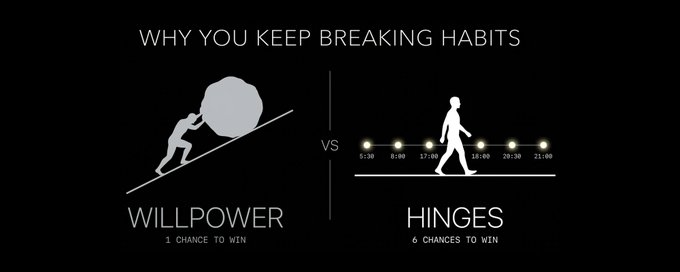
You'd assume the problem is willpower. That you need to force yourself harder. But willpower is effortful and inconsistent. Every morning you "make yourself" do something, your prefrontal cortex has to fight for it all over again.
The fix is to anchor each habit to a specific time, and let an alarm do the deciding. When it fires, you move.
I call those alarms hinges.
I. THE COFFEE SHOP
A few years back, I was chatting with my writing partner Joshua at a coffee shop. I'd just gotten better from a brutal multi-month bout of long COVID. For close to a year, it had taken me hours to get out of bed in the morning. I couldn't exercise. I could barely work. My peak performance habits got completely derailed.

And at the same time, I'd just acquired a new company AND started a full-time PhD. On top of already running a team of sixty people.
So I had to dial in my habits as fast as possible, otherwise these projects would start to topple.
Joshua looked at me and said, "Look, dude. Let's make this simple. What is the one daily habit that makes the rest of your behaviors naturally happen?"
I instantly answered. "Oh, that's easy. Waking up at 5:30 AM and diving straight into flow makes my entire day infinitely more productive. From the moment I started my first business, all my success relied on that one habit."
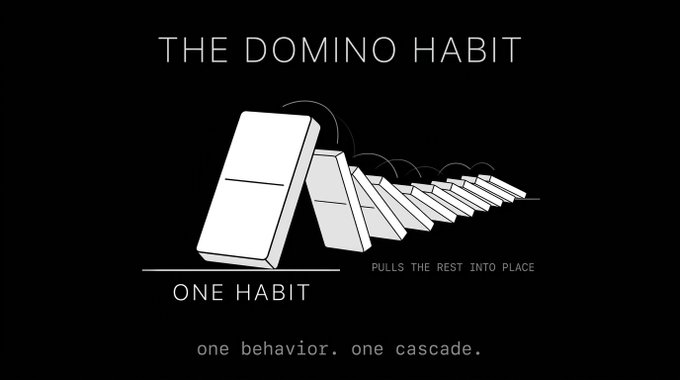
This is what's called a domino habit: a habit that, if done, auto-corrects the rest of your behavior.
A domino habit can be anything, elaborate or simple. Watching the sunrise. Taking a cold shower. Going to bed at a certain time. What makes it a domino habit is that completing it boosts the likelihood that the rest of your positive habits will occur.
The problem was, even after recovering from long COVID, I was still having trouble getting consistent with that domino habit. Staying up too late. Snoozing the alarm. Getting sucked into my phone. You know how it goes.
So I asked Joshua, "How do I ensure I actually DO the domino habit and stick to it relentlessly?"
Joshua thought about it for a second, and then reminded me of the research on temporal landmarks.
(I post daily about flow state, the state of peak performance where you feel and perform your best. Follow @RianSweetDoris if you want to see more of it.)
II. TEMPORAL LANDMARKS
Research from the University of Pennsylvania, led by Hengchen Dai, Katy Milkman, and Jason Riis at the Wharton School, describes temporal landmarks as dates of significance that are distinct from "ordinary" days. Dates that draw a boundary between one era in our lives and another.
This is often the start of a New Year, Mondays, or birthdays.
These landmarks serve as markers in time that can help separate our past selves (who are anchored to suboptimal behaviors) from our future selves (who have the potential to act differently).
Temporal landmarks produce what they call a "fresh start effect." Making people feel more motivated to pursue their goals in anticipation of and right after the landmark.
But there's no inherent reason to wait so long between temporal landmarks.
There are also intra-day temporal landmarks that occur within a 24-hour cycle.
These are the milestones of your day:
- The moment you start work
- The moment you have lunch
- The moment you go to the gym
- The moment you finish eating
- The moment you get ready for bed
- The moment you wake up
By building your habits around these temporal landmarks that occur within your days, as opposed to across weeks or months, you can get a regular fresh start effect which you can leverage to become more consistent.
III. THE HINGE DISCOVERY
Joshua asked, "Have you tried mapping out the temporal landmarks within the 24-hour period BEFORE the domino habit and seeing if observing those temporal landmarks results in you consistently hitting your domino habit?"
I looked at him, thinking he might be onto something.
He asked, "What has to happen within every 24-hour period, and by when, to make sure that no matter what, you hit that domino habit?"
So he starts firing questions:
"First, what time do you have to be asleep to hit that 5:30 AM wake-up?"
"Well, 9:00 PM," I told him.
"And to drift off by 9, when do you need to be in bed?"
"Well, 8:30 PM."
"And to hit the sack by 8:30, what time should you finish dinner?"
I thought about it for a second and mapped it out. "5:00 PM."
We continued the line of questioning until I had identified all of the temporal landmarks within my day.
Then we set alarms on my phone for each. To alert me that a temporal landmark had occurred.
The alarm would act as a trigger, to ensure that I shifted my behavior accordingly. To honor the temporal landmark and move into the next phase of the day. Which keeps me on track to hit the domino habit the next time it rolls around.
Here's what it looked like when we mapped it out:
- 5:30 AM: Wake up + flow
- 8:00 AM: Reboot routine
- 5:00 PM: Finish work
- 6:00 PM: Finish eating
- 8:30 PM: Wind down
- 9:00 PM: Lights out
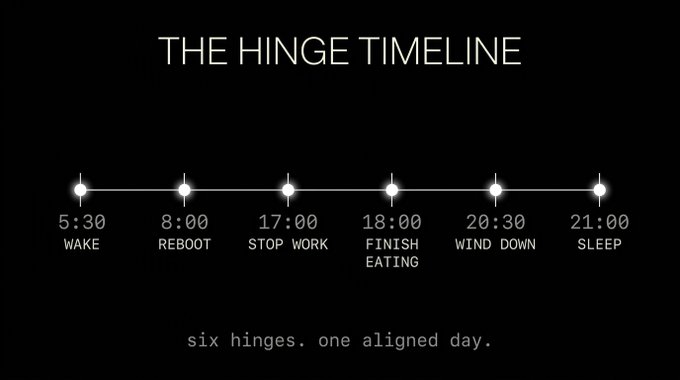
It was like setting up dominoes, and the first one was set to fall at 5:30 AM.
In between each of these alarms are other activities, of course. But those alarms are anchored to the key temporal landmarks that, if hit, ensure the domino habit occurs. For me, waking up at 5:30 AM.
That's when Joshua said, "You wanna stay consistent? Just don't get unhinged."
"What do you mean?" I asked.
> "Your day hinges upon your domino habit. Your domino habit hinges upon the temporal landmarks. And each alarm acts as a hinge. Just as a door swings from closed to open on its hinges, each alarm is a turning point in your day. A moment when you pivot from one activity to another that keeps you on track to hit your domino habit."
Here's the sequence:
Alarm → Temporal Landmark → Start Next Phase Of Day → Hit Domino Habit → Rest Of Behavior Autocorrects
Ever since I put these hinges in place, I haven't missed a single 5:30 AM wake-up.
And it's no surprise this works so well. As research from BJ Fogg at Stanford and Benjamin Gardner at University College London shows, similar to how behavior keys off environmental cues, behavior also keys off temporal cues.
Using time to drive behavior is one of the most underestimated levers on habit formation.
The goal is simple: Never get unhinged.
IV. WHY THIS WORKS
You might wonder: Surely the solution to consistently nailing your high-performance habits each day can't come down to something as trivial as setting a few alarms on your phone. Right?
Let's look at the science.
The alarms you set (the hinges) decrease your cognitive load. The amount of information you're trying to hold in working memory at any given time.
They do this by:
1. Slicing your day into manageable segments. This reduces the strain on your working memory and improves efficiency.
2. Simplifying decision-making. Once you know exactly when to START an activity and when to STOP, it reduces your decision load.
3. Outsourcing time management. They shift time management from an active, conscious process into a passive, unconscious process that automatically occurs.
And the benefits of lowering cognitive load are threefold.
First, when you have a lower cognitive load, you're more present. And this matters because flow state can only occur when you're present and fully focused.
Second, when you reduce cognitive load by setting hinges, you end up with higher flow proneness. You're more susceptible to dropping into flow at any given time.
Third, you free up working memory for the actual work that matters.
Picture it like using a GPS for a road trip. Instead of having to remember every turn, the GPS remembers everything and guides you, letting you focus on driving.
The end destination is your domino habit. The temporal landmarks are every turn that you have to take. And the hinge is the voice on the GPS that tells you WHEN to make each turn to ensure you reach your destination.
(I also put together a 30-day email sequence breaking down the science of peak performance and flow state in more detail. Access it through the link in my bio.)
V. THE THREE-STEP PROTOCOL
So how do you set this up? Three simple steps.
## STEP 1: IDENTIFY YOUR DOMINO HABIT
Identify the one habit that auto-corrects the rest of your day. The one lead domino you want to flick.
Sometimes this domino habit is obvious. It may be morning exercise, meditation, or a focused work ritual. It's different for everyone.
But other times, identifying your domino habit can be tricky or counterintuitive. Maybe you've found that it's something unexpected. Like if you read 90 minutes of inspiring literature, for whatever reason, the rest of your day auto-corrects.
Take some time to think about it. Look back on the periods when you've been most happy, most fulfilled, most productive, and when you've accessed flow state most consistently within your life.
What is the one habit during that time that you rarely or never skipped that caused the rest of your habits to click effortlessly?
Is it a workout? Time with friends? A nap in the middle of the day? Getting up at a certain time? A ritual in nature?
The key is that you find that one habit that you know, when done, makes everything else fall into place.
## STEP 2: REVERSE ENGINEER THE TEMPORAL LANDMARKS
Ask: what is every essential action or transition (temporal landmark) that must happen before and after my domino habit to ensure it happens without fail?
These temporal landmarks might be as simple as "stop working" or "eat dinner."
Sometimes you'll have to stop doing something productive to adhere to your temporal landmark so you can be set up to hit your domino habit for the following day.
For example, sometimes I'm doing something productive at 8:30 PM, and an alarm goes off. Time to get ready for bed.
On aggregate, over a 24-hour period, and then over a week and a month, I'm better off staying on track with the domino habit by adhering to the temporal landmark than ignoring it so I can continue doing something else that's productive.
It's about prioritizing the productivity of your week over your day.
## STEP 3: SET YOUR HINGES (THE ALARMS)
Since you might have alarms for other things, such as meeting reminders, make sure your hinges are distinct. Perhaps using a different sound.
These hinges specifically alert you to the fact that you've reached a temporal landmark. Time to phase shift to stay on track for your domino habit.
Your goal is to turn with each hinge. It's like a spinning top that keeps on spinning.
Aim to establish hinges for:
- When you wake up
- When you go to bed
- When you wrap up work
- Recurring activities like exercise, eating, or breaking a fast
Important: Don't have more than six hinges.
Anything more than six is too complex and disrupts the natural flexibility in your day, or causes you to not adhere to them. You just need the key hinges to keep the day moving and set you up to hit your domino habit again within that 24-hour cycle.
VI. SIX CHANCES TO WIN
What if you miss your domino habit or a hinge?
Simple: just hit your next hinge. You'll be on track for the next 24-hour cycle.
With hinges, you're removing the onus of consistency from the domino habit, and instead transferring it to every milestone that you know leads to the domino habit being hit per 24-hour cycle.
That's the beauty of it:
Rather than having one chance to win in a 24-hour period by hitting your domino habit (which you sometimes miss), you now have six chances to win.
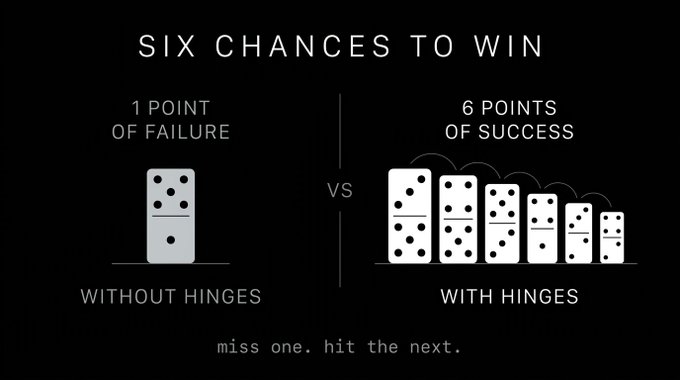
Each hinge is a win. These wins build up to the ultimate win of the domino habit, which results in you nailing your day.
This lowers the stakes, takes the pressure off, and gives you more wins.
## NEVER GET UNHINGED
That's it. No overcomplicated to-do lists. No need to make the habits obvious, attractive, or easy. Just a simple mechanism of using time itself to keep you on track for peak performance every 24 hours.
Your domino habit will become more consistent than ever. You'll be more productive. And you'll get way more access to flow state.
The satisfaction from flow will reinforce the positive feedback loop so strongly that you'll never want to miss a temporal landmark again.
Willpower breaks. Hinges hold.
Just don't get unhinged.
-Rian
If you want one breakdown like this in your feed every week, follow @RianSweetDoris.
## 相关链接
- [Rian Doris](https://x.com/RianSweetDoris)
- [@RianSweetDoris](https://x.com/RianSweetDoris)
- [11K](https://x.com/RianSweetDoris/status/2045586959008215334/analytics)
- [@RianSweetDoris](https://x.com/@RianSweetDoris)
- [@RianSweetDoris](https://x.com/@RianSweetDoris)
- [Upgrade to Premium](https://x.com/i/premium_sign_up)
- [3:35 AM · Apr 19, 2026](https://x.com/RianSweetDoris/status/2045586959008215334)
- [11.5K Views](https://x.com/RianSweetDoris/status/2045586959008215334/analytics)
---
*导出时间: 2026/4/19 11:01:52*
---
## 中文翻译
# 我如何用 6 个闹钟取代意志力(“合页”协议)
**作者**: Rian Doris
**日期**: 2026-04-18T19:35:10.000Z
**来源**: [https://x.com/RianSweetDoris/status/2045586959008215334](https://x.com/RianSweetDoris/status/2045586959008215334)
---

“持之以恒是关键。”
这句话你已经听过一千遍了。但到了周五,你总是熬夜太久、跳过了锻炼,那个你发誓雷打不动的例行公事变成了偶尔才做一次的事。
你会以为问题出在意志力上。觉得自己需要更严厉地强迫自己。但意志力是费力的且不稳定的。每天早晨当你“强迫”自己做某事时,你的前额叶皮层必须重新为此战斗一番。
解决方法是将每个习惯锚定到一个特定的时间,并让闹钟来做决定。当闹钟响起时,你就行动。
我称这些闹钟为“合页(Hinges)”。
### I. 咖啡馆的对话
几年前,我正在咖啡馆和我的写作搭档约书亚聊天。我刚刚从一场持续数月、痛苦不堪的长新冠中恢复过来。在近一年的时间里,我每天早上都要花好几个小时才能下床。我不能运动。我几乎无法工作。我的巅峰表现习惯完全被打乱了。

与此同时,我刚刚收购了一家公司并开始攻读全职博士学位。此外,我还要管理一个 60 人的团队。
所以我必须尽快调整好我的习惯,否则这些项目就要开始崩塌了。
约书亚看着我说,“听着,伙计。我们把事情简化一下吧。那唯一的一个日常习惯是什么?只要做到它,就能让你其余的行为自然发生?”
我立刻回答道,“噢,这很简单。早上 5:30 起床并直接进入心流状态,这让我一整天的效率变得无限高。从我开始创业的那一刻起,我所有的成功都依赖于这一个习惯。”
这就是所谓的“多米诺习惯”:只要做了这个习惯,就能自动修正你其余的行为。
一个多米诺习惯可以是任何事,或复杂或简单。看日出。洗冷水澡。在特定时间上床睡觉。让它成为多米诺习惯的关键在于,一旦完成了它,就能增加你其余积极习惯发生的可能性。

问题在于,即使从长新冠中恢复后,我仍然很难保持这个多米诺习惯的一致性。睡得太晚。贪睡闹钟。陷入手机的泥潭。你知道那种感觉。
所以我问约书亚,“我怎样才能确保我真的**做到**这个多米诺习惯,并坚持不懈地执行下去?”
约书亚想了一会儿,然后提醒我关于“时间地标”的研究。
(我每天都会发布关于心流状态的内容,即那种让你感觉和表现都最好的巅峰表现状态。如果你想看更多,请关注 @RianSweetDoris。)
### II. 时间地标
由宾夕法尼亚大学沃顿商学院的戴恒辰、凯蒂·米尔曼和杰森·里斯领导的研究,将时间地标描述为不同于“普通”日子的重要日期。这些日期在我们生活中的一个时代和另一个时代之间划定了界限。
这通常是一年的开始、周一或生日。
这些地标充当时间标记,可以帮助将我们的过去自我(锚定在次优行为上)与未来自我(有潜力采取不同行动)分离开来。
时间地标会产生他们所谓的“新起点效应”。促使人们在地标前后感到更有动力去追求目标。
但没有内在理由要求我们在时间地标之间等待那么久。
还有一种在 24 小时周期内发生的日内时间地标。
这些是你一天的里程碑:
- 你开始工作的时刻
- 你吃午饭的时刻
- 你去健身房的moment
- 你吃完饭的时刻
- 你准备睡觉的时刻
- 你醒来的时刻
通过围绕这些在一天内发生的时间地标来建立你的习惯,而不是跨越几周或几个月,你可以获得规律的新起点效应,你可以利用它来变得更加一致。
### III. “合页”的发现
约书亚问道,“你有没有试过在多米诺习惯之前的 24 小时周期内,描绘出时间地标,看看遵守这些时间地标是否能让你持续达成你的多米诺习惯?”
我看着他,觉得他可能发现了关键所在。
他问道,“为了确保无论如何都能达成那个多米诺习惯,在每个 24 小时周期内必须发生什么,以及必须在什么时候发生?”
于是他开始抛出问题:
“首先,为了赶上那个 5:30 的起床时间,你必须在什么时候睡着?”
“嗯,晚上 9:00,”我告诉他。
“为了在 9:00 入睡,你需要在什么时候上床?”
“嗯,晚上 8:30。”
“为了在 8:30 上床,你应该在什么时候吃完晚饭?”
我想了一会儿并规划了一下。“下午 5:00。”
我们继续这种提问,直到我确定了一天中所有的关键时间地标。
然后我们在我的手机上为每个地标设置了闹钟。以提醒我一个时间地标已经出现了。
闹钟将充当触发器,确保我相应地转变我的行为。尊崇时间地标并进入一天的下一个阶段。这让我保持在正轨上,以便下一次多米诺习惯出现时能达成。
当我们把它规划出来时,它是这样的:
- 5:30 AM: 起床 + 心流
- 8:00 AM: 重启例程
- 5:00 PM: 结束工作
- 6:00 PM: 进餐结束
- 8:30 PM: 放松
- 9:00 PM: 熄灯

这就像是在设置多米诺骨牌,第一张骨牌被设定在早上 5:30 倒下。
当然,在这些闹钟之间还有其他活动。但这些闹钟锚定在关键的时间地标上,如果达成,就能确保多米诺习惯的发生。对我来说,就是早上 5:30 起床。
那时约书亚说,“你想保持一致性吗?千万别‘脱轨’。”
“你是什么意思?”我问道。
> “你的一天取决于你的多米诺习惯。你的多米诺习惯取决于时间地标。而每一个闹钟都充当一个合页。就像门在合页上从关闭摆动到开启一样,每个闹钟是你的一天中的一个转折点。一个你从一个活动转移到另一个活动的时刻,从而让你保持在达成多米诺习惯的轨道上。”
顺序是这样的:
闹钟 → 时间地标 → 开启下一阶段 → 达成多米诺习惯 → 其余行为自动修正
自从我设置了这些合页,我就没有错过一次 5:30 的起床。
这之所以奏效并不令人惊讶。正如斯坦福大学的 BJ Fogg 和伦敦大学学院的 Benjamin Gardner 的研究所示,就像行为会因环境线索而触发一样,行为也会因时间线索而触发。
利用时间来驱动行为是习惯形成中最被低估的杠杆之一。
目标很简单:永远不要“脱轨”。
### IV. 为什么这有效
你可能会想:当然,每天持续达成你的巅峰表现习惯的解决方案,不可能归结为像在手机上设置几个闹钟这样琐碎的事情。对吧?
让我们看看科学原理。
你设置的闹钟(合页)降低了你的认知负荷。即你在任何给定时间试图在工作记忆中保持的信息量。
它们通过以下方式做到这一点:
1. 将你的一天切成可管理的片段。这减少了工作记忆的 strain(负担)并提高了效率。
2. 简化决策。一旦你确切知道何时开始一项活动以及何时停止,它就会减少你的决策负荷。
3. 外包时间管理。它们将时间管理从主动的、有意识的过程转变为被动的、无意识的、自动发生的过程。
降低认知负荷的好处是三方面的。
首先,当你认知负荷较低时,你会更专注当下。这很重要,因为只有当你专注于当下并全神贯注时,心流状态才会发生。
其次,当你通过设置合页来减少认知负荷时,你的心流倾向会最终变高。你在任何给定时间都更容易进入心流。
第三,你释放了工作记忆用于真正重要的工作。
把它想象成开车时使用 GPS。你不必记住每一个转弯,GPS 会记住一切并引导你,让你专注于驾驶。
最终目的地是你的多米诺习惯。时间地标是你必须采取的每一个转弯。而合页就是 GPS 上告诉你**何时**进行每个转弯以确保到达目的地的声音。
(我还整理了一个为期 30 天的电子邮件序列,更详细地分解了巅峰表现和心流状态的科学原理。通过我个人简介中的链接访问。)
### V. 三步协议
那么你如何设置这个?三个简单的步骤。
#### 第一步:识别你的多米诺习惯
识别那个能自动修正你一天其余部分的习惯。你想要推倒的那张首张骨牌。
有时这个多米诺习惯是显而易见的。它可能是晨练、冥想或专注的工作仪式。这因人而异。
但有时,识别你的多米诺习惯可能很棘手或反直觉。也许你发现那是意想不到的事情。比如,如果你读了 90 分钟鼓舞人心的文学作品,无论出于什么原因,你一天的其余部分都会自动修正。
花点时间想一想。回顾一下你最快乐、最满足、最高效的时期,以及你在生活中最持续地进入心流状态的时期。
在那段时间里,那个很少或从未跳过的习惯是什么?是它让你其他的习惯毫不费力地就位了?
是锻炼吗?和朋友在一起的时间?中午的小睡?在特定时间起床?在大自然中的仪式?
关键是你找到那个你都知道,只要做了它,其他一切都会到位的习惯。
#### 第二步:逆向推导时间地标
问一下:在我的多米诺习惯之前和之后,必须发生哪些每一个必要的行动或转变(时间地标)以确保它万无一失地发生?
这些时间地标可能简单到“停止工作”或“吃晚饭”。
有时你必须停止做某件富有成效的事情来遵守你的时间地标,这样你才能为第二天的多米诺习惯做好准备。
例如,有时我在晚上 8:30 正在做富有成效的事情,闹钟响了。该准备睡觉了。
总的来说,在 24 小时周期内,然后是一周和一个月内,通过遵守时间地标来保持多米诺习惯的正轨,比忽略它以便我继续做其他富有成效的事情,对我更有利。
这是要优先考虑你一周的生产力,而不是你的一天。
#### 第三步:设置你的合页(闹钟)
既然你可能已经有其他事情的闹钟,比如会议提醒,请确保你的合页是独特的。也许使用不同的声音。
这些合页专门提醒你已经到达了一个时间地标。是时候进行阶段转换以保持在多米诺习惯的正轨上了。
你的目标是随着每个合页转动。这就像一个不断旋转的陀螺。
旨在为以下情况建立合页:
- 你醒来时
- 你睡觉时
- 你结束工作时
- 重复性活动,如锻炼、进食或结束断食
**重要提示**:合页不要超过六个。
超过六个就太复杂了,会破坏你一天的自然灵活性,或者导致你无法遵守它们。你只需要关键的合页来保持一天的运动,并为你在这个 24 小时周期内再次达成多米诺习惯做好准备。
### VI. 六次获胜的机会
如果你错过了你的多米诺习惯或合页怎么办?
很简单:只需达成你的下一个合页。你将在下一个 24 小时周期内回到正轨。
有了合页,你将一致性的责任从多米诺习惯转移到了你知道的每个里程碑上,这些里程碑会导致在每 24 小时周期内达成多米诺习惯。
这就是它的美妙之处:
与其在 24 小时周期内只有一次通过达成多米诺习惯来获胜的机会(这有时会错过),你现在有六次获胜的机会。

每个合页都是一次胜利。这些胜利累积成多米诺习惯的最终胜利,从而让你搞定这一天。
这降低了风险,减轻了压力,并给了你更多的胜利。
## 永远不要“脱轨”
就这样。没有过度复杂的待办事项清单。不需要让习惯变得明显、有吸引力或容易。只是一个简单的机制,利用时间本身让你在每 24 小时内保持在巅峰表现的正轨上。
你的多米诺习惯将变得比以往任何时候都更加一致。你会更高效。你将获得更多进入心流状态的机会。
来自心流的满足感将如此强烈地强化正向反馈循环,以至于你再也不会想错过一个时间地标。
意志力会崩塌。合页会坚持住。
只要别“脱轨”。
-Rian
如果你想在你的动态中每周获得一次这样的拆解,请关注 @RianSweetDoris。