# The Daily Planning Routine For Maximum Creativity & Productivity
**作者**: Dickie Bush
**日期**: 2026-08-21T15:13:39.000Z
**来源**: [https://x.com/dickiebush/status/2090819629916831745](https://x.com/dickiebush/status/2090819629916831745)
---

The single most powerful skill you can have as a business owner:
Planning what to work on, then executing that plan.
You can have all the marketing skills, sales skills, and product skills in the world, but if you point them in the wrong direction, you will stay stuck despite being constantly “busy.”
I learned this the hard way two different times in my entrepreneurial journey:
- First, back in 2020 when I began to write online as a side hustle while working on Wall Street
- Second, when I quit that job in 2022 to go all in on building my own business
Now, what did both of these times have in common?
They both involved:
- Me starting a new initiative, with lots of excitement but no real plan
- Me having an infinite number of things I could work on for that initiative, but having limited time & energy to invest in them
- Me being 100% responsible for whether or not they were moved forward on a daily basis
The only thing that was different was the scope.
While I worked on Wall Street, I only had 6 hours per day to build my side hustle. 3 hours in the morning from 4:30 AM to 7:30 AM, and 3 hours in the evening from 6:30 PM to 9:30 PM. Because of how little time I had, I needed to invest it only in the most important tasks.
When I quit that job, I suddenly had 12 hours per day to build my business. But that made my ability to plan & execute even more important, because I lost the natural prioritization constraint that my full-time job created. Having more time didn’t immediately make me more productive, so I had to adjust my approach.
During both of these times, I remember struggling without a framework for choosing what to work on and when to work on it. At my W2 job, people mostly told me what to do, and my calendar was mostly decided for me. But as a business owner, even if it’s a side hustle, you decide what to work on & whether or not it ends up growing.
As a result, I spent a ton of time either working on the wrong thing, or procrastinating working on the right thing.
But over time, through tons of trial and error, I’ve developed a simple planning system and daily routine that allows me to:
- Concisely see all of the things I’m working on
- Prioritize those things in order of their importance
- Go to bed with clarity on exactly what I’ll do tomorrow
- Wake up with excitement to work on what I have planned
And that system is what I’m going to share with you today.
We’re going to cover:
- The only 5 types of activities you can do in your business
- How to operate your entire business with just 4 bulleted lists
- 6 mistakes to avoid when planning your day
- The 30-minute weekly strategy routine that makes sure you’re working on the right things
- The 10-minute daily planning routine that lets you wake up and execute on the most important activities
And at the end, I’ve put together a full weekly and daily planning template + prompt you can use to fully execute what you learn today.
# All you have to do to get it is like this post and leave a comment with the word ROUTINES and I’ll send it your way.
Now let’s get into it.
# 1. There are only 5 types of activities you can do in your business
When you run your own business, there is no shortage of things to work on.
Unfortunately, most of these things are a waste of time. A few of them are worth a little bit of time. And an extremely select few are worth all of your time.
And one of the most important jobs you have a business owner is figuring out where each thing could work on falls on that spectrum.
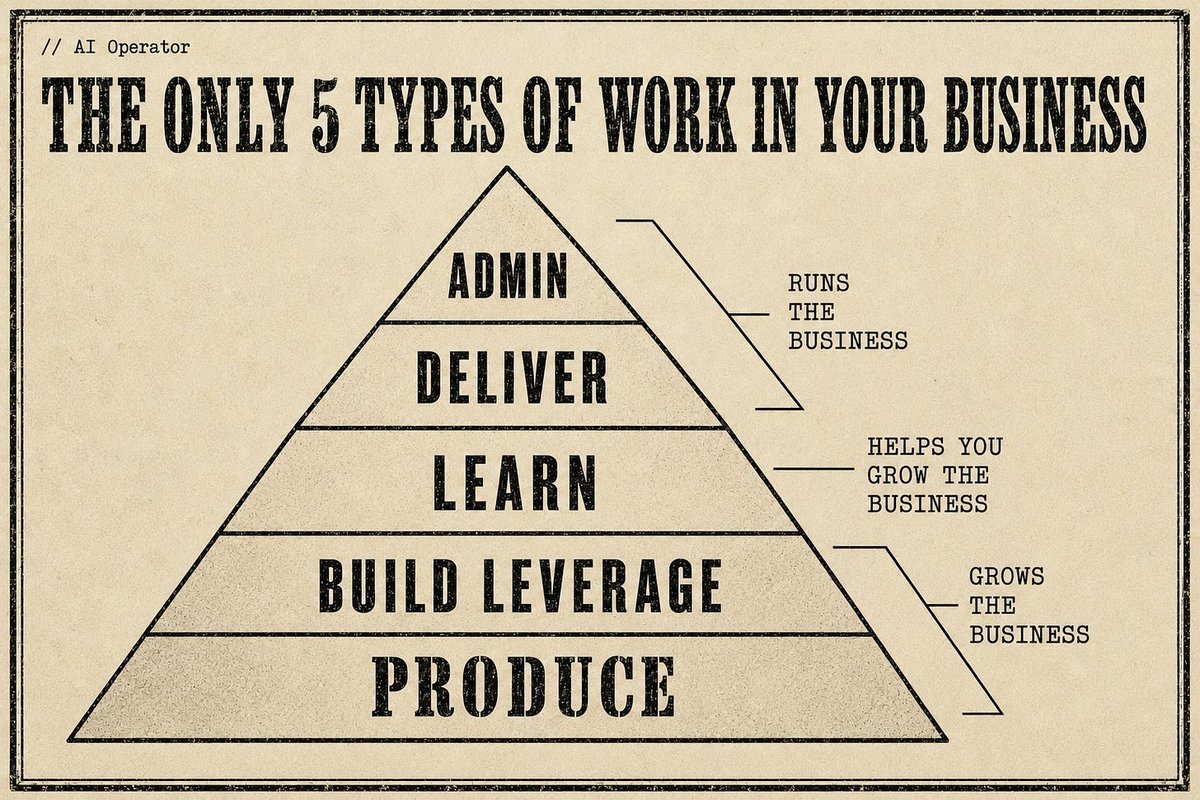
Luckily, while the number of things you could do is infinite, the types of work fall neatly into 5 buckets:
1. Produce
2. Build Leverage
3. Learn (to do 1 & 2 better)
4. Deliver
5. Admin
Let’s take a closer look at each one.
# 1. Produce
Producing is the first and most important type of work you can do.
I use the word “produce” but you could replace it with:
- Build
- Make
- Create
- Advertise
- Write
- Film
- Edit
Anything that puts something out into the world that can help grow your business.
Depending on the business you run, this could be:
- Writing ads
- Filming ads
- Writing software
- Taking sales calls
- Doing cold outreach
- Writing a newsletter
- Hosting a live training
- Creating a lead magnet
- Writing a LinkedIn post
- Writing an email sequence
- Scripting a YouTube video
- Filming a YouTube video
- Editing a YouTube video
- Recording a course lesson
- Making an Instagram Carousel
- Creating a slide deck for a presentation
The only criteria for something to be production:
1. It must directly lead to NEW revenue for YOU
2. It must create an asset that didn’t exist before
If it fails either of these criteria, it is not production. It may still be worth doing, but it will not be the most important thing you can do to grow your business.
Over time, your goal in business is to focus as much of your time as possible toward production. But you can only produce so much in a day, unless you add leverage. And that takes us to the second type of work.
# 2. Build Leverage
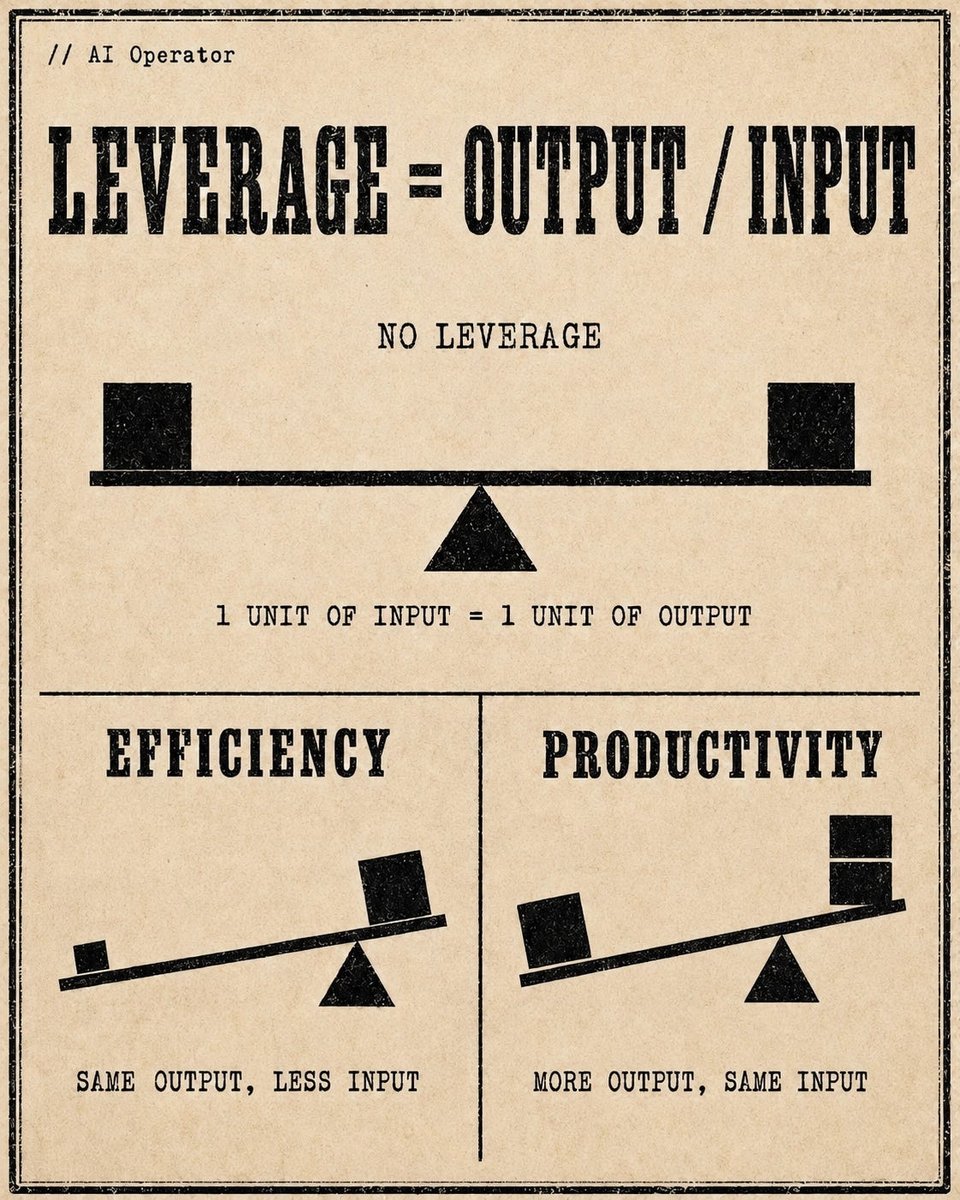
The definition of leverage is output per unit of input.
So when you build leverage, you are either:
- Creating something that will lead to more output with the same input (Productivity)
- Creating something that will lead to the same output with less input (Efficiency)
And the most common types of business leverage are:
- SOPs (Standard Operating Procedures) — Documented instructions that let someone run a process the same way every time. You think through something once, document it, and never think about it again.
- Automations — Software that executes a process automatically without anyone doing it.
- Employees (or Agents) — People (or AI) you train to produce or execute without you.
Let’s look at a few combinations of each.
Efficiency
- SOP → You document your podcast publishing checklist. The episode gets published (the output) but now it takes you 5 minutes to do it without thinking, rather than trying to remember every step and it taking 30 minutes.
- Automation → You build a Zapier/Kit automation to add new purchasers to your course directly, send them an onboarding email, and start a delivery sequence. Rather than having to do those manually for every customer, they now happen automatically. Same output, way less input.
- Employee → You hire a VA to handle your support inbox & post your social media content. You used to handle both of these, but now someone else does. So you get the same output (emails are answered, content is posted) but without using your time.
Productivity
- SOP → You build a repurposing checklist that takes your newsletter and turns it into short-form content, a LinkedIn carousel, an X article, an Atomic Essay, and a YouTube script. Now you get 5-10x the number of impressions and posts from the same amount of production.
- Automation → You build an outreach system that pulls each prospect’s recent posts & background, drafts a personalized first line, and preps the message for you to tweak. You used to spend an hour doing outreach and send 10 messages, now in the same hour you can send 50.
- Employee → You hire a short-form video editor to pull clips from your long-form YouTube. Every YouTube video or podcast you were already making now also gets you 10 short-form clips.
Now you might be thinking, what’s the difference between production and building leverage?
Production creates assets that generate revenue.
Leverage creates assets that multiply production.
And when you’re running your own business, you need time to work on both.
If you spend all your time producing, but no time building leverage, your production ability will stay capped, which will limit your growth.
If you spend all your time building leverage, but no time producing, you will not have any assets that produce revenue, which again will limit your growth.
These two activities are the most valuable uses of your time as a business owner.
And the third involves getting better at these two.
# 3. Learn (to do 1 & 2 better)
If producing & building leverage are the two most important activities in your business, learning to do them more effectively is the third most important activity.
Examples of this include:
- Reading books
- Consuming course material
- Reading a curated Twitter list
- Watching educational YouTube
- Paying for 1:1 or group coaching
- Reading newsletters (like this one!)
- Talking to people in a mastermind
Anything where you are taking in information that changes your behavior in the future.
Now, this is also the activity that most people get wrong, in multiple ways:
- They consume something, but then do nothing different as a result. This is not learning, as learning requires you to do something different than you would have done before learning it. If this does not happen, you were simply being entertained.
- They spend time “learning” before they produce or build leverage. They open up YouTube, or a course, or Twitter, telling themselves “I’m learning, this is productive!” But this is nothing but procrastination disguised as productivity. Before you start learning new information, you need to spend time acting on the information you already have. Then, once you have produced and built leverage, you “earn” the ability to learn something new.
- They “learn” something that is not directly helping them get better at producing or building leverage. Again, this might as well be entertainment. There’s a time and place for it, but you should make sure what you’re consuming directly leads to better production or more leverage.
Learning is an important daily activity. But only once you’ve produced & built leverage. And only when you’re being intentional with what you’re learning.
# 4. Deliver
The first 3 activities we walked through are the only 3 things you can do to grow your business.
- You can produce something that leads to revenue
- You can build leverage to better produce things or free up time for production
- You can learn how to build leverage or better produce things
Everything else we will cover from here simply keeps the business running.
And if you only ever spend time doing things that keep the business running, your business will not grow. And if your business is not growing, it is slowly dying.
So the first thing you must do to keep your business running is to deliver on the product or service you sell.
Depending on the [type of monetization method you’re operating](https://aioperatornewsletter.substack.com/p/full-guide-digital-monetization-methods), this could look like:
- Hosting a live cohort session
- Fulfilling on a client deliverable
- Writing client emails or social posts
- Onboarding a new client or student
- Holding 1:1 coaching / consulting calls
- Answering questions in your community
Importantly, not all methods have a “delivery” block. And that is a feature of the method (and a conscious choice one could make in their method selection).
- (Delivery-intensive) Agency services, 1:1 consulting, hybrid group coaching, cohort-based experiences, and paid communities all require you to take calls/answer questions from clients.
- (Delivery-light) Software, paid newsletters, digital products all require almost no delivery, other than engaging with customers’ comments & questions.
Ideally, you are able to “batch” these delivery activities during certain days of the week, or during certain times of the day, AFTER you have produced, built leverage, and learned something. If you do not block time to batch your delivery, it will slowly expand to eat all of your time.
For example, I take 90% of my calls on Mondays. I try to batch as much delivery as possible onto those days, which frees up the rest of my week. If I absolutely must take another call, I have a two-hour block on Thursday afternoons. The rest of my week stays completely free of live delivery, so that I can focus on production, building leverage, and learning.
Delivery is a required part of running your business. But do not let it consume every part of your day. If you’re a morning person, batch it at the end of the day and spend your morning producing. If you’re an evening person, batch it at the beginning of the day and spend your afternoon producing.
If you want your business to grow, you need to build your delivery AROUND your production, not the other way around.
# 5. Admin
Last but not least, the Admin bucket is where everything else falls that:
- Doesn’t produce new revenue
- Doesn’t make production easier
- Doesn’t teach you anything new
- Doesn’t deliver on a product or service you sold
It’s all of the boring stuff that no one wants to do, but someone needs to do.
Examples include:
- Sending invoices
- Booking travel plans
- Filling out forms of any kind
- Answering your email or DMs
- Updating passwords and logins
- Bookkeeping & categorizing financials
- Scheduling meetings with other people
- Responding to your lawyer or accountant
- Confirming a podcast guest appearance
The best practice for these Admin activities: if it must be done, batch it at the end of the day. And if it can be done by someone else, it’s an opportunity to build leverage.
And that covers the 5 core types of work. But there are two more bonus activities that don’t belong on the daily list: one that directs all five, and one that makes all five sustainable.
# (Bonus) Strategize
I’ve broken this one out as a bonus because it’s not something you need to do every single day, but it is important to do often.
Strategic allocation is deciding what you should produce, what to build leverage on, and what to learn. It sets the direction for how you will spend your days. Without it, you can spend weeks, months, or even years working on the wrong thing.
However, strategizing is not something to do constantly. If you’re rethinking your direction on a daily basis, you are giving up the compounding benefits of choosing one direction and working on it consistently.
Strategizing is ideally done:
- Outside of a normal working session
- Away from your normal working environment
It requires a completely different type of thinking than the work you most often do at your desk. So I like to switch the context & environment entirely for my strategic thinking, usually on Friday afternoons in a new cafe.
When we get to the Weekly Planning section, I’ll walk you through exactly how to do this strategic thinking.
# (Bonus) Rest/Recovery
Lastly, you are only able to produce, build leverage, learn, deliver, and keep your business running when you have enough energetic capacity.
I don’t need to turn this piece into a full guide to rest & recovery. But I’ve been someone who had seasons completely deprioritizing it, which was a mistake. Do that for too long and you end up burnt out, unable to operate at your best, all while running a business that is 100% dependent on you.
Rest & recovery best practices will differ for everyone, but I have a “recovery routine” that allows me to fully recharge my brain, motivation, and ability to think.
To build that routine, I started with inversion: what is something I would find very unrestful?
That would involve:
- Having a swirling list of open loops in my brain that are hogging all of my mental bandwidth
- Having even more information thrown at me that further overloads my brain with information
So for me to rest & recover (on both a daily and weekly basis), I simply:
- Make sure all of my lists and tasks are up to date
- Remove myself from technology entirely
And the planning routines we walk through later are designed specifically to make my weekends and my evenings as restful as possible by getting everything out of my head and onto the page.
Now you understand all the types of work you can do inside your business. You know the types that grow it, and the types that maintain it. And on any given day, you’ll have dozens of possible tasks across all 5 buckets competing for your attention, plus a hundred or more swirling around in your head. So now, you need somewhere to put them all.
And to do that, you only need 4 lists.
# 2. You can operate your entire business with just 4 lists
I’ve read every type of productivity book out there.
And I always come back to the simplest version of [Getting Things Done](https://www.amazon.com/Getting-Things-Done-Stress-Free-Productivity/dp/0142000280), which involves making 4 lists:
1. Project List
2. Later List
3. Next Actions List
4. Open Loop List
Let’s look at each one, what goes on it, and how they work together.
# List #1: Project List
This is a list of everything you’re working on inside your business right now, that requires more than one action to complete.
Looking at each part of that definition:
- You can define right now however you’d like, but I think of my Project List as anything that I will move forward this week.
- And something that requires more than one action is mostly just to keep short, easily-completable tasks off your Project List.
When you make your Project List, every project should start with a verb that signals action.
For example, my current project list looks like:
- Write weekly newsletter
- Film weekly YouTube video
- Build new CRM workflows & documentation
- Build new SOP for repurposing my weekly newsletter
- Set up new [AI Writing Skool](http://aiwritingskool.com/) Sprint infrastructure
Each of those are projects that start with a verb, take more than one step to complete, that I will work on this week. And they should map to one of the 5 categories for types of work you can do. However, the majority of your projects should be Produce or Build Leverage. If your project list is dominated by Deliver or Admin, you need to audit your priorities.
It’s fine to keep “recurring” projects on this list as well, as you’re going to repeat (and complete) them every week.
In terms of length, having more than ~7 active Projects at any given time likely means you are unfocused. It’s hard to move forward that many things in a given week, so I would use that as a rough prioritization guideline.
And one last reminder: the first list you make will be roughly 3x too long, and it’s only through making this list that you realize how thinly spread you’ve been operating.
To focus in on the few projects that matter, you need to move some to the Later List.
# List #2: Later List
The Later List has the same “types” of work as the Project List, except you’re not working on them right now.
This is a “catch all” list where you can put anything that is:
1. Coming up in the next few weeks
2. Something you might want to pursue in the future
Reviewing your Later List is part of the Weekly Review, during which you can promote something to your Project List if you plan on working on it that week.
Importantly, your Later List should be significantly longer than your active Project List. If that is not the case, chances are you are trying to do too many things at once.
For example, my Later List includes:
- Run End of Month finance reporting
- Run a webinar for AIWS free trial/$800/year combo
- Run a bootcamp on Personal Finance
- Hire a new short-form video editor
- Build segmentation into my Substack newsletter
- Build and setup a LinkedIn Newsletter
- Build an AIWS internal referral program
- And lots of other things I just check on there.
At the end of every week where I update my Project List, some of the things on my Later List get promoted. Others sit there for a while just in case I may want to do them in the future. And others get removed entirely after realizing I don’t actually need or want to do them.
And once I’ve fully built these lists, it’s time to move them forward by defining their Next Actions.
# List #3: Next Actions List
The Next Actions List (or to-do list if you want to keep it simple) is the list of actions that drive forward each of your projects.
For simplicity, I define a Next Action as something that can be completed in one sitting or work block. The “Getting Things Done” version says to make it the smallest possible next action, but I find it annoying to write so many small things down.
Every project has a set of tasks that move it closer to completion. And each of them goes on the Next Actions list. You can put 7 Next Actions for a project on the list if you’d like, or you can just put one (the literal Next Action).
This is the list you will pull from when sitting down to figure out what you should do on any given day.
For example, going into this week my Next Action list looked like:
- Write weekly newsletterBrain dump 10 bullets on newsletter Create full newsletter outline Draft newsletter from outline Copy edit newsletter Publish newsletter Run lean writing distribution flow
- Film weekly YouTube videoTweak script from written newsletter into YouTube script Record video Document editing ideas, title, and posting logistics
- Build CRM workflows for AI Writing SkoolDocument current zap system
- Build repurposing SOP for my newsletterReview Cole’s current SOP to see what I can tweak/add
- Set up Sprint infrastructureWrite out list of elements to include in this Sprint Create infrastructure hub with full build order
As you can see, for some of these (where I know all of the steps), I can put all of the Next Actions on one list. And for those that will be a bit bigger of a lift, I just put the first Next Action that would allow me to build momentum on it.
And as I take action on each of these, one of two things happens:
- I complete the action and move onto the next one
- Completing the action creates an Open Loop that is blocking me from moving forward
And those Open Loops get their own list, our last and final one.
# List #4: Open Loop List
The Open Loop List is anything that you are waiting for before you can take the Next Action.
This is by far the most important list to get out of your head and onto the page. Otherwise, these Open Loops will hog all of the mental bandwidth that you could instead spend on producing or building leverage. By putting these loops on a separate list, it gives you a place to scan at the end of the day to see if there’s anything that has been open too long. If you’ve been waiting for something longer than necessary, you can add a Next Action to follow up on that thing the next day.
For example, let’s say this morning you had a Next Action that was Film YouTube Video. Once you’ve completed that and sent it off to the editor, there is nothing you can do to move the project forward until the editor gets back to you with a V1. If you let that “open loop” float around in your head, you will operate with slightly less cognitive bandwidth because your brain is trying to keep track of the status of that project. Instead, you want to “close the loop” by adding “Waiting on editor to return with V1 draft” to your Open Loop list. There’s a good chance they will come back to you without you having to check in, which is why this goes on Open Loops and not Next Actions.
A few of my recent Open Loops included:
- Waiting to hear back from VA staffing agency on contract
- Waiting for V1 of my next YouTube vid
- Waiting for response from tax lawyer on structuring question
- Waiting for VA to respond with software cancellation confirmation
Each of these “opened” immediately after I took an action. And until they are resolved, I cannot take another action. Once they’re resolved, I get a new thing to work on, and I remove the Open Loop from my list.
Alrighty, so far we’ve covered:
- The types of work you can do in your business
- How to organize that work into projects & next actions
With these frameworks covered, we can now get tactical with how to turn them into a daily plan that drives your business forward.
But before we get into the step-by-step process, let’s talk about a few mistakes to avoid.
# 6 Mistakes To Avoid When Planning And Executing Your Day
What follows is a list of hard-earned mistakes I’ve made after 6 years of running my own business, plus multiple years of consulting my students on running theirs.
And those 6 mistakes are:
1. Not planning your day at all
2. Doing something other than producing first thing
3. Building leverage on things that don’t need leverage
4. “Learning” something that isn’t directly growing your business
5. Having more than one thing to produce the next day
6. Adding everything to your project list & everything to your next action list without any prioritization
# 1. Not planning your day at all
If you’re reading this, you’re already on the right path to avoiding this mistake.
Too many business owners go to bed with no clue what they will do tomorrow. And as a result, they wake up and lose their day to the whims of clients, admin, and algorithms telling them what to do. 10 hours go by, they spent the entire time “working,” and yet nothing got done.
And if you want your business to grow, this is not a sustainable way to operate.
So take the 10 minutes each day at the end of your work day to plan the next day. When you define the day, and what winning the day looks like, it will be much easier to wake up and execute. And the momentum of one day feeds the next, and then the next, and on and on you go down the path of progress.
# 2. Doing something other than producing first thing
Production is what allows your business to keep growing.
And as your business grows, more and more things will pop up that compete with production for attention. The second you stop making this the main thing you focus on accomplishing each day, your business will slowly stop growing. It won’t stop growing overnight, but a year will go by where you’ve filled your most creative and productive hours with things that do not move the needle.
So do not make this mistake.
Build your entire day around making sure that something is produced. Fight to protect this time. Otherwise, the endless list of tasks that feel productive but don’t grow your business will dominate your working hours, and your business will slowly die as a result.
# 3. Building leverage on things that are unnecessary
Before you build leverage on something, you should first ask if it’s something worth doing.
Too many people waste time automating, organizing, or hiring for things that are not critical functions in their business.
Again, this feels productive, which is why it’s dangerous.
- You’re hiring someone, that must mean you’re growing!
- You’re building an AI dashboard, that must mean you’re saving time!
- You’re creating a zap that sends you notifications, that means you’re being more efficient!
Unfortunately, most of this is a waste of time.
Before you spend time building leverage, ask yourself: is this going to directly make my ability to produce more productive or more efficient?
If it isn’t, move it to the Later List and get back to work on things you know will lead to growth.
# 4. “Learning” something that isn’t directly growing your business
Here’s a harsh truth:
Most of the time you think you’re learning, you’re actually just being entertained.
Once again, these activities feel productive, but they are not driving your business forward.
So make sure what you are learning is something that is directly helping you produce more, or build better leverage. Otherwise, you are engaging in “productive procrastination.”
And also, make sure you are not “learning” before you’ve produced & built leverage on any given day. Starting the day with YouTube will feel productive, but it’s better to start with acting on the information you already have on the activities you already know will grow the business.
Then, once those are completed for the day, you can start to consume new information.
# 5. Having more than one thing to produce the next day
This is by far the biggest mistake I’ve made personally, and therefore the one I fight hardest to avoid.
The most important part of my productivity routine is having ONE thing to produce the next morning. Not two. Not three. Not zero. ONE.
Having one thing allows me to go to bed with one problem for my subconscious to think on overnight. And this overnight subconscious thinking time is where all of my creative breakthroughs come from.
As I am writing this newsletter, I went to bed with the ONE thing to produce the next day being this section of the newsletter.
Every single time I do this, I wake up with elite clarity on exactly what I want to say. I drop into flow state significantly faster. Social media and other cheap sources of dopamine are not appealing to me because I’m itching to write down the ideas that came to me overnight.
So please, trust me on this one. When we get into the planning section, take the ONE BIG THING part seriously.
Watch your creativity & productivity skyrocket as a result.
# 6. Adding everything to your project list & everything to your next action list without any prioritization
Finally, the last mistake to avoid is thinking you can do everything.
The Later List exists for a reason. We only have so much time and attention to invest on a daily basis. Therefore we should be intentional with the select few things we invest them into, putting everything else on a different list for us to revisit later.
So as we get into the planning section, be ruthless in protecting the few slots you have on your Project List and Next Action list, and be liberal with moving things off of them.
Now let’s get into the tactics of setting up your day for success.
To do that, we need to start with one Weekly Planning session that gets your lists up to date. This is your strategic thinking time where you step out of executing and step into deciding what to execute.
Once we’ve done that, we can execute the Daily Planning routine for the rest of the week until we need to reset with more Strategic Allocation.
# Your 5-Step Weekly Planning Routine
The goal of your Weekly Planning routine is simply to get your lists up to date.
Having these up to date is what allows you to only spend a few minutes per day planning your day. When these are stale, you’re constantly spending time each day figuring out what to do and if you’re working on the right things. By separating this type of thinking out into its own container each week, you can be more efficient with your daily planning.
I like to do this on Friday afternoon at the end of the work week, which lets me go into the weekend without any open loops swirling around in my brain. Then I can hit the ground running on Sunday (my favorite work day) with a clear list of actions to take.
The whole routine is 5 steps. The first time you do it, it might take you an hour. Once you’ve done it a few times, you can do it in 30 minutes or less.
The 5 steps are:
1. Recap what happened last week
2. Clarify your current bottleneck
3. Update your Project List & Later List
4. Update your Next Actions list
5. Update your Open Loops list
# Step 1: Recap what happened last week
Make a quick brain dump list of everything you completed and moved forward. This helps you recognize what is done and what is still open as you go into the next week.
# Step 2: Clarify your current bottleneck
To make sure you’re aligning your projects on the right things, ask yourself:
“What is the one thing that is most limiting the growth of my business right now?”
Depending on your business type and your business stage, this could be:
- I am not generating enough new leads
- I am not getting enough email subscribers
- I have no backend product to sell my current customers
- I am spending all of my time in delivery and have no time for production
- No one on my email list is buying my product
- I am not converting any of my sales calls
Importantly, this needs to be ONE thing. By definition, you cannot have more than one bottleneck. You can have lots of problems and lots of opportunities within your business. But you only have one thing that is limiting the growth, and that is where you need to invest your time & energy.
For example, the bottleneck in our business right now is the number of new people on our email list each week. If that number was 3x what it is right now, our revenue would 3x. Nothing else matters except making this number go up.
With your bottleneck identified, you can now update your Project List & Later List.
# Step 3: Update your Project List and Later List
Starting with your Project List from last week:
- Remove anything that is completed
- Add anything that you’ve recently started
- Review your Later List and add anything that needs to be worked on this week
- Demote anything that is not either working on the bottleneck of your business, or keeping your current business running, to the Later List
This should take no more than a couple minutes. And you should feel a sense of clarity looking at the few things you are responsible to move forward this week.
# Step 4: Write Next Actions for every active project
Every active project gets at least one next action.
Again, if you have full clarity on all of the steps, you can add all of them. Or if you just know the next action you can take, add that one.
# Step 5: Sweep your Open Loops
Lastly, run down your Open Loops list to clear it out:
- Resolved → delete it, no longer needed
- Still waiting on it → keep it
- Open too long → add a next action to follow up on it
This should take under two minutes and leave your brain feeling calm and focused without anything hogging bandwidth in the background.
Your entire Weekly Planning routine might take an hour or more the first time, but over time you will get more efficient with it.
And once completed, you head into the next week with:
- A clear, high-impact Project List
- All other things you could pursue on the Later List
- A clear list of actions you can take next time you work
- An organized list of open loops that allow you to focus on the things you can move forward
Just doing this exercise on a weekly basis will lead to you being more productive and effective on a daily basis.
But where it gets even more powerful is connecting it to the Daily Planning routine.
# Your 5-Step Daily Planning & Execution Routine
Everything we’ve covered so far comes together in the last 10 minutes of your workday.
- We’ve covered the 5 types of work, and you know that production comes first
- You are armed with 4 types of lists that keep all of your work organized
Now, all you’re going to do is allocate them in the order you’ll work on them.
Looking at all 5 steps, you are going to:
1. Fill in your Gameplan section
2. Fill in your One Big Thing section
3. Fill in your Build Leverage section
4. Fill in your Learn section
5. Fill in your 1-off section
So before you begin, you start with 5 separate headers:
- Gameplan
- ONE BIG THING
- Build Leverage
- Learn
- 1-off
If you’re doing this by hand, you can space them out across a page like this:
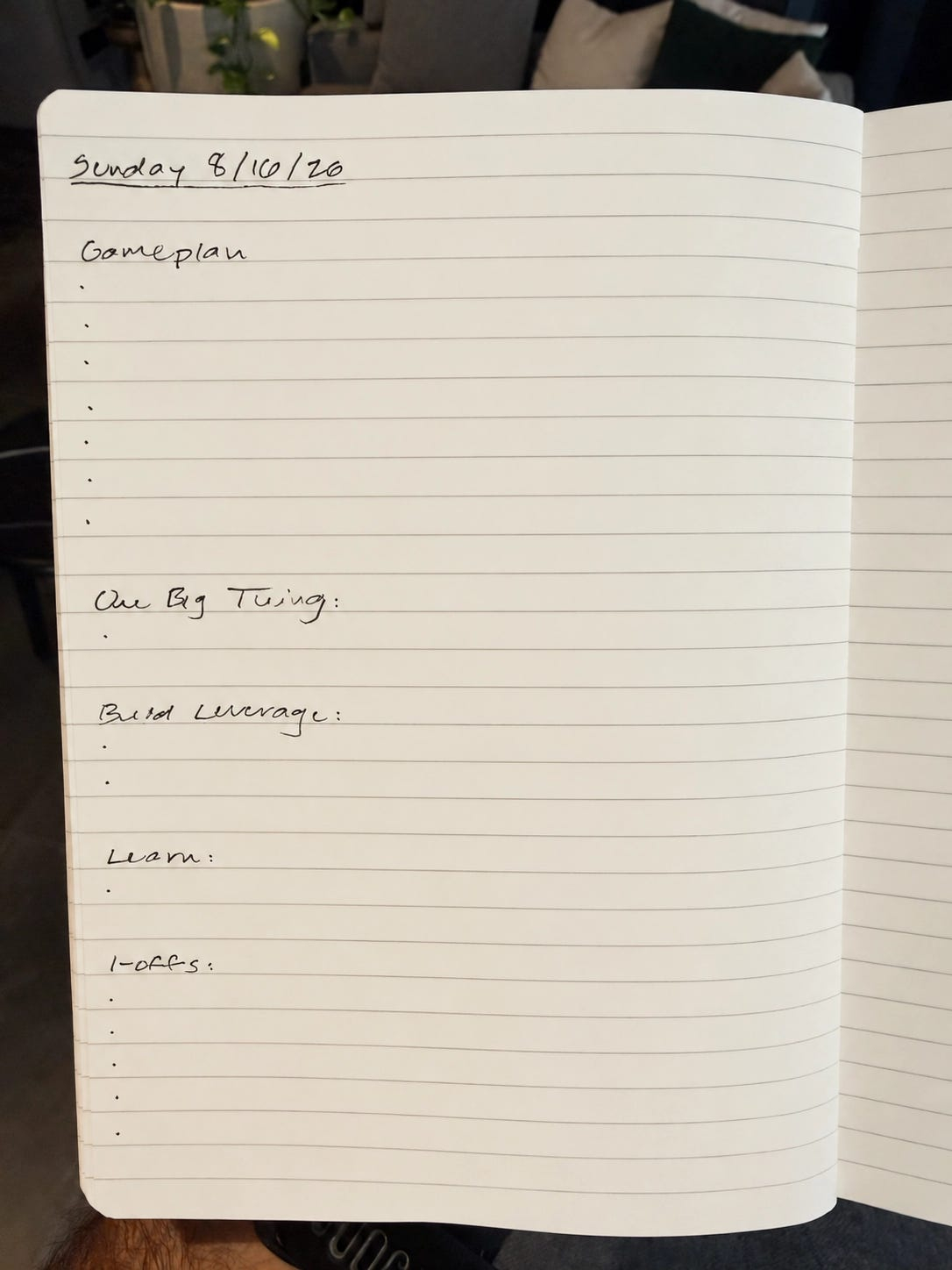
If you’re using the computer, you can just start with them as a bulleted list and add sub-bullets under them.
If you’ve been paying attention, you’ll see these almost perfectly map to the types of work you can do. The only differences:
- I make “1-off” hold all admin & delivery activities, because I always batch them
- I have a “Gameplan” section which is my way of listing out all of the scheduled activities I have, giving me another thing to check off throughout the day
With your page prepped, let’s build the plan.
# Step 1: Fill in your Gameplan
This is a bullet list of everything you have scheduled tomorrow, in order.
This should include:
- Wake time
- Morning routine
- Work blocks
- Scheduled meetings
- Workouts
- Meals
- Family time
- Anything else you have scheduled
This lets you see the entire day at a glance and how it will unfold before it starts. If something happens at a certain time, I like to put the time in front of it. But if something is a bit less structured, I just put the name of the block.
As the day goes on, I like to check these off as a simple way to feel like I’m making progress just for showing up for the things I already have scheduled. This gives me an extra bit of dopamine throughout the day to keep my momentum high.
Once you have all of those listed out, you can slot in the type of work you’re going to do.
# Step 2: Fill in your One Big Thing section
This is the single thing you will produce first thing the next day, and the last thing you will think about before bed tonight.
Importantly, this is one thing and one thing only. It gets its entire own section to make sure there is nothing else competing with it. The only objective of your deep work time is to complete the thing you said you would produce.
Completing your One Big Thing is all it takes to win the day. If you define this activity, and knock it out without letting all of the other competing things rob you of your focus, you have won the day.
This is also a natural prioritization forcing function. You must choose, every day, the single most important thing you can do. And stacking days with that One Big Thing completed will deliver a shocking amount of progress over weeks & months.
# Step 3: Fill in your Build Leverage section
After your One Big Thing, you want at least one thing you can do to build leverage.
As a reminder, this will fall into one of three buckets:
- Documenting an SOP
- Building an automation
- Training an employee or agent
Some days, this could be three or four things, and it’s fine to list all of them here. Other days, you might not have any leverage to build and can instead spend more time producing.
But if you can wake up and spend your morning producing something valuable, and building leverage to help you better produce value in the future, your stack of assets will compound.
# Step 4: Fill in your Learn section
This is one thing you will intentionally consume tomorrow. This comes as a reward AFTER you have produced and built leverage.
This could be:
- Specific (like reading 2 chapters of a certain book)
- Vague (like 30 minutes listening to a podcast)
The point is choosing some of your inputs the night before rather than letting the algorithm dictate them to you in the moment. And just like being intentional with what you’re producing & building, being intentional with what you learn will compound your knowledge much faster than you expect.
# Step 5: Fill in your 1-offs
This is everything else that needs doing across your Delivery/Admin/follow-ups that aren’t already scheduled in your Gameplan section.
For example, I wouldn’t put a scheduled call in this list, I would put that in the Gameplan section. But if I needed to send an email to my accountant to track down an invoice, that would go in the 1-offs.
I also always have a 1-off task that is “sweep open loops list” to make sure there is nothing time-sensitive there that I need to deal with. I keep this as one task rather than rewriting my open loop list from scratch every day.
I also always leave a little bit of extra space in this section so as the annoying 1-off items pop up throughout the day, they have a place to go. And they are kept separate from the important work that actually moves my business forward.
And just like that, you have a complete gameplan for the next day.
This will take a few reps to nail down, and you will find the best way to adapt it for yourself and your business.
But stick with this routine long enough to feel the euphoric benefit of waking up with ONE THING. Then, after a few days of knocking it out first thing, you will quickly find this type of planning addicting. And when you stack together days, weeks, and months of producing and building leverage, you will ask yourself how you ever possibly went so long without it.
# What this routine looks like for me
The only reason I write this post is because I love this system and it works great for me.
I use it every day and every week to organize my entire life. And so I want to briefly take you behind the scenes of how I implement all of it. Feel free to take what is useful, discard the rest, and adapt the system for what works best for YOU.
- I am currently living in Amsterdam, but operating a business with a co-founder on the west coast of the US & primarily US clients. That means my daily schedule will look different than someone who operates completely in one time zone.
- Because of the time zone, my work day starts around 9 AM and ends around 8 PM.
## I split my day roughly into 4 blocks:
- 9-2 is for production and building leverage. This is 5 hours of clock time with about 4 hours of actual deep work done. I have an office in a social coworking spot here that allows me to work in different environments depending on how I feel that day.
- 2-5 is for eating, learning, and training. I break my fast around this time, throw on a podcast, and walk to the gym, hit some cardio, or sauna/cold plunge.
- 5-8 is for delivery, admin, calls, and talking to my team. This is when I relay anything I worked on to my team, hold calls with my community & co-founder, and knock out any admin.
- 8-11 is for rest & recovery. The last thing I do before heading home is complete my daily planning routine so I can be fully present with my girlfriend when I get home.
Over the course of a week, I try to take calls just two days, ideally one.
- I have several recurring calls on Monday, and anything I can’t fit into Monday I will push to Thursday afternoon. That gives me 4 days per week (Sunday, Tuesday, Wednesday, Friday) where I know I could spend the entire day producing if I wanted to, and 5 if I end up working on Saturday.
- I try to do my weekly planning on Friday afternoon before the workweek ends. This allows me to be fully present on Saturdays and hit the ground running with deep work on Sunday. If I can’t do my planning on Friday, I try to do it first thing on Friday morning.
- I do all of my planning work with pen & paper. Muji A5 notebook & Muji 0.5 clicker pen. I’ve done it this way for as long as I’ve been working as an adult, for a few reasons: It forces me to slow down and deliberately write and rewrite. This naturally prevents me from keeping a list that is too long, or leaving things on the list for a long period of time because of the forced copy/pasting. It allows me to still work & plan without any technology on me. There is no more freeing feeling than walking to a cafe with just my notebook, knowing I can move forward a bunch of my projects without needing my computer or phone nearby.
- In terms of recovery activities, I try to have one day per week without any structure or work. Saturdays work best for me to be off the grid, in nature, with my family, and letting my brain recharge for another effective week ahead.
- And then all of the other recovery basics — eating well, sleeping well, getting sunlight, exercising, staying off my phone in the morning and evening, I am consistent with all of these as the foundation for everything else.
# [FULL SETUP PROMPT + TEMPLATES] Build Your 4 Lists & Plan Your First Week
Now if you made it this far, you might be thinking:
“All of this sounds great. But this sounds like a lot of work to get set up.”
That might be true - unless you have a quickstart guide.
So I’ve put together a full interview prompt that will build your entire planning system with you, based on your business, everything currently on your plate, and everything swirling around in your head.
Then, based on your answers, it gives you 2 things:
1. Your 4 lists. It takes your brain dumps and organizes them into your Project List, Later List, Next Actions List, and Open Loop List. It also helps you cut down your Project List to a more manageable length.
2. Your current bottleneck. It asks you to identify the one thing limiting your growth right now, then checks your Project List against it and tells you directly if none of your projects are attacking it.
I’ve also included a full Daily Planning template you can either print out or copy to your note-taking app of choice to help with your daily planning session.
To get all of these for free, all you have to do is:
1. Subscribe to AI Operator
2. Leave a comment [on this post here](https://substack.com/home/post/p-211410011) with the word ROUTINES and I’ll send it over to you
And if you have any questions about any of these routines, feel free to leave a comment or hit reply to let me know. I read and reply to every one of them.
Thanks for reading - I hope it was valuable.
Dickie
PS: If you want my direct help building your very own productivity system, [come join us inside AI Writing Skool free for 30 days.](https://learn.aiwritingskool.com/aiws-trial/)
PPS: If you found this valuable and know someone else who would benefit from this system, I’d appreciate if you forwarded it to them to help the newsletter grow.
## 相关链接
- [Dickie Bush](https://x.com/dickiebush)
- [@dickiebush](https://x.com/dickiebush)
- [11K](https://x.com/dickiebush/status/2090819629916831745/analytics)
- [type of monetization method you’re operating](https://aioperatornewsletter.substack.com/p/full-guide-digital-monetization-methods)
- [Getting Things Done](https://www.amazon.com/Getting-Things-Done-Stress-Free-Productivity/dp/0142000280)
- [AI Writing Skool](http://aiwritingskool.com/)
- [on this post here](https://substack.com/home/post/p-211410011)
- [come join us inside AI Writing Skool free for 30 days.](https://learn.aiwritingskool.com/aiws-trial/)
- [Upgrade to Premium](https://x.com/i/premium_sign_up)
- [11:13 PM · Aug 21, 2026](https://x.com/dickiebush/status/2090819629916831745)
- [11.7K Views](https://x.com/dickiebush/status/2090819629916831745/analytics)
---
*导出时间: 2026/8/22 08:50:56*
---
## 中文翻译
# 最大化创造力与生产力的每日规划日常
**作者**: Dickie Bush
**日期**: 2026-08-21T15:13:39.000Z
**来源**: [https://x.com/dickiebush/status/2090819629916831745](https://x.com/dickiebush/status/2090819629916831745)
---

作为企业主,你能拥有的最强大的一个技能是:
规划要做什么,然后执行这个计划。
你可以拥有世界上所有的营销技能、销售技能和产品技能,但如果方向错了,即使你一直很“忙”,也会停滞不前。
在我的创业历程中,我曾两次惨痛地学到这个教训:
- 第一次是2020年,当时我在华尔街工作的同时开始在网上写作作为副业
- 第二次是2022年,我辞掉那份工作,全力投入打造自己的事业
那么,这两次经历有什么共同点呢?
它们都涉及:
- 我开始一项新的事业,满怀热情却没有真正的计划
- 我有无数可以做的事情,但投入其中的时间和精力有限
- 我100%负责这些事情每天是否能向前推进
唯一不同的是规模。
在华尔街工作时,我每天只有6个小时来经营副业。早上从4:30到7:30的3个小时,晚上从6:30到9:30的3个小时。因为时间太少,我必须只把时间投入最重要的任务。
辞职后,我每天突然有了12个小时来经营事业。但这让我规划和执行的能力变得更加重要,因为我失去了全职工作带来的天然优先级约束。有更多的时间并没有立即让我更有效率,所以我不得不调整我的方法。
在这两段时间里,我记得自己因为没有一套框架来选择做什么以及何时做而苦苦挣扎。在W2雇佣制工作中,别人大多会告诉我做什么,我的日程表基本上是为我安排好的。但作为企业主,即使是副业,都要由你来决定做什么,以及它最终能否成长。
结果,我花了大量时间要么在做错误的事情,要么在拖延做正确的事情。
但随着时间的推移,通过大量的试错,我开发了一套简单的规划系统和日常流程,让我能够:
- 简明地看到我正在做的所有事情
- 按重要性对它们进行排序
- 睡觉时清楚地知道明天要做什么
- 醒来时对执行计划好的事情充满期待
这套系统就是我今天要与大家分享的。
我们将涵盖:
- 你的事业中只有5种类型的活动
- 如何仅用4个列表来运营整个事业
- 规划一天时要避免的6个错误
- 确保你做对事情的30分钟每周战略规划流程
- 让你醒来就能执行最重要活动的10分钟每日规划流程
在最后,我还整理了完整的每周和每日规划模板+提示词,你可以用它来完全落实今天学到的东西。
# 你只需要点赞这篇帖子,并留下包含ROUTINES一词的评论,我就会把它发送给你。
现在让我们开始吧。
# 1. 你的事业中只有5种类型的活动
当你经营自己的事业时,可做的事情不胜枚举。
不幸的是,这些事情大多是浪费时间。其中一些值得花一点时间。而极少数精选的事情值得投入你所有的时间。
作为企业主,你最重要的工作之一就是弄清楚每件可做的事情在这个光谱上的位置。
幸运的是,虽然可做的事情是无限的,但工作类型可以整齐地归入5个类别:
1. 生产
2. 构建杠杆
3. 学习(为了更好地做1和2)
4. 交付
5. 行政
让我们仔细看看每一种。

# 1. 生产
生产是你能做的第一类也是最重要的一类工作。
我用“生产”这个词,但你可以用以下词语替代:
- 构建
- 制作
- 创造
- 广告
- 写作
- 拍摄
- 剪辑
任何能把东西输出到世界上并能帮助你的事业成长的事情。
取决于你经营的事业类型,这可能是:
- 写广告文案
- 拍摄广告
- 编写软件
- 进行销售电话
- 进行冷启动外联
- 撰写通讯
- 主持现场培训
- 制作引流磁铁(免费资源)
- 撰写LinkedIn帖子
- 撰写邮件序列
- 为YouTube视频写脚本
- 拍摄YouTube视频
- 剪辑YouTube视频
- 录制课程内容
- 制作Instagram轮播图
- 为演讲制作幻灯片
判断是否属于生产的唯一标准:
1. 它必须直接为你带来新收入
2. 它必须创造一个以前不存在的资产
如果不符合其中任何一条,它就不是生产。它可能仍然值得做,但它不会是你能做的最重要的事情。
随着时间推移,你在事业中的目标是尽可能多地把时间集中在生产上。但你一天能生产的量是有限的,除非你增加杠杆。这就引出了第二类工作。
# 2. 构建杠杆
杠杆的定义是每单位投入的产出。
所以当你构建杠杆时,你要么是:
- 创造一些能以相同投入带来更多产出的东西(生产力)
- 创造一些能以更少投入带来相同产出的东西(效率)

最常见的商业杠杆类型有:
- SOP(标准操作流程)——记录下来的说明,让某人每次都以相同的方式运行一个流程。你把某件事想透一次,记录下来,然后就再也不用再想它了。
- 自动化——无需任何人操作就能自动执行流程的软件。
- 员工(或智能体)——你训练的能在没有你的情况下进行生产或执行的人(或AI)。
让我们看看每种杠杆的一些组合示例。
效率
- SOP → 你记录下播客发布清单。节目照样发布(产出),但现在你只需5分钟不假思索就能完成,而不是努力回忆每个步骤并花上30分钟。
- 自动化 → 你搭建了一个Zapier/Kit自动化流程,直接将新购买者添加到你的课程中,给他们发送入职邮件,并启动交付序列。不再需要为每个客户手动做这些事,现在它们自动完成。相同的产出,大大减少的投入。
- 员工 → 你雇了一个虚拟助理来处理你的客服收件箱并发布社交媒体内容。这些以前都由你处理,但现在由别人来做。所以你得到相同的产出(邮件被回复,内容被发布)却不用花你的时间。
生产力
- SOP → 你建立了一个内容再利用清单,把你的通讯转化为短内容、LinkedIn轮播图、X文章、Atomic Essay和YouTube脚本。现在你用相同数量的产出获得5-10倍的曝光和帖子。
- 自动化 → 你建立了一个外联系统,可以拉取每个潜在客户的最新帖子和背景信息,起草个性化的第一句话,并准备好让你微调的消息。你以前花一小时做外联发10条消息,现在同样的一小时你可以发50条。
- 员工 → 你雇了一个短视频剪辑师从你的长视频YouTube内容中剪出片段。你已经在做的每个YouTube视频或播客现在还能为你带来10个短视频片段。
现在你可能会想,生产和构建杠杆之间有什么区别?
生产创造产生收入的资产。
杠杆创造放大生产的资产。
当你经营自己的事业时,你需要时间同时做这两件事。
如果你把所有时间都用于生产,而不花时间构建杠杆,你的生产能力将保持上限,这将限制你的增长。
如果你把所有时间都用于构建杠杆,而不花时间生产,你将不会有任何产生收入的资产,这同样会限制你的增长。
这两种活动是企业主对时间的最宝贵利用方式。
而第三种则涉及更好地做这两件事。
# 3. 学习(为了更好地做1和2)
如果生产和构建杠杆是你事业中最重要的两种活动,那么学习如何更有效地做它们就是第三重要的活动。
这方面的例子包括:
- 读书
- 学习课程材料
- 阅读精选的Twitter列表
- 观看教育性YouTube视频
- 支付1对1或团体辅导费用
- 阅读通讯(比如这一篇!)
- 与智囊团中的人交流
任何你接收信息并因此改变未来行为的活动。
然而,这也是大多数人最容易搞错的活动,错误方式有多种:
- 他们消费了某些内容,但之后没有任何不同的行动。这不是学习,因为学习要求你做一些与学习之前不同的事情。如果没有发生这种改变,你只是在被娱乐。
- 他们在生产或构建杠杆之前花时间“学习”。他们打开YouTube、课程或Twitter,告诉自己“我在学习,这是有效率的!”但这不过是伪装成效率的拖延。在你开始学习新信息之前,你需要先花时间对你已有的信息采取行动。然后,一旦你完成了生产和杠杆构建,你就“赢得”了学习新东西的资格。
- 他们“学习”的东西并不能直接帮助他们更好地生产或构建杠杆。同样,这不如说是娱乐。它有合适的时间和场合,但你应该确保你消费的内容能直接带来更好的生产或更多的杠杆。
学习是重要的日常活动。但必须是在你已经完成生产和杠杆构建之后。而且要有意识地去选择学习的内容。
# 4. 交付
我们讲的前3种活动是仅有的3种能让你的事业成长的事情。
- 你可以生产带来收入的东西
- 你可以构建杠杆来更好地生产或腾出生产时间
- 你可以学习如何构建杠杆或更好地生产
从这里开始我们要讲的其他内容都只是维持事业运转。
如果你只花时间做维持事业运转的事情,你的事业就不会成长。而如果你的事业不在成长,它就在慢慢死亡。
所以要保持事业运转,你必须做的第一件事就是交付你销售的产品或服务。
取决于你运营的[变现方式类型](https://aioperatornewsletter.substack.com/p/full-guide-digital-monetization-methods),这可能表现为:
- 主持现场训练营课程
- 完成客户交付物
- 为客户写邮件或社交媒体帖子
- 为新客户或学员做入职引导
- 进行1对1辅导/咨询通话
- 在你的社群中回答问题
重要的是,并非所有方式都有“交付”环节。这是该方式的一个特点(也是人们在选择方式时可以有意识做出的选择)。
- (交付密集型)代理服务、1对1咨询、混合团体辅导、训练营式体验和付费社群都要求你与客户通话/回答问题。
- (交付轻量型)软件、付费通讯、数字产品几乎不需要交付,只需要回应客户的评论和问题。
理想情况下,你可以在一周的某些天或一天中的某些时段“批量”处理这些交付活动,而且是在你完成生产、杠杆构建和学习之后。如果你不划出时间批量处理交付,它会慢慢扩张并吞噬你所有的时间。
例如,我90%的通话都安排在周一。我尽量把交付批量集中到那一天,这释放了我一周的其余时间。如果实在必须再安排通话,我会在周四下午留出两小时的时间块。我一周的其余时间完全没有实时交付,这样我就可以专注于生产、构建杠杆和学习。
交付是运营事业的必要部分。但不要让它吞噬你一整天。如果你是早起型的人,把交付批量放在一天结束时,把早晨用于生产。如果你是晚起型的人,把交付批量放在一天开始时,把下午用于生产。
如果你想让事业成长,你需要围绕生产来安排交付,而不是相反。
# 5. 行政
最后但同样重要的是,行政类包含所有其他不符合以下条件的事情:
- 不产生新收入
- 不让生产变得更容易
- 不教你任何新东西
- 不履行你销售的产品或服务的交付
这些都是没人想做但总得有人做的无聊事情。
例子包括:
- 发送发票
- 预订差旅计划
- 填写各种表格
- 回复邮件或私信
- 更新密码和登录信息
- 记账和财务分类
- 与他人安排会议
- 回复你的律师或会计师
- 确认播客嘉宾出场
这些行政活动的最佳实践是:如果必须做,就批量放在一天结束时。如果可以由别人来做,那就是一个构建杠杆的机会。
这就涵盖了5种核心工作类型。但还有两个额外的活动不属于每日清单:一个统领所有五种,一个让所有五种可持续。
# (附加)战略规划
我把这一项单列为附加项,因为它不是你每天都需要做的事,但经常做很重要。
战略配置是决定你应该生产什么、在什么上面构建杠杆、以及学习什么。它为你如何度过每一天设定方向。没有它,你可能在错误的事情上花上几周、几个月甚至几年。
然而,战略规划不应该持续不断地做。如果你每天都在重新思考方向,你就放弃了选择一个方向并持续投入所带来的复利效应。
战略规划最好在以下条件下进行:
- 在正常工作时段之外
- 离开你正常的工作环境
它需要的思维方式与你通常在办公桌前做的工作完全不同。所以我喜欢完全切换情境和环境来做战略思考,通常是周五下午在一个新的咖啡馆。
当我们讲到每周规划部分时,我会带你详细了解如何进行这种战略思考。
# (附加)休息/恢复
最后,只有当你有足够的精力储备时,你才能生产、构建杠杆、学习、交付并维持事业运转。
我不需要把这篇文章变成完整的休息与恢复指南。但我曾经有一段时间完全忽视了它,那是个错误。那样做太久你会倦怠,无法发挥最佳状态,而这一切发生在你经营一个100%依赖你的事业时。
休息与恢复的最佳实践因人而异,但我有一个“恢复流程”,能让我充分恢复大脑、动力和思考能力。
为了构建这个流程,我从反向思考开始:什么事情会让我觉得非常不安宁?
那会是:
- 脑子里盘旋着一系列未解决的事务,占用我所有的心理带宽
- 有更多信息涌向我,让我的大脑信息过载进一步加剧
所以为了休息和恢复(每天和每周),我只需:
- 确保我所有的列表和任务都是最新的
- 完全远离科技产品
而我们后面要讲的规划流程,专门设计成通过把一切从大脑中转移到纸面上,让我的周末和夜晚尽可能安宁。
现在你已经了解了你在事业中能做的所有工作类型。你知道了让事业成长的类型和维持事业运转的类型。在任何一天,你都会有跨越所有5个类别的数十个可能任务争夺你的注意力,还有上百件事在脑中盘旋。所以现在,你需要一个地方来安放它们。
为此,你只需要4个列表。
# 2. 你只需4个列表就能运营整个事业
我读遍了各种效率类书籍。
而我总是回到最简单版的[《搞定》(Getting Things Done)](https://www.amazon.com/Getting-Things-Done-Stress-Free-Productivity/dp/0142000280),其中涉及制作4个列表:
1. 项目列表
2. 待办列表
3. 下一步行动列表
4. 未决事务列表
让我们逐一看看它们是什么、放什么内容,以及它们如何协同工作。
# 列表#1:项目列表
这是你目前在事业中正在做的、需要多个行动才能完成的所有事情的列表。
看这个定义的各个部分:
- “目前”可以随你定义,但我把我的项目列表视为本周要推进的任何事情。
- “需要多个行动”主要是为了防止把简短、容易完成的任务放到项目列表上。
制作项目列表时,每个项目都应该以一个表示行动的动词开头。
例如,我当前的项目列表是这样的:
- 撰写每周通讯
- 拍摄每周YouTube视频
- 构建新的CRM工作流和文档
- 为每周通讯的再利用构建新SOP
- 搭建新的[AI Writing Skool](http://aiwritingskool.com/) Sprint基础设施
这些都是以动词开头、需要多个步骤完成、我本周要做的事情。它们应该对应你能做的5种工作类型之一。然而,你的大部分项目应该是生产或构建杠杆。如果你的项目列表被交付或行政主导,你需要审视你的优先级。
在这个列表上保留“周期性”项目也可以,因为你每周都会重复(并完成)它们。
在长度方面,任何时候有超过约7个活跃项目都可能意味着你不够专注。在一周内推进那么多事情是很难的,所以我把它作为一个粗略的优先级指导原则。
最后一个提醒:你制作的第一个列表大约会长3倍,只有通过制作这个列表,你才会意识到自己一直铺得太开。
要专注于少数重要的项目,你需要把一些移到待办列表。
# 列表#2:待办列表
待办列表与项目列表有相同“类型”的工作,只是你现在不在做它们。
这是一个“包罗万象”的列表,你可以放任何:
1. 接下来几周要来的事情
2. 将来可能想追求的事情
审查待办列表是每周回顾的一部分,在那期间如果你计划某周做某件事,可以把它提升到项目列表。
重要的是,你的待办列表应该明显长于你的活跃项目列表。如果不是这样,你很可能同时在做太多事情。
例如,我的待办列表包括:
- 运行月末财务报告
- 为AIWS免费试用/$800/年组合举办一场网络研讨会
- 举办一场个人理财训练营
- 招聘一名新的短视频剪辑师
- 在我的Substack通讯中建立用户分层
- 构建并设置LinkedIn Newsletter
- 建立AIWS内部推荐计划
- 还有很多我只是放在那里看看的事情。
在每周更新项目列表的最后,待办列表上的一些事情会被提升。其他事情会放一阵子,以防我将来想做。还有一些在意识到我其实不需要或不想做之后被完全删除。
一旦我完全建好了这些列表,就该通过定义下一步行动来推进它们了。
# 列表#3:下一步行动列表
下一步行动列表(或者简单点就叫待办事项列表)是推动你每个项目前进的行动列表。
为了简单起见,我把下一步行动定义为可以在一个时段或工作块内完成的事情。《搞定》的版本说要把它拆成尽可能小的下一步行动,但我觉得写下那么多细小的事情很烦人。
每个项目都有一组让它更接近完成的任务。它们每一个都会放到下一步行动列表上。如果你愿意,可以在列表上为一个项目放7个下一步行动,也可以只放一个(字面意义上的下一个行动)。
这是你坐下来决定某一天该做什么时所要参考的列表。
例如,进入本周时我的下一步行动列表是这样的:
- 撰写每周通讯:为通讯做10条要点头脑风暴 制定完整通讯大纲 根据大纲起草通讯 对通讯进行文字编辑 发布通讯 运行精简的写作分发流程
- 拍摄每周YouTube视频:把书面通讯的脚本调整成YouTube脚本 录制视频 记录剪辑想法、标题和发布安排
- 为AI Writing Skool构建CRM工作流:记录当前的zap系统
- 为我的通讯构建再利用SOP:审阅Cole的现有SOP,看看可以调整/增加什么
- 搭建Sprint基础设施:列出本次Sprint要包含的要素清单 创建包含完整构建顺序的基础设施枢纽
如你所见,对于其中一些(我知道所有步骤的),我可以把所有下一步行动放在一个列表上。而对于那些工程量较大的,我只放第一个能让我建立势头的下一步行动。
当我对这些采取行动时,会发生两种情况之一:
- 我完成了这个行动,然后进入下一个
- 完成这个行动产生了一个阻碍我前进的未决事务
这些未决事务有它们自己的列表,也就是我们最后一个列表。
# 列表#4:未决事务列表
未决事务列表是你能采取下一步行动之前正在等待的所有事情。
到目前为止,这是最需要从头脑中转移到纸面上的列表。否则,这些未决事务会占用你本可以用于生产或构建杠杆的所有心理带宽。把这些事务放到单独的列表上,让你有一个在一天结束时扫描的地方,看看有没有什么事悬置太久。如果你等待某件事的时间超过了必要时长,你可以添加一个下一步行动在第二天跟进它。
例如,假设你今天早上有一个“拍摄YouTube视频”的下一步行动。完成拍摄并把它发给剪辑师之后,在剪辑师给你回传V1版本之前,你没有任何办法推进这个项目。如果你让那个“未决事务”在脑子里飘着,你的认知带宽会略微减少,因为你的大脑在试图跟踪那个项目的状态。相反,你要通过把“等待剪辑师回传V1草稿”加到未决事务列表上来“关闭这个环”。很可能他们不用你催促就会回来找你,这就是为什么这件事放在未决事务而不是下一步行动里。
我最近的一些未决事务包括:
- 等待VA人力中介回复合同事宜
- 等待下一个YouTube视频的V1版本
- 等待税务律师回复架构问题
- 等待VA回复软件取消确认
每一个都在我采取行动后立即“打开”。在它们解决之前,我无法采取另一个行动。一旦解决,我就有了新的可做之事,并从未决事务列表中移除该条目。
好了,到目前为止我们已经讲了:
- 你在事业中可以做的工作类型
- 如何把这些工作组织成项目和下一步行动
讲完这些框架后,我们现在可以进入实操,把它们转化为推动事业前进的每日计划。
但在进入分步流程之前,让我们先谈谈几个要避免的错误。
# 规划和执行每一天时要避免的6个错误
以下是我在经营自己的事业6年,以及多年指导学生经营他们的事业过程中,辛苦换来的错误清单。
这6个错误是:
1. 完全不规划你的一天
2. 一天开始的第一件事不是生产
3. 在不需要杠杆的事情上构建杠杆
4. “学习”不能直接让事业成长的东西
5. 第二天要生产的东西超过一件
6. 把所有东西都加到项目列表和下一步行动列表上而没有任何优先级排序
# 1. 完全不规划你的一天
如果你在读这篇文章,你已经在避免这个错误的正确道路上了。
太多的企业主睡觉时完全不知道明天要做什么。结果,他们醒来后,一天就在客户、行政事务和算法告诉他们做什么的摆布中流逝。10个小时过去了,他们整段时间都在“工作”,却什么也没完成。
如果你想让事业成长,这不是一种可持续的运营方式。
所以每天在工作日结束时花10分钟规划第二天。当你定义了一天,以及什么算赢得这一天,醒来并执行就会容易得多。一天的势能会带动下一天,然后又带动下一天,你就这样在进步的道路上不断前行。
# 2. 一天开始的第一件事不是生产
生产是让你的事业持续成长的东西。
随着事业的成长,越来越多的事情会冒出来与生产争夺注意力。当你停止把生产作为每天要完成的主要事情的那一刻,你的事业就会慢慢停止成长。它不会一夜之间停止成长,但一年过去,你会发现你最富创造力和生产力的时间都被那些无法带来实质性改变的事情填满了。
所以不要犯这个错误。
围绕“确保有东西被生产出来”来构建你的一整天。努力保护这段时间。否则,那些看起来有效率但不让你事业成长的 endless 任务清单将主导你的工作时间,你的事业会因此慢慢死亡。
# 3. 在不必要的事情上构建杠杆
在为某件事构建杠杆之前,你应该先问它是否值得做。
太多人浪费时间在自动化、整理或为那些在他们事业中不关键的功能招聘人员。
再说一次,这些事感觉有效率,这正是危险之处。
- 你在招人,那一定意味着你在成长!
- 你在构建AI仪表板,那一定意味着你在节省时间!
- 你在创建一个给你发通知的zap,那意味着你更高效了!
不幸的是,这些大多是浪费时间。
在花时间构建杠杆之前,问自己:这会直接让我的生产能力变得更强或更高效吗?
如果不会,把它移到待办列表,回去做那些你知道会带来成长的事情。
# 4. “学习”不能直接让事业成长的东西
这是一个残酷的事实:
大多数你以为自己在学习的时间,实际上只是在被娱乐。
这些活动再次感觉有效率,但它们并没有推动你的事业前进。
所以确保你学习的东西能直接帮助你更多地生产或构建更好的杠杆。否则,你就是在进行“有效率的拖延”。
同时,确保在一天中完成生产和杠杆构建之前不要“学习”。以看YouTube开始一天会感觉有效率,但更好的做法是先用你已经掌握的信息,去做你已经知道会让事业成长的活动。
然后,当这些完成后,你才可以开始消费新信息。
# 5. 第二天要生产的东西超过一件
这是我个人犯过的最大错误,因此也是我最努力避免的。
我的效率流程中最重要的部分是第二天早上只生产一件事(ONE thing)。不是两件。不是三件。也不是零件。是一件。
只生产一件事能让我带着一个问题入睡,让潜意识在夜间思考。而这种夜间的潜意识思考时间是我所有创造性突破的来源。
就在我写这篇通讯的时候,我睡觉时定下的第二天要生产的一件事就是通讯的这个部分。
每一次我这样做,醒来时我都能极其清晰地知道我到底想说什么。我能显著更快地进入心流状态。社交媒体和其他廉价的多巴胺来源对我没有吸引力,因为我迫不及待想把夜间浮现的想法写下来。
所以请相信我这一点。当我们进入规划部分时,认真对待“一件大事”这个部分。
看着你的创造力和生产力因此飙升。
# 6. 把所有东西都加到项目列表和下一步行动列表上而没有任何优先级排序
最后,要避免的最后一个错误是认为自己可以做所有事情。
待办列表的存在是有原因的。我们每天能投入的时间和注意力是有限的。因此我们应该有意识地选择少数事情来投入,把其他一切放到另一个列表里以备日后重新审视。
所以在进入规划部分时,要无情地保护你项目列表和下一步行动列表上的少数位置,要大方地把事情从上面移走。
现在让我们进入为成功设置一天的实战方法。
为此,我们需要从一次让列表更新到最新状态的每周规划开始。这是你的战略思考时间,你从执行中走出来,进入决定执行什么的模式。
完成之后,我们就可以在一周的其余时间执行每日规划流程,直到需要通过更多的战略配置来重置。
# 你的5步每周规划流程
你的每周规划流程的目标很简单:让你的列表保持最新。
列表保持最新,才能让你每天只花几分钟规划一天。当列表过时时,你每天都得花时间弄清楚要做什么以及是否在做对的事情。通过把这类思考分离到每周一个独立的时间段里,你的每日规划可以更高效。
我喜欢在周五下午工作周结束时做这件事,这让我可以不带任何未决事务进入周末。然后周日(我最喜欢的工作日)我就能带着清晰的行动清单立即投入工作。
整个流程有5步。第一次做时,可能要花一个小时。做过几次后,30分钟或更少就能完成。
这5步是:
1. 回顾上周发生的事
2. 明确你当前的瓶颈
3. 更新你的项目列表和待办列表
4. 更新你的下一步行动列表
5. 更新你的未决事务列表
# 第1步:回顾上周发生的事
快速把已完成和已推进的所有事情做一个头脑风暴清单。这帮助你在进入新一周时认清哪些已完成、哪些仍未结束。
# 第2步:明确你当前的瓶颈
为了确保你的项目对准正确的事情,问自己:
“现在最限制我事业成长的一件事是什么?”
取决于你的事业类型和阶段,这可能是:
- 我没有产生足够多的新销售线索
- 我的邮件订阅者不够多
- 我没有可以向现有客户销售的后端产品
- 我所有时间都花在交付上,没有时间生产
- 我邮件列表上没人购买我的产品
- 我的销售电话一个都没有转化
重要的是,这必须是一件事。根据定义,瓶颈不可能多于一个。你的事业中可能有很多问题和很多机会。但只有一件事在限制成长,而那就是你应该投入时间和精力的地方。
例如,我们事业当前的瓶颈是每周邮件列表新增人数。如果这个数字是现在的3倍,我们的收入也会是3倍。除了让这个数字上升,其他一切都不重要。
确定了瓶颈,你现在就可以更新你的项目列表和待办列表了。
# 第3步:更新你的项目列表和待办列表
从上周的项目列表开始:
- 删除任何已完成的项目
- 添加你最近开始的任何项目
- 审查你的待办列表,添加本周需要处理的任何事项
- 把任何既不在解决事业瓶颈、也不在维持事业运转的事情降级到待办列表
这应该花不了几分钟。看着本周由你负责推进的这几件事,你应该感到一种清晰感。
# 第4步:为每个活跃项目写下一步行动
每个活跃项目至少有一个下一步行动。
同样,如果你对所有步骤都完全清楚,可以把它们全部加上。或者如果你只知道你能采取的下一个行动,就加那一个。
# 第5步:清理你的未决事务
最后,浏览你的未决事务列表进行清理:
- 已解决 → 删除,不再需要
- 仍在等待 → 保留
- 悬置太久 → 添加一个跟进的下一步行动
这应该在两分钟内完成,并让你的大脑感到平静和专注,没有任何事情在后台占用带宽。
你的整个每周规划流程第一次可能要花一小时或更久,但随着时间推移你会越来越熟练。
一旦完成,你就带着以下内容进入新的一周:
- 一个清晰、高影响力的项目列表
- 所有其他可以追求的事情在待办列表上
- 一份下次工作时可以采取的清晰行动清单
- 一份有条理的未决事务列表,让你能专注于可以推进的事情
仅仅每周做这个练习,就会让你在每天的基础上更有效率、更有成果。
但它变得更强大的地方在于与每日规划流程的连接。
# 你的5步每日规划与执行流程
到目前为止我们讲的所有内容,都会在你工作日的最后10分钟汇总起来。
- 我们讲了5种工作类型,你知道生产排在第一位
- 你手上有4种列表,让所有工作保持有序
现在,你要做的就是按工作顺序分配它们。
看全部5个步骤,你要做的是:
1. 填写你的“全天计划”部分
2. 填写你的“一件大事”部分
3. 填写你的“构建杠杆”部分
4. 填写你的“学习”部分
5. 填写你的“一次性事务”部分
所以在开始之前,你先准备5个独立的标题:
- 全天计划
- 一件大事
- 构建杠杆
- 学习
- 一次性事务
如果你手写,可以像这样在页面上把它们间隔开:

如果你用电脑,可以先把它们做成一个列表,然后在下面添加子项。
如果你一直在认真读,你会发现这些几乎完美对应你能做的工作类型。唯一的区别是:
- 我把“一次性事务”用于容纳所有行政和交付活动,因为我总是批量处理它们
- 我有一个“全天计划”部分,这是我列出所有已安排活动的方式,让我在一天中又多一个可以勾选的东西
页面准备好了,我们来制定计划吧。
# 第1步:填写你的全天计划
这是你明天所有已安排事项的列表,按顺序排列。
这应该包括:
- 起床时间
- 晨间流程
- 工作块
- 已安排的会议
- 锻炼
- 三餐
- 家庭时间
- 其他任何你已安排的事情
这让你在一天开始前就能一览整天以及它将如何展开。如果某件事发生在特定时间,我喜欢在前面加上时间。但如果某件事没那么严格,我就只写这个时间块的名称。
随着一天进行,我喜欢把这些勾掉,作为一种简单的方式,让我感到自己在进步,仅仅因为按计划出现了。这给了我一点额外的多巴胺,让我整天保持势头。
一旦所有这些都列出来了,你就可以填入你要做的工作类型。
# 第2步:填写你的“一件大事”部分
这是你明天一大早要生产的唯一一件事,也是你今晚睡前要想的最后一件事。
重要的是,这是一件事且只有一件事。它有完全独立的区域,以确保没有其他事情与它竞争。你的深度工作时间唯一的目标就是完成你说要生产的东西。
完成你的一件大事就足以赢得这一天。如果你定义了这个活动,并且不让所有其他竞争事务抢走你的注意力而把它完成了,你就赢得了这一天。
这也是一个天然的优先级强制机制。你必须每天选择你能做的最重要的一件事。日复一日地叠加完成一件大事的日子,会在几周和几个月里带来惊人的进展。
# 第3步:填写你的“构建杠杆”部分
在你的一件大事之后,你想要至少一件可以做的构建杠杆的事情。
提醒一下,这将归入三个类别之一:
- 记录SOP
- 构建自动化
- 培训员工或智能体
有些天,这可能是三四件事,全部列在这里也可以。另一些天,你可能没有任何杠杆可建,可以转而花更多时间生产。
但如果你能醒来后花早晨生产有价值的东西,并构建杠杆帮助你在未来更好地生产价值,你的资产堆就会复利增长。
# 第4步:填写你的“学习”部分
这是你明天有意要消费的一件事。这是在你完成生产和杠杆构建之后的奖励。
它可以是:
- 具体的(比如读某本书的2个章节)
- 模糊的(比如听30分钟播客)
关键在于前一天晚上选择你的一部分信息输入,而不是让算法在当下替你决定。就像对生产和构建保持有意一样,对学习保持有意会让你的知识以比你预期快得多的速度复利增长。
# 第5步:填写你的“一次性事务”
这是其他所有需要做的事情,包括交付/行政/跟进,且尚未排入你的全天计划部分。
例如,我不会把已安排的通话放到这个列表上,那会放到全天计划部分。但如果我需要给会计师发邮件追踪一张发票,那就会放到一次性事务里。
我也总是有一个一次性任务是“清理未决事务列表”,以确保那里没有需要处理的时效性事务。我把它保留为一个任务,而不是每天从头重写我的未决事务列表。
我还总是在这个部分留一些额外空间,这样当烦人的一次性事务在一天中冒出来时,它们有地方可去。而且它们与真正推动我事业前进的重要工作保持分离。
就这样,你为第二天制定了一个完整的计划。
这需要练习几次才能掌握,你会找到最适合自己和事业的调整方式。
但请坚持这个流程足够久,去体验醒来时只有一件事的那种亢奋好处。然后,在连续几天第一件事就把它搞定之后,你会很快发现这种规划方式让人上瘾。而当你把几天、几周、几个月的生产和杠杆构建叠加起来时,你会问自己当初怎么可能在没有它的情况下撑那么久。
# 这个流程在我这里是什么样子
我写这篇文章的唯一原因是我喜欢这个系统,而且它对我非常有效。
我每天每周都在用它来组织我的整个生活。所以我想简要带你看看我如何实施这一切的幕后。请随意取有用的部分,舍弃其余的,并把系统调整为最适合你的样子。
- 我目前住在阿姆斯特丹,但与一位在美国西海岸的联合创始人共同经营事业,客户也主要在美国。这意味着我的日程安排与完全在一个时区工作的人不同。
- 因为时差,我的工作日大约从上午9点开始,晚上8点左右结束。
## 我把一天大致分成4个时间块:
- 9点到2点用于生产和构建杠杆。这是5个小时的时钟时间,实际完成约4小时的深度工作。我在这里一个社交型联合办公空间有办公室,让我可以根据当天的状态在不同的环境中工作。
- 2点到5点用于吃饭、学习和锻炼。我大约在这个时间打破断食,戴上播客,步行去健身房,做些有氧运动,或者桑拿/冷水浴。
- 5点到8点用于交付、行政、通话以及与团队交流。这是我把工作成果传达给团队、与社群和联合创始人通话、处理行政事务的时间。
- 8点到11点用于休息和恢复。回家前我做的最后一件事是完成每日规划流程,这样回家后就能与女友完全专注地相处。
在一周中,我尽量只在两天安排通话,最好是一天。
- 我周一有几个固定通话,塞不进周一的任何事项我会推到周四下午。这给了我每周4天(周日、周二、周三、周五)我知道如果愿意可以整天生产,如果周六也工作那就是5天。
- 我尽量在周五下午工作周结束前做每周规划。这让我周六可以完全放松,周日立即投入深度工作。如果周五做不了规划,我会尽量在周五早上第一件事做。
- 我所有的规划工作都用纸笔完成。Muji A5笔记本和Muji 0.5按动笔。从我成年工作以来一直这样做,原因有几个:这迫使我放慢速度,刻意地书写和重写。这自然地防止我保留一个过长的列表,或者因为被迫的手动“复制粘贴”而让事项长期留在列表上。这让我在没有科技产品的情况下也能工作和规划。没有比只带着笔记本走到咖啡馆更自由的感觉了,我知道我不需要电脑或手机在身边也能推进一堆项目。
- 在恢复活动方面,我尽量每周有一天完全没有日程或工作。周六最适合我离线、亲近自然、陪伴家人,让大脑为接下来高效的一周充电。
- 然后是所有其他恢复的基础——好好吃饭、好好睡觉、晒太阳、锻炼、早晚远离手机,我坚持把所有这些作为其他一切的基础。
# [完整设置提示词+模板] 构建你的4个列表并规划你的第一周
如果你读到了这里,你可能在想:
“这一切听起来很棒。但听起来搭建起来工作量很大。”
这可能是真的——除非你有一份快速入门指南。
所以我整理了一个完整的访谈式提示词,它会基于你的事业、你手上所有正在处理的事情、以及你脑中盘旋的所有事情,和你一起构建整个规划系统。
然后,基于你的回答,它给你两样东西:
1. 你的4个列表。它把你的头脑风暴整理到项目列表、待办列表、下一步行动列表和未决事务列表中。它还会帮你把项目列表缩减到更可管理的长度。
2. 你当前的瓶颈。它让你找出当前限制成长的一件事,然后用它检查你的项目列表,并直接告诉你是否有项目没有在攻克它。
我还附上了一个完整的每日规划模板,你可以打印出来或复制到你喜欢的笔记应用中,辅助你的每日规划。
要免费获得所有这些,你只需:
1. 订阅AI Operator
2. 在[这篇帖子这里](https://substack.com/home/post/p-211410011)留下包含ROUTINES一词的评论,我就会把它发给你
如果你对这些流程有任何问题,欢迎留言或直接回复告诉我。我每一条都会阅读和回复。
感谢阅读——希望它对你有价值。
Dickie
PS:如果你想让我直接帮助你构建你自己的效率系统,[欢迎免费加入AI Writing Skool 30天试用](https://learn.aiwritingskool.com/aiws-trial/)。
PPS:如果你觉得这篇文章有价值,并且知道有其他人会从这个系统中受益,如果你能转发给他们帮助通讯成长,我将不胜感激。
## 相关链接
- [Dickie Bush](https://x.com/dickiebush)
- [@dickiebush](https://x.com/dickiebush)
- [11K](https://x.com/dickiebush/status/2090819629916831745/analytics)
- [type of monetization method you're operating](https://aioperatornewsletter.substack.com/p/full-guide-digital-monetization-methods)
- [Getting Things Done](https://www.amazon.com/Getting-Things-Done-Stress-Free-Productivity/dp/0142000280)
- [AI Writing Skool](http://aiwritingskool.com/)
- [on this post here](https://substack.com/home/post/p-211410011)
- [come join us inside AI Writing Skool free for 30 days.](https://learn.aiwritingskool.com/aiws-trial/)
- [Upgrade to Premium](https://x.com/i/premium_sign_up)
- [11:13 PM · Aug 21, 2026](https://x.com/dickiebush/status/2090819629916831745)
- [11.7K Views](https://x.com/dickiebush/status/2090819629916831745/analytics)
---
*导出时间: 2026/8/22 08:50:56*