# Connecting Agents to Decisions
**作者**: Palantir
**日期**: 2026-04-28T14:41:18.000Z
**来源**: [https://x.com/PalantirTech/status/2049136883528011954](https://x.com/PalantirTech/status/2049136883528011954)
---
## The Palantir Ontology
Palantir’s software powers real-time, human-agent decision-making in many of the most critical commercial and government contexts around the world. From disaster response to nuclear energy production, our customers depend on Palantir AIP to safely, securely, and effectively leverage AI in their enterprises — and drive operational transformation.
While many factors contribute to achieving and scaling operational impact, including our AIP AgentCamps — where customers are hands-on-keyboards and achieving outcomes with AI in a matter of hours — the key differentiator is a software architecture which revolves around the Palantir Ontology.
The Ontology is a system designed to represent the decisions in an enterprise, not simply the data. The prime directive of every organization in the world is to execute the best possible decisions, often in real-time, while contending with internal and external conditions that are constantly in flux. Traditional data architectures do not capture the reasoning that goes into decision-making or the action that results, and therefore limit learning and the incorporation of AI. Conventional analytics architectures do not contextualize computation within lived reality, and therefore remain disconnected from operations. To navigate and win in today’s world, the modern enterprise needs a decision-centric software architecture.
To understand the value of the Ontology, let’s start by considering the four components of any operational decision:
- Data: the information leveraged to make the decision
- Logic: the heuristics and computational processes that evaluate a decision
- Action: the orchestration and execution of the chosen decision
- Security: the assurance that the decision complies with operational policies
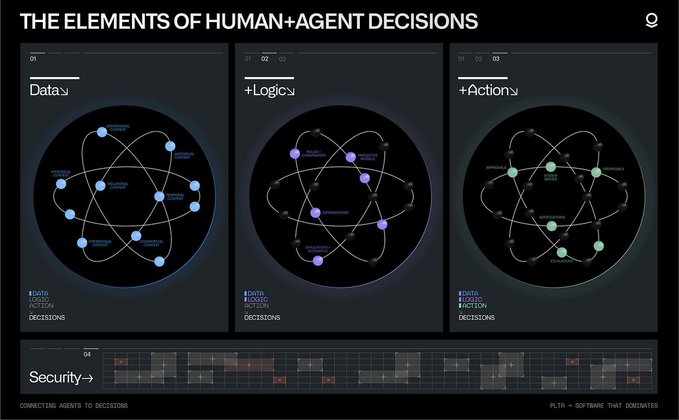
At a fundamental level, every decision is comprised of data (the information used to make a decision), logic (the process of evaluating a decision), and action (the execution of the decision) — all of which must be governed by security to ensure decisions are made safely and consistently.
The Ontology integrates these four constituent elements of decision-making into a scalable, dynamic, collaborative foundation which reflects the ever-changing conditions and ambitions of the organization as they evolve in real time.
## Data
Today’s organizations are inundated with unprecedented amounts of data. The volume, variety, and velocity of data sources is not only increasing, but accelerating over time. While plenty of ink has been spilled on the virtues of cleaning and unifying data, in the age of AI the principal problem is relevance. Relevant data of course includes the full range of enterprise data sources — structured data, streaming and edge sources, unstructured repositories, imagery data, and more — but it also includes the data that is generated by end users and agents as decisions are being made. This “decision data” contains the context surrounding a given decision, the different options evaluated, and the downstream implications of the committed choice. Generative AI provides a breakthrough ability to synthesize learnings from the full scale of decision data, and continuously enrich both human- and agent-driven workflows. Naturally, integrating the full range of enterprise data with the fluid landscape of decision data requires a very different architecture than a classical database management solution that is optimized for reporting and analytics.
The Ontology integrates all modalities of data into a full-scale, full-fidelity semantic representation of the enterprise. The wide range of operational data sources (ERPs, MES, WMS, et al.) can be synchronized and contextualized alongside data streams from IoT and edge systems, the relevant sections of unstructured data repositories, geospatial data stores, and more. The Ontology unites and activates these fragmented pools of data, and surfaces them in the language of the enterprise. Instead of dealing with golden tables that flatten the richness of operations into narrow schemas, the full expanse of the enterprise comes to life in the form of objects, properties, and links which evolve in real-time, and are designed to be embedded directly into decision-making workflows. Critically, the Ontology is designed to safely capture the decision data that is produced by operational users as they carry out daily work (e.g., within supply chains, hospital systems, customer service centers). This includes decisions made at the edge, captured through the lightweight Embedded Ontology. The end-to-end “decision lineage” of when a given decision was made, atop which version of enterprise data, and through which application, is automatically captured and securely accessible to both human developers and agents. This provides the comprehensive foundation that is required to power AI-driven learning at scale, and continuously refine all forms of agentic memory (working memory, episodic memory, semantic memory, procedural memory, et al.)
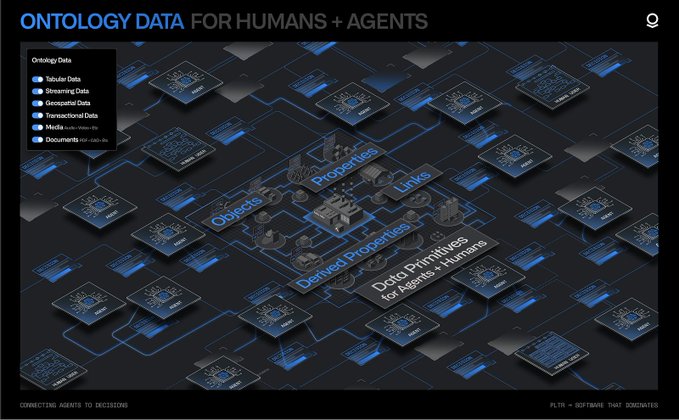
The Ontology integrates all modalities of data into a full-scale, full-fidelity semantic representation that captures the constantly evolving reality of the enterprise and serves as the foundation for human-agent workflows.
## Logic
While data is foundational, it is only one dimension of the decision-making process; it must be complemented by the reasoning, or logic, that determines when and how to make a given decision. The logic that underpins a decision can be a simple piece of business logic within a core business system, a forecast model that is maintained using a cloud data science workbench, an optimization model that uses several data sources to produce an operational plan — among myriad possibilities. In real-world contexts, human reasoning is often what orchestrates which logical assets are utilized at different points in a given workflow, and how they are potentially chained together in more complex processes. With the advent of agentic orchestration, it is now critical that AI-driven reasoning can leverage all of these logical assets in the same way that humans have historically. Deterministic functions, algorithms, and conventional statistical processes must be surfaced as operational tools which complement the non-deterministic reasoning of LLMs and multi-modal models. Moreover, as workflows are conducted by humans and agents, the tribal knowledge accumulated can be incorporated into different pieces of logic, and can feed a continuous process of generating new functional encapsulations that are leveraged throughout workflows.
The Ontology enables the full set of logic assets — the calculations and processes that dictate how decisions are made — to be connected and contextualized for both human and agents. This includes business logic pertaining to customer interactions often found in CRMs and ERPs; the modeling logic that drives conventional machine learning, which is spread across data science environments; and the planning, optimization, and simulation algorithms that are typically intertwined with domain-specific tools. The Ontology’s flexible “logic binding” paradigm provides a consistent interface for constructing workflows that seamlessly incorporate and combine heterogeneous logic assets — which may all live in very different environments (e.g., on-premises data centers, enterprise cloud environments, SaaS environments, the Palantir platform). Ultimately, this means that agent-driven reasoning can be smoothly introduced into decision-making contexts which leverage diverse sets of logic, and which have been traditionally steered exclusively by human users.
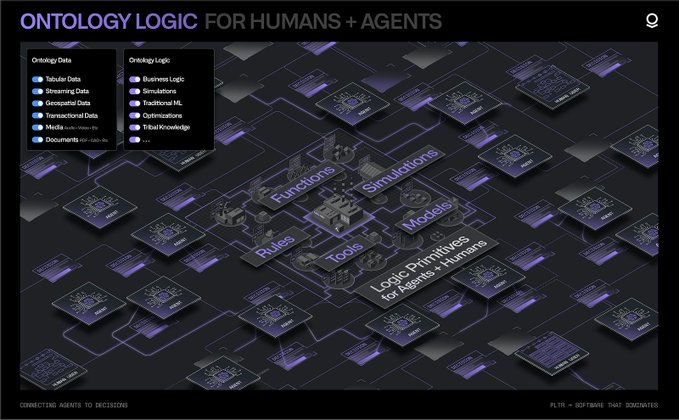
The Ontology enables users to construct workflows that incorporate tribal knowledge and combine heterogeneous logic assets. Ultimately, this means that agents can be securely introduced into increasingly complex decision-making contexts.
## Action
With both information (the data) and reasoning (the logic) incorporated into a shared representation, the next piece to model is the execution and orchestration of the decision itself (the action). Closing the action loop as decisions are made in real-time is what distinguishes an operational system from an analytical system. Since Palantir’s inception, the execution of decisions has been as critical a consideration as the synthesis of data, or the incorporation of analytics. This has required the design and implementation of a broad set of functionality which includes how to safely capture decisions which might be happening simultaneously and are potentially in conflict; a collaborative model that segments those who can explore possible decisions, those who can stage decisions for review, and those who can commit those decisions; and an extensive framework for synchronizing decisions to existing databases, edge platforms, and rugged assets.
The Ontology natively models actions within a cohesive, decision-centric model of the enterprise. If the data elements in the Ontology are “the nouns” of the enterprise (the semantic, real-world objects and links), then the actions can be considered “the verbs” (the kinetic, real-world execution). With every Ontology-driven workflow, the nouns and the verbs are brought together into complete sentences through human- and/or AI-driven reasoning, which incorporates various pieces of logic. While uniting data within a semantic model is itself valuable, and while it is imperative to stitch together the logic required to holistically evaluate possible decisions — it is all ultimately of limited value unless the executed decisions are synchronized with operational systems, with the full decision lineage captured within a compounding substrate that can better inform the next decision. The Ontology enables human and agent actions to be safely staged as scenarios, governed with the same granular access controls as data and logic primitives, and securely written back to every enterprise substrate — transactional systems, edge devices, custom applications, et al.
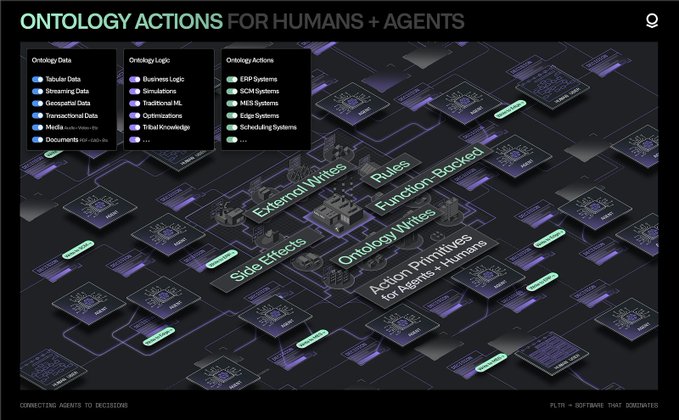
The Ontology natively models actions within a cohesive, decision-centric model of the enterprise, enabling human and AI-driven actions to be safely staged as scenarios, governed with the same access controls as data and logic primitives, and securely written back to every enterprise substrate.
## Security
In any operational setting, human-agent interaction requires rigorous security and governance capabilities that stretch far beyond conventional role-driven policies on buckets of data. Palantir AIP provides a security architecture that can blend marking-, purpose-, and role-based policies; dynamic lineage that flows across data, logic, action, and application artifacts; and a full suite of integrated change and release management tools that apply across both human-driven and agentic workflows. Granular policies can be affixed across the Ontology to constrain both agentic and human access to sensitive or context-dependent information. These policies are dynamically computed at runtime for every interaction, and can combine row- and column-level restrictions that have been applied to underlying datasets, attributes of particular user groups (including those that flow via SSO), security markings that propagate across underlying data pipelines, and more.
Tool usage is dynamically enforced through the same security architecture that governs data access and all forms of memory. This ensures, at minimum, that any tool invocations are dependent on access to the underlying objects, properties, and links in the Ontology. Moreover, tools can contain runtime validations that are dependent on granular submission criteria. Every agentic or human action depends on precise authorization grants that explicitly dictate the set of allowable operations, safeguarding against unexpected invocations (e.g., querying data that exists across organizational boundaries, or tools that connect to unspecified external systems) and other forms of privilege escalation. As detailed telemetry is generated by agents, the security and transmission of the logs is a critical last-mile concern. AIP enables administrators to control how logging is accessible across specific projects, workflows, and agents. Data markings and other active security primitives govern log access, in the same manner that they govern access to the underlying data, logic, and action primitives.
In short, the Ontology brings together data, logic, action, and security into a decision-centric model of the enterprise, which can be jointly leveraged by both humans and agents. Everything from data integration, to application building, to end user workflows is driven through a battle-tested, modular architecture — enabling human users and agents to query, reason, and act across a shared operational foundation.
Let’s step through a notional example to unpack how the Ontology is enabling organizations across 50+ sectors to activate human-agent workflows in days.
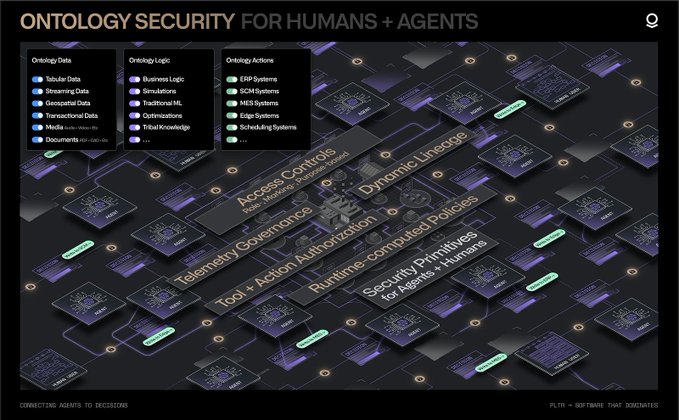
The Ontology cohesively governs human-agent activity in a decision-centric model of the enterprise, enabling role-, marking-, and purpose-based policies to be dynamically computed at runtime, applied consistently across every human and agent interaction with data, logic, and action primitives, and extended seamlessly to tool invocations, agent memory, and telemetry logs.
## An Operational Example
Onyx Incorporated, a fictional manufacturer of medical equipment, produces a range of finished goods, from syringes to surgical masks, each of which requires moving a precise set of materials through an associated manufacturing process. A diverse set of teams is managing everything from supplier relations, to warehouse operations, to production of the finished goods, to distribution to end customers; decisions are interdependent, and constantly adapting to changing circumstances. In short, every day brings unique challenges when operating the business.
In this example, Onyx is faced with an unexpected disruption with one of their major suppliers, who provides the key raw materials needed to produce surgical masks. Given the tight production schedules across Onyx’s manufacturing plants and the escalating demand from customers for surgical masks, this disruption is poised to create serious issues with fulfilling outstanding customer orders. Fortunately, Onyx’s operational teams have leveraged AI FDE to connect a wide array of data sources, logic assets, and systems of action into their enterprise ontology — and have the ability to swiftly respond.
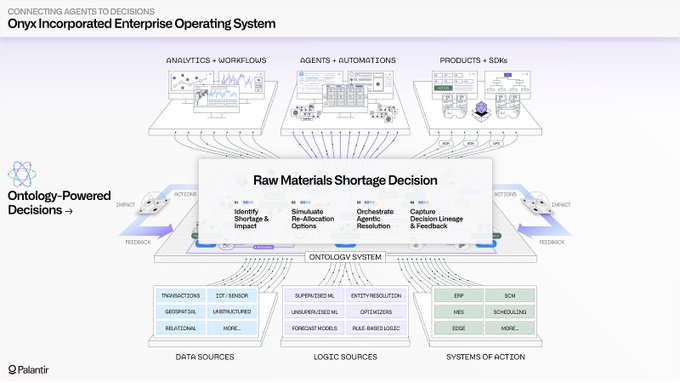
Onyx’s ontology brings together all decision-making elements necessary to navigate this raw materials disruption: It provides full visibility into revenue impact for each shortage to inform prioritization, allows for agentic recommendations and resolutions which account for the enterprise’s operational reality, and drives writeback and continuous learning to not only keep systems current, but also optimize future decisions.
Onyx will start by assessing the immediate impact of the supplier shortage, and will then employ AI to assess possible reallocation strategies across production lines, before finally translating their decisions into a set of connected actions that will simultaneously update warehouse processes, production schedules, and fulfillment routes.
Onyx’s ontology provides real-time, end-to-end visibility into the operations happening across each interdependent part of the business — enabling both leadership and on-the-ground teams to quickly understand the supplier disruption. The vital data systems pertaining to supplier management, warehouse operations, production activity within plants, distribution center processing, and customer fulfillment are all synthesized into semantic objects and links, which reflect the language of the business. In a few clicks, an operations leader is able to pinpoint the surgical mask production that is at risk due to the raw material shortage, and through the connections in their ontology, navigate to every outstanding customer order that is now also at risk. The Ontology’s granular security model ensures that more sensitive data elements (e.g., financial metrics) are automatically hidden by default, as the response widens to include more teams across the enterprise.
While it is seamless for operational users to navigate the Ontology through intuitive Workshop- and SDK-driven applications, the inclusion of agentic capabilities is a force multiplier for Onyx Incorporated. Agents, which leverage both open-source and proprietary LLMs, are able to fluidly navigate across supplier information, stock levels, real-time production metrics, shipping manifests, and customer feedback all contained within the organization’s ontology. Critically, all agentic activity is controlled with the same security policies that govern human usage — ensuring that Onyx engineers always have precise control over what the LLMs can query, recommend, and act upon. Each constructed and deployed agent can be considered a new team member, who is gradually granted a wider purview as Onyx team members gain confidence in its performance.
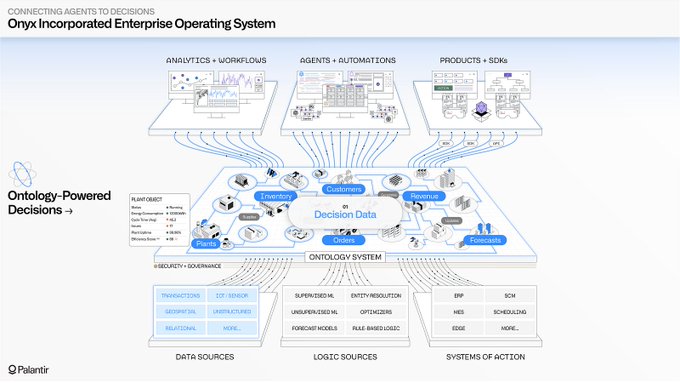
Onyx’s ontology integrates data from the organization’s vital systems, synthesizing it into semantic objects and links which provide real-time, end-to-end visibility into operations and allow both leadership and on-the-ground users to rapidly assess the full impact of the disruption.
Situational awareness is only the tip of the ontological iceberg; Onyx Incorporated needs to rapidly identify solutions to deal with the supplier disruption, and explore the tradeoffs inherent with each possible decision. Fortunately, the diverse set of forecast models, allocation models, production optimizers, and other logic assets have been connected into Onyx’s ontology, alongside the aforementioned data sources. This enables supply chain analysts to quickly run a battery of simulations that detail the consequences of the different possible material substitutions. The connected, real-time nature of the Ontology is key at this stage, since substituting raw materials will potentially have downstream implications for the other products (e.g., syringes, gloves) being produced from the same materials. As the simulations are run, the simulated outputs are staged as ontology scenarios, which safely package the proposed changes into a sandboxed subset of the Ontology — enabling teams to safely explore and analyze the implications of the decision before committing to it.
The true game-changer for the Onyx team is that fleets of agents can securely leverage the full range of logic assets, and the same scenarios framework. The Ontology enables agents to go beyond the data-centric limitations of retrieval-augmented generation, and instead interface with the interconnected data, logic, and action primitives in the Ontology through an extensible tools paradigm. This means that as Onyx’s analytics and data science teams are creating new machine learning models in their cloud workbenches, tuning optimization algorithms within enterprise systems, and fine-tuning LLMs using Palantir’s open model building framework, the Ontology securely surfaces all of these logic assets as AI-ready tools. In this case, Onyx has created a tuned agent, “Disruption Bot,” that is able to use a set of Ontology-driven tools to scan across the full range of enterprise data sources, the after-action reports on prior courses of action taken in similar situations, and the potentially applicable material reallocation models. Because of the rich, dense context provided through the Ontology, Disruption Bot is able to surface a novel reallocation plan, which uses a newer model that the supply chain analysts had not yet considered. With the consequences of the plan safely staged in a scenario, the agent’s proposed decision is handed off to a human analyst for final review.
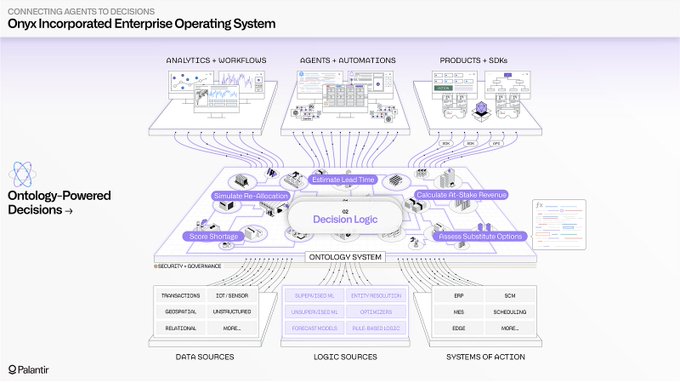
The Ontology securely surfaces Onyx’s logic assets — from machine learning to optimization models — as AI-ready tools, providing rich, dense context for human-agent teaming.
With a viable plan to address the material shortage identified, Onyx Incorporated needs to rapidly and safely push the decision to the operational systems that run the constituent processes. Given that the enterprise has grown through acquisition, and contains a diverse and delicate mix of critical operational systems, the Onyx IT team is vigilant about which processes can write back to these systems, and under which conditions. Fortunately, the Ontology applies the same rigorous control and validation to actions as it does to data and logic; enabling fine-grain control over who can invoke a given action, test-driven frameworks for publishing changes, the ability to stage and review changes in batch, and detailed logging for every event. In this case, the execution of the material reallocation plan automatically orchestrates a set of writeback routines, each tuned for the receiving system: the warehouse management system receives an API-driven update; the three ERP systems each receive updates via native Ontology-driven connectors, which abide by the safeguards in each system; and the production planning system receives a consolidated flat file, which it ingests asynchronously. As actions are executed, the Onyx IT team can monitor system responses, and always has the ability to audit past activity.
The Ontology provides the guardrails needed for AI to safely take action within permitted boundaries. Alongside data and logic, actions can be automatically surfaced as tools for all types of agents. The scope of an action can be limited to simply reflecting a given change (e.g., an edit to an object, or the creation of a new object) in the Ontology itself; or can write back to single, or multiple systems. In Onyx’s context, they have granted Disruption Bot and the handful of other production AI agents access to a handful of actions. In the default case, these actions (e.g., changing the status of a work order, or pushing a reallocation plan) can only be staged by the AI, and are then handed off to a human for final review. However, with the granular logging and operational instrumentation provided by the Ontology (and the wider Palantir platform), Onyx is able to surgically choose which trusted, well-worn AI processes can automatically close the action loop without human review. As conditions evolve, the latitude given to AI can be expanded or contracted — and instantly reflected across all Ontology-driven workflows.
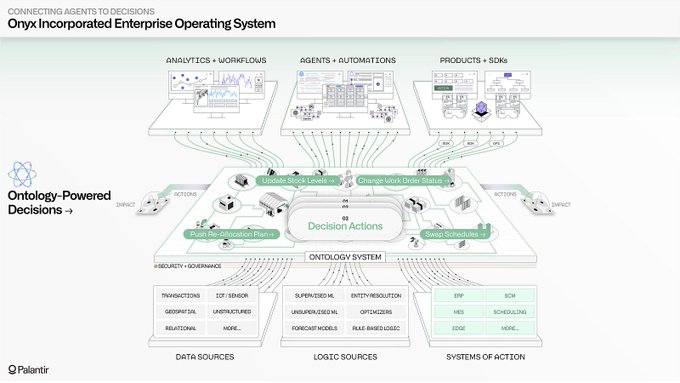
The Ontology allows Onyx to automatically surface actions as tools for AI-driven agents and automations while providing the necessary guardrails for AI to safely take action within predetermined boundaries.
What comes after the crisis? With data, logic, action, and security all connected into Onyx’s ontology, the organization has the ability to conduct powerful decision-centric learning. The human-agent teaming that produced a specific solution to the material shortage also revealed generalizable workflows, which the organization will want to memorialize and surface in the future. Every data element, logic asset, and action assessed is captured in end-to-end decision lineage — which serves as rich, contextual fuel for optimizing the performance of AI. The aggregate decisions made by thousands of users and agents throughout Ontology can be securely leveraged as training data when fine-tuning models, and can be distilled into targeted principles that are called upon during agent prompting. The tribal knowledge that has been traditionally trapped in the seams of workflows can be illuminated by AI, in order to improve the application of AI.
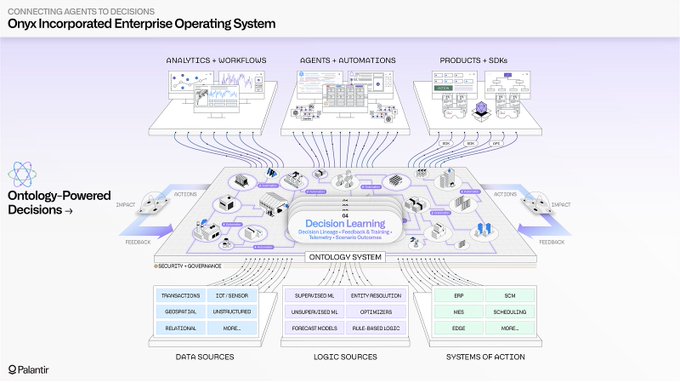
The Ontology captures updates to every data element, logic asset, and action as decisions are securely made — which serves as rich, contextual fuel for optimizing the performance of humans and agents over time.
## Onward with the Ontology
Ultimately, the Ontology allows each organization to implement and scale human-agent operations, and precisely control how and when agent-driven recommendations, augmentations, and automations can be utilized in frontline contexts. This is uniquely possible because the Ontology is decision-centric, not simply data-centric; it brings together the constituent elements of decision-making — data, logic, action, and security — within a single software system. New data can be rapidly integrated into a full-fidelity semantic representation; new algorithms and business logic can be seamlessly surfaced for both human and AI users; and robust action integration is achieved through real-time connections with the full range of operational systems. Each organization’s ontology is a real-time pulse on the changing conditions, ambitions, and decisions being made across teams — ensuring that AI is always anchored in the reality of the enterprise.
This post has only scratched the surface on the Ontology’s underlying decision-centric architecture; the system’s native simulation and scenario-building capabilities; the extensibility provided through the Ontology SDK; the Global Branching framework that allows for safe and zero-downtime evolution of the Ontology; and the tradecraft for scaling human-agent teaming across the entire enterprise.
## Real-World Examples
- See how American Airlines is using their ontology to power AI-enabled network planning
- See how the U.S. Army Software Factory is implementing in days what used to take months
- See how Novartis is transforming drug discovery with agentic R&D
- See how Andretti Global is turbocharging IndyCar operations with human-agent teaming
## 相关链接
- [Palantir](https://x.com/PalantirTech)
- [@PalantirTech](https://x.com/PalantirTech)
- [117K](https://x.com/PalantirTech/status/2049136883528011954/analytics)
- [disaster response](https://youtu.be/sk2peD8SB3s?si=ZYJ1FEhgS2X73qLR)
- [nuclear energy production](https://youtu.be/hjIzKUeXmAk?si=lDsl6Nd-5Zx5rQQC)
- [AIP AgentCamps](https://www.palantir.com/platforms/aip/agentcamp/)
- [Embedded Ontology](https://blog.palantir.com/osdk-and-mobile-applications-building-with-the-embedded-ontology-668432da6572)
- [AI FDE](https://www.palantir.com/docs/foundry/ai-fde/overview/)
- [Workshop](https://www.palantir.com/docs/foundry/workshop/overview/)
- [SDK](https://www.palantir.com/docs/foundry/ontology-sdk/overview/)
- [architecture](https://www.palantir.com/docs/foundry/architecture-center/ontology-system)
- [Ontology SDK](https://www.palantir.com/docs/foundry/ontology-sdk/overview)
- [Global Branching](https://www.palantir.com/docs/foundry/global-branching/overview/)
- [American Airlines](https://youtu.be/DLx3ix6c0Oo?list=PLmKm_LhXXgqT-iNvEF3y7dNGleXIRH866)
- [U.S. Army Software Factory](https://www.youtube.com/watch?v=Osa9yw_IFgc&list=PLqTLGbLI0Cvk17YrpH5etpJ5FKCL8JdwB&index=10&pp=iAQB)
- [Novartis](https://youtu.be/dQ8KeyVmfUM?list=PLmKm_LhXXgqT-iNvEF3y7dNGleXIRH866)
- [Andretti Global](https://youtu.be/mBDQK7OJ1Ls?list=PLmKm_LhXXgqT-iNvEF3y7dNGleXIRH866)
- [Upgrade to Premium](https://x.com/i/premium_sign_up)
- [10:41 PM · Apr 28, 2026](https://x.com/PalantirTech/status/2049136883528011954)
- [117.1K Views](https://x.com/PalantirTech/status/2049136883528011954/analytics)
- [View quotes](https://x.com/PalantirTech/status/2049136883528011954/quotes)
---
*导出时间: 2026/4/29 08:49:06*
---
## 中文翻译
# 将智能体连接到决策
**作者**: Palantir
**日期**: 2026-04-28T14:41:18.000Z
**来源**: [https://x.com/PalantirTech/status/2049136883528011954](https://x.com/PalantirTech/status/2049136883528011954)
---

## Palantir 本体
Palantir 的软件为全球许多最关键的商业和政府环境提供实时的人机协同决策支持。从灾难响应到核能生产,我们的客户依赖 Palantir AIP 在其企业中安全、可靠、高效地利用 AI——并推动运营变革。
虽然许多因素有助于实现并扩大运营影响,包括我们的 AIP AgentCamps——客户在其中亲手操作,并在数小时内通过 AI 取得成果——但关键的区别在于一种围绕 Palantir 本体构建的软件架构。
本体是一个旨在反映企业决策的系统,而不仅仅是数据。世界上每个组织的首要指令都是执行尽可能好的决策,通常是在实时的,同时应对不断变化的内外部条件。传统的数据架构无法捕捉决策过程中的推理或由此产生的行动,因此限制了学习和 AI 的整合。传统的分析架构无法将计算与实际环境结合起来,因此仍然与运营脱节。要在当今的世界中航行并获胜,现代企业需要一种以决策为中心的软件架构。
为了理解本体的价值,让我们首先考虑任何运营决策的四个组成部分:
- 数据:用于制定决策的信息
- 逻辑:评估决策的启发式和计算过程
- 行动:对选定决策的编排和执行
- 安全:确保决策符合运营政策的保证

从根本上说,每个决策都由数据(用于制定决策的信息)、逻辑(评估决策的过程)和行动(执行决策)组成——所有这些都必须由安全机制管理,以确保决策安全且一致地做出。
本体将决策制定的这四个构成要素整合到一个可扩展、动态且协作的基础中,该基础反映了组织在实时演变中不断变化的条件和抱负。
## 数据
如今,组织被前所未有的数据量所淹没。数据源的量、种类和速度不仅正在增加,而且随时间加速。虽然关于清洗和统一数据的优点已经有很多讨论,但在 AI 时代,主要问题是相关性。相关数据当然包括全范围的企业数据源——结构化数据、流和边缘源、非结构化存储库、图像数据等等——但也包括最终用户和智能体在做出决策时生成的数据。这种“决策数据”包含围绕特定决策的上下文、评估的不同选项以及所做选择的下游影响。生成式 AI 提供了一种突破性的能力,可以从全规模的决策数据中综合学习,并持续丰富人类和智能体驱动的工作流。自然,将全范围的企业数据与动态的决策数据集成,需要一种非常不同于针对报告和分析进行优化的经典数据库管理解决方案的架构。
本体将所有模态的数据整合到企业全规模、全保真的语义表示中。广泛的运营数据源(ERP、MES、WMS 等)可以与来自物联网和边缘系统的数据流、非结构化数据存储库的相关部分、地理空间数据存储等同步并上下文化。本体联合并激活这些分散的数据池,并以企业的语言将它们呈现出来。不再使用将运营的丰富性压缩到狭窄模式中的黄金表,企业的全貌通过对象、属性和链接的形式栩栩如生地展现出来,它们实时演变,并设计为直接嵌入到决策工作流中。关键是,本体旨在安全地捕获运营用户在执行日常工作(例如,在供应链、医院系统、客户服务中心中)时产生的决策数据。这包括在边缘做出的决策,通过轻量级嵌入式本体捕获。特定决策何时做出、基于哪个版本的企业数据以及通过哪个应用程序的端到端“决策谱系”会被自动捕获,并安全地供人类开发人员和智能体访问。这提供了大规模驱动 AI 学习所需的综合基础,并持续改进所有形式的智能体记忆(工作记忆、情景记忆、语义记忆、程序记忆等)。

本体将所有模态的数据整合到全规模、全保真的语义表示中,捕捉不断演变的企业现实,并作为人机工作流的基础。
## 逻辑
虽然数据是基础,但它只是决策过程的一个维度;它必须辅以确定何时以及如何做出给定决策的推理,或逻辑。支撑决策的逻辑可以是核心业务系统中的一段简单业务逻辑、使用云数据科学工作台维护的预测模型,或使用多个数据源生成运营计划的优化模型——以及无数其他可能性。在现实环境中,人类推理通常负责编排在工作流的不同阶段使用哪些逻辑资产,以及如何将它们链接到更复杂的流程中。随着智能体编排的出现,现在至关重要的是,AI 驱动的推理必须能够像历史上人类那样利用所有这些逻辑资产。确定性函数、算法和传统统计过程必须作为运营工具呈现,以补充大语言模型和多模态模型的非确定性推理。此外,随着工作流由人类和智能体执行,积累的经验知识可以整合到不同的逻辑片段中,并可以为一个持续的过程提供支持,从而生成在整个工作流中利用的新功能封装。
本体使全套逻辑资产——规定如何制定决策的计算和过程——能够为人类和智能体进行连接和上下文化。这包括通常在 CRM 和 ERP 中发现的与客户交互相关的业务逻辑;驱动传统机器学习的建模逻辑,它们分散在数据科学环境中;以及通常与领域特定工具交织在一起的规划、优化和模拟算法。本体灵活的“逻辑绑定”范式为构建工作流提供了一致的接口,这些工作流无缝地整合和组合异构的逻辑资产——这些资产可能存在于非常不同的环境中(例如,本地数据中心、企业云环境、SaaS 环境、Palantir 平台)。最终,这意味着智能体驱动的推理可以平滑地引入到利用多样化逻辑集的决策制定环境中,而这些环境传统上仅由人类用户引导。

本体使用户能够构建结合经验知识并组合异构逻辑资产的工作流。最终,这意味着可以安全地将智能体引入到日益复杂的决策环境中。
## 行动
当信息(数据)和推理(逻辑)被整合到一个共享的表示中后,下一个要建模的部分是决策本身的执行和编排(行动)。在实时制定决策时闭环行动循环,这是区分运营系统和分析系统的关键。自 Palantir 成立以来,决策的执行一直与数据综合或分析整合一样重要。这需要设计和实施广泛的功能,包括如何安全地捕获可能同时发生且潜在冲突的决策;一个协作模型,将那些可以探索可能决策的人、那些可以暂存决策以供审查的人以及那些可以提交决策的人区分开来;以及一个用于将决策同步到现有数据库、边缘平台和坚固资产的广泛框架。
本体在一个以决策为中心的企业凝聚模型中原生地建模行动。如果本体中的数据元素是企业的“名词”(语义的、现实世界的对象和链接),那么行动可以被视为“动词”(动态的、现实世界的执行)。在每个本体驱动的工作流中,名词和动词通过人类和/或 AI 驱动的推理结合成完整的句子,其中包含各种逻辑片段。虽然在语义模型中统一数据本身是有价值的,虽然将全面评估可能决策所需的逻辑拼接在一起至关重要——除非执行的决策与运营系统同步,并且在能够更好地为下一个决策提供信息的复合基质中捕获完整的决策谱系,否则这一切的价值都是有限的。本体使人类和智能体行动能够安全地暂存为场景,受到与数据和逻辑原语相同的细粒度访问控制管理,并安全地写回到每个企业基质——事务系统、边缘设备、自定义应用程序等。

本体在一个以决策为中心的企业凝聚模型中原生地建模行动,使人类和 AI 驱动的行动能够安全地暂存为场景,受到与数据和逻辑原语相同的访问控制管理,并安全地写回到每个企业基质。
## 安全
在任何运营环境中,人机交互都需要严格的安全和治理能力,这些能力远远超出了对数据桶的传统基于角色的策略。Palantir AIP 提供了一种安全架构,可以混合基于标记、目的和角色的策略;跨越数据、逻辑、行动和应用程序制品流动的动态谱系;以及一套全面的集成变更和发布管理工具,适用于人类驱动和智能体工作流。细粒度策略可以附加到整个本体,以限制智能体和人类对敏感或依赖上下文的信息的访问。这些策略在运行时为每次交互动态计算,并且可以组合应用于基础数据集的行和列级限制、特定用户组的属性(包括通过 SSO 流动的属性)、跨越基础数据管道传播的安全标记等。
工具使用通过管理数据访问和所有形式内存的相同安全架构动态执行。这至少确保任何工具调用都依赖于对本体中的基础对象、属性和链接的访问。此外,工具可以包含依赖于细粒度提交标准的运行时验证。每个智能体或人类行动都依赖于精确的授权授予,这些授予明确规定了允许的操作集,以防止意外调用(例如,查询跨组织边界存在的数据,或连接到未指定的外部系统的工具)和其他形式的权限升级。当智能体生成详细的遥测数据时,日志的安全和传输是一个关键的最后一公里问题。AIP 使管理员能够控制日志如何在特定项目、工作流和智能体中访问。数据标记和其他活动安全原语管理日志访问,方式与管理基础数据、逻辑和行动原语的访问相同。
简而言之,本体将数据、逻辑、行动和安全整合到一个以决策为中心的企业模型中,人类和智能体可以共同利用。从数据集成、应用程序构建到最终用户工作流,所有这些都通过经过实战检验的模块化架构驱动——使人类用户和智能体能够在共享的运营基础上查询、推理和行动。
让我们通过一个概念性的例子来拆解本体如何使 50 多个行业的组织能够在几天内激活人机工作流。

本体在一个以决策为中心的企业模型中凝聚地管理人机活动,使基于角色、标记和目的的策略能够在运行时动态计算,一致地应用于每个人类和智能体与数据、逻辑和行动原语的交互,并无缝扩展到工具调用、智能体内存和遥测日志。
## 一个运营示例
虚构的医疗设备制造商 Onyx Inc. 生产一系列成品,从注射器到手术口罩,每种产品都需要将一组精确的材料通过相关的制造流程进行移动。不同的团队管理着从供应商关系到仓库运营、再到成品生产以及分销给最终客户的所有事情;决策相互依存,并不断适应变化的环境。简而言之,每天在运营业务时都会带来独特的挑战。
在这个例子中,Onyx 面临着与其主要供应商之一的中断,该供应商提供生产手术口罩所需的关键原材料。鉴于 Onyx 制造工厂紧张的生产计划以及客户对手术口罩不断升级的需求,这一中断将导致严重的问题,无法完成未完成客户订单。幸运的是,Onyx 的运营团队利用 AI FDE 将广泛的数据源、逻辑资产和行动系统连接到他们的企业本体中——并拥有迅速做出反应的能力。

Onyx 的本体汇集了应对此次原材料中断所需的所有决策要素:它提供对每个短缺的收入影响的全面可见性,以告知优先级排序,允许考虑到企业运营现实的智能体建议和解决方案,并驱动写回和持续学习,不仅使系统保持最新,还优化未来的决策。
Onyx 将首先评估供应商短缺的直接影响,然后利用 AI 评估跨生产线的可能重新分配策略,最后将其决策转换为一组将同时执行的连接行动