# The Claude Trick 99% Developers Don’t Understand
**作者**: Nainsi Dwivedi
**日期**: 2026-04-30T10:37:28.000Z
**来源**: [https://x.com/NainsiDwiv50980/status/2049800297300832644](https://x.com/NainsiDwiv50980/status/2049800297300832644)
---
The Shift Nobody Understands
Everyone is using Claude Code.
But most are just… talking to it.
They write prompts.
They tweak wording.
They retry when it fails.
And sometimes it works.
But serious builders don’t rely on luck.
They build systems.
> Claude is not a chatbot for developers
It’s a programmable reasoning engine
From Prompts → Systems
Most people operate like this:
"Build a login system"
And hope for the best.
Advanced users operate like this:
define context
enforce constraints
structure reasoning
create feedback loops
> Prompts give outputs
Systems give consistency
The Real Architecture (With Code)
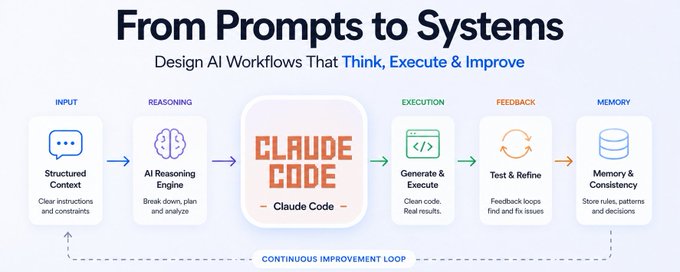
A proper Claude workflow looks like:
Input → Reasoning → Execution → Feedback → Memory
Let’s break this down with actual implementation.
1. Input Layer — Structured Context (Code Template)
Instead of random prompts, use a prompt builder system.
```
def build_prompt(task, context, constraints):
return f"""
You are a senior software engineer.
Task:
{task}
Context:
{context}
Constraints:
{constraints}
Instructions:
1. First, break down the problem
2. Identify edge cases
3. Propose approach
4. Then write clean code
Output format:
- Plan
- Code
- Edge Cases
"""
```
Example Usage:
```
task = "Build a reusable modal component"
context = """
Next.js (App Router)
Tailwind CSS
No external libraries
"""
constraints = """
- Must follow existing component structure
- Accessible (ARIA compliant)
- No new dependencies
"""
prompt = build_prompt(task, context, constraints)
print(prompt)
```
> You’re not writing prompts anymore
You’re generating them
2. Reasoning Layer — Forcing Structured Thinking
You can force Claude into better reasoning patterns.
Before writing code:
1. Break the problem into smaller parts
2. List possible edge cases
3. Choose the best approach
4. THEN generate code
Do not skip steps.
This small addition dramatically improves:
logic clarity
completeness
fewer bugs
> If you don’t guide the thinking
you’ll debug the output later
3. Execution Layer — Controlled Code Generation
Now Claude generates code.
But instead of trusting it blindly, we wrap it.
Example: Claude API Wrapper (Pseudo Implementation)
```
def ask_claude(prompt):
# Replace with actual API call
response = f"[Claude Output for]: {prompt[:100]}..."
return response
```
4. Feedback Loop — Automated Debug Cycle
This is where real power comes in.
Instead of fixing manually →
you create a self-improving loop
Example: Test → Fix → Repeat System
```
import subprocess
def run_tests():
result = subprocess.run(
["npm", "test"],
capture_output=True,
text=True
)
return result.stdout
def fix_with_claude(error_output):
prompt = f"""
Tests are failing.
Error logs:
{error_output}
Task:
Fix the issue.
Constraints:
- Do not change working logic
- Only modify necessary parts
Return only updated code.
"""
return ask_claude(prompt)
while True:
output = run_tests()
if "FAIL" in output or "Error" in output:
print("❌ Tests failed. Asking Claude to fix...\n")
fix = fix_with_claude(output)
print(fix)
# Here you'd apply patch (simplified)
else:
print("✅ All tests passed!")
break
```
What this does:
detects failures
feeds them back to Claude
iterates automatically
> This is where Claude stops being a tool
and becomes a system
5. Memory Layer — CLAUDE.md System
Instead of repeating instructions every time →
store them once.
Example: CLAUDE.md
```
# Project Rules
## Architecture
- Functional components only
- Follow modular folder structure
## Naming
- Components: PascalCase
- Hooks: useCamelCase
## Constraints
- No new dependencies
- Use existing utilities
## Patterns
- Composition over inheritance
- Reusable components first
```
Injecting Memory into
```
def load_memory():
with open("CLAUDE.md", "r") as f:
return f.read()
def build_prompt_with_memory(task):
memory = load_memory()
return f"""
Project Memory:
{memory}
Task:
{task}
Follow all rules strictly.
"""
```
Memory converts randomness into consistency
6. Constraint Layer — Controlling Output
Without constraints → chaos
With constraints → precision
Example:
Build authentication system
Constraints:
- Use JWT only
- No external auth providers
- Do not modify database schema
- Use existing API routes only
Do NOT:
- Add dependencies
- Change architecture
> Constraints don’t limit AI
They focus it
Full Workflow in Action
Here’s how everything connects:
```
task = "Build a user authentication system"
context = """
Node.js backend
Express framework
MongoDB database
"""
constraints = """
- Use JWT
- No new dependencies
- Follow existing structure
"""
prompt = build_prompt(task, context, constraints)
response = ask_claude(prompt)
print("🚀 Initial Output:\n", response)
# Then run:
# → tests
# → feedback loop
# → refinement cycle
```
Why This Changes Everything
Because now:
You’re not:
writing code
fixing bugs manually
You’re:
designing systems
orchestrating intelligence
controlling outputs
Old Way
Write → Debug → Rewrite
New Way
Design → Generate → Test → Refine
The Real Edge
Most people will keep:
writing prompts
chasing better wording
A few will:
build systems
create workflows
scale output massively
> The future of coding isn’t typing faster
It’s thinking in systems
Final Thought
Claude Code is not magic.
It’s leverage.
And leverage only works when applied correctly.
> Stop asking Claude to write code
Start designing systems that make code inevitable
## 相关链接
- [Nainsi Dwivedi](https://x.com/NainsiDwiv50980)
- [@NainsiDwiv50980](https://x.com/NainsiDwiv50980)
- [4.4K](https://x.com/NainsiDwiv50980/status/2049800297300832644/analytics)
- [Upgrade to Premium](https://x.com/i/premium_sign_up)
- [6:37 PM · Apr 30, 2026](https://x.com/NainsiDwiv50980/status/2049800297300832644)
- [4,460 Views](https://x.com/NainsiDwiv50980/status/2049800297300832644/analytics)
---
*导出时间: 2026/5/1 14:47:11*
---
## 中文翻译
# 99% 的开发者都不懂的 Claude 技巧
**作者**: Nainsi Dwivedi
**日期**: 2026-04-30T10:37:28.000Z
**来源**: [https://x.com/NainsiDwiv50980/status/2049800297300832644](https://x.com/NainsiDwiv50980/status/2049800297300832644)
---

**没人理解的转变**
每个人都在用 Claude Code。
但大多数人只是……在跟它聊天。
他们写提示词。
他们调整措辞。
失败时他们重试。
有时这确实有用。
但认真的构建者不靠运气。
他们构建系统。
> Claude 不是开发者的聊天机器人
> 它是一个可编程的推理引擎
**从提示词到系统**
大多数人的操作方式是这样的:
“构建一个登录系统”
然后祈祷一切顺利。
高级用户的操作方式是这样的:
定义上下文
强制约束
构建推理
创建反馈循环
> 提示词给出输出
> 系统给出一致性
**真正的架构(含代码)**
一个正确的 Claude 工作流看起来是这样的:
输入 → 推理 → 执行 → 反馈 → 记忆
让我们通过实际实现来拆解一下。
**1. 输入层 — 结构化上下文(代码模板)**
不要用随意的提示词,改用提示词构建系统。
```
def build_prompt(task, context, constraints):
return f"""
You are a senior software engineer.
Task:
{task}
Context:
{context}
Constraints:
{constraints}
Instructions:
1. First, break down the problem
2. Identify edge cases
3. Propose approach
4. Then write clean code
Output format:
- Plan
- Code
- Edge Cases
"""
```
示例用法:
```
task = "Build a reusable modal component"
context = """
Next.js (App Router)
Tailwind CSS
No external libraries
"""
constraints = """
- Must follow existing component structure
- Accessible (ARIA compliant)
- No new dependencies
"""
prompt = build_prompt(task, context, constraints)
print(prompt)
```
> 你不再是写提示词
> 你是在生成它们
**2. 推理层 — 强制结构化思考**
你可以强迫 Claude 进入更好的推理模式。
在写代码之前:
1. 将问题拆解为更小的部分
2. 列出可能的边缘情况
3. 选择最佳方案
4. 然后再生成代码
不要跳过步骤。
这一小小的添加能显著改善:
逻辑清晰度
完整性
更少的 Bug
> 如果你不引导思考
> 你稍后就得调试输出
**3. 执行层 — 受控的代码生成**
现在 Claude 生成代码。
但不再盲目信任它,我们把它包装起来。
示例:Claude API 包装器(伪实现)
```
def ask_claude(prompt):
# Replace with actual API call
response = f"[Claude Output for]: {prompt[:100]}..."
return response
```
**4. 反馈循环 — 自动调试周期**
这才是真正厉害的地方。
不再手动修复 →
你创建了一个自我改进的循环
示例:测试 → 修复 → 重复系统
```
import subprocess
def run_tests():
result = subprocess.run(
["npm", "test"],
capture_output=True,
text=True
)
return result.stdout
def fix_with_claude(error_output):
prompt = f"""
Tests are failing.
Error logs:
{error_output}
Task:
Fix the issue.
Constraints:
- Do not change working logic
- Only modify necessary parts
Return only updated code.
"""
return ask_claude(prompt)
while True:
output = run_tests()
if "FAIL" in output or "Error" in output:
print("❌ Tests failed. Asking Claude to fix...\n")
fix = fix_with_claude(output)
print(fix)
# Here you'd apply patch (simplified)
else:
print("✅ All test passed!")
break
```
它的作用:
检测失败
将其反馈给 Claude
自动迭代
> 这就是 Claude 停止成为工具
> 变成系统的时刻
**5. 记忆层 — CLAUDE.md 系统**
不再每次重复指令 →
一次性存储它们。
示例:CLAUDE.md
```
# Project Rules
## Architecture
- Functional components only
- Follow modular folder structure
## Naming
- Components: PascalCase
- Hooks: useCamelCase
## Constraints
- No new dependencies
- Use existing utilities
## Patterns
- Composition over inheritance
- Reusable components first
```
将记忆注入
```
def load_memory():
with open("CLAUDE.md", "r") as f:
return f.read()
def build_prompt_with_memory(task):
memory = load_memory()
return f"""
Project Memory:
{memory}
Task:
{task}
Follow all rules strictly.
"""
```
记忆将随机性转化为一致性
**6. 约束层 — 控制输出**
没有约束 → 混乱
有了约束 → 精确
示例:
构建身份验证系统
约束:
- 仅使用 JWT
- 无外部身份验证提供商
- 不修改数据库架构
- 仅使用现有的 API 路由
不要:
- 添加依赖项
- 更改架构
> 约束不会限制 AI
> 它们能聚焦 AI
**实际运作的完整工作流**
所有部分是如何连接的:
```
task = "Build a user authentication system"
context = """
Node.js backend
Express framework
MongoDB database
"""
constraints = """
- Use JWT
- No new dependencies
- Follow existing structure
"""
prompt = build_prompt(task, context, constraints)
response = ask_claude(prompt)
print("🚀 Initial Output:\n", response)
# Then run:
# → tests
# → feedback loop
# → refinement cycle
```
**这将改变一切的原因**
因为现在:
你不再是:
写代码
手动修复 Bug
你现在是:
设计系统
编排智能
控制输出
**旧方式**
编写 → 调试 → 重写
**新方式**
设计 → 生成 → 测试 → 优化
**真正的优势**
大多数人会继续:
写提示词
追求更好的措辞
少数人将会:
构建系统
创建工作流
大规模扩展输出
> 编码的未来不是打字更快
> 而是以系统的思维思考
**最后的思考**
Claude Code 不是魔法。
它是杠杆。
而杠杆只有在正确使用时才有效。
> 别再要求 Claude 写代码了
> 开始设计让代码必然产生的系统
## 相关链接
- [Nainsi Dwivedi](https://x.com/NainsiDwiv50980)
- [@NainsiDwiv50980](https://x.com/NainsiDwiv50980)
- [4.4K](https://x.com/NainsiDwiv50980/status/2049800297300832644/analytics)
- [升级到 Premium](https://x.com/i/premium_sign_up)
- [6:37 PM · Apr 30, 2026](https://x.com/NainsiDwiv50980/status/2049800297300832644)
- [4,460 次查看](https://x.com/NainsiDwiv50980/status/2049800297300832644/analytics)
---
*导出时间: 2026/5/1 14:47:11*