# How to Build a Real AI Agent System With Claude (Beginner-Friendly Full Guide)
**作者**: Nainsi Dwivedi
**日期**: 2026-05-25T15:45:33.000Z
**来源**: [https://x.com/NainsiDwiv50980/status/2058937525595681016](https://x.com/NainsiDwiv50980/status/2058937525595681016)
---
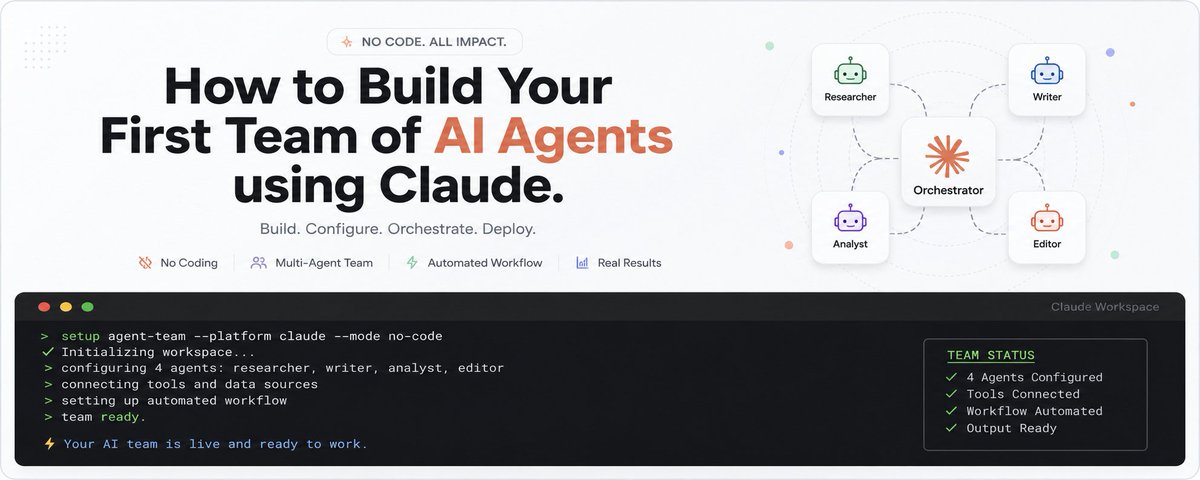
Everyone online is suddenly an "AI agent expert."
Every day you see the same posts:
"AI agents will replace teams." "Build autonomous workflows." "One-person billion-dollar company." "Agentic systems are the future."
But the moment you actually try building one yourself, everything falls apart.
You open a tutorial. It starts with Python. Then APIs. Then terminals. Then frameworks with names you have never heard before.
And within twenty minutes you convince yourself:
"Maybe this is only for developers."
It is not.
Most people completely misunderstand what AI agents actually are.
An AI agent is not magic. It is not some futuristic robot. And you do not need to become an engineer to build one.
An AI agent is simply:
An AI system with a role, instructions, tools, and memory that can complete tasks with minimal supervision.
That is it.
And today, using Claude + Cowork, you can build your own working AI agent team without writing code.
This guide will show you exactly how.
By the end, you will have:
A working AI research agent
A writing workflow powered by multiple agents
Automated systems that save hours every week
A clear understanding of how real AI workflows are built
A foundation you can turn into freelance services, internal systems, or even products
This is the beginner-friendly full course. No coding. No jargon. No fluff.
---
Part 1: What AI Agents Actually Are
Most people still use AI like a search engine.
They ask one question. Get one answer. Ask another question. Repeat.
That is chatbot usage.
Agents are different.
A chatbot reacts. An agent executes.
Here is the easiest way to understand it.
Imagine hiring an assistant.
A chatbot version looks like this:
"Open Google Docs." "Now create a document." "Now write a title." "Now research this topic." "Now summarize it."
You micromanage every step.
An agent version looks like this:
"Research this topic and prepare a report for tomorrow morning."
The system figures out the rest.
That is the difference.
Agents reduce supervision.
And once you understand that, everything becomes easier.
---
Part 2: The 4 Building Blocks of Every AI Agent
Every AI agent system — no matter how advanced — is built from four simple pieces.
Learn these once and you will understand almost every AI workflow online.
1. The Role
Every agent needs one clear responsibility.
Bad:
"You are an AI assistant that helps with many things."
Good:
"You are a research analyst that finds industry trends and summarizes them clearly."
The more specific the role, the stronger the output.
Examples:
Research Agent
Content Writer Agent
SEO Agent
Data Analysis Agent
Meeting Prep Agent
Customer Support Agent
Social Media Agent
Do not create one giant agent that tries to do everything.
Specialization creates better results.
---
2. Instructions
Instructions define HOW the agent works.
Most people give terrible instructions.
They say:
"Write me an article about AI."
Strong instructions are process-based.
Example:
"Research the topic using at least five credible sources. Identify major trends, conflicting opinions, and actionable insights. Structure findings into sections. Keep paragraphs short. Avoid generic statements."
Good instructions define:
The workflow
The quality standard
The tone
The format
The constraints
The clearer the process, the better the system performs.
---
3. Tools
AI becomes dramatically more powerful once it can interact with external systems.
Tools allow agents to:
Search the web
Read files
Access Google Drive
Analyze spreadsheets
Use Gmail
Connect to Slack
Organize documents
Schedule workflows
Without tools, AI only generates text.
With tools, AI becomes operational.
---
4. Memory
Memory allows the agent to remember context over time.
For example:
Your preferred writing style
Your audience
Previous outputs
Past feedback
Ongoing projects
Without memory, every session starts from zero.
With memory, the system improves continuously.
This is what makes agents feel like assistants instead of temporary chatbots.
---
Part 3: Build Your First AI Agent (No Coding Required)
Now let us build one.
Open Claude Desktop. Go to Cowork. Create a new workspace.
Your first agent will be a:
Content Research Agent
This is one of the highest-leverage beginner agents because almost every workflow starts with research.
---
Step 1: Define the Role
Your agent needs a single responsibility.
Paste this:
"You are my Content Research Agent.
Your job is to research topics deeply and produce structured research briefs that are easy to understand and immediately useful."
Simple. Specific. Clear.
---
Step 2: Add Process Instructions
Now define exactly how the agent should operate.
Use this framework:
You are my Content Research Agent.
Your responsibilities:
1. Break every topic into major subtopics
2. Identify important trends, data, examples, and expert insights
3. Highlight disagreements or conflicting viewpoints
4. Summarize findings clearly
5. Create actionable takeaways at the end
Rules:
No fluff
No vague claims
Keep explanations concise
Use structured formatting
If information is uncertain, clearly say so
Output format:
Executive Summary
Key Trends
Important Statistics
Contrarian Insights
Actionable Takeaways
Tone: Professional, direct, beginner-friendly.
This immediately upgrades output quality.
---
Step 3: Give the Agent Access
Create folders for your workflow.
Example:
/Research /Outlines /Drafts /Published
Grant Cowork access.
Now your agent can automatically save work into organized systems.
This sounds simple. But this is the moment AI stops being "just a chatbot" and starts becoming infrastructure.
---
Step 4: Run Your First Task
Give the agent a real assignment.
Example:
"Research how small businesses are using AI agents in 2026. Focus on practical workflows, not theory."
Then watch the system work.
It will:
Plan the research
Search for information
Structure findings
Generate summaries
Save the output automatically
You delegated work. Not prompts.
That distinction matters.
---
Step 5: Improve Through Feedback
Your first result will not be perfect.
That is normal.
Agents improve through iteration.
Give specific feedback like:
"Shorten each section"
"Use more real-world examples"
"Include stronger statistics"
"Make the executive summary sharper"
"Avoid generic startup language"
Every refinement upgrades future outputs.
Over time, your system becomes customized to your standards.
---
Part 4: Why Single Agents Are Limited
One agent is helpful.
Multiple specialized agents are where things become powerful.
Most advanced AI workflows are not built with one super-agent.
They are built with:
Specialized roles
Clear handoffs
Sequential workflows
Layered quality control
Exactly like real teams.
So instead of building one giant AI worker, you build a system.
---
Part 5: Build Your First Multi-Agent Team
We will build a complete content production system.
This is one of the most practical beginner workflows because it directly saves time and creates real output.
The workflow:
Research → Outline → Draft → Edit
Four agents. Four responsibilities. One pipeline.
---
Agent 1: Research Agent
You already built this.
Purpose:
Gather information
Identify insights
Structure knowledge
Output:
Research brief.
---
Agent 2: Outline Agent
This agent transforms research into structure.
Instructions:
You are my Outline Agent.
Your job is to turn research briefs into detailed content outlines.
Responsibilities:
1. Identify the strongest angle
2. Create compelling headlines
3. Structure the article section by section
4. Add examples and supporting points
5. Estimate section lengths
6. Write the opening hook
7. Write the conclusion CTA
Rules:
Prioritize clarity
Use strong curiosity hooks
Avoid generic structure
Make the outline detailed enough for another writer to follow easily
Output:
A complete article outline.
---
Agent 3: Writer Agent
Now the system turns outlines into full drafts.
Instructions:
You are my Writer Agent.
Your job is to convert outlines into polished articles.
Writing style:
Conversational
Direct
Short paragraphs
High readability
No corporate language
No robotic phrasing
Rules:
Follow the outline exactly
Include specific examples
Use bolding for important phrases
Keep momentum high
Avoid filler completely
This agent focuses purely on execution.
---
Agent 4: Editor Agent
This is the quality control layer.
Instructions:
You are my Editor Agent.
Your job is to improve articles to publication quality.
Review for:
Clarity
Flow
Redundancy
Weak sections
Tone consistency
Structure
Engagement
Improve:
Hooks
Transitions
Endings
Specificity
Formatting
Remove:
Repetition
Fluff
Generic phrasing
Weak sentences
This final step dramatically upgrades output quality.
---
Part 6: Running the Workflow
Now combine the agents.
Step 1: Tell the Research Agent:
"Research AI automation for creators."
Step 2: Send the output to the Outline Agent.
Step 3: Send the outline to the Writer Agent.
Step 4: Send the draft to the Editor Agent.
The system produces:
Topic → Research → Structure → Draft → Final Article
Without you manually writing every section.
This is how leverage works.
---
Part 7: Advanced Agent Techniques
Once your basic workflow functions properly, you can make it dramatically more powerful.
---
Technique 1: Scheduled Workflows
Cowork allows scheduled automation.
Example:
Every Monday:
7:00 AM → Research trending AI topics 8:00 AM → Generate outlines 9:00 AM → Draft top article 10:00 AM → Edit and finalize
You wake up to completed work.
This is where AI starts behaving like infrastructure instead of software.
---
Technique 2: Shared Context Files
Create a file called:
context.md
This acts like a company handbook for your agents.
Example:
Brand Context
Audience: Founders and AI builders Tone: Direct and practical Avoid: Corporate jargon and motivational fluff Always include:
Real examples
Specific numbers
Actionable insights
Short paragraphs
Every agent reads this before starting.
This creates consistency across your entire workflow.
---
Technique 3: Feedback Loops
The best AI systems improve continuously.
After outputs, give targeted feedback.
Bad feedback:
"This wasn't good."
Good feedback:
"The opening lacked tension. Use stronger contrasts and more specific examples next time."
Specific feedback trains better future behavior.
Over time your agents adapt to your preferences.
---
Technique 4: Full Pipeline Commands
Eventually you can automate entire chains.
Example:
"Research the topic 'AI workflows for agencies,' generate an outline, write the draft, edit it, and save the final version."
One command. Multiple agents. Complete workflow.
This is how advanced teams are operating right now.
---
Part 8: Real AI Agent Teams You Can Build Today
Here are practical systems you can create immediately.
---
The Business Intelligence Team
Data Agent
Collects metrics and reports.
Analysis Agent
Finds trends and anomalies.
Strategy Agent
Recommends actions.
Reporting Agent
Creates executive summaries.
This system replaces hours of manual reporting.
---
The Customer Research Team
Survey Agent
Creates research questions.
Processing Agent
Organizes responses.
Insight Agent
Identifies patterns.
Recommendation Agent
Suggests product improvements.
This is incredibly useful for founders.
---
The Social Media Team
Trend Research Agent
Finds high-performing content.
Planning Agent
Creates weekly schedules.
Writing Agent
Drafts platform-specific posts.
Optimization Agent
Improves hooks, formatting, and engagement.
This workflow alone can save creators dozens of hours monthly.
---
Part 9: The Biggest Mistake Beginners Make
Most people try to build something too complicated immediately.
They want:
Autonomous businesses
Fully automated companies
Infinite workflows
Multi-tool ecosystems
Before they have built one simple working agent.
Start smaller.
Build one useful workflow.
Then improve it.
Then expand it.
AI systems compound.
A simple working system beats a complicated unfinished system every time.
---
Part 10: What Happens Next
Right now, most people still use AI like a toy.
Ask question. Get answer. Repeat.
But the people creating massive leverage are building systems.
Systems that:
Research automatically
Organize information
Draft content
Analyze data
Generate reports
Save time daily
And the gap between those two groups is getting larger every month.
The good news:
You do not need to become an engineer to participate.
You just need to understand workflows.
That is the real skill.
Not coding. Not prompting. Not hype.
Workflow design.
You now understand the fundamentals:
Roles
Instructions
Tools
Memory
Multi-agent systems
Workflow chaining
Feedback loops
Automation pipelines
That already puts you ahead of most people discussing AI online.
Now do the important part.
Actually build one.
Pick a workflow that wastes your time every week. Turn it into an agent system. Run it for seven days. Refine it. Improve it.
Within a month, you will think about work completely differently.
Because once you stop treating AI like a chatbot and start treating it like an operational system, everything changes.
And that shift is where the real opportunity begins.
## 相关链接
- [Nainsi Dwivedi](https://x.com/NainsiDwiv50980)
- [@NainsiDwiv50980](https://x.com/NainsiDwiv50980)
- [Upgrade to Premium](https://x.com/i/premium_sign_up)
- [11:45 PM · May 25, 2026](https://x.com/NainsiDwiv50980/status/2058937525595681016)
- [7,731 Views](https://x.com/NainsiDwiv50980/status/2058937525595681016/analytics)
- [View quotes](https://x.com/NainsiDwiv50980/status/2058937525595681016/quotes)
---
*导出时间: 2026/5/26 09:59:56*
---
## 中文翻译
# 如何使用 Claude 构建真正的 AI Agent 系统(新手友好全指南)
**作者**: Nainsi Dwivedi
**日期**: 2026-05-25T15:45:33.000Z
**来源**: [https://x.com/NainsiDwiv50980/status/2058937525595681016](https://x.com/NainsiDwiv50980/status/2058937525595681016)
---

网上的每个人突然都成了“AI Agent 专家”。
每天你都会看到同样的帖子:
“AI Agent 将取代团队。”“构建自主工作流。”“一人独角兽公司。”“Agentic 系统是未来。”
但当你真正尝试自己构建一个时,一切都崩塌了。
你打开一个教程。它从 Python 开始。然后是 API。然后是终端。然后是各种你从未听说过的框架。
二十分钟内,你就说服了自己:
“也许这只是开发员的专利。”
并非如此。
大多数人对 AI Agent 的本质完全误解了。
AI Agent 不是魔法。它不是什么未来机器人。你不需要成为工程师也能构建一个。
AI Agent 简单来说就是:
一个具有角色、指令、工具和记忆的 AI 系统,能在极少监督下完成任务。
仅此而已。
今天,使用 Claude + Cowork,你可以无需编写代码,构建自己的可用 AI Agent 团队。
本指南将准确展示如何操作。
在结束之前,你将拥有:
一个可用的 AI 研究型 Agent
由多个 Agent 驱动的写作工作流
每周节省数小时的自动化系统
对如何构建真正的 AI 工作流的清晰理解
可转化为自由职业服务、内部系统甚至产品的基础
这是新手友好的完整课程。无代码。无行话。无废话。
---
第 1 部分:AI Agent 到底是什么
大多数人仍然像使用搜索引擎一样使用 AI。
他们问一个问题。得到一个答案。再问另一个问题。重复。
那是聊天机器人的用法。
Agent 则不同。
聊天机器人做出反应。Agent 执行任务。
这是最简单的理解方式。
想象雇佣一位助理。
聊天机器人版本看起来是这样的:
“打开 Google Docs。”“现在创建一个文档。”“现在写一个标题。”“现在研究这个话题。”“现在总结它。”
你对每一步都进行微观管理。
Agent 版本看起来是这样的:
“研究这个话题并为明天早上准备一份报告。”
系统会搞定剩下的。
这就是区别。
Agent 减少了监督。
一旦你理解了这一点,一切都会变得简单。
---
第 2 部分:每个 AI Agent 的 4 个构建模块
每个 AI Agent 系统——无论多么先进——都由四个简单的部分组成。
只需学习一次,你就能理解网上几乎所有的 AI 工作流。
1. 角色
每个 Agent 都需要一个明确的职责。
不好的:
“你是一个帮助处理许多事情的 AI 助手。”
好的:
“你是一名研究分析师,负责寻找行业趋势并清晰地总结它们。”
角色越具体,输出越强。
例子:
研究 Agent
内容写作 Agent
SEO Agent
数据分析 Agent
会议准备 Agent
客户支持 Agent
社交媒体 Agent
不要创建一个试图做所有事情的巨型 Agent。
专业化能创造更好的结果。
---
2. 指令
指令定义了 Agent 如何运作。
大多数人给出的指令都很糟糕。
他们会说:
“给我写一篇关于 AI 的文章。”
强有力的指令是基于流程的。
例子:
“使用至少五个可信来源研究该话题。确定主要趋势、相互冲突的观点和可操作的见解。将发现构建成章节。保持段落简短。避免泛泛而谈的陈述。”
好的指令定义了:
工作流程
质量标准
语气
格式
限制条件
流程越清晰,系统性能越好。
---
3. 工具
一旦 AI 能与外部系统交互,它的力量会大增。
工具允许 Agent:
搜索网页
读取文件
访问 Google Drive
分析电子表格
使用 Gmail
连接到 Slack
整理文档
安排工作流
没有工具,AI 只生成文本。
有了工具,AI 变得可操作。
---
4. 记忆
记忆允许 Agent 随着时间的推移记住上下文。
例如:
你偏好的写作风格
你的受众
之前的输出
过去的反馈
正在进行的项目
没有记忆,每次会话都从零开始。
有了记忆,系统持续改进。
这正是让 Agent 感觉像助理而不是临时聊天机器人的原因。
---
第 3 部分:构建你的第一个 AI Agent(无需编码)
现在让我们构建一个。
打开 Claude Desktop。进入 Cowork。创建一个新工作区。
你的第一个 Agent 将是:
内容研究 Agent
这是初学者最高杠杆的 Agent 之一,因为几乎每个工作流都始于研究。
---
步骤 1:定义角色
你的 Agent 需要单一职责。
粘贴这段内容:
“你是我的内容研究 Agent。
你的工作是深入研究话题并生成结构化的研究简报,使其易于理解且立即可用。”
简单。具体。清晰。
---
步骤 2:添加流程指令
现在准确定义 Agent 应该如何运作。
使用这个框架:
你是我的内容研究 Agent。
你的职责:
1. 将每个话题分解为主要的子话题
2. 确定重要的趋势、数据、例子和专家见解
3. 强调分歧或相互冲突的观点
4. 清晰地总结发现
5. 在最后创建可操作的要点
规则:
无废话
无模糊的主张
保持解释简洁
使用结构化格式
如果信息不确定,请明确说明
输出格式:
执行摘要
关键趋势
重要统计数据
反向见解
可操作的要点
语气:专业、直接、新手友好。
这会立即提升输出质量。
---
步骤 3:授予 Agent 访问权限
为你的工作流创建文件夹。
例子:
/Research /Outlines /Drafts /Published
授予 Cowork 访问权限。
现在你的 Agent 可以自动将工作保存到有组织的系统中。
这听起来很简单。但这正是 AI 停止成为“仅仅是聊天机器人”并开始成为基础设施的时刻。
---
步骤 4:运行你的第一个任务
给 Agent 一个真实的任务。
例子:
“研究小企业在 2026 年如何使用 AI Agent。专注于实用工作流,而不是理论。”
然后观察系统工作。
它将:
规划研究
搜索信息
构建发现
生成摘要
自动保存输出
你委派的是工作,而不是提示词。
这种区别很重要。
---
步骤 5:通过反馈进行改进
你的第一个结果不会是完美的。
这很正常。
Agent 通过迭代来改进。
给出具体的反馈,例如:
“缩短每个部分”
“使用更多真实世界的例子”
“包含更强的统计数据”
“使执行摘要更犀利”
“避免通用的创业语言”
每次改进都会升级未来的输出。
随着时间的推移,你的系统会根据你的标准进行定制。
---
第 4 部分:为什么单一 Agent 是有限的
一个 Agent 很有帮助。
多个专业化的 Agent 才是强大的地方。
大多数高级 AI 工作流不是由一个超级 Agent 构建的。
它们由以下部分构建:
专业化的角色
清晰的交接
顺序工作流
分层质量控制
就像真实的团队一样。
因此,不要构建一个巨型 AI 工人,而是构建一个系统。
---
第 5 部分:构建你的第一个多 Agent 团队
我们将构建一个完整的内容生产系统。
这是最实用的新手工作流之一,因为它直接节省时间并创建真实的输出。
工作流:
研究 → 大纲 → 草稿 → 编辑
四个 Agent。四个职责。一条流水线。
---
Agent 1:研究 Agent
你已经构建了这个。
目的:
收集信息
确定见解
构建知识
输出:
研究简报。
---
Agent 2:大纲 Agent
这个 Agent 将研究转化为结构。
指令:
你是我的大纲 Agent。
你的工作是将研究简稿转化为详细的内容大纲。
职责:
1. 确定最强的角度
2. 创作引人注目的标题
3. 逐节构建文章结构
4. 添加例子和支持点
5. 估算各部分长度
6. 撰写开篇钩子
7. 撰写结论 CTA
规则:
优先考虑清晰度
使用强有力的好奇心钩子
避免通用结构
使大纲足够详细,以便另一位撰稿人轻松遵循
输出:
一份完整的文章大纲。
---
Agent 3:写作 Agent
现在系统将大纲转化为完整的草稿。
指令:
你是我的写作 Agent。
你的工作是将大纲转化为精美的文章。
写作风格:
对话式
直接
短段落
高可读性
无企业语言
无机器人措辞
规则:
完全遵循大纲
包含具体例子
对重要短语使用粗体
保持势头高昂
完全避免填充内容
这个 Agent 专注于纯粹的执行。
---
Agent 4:编辑 Agent
这是质量控制层。
指令:
你是我的编辑 Agent。
你的工作是将文章提升到发表质量。
审查以下方面:
清晰度
流畅度
冗余
薄弱章节
语气一致性
结构
吸引力
改进:
钩子
过渡
结尾
具体性
格式
删除:
重复
废话
通用措辞
弱句
这最后一步将大幅提升输出质量。
---
第 6 部分:运行工作流
现在组合这些 Agent。
步骤 1:告诉研究 Agent:
“研究创作者的 AI 自动化。”
步骤 2:将输出发送给大纲 Agent。
步骤 3:将大纲发送给写作 Agent。
步骤 4:将草稿发送给编辑 Agent。
系统产生:
主题 → 研究 → 结构 → 草稿 → 最终文章
无需你手动编写每个部分。
这就是杠杆的运作方式。
---
第 7 部分:高级 Agent 技巧
一旦你的基本工作流正常运行,你可以使其强大得多。
---
技巧 1:定时工作流
Cowork 允许定时自动化。
例子:
每周一:
上午 7:00 → 研究热门 AI 话题 上午 8:00 → 生成大纲 上午 9:00 → 起草热门文章 上午 10:00 → 编辑并定稿
你醒来时工作已经完成。
这就是 AI 开始表现得像基础设施而不是软件的地方。
---
技巧 2:共享上下文文件
创建一个名为:
context.md 的文件
这就像你 Agent 的公司手册。
例子:
品牌上下文
受众:创始人和 AI 构建者 语气:直接和实用 避免:企业术语和励志废话 始终包括:
真实例子
具体数字
可操作的见解
短段落
每个 Agent 在开始前阅读此内容。
这会在整个工作流中创建一致性。
---
技巧 3:反馈循环
最好的 AI 系统持续改进。
在输出后,给出针对性的反馈。
糟糕的反馈:
“这不好。”
好的反馈:
“开头缺乏张力。下次使用更强的对比和更具体的例子。”
具体的反馈能训练出更好的未来行为。
随着时间的推移,你的 Agent 会适应你的偏好。
---
技巧 4:全流水线命令
最终你可以自动化整个链条。
例子:
“研究‘代理商的 AI 工作流’这一主题,生成大纲,撰写草稿,进行编辑,并保存最终版本。”
一个命令。多个 Agent。完整工作流。
这就是高级团队目前的运作方式。
---
第 8 部分:你今天就可以构建的真实 AI Agent 团队
这里有一些你可以立即创建的实用系统。
---
商业智能团队
数据 Agent
收集指标和报告。
分析 Agent
发现趋势和异常。
策略 Agent
建议行动。
报告 Agent
创建执行摘要。
该系统取代了数小时的手动报告。
---
客户研究团队
调查 Agent
创建研究问题。
处理 Agent
整理回复。
洞察 Agent
识别模式。
建议 Agent
建议产品改进。
这对创始人非常有用。
---
社交媒体团队
趋势研究 Agent
查找高表现内容。
规划 Agent
创建每周时间表。
写作 Agent
起草特定平台的帖子。
优化 Agent
改进钩子、格式和互动。
仅此工作流每月就能为创作者节省数十小时。
---
第 9 部分:初学者最大的错误
大多数人试图立即构建过于复杂的东西。
他们想要:
自主业务
全自动公司
无限工作流
多工具生态系统
在他们构建一个简单的可用 Agent 之前。
从小处着手。
构建一个有用的工作流。
然后改进它。
然后扩展它。
AI 系统是复利的。
一个简单可用的系统每次都胜过一个复杂未完成的系统。
---
第 10 部分:接下来会发生什么
目前,大多数人仍然像对待玩具一样对待 AI。
提问。得到答案。重复。
但创造巨大杠杆的人正在构建系统。
这些系统可以:
自动研究
整理信息
起草内容
分析数据
生成报告
每天节省时间
这两类人之间的差距每个月都在拉大。
好消息是:
你不需要成为工程师也能参与其中。
你只需要理解工作流。
这才是真正的技能。
不是编码。不是提示工程。不是炒作。
工作流设计。
你现在掌握了基础知识:
角色
指令
工具
记忆
多 Agent 系统
工作流链接
反馈循环
自动化流水线
这已经让你领先于大多数在网上讨论 AI 的人。
现在做重要的一部分。
真正构建一个。
选择一个每周都在浪费你时间的工作流。将其转化为 Agent 系统。运行七天。优化它。改进它。
在一个月内,你将以完全不同的方式思考工作。
因为一旦你停止将 AI 视为聊天机器人并开始将其视为运营系统,一切都会改变。
而这种转变正是真正机会的开始。
## 相关链接
- [Nainsi Dwivedi](https://x.com/NainsiDwiv50980)
- [@NainsiDwiv50980](https://x.com/NainsiDwiv50980)
- [Upgrade to Premium](https://x.com/i/premium_sign_up)
- [11:45 PM · May 25, 2026](https://x.com/NainsiDwiv50980/status/2058937525595681016)
- [7,731 Views](https://x.com/NainsiDwiv50980/status/2058937525595681016/analytics)
- [View quotes](https://x.com/NainsiDwiv50980/status/2058937525595681016/quotes)
---
*导出时间: 2026/5/26 09:59:56*