# Arcads + Claude Code = 550 videos per day. No camera. No team. The 4-file system runs alone
**作者**: Noah Frydberg | Tiktok Shop For Brands
**日期**: 2026-05-03T16:45:54.000Z
**来源**: [https://x.com/maverickecom/status/2050980176880697515](https://x.com/maverickecom/status/2050980176880697515)
---
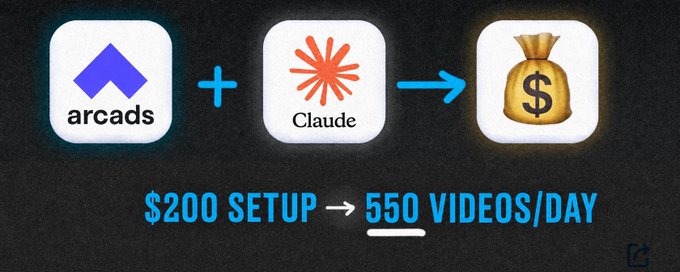
CONTENT INFRASTRUCTURE
E-com brands are running 550-video content machines from a single folder.
No content team. No creative director. No wasted product samples. Just four files and an AI that never sleeps.
The brand does $200K a month on Amazon. Good margins, strong reviews, loyal repeat buyers. The founder is good at sourcing. He is not good at content. He has tried three UGC agencies. The first ghosted him after onboarding. The second sent six clips that didn't convert. The third charged $4,000 for a creative brief and two deliverables. He spent $11,000 learning that human UGC at scale doesn't scale.
Then he found out what was possible when content becomes a system instead of a service.
Today his brand publishes 550 short-form videos per day across TikTok, Facebook, and Instagram. Every single one is on-brand, on-script, product-accurate. None required a creator on location. None required a sample to be shipped. None required a single revision call.
The whole machine is four files.
The old model is broken.
UGC used to mean hiring creators to film themselves using your product and post it. The promise was authenticity. The reality was: inconsistent quality, missed deadlines, scripts rewritten in the caption, and a CPM that made your CFO physically uncomfortable.
Even when it worked, it didn't scale. You could get ten videos a month if you were lucky, organized, and willing to manage twenty freelancers at once. You could not get five hundred. If you did, you most certainly were not doing so with real consistent profits.
The creative teams that replaced freelancer chaos — the $15k/month agencies — solved consistency but created a new problem. They needed briefing cycles. Approval rounds. Revision loops. The fastest turnaround in the industry was still measured in weeks. And sometimes creators still said things they weren't supposed to.
The brands winning on TikTok Shop now publish daily. Not weekly. Daily. Some accounts publish 10 times a day, testing hooks, testing angles, testing products, watching the data in real time, and doubling down on whatever is pulling.
That is not possible with human content infrastructure. It is possible with four files.
Meet the system.
The workflow I run for e-com brands at my agency has four components. It is the same four components every time. The brand changes. The products change. The persona changes. The system does not.
brand.md
Who the brand is. Voice rules, forbidden phrases, tone anchors, competitor positioning. The brand brief that never gets lost in Slack.
persona.md
Who is speaking. The AI creators names, ages, visual reference, backstory, relationship to the product. 1,200 words of character that never breaks.
product.md
What is being sold. Every SKU, every claim, every differentiator, every objection and its answer. The source of truth the AI writes from.
hooks.md
What stops the scroll. A live library of hook frameworks, tested openers, emotional triggers, and format variations the system draws from on every generation.
Claude reads all four before writing every script. Arcads renders the AI creator on screen, delivering the script in a face and voice that is consistent across every video. The output goes to TikTok, Instagram Reels, and TikTok Shop listings the same day it's generated.
The loop runs on autopilot. New scripts generate every morning. The brand's job is not to manage creators. It is to read the data and tell the system which direction to go. It is to make sure that things are going in the right direction.
Why e-com brands specifically.
Every content problem in e-commerce has the same shape: you have more products than content, more products than time, and more competition than budget. You are not short on things to say. You are short on the infrastructure to say them fast enough.
A brand with ten SKUs has a hundred angles. Different hooks for different demographics. Different pain points for different seasons. Different formats for TikTok versus Reels versus a Shop listing. A human content team can maybe cover twenty of those angles in a month. The system covers all of them in a week and starts testing which ones pull.
No sample shipped. No creator scheduled. No revision call on Friday at 4pm. No wait to find out if the hook lands — you test ten hooks and you know by Monday.
That is the structural advantage. Not that the content is free. Not that it's faster. That it is testable at a speed where the data actually tells you something before the season ends.
How I build this ai ugc workflow for ecom brands.
PHASE 01
brand.md — The brief that doesn't leave.
Every agency relationship ends with the brief living in someone's email thread, half in a Notion doc, half in a Slack DM with a freelancer who quit in February. The first thing I build is a permanent brief. Not a document. A source of truth the system reads every time it generates anything.
Voice rules. Tone anchors. What the brand is not allowed to say. What the competitor says that you counter. Who the customer is in one paragraph, not ten slides. Done when Claude can write five scripts from it without asking a single clarifying question.
PHASE 02
persona.md — The creator who never cancels.
The AI creator is not a random face. It is a constructed character with a specific relationship to the product category. A supplement brand gets a persona with a fitness backstory. A skincare brand gets a persona with the skin journey. The persona's history is why they would authentically use and recommend this exact product.
Arcads renders that persona at scale. Consistent face. Consistent voice. Consistent delivery. The customer sees the same person every time, building the same brand recognition that a human creator would build — without the human creator's availability problems, rate increases, or content restrictions.
PHASE 03
product.md — No more off-script claims.
The single most expensive UGC mistake in e-commerce is a creator who goes off-script on a claim. Not maliciously. They misread the brief, ad-libbed something that sounded right, and now the video has 400k views and the claim is wrong and the FTC guidelines are very clear about what happens next.
product.md is the closed loop. Every claim in every script is sourced from this file. The system does not invent. It does not ad-lib. It writes from the brief and only from the brief. The creative director approves the file once. Everything after that is downstream of that approval.
PHASE 04
hooks.md — The library that compounds.
This is the file that separates a system from a campaign. A campaign runs a hook once. A system runs a hundred variations, watches which ones pull, and writes the next hundred from the patterns in the winners.
hooks.md grows with every batch. Every format that outperforms goes back in. Every angle that flops gets flagged. Within sixty days, the system is writing from a hook library built on actual performance data from this brand's actual audience — not a generic creative brief written by someone who has never seen your analytics dashboard.
The real cost of the old model.
The argument against this workflow is usually: "but human UGC feels more authentic."
The answer is: authentic to who? Authentic to what? The viewer on TikTok doesn't know if the person on screen is a freelancer in Portland who got paid $200 to hold your product for thirty seconds. They respond to the hook. They respond to the story. They respond to whether the person on screen seems like someone they trust.
The system builds that trust over time. The persona is consistent. The voice is consistent. The product knowledge is accurate. The creator never disappears from the platform, never violates the content policy, never decides your product conflicts with their personal brand in month three.
WHAT THE OLD MODEL ACTUALLY COSTS
───────────────────────────────────────────────
freelance ugc (10 videos/mo) $2,000–4,000
ugc agency retainer $8,000–15,000
internal creative hire $65,000/yr salary
time to brief, revise, approve 12–18 days/batch
────────────────────────────────────────────────
output ceiling ~40 videos/month
testable variations 3–5 per campaign
data latency weeks
WHAT THE WORFKLOW SYSTEM COSTS
────────────────────────────────────────────────
four markdown files one-time build
claude + arcads + distribution ~$1000-5000/mo to start (can grow with aggressive content volume)
────────────────────────────────────────────────
output ceiling 550+ videos/day
testable variations unlimited
data latency same day
The old model charges more for less. That is not a critique of the people in it. It is the natural result of trying to solve a scale problem with a labor solution.
Who this is for.
Not every brand needs 550 videos a day. Some brands need twenty really good ones. The system makes those too — and makes them faster, cheaper, and more consistently than any agency will.
But the brands that this is built for are the ones who understand that TikTok Shop and Amazon are not marketing problems. They are content problems. The winner is not the brand with the best product. It is the brand with the most surface area — the most hooks in the water, the most angles tested, the most data points telling them where the audience actually lives.
That brand cannot be built by a creative team billing by the hour. It is built by a system that runs while the founder sleeps.
"The winner is not the brand with the best product. It is the brand with the most surface area."
I have built this for e-com brands in supplements, skincare, home goods, and personal care. The stack is the same every time. The results are different because the brands are different. The system finds those differences and amplifies them.
Four files. One system. Every product, every platform, every day.
BOOKMARK THIS. THE QUESTION ISN'T IF YOUR COMPETITORS ARE RUNNING THIS. IT'S HOW FAR AHEAD THEY ALREADY ARE.
## 相关链接
- [Noah Frydberg | Tiktok Shop For Brands](https://x.com/maverickecom)
- [@maverickecom](https://x.com/maverickecom)
- [2.8K](https://x.com/maverickecom/status/2050980176880697515/analytics)
- [$200K](https://x.com/search?q=%24200K&src=cashtag_click)
- [$15k](https://x.com/search?q=%2415k&src=cashtag_click)
- [12:45 AM · May 4, 2026](https://x.com/maverickecom/status/2050980176880697515)
- [2,869 Views](https://x.com/maverickecom/status/2050980176880697515/analytics)
---
*导出时间: 2026/5/4 11:16:53*
---
## 中文翻译
# Arcads + Claude Code = 每天 550 条视频。无需摄像机。无需团队。由 4 个文件驱动的系统独立运转
**作者**: Noah Frydberg | Tiktok Shop For Brands
**日期**: 2026-05-03T16:45:54.000Z
**来源**: [https://x.com/maverickecom/status/2050980176880697515](https://x.com/maverickecom/status/2050980176880697515)
---

内容基础设施
电商品牌正仅凭一个文件夹,运营着每天产出 550 条视频的内容机器。
没有内容团队。没有创意总监。没有浪费的产品样品。只有四个文件和一个永不疲倦的 AI。
该品牌在亚马逊上的月销售额达到 20 万美元。拥有可观的利润率、强劲的评论和忠诚的复购买家。创始人很擅长选品。但他不擅长做内容。他试过三家 UGC(用户生成内容)代理商。第一家在对接后就玩起了失踪。第二家发了六条转化率很低的视频。第三家收了 4000 美元,只给了一份创意简报和两个交付物。他花了 11,000 美元才明白:人类 UGC 的规模化根本无法规模化。
后来他发现,当内容变成一种系统而非服务时,一切皆有可能。
如今,他的品牌每天在 TikTok、Facebook 和 Instagram 上发布 550 条短视频。每一条都符合品牌调性、按脚本执行、产品信息准确。没有任何一条需要创作者到场。没有任何一条需要寄送样品。没有任何一条需要哪怕是仅仅一次的修改通话。
整台机器由四个文件组成。
旧模式已经崩坏。
UGC 过去意味着雇佣创作者拍摄他们使用你产品的过程并发布。它的承诺是真实感。现实却是:质量参差不齐、错过截止日期、脚本在标题中被随意篡改,以及让你的 CFO(首席财务官)感到生理不适的 CPM(千次展示费用)。
即使奏效了,也无法规模化。如果你幸运、有条理,并且愿意同时管理二十名自由职业者,你一个月也许能拿到十条视频。你不可能拿到五百条。如果你拿到了,你肯定无法在保持真实且持续盈利的情况下做到这一点。
取代了自由职业者混乱局面的创意团队——那些月费 1.5 万美元的代理商——解决了连贯性问题,但制造了新问题。他们需要简报周期、审批轮次和修改循环。行业里最快的周转时间仍然以周为单位计算。有时创作者仍然会说出不该说的话。
如今在 TikTok Shop 上获胜的品牌每天都在发布。不是每周。是每天。有些账号每天发布 10 次,测试钩子(hooks)、测试角度、测试产品、实时观察数据,并加倍投入那些效果好的方向。
这在人类内容基础设施下是不可能的。但在四个文件的系统下,这是可能的。
认识一下这个系统。
我在我的代理机构为电商品牌运行的工作流包含四个组件。每次都是这同样的四个组件。品牌在变。产品在变。人设在变。系统不变。
brand.md
品牌是谁。语音规则、禁忌短语、语调锚点、竞争对手定位。这是一份永远不会在 Slack 消息流中丢失的品牌简报。
persona.md
谁在说话。AI 创作者的名字、年龄、视觉参考、背景故事、与产品的的关系。1200 字的永不崩坏的人设描述。
product.md
卖的是什么。每一个 SKU、每一个宣称、每一个差异化卖点、每一个异议及其解答。AI 据此撰写的真实来源。
hooks.md
什么能让人停止滑动。一个包含钩子框架、经过测试的开场白、情绪触发器和格式变体的实时素材库,系统在每次生成时都会从中提取。
Claude 在撰写每个脚本之前会读取全部四个文件。Arcads 将 AI 创作者渲染在屏幕上,用一张在每条视频中保持一致的脸和声音来讲述脚本。输出内容会在生成的同一天发送到 TikTok、Instagram Reels 和 TikTok Shop 商品列表。
这个循环自动运行。每天早上都会生成新脚本。品牌的工作不再是管理创作者。而是阅读数据并告诉系统下一步该往哪个方向走。是确保事情朝着正确的方向发展。
为什么专门针对电商品牌。
电商中的每一个内容问题都有相同的形状:你的产品多于内容,产品多于时间,竞争多于预算。你不缺要说的话。你缺的是能足够快地表达这些内容的基础设施。
一个拥有 10 个 SKU 的品牌有一百种切入角度。针对不同人群的不同钩子。针对不同季节的不同痛点。针对 TikTok 与 Reels 与商品列表的不同格式。一个人类内容团队一个月可能只能覆盖其中的 20 个角度。该系统在一周内就能覆盖所有角度,并开始测试哪些能行得通。
无需寄送样品。无需安排创作者。无需在周五下午 4 点进行修改通话。无需等待看钩子是否有效——你测试 10 个钩子,周一之前你就知道结果了。
这就是结构性优势。不在于内容是免费的。也不在于它更快。而在于它可以在一个测试速度下进行验证,使得数据实际上能在季度结束之前就告诉你一些东西。
我是如何为电商品牌构建这种 AI UGC 工作流的。
第一阶段(PHASE 01)
brand.md — 不会丢失的简报。
每一次代理关系的结束,往往伴随着简报迷失在某个人的电子邮件线程里,一半在 Notion 文档里,一半在 Slack 私信里——而那个自由职业者在二月就辞职了。我构建的第一样东西就是一份永久性简报。不是一份文档。而是系统每次生成任何内容时都会阅读的真实来源。
语音规则。语调锚点。品牌不允许说的话。竞争对手说了什么以及你如何反驳。谁是一段话描述的客户,而不是十张 PPT。当 Claude 能够根据它写出五个脚本而无需提出任何澄清问题时,这个阶段就完成了。
第二阶段(PHASE 02)
persona.md — 永不取消的创作者。
AI 创作者不是一张随机的脸。它是一个构建出来的角色,与产品类别有着特定的关系。一个补充剂品牌会得到一个有健身背景的人设。一个护肤品牌会得到一个有皮肤改善历程的人设。人设的背景故事就是他们会真实使用并推荐这款特定产品的理由。
Arcads 能够规模化地渲染该人设。一致的脸。一致的声音。一致的演绎。客户每次看到的都是同一个人,建立起与人类创作者相同的品牌认知度——但没有人类创作者的档期问题、涨价或内容限制。
第三阶段(PHASE 03)
product.md — 不再有跑偏的宣称。
电商中 UGC 最昂贵的单一错误,莫过于创作者在产品宣称上跑偏了。并非出于恶意。他们看错了简报,即兴发挥了一些听起来没错的话,结果视频有了 40 万次观看,但宣称是错的,而 FTC(美国联邦贸易委员会)指南对接下来会发生什么非常明确。
product.md 是一个闭环。每个脚本中的每个宣称都源自该文件。系统不会臆造。它不会即兴发挥。它根据简报撰写,且仅根据简报撰写。创意总监只需审批该文件一次。之后的所有操作都是该审批的下游产物。
第四阶段(PHASE 04)
hooks.md — 能够复利增长的素材库。
这是区分系统与单一战役的文件。战役只运行一次钩子。系统运行一百个变体,观察哪些有效,并根据获胜模式编写接下来的一百个。
hooks.md 随着每一批内容而增长。每个表现优异的格式都会被放回库中。每个表现糟糕的角度都会被标记。在六十天内,系统就根据该品牌真实受众的实际表现数据编写钩子——而不是由一个从未看过你分析仪表板的人编写的通用创意简报。
旧模式的真实成本。
反对这种工作流的论点通常是:“但人类 UGC 感觉更真实。”
答案是:对谁真实?对什么真实?TikTok 上的观众不知道屏幕上的人是不是波特兰一个拿了 200 美元、拿着你产品 30 秒的自由职业者。他们回应的是钩子。他们回应的是故事。他们回应的是屏幕上的人是否看起来像他们信任的人。
系统随着时间的推移建立这种信任。人设是一致的。声音是一致的。产品知识是准确的。创作者永远不会从平台上消失,永远不会违反内容政策,永远不会在第三个月决定你的产品与他们的个人品牌相冲突。
**旧模式实际成本**
───────────────────────────────────────────────
自由职业 UGC (10 条视频/月) $2,000–4,000
UGC 代理商月费 $8,000–15,000
内部创意招聘 $65,000/年 薪资
简报、修改、审批时间 12–18 天/批次
────────────────────────────────────────────────
产出上限 ~40 条视频/月
可测试变体 3–5 个/战役
数据延迟 数周
**工作流系统成本**
────────────────────────────────────────────────
四个 Markdown 文件 一次性构建
Claude + Arcads + 分发 ~$1000-5000/月 起步(可随激增的内容量增长)
────────────────────────────────────────────────
产出上限 550+ 条视频/天
可测试变体 无限
数据延迟 当天
旧模式收费更高,产出却更少。这不是对从业者的批评。这是试图用劳动力解决方案解决规模问题的必然结果。
这是为谁准备的。
并不是每个品牌每天都需要 550 条视频。有些品牌需要 20 条真正好的视频。这个系统也能制作那些——并且比任何代理商都更快、更便宜、更稳定。
但这系统是为那些理解 TikTok Shop 和 Amazon 不是营销问题,而是内容问题的品牌建立的。赢家不是拥有最好产品的品牌。而是拥有最大“表面积”的品牌——水里有最多的钩子,测试了最多的角度,拥有最多数据点来告诉他们受众真正在哪里。
那个品牌不可能由一个按小时收费的创意团队建立。它是由一个在创始人睡觉时仍在运行的系统建立的。
“赢家不是拥有最好产品的品牌。而是拥有最大表面积的品牌。”
我已经为补充剂、护肤、家居用品和个人护理领域的电商品牌构建了这个系统。每次的技术栈都是一样的。结果之所以不同是因为品牌不同。系统发现了这些差异并将其放大。
四个文件。一个系统。每个产品,每个平台,每一天。
**请收藏本条内容。问题不在于你的竞争对手是否在运行这个系统。而在于他们已经领先你多远了。**