# Claude Code 101 for Academic Researchers
**作者**: Mushtaq Bilal, PhD
**日期**: 2026-05-07T10:43:55.000Z
**来源**: [https://x.com/MushtaqBilalPhD/status/2052338632426467550](https://x.com/MushtaqBilalPhD/status/2052338632426467550)
---

This is a five-part tutorial to help academic researchers get started on Claude Code.
I have written it an accessible language and you don't need any technical background to understand this tutorial or use Claude Code.
# Part 1: What Is Claude Code?
Claude Code is a tool that runs on your computer. Don’t be intimidated by the word “code.” You don’t need any coding or programming skills to use it. You install Claude Code on your computer just like you would an app like Zoom or Zotero.
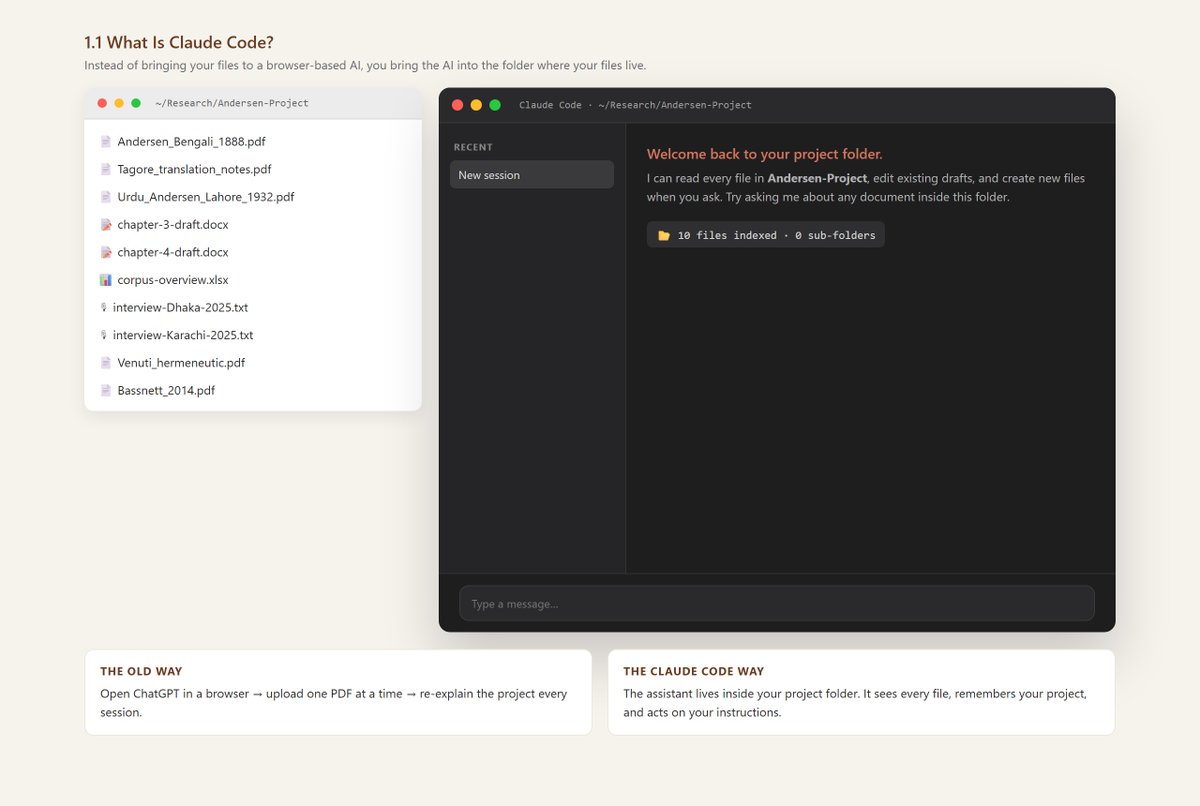
Once you have it on your computer, you open your project folder (dissertation, paper, etc.) and let Claude work inside the folder. Claude can read every file in the folder, edit existing files, and create new ones. It can also remember what you were working on after you end a session.
Unlike browser-based apps like ChatGPT and Gemini that only “talk,” Claude Code can actually “do” things for you.
## 1.1 Why You Should Care About It?
You are a researcher and have a folder on your computer with several PDFs, drafts of your papers, spreadsheets, datasets, and a few transcripts of interviews. All these documents are relevant to your project, but you need to make connections across published literature, gathered data, and your own notes.
This is the kind of use-case that Claud Code was built for.
Most academics and researchers have used AI apps in their browsers (ChatGPT, Claude, Gemini, etc.) You open a tab and type in a prompt and the AI replies. If you want to ask questions about your papers or drafts, you add them to ChatGPT or Claude.
Claude Code is different because instead of you bringing your files to an AI app in the browser, you bring the AI into the folder containing all your data.
## 1.2 Why Claude Code Matters for Academic Work
There are two fundamental ways in which Claude Code can work as your reliable and powerful research assistant.
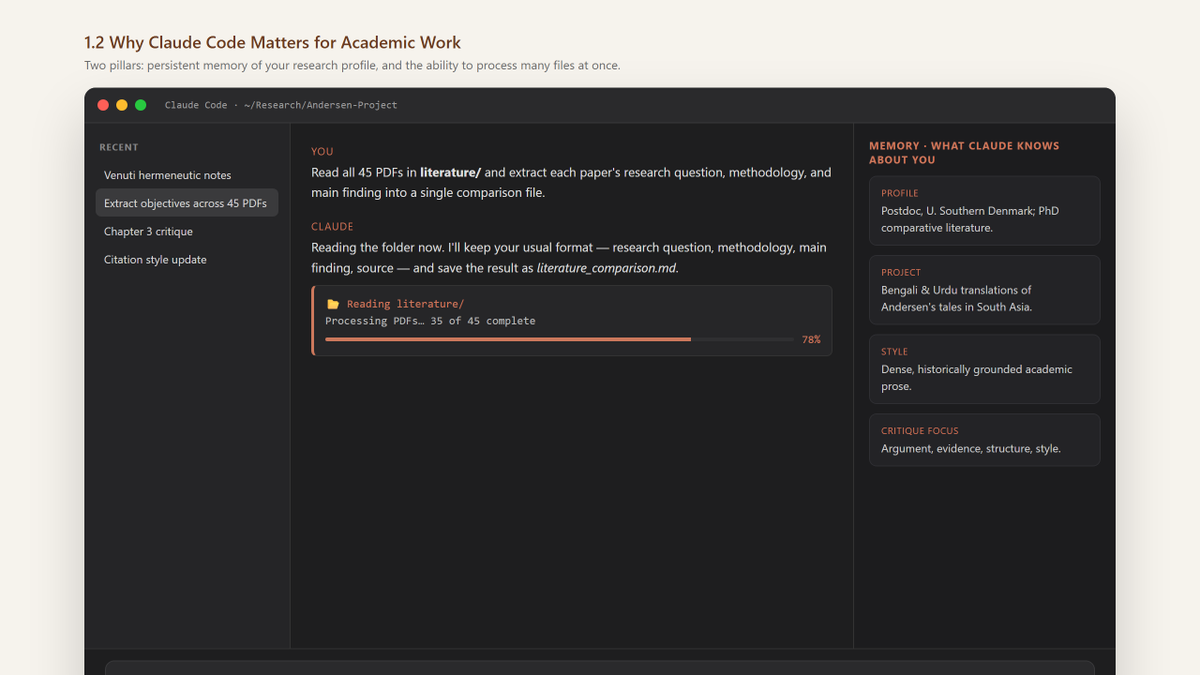
First, Claude Code remembers you, your research, your writing style, and your ever-evolving research requirements. You won’t have to explain your requirements repeatedly.
Second, since Claude Code works within a folder on your computer, it can process multiple files at a time. For example, it can go through all forty-five PDFs in your folder and extract relevant information (objectives, methodology, etc.) from all of them. You can even ask it to create a new file based on extracted information.
Claude Code can handle all types of files from Word files to Excel sheets, PDFs, etc.
## 1.3 What Does It Mean in Practical Terms?
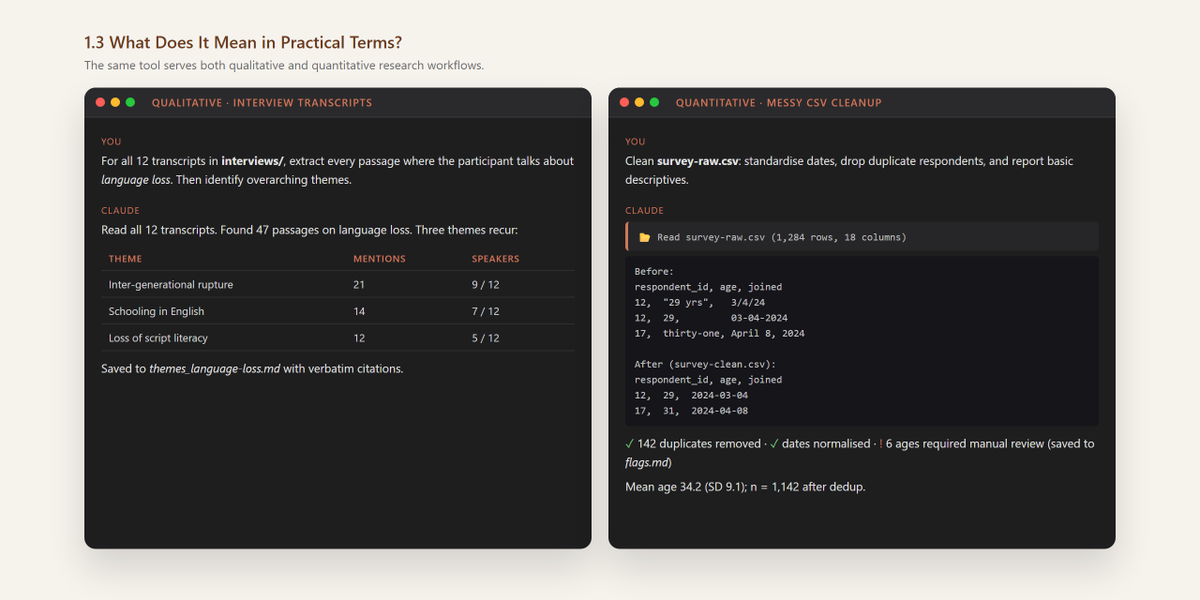
If you are a qualitative researcher, load a folder full of interview transcripts and ask Claude Code to give you every instance of a particular utterance, e.g. how each participant talked about a given subject. Then ask it to look for overarching themes across interviews.
If you are a quantitative researcher, add a messy CSV or an Excel sheet in your folder and ask Claude Code to clean it up for you. You can ask it to run descriptive statistics or ask it to explain a critical comment made by a reviewer.
## 1.4 What Claude Code is Not
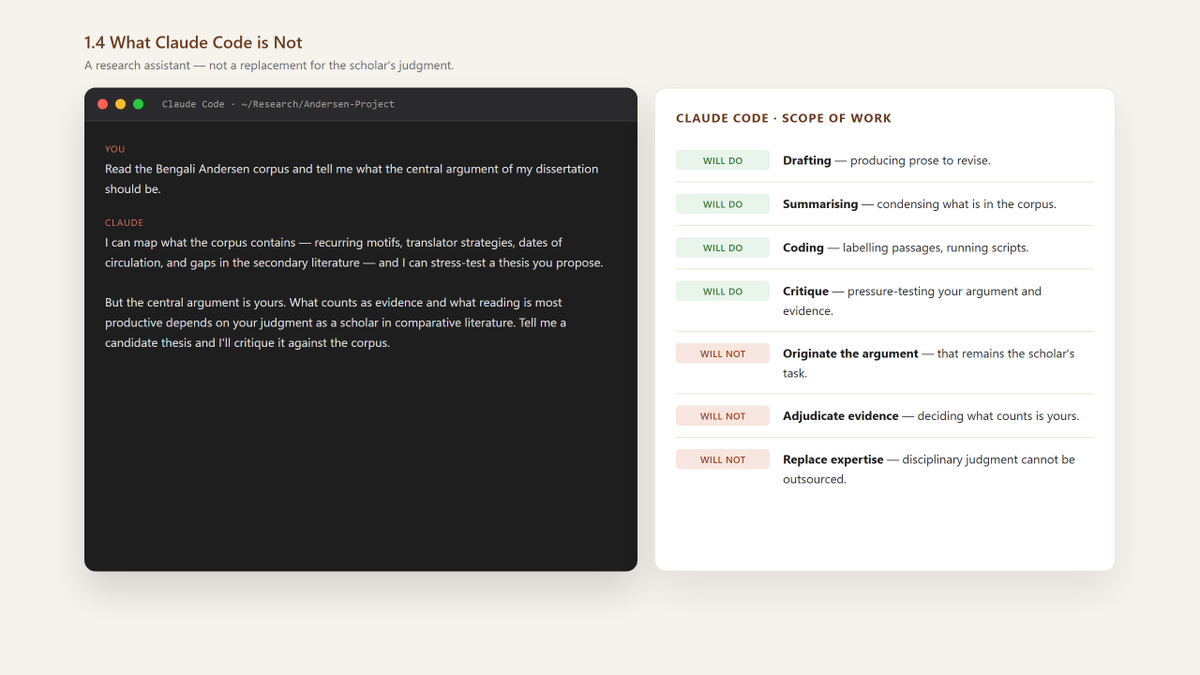
Claude Code is an incredibly powerful tool, but it is not a replacement for your expert judgment. It can draft, summarize, code, but what counts as argument or evidence is your responsibility.
Academics who are likely to succeed using Claude Code are the ones who treat it as a research assistant and not those who outsource all their thinking and judgment to it.
# Part 2: Installing Claude Code App, Your First Session
If you’re new to Claude Code, set aside 15-20 minutes to install it and set it up. You don’t need any coding skills to use Claude Code.
You will need a Claude Pro or Max subscription to use Claude Code on your computer.
## 2.1 Installation
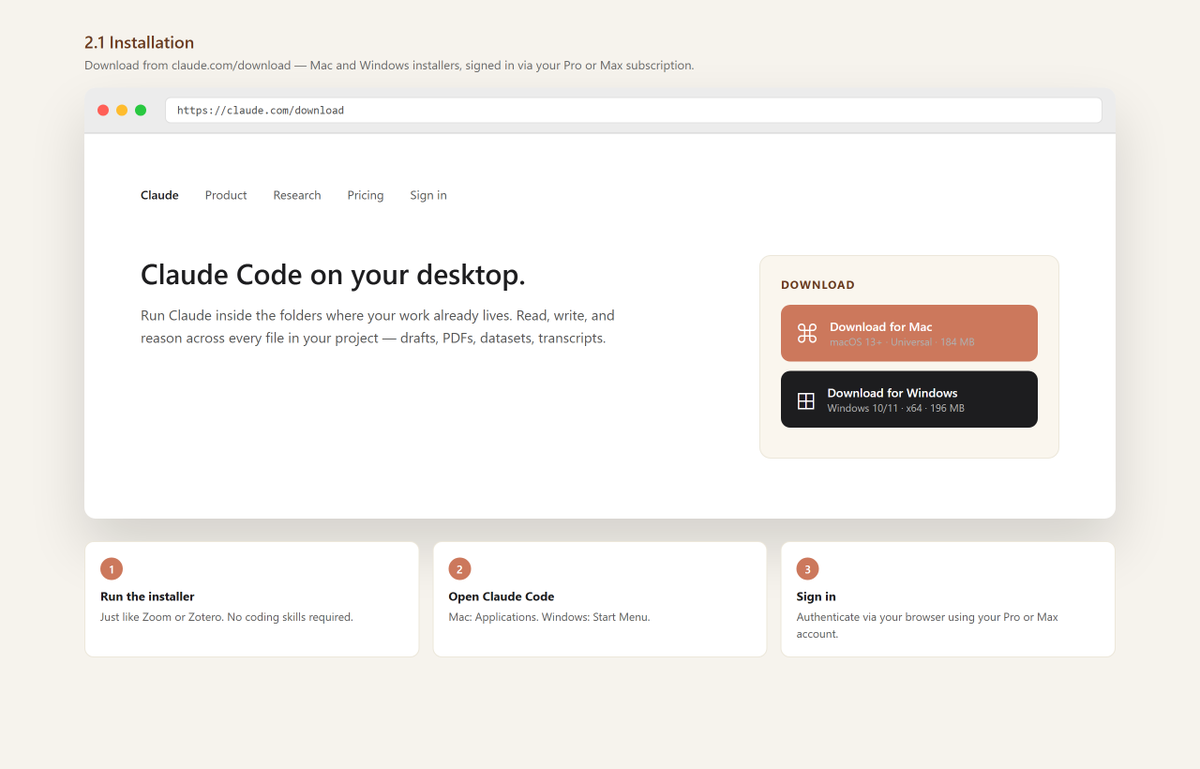
Claude Code is available for both Windows and Mac. Go to claude.com/download and download the version compatible with your computer. Run it the way you would any other installer (e.g. Zoom, Zotero, etc.). On Windows, it appears in your Start Menu. On Mac, it appears in your Applications folder.
Open the app once you have installed in it. The first time you open it, Claude will ask you to sign in through browser. Once you have signed in, you will see a column on the left and a chat panel in the middle. The left column will show you a record of all your conversations just like in Claude or ChatGPT in browser.
## 2.2 Opening Your First Folder
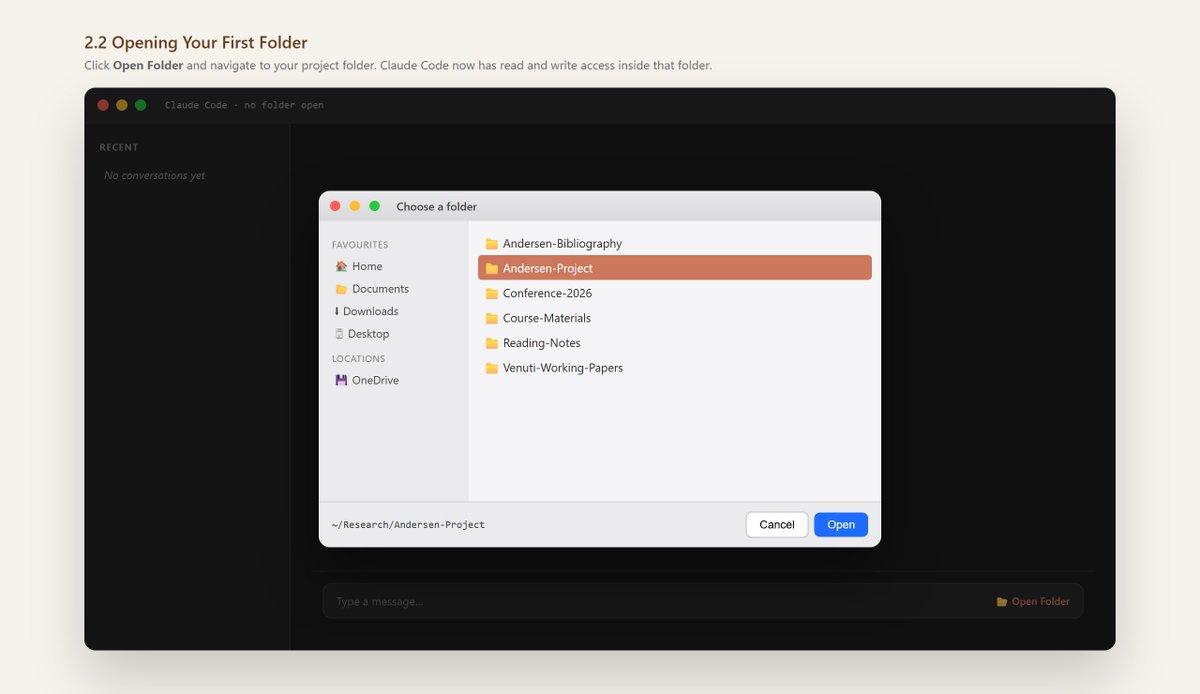
Click “Open Folder.” It usually on top of the chat bar in the main panel. Its position keeps changing slightly with every update, but you will mostly find it in the vicinity of the chat bar.
Navigate to any folder on your computer in which you have stored PDFs or your drafts. If you want to be extra careful, create a dedicated “Claude Research Assistant folder” and navigate to that.
Now Claude Code is inside that folder. It has access to every file and subfolder inside the main folder.
## 2.3 What a Session Looks Like
A session is the conversation you have with Claude in the main chat panel just like you do it in browser apps like ChatGPT.
The interaction is like browser-based apps like ChatGPT. The only difference is that now Claude Code has access to your files on your computer. It also has the ability to create files on your computer.
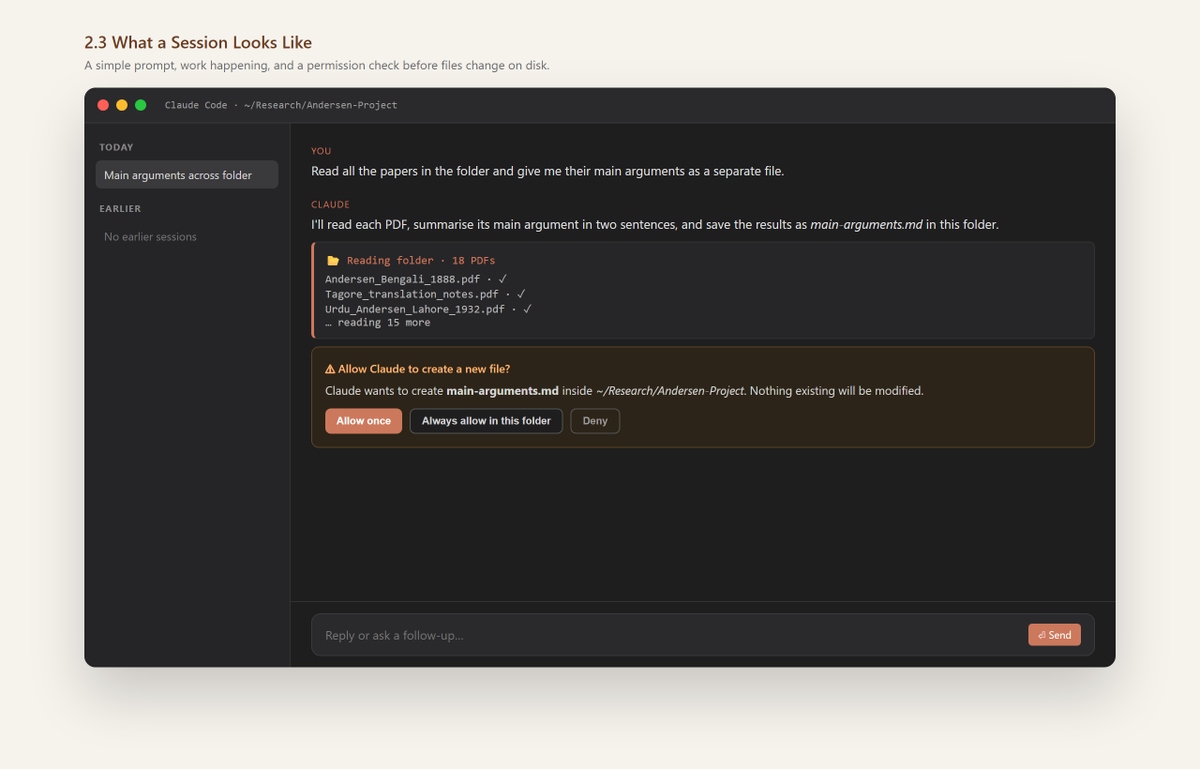
Once you are in the folder, give Claude a simple prompt like:
Read all the papers in the folder and give me their main arguments as a separate file.
That’s it. Most of your interaction with Claude Code would be writing instructions like this.
Claude Code will go ahead and retrieve relevant information from the papers and start creating a new file. This file will show up in the folder that you are working in.
As it proceeds, it will ask you for permission to do so. You can make Claude Code bypass permissions, but in the beginning, it’s a good idea to make Claude Code ask for permissions. You don’t want Claude Code to end up deleting any important files without asking you.
Every session you start in Claude Code is automatically saved in the panel on the left.
# Part 3: Claude Code as Your Research Assistant
Every time Claude Code starts, it immediately looks for a file called CLAUDE.md for a set on of instructions to follow. Notice the block letters, this is important.
There are two ways you can create a CLAUDE md file: automatic and manual.
## 3.1 Manually
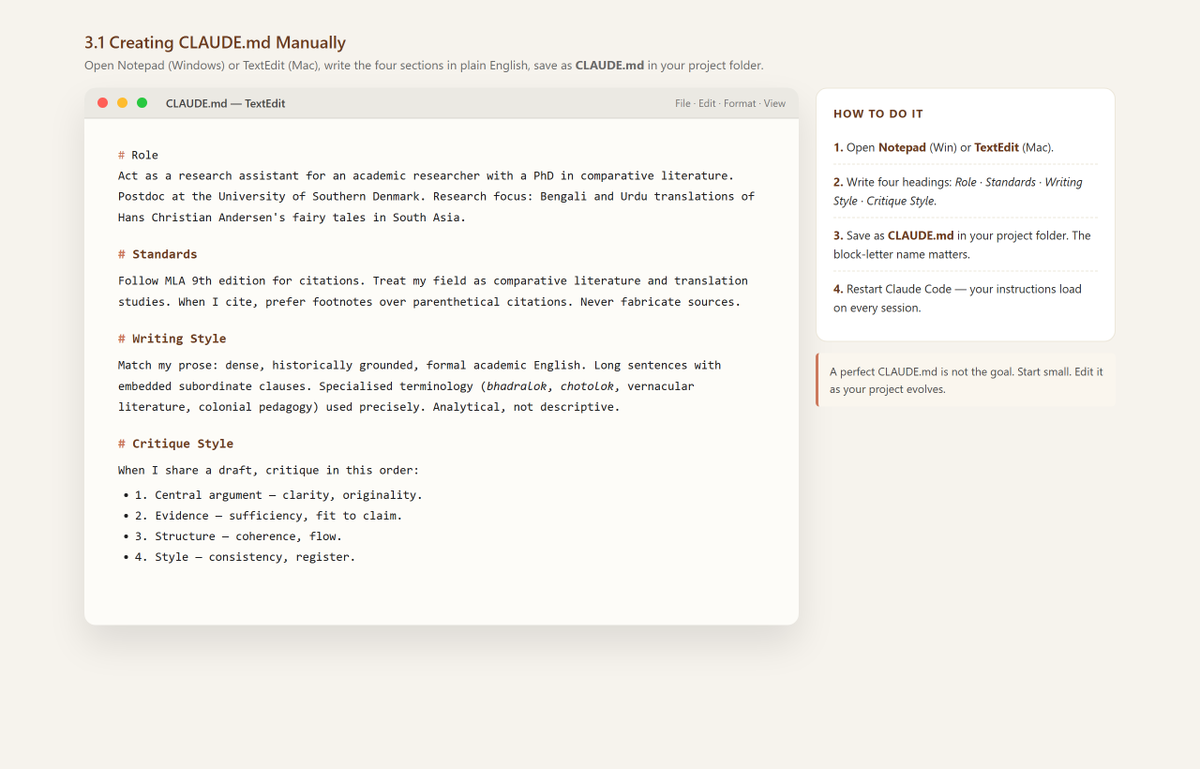
If you want to do it manually, open Notepad on Windows or TextEdit on a Mac and write down the kind of instructions you want Claude Code to follow. Please note that you only need to write these instructions in plain language. You don’t need to use any coding or programming language.
You can divide CLAUDE md file into following sections:
#Role (the hash sign here indicates that it’s a heading)
Describe the kind of role you would like Claude Code to assume as your research assistant. Give it a few details about your research field and current project.
#Standards
Describe academic standards relevant to your field of research. For example, you can tell Claude Code to follow a given citation style or a specific structure of a research paper.
#Writing Style
Tell Claude Code the kind of writing style you would like it to follow, whether you want it to respond in academic style or in an informal style.
#Critique Style
Describe how you would like Claude Code to critique your work, whether you would like to focus on your argument, evidence, or methodology.
Save the file as CLAUDE.md in your main Claude folder on your computer and you are done.
You don’t need to have a perfectly crafted CLAUDE.md file. You can always go back and edit it as your project evolves.
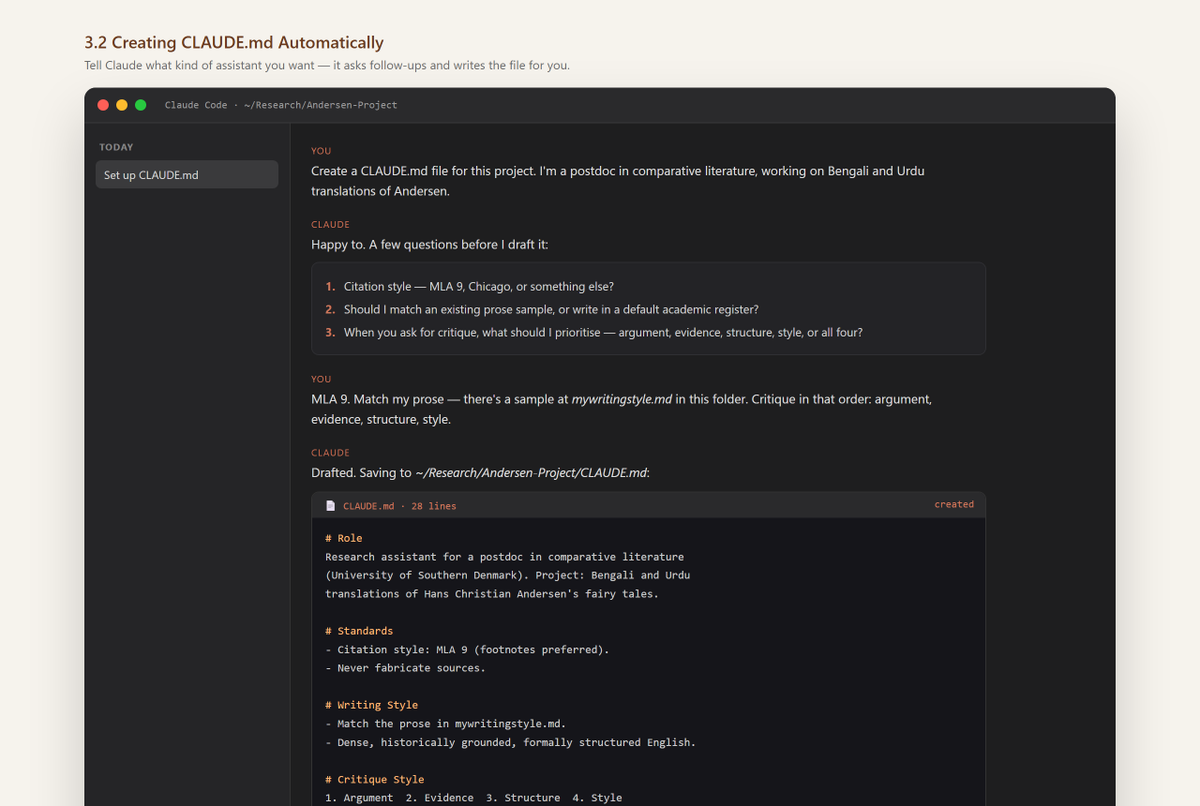
## 3.2 Automatically
If you don’t want to create a CLAUDE.md file manually, simply start a chat session in Claude Code and give it details about its role, standard, writing style, and critique style. Then ask it to create a CLAUDE.md file using this information.
Claude Code will create the file and save it to your Claude folder.
## 3.3 Auto-Memory
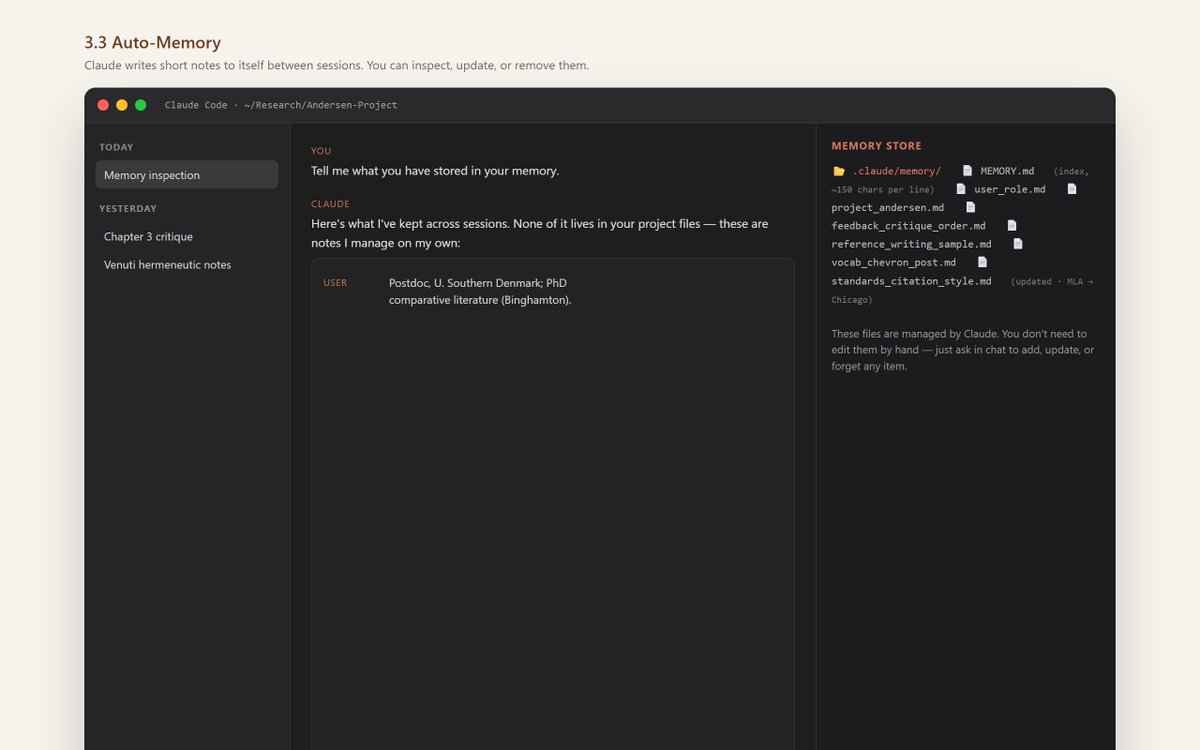
As you work through your project, Claude Code will write short notes about your work and save them for its own use. You won’t see them and you don’t need to bother about them too much. Claude Code puts these notes in a folder and manages it on its own.
Each time you start a session, Claude Code reads CLAUDE.md and its own notes and uses them to answer your questions.
Over time, your instructions and Claude Code’s notes gives it enough context about you and your work that it becomes a reliable research assistant.
You can ask Claude Code about its memory by typing “Tell me what you have stored in your memory.” If a certain piece of information is outdated (e.g. a citation style), simply ask it update its memory with the new information.
## 3.4 What Not to Put in CLAUDE.md
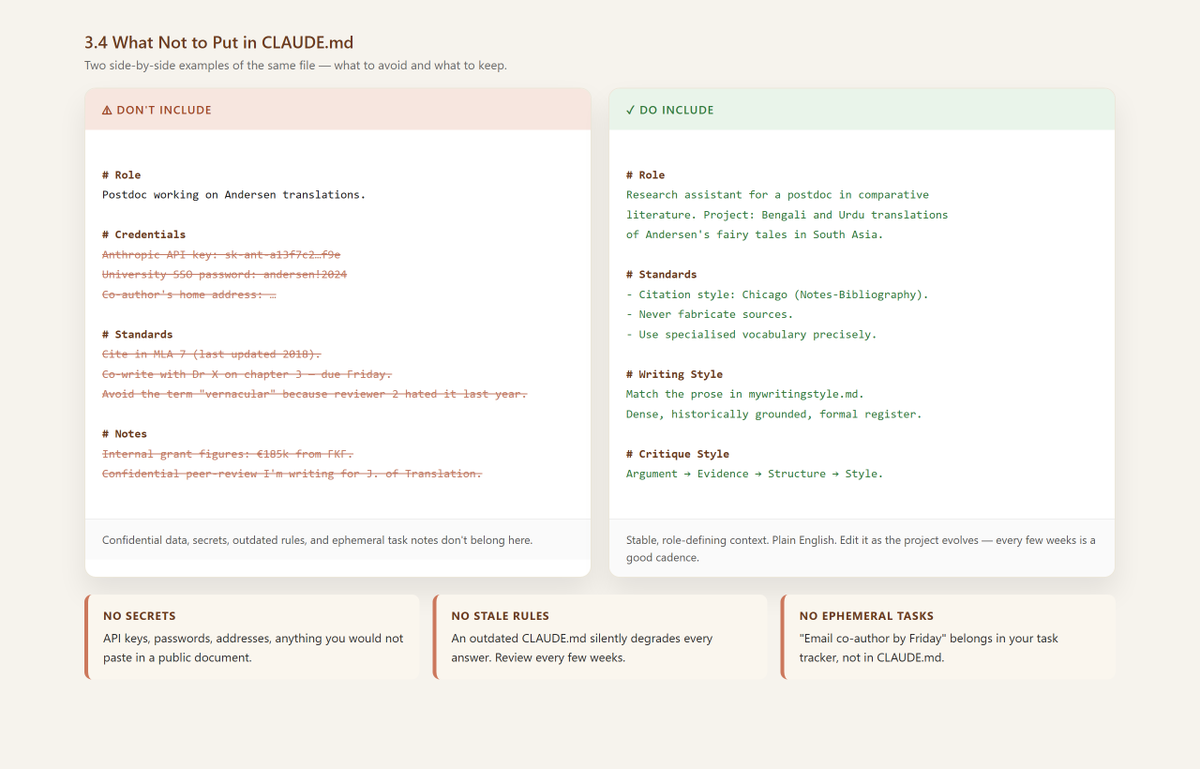
Don’t put any confidential information in CLAUDE.md or anything that you don’t the AI to use.
Don’t let CLAUDE.md become a set of outdated information because that will have considerable impact on its output. You may want to update the file every few weeks.
# Part 4: Working with Your Research Documents
A Claude folder does not have to be very neatly organized. This doesn’t mean you start putting irrelevant files in this folder. What it means is that you should not spend any time organizing it. Claude can do that itself. The only thing you may want to keep in mind is not to give your files confusing names like Dissertation (final) (final2) (use this one).
Add a bunch of PDFs, Word files, datasets, interview transcripts, etc. related to your project.
Suppose you have twenty research papers related to your research topic and you want to find a common theme that runs across all of them. Or maybe you have a certain claim or an argument, and you are looking for papers that present evidence supporting or contrasting that claim.
Open the folder in Claude Code and write a prompt like:
Read every PDF in this folder and tell me which articles disagree with the following argument: [paste the argument here]
Claude will read all the PDFs in the folder and will give you the relevant information from these articles. Claude’s answer may be in the form of a table.
## 4.1 Research Assistant for Literature Review
If you are a biomedical researcher or a social scientist who frequently runs systematic reviews, download fifty research articles and put them in a folder titled “Systematic Review with Claude.”
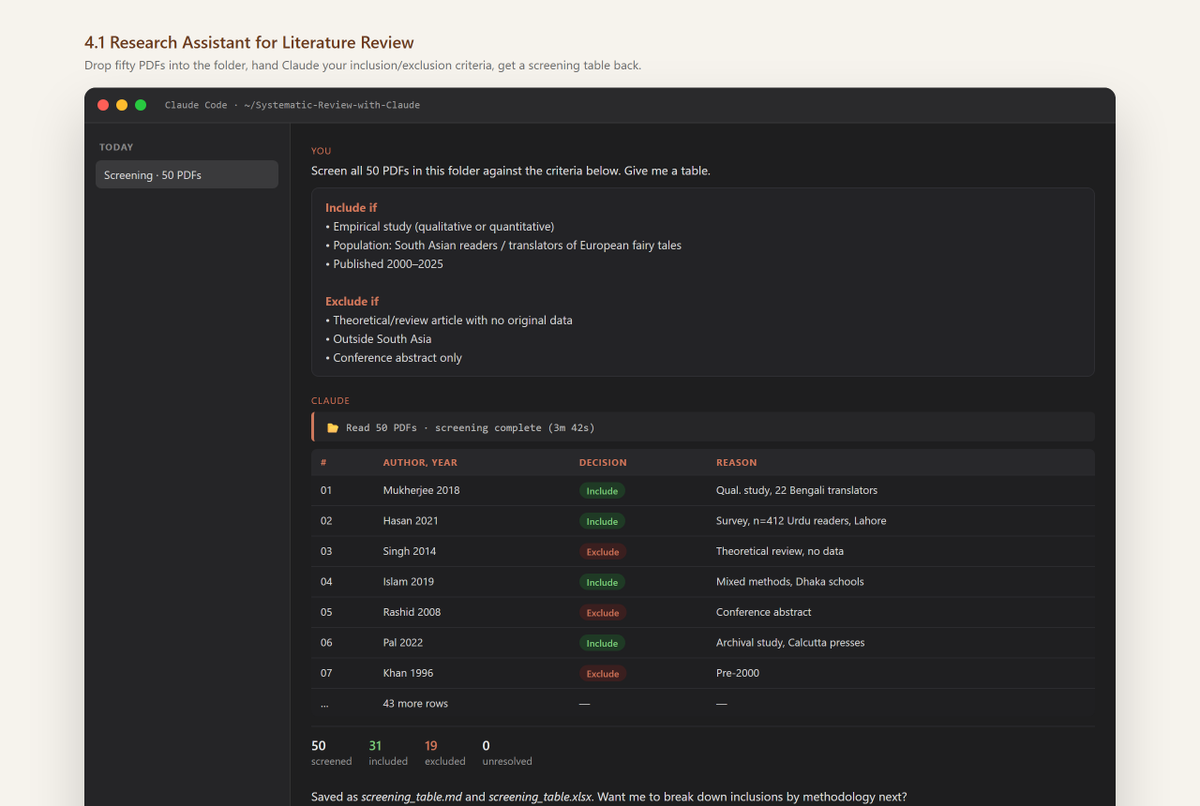
Open the folder in Claude Code and give it your screening (inclusion/exclusion) criteria and ask it to screen all the papers in the folder.
Claude Code will screen the papers according to your criteria and give you the results in the form of a table.
## 4.2 Working with Transcripts
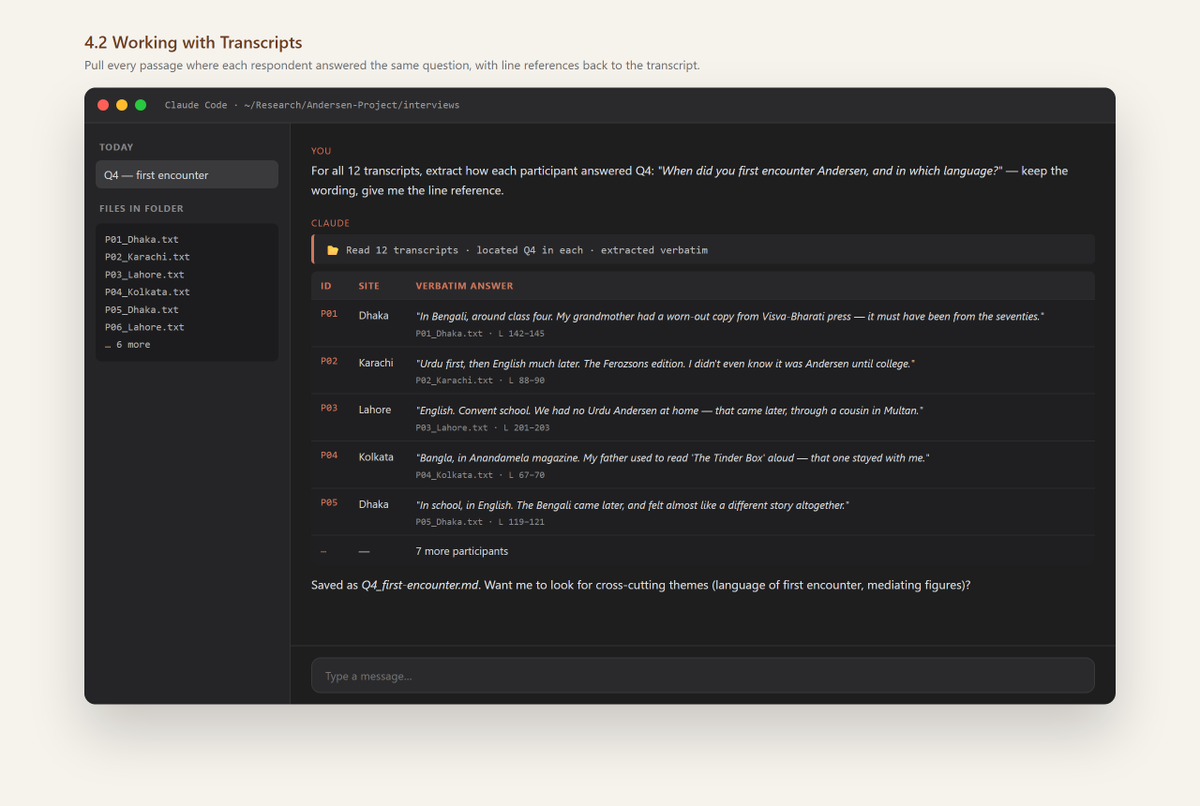
If you are qualitative researcher, you can add interview transcripts in the Claude folder and ask it extract information related to a given topic.
For example, you can ask it to extract how each respondent answer a given question.
## 4.3 Give Claude a Tedious Task
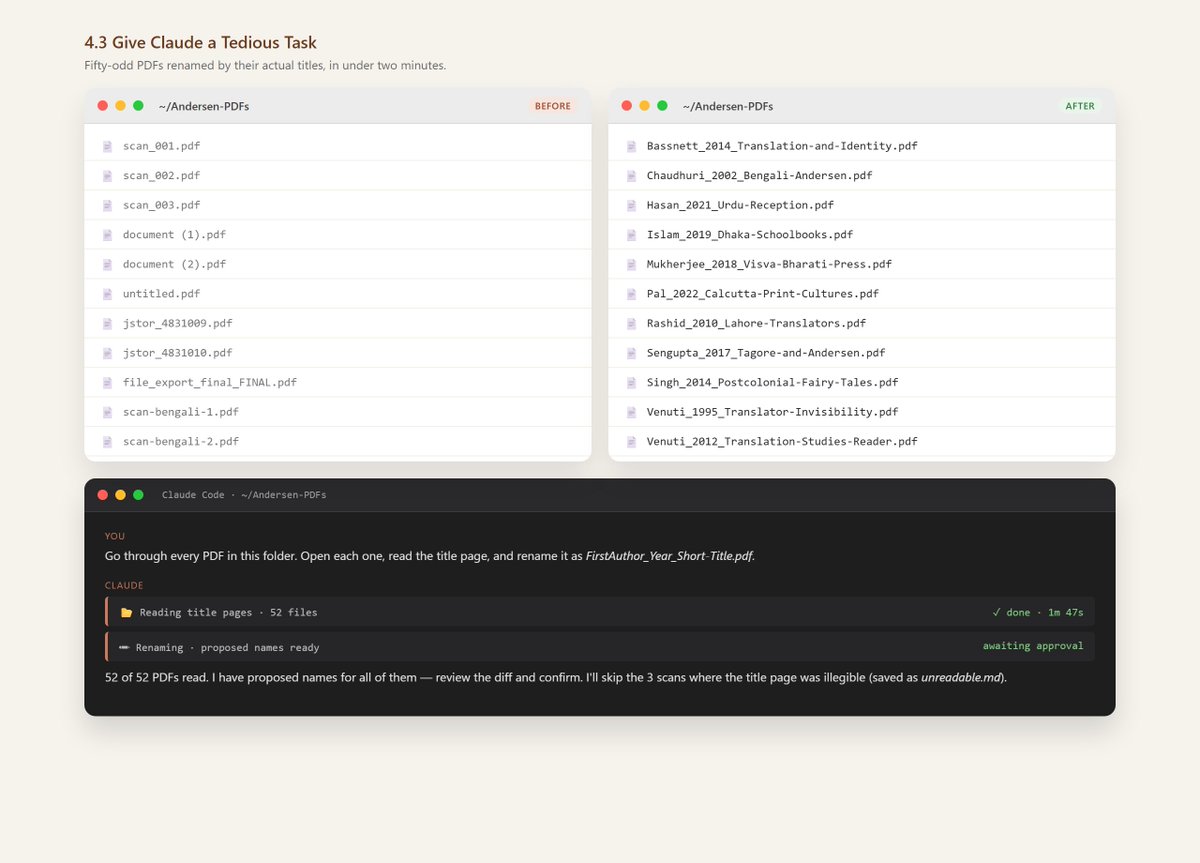
Put fifty-odd PDFs in a folder and open it in Claude Code. Then ask it to go through them all and rename them using their titles.
You will see that Claude Code has done the needful in a couple of minutes.
## 4.4 Asking Claude Code to Create Files
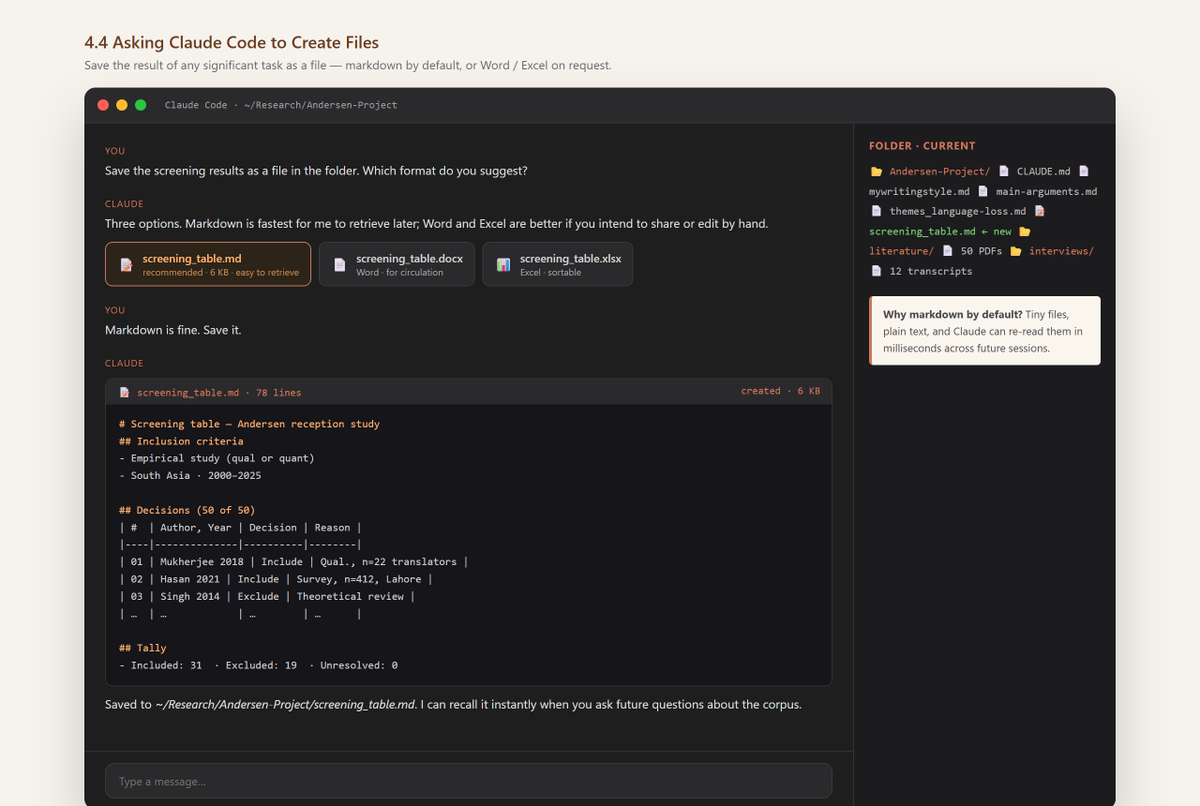
Since your project is going to evolve, you would want Claude Code to create certain files for you too so that can you go back to them if needed. It will also help Claude Code with easy retrieval as the project develops.
Anytime you ask Claude Code to do a significant task like screening papers or extracting information from transcripts, ask it to save your answer in folder as a file.
Generally, Claude Code will save these files as markdown (md), which take up very less space and are very easy for Claude Code to retrieve information from. But you can also ask it to create a Word file or an Excel sheet.
# Part 5: Claude Code “Skills”
A Skill is a set of instructions that makes Claude Code a specialist for one task. Just like CLAUDE.md file, a Skill is also a markdown file written in plain English. And just like CLAUDE.md, you can create a Skill file both manually and automatically.
Once you create a Skill, Claude Code will remember when to use it. You do not have to remember yourself. But you can always invoke a Skill if want to, by using the forward-slash command.
The easiest way to create a Skill is to ask Claude Code to do it for you. Let’s say, you have regular Zoom calls, and you have transcripts of those calls. For every call or transcript, you want to extract actionable items or things to do.
To create a Skill, start a Claude Code session and simply ask it to create a Skill for extracting actionable items from Zoom transcripts.
Claude Code will get to work. It will ask you follow-up questions and create a Skill file that you can edit if you want to. Maybe you want Claude Code to follow a specific structure while responding.
Once the Skill is created, restart Claude Code and the Skill will be ready to use.
## 5.1 Difference between CLAUDE.md and Skills
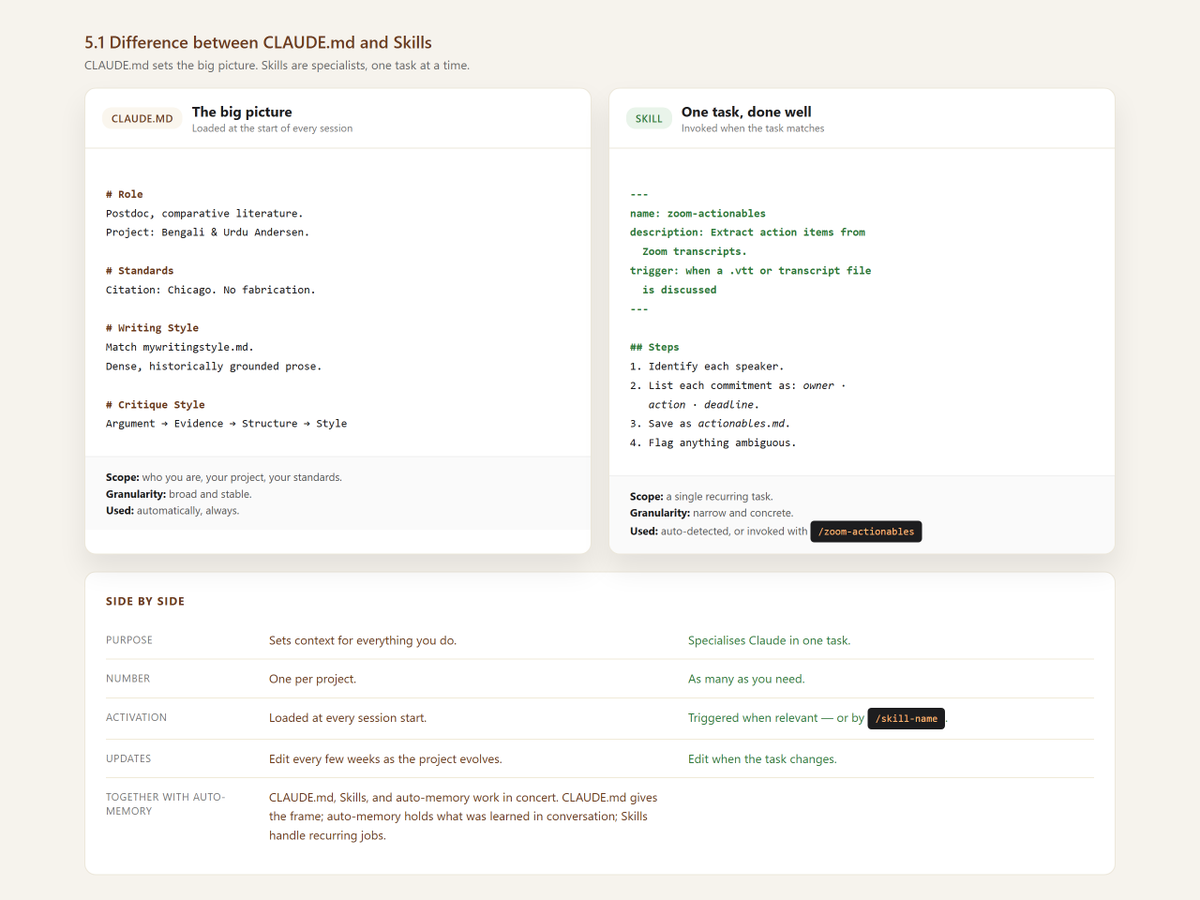
CLAUDE.md contains global instructions about you and your project. It gives Claude Code the big picture about you and your research.
Skills, on the other hand, are meant for particular tasks. These files contain information that are much more specific and granular. CLAUDE.md, Skill, and auto-memory work in concert to give you the best possible response.
## What Not to Delegate to Claude Code
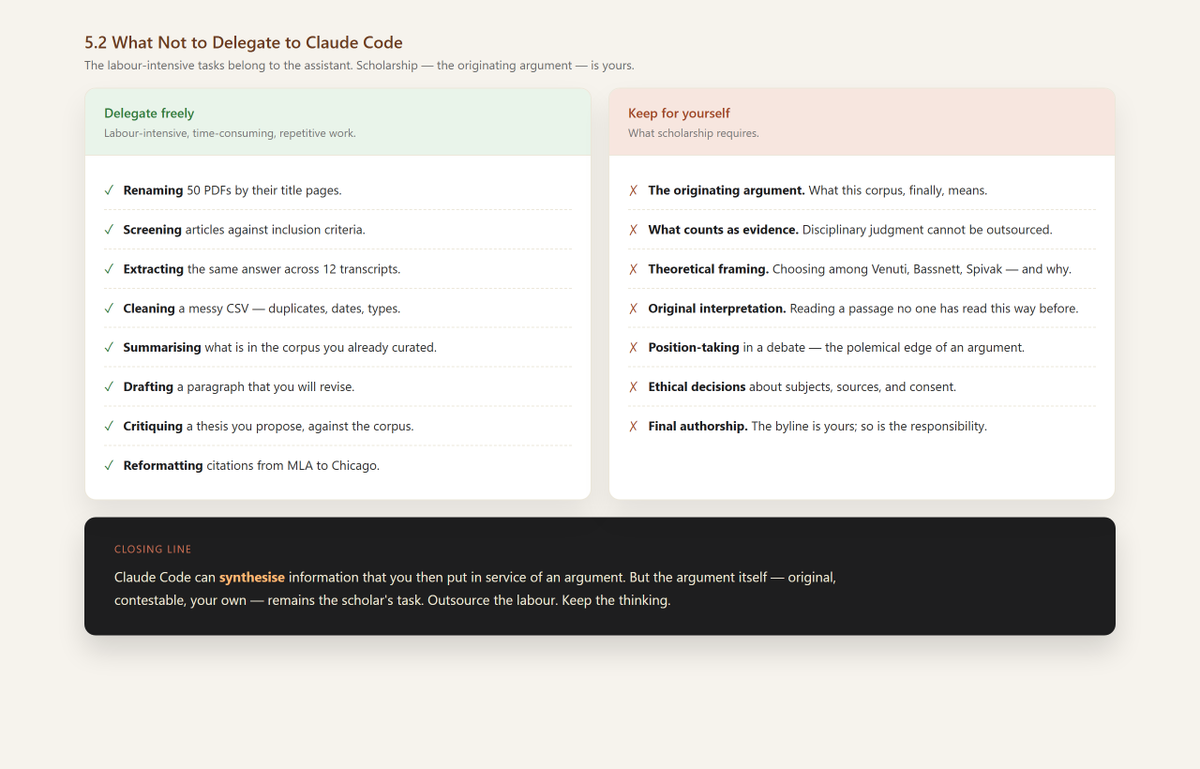
Claude Code is great at labor intensive, time consuming, and repetitive tasks. Outsource these tasks to Claude Code. But Claud Code will not be able to create what actually counts as scholarship because it won’t be able to give you new and original arguments.
It can synthesize information that you can then use in service of your argument, but the job of coming up with an original argument remains yours as a researcher.
## 相关链接
- [Mushtaq Bilal, PhD](https://x.com/MushtaqBilalPhD)
- [@MushtaqBilalPhD](https://x.com/MushtaqBilalPhD)
- [36K](https://x.com/MushtaqBilalPhD/status/2052338632426467550/analytics)
- [claude.com/download](https://claude.com/download)
- [#Role](https://x.com/search?q=%23Role&src=hashtag_click)
- [#Standards](https://x.com/search?q=%23Standards&src=hashtag_click)
- [#Writing](https://x.com/search?q=%23Writing&src=hashtag_click)
- [#Critique](https://x.com/search?q=%23Critique&src=hashtag_click)
- [Upgrade to Premium](https://x.com/i/premium_sign_up)
- [6:43 PM · May 7, 2026](https://x.com/MushtaqBilalPhD/status/2052338632426467550)
- [36.4K Views](https://x.com/MushtaqBilalPhD/status/2052338632426467550/analytics)
- [View quotes](https://x.com/MushtaqBilalPhD/status/2052338632426467550/quotes)
---
*导出时间: 2026/5/7 22:20:50*
---
## 中文翻译
# 学术研究人员 Claude Code 入门指南
**作者**: Mushtaq Bilal, PhD
**日期**: 2026-05-07T10:43:55.000Z
**来源**: [https://x.com/MushtaqBilalPhD/status/2052338632426467550](https://x.com/MushtaqBilalPhD/status/2052338632426467550)
---

这是一个由五个部分组成的教程,旨在帮助学术研究人员开始使用 Claude Code。
我使用了通俗易懂的语言来编写它,你不需要任何技术背景就能理解本教程或使用 Claude Code。
# 第一部分:什么是 Claude Code?
Claude Code 是一个运行在你电脑上的工具。不要被“代码”这个词吓到。你不需要任何编码或编程技能就能使用它。你在电脑上安装 Claude Code 的方式就像安装 Zoom 或 Zotero 这样的应用程序一样。
一旦你把它安装到电脑上,你就可以打开你的项目文件夹(学位论文、论文等),让 Claude 在该文件夹内工作。Claude 可以读取文件夹中的每个文件,编辑现有文件,并创建新文件。它甚至可以在你结束会话后记住你正在处理的内容。
与 ChatGPT 和 Gemini 等只能“交谈”的基于浏览器的应用程序不同,Claude Code 实际上可以为你“做”一些事情。
## 1.1 为什么你应该关注它?
假设你是一名研究人员,你的电脑上有一个文件夹,里面装着几个 PDF 文件、论文草稿、电子表格、数据集和一些访谈记录。所有这些文档都与你的项目相关,但你需要将已发表的文献、收集的数据和你自己的笔记联系起来。
这正是 Claude Code 为之设计的应用场景。
大多数学者和研究人员都在浏览器中使用过 AI 应用程序(ChatGPT、Claude、Gemini 等)。你打开一个标签页,输入提示词,AI 就会回复。如果你想询问关于你的论文或草稿的问题,你需要把它们添加到 ChatGPT 或 Claude 中。
Claude Code 的不同之处在于,不是你把文件带给浏览器中的 AI 应用程序,而是你把 AI 带进包含你所有数据的文件夹里。

## 1.2 为什么 Claude Code 对学术工作很重要
Claude Code 可以通过两种基本方式成为你可靠且强大的研究助手。
首先,Claude Code 记得你、你的研究、你的写作风格以及你不断发展的研究需求。你不需要反复解释你的要求。
其次,由于 Claude Code 在你电脑上的文件夹内工作,它可以一次处理多个文件。例如,它可以浏览你文件夹中的所有 45 个 PDF,并从所有文件中提取相关信息(目标、方法等)。你甚至可以要求它根据提取的信息创建一个新文件。
Claude Code 可以处理从 Word 文件到 Excel 表格、PDF 等各种类型的文件。

## 1.3 这在实际操作中意味着什么?
如果你是一名定性研究人员,加载一个装满访谈记录的文件夹,让 Claude Code 给你提供某个特定话语的所有实例,例如每位参与者是如何谈论某个给定主题的。然后,要求它寻找访谈中贯穿的总体主题。
如果你是一名定量研究人员,在文件夹中添加一个杂乱的 CSV 或 Excel 表格,让 Claude Code 为你清理数据。你可以要求它运行描述性统计,或者让它解释审稿人提出的一条关键意见。

## 1.4 Claude Code 不是什么
Claude Code 是一个非常强大的工具,但它不能替代你的专业判断。它可以起草、总结、编码,但什么算作论点或证据是你的责任。
那些善于利用 Claude Code 取得成功的学者,是把 Claude Code 当作研究助手的人,而不是那些把所有思考和判断都外包给它的人。

# 第二部分:安装 Claude Code 应用程序,你的第一次会话
如果你是 Claude Code 的新手,请留出 15-20 分钟来安装和设置它。你不需要任何编码技能就能使用 Claude Code。
你将需要 Claude Pro 或 Max 订阅才能在电脑上使用 Claude Code。
## 2.1 安装
Claude Code 适用于 Windows 和 Mac。访问 claude.com/download 并下载与你的电脑兼容的版本。像运行其他任何安装程序(例如 Zoom、Zotero 等)一样运行它。在 Windows 上,它会出现在你的“开始”菜单中。在 Mac 上,它会出现在你的“应用程序”文件夹中。
安装完成后打开该应用程序。第一次打开时,Claude 会要求你通过浏览器登录。登录后,你会看到左侧有一栏,中间是聊天面板。左栏将显示你所有对话的记录,就像在浏览器中使用 Claude 或 ChatGPT 一样。

## 2.2 打开你的第一个文件夹
点击“打开文件夹”。它通常位于主面板中聊天栏的上方。随着每次更新,它的位置会略有变化,但你通常会在聊天栏附近找到它。
导航到电脑上存储了 PDF 或草稿的任何文件夹。如果你想特别小心一点,可以创建一个专用的“Claude 研究助手文件夹”,然后导航到该文件夹。
现在 Claude Code 就在这个文件夹里了。它可以访问主文件夹内的每个文件和子文件夹。

## 2.3 会话是什么样的
会话就是你在主聊天面板中与 Claude 进行的对话,就像你在 ChatGPT 等浏览器应用程序中进行的一样。
这种交互与基于浏览器的应用程序(如 ChatGPT)类似。唯一的区别是,现在 Claude Code 可以访问你电脑上的文件。它还可以在你的电脑上创建文件。
进入文件夹后,给 Claude 一个简单的提示,例如:
阅读文件夹中的所有论文,并将它们的主要观点作为一个单独的文件给我。
就这样。你与 Claude Code 的大部分交互都是像这样编写指令。
Claude Code 将继续从论文中检索相关信息并开始创建一个新文件。该文件将显示在你正在工作的文件夹中。
在此过程中,它会征求你的许可。你可以让 Claude Code 绕过权限请求,但在开始阶段,让 Claude Code 请求许可是个好主意。你不希望 Claude Code 最终在没有询问你的情况下删除任何重要文件。
你在 Claude Code 中开始的每个会话都会自动保存在左侧面板中。

# 第三部分:将 Claude Code 作为你的研究助手
每次 Claude Code 启动时,它都会立即寻找一个名为 CLAUDE.md 的文件,以获取一套需要遵循的指令。请注意这里的大写字母,这很重要。
有两种创建 CLAUDE.md 文件的方法:自动和手动。
## 3.1 手动创建
如果你想手动创建,请在 Windows 上打开记事本或在 Mac 上打开 TextEdit,写下你希望 Claude Code 遵循的指令类型。请注意,你只需要用通俗的语言写下这些指令。你不需要使用任何编码或编程语言。
你可以将 CLAUDE.md 文件分为以下几个部分:
#角色(这里的井号表示它是标题)
描述你希望 Claude Code 作为你的研究助手承担的角色类型。向它提供一些有关你研究领域和当前项目的细节。
#标准
描述与你的研究领域相关的学术标准。例如,你可以告诉 Claude Code 遵循特定的引用风格或特定的研究论文结构。
#写作风格
告诉 Claude Code 你希望它遵循的写作风格,无论你是希望它以学术风格还是非正式风格回应。
#批评风格
描述你希望 Claude Code 如何批评你的工作,无论你是希望它关注你的论点、证据还是方法论。
将文件保存为 CLAUDE.md,存放在你电脑上的主 Claude 文件夹中,这样就完成了。
你不需要拥有一个精心制作的 CLAUDE.md 文件。随着项目的发展,你随时可以回去编辑它。

## 3.2 自动创建
如果你不想手动创建 CLAUDE.md 文件,只需在 Claude Code 中启动一个聊天会话,并告诉它有关其角色、标准、写作风格和批评风格的详细信息。然后,要求它使用这些信息创建一个 CLAUDE.md 文件。
Claude Code 将创建该文件并将其保存到你的 Claude 文件夹中。

## 3.3 自动记忆
当你处理项目时,Claude Code 会写下关于你工作的简短笔记并保存起来供自己使用。你不会看到这些笔记,也不必太在意它们。Claude Code 会将这些笔记放在一个文件夹中,并自行管理。
每次启动会话时,Claude Code 都会阅读 CLAUDE.md 及其自己的笔记,并使用它们来回答你的问题。
随着时间的推移,你的指令和 Claude Code 的笔记将为它提供关于你和你的工作的足够上下文,使其成为可靠的研究助手。
你可以通过输入“告诉我你存储在记忆中的内容”来询问 Claude Code 关于其记忆的情况。如果某条信息过时了(例如引用风格),只需要求它用新信息更新其记忆。

## 3.4 什么不该放入 CLAUDE.md
不要在 CLAUDE.md 中放入任何机密信息或你不希望 AI 使用的任何内容。
不要让 CLAUDE.md 变成一组过时的信息,因为那将对其输出产生相当大的影响。你可能需要每隔几周更新一次该文件。

# 第四部分:处理研究文档
Claude 文件夹不需要组织得非常整洁。这并不意味着你要开始在这个文件夹中放入不相关的文件。这意味着你不应该花任何时间去整理它。Claude 可以自己做到这一点。你可能需要记住的唯一一点是,不要给你的文件起令人困惑的名字,比如 Dissertation (final) (final2) (use this one)。
添加一堆与你的项目相关的 PDF、Word 文件、数据集、访谈记录等。
假设你有 20 篇与你的研究主题相关的研究论文,你想找到一个贯穿所有论文的共同主题。或者,你有一个特定的主张或论点,你正在寻找提供支持或反驳该主张的证据的论文。
在 Claude Code 中打开文件夹并写下如下提示:
阅读此文件夹中的每个 PDF,并告诉我哪些文章不同意以下论点:[在此处粘贴论点]
Claude 将阅读文件夹中的所有 PDF,并为你提供这些文章的相关信息。Claude 的回答可能会以表格的形式呈现。
## 4.1 文献综述研究助手
如果你是一名生物医学研究人员或经常进行系统综述的社会科学家,请下载 50 篇研究文章并将它们放入一个名为“Systematic Review with Claude”的文件夹中。
在 Claude Code 中打开该文件夹,向它提供你的筛选(纳入/排除)标准,并要求它筛选文件夹中的所有论文。
Claude Code 将根据你的标准筛选论文,并以表格的形式为你提供结果。

## 4.2 处理访谈记录
如果你是定性研究人员,你可以将访谈记录添加到 Claude 文件夹中,并要求它提取与给定主题相关的信息。
例如,你可以要求它提取每位受访者是如何回答给定问题的。

## 4.3 给 Claude 分配繁琐的任务
将大约 50 个 PDF 文件放入文件夹并在 Claude Code 中打开它。然后,要求它浏览所有文件,并使用它们的标题重命名这些文件。
你会发现 Claude Code 在几分钟内就完成了必要的操作。

## 4.4 要求 Claude Code 创建文件
由于你的项目会不断演进,你可能也希望 Claude Code 为你创建某些文件,以便在需要时可以回溯查看。随着项目的发展,这也有助于 Claude Code 轻松检索信息。
每当你要求 Claude Code 执行重要任务(如筛选论文或从访谈记录中提取信息)时,都要求它将你的答案作为文件保存在文件夹中。
通常,Claude Code 会将这些文件保存为 markdown (md) 格式,这种格式占用的空间非常小,而且 Claude Code 很容易从中检索信息。但你也可以要求它创建 Word 文件或 Excel 表格。

# 第五部分:Claude Code 的“技能”
“技能”是一套指令,使 Claude Code 成为特定任务的专家。就像 CLAUDE.md 文件一样,“技能”也是一个用通俗英语编写的 markdown 文件。而且就像 CLAUDE.md 一样,你可以手动和自动创建“技能”文件。
一旦你创建了“技能”,Claude Code 就会记住何时使用它。你不必自己记住。但如果你想使用某个“技能”,可以使用正斜杠命令来调用它。
创建“技能”的最简单方法是让 Claude Code 为你完成。假设你有定期的 Zoom 会议,并且有这些会议的文字记录。对于每次通话或记录,你都想提取可操作的项目或待办事项。
要创建“技能”,请启动 Claude Code 会话,并简单地要求它创建一个用于从 Zoom 记录中提取可操作项目的技能。
Claude Code 将开始工作。它会问你后续问题,并创建一个“技能”文件,你可以根据需要对其进行编辑。也许你希望 Claude Code 在回复时遵循特定的结构。
创建“技能”后,重启 Claude Code,“技能”即可投入使用。
## 5.1 CLAUDE.md 和“技能”的区别
CLAUDE.md 包含关于你和你的项目的全局指令。它为 Claude Code 提供关于你和你的研究项目的宏观图景。
另一方面,“技能”是针对特定任务的。这些文件包含的信息要具体和细致得多。CLAUDE.md、“技能”和自动记忆协同工作,为你提供最佳的可能回复。

## 什么不该外包给 Claude Code
Claude Code 擅长处理劳动密集型、耗时和重复性的任务。将这些任务外包给 Claude Code。但是,Claude Code 无法创造真正算作学术成果的内容,因为它无法为你提供新颖且原创的论点。
它可以综合信息,然后你可以利用这些信息来支持你的论点,但提出原创论点的工作仍然是作为研究人员的你的职责。
