# HERMES AGENT: THE COMPLETE GUIDE. From Zero to Self-Improving AI Employee
**作者**: YanXbt
**日期**: 2026-05-27T16:38:05.000Z
**来源**: [https://x.com/IBuzovskyi/status/2059675518966894767](https://x.com/IBuzovskyi/status/2059675518966894767)
---
I've been running Hermes Agent 24/7 for months. This is everything I learned: installation, models, use cases, the dashboard 99% of people use wrong, self-improvement, security. All of it.
Bookmark this. You'll need it when you start building.
## Table of Contents
1. What Hermes Agent Actually Is
2. Hermes vs OpenClaw vs Claude Code
3. Installation
4. Model Selection — What to Use for What
5. Messaging Platform
6. First Things to Do
7. The Dashboard
8. Use Cases
9. Self-Improvement — The Actual Edge
10. Security
11. Appendix: Complete Command Reference
## LAYER 1 — WHAT HERMES AGENT ACTUALLY IS
Hermes Agent is a 247 autonomous AI employee built by Nous Research.
An agent that works while you sleep, proactively figures out tasks aligned with your goals, and gets better every single session.
Three things separate it from everything else:
Memory. Everything lives in markdown files on your computer — not in the cloud, not in a black box. On your machine. You can read it, edit it, delete it. Full transparency.
Self-improvement. Every task it completes, it reviews. What worked. What didn't. How to do it better next time. It edits its own skills after every session.
Session recall. Every conversation you've ever had is logged with FTS5 full-text search and LLM summarization. Ask it what you talked about 3 months ago. It knows.
## LAYER 2 — HERMES vs OPENCLAW vs CLAUDE CODE
Three tools. Three different jobs. Here's where each one fits.
Hermes vs OpenClaw
OpenClaw has gotten bloated. Feels slow. And the updates break it — every single one. For someone who lives with AI agents, that's painful. For someone newer to agents, it's a dealbreaker.
Hermes is lighter, snappier, and updates don't destroy your setup. That reliability alone is the reason to switch right now.
Additional Hermes advantages:
- Built-in multi-agent via Kanban (v0.12.0+) — agents claim tasks from a board, work in parallel, hand off when blocked
- Nous Portal with curated models built in
- 166 tracked skills (87 bundled + 79 optional) across 26+ categories
- 20+ messaging platforms: Telegram, Discord, Slack, WhatsApp, Signal, Matrix, Teams, and more
Hermes vs Claude Code vs Codex
Different tools. Different jobs. Use both.
Hermes = your general purpose employee. Day-to-day tasks. Research. Documents. Spreadsheets. Computer administration. Business advisor. Prototypes. Everything that needs to continuously improve over time. Think of it as your Chief of Staff.
Claude Code / Codex = deep focused vibe coding sessions. Large-scale complex applications. End-to-end testing. Two windows open side by side. You're locked in. That's when you reach for Claude Code or Codex.
Hermes handles everything else so you can go deep when you need to.
## LAYER 3 — INSTALLATION
One command. That's it.
Linux / macOS / WSL2:
```
curl -fsSL https://raw.githubusercontent.com/NousResearch/hermes-agent/main/scripts/install.sh
```
Windows (native, PowerShell) — early beta:
```
iex (irm https://raw.githubusercontent.com/NousResearch/hermes-agent/main/scripts/install.ps1)
```
Android (Termux): same curl one-liner as Linux — installer auto-detects Termux.
After install, start with:
```
hermes
```
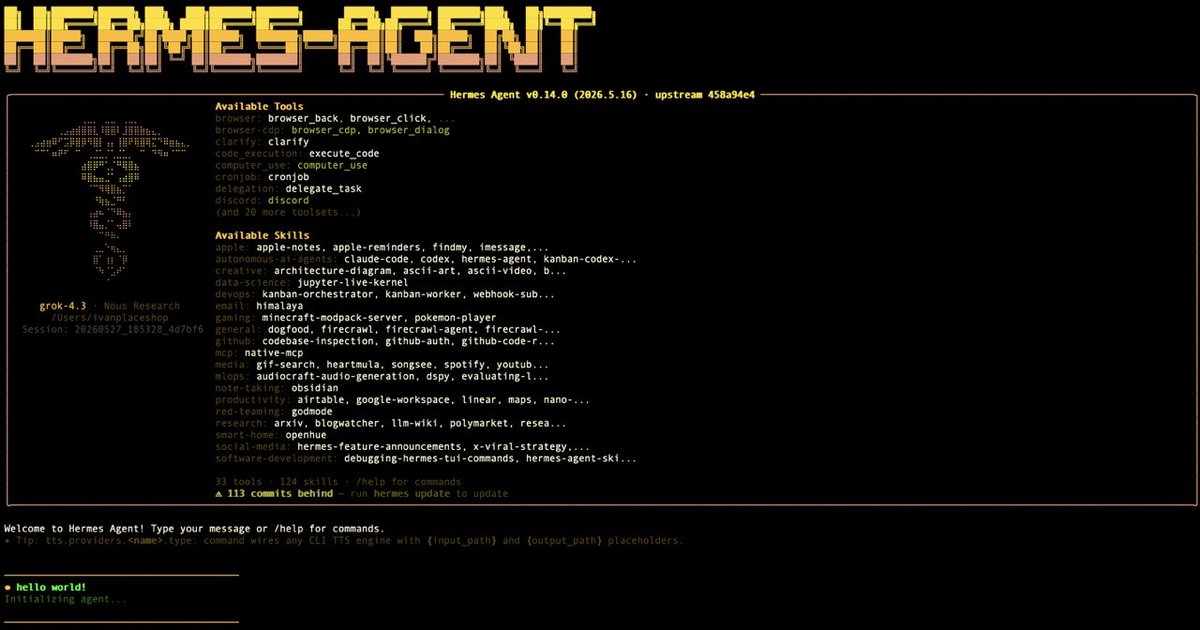
Quick setup walks you through model selection and messaging platform.
If you have OpenClaw installed: you'll get an option to import memories. Recommendation: start clean. Two separate agents with separate memories and skills is better than merging everything.
## LAYER 4 — MODEL SELECTION
Three tiers. The right choice depends on what you're doing, not just budget.
> Expensive — claude-opus-4 / claude-sonnet-4
Best for: complex reasoning, long /goal tasks, nuanced writing, business advisor role. Claude handles ambiguity better than any other model. When Hermes needs to make judgment calls mid-task — opus-4. When you want speed with 90% of opus quality — sonnet-4.
One catch: Anthropic disabled OAuth for agents. API key required — you pay per token. Budget: a few hundred dollars a month with heavy use.
> Moderate — GPT-5.5
Best for: coding tasks, prototyping, budget-conscious daily driver. GPT-5.4 and earlier were nearly useless inside agents. GPT-5.5 changed that. Works with your existing $20/month ChatGPT subscription. Way more usage than Anthropic at a fraction of the cost.
Start here if you're new to Hermes. Switch to Claude once you know what tasks need the upgrade.
> Affordable — Qwen 3.7 Max, Grok, Nous Portal
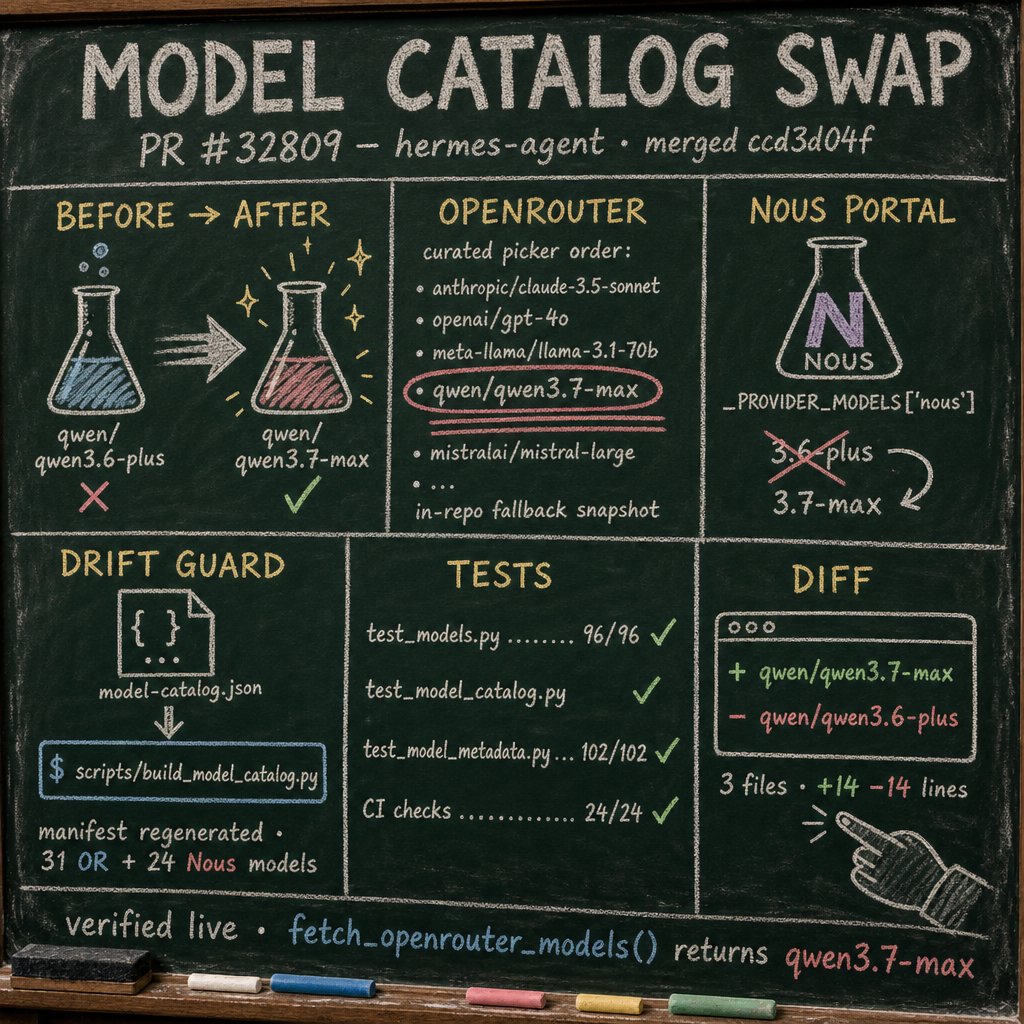
Qwen 3.7 Max — best for long-horizon autonomous tasks. 35 hours continuous execution, 1,000+ tool calls without losing context. Top model in OpenRouter's curated picker (PR #32809). Use via OpenRouter ($0 per token on free tier up to limits).
XAI Grok — best if you already pay for SuperGrok. OAuth works. Strong on X-related tasks and research. Pairs well with xurl skill.
Nous Portal — $20/month flat, curated models, built by the Hermes team. Starting point for anyone who wants one bill and no API key management.
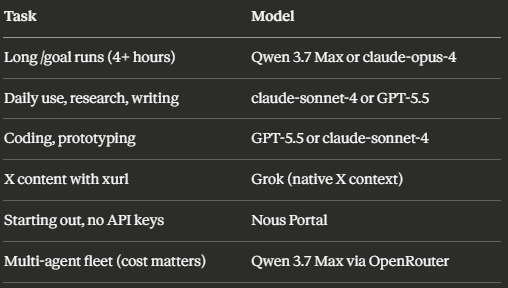
Task-to-model quick reference
Switch models anytime:
```
hermes model
```
No code changes, no reinstall. Different profiles can run different models simultaneously.
## LAYER 5 — MESSAGING PLATFORM
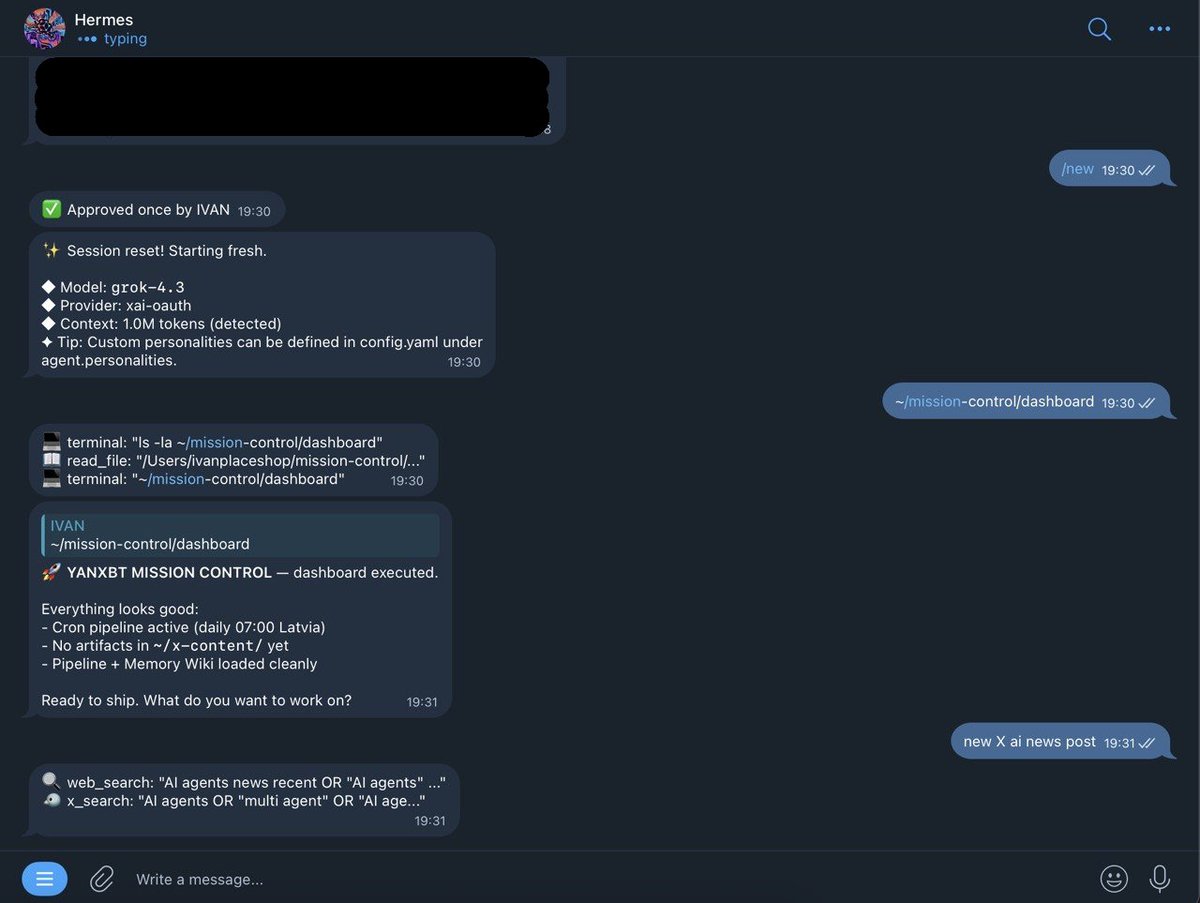
Telegram. Set it up. Don't overthink this.
Telegram is the only messaging platform actively building for AI agents. Topics. Agent-to-agent communication. Constantly adding features. Free.
Setup: Hermes walks you through it during install. Copy a token from Telegram's BotFather into Hermes. Done. Five minutes total.
Other supported platforms if you need them: Discord, Slack, WhatsApp, Signal, Matrix, Mattermost, Email, SMS, DingTalk, Feishu, Microsoft Teams, Google Chat, and more. 20+ total from one gateway process.
## LAYER 6 — FIRST THINGS TO DO
Day one with a new employee: you tell them who you are.
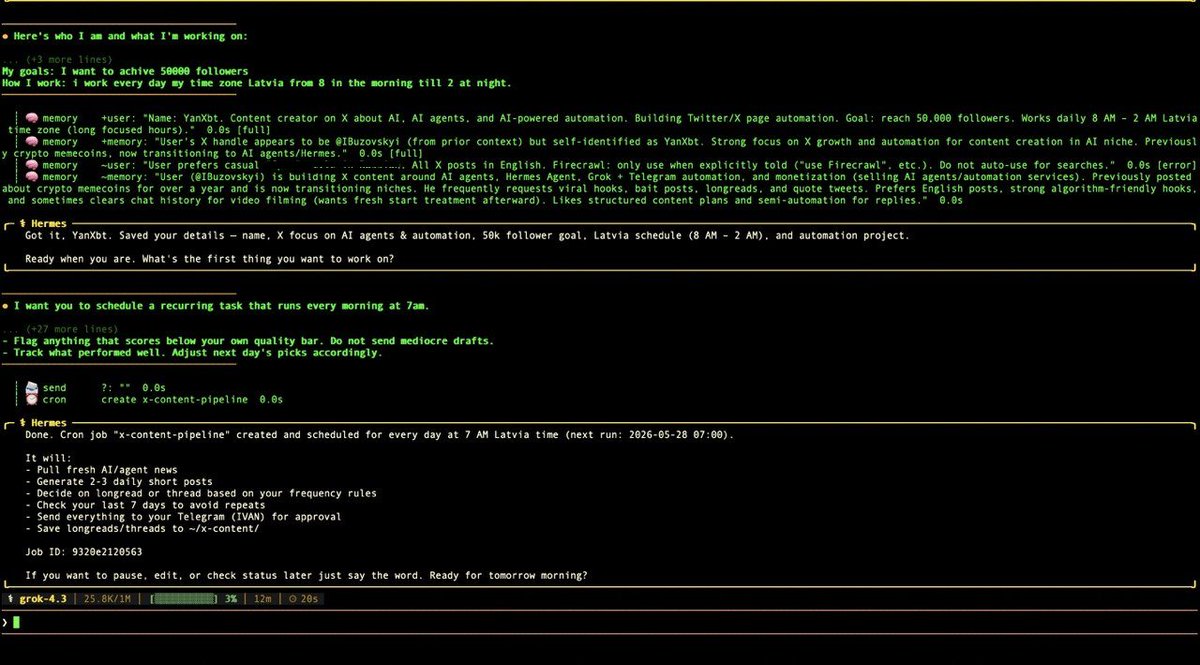
Step 1: Tell Hermes about yourself
Send this as your first message (fill in your details):
```
Here's who I am and what I'm working on:
Name: [Your name]
What I do: [your role / business]
What I'm building: [current projects]
My goals: [what you want to achieve in the next 3-6 months]
How I work: [your working style, preferences, timezone]
```
This goes into memory. Every proactive task Hermes does from now on is filtered through these goals. Skip this step and it's working blind.
Step 2: Set up your first cron job
Cron jobs are scheduled autonomous tasks. Plain English. No code.
```
I want you to schedule a task for yourself to do every single
night at 2am. It should be a micro app, UI, or system that helps
us get closer to my personal goals and ambitions. It should save
us time, make us more productive, or just be generally useful.
Make sure it surprises me and makes me happy.
```
Wake up every morning with something new built for you. That's your agent working.
Step 3: Learn /goal
/goal is the most powerful command in Hermes. It turns the agent from reactive chatbot into a background worker. You set an objective, Hermes breaks it into tasks, executes autonomously, and continues until done.
Core /goal commands:
```
/goal [description] # start autonomous execution
/goal status # check what's running
/goal pause # pause without losing context
/goal resume # continue after pause
/goal clear # end the current goal
/subgoal [text] # add conditions mid-execution
```
For the complete /goal guide including 21 copy-paste workflows for research, sales, content, email, ops, and dev → The Complete Hermes /goal Playbook
For a deep dive on writing strong goals, max_turns config, and avoiding the most common mistakes → Hermes /goal — The Full Guide
## LAYER 7 — THE DASHBOARD (99% USE IT WRONG)
```
hermes dashboard
```
Opens in browser at localhost:9119.
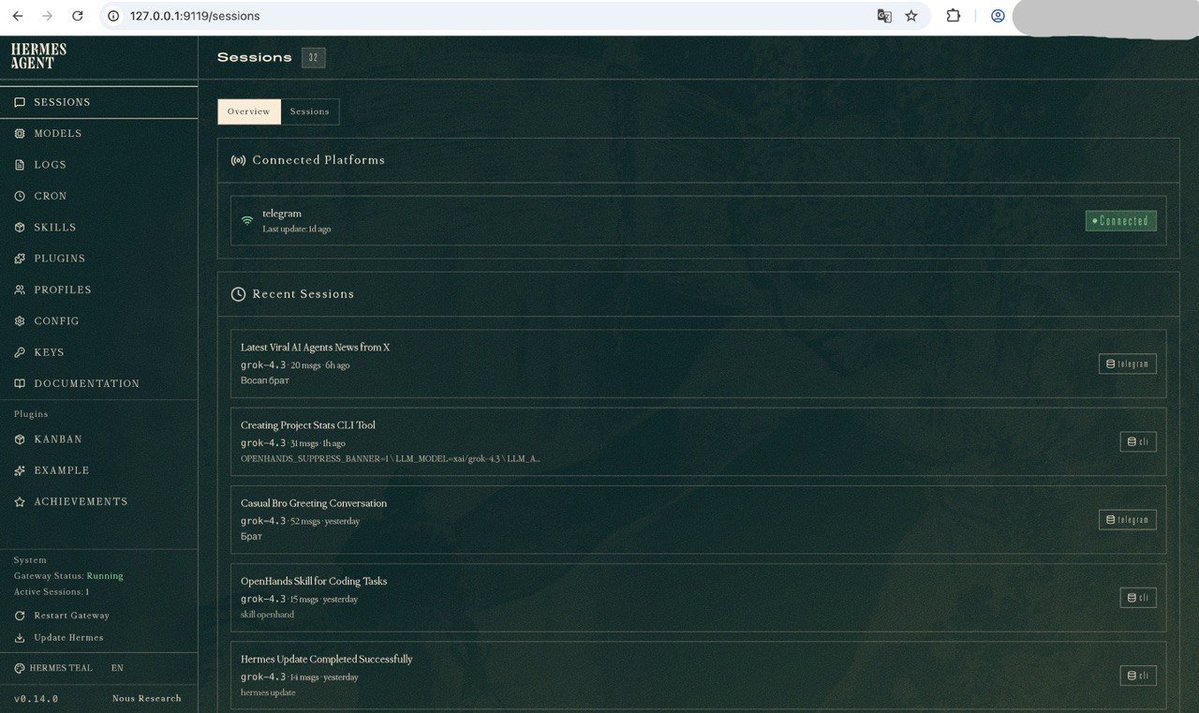
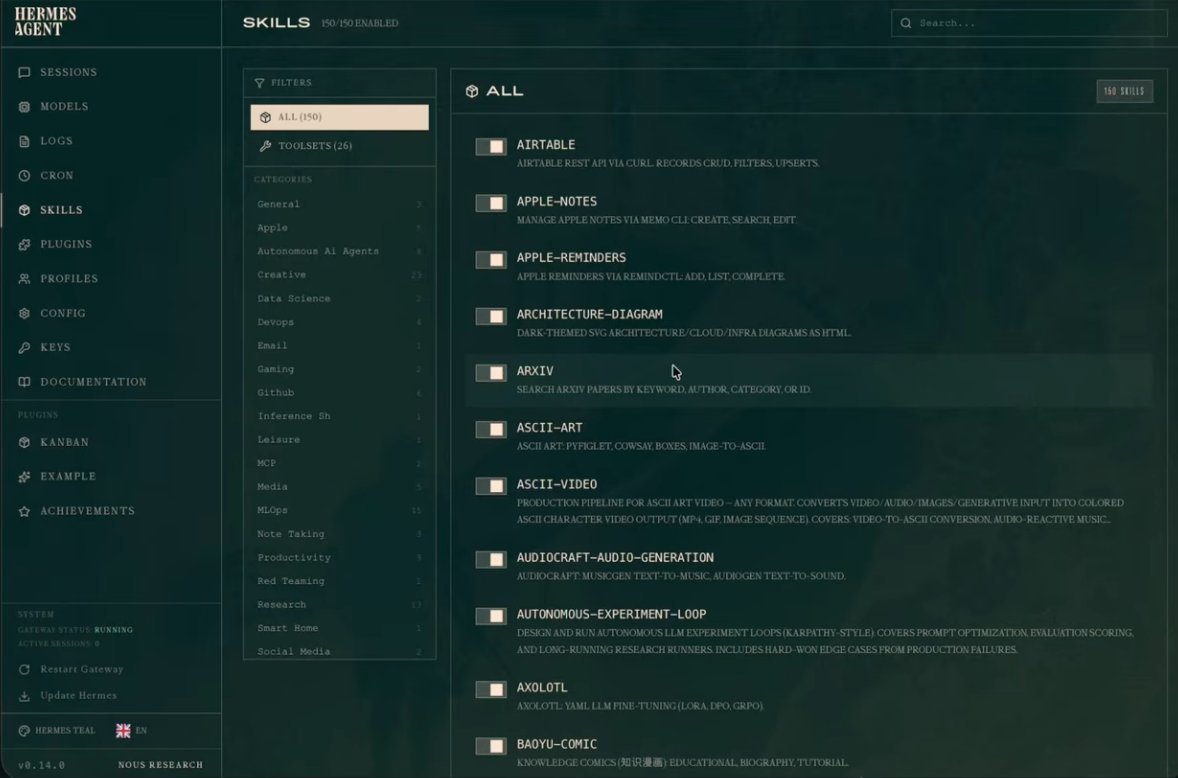
Open the Skills tab first. That's where the real value is.
> Models tab
Swap models instantly. No terminal needed. Set different models per profile.
> Cron tab
See all scheduled tasks. Create complex ones manually here with more control than typing in Telegram.
> Skills tab
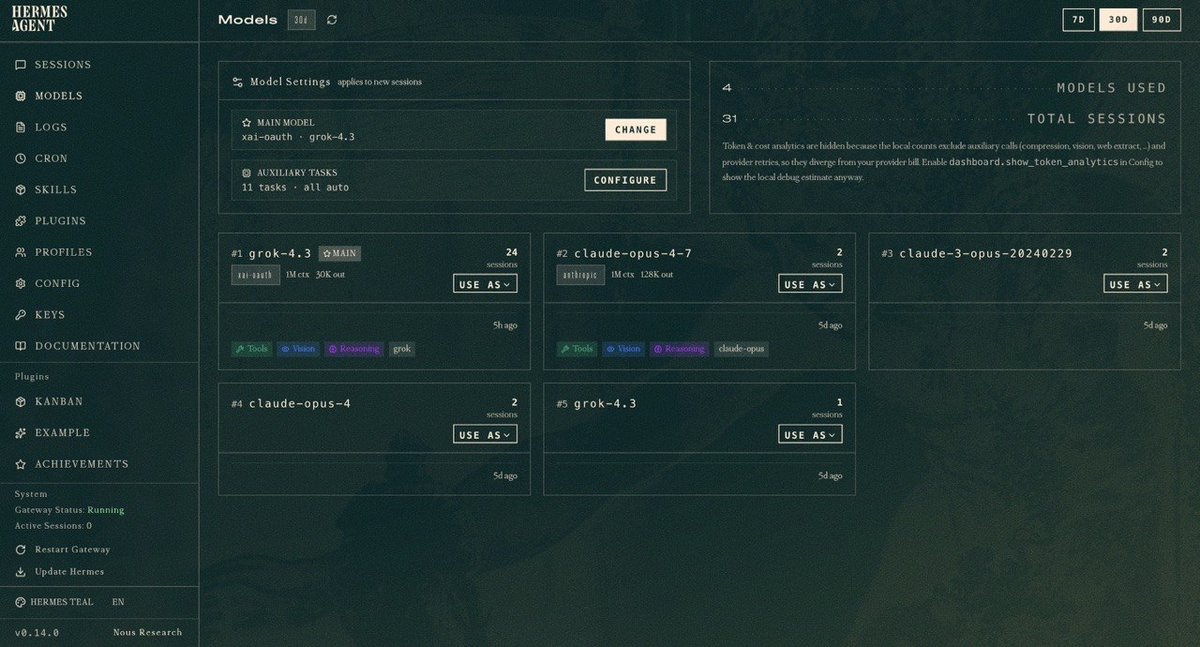
Every skill Hermes has learned is here. Browse, toggle on/off, read the markdown.
A well-used agent: 150+ skills. It knows your specific workflows by name. It can do things you never explicitly taught it because it learned from watching you.
Built-in skills you should turn on immediately:
- Browser automation — lets Hermes crawl the web, extract data, interact with pages
- Computer use — lets Hermes control your screen, move files, open apps
- Image generation — connects to OpenAI or Grok image models, generates assets mid-task
- Video generation — generates videos directly from your conversations
> Plugins tab
Extra capabilities via API keys. Turn on browser-use, fire-crawl, computer-use. Add any API key you already have to extend what Hermes can do.
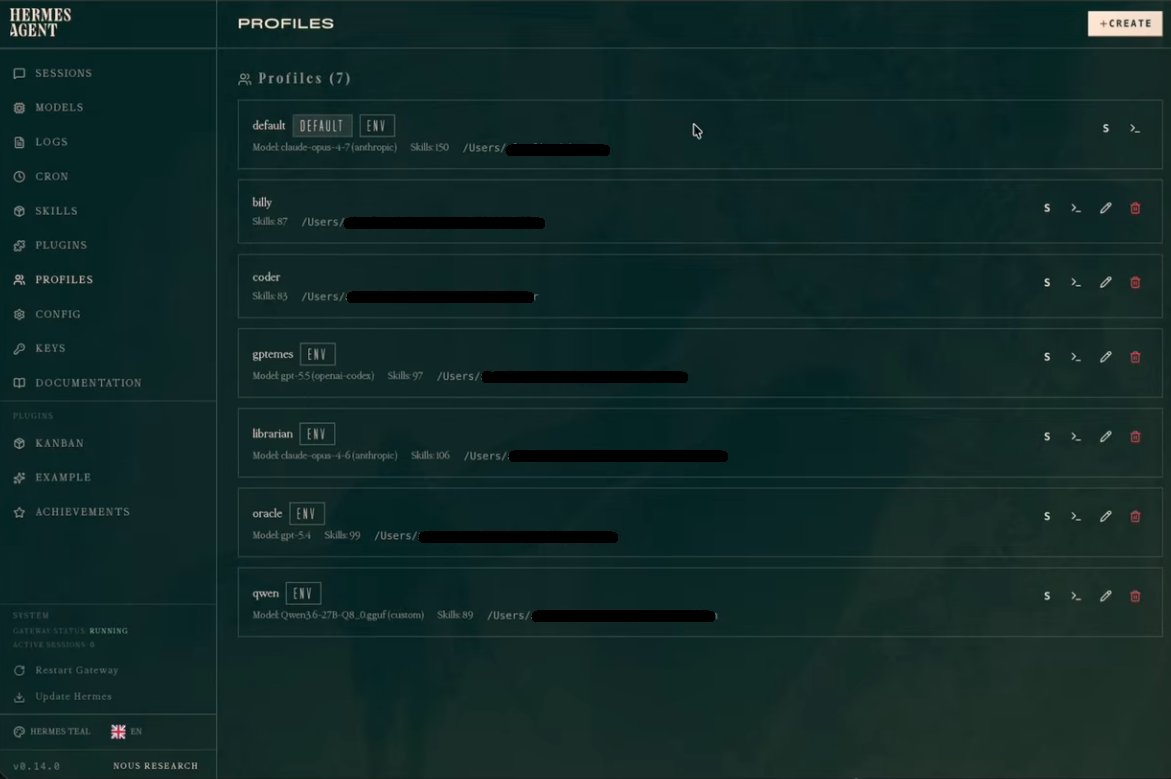
> Profiles tab
This is multi-agent setup.
One profile = one Hermes agent with its own memories, skills, and model. Create multiple profiles for different roles: Chief of Staff, Head of Content, Research Agent, DevOps Engineer.
Run them simultaneously. Each specialised. Each improving independently.
Kanban board — the most powerful screen
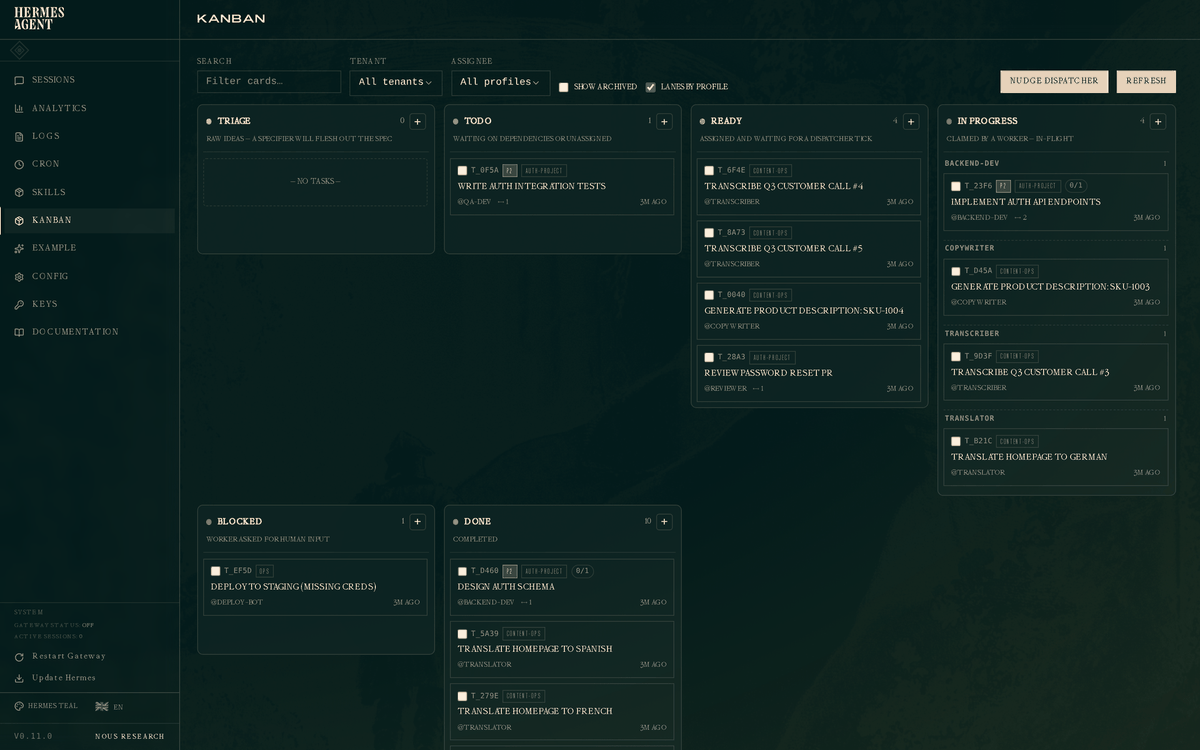
How to use it correctly:
> Every morning, write down your to-do list. Take every task an AI agent can handle. Drop it into Triage. Walk away. Make breakfast.
What happens automatically:
1. Hermes takes each task from Triage
2. Splits it into subtasks
3. Moves to To-Do
4. Assigns subtasks to sub-agents
5. They execute in parallel
By the time breakfast is done, half your to-do list is finished.
Statuses: Triage → To-Do → Ready → In Progress → Blocked → Done
The daemon runs continuously (v0.16+), checking for new tasks every 60 seconds. No cron-based polling, no wasted tokens between tasks.
## LAYER 8 — USE CASES
1. Daily Tutor
Found a useful YouTube video? Don't just watch it and forget it.
> Check this video out. Read the transcript.
> Then every morning at 8am remind me of a concept or two from
> the video, then quiz me on it.
> [paste YouTube link]
Hermes pulls the transcript, extracts 10 key concepts, schedules a cron job. Every morning at 8am: lesson + quiz delivered to Telegram.
Use this for every educational video you watch. You stop forgetting everything.
2. Computer Administrator
Install Tailscale (free) on all your devices. Now Hermes can move across every machine you own.
On your phone, anywhere in the world:
> Get me the agent.md file from my Mac Studio
> and drop it on my MacBook Pro.
Done. Any file. Any device. No SSH, no Google Drive, no manual transfer.
Also works for developers: test local hosts running on other machines without being physically at that computer.
3. Session Recall
> Remind me of every business idea we discussed last month.
Every conversation logged. Every idea you dropped in — recalled on demand. What links you shared 2 months ago. What you were building 3 months ago.
No other AI agent has this. FTS5 full-text search with LLM summarization across your entire history.
4. X Content Workflow with xurl
xurl is a Hermes skill that gives your agent direct access to X — searching posts, reading discussions, publishing content.
On its own it's an execution tool. Combined with /goal, research skills, and memory it becomes a recurring content system.
The workflow that works:
> hermes goal "Every morning and evening, research the latest
> AI agent discussions, analyze against my content style,
> check previously published topics, generate a thread,
> evaluate virality score, and publish via xurl if it passes the bar."
Structure it in stages: Data Collection → Style Check → Repetition Check → Draft → Quality Score → Publish decision.
Key mistake: don't let it publish automatically on day one. Review outputs manually for 5-7 runs first.
For the complete xurl + /goal workflow with step-by-step setup → How to Make Hermes + xurl Actually Work as a System
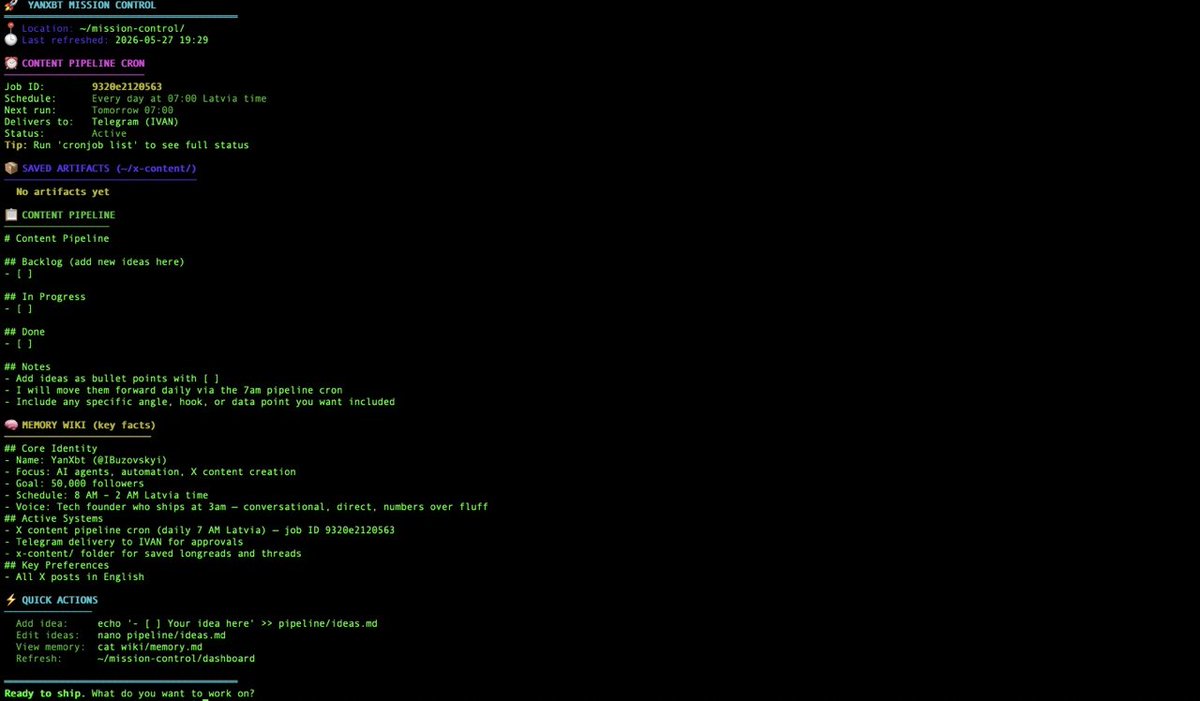
5. Mission Control
Ask Hermes to build you a custom dashboard:
> Build out a mission control for me where we can
> add tools to improve our workflows. Start with:
> - A content pipeline where I can add ideas and you move them forward
> - A memory wiki showing everything we've worked on
> - A docs page showing every artifact we've created
No code required. Describe what you want. It builds it.
Add tools as you need them. Your dashboard becomes a custom interface built for how you work.
6. Prototype Builder
At the gym. Get an idea. Pull out Telegram.
> Build me a landing page for [idea].
> One page. Hero section, 3 features, pricing, CTA.
> Deploy to localhost. Send me the link.
Come back in an hour. Prototype is ready.
Hermes knows your stack from memory. It doesn't ask what framework you use. It uses what you always use.
7. Business Advisor
> I'm thinking about [decision or problem].
> Here's the context: [paste context].
> What are the 3 strongest arguments for and against?
> What would you do?
Unlike ChatGPT, Hermes knows your business, your goals, your constraints. The advice is filtered through your actual situation, not a generic framework.
8. Overnight /goal Runs
Give Hermes a complex task before bed.
> /goal build a competitor research report on [competitor 1], [competitor 2], [competitor 3].
> Cover: pricing, feature set, content strategy, top performing posts last 30 days,
> estimated team size, recent funding or news.
> Format as a structured markdown doc. Save to file.
Wake up with a research report that would take a human analyst a full day.
Works for: code refactoring, database migrations, full app builds, SEO audits, content calendars.
Set max_turns higher for complex overnight tasks:
Default is 5-10. Raise it only when the task genuinely needs more steps:
```
hermes config set goals.max_turns 20 # research, reports, content drafts
hermes config set goals.max_turns 50 # code refactoring, multi-step builds
```
Don't go higher without a reason. Every turn costs tokens.
9. Multi-Agent Org Chart
Multi-agent is where the org chart becomes real.
Create separate profiles for each role:
> Profile: Chief of Staff
> soul.md: You coordinate all other agents. Morning brief at 7am.
> Delegate research to Head of Research. Delegate content to Head of Content.
> Report back with merged summary.
> Profile: Head of Research
> soul.md: You find information. Monitor X for top posts in [niche].
> Track competitor activity. Send weekly intelligence brief.
> Profile: Head of Content
> soul.md: You produce content. Draft posts based on research briefs.
> Repurpose articles into 5 formats. Maintain content calendar.
One morning brief in Telegram. Multiple agents working in parallel. You read the output.
## LAYER 9 — SELF-IMPROVEMENT (THE ACTUAL EDGE)
The self-improvement loop is what no other agent has.
The loop:
1. You give Hermes a task
2. It executes
3. After completion, it reviews: what worked, what didn't, optimal path
4. It saves that as a skill in ~/.hermes/skills/
5. Next time you give it the same task, it uses that skill directly
You correct it once. It never makes that mistake again.
Six months in, it knows your work better than a human assistant would:
- How you like things formatted
- Which tools work for your specific workflows
- What tone you prefer in different contexts
- Which shortcuts to take and which to avoid
Skills are transparent. They live as markdown files on your computer. You can open them, read them, edit them. No black box.
Updates add new skills automatically. Computer use. Video generation. Qwen 3.7 Max support. Every update from Nous Research extends what it can do without breaking what already works.
To see all available tools and configure them:
```
hermes tools
```
Turn on immediately: browser-automation, computer-use
## LAYER 10 — SECURITY (THE HONEST TAKE)
Security concerns with Hermes are vastly overrated for basic use.
It only does what you tell it to do.
Ask it to build a presentation — it builds a presentation. It does not then open your photos folder. Ask it to check a score — it checks the score. It does not leak your messages anywhere.
The only catastrophic security event possible is if you tell it to do something catastrophic. Think before you prompt. That's the basic security model.
What you don't need for personal use:
- A separate iCloud account
- A dedicated Google account
- A VPS (VPS recommendations from AI YouTubers are sponsored content — they don't use them themselves)
What you do need:
- Common sense
- Reviewing prompts before hitting enter on anything destructive
- The ground rule in your soul.md: "Never send money to anyone without explicit confirmation"
Install it on your main computer. Use good judgment. That's it.
If something breaks: open the Hermes folder in Claude Code or Codex, say "I have this problem, please fix it." Solves 100% of issues.
For production agents that touch sensitive systems, Hermes ships a proper security stack:
Layer 1 — Bitwarden Secrets Manager (credential management)
```
hermes secrets bitwarden setup # wizard: installs bws, prompts for token
hermes secrets bitwarden status # verify connection
hermes secrets bitwarden sync # dry-run: see what gets applied
```
One bootstrap token in .env. All real credentials live in Bitwarden. Every Hermes instance pulls secrets at startup. Rotate a key once in the web app — every instance picks it up on next restart. Instant revocation from the web UI. Free tier.
Layer 2 — iron-proxy egress firewall (credential protection)
```
hermes egress install # downloads iron-proxy binary, SHA-256 verified
hermes egress setup # interactive wizard
hermes egress start # spawn managed proxy daemon
hermes egress status # binary + config + active mappings
hermes egress setup --from-bitwarden # pull real credentials from BSM at proxy startup
```
Instead of injecting real credentials into the sandbox, Hermes gives the agent opaque proxy tokens. iron-proxy intercepts at the network boundary, swaps for the real credential, forwards the request. The sandbox never holds the actual key. Compromise the sandbox — the attacker gets tokens that only work from behind the proxy.
The two layers compose: rotate in Bitwarden, propagates to all sandboxes automatically. One action in a web UI, full propagation across the fleet.
For the full architecture breakdown including how this compares to CrewAI, LangGraph, and LangChain → Hermes x Bitwarden — The Security Stack AI Agents Actually Need
## The Real Insight
ChatGPT and Claude are powerful. Each conversation starts from zero. No memory. No improvement. No context. Stop using one for a week and it's like you never met.
Hermes compounds.
Day 1: it knows nothing about you. Month 1: it knows how you work and what you're building. Month 6: it knows how you think, which tasks you do every day, and the optimal way to do each one.
Memory. The improvement loop. Trust. Those three things are the bottleneck in AI agents. Models are solved.
Hermes Agent solves all three. Open source. $0 for the agent itself.
The stack is ready. Set it up and use it.
→ Follow — AI agent blueprints every week
→ Save this — the setup prompts are worth bookmarking
→ Comment "HERMES" and I'll send you the full soul.md + cron job template for your use case
## Resources
Official:
- Hermes Agent Docs — installation, configuration, full CLI reference
- Skills Hub — community skills, browse and install
- GitHub — source, issues, PRs
My articles on Hermes:
- The Complete Hermes /goal Playbook — 21 Workflows — copy-paste /goal commands for every business function
- Hermes /goal — The Full Guide — autonomous execution, max_turns, best practices
- How to Make Hermes + xurl Actually Work as a System — recurring X content workflow
- Hermes x Bitwarden — The Security Stack AI Agents Actually Need — production credential management + egress firewall
@NousResearch @Teknium
## 相关链接
- [YanXbt](https://x.com/IBuzovskyi)
- [@IBuzovskyi](https://x.com/IBuzovskyi)
- [7.5K](https://x.com/IBuzovskyi/status/2059675518966894767/analytics)
- [What Hermes Agent Actually Is](https://claude.ai/chat/219c14d2-24dc-4bf6-9eda-873b2f195d7c#layer-1)
- [Hermes vs OpenClaw vs Claude Code](https://claude.ai/chat/219c14d2-24dc-4bf6-9eda-873b2f195d7c#layer-2)
- [Installation](https://claude.ai/chat/219c14d2-24dc-4bf6-9eda-873b2f195d7c#layer-3)
- [Model Selection — What to Use for What](https://claude.ai/chat/219c14d2-24dc-4bf6-9eda-873b2f195d7c#layer-4)
- [Messaging Platform](https://claude.ai/chat/219c14d2-24dc-4bf6-9eda-873b2f195d7c#layer-5)
- [First Things to Do](https://claude.ai/chat/219c14d2-24dc-4bf6-9eda-873b2f195d7c#layer-6)
- [The Dashboard](https://claude.ai/chat/219c14d2-24dc-4bf6-9eda-873b2f195d7c#layer-7)
- [Use Cases](https://claude.ai/chat/219c14d2-24dc-4bf6-9eda-873b2f195d7c#layer-8)
- [Self-Improvement — The Actual Edge](https://claude.ai/chat/219c14d2-24dc-4bf6-9eda-873b2f195d7c#layer-9)
- [Security](https://claude.ai/chat/219c14d2-24dc-4bf6-9eda-873b2f195d7c#layer-10)
- [Appendix: Complete Command Reference](https://claude.ai/chat/219c14d2-24dc-4bf6-9eda-873b2f195d7c#appendix)
- [The Complete Hermes /goal Playbook](https://x.com/IBuzovskyi/status/2059303967767593247?s=20)
- [Hermes /goal — The Full Guide](https://x.com/IBuzovskyi/status/2056764150936748082?s=20)
- [Tailscale](https://tailscale.com/)
- [How to Make Hermes + xurl Actually Work as a System](https://x.com/IBuzovskyi/status/2057114309616885997?s=20)
- [Hermes x Bitwarden — The Security Stack AI Agents Actually Need](https://x.com/IBuzovskyi/status/2057914816015249515?s=20)
- [Hermes Agent Docs](https://hermes-agent.nousresearch.com/docs)
- [Skills Hub](https://agentskills.io/)
- [GitHub](https://github.com/NousResearch/hermes-agent)
- [The Complete Hermes /goal Playbook](https://x.com/IBuzovskyi/status/2059303967767593247?s=20)
- [Hermes /goal — The Full Guide](https://x.com/IBuzovskyi/status/2056764150936748082?s=20)
- [How to Make Hermes + xurl Actually Work as a System](https://x.com/IBuzovskyi/status/2057114309616885997?s=20)
- [Hermes x Bitwarden — The Security Stack AI Agents Actually Need](https://x.com/IBuzovskyi/status/2057914816015249515?s=20)
- [@NousResearch](https://x.com/@NousResearch)
- [@Teknium](https://x.com/@Teknium)
- [Upgrade to Premium](https://x.com/i/premium_sign_up)
- [12:38 AM · May 28, 2026](https://x.com/IBuzovskyi/status/2059675518966894767)
- [7,596 Views](https://x.com/IBuzovskyi/status/2059675518966894767/analytics)
---
*导出时间: 2026/5/28 09:26:04*
---
## 中文翻译
# HERMES AGENT:完全指南。从零到自我进化的 AI 员工
**作者**: YanXbt
**日期**: 2026-05-27T16:38:05.000Z
**来源**: [https://x.com/IBuzovskyi/status/2059675518966894767](https://x.com/IBuzovskyi/status/2059675518966894767)
---

我已经全天候运行 Hermes Agent 数月了。这是我学到的所有内容:安装、模型、用例、99% 的人都会用错的仪表板、自我进化、安全性。全部内容都在这里了。
收藏这篇文章。当你开始构建时你会用到它。
## 目录
1. Hermes Agent 到底是什么
2. Hermes vs OpenClaw vs Claude Code
3. 安装
4. 模型选择 —— 针对不同任务使用什么
5. 消息平台
6. 首先要做的事
7. 仪表板
8. 用例
9. 自我进化 —— 真正的优势
10. 安全性
11. 附录:完整命令参考
## 第一层 —— HERMES AGENT 到底是什么
Hermes Agent 是由 Nous Research 构建的 24/7 自主 AI 员工。
这是一个在你睡觉时工作的代理,主动制定符合你目标的任务,并且在每一次会话中变得更好。
三件事将它与其他所有工具区分开来:
记忆。所有内容都以 Markdown 文件的形式存储在你的电脑上 —— 不在云端,不在黑盒里。就在你的机器上。你可以阅读、编辑、删除它。完全透明。
自我进化。它完成的每项任务,它都会复盘。什么有效。什么无效。下次如何做得更好。它在每次会话后编辑自己的技能。
会话回溯。你进行的每一次对话都会被记录,并使用 FTS5 全文搜索和 LLM 摘要进行索引。问它三个月前我们谈了什么。它都知道。

## 第二层 —— HERMES vs OPENCLAW vs CLAUDE CODE
三种工具。三种不同的工作。这里说明了每种工具的定位。
Hermes vs OpenClaw
OpenClaw 变得臃肿了。感觉很慢。而且更新会破坏它 —— 每一次更新都是如此。对于与 AI 代理共同生活的人来说,这很痛苦。对于代理新手来说,这是致命伤。
Hermes 更轻量、更敏捷,而且更新不会破坏你的设置。仅凭可靠性,就是现在切换过来的理由。
Hermes 的其他优势:
- 内置看板多代理 (v0.12.0+) —— 代理从板上认领任务,并行工作,受阻时移交
- 内置精选模型的 Nous Portal
- 跨 26+ 类别的 166 项跟踪技能(87 个内置 + 79 个可选)
- 20+ 消息平台:Telegram, Discord, Slack, WhatsApp, Signal, Matrix, Teams 等等
Hermes vs Claude Code vs Codex
不同的工具。不同的工作。两个都要用。
Hermes = 你的通用型员工。日常任务。调研。文档。表格。计算机管理。商业顾问。原型。所有需要随着时间推移不断改进的事情。把它想象成你的幕僚长。
Claude Code / Codex = 深度专注的氛围式编程环节。大型复杂应用。端到端测试。两个窗口并排打开。你进入了深度工作状态。这就是你该使用 Claude Code 或 Codex 的时候。
Hermes 处理其他一切,这样你在需要深度工作时就能专注。

## 第三层 —— 安装
一条命令。仅此而已。
Linux / macOS / WSL2:
```
curl -fsSL https://raw.githubusercontent.com/NousResearch/hermes-agent/main/scripts/install.sh
```
Windows (原生, PowerShell) —— 早期测试版:
```
iex (irm https://raw.githubusercontent.com/NousResearch/hermes-agent/main/scripts/install.ps1)
```
Android (Termux): 同 Linux 使用同一条 curl 命令 —— 安装程序会自动检测 Termux。
安装后,使用以下命令启动:
```
hermes
```
快速设置会引导你完成模型选择和消息平台配置。
如果你安装了 OpenClaw:你会看到一个导入记忆的选项。建议:从零开始。两个拥有独立记忆和技能的独立代理,比合并所有东西要好。

## 第四层 —— 模型选择
三个档次。正确的选择取决于你在做什么,而不仅仅是预算。
> 昂贵 — claude-opus-4 / claude-sonnet-4
最适合:复杂推理、长 /goal 任务、细腻的写作、商业顾问角色。Claude 处理歧义的能力比任何其他模型都强。当 Hermes 需要在任务中做出判断时 —— opus-4。当你想要以 opus 90% 的质量获得速度时 —— sonnet-4。
一个注意事项:Anthropic 禁用了代理的 OAuth。需要 API 密钥 —— 你按 token 付费。预算:重度使用时每月几百美元。
> 中等 — GPT-5.5
最适合:编程任务、原型制作、预算敏感的日常主力工具。GPT-5.4 及更早版本在代理内部几乎没用。GPT-5.5 改变了这一点。使用你现有的每月 20 美元的 ChatGPT 订阅。比 Anthropic 用量多得多,成本却只是一小部分。
如果你是 Hermes 新手,从这里开始。一旦你知道哪些任务需要升级,再切换到 Claude。
> 低成本 — Qwen 3.7 Max, Grok, Nous Portal
Qwen 3.7 Max — 最适合长视距自主任务。35 小时连续执行,1,000+ 次工具调用而不丢失上下文。OpenRouter 精选列表中的顶级模型 (PR #32809)。通过 OpenRouter 使用(免费层每 token $0,有限制)。
XAI Grok — 如果你已经付费订阅 SuperGrok 则最佳。OAuth 可用。在 X 相关任务和调研方面表现出色。与 xurl 技能搭配良好。
Nous Portal — 每月 20 美元固定费用,精选模型,由 Hermes 团队构建。对于想要一张账单且无需管理 API 密钥的人来说,这是理想的起点。
任务到模型快速参考表

随时切换模型:
```
hermes model
```
无需更改代码,无需重新安装。不同的配置文件可以同时运行不同的模型。

## 第五层 —— 消息平台
Telegram。设置好它。别想太多。
Telegram 是唯一一个积极为 AI 代理构建功能的消息平台。话题。代理与代理通信。不断增加新功能。免费。
设置:Hermes 会在安装过程中引导你。从 Telegram 的 BotFather 复制一个 token 粘贴到 Hermes 中。完成。总共五分钟。
如果你需要,其他支持的平台包括:Discord, Slack, WhatsApp, Signal, Matrix, Mattermost, Email, SMS, DingTalk, Feishu, Microsoft Teams, Google Chat 等等。一个网关进程支持 20 多种平台。

## 第六层 —— 首先要做的事
和新员工的第一天:你告诉他们你是谁。
步骤 1:告诉 Hermes 关于你的信息
把这条作为你的第一条消息发送(填入你的详细信息):
```
Here's who I am and what I'm working on:
Name: [Your name]
What I do: [your role / business]
What I'm building: [current projects]
My goals: [what you want to achieve in the next 3-6 months]
How I work: [your working style, preferences, timezone]
```
这会被存入记忆。从现在起,Hermes 进行的每一项主动任务都会根据这些目标进行过滤。跳过这一步,它就是盲目工作。
步骤 2:设置你的第一个 Cron 任务
Cron 任务是定时的自主任务。纯英语。无需代码。
```
I want you to schedule a task for yourself to do every single
night at 2am. It should be a micro app, UI, or system that helps
us get closer to my personal goals and ambitions. It should save
us time, make us more productive, or just be generally useful.
Make sure it surprises me and makes me happy.
```
每天早上醒来,都有为你构建的新东西。这就是你的代理在工作。
步骤 3:学习 /goal
/goal 是 Hermes 中最强大的命令。它将代理从被动聊天机器人转变为后台工作者。你设定一个目标,Hermes 将其分解为任务,自主执行,并持续直到完成。
核心 /goal 命令:
```
/goal [description] # start autonomous execution
/goal status # check what's running
/goal pause # pause without losing context
/goal resume # continue after pause
/goal clear # end the current goal
/subgoal [text] # add conditions mid-execution
```
获取完整的 /goal 指南,包含 21 个针对调研、销售、内容、邮件、运营和开发的复制粘贴工作流 → 《完整的 Hermes /goal 剧本》
深入了解如何编写强目标、max_turns 配置以及避免最常见的错误 → 《Hermes /goal — 完全指南》

## 第七层 —— 仪表板(99% 的人用错了)
```
hermes dashboard
```
在浏览器中打开 localhost:9119。

首先打开“技能”选项卡。那里才有真正的价值。
> 模型选项卡
即时交换模型。无需终端。为每个配置文件设置不同的模型。
> Cron 选项卡
查看所有计划任务。在这里手动创建复杂任务,比在 Telegram 中输入有更多控制权。
> 技能选项卡
Hermes 学到的每一项技能都在这里。浏览、开启/关闭、阅读 markdown。
一个使用良好的代理:拥有 150+ 技能。它知道你的具体工作流名称。它可以做你从未明确教过它的事情,因为它是通过观察你学会的。
你应该立即开启的内置技能:
- 浏览器自动化 — 允许 Hermes 抓取网页、提取数据、与页面交互
- 计算机控制 — 允许 Hermes 控制你的屏幕、移动文件、打开应用
- 图像生成 — 连接到 OpenAI 或 Grok 图像模型,在任务中生成素材
- 视频生成 — 直接从你的对话生成视频
> 插件选项卡
通过 API 密钥提供的额外功能。开启 browser-use, fire-crawl, computer-use。添加你已有的任何 API 密钥以扩展 Hermes 的能力。
> 配置文件选项卡
这是多代理设置。
一个配置文件 = 一个 Hermes 代理,拥有自己的记忆、技能和模型。为不同角色创建多个配置文件:幕僚长、内容主管、调研代理、DevOps 工程师。
同时运行它们。各有所长。各自独立进化。
看板 — 最强大的界面

如何正确使用它:
> 每天早上,写下你的待办事项清单。把所有 AI 代理能处理的任务挑出来。把它们扔到 Triage(分类)。走开。做早餐。
自动发生的事情:
1. Hermes 从 Triage 接过每个任务
2. 将其拆分为子任务
3. 移动到 To-Do
4. 将子任务分配给子代理
5. 它们并行执行
等早餐做完,你的待办事项清单已经完成了一半。
状态:Triage → To-Do → Ready → In Progress → Blocked → Done
守护进程持续运行(v0.16+),每 60 秒检查一次新任务。没有基于 cron 的轮询,任务之间不浪费 token。
## 第八层 —— 用例
1. 每日导师
发现了一个有用的 YouTube 视频?别只是看看就忘了。
> Check this video out. Read the transcript.
> Then every morning at 8am remind me of a concept or two from
> the video, then quiz me on it.
> [paste YouTube link]
Hermes 抓取字幕,提取 10 个关键概念,安排一个 cron 任务。每天早上 8 点:课程 + 测验通过 Telegram 发送。
你看的每一个教育视频都用这个。你不再会忘记所有内容。
2. 计算机管理员
在你所有设备上安装 Tailscale(免费)。现在 Hermes 可以在你拥有的每台机器之间穿梭。
在手机上,在世界任何地方:
> Get me the agent.md file from my Mac Studio
> and drop it on my MacBook Pro.
完成。任何文件。任何设备。无需 SSH,无需 Google Drive,无需手动传输。
也适用于开发者:测试在其他机器上运行的本地主机,无需亲自在那台电脑前。
3. 会话回溯
> Remind me of every business idea we discussed last month.
每次对话都有记录。你提出的每一个想法 —— 按需回忆。两个月前你分享的链接。三个月前你在构建什么。
没有其他 AI 代理能做到这一点。FTS5 全文搜索结合 LLM 摘要,覆盖你的全部历史。
4. X 内容工作流与 xurl
xurl 是一个 Hermes 技能,让代理可以直接访问 X —— 搜索帖子、阅读讨论、发布内容。
单独使用它是一个执行工具。结合 /goal、调研技能和记忆,它就变成了一个循环内容系统。
有效的工作流:
> hermes goal "Every morning and evening, research the latest
> AI agent discussions, analyze against my content style,
> check previously published topics, generate a thread,
> evaluate virality score, and publish via xurl if it passes the bar."
分阶段构建它:数据收集 → 风格检查 → 重复检查 → 草稿 → 质量评分 → 发布决策。
关键错误:第一天不要让它自动发布。先手动审查 5-7 次输出。
获取完整的 xurl + /goal 工作流及分步设置 → 《如何让 Hermes + xurl 真正作为系统运作》
5. 任务控制中心
让 Hermes 为你构建一个自定义仪表板:
> Build out a mission control for me where we can
> add tools to improve our workflows. Start with:
> - A content pipeline where I can add ideas and you move them forward
> - A memory wiki showing everything we've worked on
> - A docs page showing every artifact we've created
无需代码。描述你想要的。它会构建出来。
按需添加工具。你的仪表板变成了为你的工作方式构建的自定义界面。

6. 原型构建器
在健身房。有个想法。拿出 Telegram。
> Build me a landing page for [idea].
> One page. Hero section, 3 features, pricing, CTA.
> Deploy to localhost. Send me the link.
一小时后回来。原型准备好了。
Hermes 从记忆中知道你的技术栈。它不问你用什么框架。它用的是你一直用的。
7. 商业顾问
> I'm thinking about [decision or problem].
> Here's the context: [paste context].
> What are the 3 strongest arguments for and against?
> What would you do?
不像 ChatGPT,Hermes 知道你的生意、你的目标、你的约束条件。建议是根据你的实际情况筛选的,而不是通用框架。
8. 过夜 /goal 运行
睡前给 Hermes 一个复杂任务。
> /goal build a competitor research report on [competitor 1], [competitor 2], [competitor 3].
> Cover: pricing, feature set, content strategy, top performing posts last 30 days,
> estimated team size, recent funding or news.
> Format as a structured markdown doc. Save to file.
醒来时看到一份人类分析师需要一整天才能完成的研究报告。
适用于:代码重构、数据库迁移、完整应用构建、SEO 审计、内容日历。
为复杂的过夜任务设置更高的 max_turns:
默认是 5-10。只有当任务真正需要更多步骤时才提高:
```
hermes config set goals.max_turns 20 # research, reports, content drafts
hermes config set goals.max_turns 50 # code refactoring, multi-step builds
```
没有理由不要设置得更高。每一次轮转都会消耗 token。
9. 多代理组织架构图
多代理让组织架构图变为现实。
为每个角色创建单独的配置文件:
> Profile: Chief of Staff
> soul.md: You coordinate all other agents. Morning brief at 7am.
> Delegate research to Head of Research. Delegate content to Head of Content.
> Report back with merged summary.
> Profile: Head of Research
> soul.md: You find information. Monitor X for top posts in [niche].
> Track competitor activity. Send weekly intelligence brief.
> Profile: Head of Content
> soul.md: You produce content. Draft posts based on research briefs.
> Repurpose articles into 5 formats. Maintain content calendar.
在 Telegram 收到一份早晨简报。多个代理并行工作。你阅读输出。

## 第九层 —— 自我进化(真正的优势)
自我进化循环是其他任何代理都没有的。
循环:
1. 你给 Hermes 一个任务
2. 它执行