# How to Build a Company Brain That (actually) Runs While You Sleep (Full Guide)
**作者**: Hila Shmuel
**日期**: 2026-07-28T20:15:31.000Z
**来源**: [https://x.com/HilaShmuel/status/2082198288061944311](https://x.com/HilaShmuel/status/2082198288061944311)
---
Timing matters. Claude Opus 5 released this week, and everyone's first question is "what should I do with it?" Wrong question. A frontier model with no context is a genius intern on day one.
The best thing you can give it is not a better prompt. It's a company brain to run.
Karpathy posted about LLM knowledge bases in April. 108,000 bookmarks and counting. Since then the same guide has gone viral a dozen times in different clothes: Obsidian + a plugin, a terminal inside your notes app, three folders and a schema file.
All of them are right about the pattern. All of them stop at the same place.
They stop at you. One person, one vault, one chat window, one agent that does something when you ask it to.
This guide is about the next step: turning that pattern into a company brain, a knowledge base where a team of AI agents lives inside your files, works on schedules, reads the knowledge your company already has, and gets smarter while you sleep.
A frontier model running inside your files is not an intern. It's a team. This guide is how you build the place it runs.
Everything below runs on Cabinet, an open-source, self-hosted app you can install tonight (repo here). But the pattern matters more than the tool, so let's start there.
## The pattern everyone agrees on
Strip away the branding and every viral knowledge-base guide is the same three ideas:
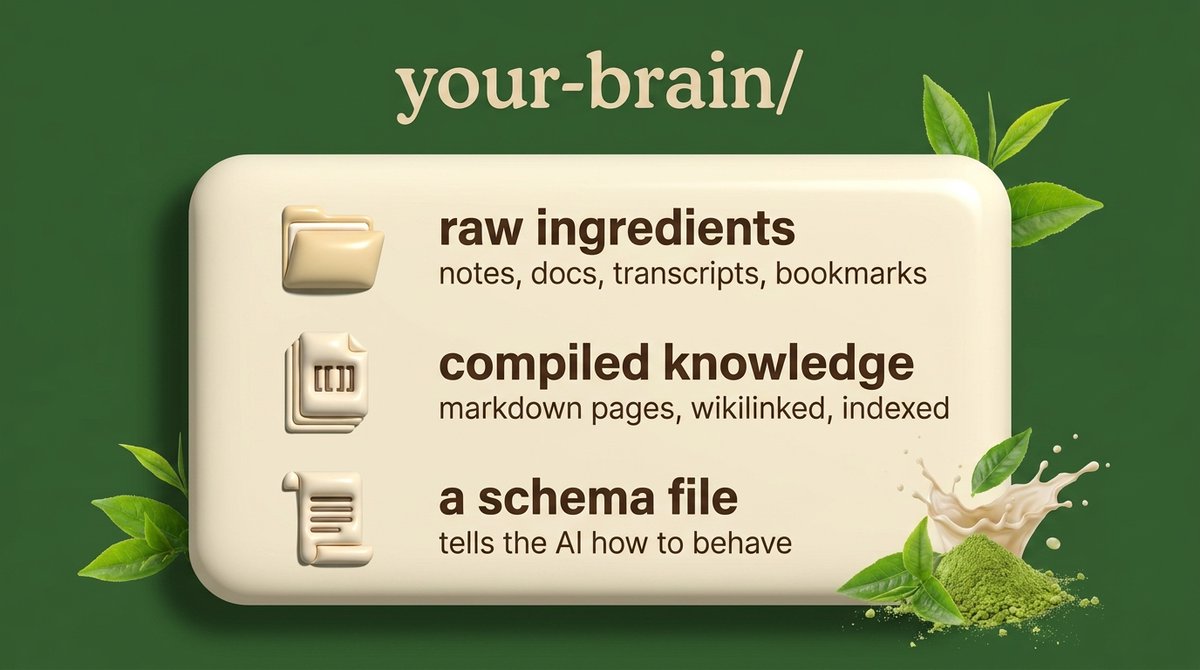
Plain folders. Plain markdown. An AI that reads and writes them.
This works because files are the one interface every AI agent already speaks. No embeddings pipeline, no database, no RAG infra. At the scale of one person's knowledge, a well-organized wiki beats retrieval: the agent just reads the relevant pages.
If you've built this: good. You're ahead of 90% of people.
Now here's where it breaks.
## Where the personal version hits a wall
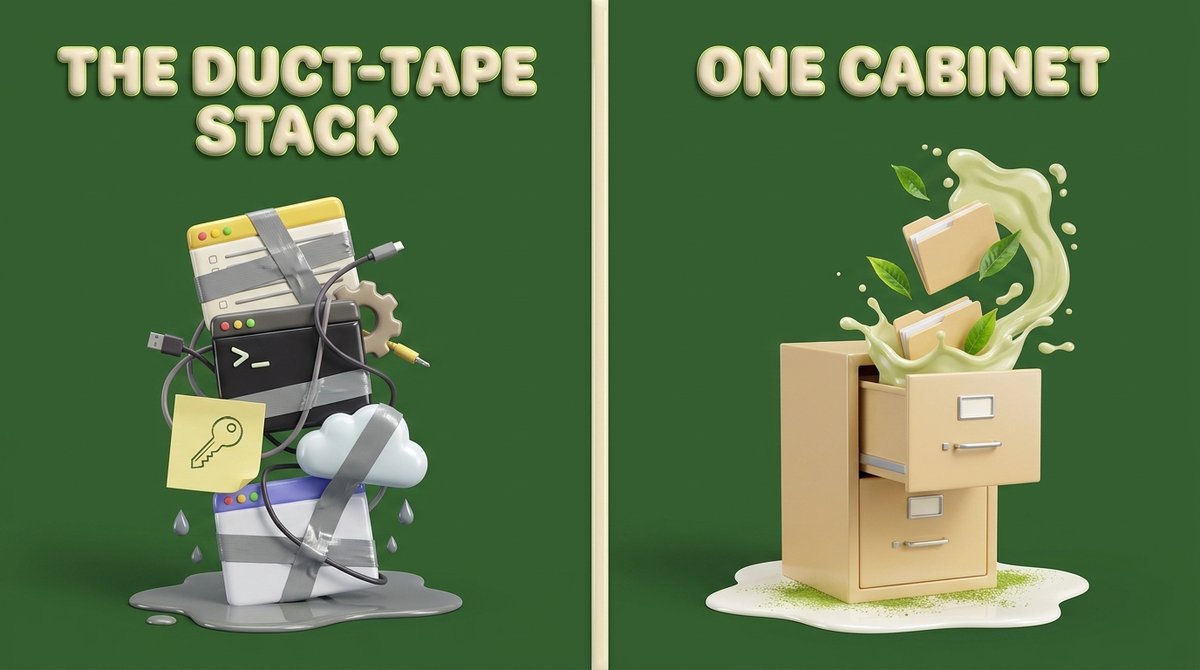
That picture is the honest architecture diagram of most second-brain setups: a notes app, a terminal, a plugin, an API key on a sticky note, all taped together and leaking. I've watched dozens of people (me included) build the Karpathy pattern by hand. The same five walls, every time:
1. You are the scheduler. The wiki updates when you remember to run /wiki-ingest. Miss a week and the inbox rots. A knowledge base that depends on your discipline is a diary.
2. One agent, one hat. The same chat session is your researcher, editor, strategist, and janitor. Every prompt starts with re-explaining which hat to wear.
3. Your real knowledge isn't in the vault. It's in Google Drive. It's in the shared folder your co-founder dumps contracts into, the Docs your clients comment on, the Sheets finance actually lives in. Copy-pasting that into raw/ is a part-time job, so nobody does it, and the brain stays half-empty.
4. The glue is duct tape. REST plugin + API key + terminal plugin + MCP config + a prayer that it all still works after the next update. The setup guide is the product. That's why setup guides are what goes viral.
5. It's a library, not an employee. It answers when asked. It never notices the campaign doc contradicts the budget sheet, never files yesterday's meeting notes, never flags that a supplier price changed.
Each wall has the same shape: the pattern is right, but you're the operating system running it.
So let's look at what happens when the files run themselves.
## A worked example: launching a product with a company brain
This is ChocoBar, a demo company that ships inside Cabinet. Every "department" is a folder of markdown files on disk. Agents live in the folders.
The marketing team (one human, two agents) is launching a canned matcha drink. The human wrote the intent. The agents did the work.
Here's the campaign plan the marketing agent wrote (budget split, four-week ad rotation, launch copy) as a normal markdown file, wikilinked to the brand guidelines and the campaign calendar it pulled the rules from:
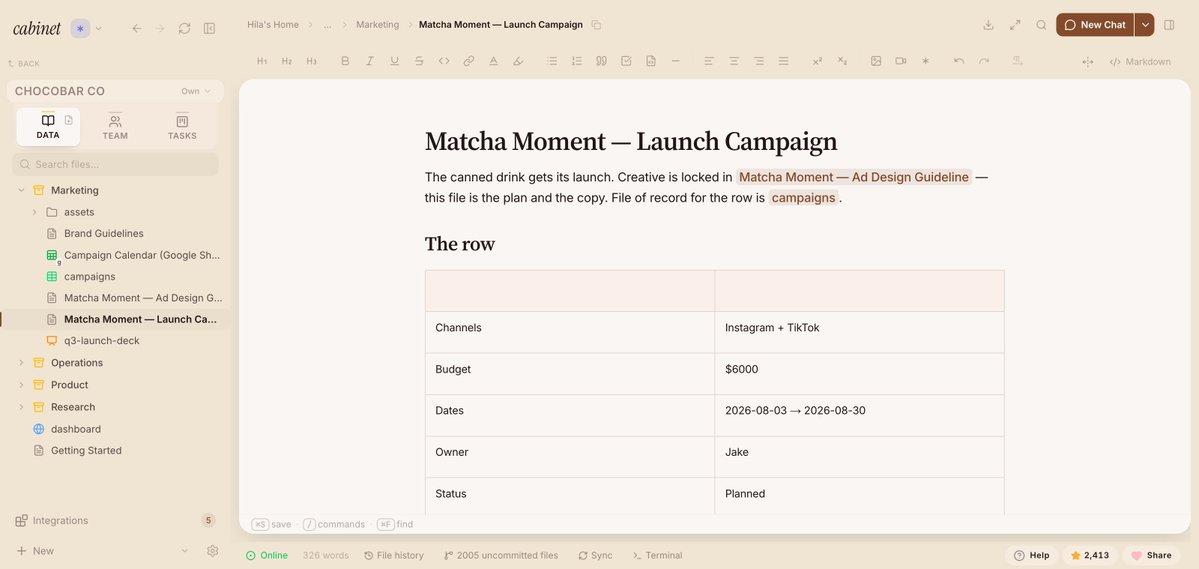
Notice the details: a $6,000 budget split across paid, creator seeding and contingency; a week-by-week rotation table that says which ad runs when and why; and a "rules check" at the bottom confirming the plan obeys the marketing rules written elsewhere in the brain. No human formatted that table.
And here's the part that surprises people. The creative isn't a moodboard of ideas. It's five finished, on-brand ad images, sitting in the same folder tree as the plan that schedules them:
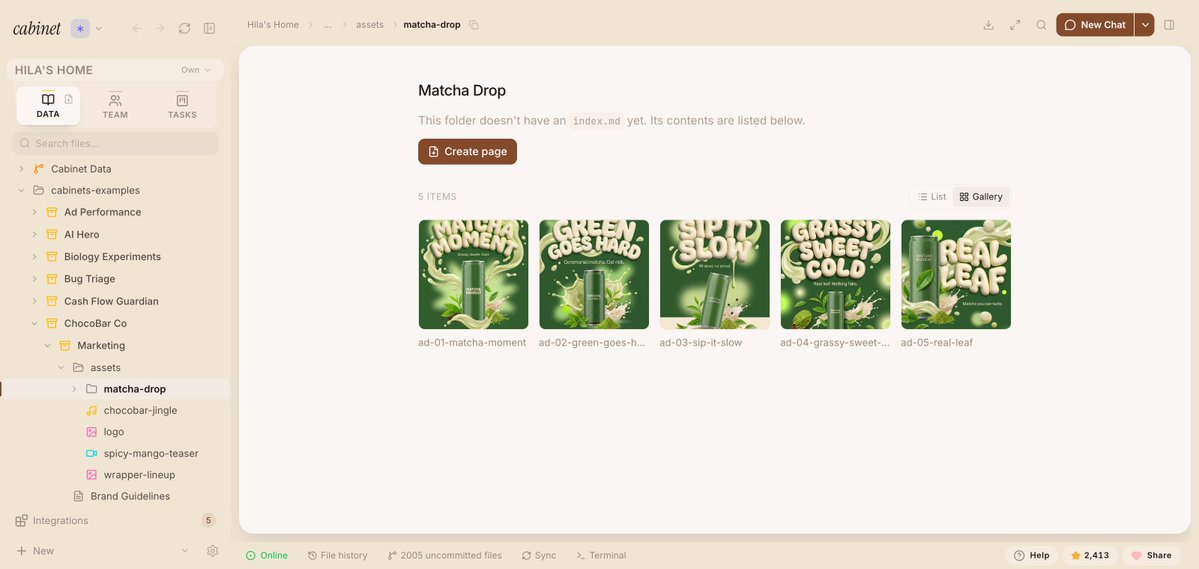
These aren't mockups made for this article. They're the actual files from the agent's assets/matcha-drop/ folder. Here are two of them at full size:


The can line, the "Grassy. Sweet. Cold." descriptor, the "REAL INGREDIENTS. REAL CHOCOLATE." tagline: all of it came from the brand guidelines file sitting two folders up. The agent didn't invent a style. It read one. That is the entire thesis of a knowledge base, proven in pixels.
Plan, copy, budget, creative, calendar: all files, all linked, all versioned in git. When week 3 arrives, a scheduled agent picks ad 04 because the rotation table says so. Nobody re-explains the campaign to a chat window.
That's the difference between a second brain and a company brain: the second brain remembers. The company brain ships.

## The anatomy (steal this even if you build it yourself)
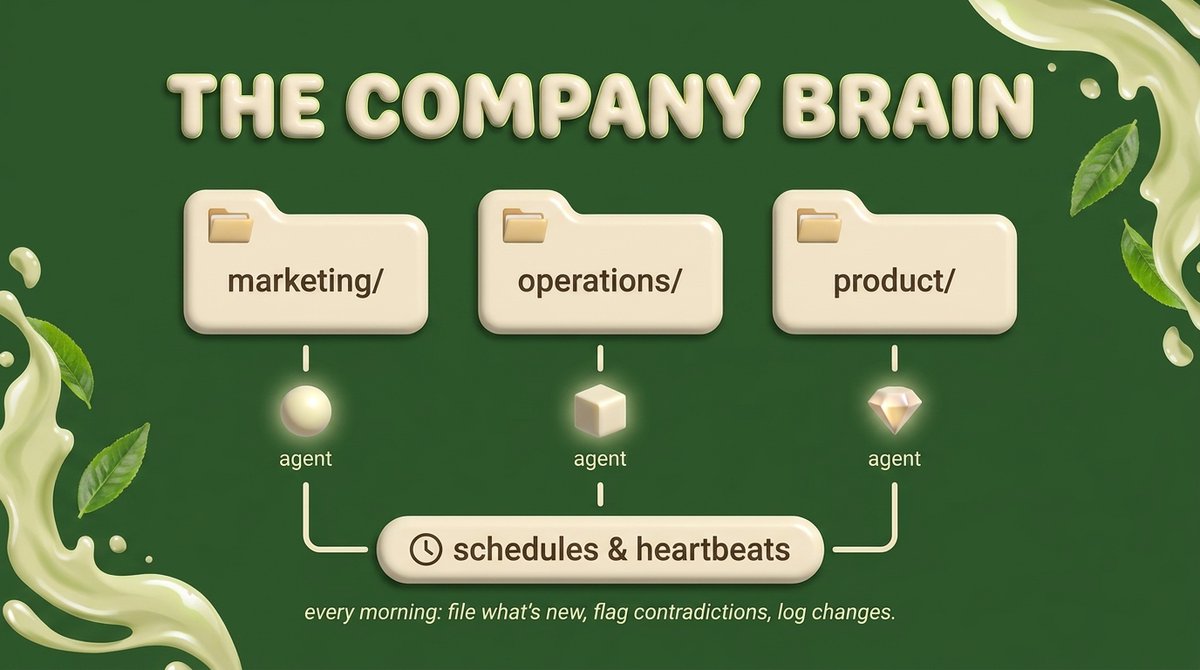
Three rules make this work, and they're portable to any setup:
Rule 1: Agents live in folders, not in chats. Each agent is scoped to its department's directory. The marketing agent physically cannot wander into legal. Scope is a file permission, not a polite request in a prompt.
Rule 2: Schedules, not discipline. Every maintenance task you'd "try to remember" becomes a heartbeat. In Cabinet's Company Brain template, a Knowledge Researcher sweeps the question inbox every 30 minutes and a Source Analyst audits sources every morning at 7. Here's what that looks like:
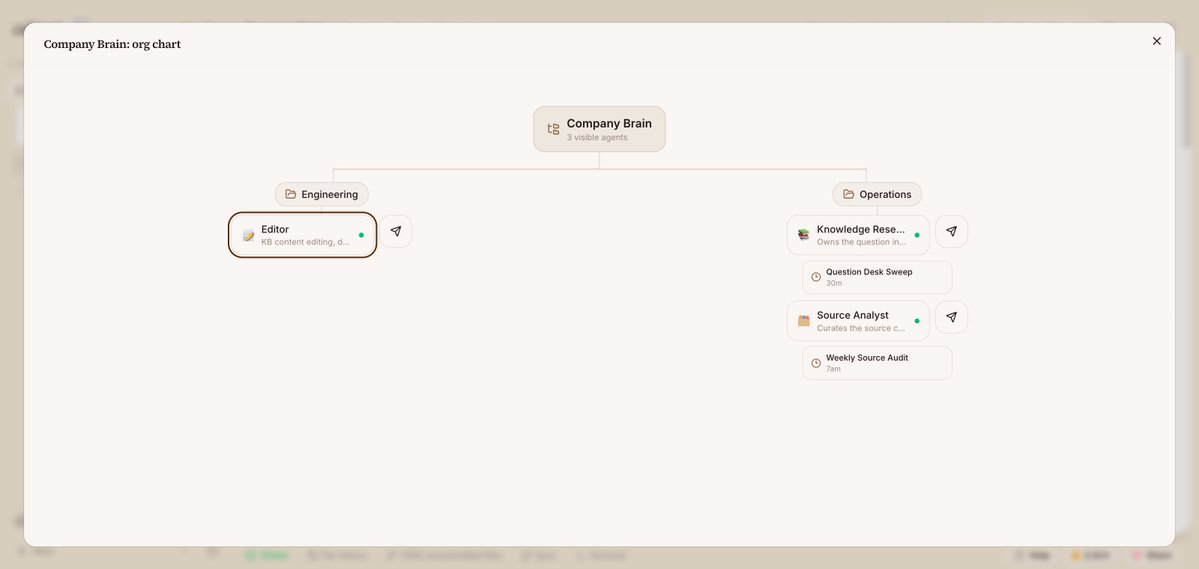
Yes, that's an org chart. Of agents. With cron schedules where salaries would be. It reads as a joke until you watch the activity feed fill up overnight. Then it reads as headcount:
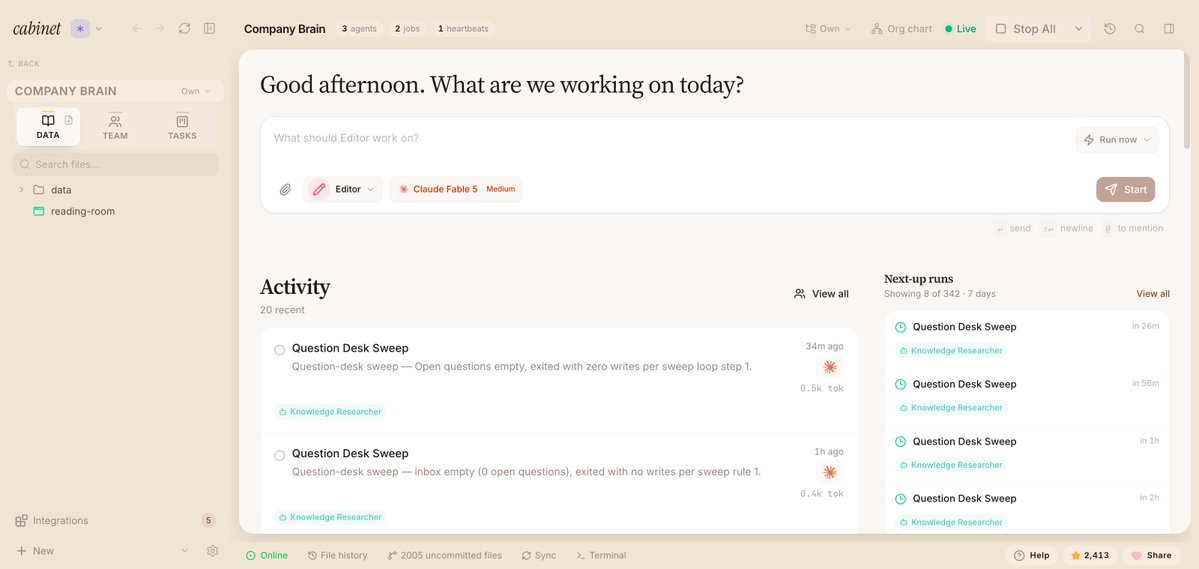
Rule 3: The brain reports like a team. Every run in that feed leaves a trail: what was done, which files changed, how many tokens it cost (note the 0.4k tok sweeps: an empty inbox check costs fractions of a cent). You skim it with your coffee the way you'd skim standup notes.
## Connect the knowledge you already have (the step everyone skips)
The #1 reason knowledge bases die: the knowledge is somewhere else.
Your company's actual memory is in Apple Notes, Google Drive, Notion pages, iCloud folders, meeting recordings, a SharePoint nobody loves. A brain that requires you to migrate all of it will stay empty forever.
The fix is to mount, not migrate. In Cabinet, right-click any folder → Connect Knowledge, and point it at the sources you already use. It detects the accounts synced on your machine and mounts them straight into the tree:
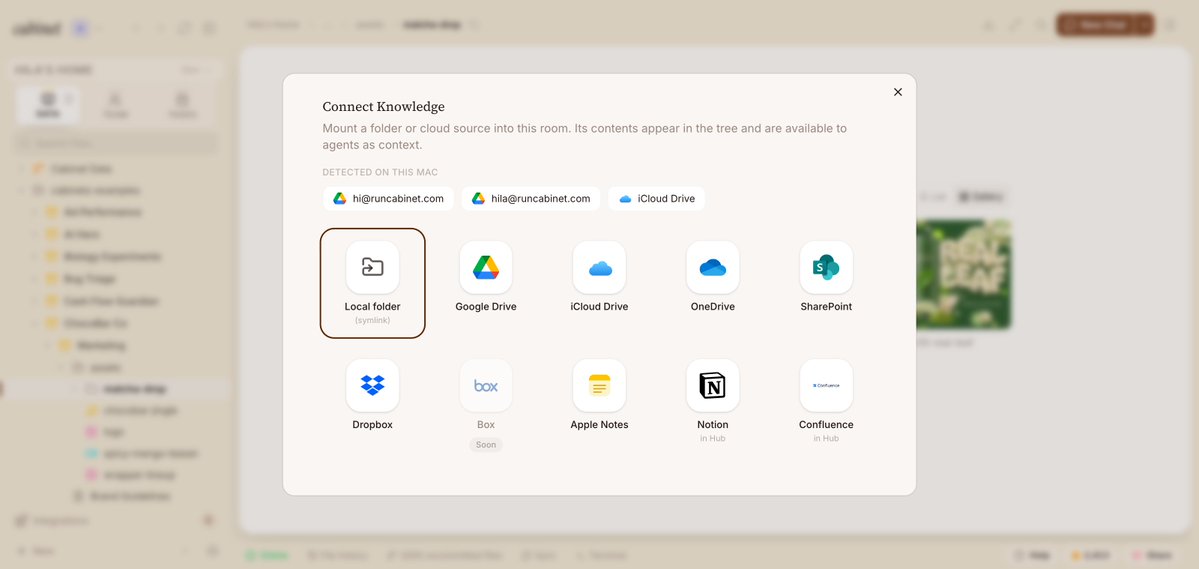
That dialog is live, not a concept: it found the Google accounts and iCloud Drive on this Mac by itself. Pick Google Drive, choose a folder, and it becomes part of the brain:
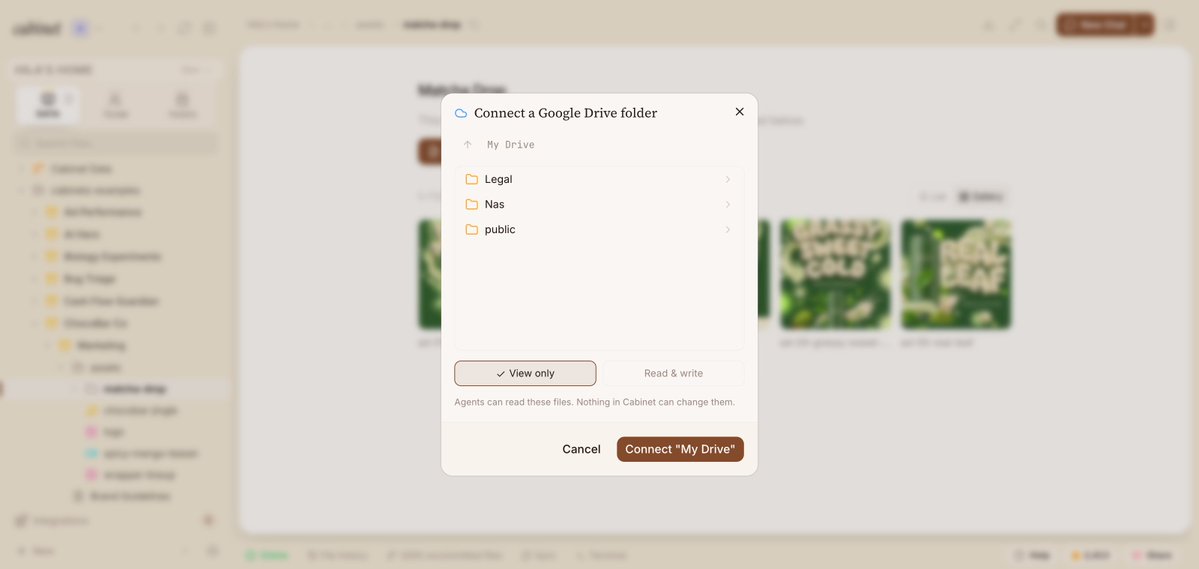
Your legal/ folder in Drive becomes a folder agents can read. Finance sheets stay in Sheets (and stay current), but agents can cite them. And read the permission line in that screenshot carefully, because it's the most important sentence in this article:
"View only: agents can read these files. Nothing in Cabinet can change them."
One rule you never break when you give agents access to real company data: keys, not prompts. "Please don't modify the contracts" is a suggestion. A read-only mount is a guarantee. Set permissions at the access level and you never have to trust a prompt again. This applies to every agent setup you will ever build, with any tool.
## The core unlock: your knowledge builds its own UI

Here's the part that separates a company brain from a markdown viewer, and honestly the reason I think this pattern wins: the interface is generated too.
Every SaaS dashboard you've ever used is someone else's guess at your workflow. You adapt to it: you learn its tabs, export its CSVs, ignore the 80% of features that were built for someone else. That deal made sense when software was expensive to write. It isn't anymore.
In Cabinet, an agent can write an index.html right next to the markdown, and the app renders it as a live embedded page. Which means the interface for your data is whatever you ask for. ChocoBar's ops agent compiled the CSVs it maintains into this dashboard:
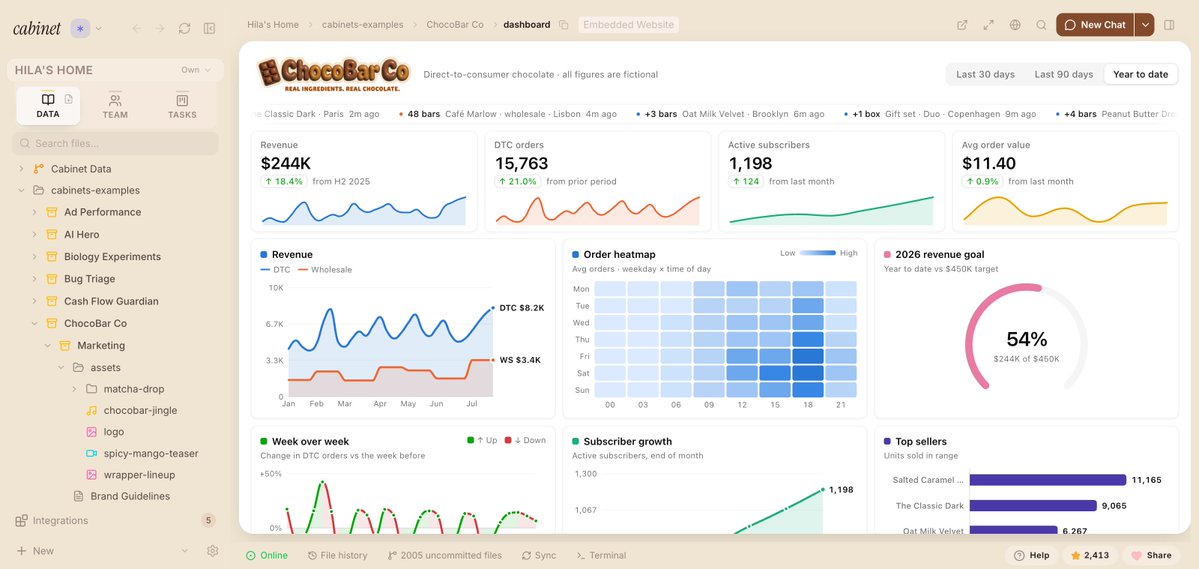
Revenue, order heatmap, subscriber growth, top sellers: generated from the same files the agents keep fresh, rendered inside the knowledge base, refreshed on request or on a schedule.
And it goes past dashboards. The product team needed a tool, so the agent built one: a packaging designer with a live label preview. Type a flavor, pick a wrapper color, watch the bar redesign itself:
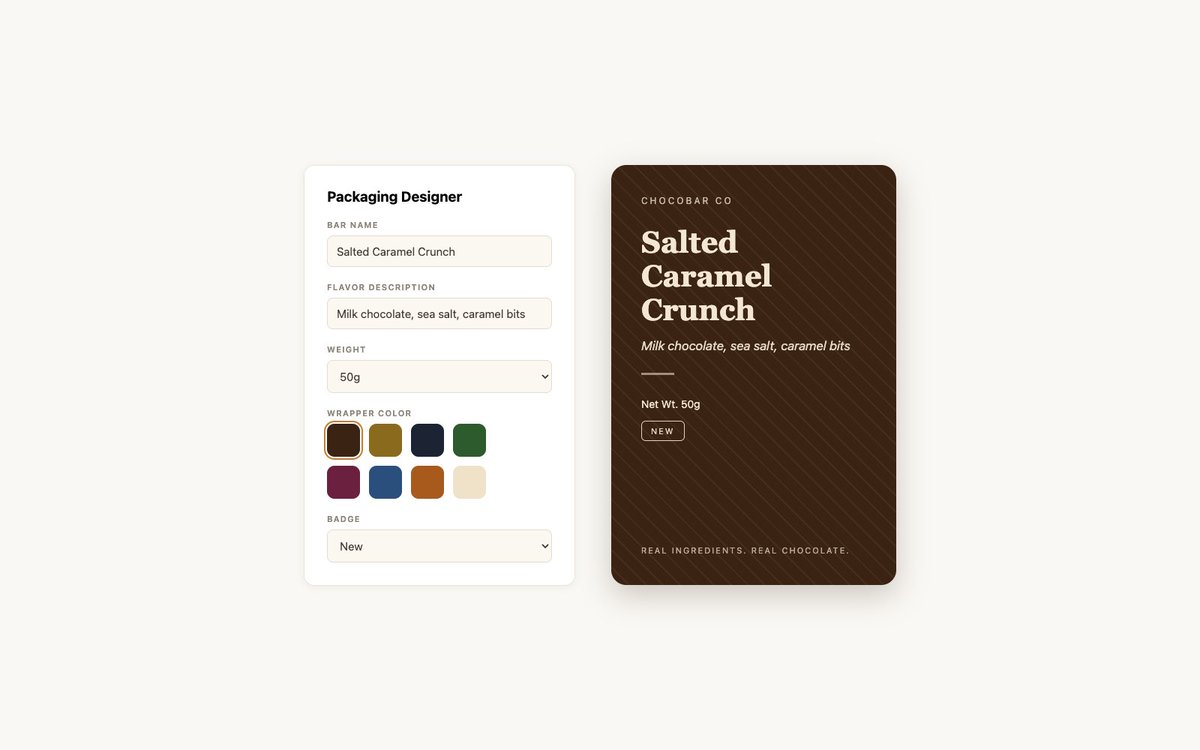
Anywhere else, that's a Figma template and a dev ticket. Here it's a file an agent wrote in one run, sitting in product/packaging-designer/, versioned in git like everything else.
This is what "adaptive UI" actually means: describe the view you wish existed ("a runway calculator with sliders", "a QBR board", "a campaign calendar heatmap") and the brain renders it, for you, from your data. When your workflow changes, you don't migrate to a new tool. You regenerate the interface.
SaaS ships you their UI. A company brain ships yours.
## No vendor lock, actually
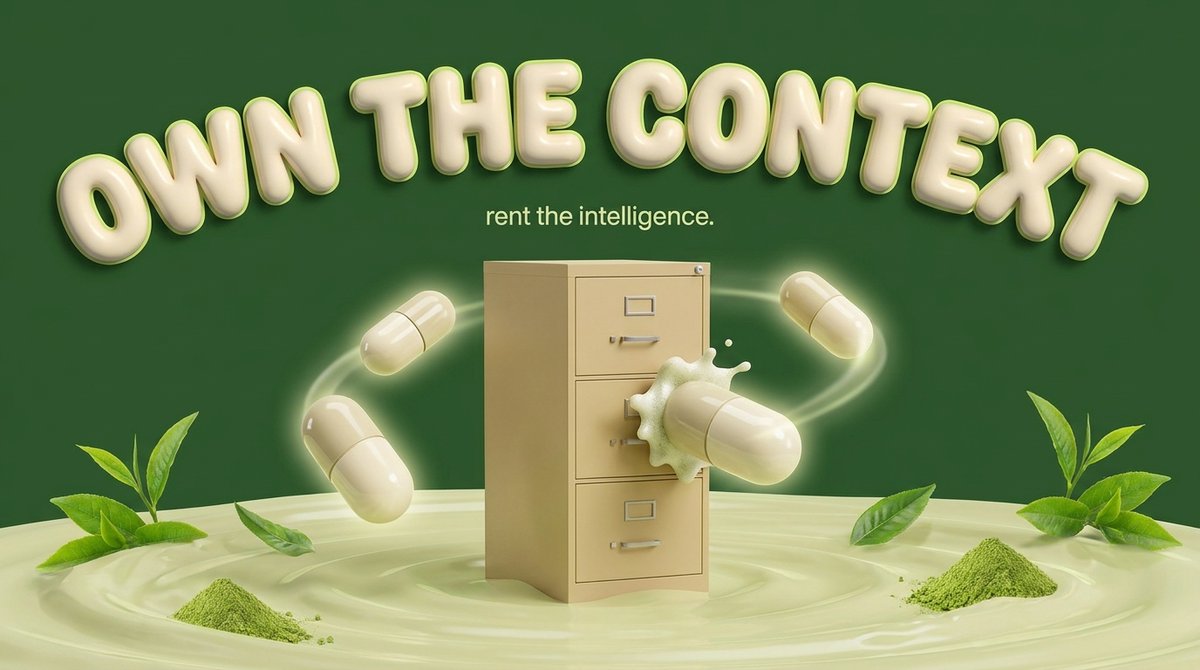
Every viral second-brain guide promises "it's just text files, point another model at it next year." For a personal vault, that's true by accident. For a company brain, it has to be true by design:
- Files on your disk. Markdown, CSV, images. grep works. Git works. Backups are rsync.
- Bring your own AI. Cabinet drives whatever CLI you already pay for: Claude Code, Gemini CLI, Codex, Kimi. When Opus 5 shipped this week, upgrading the whole company brain to it was a dropdown, not a migration: the files didn't move, the agents didn't change, only the intelligence got swapped. Mixing is normal too: Opus 5 for strategy, a cheap model for filing.
- Self-hosted, open source. Your company's brain on someone else's server, trained into someone else's product, is not your brain. This one runs on your machine. The code is MIT-licensed on GitHub.
The uncomfortable truth of the AI tools market: models are interchangeable, your accumulated context is not. Own the context. Rent the intelligence.
## Already living in Obsidian? Good news: you're 90% done
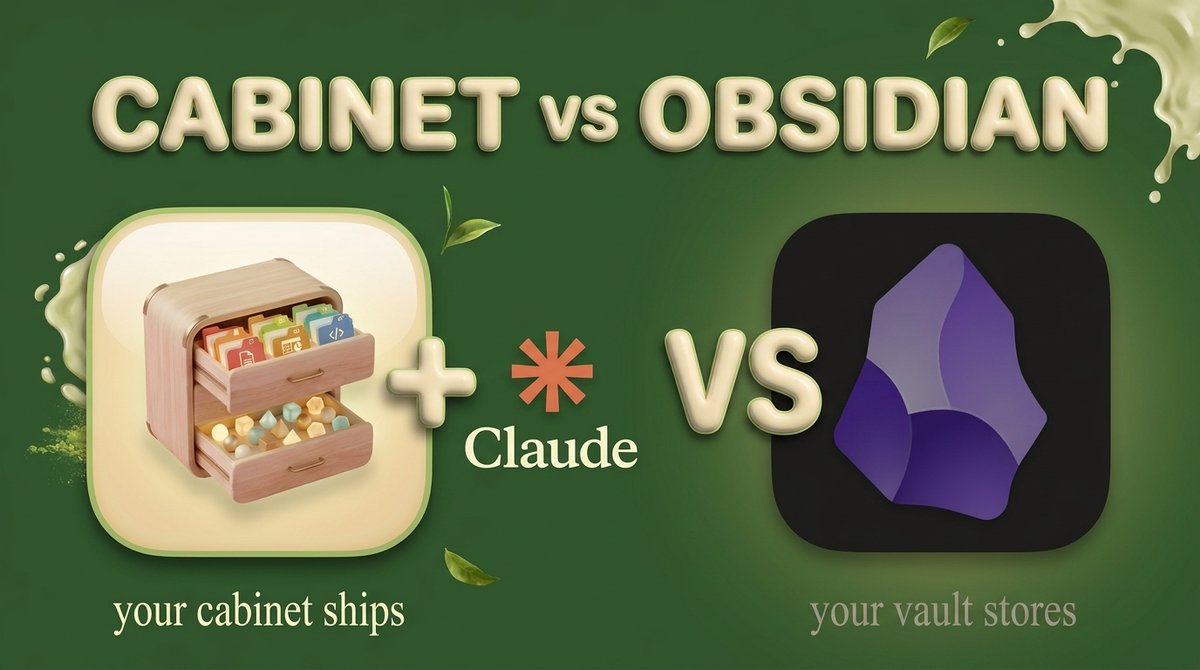
This is not a rip-and-replace pitch, and here's why: your Obsidian vault is already a cabinet. It's a folder of markdown files with [[wikilinks]], which is exactly what Cabinet reads and writes.
So the "migration" is: none.
- Mount your vault folder (right-click → Connect Knowledge → Local folder). The notes render, the [[wikilinks]] resolve, nothing is converted, no lock-in in either direction.
- Keep using Obsidian on the same folder if you like it. Both apps are just views over the same files on disk. Obsidian stays your reading chair; Cabinet becomes the staff that files, links, and maintains while you're not looking.
- What changes is who does the work. In the Obsidian setup, you run the plugin, you paste the notes, you remember the weekly review. Here, agents with schedules do, and your vault's months of accumulated notes become their day-one context.
Your vault stores. Your cabinet ships. Same files, different verb.
## Set it up tonight (20 minutes)
1. Install. npx cabinet, or grab the desktop app from runcabinet.com. Free, open source, runs on your machine.
2. Make a room per department, even if you're a team of one: marketing/, product/, ops/. Empty folders are a plan.
3. Mount reality. Right-click → Connect Knowledge → your Google Drive folders, Apple Notes, Notion. Read-only. This is the step that makes the brain worth asking.
4. Hire your first agent and give it this heartbeat, daily at 7am:
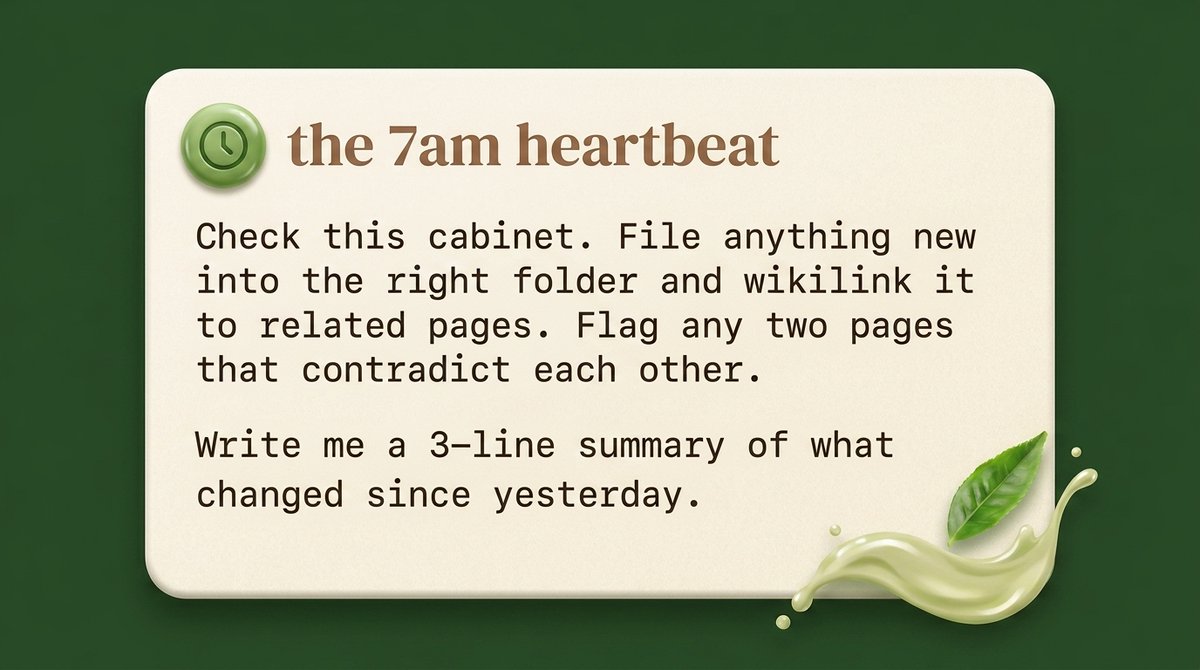
5. Ask your first real question:
Save the answer back into the brain. That's the loop: every question you ask becomes a page, every page makes the next answer sharper.
6. Only after it's boring and reliable: add the second agent, then the third. An org chart of agents you built one hire at a time will beat any 40-agent template you cloned.
## The window
Three of these guides went viral this year (1.7M, 8.1M, and half a million views), and the honest number hiding under all of them is this: most readers bookmarked, nodded, and built nothing.
The few who built the personal version now have a vault that remembers everything they've read.
The ones who build the company version get something different in kind, not degree: they wake up to filed documents, flagged contradictions, a matcha campaign that moved to week 2 on schedule, and a three-line summary of what their company learned overnight.
Files. Agents. Schedules. That's the whole system. And every time a better model ships (like this week), the same brain gets smarter for free, because you own the context and just rent the intelligence.
Your company already knows more than you do. Give it a brain.
⭐ Get started: runcabinet.com · Star the repo: github.com/cabinetai/cabinet · Open source, self-hosted, bring your own AI.
## 相关链接
- [Hila Shmuel](https://x.com/HilaShmuel)
- [@HilaShmuel](https://x.com/HilaShmuel)
- [1.2K](https://x.com/HilaShmuel/status/2082198288061944311/analytics)
- [Karpathy posted about LLM knowledge bases](https://x.com/karpathy/status/2039805659525644595)
- [repo here](https://github.com/cabinetai/cabinet)
- [Cabinet](https://github.com/cabinetai/cabinet)
- [MIT-licensed on GitHub](https://github.com/cabinetai/cabinet)
- [github.com/cabinetai/cabinet](https://github.com/cabinetai/cabinet)
- [Upgrade to Premium](https://x.com/i/premium_sign_up)
- [4:15 AM · Jul 29, 2026](https://x.com/HilaShmuel/status/2082198288061944311)
- [1,296 Views](https://x.com/HilaShmuel/status/2082198288061944311/analytics)
---
*导出时间: 2026/7/29 09:35:02*
---
## 中文翻译
# 如何构建一个(真正)在你睡觉时运行的“公司大脑”(完整指南)
**作者**: Hila Shmuel
**日期**: 2026-07-28T20:15:31.000Z
**来源**: [https://x.com/HilaShmuel/status/2082198288061944311](https://x.com/HilaShmuel/status/2082198288061944311)
---

时机很重要。Claude Opus 5 本周发布了,每个人的第一个问题都是“我该拿它做什么?” 问错问题了。没有上下文的前沿模型就像第一天入职的天才实习生。
你能给它最好的东西不是更好的提示词。而是一个可以运行的公司大脑。
Karpathy 在 4 月发布了关于 LLM 知识库的内容。10.8 万个书签并且还在增加。从那以后,同样的指南换了不同的外衣又病毒式传播了十几次:Obsidian 加个插件、笔记应用里的终端、三个文件夹和一个 schema 文件。
它们在模式上都是对的。但它们也都停在了同一个地方。
它们停在了你身上。一个人,一个仓库,一个聊天窗口,一个只有在你要求时才会做事情的智能体。
本指南是关于下一步:将这种模式转化为公司大脑,一个知识库,其中一支 AI 智能体团队栖身于你的文件中,按计划工作,阅读你公司已有的知识,并在你睡觉时变得更聪明。
运行在你文件内部的前沿模型不是实习生。它是一个团队。本指南就是教你如何构建它的运行场所。
下面的所有内容都在 Cabinet 上运行,这是一个开源、自托管的应用程序,你今晚就可以安装(代码库在这里)。但模式比工具更重要,所以让我们从那里开始。
## 每个人都认同的模式
剥离掉品牌营销,每个病毒式传播的知识库指南都是同样的三个想法:

普通的文件夹。普通的 Markdown。一个读取和写入它们的 AI。
这行得通,因为文件是每个 AI 智能体已经会说的一种接口。没有嵌入管道,没有数据库,没有 RAG 基础设施。在一个人知识的规模上,一个组织良好的 Wiki 胜过检索:智能体只需阅读相关页面。
如果你已经构建了这个:很好。你已经领先了 90% 的人。
现在问题来了。
## 个人版碰壁的地方

那张图是大多数第二大脑设置的真实架构图:一个笔记应用、一个终端、一个插件、一张便利贴上的 API 密钥,全都被胶带粘在一起还在漏数据。我看着几十个人(包括我自己)手动构建 Karpathy 模式。每次都是同样的五堵墙:
1. 你是调度员。只有当你记得运行 /wiki-ingest 时 Wiki 才会更新。错过一周,收件箱就会腐烂。一个依赖你自律的知识库只是一本日记。
2. 一个智能体,一顶帽子。同一个聊天会话既是你的研究员、编辑、战略家,又是清洁工。每次提示都要重新解释该戴哪顶帽子。
3. 你真正的知识不在仓库里。它在 Google Drive 里。在你联合创始人把合同丢进去的共享文件夹里,在你的客户评论的 Docs 里,在财务实际生存的 Sheets 里。复制粘贴到 raw/ 是一份兼职工作,所以没人去做,大脑也保持半空状态。
4. 粘合剂是胶带。REST 插件 + API 密钥 + 终端插件 + MCP 配置 + 祈祷它在下一次更新后仍然能用。安装指南就是产品。这就是为什么安装指南会病毒式传播。
5. 它是一个图书馆,而不是员工。它回答问题。它从不会注意到活动文档与预算表相矛盾,从不归档昨天的会议记录,从不标记供应商价格发生了变化。
每一堵墙都有相同的形状:模式是对的,但你是运行它的操作系统。
那么让我们看看文件自行运行时会发生什么。
## 一个实战案例:用公司大脑发布产品
这是 ChocoBar,一个内置于 Cabinet 中的演示公司。每个“部门”都是磁盘上的一个 Markdown 文件夹。智能体就住在这些文件夹里。
营销团队(一个人类,两个智能体)正在发布一款罐装抹茶饮料。人类写下了意图。智能体完成了工作。
这是营销智能体撰写的活动计划(预算分配、四周广告轮换、发布文案),它是一个普通的 Markdown 文件,通过 wikilink 链接到品牌指南和它从中提取规则的日历:

注意这些细节:6,000 美元的预算分配在付费广告、达人种草和应急资金上;逐周轮换表说明了哪个广告何时运行以及原因;底部的“规则检查”确认该计划遵守了大脑其他地方写的营销规则。没有人工格式化那张表。
下面是让人们惊讶的部分。创意不是想法的情绪板。它是五张完成的、符合品牌形象的广告图片,与安排它们的计划位于同一个文件夹树中:

这些不是为这篇文章制作的模型。它们是智能体 assets/matcha-drop/ 文件夹中的实际文件。这里是其中两张全尺寸图:


罐身线条、“草香。甜美。冰冷。”的描述语、“REAL INGREDIENTS. REAL CHOCOLATE.”的标语:所有这些都来自位于上两级文件夹的品牌指南文件。智能体没有发明一种风格。它读到了一种风格。这就是知识库的全部论点,在像素中得到了证明。
计划、文案、预算、创意、日历:都是文件,全部链接,都在 git 中进行了版本控制。当第 3 周到来时,一个预定的智能体会选择广告 04,因为轮换表是这样规定的。没有人向聊天窗口重新解释活动。
这就是第二大脑和公司大脑的区别:第二大脑记住。公司大脑交付。

## 解构(即使你自己构建也要借鉴这一点)

三条规则让这行之有效,并且它们可移植到任何设置:
规则 1:智能体住在文件夹里,而不是聊天里。每个智能体的范围限定在其部门的目录内。营销智能体在物理上无法游荡到法律部。范围是文件权限,而不是提示词中礼貌的请求。
规则 2:时间表,而不是自律。每一个你会“试着记住”的维护任务都变成了一个心跳。在 Cabinet 的公司大脑模板中,一名知识研究员每 30 分钟清理一次问题收件箱,一名源分析师每天早上 7 点审核来源。这看起来是这样的:

是的,那是一张组织结构图。智能体的组织结构图。用本该是薪水的位置放着 cron 时间表。这看起来像是个笑话,直到你看到活动流一夜之间被填满。然后它读起来就像是人手配置:

规则 3:大脑像团队一样汇报。该流中的每一次运行都会留下痕迹:做了什么,哪些文件改变了,花费了多少 Token(注意 0.4k token 的清理:空收件箱检查只需几分钱)。你一边喝咖啡一边浏览它,就像浏览站会笔记一样。
## 连接你已有的知识(每个人都跳过的步骤)
知识库死亡的第一大原因:知识在别处。

你公司的实际记忆在 Apple Notes、Google Drive、Notion 页面、iCloud 文件夹、会议录音、没人爱的 SharePoint 里。一个需要你迁移所有这些的大脑将永远保持空虚。
解决方法是挂载,而不是迁移。在 Cabinet 中,右键单击任何文件夹 → 连接知识,然后将其指向你已经使用的来源。它会检测你机器上同步的账户,并将它们直接挂载到树中:

该对话框是实时的,不是概念:它自己在这台 Mac 上找到了 Google 账户和 iCloud Drive。选择 Google Drive,选择一个文件夹,它就变成了大脑的一部分:

你在 Drive 中的 legal/ 文件夹变成了智能体可以读取的文件夹。财务表格留在 Sheets 中(并保持最新),但智能体可以引用它们。并且仔细阅读该截图中的权限行,因为它是本文中最重要的句子:
“仅查看:智能体可以读取这些文件。Cabinet 中的任何内容都无法更改它们。”
当你给智能体访问真实公司数据的权限时,有一条你永远不能打破的规则:是密钥,而不是提示词。“请不要修改合同”是一个建议。只读挂载是一个保证。在访问级别设置权限,你就再也不必信任提示词了。这适用于你将要构建的每一个智能体设置,无论使用什么工具。
## 核心解锁:你的知识构建自己的 UI

这是区分公司大脑和 Markdown 查看器的部分,老实说,也是我认为这种模式会赢的原因:界面也是生成的。
你用过的每个 SaaS 仪表盘都是别人对你工作流程的猜测。你适应它:你学习它的选项卡,导出它的 CSV,忽略那些为别人构建的 80% 的功能。当编写软件成本很高时,这笔交易是有道理的。现在不再是了。
在 Cabinet 中,智能体可以在 Markdown 旁边写一个 index.html,应用程序将其呈现为实时嵌入页面。这意味着你的数据的界面是你索要的任何东西。ChocoBar 的运营智能体将其维护的 CSV 编译成了这个仪表盘:

收入、订单热力图、订阅者增长、畅销品:从智能体保持新鲜的相同文件生成,在知识库内呈现,按请求或按计划刷新。
它超越了仪表盘。产品团队需要一个工具,所以智能体构建了一个:带有实时标签预览的包装设计师。输入一种口味,选择一种包装纸颜色,看着巧克力棒重新设计自己:

在任何其他地方,那是一个 Figma 模板和一个开发工单。在这里它是智能体在一次运行中编写的一个文件,位于 product/packaging-designer/ 中,像其他所有内容一样在 git 中进行版本控制。
这就是“自适应 UI”的真正含义:描述你希望存在的视图(“带滑块的跑道计算器”、“QBR 看板”、“活动日历热力图”),大脑会根据你的数据为你渲染它。当你工作流程改变时,你不需要迁移到新工具。你重新生成界面。
SaaS 给你发货他们的 UI。公司大脑给你发货你的 UI。
## 真的没有供应商锁定

每个病毒式传播的第二大脑指南都承诺“这只是文本文件,明年把另一个模型指向它”。对于个人仓库,这是偶然成立的。对于公司大脑,它必须在设计上成立:
- 磁盘上的文件。Markdown、CSV、图片。grep 可用。Git 可用。备份就是 rsync。
- 自带 AI。Cabinet 驱动你已经在付费的任何 CLI:Claude Code、Gemini CLI、Codex、Kimi。当 Opus 5 本周发货时,将整个公司大脑升级到它只是一个下拉菜单,而不是迁移:文件没有移动,智能体没有改变,只有智力被交换了。混合也是正常的:Opus 5 用于战略,便宜模型用于归档。
- 自托管,开源。你公司的大脑在别人的服务器上,被训练进别人的产品里,那不是你的大脑。这一个在你的机器上运行。代码在 GitHub 上采用 MIT 许可证。
AI 工具市场的不适真相:模型是可以互换的,你积累的上下文则不然。拥有上下文。租用智力。
## 已经在使用 Obsidian?好消息:你已经完成了 90%

这不是一个推倒重来的推销,原因如下:你的 Obsidian 仓库已经是一个 Cabinet 了。它是一个带有 [[wikilinks]] 的 Markdown 文件夹,这正是 Cabinet 读取和写入的内容。
所以“迁移”是:无。
- 挂载你的仓库文件夹(右键单击 → 连接知识 → 本地文件夹)。笔记呈现,[[wikilinks]] 解析,没有任何转换,任何方向都没有锁定。
- 如果你喜欢,继续在同一文件夹上使用 Obsidian。两个应用程序都只是磁盘上相同文件的视图。Obsidian 保持你的阅读椅;Cabinet 成为当你没在看时负责归档、链接和维护的员工。
- 改变的是谁做工作。在 Obsidian 设置中,你运行插件,你粘贴笔记,你记得每周审查。在这里,有计划的智能体来做这些,你仓库数月积累的笔记成为他们第一天的上下文。
你的仓库存储。你的 Cabinet 交付。相同的文件,不同的动词。
## 今晚设置(20 分钟)
1. 安装。npx cabinet,或者从 runcabinet.com 获取桌面应用。免费、开源、在你的机器上运行。
2. 为每个部门腾出一个房间,即使你只有一个人的团队:marketing/、product/、ops/。空文件夹就是一个计划。
3. 挂载现实。右键单击 → 连接知识 → 你的 Google Drive 文件夹、Apple Notes、Notion。只读。这是让大脑值得一问的步骤。
4. 雇佣你的第一个智能体并给它这个心跳,每天早上 7 点:

5. 问你的第一个真正的问题:

将答案保存回大脑。这就是循环:你问的每一个问题都变成一页,每一页都让下一个答案更敏锐。
6. 只有当它变得无聊且可靠后:添加第二个智能体,然后第三个。你一次雇佣一个构建的智能体组织结构图,将击败你克隆的任何 40 个智能体模板。
## 窗口期
今年有三个这样的指南病毒式传播(170 万、810 万和 50 万浏览量),隐藏在它们所有之下的诚实数字是这样的:大多数读者加了书签,点了点头,什么也没构建。
那些构建了个人版本的少数人现在拥有一个记住他们所有阅读内容的仓库。
那些构建了公司版本的人得到的某种东西在性质上而不是程度上不同:他们醒来看到已归档的文档、被标记的矛盾、按计划转移到第 2 周的抹茶活动,以及关于他们公司一夜之间学到了什么的总结。
文件。智能体。时间表。这就是整个系统。每当有更好的模型发布(比如本周),同一个大脑都会免费变得更聪明,因为你拥有上下文,只是租用智力。
你的公司知道的已经比你多了。给它一个大脑。

⭐ 开始使用:runcabinet.com · Star 代码库:github.com/cabinetai/cabinet · 开源,自托管,自带 AI。