# How to think using AI
**作者**: Rohit
**日期**: 2026-02-19T01:23:48.000Z
**来源**: [https://x.com/rohit4verse/status/2050968031493550202](https://x.com/rohit4verse/status/2050968031493550202)
---

There is no neutral way to use AI. You either get sharper using it or you get hollower. Most people are getting hollower. They will not notice until they try to work without it.
Stop scrolling for a second.
If every AI tool you use disappeared tomorrow morning, what could you still build? What could you still write? What could you still figure out alone, with no chat window open and no autocomplete suggesting the next line?
How many hours of your last week were spent thinking versus prompting? Are those the same thing? Are you sure?
How much of the work you call yours is actually yours, and how much of it would collapse the moment your subscription lapsed?
Most people will not sit with these questions because the answers are uncomfortable. The discomfort is the signal. Sit with it anyway. Whatever you are about to read in this article works only if you have first admitted to yourself how much of your cognition has already migrated outward.
Three months ago I sat staring at a function I had written six weeks earlier and could not make sense of it. I read it once. Then again. Then I opened the chat window and asked the model to explain what I had written. That small moment landed harder than it should have. I had spent the previous months calling myself productive while the part of my brain that reads code had started shutting down.
Other cracks followed over the next few weeks. My hand drifted toward the chat window before I tried to think through a problem. I would draft a tweet and reach for the polish button as a reflex. I would open a paper and feel my brain refuse to load the abstract because I could paste it into a summary tool. I would sit in a meeting and feel that pull toward my laptop the moment a strategic question got harder than I wanted it to be.
I had been working those months without thinking through any of it. The output stayed the same. The work shipped. The income kept coming. The muscle that does the actual work behind the work, the one that lets you sit with a hard problem in silence for three minutes and come back with a real answer, had withered while I was busy congratulating myself on the shipping velocity.
I am writing this article because I came close to not noticing. Most people will not notice. Some will read it, recognise themselves, close the tab, and open ChatGPT to summarise what they read.
## what MIT actually found
A few weeks after I figured this out, a paper from the MIT Media Lab went viral. The loudest tweets framed it as: AI is making you dumb. Worse than narcotics.
> **ℏεsam@Hesamation**: [原文链接](https://x.com/Hesamation/status/2024293811405398221)
>
> this is in fact true. MIT did a complete research on the effect of AI on your cognitive abilities and i’ve never looked at AI the same way since then:
> > LLM use accumulate cognitive debt
> > the more you rely on AI the worse you get at thinking without it
> > you stop exercising
>
> 
That reading is wrong. The underlying paper is correct. And the part most readers missed is the part that matters.
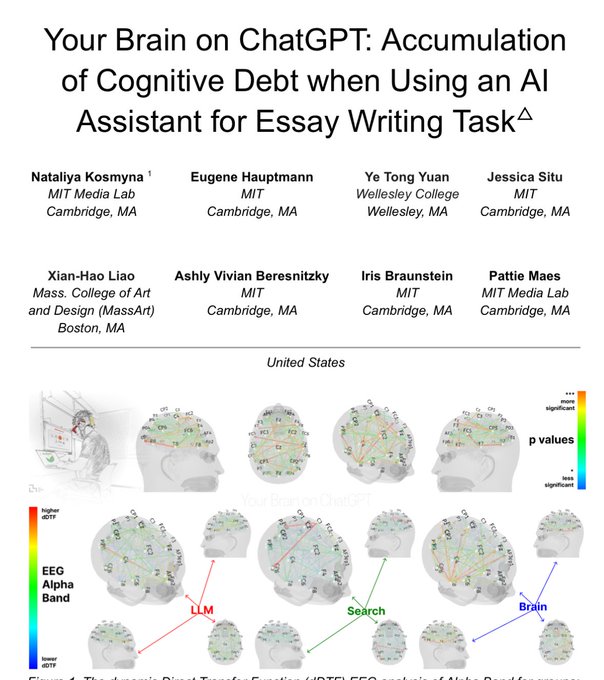
Eight researchers wired 54 university students to EEG machines and ran them through three essay-writing sessions over four months. One group used ChatGPT. Another used Google. A third used nothing. The ChatGPT group's neural connectivity weakened across every session. By session three, participants were copy-pasting. Asked to quote a single line from the essay they had written minutes earlier, most could not.
The phrase the authors coined for this is "cognitive debt." You borrow against your own thinking to ship faster today, and the interest compounds against your future capacity to think at all.
The viral tweets skipped the fourth session.
In session four the researchers swapped the groups. The hand-writers got ChatGPT. The ChatGPT users had their tools removed. The results inverted in a way the loudest takes missed.
The hand-writers, after they got AI in session four, showed higher neural connectivity across alpha, beta, theta, and delta bands than any of the AI-only sessions. Their brains lit up wider when they added AI to an existing structure of competence.
The AI users, after losing their tool, could not function. The researchers asked them to quote from the essay they had written minutes earlier. Seventy-eight percent could not produce a single line. Eleven percent produced a correct quote.
The paper's actual finding is narrower and more useful than the dunk on Twitter. Using AI before independent cognitive engagement builds debt. Using AI after independent cognitive engagement amplifies you. The order matters more than the tool.
The mechanism the paper proposes is not magic. The hand-writers had spent three months building neural structure around the topic. Their default mode network had something to retrieve and compare against when AI suggestions arrived in session four. The AI users had no internal structure to compare anything against. They had been outputting essays for months without ever encoding them. When the AI produced something close-but-wrong, the hand-writers caught it. The AI users had nothing to catch it with. The same input ran through two different brains and the brain with prior structure got smarter, while the brain without prior structure got nothing.
This is the thing that should keep you up at night. AI is not neutral. It interacts with whatever is already there. If you have built nothing, AI accelerates the building of nothing.
A second study at CHI 2025 from Microsoft Research surveyed 319 knowledge workers across 936 real workplace AI use cases. Higher trust in AI predicted lower critical thinking. Effort shifted from producing the work to verifying the output. The authors warned that routine offloading leaves your judgment "atrophied and unprepared" when an exception arrives.
The students themselves can feel this happening. A late-2025 RAND survey found that sixty-seven percent of US students said heavy AI use was harming their own thinking, ten points up from ten months earlier.
The students know. The researchers know. The CTOs of AI companies who can no longer read their own code know.
The question is what to do about it.
## the reliance trap
Here is the thing nobody wants to say out loud. AI is not a unique problem. It is the latest instance of an old pattern.
Rely on your parents past the point you should and you become weak in the way grown adults who cannot make decisions are weak. Rely on a single relationship to regulate your emotions and you become brittle in the way people who cannot be alone are brittle. Rely on a single job to define your identity and you become fragile in the way people who fall apart after layoffs fall apart.
Reliance is the universal weakening agent.
What makes AI different is the speed at which it offers the bargain. With parents you have eighteen years of small concessions before the dependency calcifies. With AI you can outsource your thinking on Monday and feel the atrophy by Friday.
The bargain looks like productivity. You ship more. You earn more. You feel competent. The cost is invisible because the cost is your future ability to do the thing without help. By the time you notice, you have paid.
I noticed mine when I tried to debug my own code.
The fix is the same fix that has always existed for this category of problem. Use the thing as leverage. Refuse to let the thing replace the muscle.
## the mistake everyone is making
Pull this thread one step further.
Most knowledge workers using AI in 2026 use it to do the same amount of work, easier. The job that used to take eight hours now takes two. They spend the other six on Twitter, Netflix, and what researchers label "non-cognitive activities," which translates to phone scrolling. The hours that used to hold their thinking are now empty. The thinking has been transferred outward to a model and the time it freed has been spent on dopamine.
The phrase I keep using in my head for this is transferred cognition. The thinking did not stop happening. It got moved. The hours your brain used to spend on the actual work, draft after draft, false start after false start, got handed to a model. The part of you that used to grow during those hours does not grow anymore. Meanwhile the time those hours used to occupy gets spent on something that grows nothing. Feed scrolling. Video loops. The gentle parasocial drift of watching strangers cook on the internet for three hours an evening.
That trade is the trap.
The whole point of having a tool that makes you 4x more productive is to do 4x more, or to attempt things that were 4x harder than what you used to attempt. If you use AI to compress an eight-hour workday into a two-hour workday with the same output, you have made yourself easier to replace.
The CTO who uses Claude Code to ship in a quarter what used to take a year, then spends the saved nine months on the next harder problem, becomes more valuable every quarter. The CTO who uses Claude Code to ship in a quarter what used to take a year, then spends the saved nine months scrolling, becomes interchangeable with anyone who can prompt a model.
Same tool, two outcomes. The difference is what you do with the saved cognition.
You either reinvest it or you spend it on dopamine. There is no third option.
## how to think with AI
I have spent the last three months reverse-engineering my own collapse and rebuilding the loop. None of what follows is theoretical. I rebuilt my debugging instinct using these.
1. think first, prompt second
The MIT paper's most actionable finding is the simplest one. The session-four hand-writers, who got high cognitive engagement when they added AI later, had spent three months building competence first. Their brains had something to bring to the conversation. The AI extended an existing structure rather than replacing one that did not exist.
Translate this to your own work. Before you open any AI tool for any non-trivial task, spend ten minutes producing your own rough answer. Write the bad version. List your own confusions. State what you think the answer might be and why. Use a pen if it helps you avoid drift toward the chat window.
Then open the chat with something to spar against.
The cost of this is fifteen minutes a day. The benefit is that your brain stays in the loop instead of becoming a cursor.
2. force the AI to disagree
Language models are trained with reinforcement learning from human feedback, which means they are optimized to be agreeable. Their default response to your idea is some version of validation. This feels good and teaches you nothing.
The fix is structural. Build adversarial framing into your prompts. Ask the model to find the three weakest claims in what you just wrote. Ask it to steelman the position you disagree with. Ask it to predict the most damaging counter-example.
I keep four prompts saved as snippets and reach for them every day. One of them says: "Read this carefully. Find the single weakest claim. Quote it back to me and explain why it is weak. Find the rhetorical move I am using to hide a gap. Be specific. Do not be polite."
The first time I ran this prompt seriously, against an article I had been about to ship, the model surfaced two assumptions I had not realized I was making. One of them was load-bearing. The whole argument fell apart once it was named. I rewrote the article that night. It went from a piece I would have been mildly proud of to a piece that taught me something I did not know going in. That has been the pattern every time since. The output gets sharper. My understanding of the topic gets sharper for the output.
Disagreement is where the learning lives. Agreement is expensive flattery.
3. reverse the flow: explain things to the AI
Most people use AI as a teacher. The inversion is more useful. Make AI the audience for your explanations.
The Feynman method works because explaining a concept forces your brain to fill the gaps in your own model. Reading a clear explanation does not produce the same effect. It produces familiarity, which feels like understanding from the inside but is not.
Pick a concept you think you understand. Explain it to the AI as if it were a smart twelve-year-old who is allowed to ask hostile questions. Then ask the model to find every place your explanation went vague, hand-wavy, or skipped a step. Ask it to score your clarity, accuracy, and completeness with one specific reason per dimension.
Do not let the model give you the correct explanation up front. Make it audit yours first.
The discomfort of generating your own explanation, especially when it is bad, is what cognitive scientists call desirable difficulty. The wrong attempt pre-conditions the brain to encode the correct version. Skip the wrong attempt and you skip the encoding.
4. verify the load-bearing claims
The Microsoft Research finding was that AI users shift effort from producing work to verifying output, then fail to do the verification. They feel like they verified. The verification was vibes.
Pick three claims in any AI answer you are about to act on. The three that, if wrong, would change your decision. Open primary sources for those three. Read enough to confirm or break the claim.
The example that taught me this: I was writing about embedding model performance and the AI confidently quoted benchmark numbers that turned out to come from an outdated paper using an older version of the model. I had been about to publish those numbers under my name. Twenty minutes of source-checking saved me from putting a fake number into the world with my face attached to it. I have never skipped the verification step since.
This step costs you twenty minutes. It preserves the part of your brain that distinguishes confident-correct from confident-wrong, which is the most important faculty you have when working with a tool that produces both with equal fluency.
5. write the synthesis with the AI closed
Whatever the AI helped you with, the final thing you ship, the closing paragraph, the commit message, the plan, write it with the chat window closed. From memory. In your own words.
This step is non-negotiable. It is the moment where the work becomes yours, both in the legal sense and in the cognitive one. Anything written through the AI passes through you. Anything written from your own brain becomes part of your structure.
The example that taught me this: I was writing a strategy document for our company two months ago. I used Claude to draft sections, stress-test arguments, refine the language. By the end I had thirty pages of clean, structured material I could not have produced from scratch in a week. Then I did the thing. I closed the chat. I opened a blank page. I tried to write a one-paragraph executive summary from memory. The summary was wrong in three places. The structure I had been building with Claude had never entered my head. I had been the typist for thirty pages I did not own. I went back and rebuilt the document using the protocol from this article, with my brain in the loop the whole time. The version I shipped was twelve pages. It was mine. I could quote any line of it from memory three weeks later.
If you cannot write the synthesis without the AI, you did not learn the thing. The AI did the work and you watched. Notice this. Go back to pillar one.
## the compression that is real, and the compression that is fake
You have probably seen the claim that AI lets you do ten years of learning in six months. The claim is half-true. Knowing which half is the difference between getting strong and getting hollow.
The half that is true: AI removes the bottleneck of finding good explanations and good feedback. For most of human history, mastering a hard field meant either gaining access to a mentor who would explain things and correct your mistakes, or grinding through bad textbooks alone for years. The mentor was rare and expensive. The textbooks were slow. AI collapses the cost of explanation and the cost of feedback to roughly zero. That part of the bottleneck is gone.
The half that is false: the assumption that explanation and feedback were the bottleneck. They never were. The bottleneck has always been your own generative effort. The hours you spend producing things from your own brain, getting them wrong, fixing them, producing again. Those hours cannot be compressed by any tool ever invented because the thing being built during those hours is the structure inside your skull. It is biological. It takes the time it takes.
The right model is the one Andrej Karpathy keeps gesturing at when he talks about Software 3.0 and agentic engineering. Your job becomes orchestrator and overseer. AI does the typing. You do the thinking. That arrangement only works if your judgment is sharp enough to oversee. If your judgment is dull, you are not orchestrating anything. You are rubber-stamping.
The orchestrator role looks specific. You hold the question in your head. You decompose it into the parts you need help on and the parts you need to do yourself. You hand the model the parts where it has leverage, with enough context that it produces good output. You read its output critically because you understand what you asked for. You decide what is good, what is wrong, what gets shipped. The role is harder than doing the work yourself. The execution gets faster. The direction gets heavier. If your direction is weak, the speed becomes the thing that kills you.
A workable cadence looks like this. Every Monday, use AI to map the next concept you are trying to learn. Get a six-week curriculum with weekly self-tests. Save it in a file you control. On weekdays, spend forty-five to ninety minutes per topic. Pre-think for ten minutes. Use the model in Socratic-tutor mode. Verify one primary source. Write a two-hundred-word explanation from memory at the end. Mid-week, build something real with the concept, code, a memo, a working prototype. Friday, run the Feynman audit. Sunday, with no AI in the room, re-derive the week's three biggest insights from a blank page. Whatever you cannot reproduce was not learned. Add it to next Monday's map.
The whole protocol is built around one principle. AI handles the explanation and the feedback. You handle the generation. The minute you outsource the generation, the loop breaks and the debt starts compounding.
## the two kinds of people emerging
We are roughly four years into the LLM era and the population is splitting into two categories.
The first category uses AI to do the same job easier and pockets the saved time as comfort. Their output stays the same. Their capability erodes. Their economic position becomes worse every year because the thing they are doing gets cheaper to replace every year. They feel productive while becoming replaceable. The developer who can no longer code without Cursor open. The writer who can no longer draft without ChatGPT in the next tab. The analyst who can no longer think through a model without an LLM holding their hand. They can still do their jobs. They cannot do those jobs alone anymore. The tool has become part of the cognition.
The second category uses AI to attempt things that were impossible before, and reinvests the saved cognition into harder problems and deeper skills. Their output goes up. Their capability compounds. They become harder to replace every year because they are doing things the previous generation could not do at all. The solo founder who ships what used to take a fifty-person team. The researcher who reads three times as many papers and synthesizes across fields nobody else is connecting. The engineer who used to maintain one system now architecting four.
The tool is the same. The protocol is different. The protocol is the entire game.
I noticed which category I was sliding into when I could not read my own code. I have spent three months crawling back to the second one. The protocol I described above is what got me back. Treat it as hygiene, the same way going to the gym is hygiene if you want a body that works at fifty.
You will not coast on AI. Nobody coasts on AI. You either get sharper using it or you get duller using it. The pattern comes down to the order in which you engage your own brain.
It comes down to one rule. Engage your own brain first, then open the chat. Everything above explains why that rule works.
This will feel slower at first. It is slower at first. The two-hour task that became a thirty-minute task with AI becomes a forty-five minute task again when you put the thinking back in. The gain over time is that your forty-five minutes is producing a person who is getting smarter, while the thirty-minute version is producing a cursor that is getting hollower. Compounding works in both directions. You are choosing which one runs.
I am still in the middle of the rebuild. The debugging instinct is back. The strategic thinking is sharper than it was a year ago because I am running it through the protocol now, with AI as a sparring partner instead of a substitute. The reps I had skipped for months are now reps I do daily. The shipping velocity is the same. The person doing the shipping is different.
That is the only metric that has ever mattered.
## 相关链接
- [Rohit](https://x.com/rohit4verse)
- [@rohit4verse](https://x.com/rohit4verse)
- [29K](https://x.com/rohit4verse/status/2050968031493550202/analytics)
- [Feb 19](https://x.com/Hesamation/status/2024293811405398221)
- [517K](https://x.com/Hesamation/status/2024293811405398221/analytics)
- [Upgrade to Premium](https://x.com/i/premium_sign_up)
- [11:57 PM · May 3, 2026](https://x.com/rohit4verse/status/2050968031493550202)
- [29K Views](https://x.com/rohit4verse/status/2050968031493550202/analytics)
- [View quotes](https://x.com/rohit4verse/status/2050968031493550202/quotes)
---
*导出时间: 2026/5/4 09:15:29*
---
## 中文翻译
# 如何利用 AI 进行思考
**作者**: Rohit
**日期**: 2026-02-19T01:23:48.000Z
**来源**: [https://x.com/rohit4verse/status/2050968031493550202](https://x.com/rohit4verse/status/2050968031493550202)
---

使用 AI 没有所谓的中立之道。你要么因使用它而变得敏锐,要么变得空洞。大多数人正在变得空洞。除非他们尝试在没有 AI 的情况下工作,否则他们不会意识到这一点。
暂停滑动屏幕一秒钟。
如果你使用的每一个 AI 工具明天早上都消失了,你还能构建什么?你还能写出什么?在没有聊天窗口打开、也没有自动补全提示下一行字的情况下,你还能独自解决什么问题?
上周你花了多少小时在思考,又有多少小时在提示(Prompting)?这是一回事吗?你确定吗?
你称之为“你的”工作中,有多少真正属于你,又有多少会在你的订阅过期的那一刻土崩瓦解?
大多数人不愿面对这些问题,因为答案令人不适。这种不适感就是信号。无论如何,请直面它。除非你首先承认自己的认知能力有多少已经外包了出去,否则你即将读到的这篇文章将毫无用处。
三个月前,我盯着自己六周前写的一个函数,却完全看不懂它。我读了一遍,又读了一遍。然后我打开聊天窗口,让模型解释我写了什么。那一瞬间的冲击力超乎寻常。在过去的几个月里,我还自诩高效,殊不知我大脑中负责阅读代码的部分已经开始关闭。
接下来的几周里,裂痕接踵而至。我的手会在尝试思考问题之前下意识地滑向聊天窗口。我会起草一条推文,然后像条件反射一样点击润色按钮。我会打开一篇论文,却感到大脑拒绝加载摘要,因为我知道可以把它粘贴到摘要工具里。我会坐在会议室里,一旦遇到超出预期难度的战略问题,就会感到一股想把注意力转移到笔记本电脑上的冲动。
那几个月里,我一直在工作,却从未真正思考。产出还在。工作照常交付。收入源源不断。但那块在“工作背后”完成实际工作的肌肉——那块能让你在沉默中与难题独坐三分钟并给出真实答案的肌肉——已经萎缩,而我还在沾沾自喜于自己的交付速度。
我写这篇文章是因为我险些就对此毫无察觉。大多数人不会察觉。有些人会读到这篇文章,认出自己,然后关闭标签页,打开 ChatGPT 总结刚才读到的内容。
## MIT 实际上发现了什么
在我意识到这一点几周后,麻省理工学院媒体实验室(MIT Media Lab)的一篇论文火了。声量最大的推文将其概括为:AI 正在让你变笨。比毒品还糟糕。
> **ℏεsam@Hesamation**: [原文链接](https://x.com/Hesamation/status/2024293811405398221)
>
> 这确实是真的。MIT 对 AI 对认知能力的影响做了全面研究,从那以后我再也没用同样的眼光看过 AI:
> > LLM 的使用会累积认知债
> > 你越依赖 AI,不使用它思考时的能力就越差
> > 你停止了锻炼大脑
>
> 
这种解读是错误的。底层的论文是正确的。但大多数读者遗漏的部分,恰恰是最关键的部分。
八名研究人员让 54 名大学生连上脑电图(EEG)机器,在四个月内进行了三次论文写作练习。一组使用 ChatGPT。另一组使用 Google。第三组什么都不用。ChatGPT 组的神经连接在每一次练习中都在减弱。到了第三次练习时,参与者们开始复制粘贴。当被要求引用几分钟前自己写的论文中的一句话时,大多数人都做不到。
作者为此造的词叫“认知债”。你透支自己的思考能力以换取今天更快的交付,而利息则累积,侵蚀你未来的思考能力本身。
那些疯传的推文略过了第四次练习。
在第四次练习中,研究人员调换了分组。手写组获得了 ChatGPT。ChatGPT 用户则被移除了工具。结果发生了反转,这也是那些聒噪的评论所忽略的。
手写组在第四次练习中获得 AI 后,其 Alpha、Beta、Theta 和 Delta 波段的神经连接性都比任何仅使用 AI 的练习要高。当他们在已有的能力结构上添加 AI 时,他们的大脑被更广泛地激活了。
AI 用户在失去工具后,彻底无法运作。研究人员要求他们引用几分钟前自己写的论文。78% 的人写不出一句话。11% 的人引用正确。
这篇论文的实际发现比推特上的嘲讽要窄得多,也更有用。在独立认知投入*之前*使用 AI 会累积债务。在独立认知投入*之后*使用 AI 则会放大你的能力。顺序比工具本身更重要。
论文提出的机制并不神秘。手写组花了三个月时间在大脑中围绕主题建立神经结构。当第四次练习 AI 的建议出现时,他们的默认模式网络(Default Mode Network)有东西可以提取和比对。AI 用户没有任何内部结构作为比对基准。他们几个月来一直在输出论文,却从未将其编码入脑。当 AI 产生似是而非的错误时,手写组发现了它。AI 组却无从发现。同样的输入流经两个不同的大脑,拥有先验结构的大脑变聪明了,而没有先验结构的大脑一无所获。
这才是真正让你夜不能寐的事情。AI 并不中立。它与原本存在的东西相互作用。如果你什么都没建立,AI 就会加速这种“空无一物”的建立。
2025 年 CHI 会议上的另一项来自微软研究院的研究调查了 319 名知识工作者,涵盖了 936 个真实的职场 AI 使用案例。对 AI 的信任度越高,预测的批判性思维就越低。精力从产出工作转移到了验证输出上。作者警告说,常规的卸载会让你的判断力在遇到异常情况时“萎缩且毫无准备”。
学生们自己也能感觉到这一点。2025 年底的一项 RAND 调查发现,67% 的美国学生表示大量使用 AI 正在损害他们自己的思维,这一数字比十个月前上升了 10 个百分点。
学生们知道。研究人员知道。那些 AI 公司的、已经看不懂自己代码的 CTO 们也知道。
问题是该怎么做。
## 依赖陷阱
有一件事没人愿意大声说出来。AI 并不是一个独特的问题。它只是旧有模式的最新实例。
在应该独立的年纪依然依赖父母,你会变得软弱,就像那些无法做决定的成年巨婴一样软弱。依赖单一的关系来调节情绪,你会变得脆弱,就像那些无法独处的人一样脆弱。依赖单一的工作来定义你的身份,你会变得易碎,就像那些被裁员后崩溃的人一样易碎。
依赖是通用的削弱剂。
AI 的不同之处在于它提供交易的速度。对于父母,你有十八年的小让步,依赖才会硬化。对于 AI,你可以在周一外包你的思考,周五就能感觉到萎缩。
这笔交易看起来像生产力。你交付更多。你赚得更多。你感觉自己很能干。代价是不可见的,因为代价是你未来不依赖帮助做这件事的能力。等你注意到时,代价已经付出了。
当我尝试调试自己的代码时,我注意到了我的代价。
解决之道是这一类问题一直存在的解决之道。把这件事当作杠杆。拒绝让它取代肌肉。
## 每个人都在犯的错误
再顺着这根线头深究一步。
大多数在 2026 年使用 AI 的知识工作者,用它来做同样的工作量,只是更轻松了。以前要花八小时的工作现在只要两小时。他们把剩下的六小时花在 Twitter、Netflix 上,以及研究人员称之为“非认知活动”的事情上,翻译过来就是刷手机。以前承载他们思考的时间现在是空的。思考已经被外移给了一个模型,而释放出来的时间则花在了多巴胺上。
我在脑海中一直用来描述这个情况的词是“认知转移”。思考并没有停止。它只是移动了位置。你的大脑以前用于实际工作的时间——一遍遍起草、一次次试错——都交给了一个模型。那个曾经在这些时间里成长的你,不再成长了。与此同时,这些时间原本占据的时段被花在了毫无长进的事情上。刷动态流。短视频循环。每晚在网上花三个小时看陌生人做饭的温和准社会漂移。
这笔交易就是陷阱。
拥有一个让你效率提高 4 倍的工具,全部意义在于做 4 倍的工作,或者去尝试那些比你以前尝试过的难度高 4 倍的事情。如果你使用 AI 将八小时的工作日压缩为两小时,且产出相同,那你就是在让自己更容易被替代。
那位使用 Claude Code 在一个季度内交付过去需要一年才能完成的工作,然后将节省出来的九个月投入到下一个更难问题上的 CTO,每个季度都变得更有价值。那位使用 Claude Code 在一个季度内交付过去需要一年才能完成的工作,然后将节省出来的九个月花在刷屏上的 CTO,变得与任何会提示模型的人毫无二致。
同样的工具,两种结果。区别在于你用节省下来的认知做了什么。
你要么将其再投资,要么将其挥霍在多巴胺上。没有第三个选项。
## 如何与 AI 一起思考
我花了过去三个月时间逆向剖析我自己的崩溃并重建这个循环。以下内容没有任何理论假设。我利用这些方法重建了我的调试直觉。
1. 先思考,后提示
MIT 论文最具可操作性的发现也是最简单的一个。在第四次练习中获得 AI 后产生高认知投入的手写者,在前三个月先建立了能力。他们的大脑有东西可以带入对话。AI 延伸了一个现有的结构,而不是取代一个不存在的结构。
将其转化到你的工作中。在打开任何 AI 工具处理任何非平凡任务之前,花十分钟生成你自己的粗略答案。写出那个糟糕的版本。列出你自己的困惑。陈述你认为的答案可能是什么以及为什么。如果有帮助,用笔写,以避免不自觉地滑向聊天窗口。
然后带着可以与之切磋的东西打开聊天。
这每天的成本是十五分钟。收益是你的大脑保持在线,而不是变成了一个光标。
2. 强迫 AI 持反对意见
语言模型是用人类反馈强化学习训练的,这意味着它们被优化为“好商量”。它们对你想法的默认回应是某种形式的认可。这感觉很好,但教不到你任何东西。
解决方法是结构性的。在你的提示中构建对抗性框架。让模型找出你刚才写的三个最薄弱的论点。让它为你反对的观点提供最强有力的辩护(Steel man)。让它预测最有破坏性的反例。
我保存了四个提示作为片段,每天都会用到。其中一个说:“仔细阅读这个。找出唯一的薄弱论点。把它引用给我并解释为什么它薄弱。找出我用来掩盖漏洞的修辞手法。要具体。不要客套。”
我第一次认真运行这个提示时,是针对一篇我正准备发布的文章,模型揭示了我两个没有意识到的假设。其中一个是承重假设。一旦被指出来,整个论点就分崩离析了。那天晚上我重写了文章。它从一篇我会感到轻微自豪的文章,变成了一篇在进入时教会了我一些我不知道的东西的文章。从那以后每次都是这样。产出变得更犀利。我对主题的理解也随着产出变得更犀利。
学习存在于分歧之中。赞同是昂贵的奉承。
3. 逆转流向:向 AI 解释事物
大多数人把 AI 当作老师。反过来更有用。让 AI 成为你解释的受众。
费曼技巧之所以有效,是因为解释一个概念会迫使你的大脑填补自己模型中的空白。阅读一个清晰的解释不会产生同样的效果。它产生的是熟悉感,这在内部感觉像是理解,但实际上不是。
选一个你认为自己理解的概念。向 AI 解释它,就像它是一个聪明的十二岁孩子,并且被允许问一些带有敌意的问题。然后让模型找出你的解释中所有变得模糊、含糊不清或跳过步骤的地方。让它在一个维度上给出一个具体原因,以此给你的清晰度、准确性和完整性打分。
不要让模型在一开始就给出正确的解释。让它先审核你的。
生成你自己的解释(尤其是当它很糟糕时)所带来的不适,正是认知科学家所说的“合意难度”。错误的尝试会让大脑预先条件化以编码正确的版本。跳过错误的尝试,你就跳过了编码。
4. 验证承重主张
微软研究院的发现是,AI 用户将精力从产出工作转移到了验证输出,然后未能进行验证。他们感觉自己验证了。但实际上验证只是“感觉”。
在任何你准备据此行动的 AI 回答中,挑选三个主张。挑那三个如果错了会改变你决策的主张。为这三个主张打开原始来源。阅读足够的资料来确认或推翻该主张。
教会我这个道理的例子:当时我正在写关于嵌入模型性能的文章,AI 自信地引用了基准测试数据,结果这些数据来自一篇过时的论文,使用的是旧版本的模型。我差点就把这些数字以我的名义发布了。二十分钟的源头检查,让我免于把一个伪造的数字连同我的脸一起发布到世界上。从那以后,我再也没跳过验证步骤。
这一步花费你二十分钟。它保留了你的大脑中区分“自信的正确”和“自信的错误”的那一部分,这是你使用一个能以同等流利度产生这两种结果的工具时最重要的能力。
5. 在 AI 关闭的情况下撰写综合概述
无论 AI 帮助了你什么,最后你交付的东西、结尾段落、提交信息、计划,都要在聊天窗口关闭的情况下写。凭记忆。用你自己的话。
这一步是不可谈判的。这是工作变成你的东西的时刻,无论是在法律意义上还是在认知意义上。任何通过 AI 写的东西只是流经了你。任何用你自己的大脑写的东西变成了你结构的一部分。
教会我这个道理的例子:两个月前,我在为我们的公司写一份战略文件。我使用 Claude 起草章节、压力测试论点、润色语言。最后,我有三十页干净、结构化的材料,那是我在一周内无法从头生成的。然后我做了那件事。我关掉了聊天。打开了一个空白页。我试图凭记忆写一段一页纸的执行摘要。摘要错了三个地方。我和 Claude 一起构建的结构从未进入我的脑海。我成了三十页不属于我的文字打字员。我回去,使用本文中的协议重建了文档,让我的大脑全程在线。我发布的版本有十二页。它是我的。三周后,我可以凭记忆引用其中的任何一行。
如果你不能在没有 AI 的情况下写出综合概述,你就没有学会那个东西。AI 做了工作,而你只是旁观。注意到这一点。回到第一点。
## 真实的压缩与虚假的压缩
你可能听说过这种说法:AI 让你在六个月内完成十年的学习。这种说法说对了一半。知道哪一半是真假,是变强还是变空的区别。
那一半我