# How To Build A Local Agent OS With Hermes Agent Claude
**作者**: Julian Goldie SEO
**日期**: 2026-05-17T04:39:09.000Z
**来源**: [https://x.com/JulianGoldieSEO/status/2055884006621876562](https://x.com/JulianGoldieSEO/status/2055884006621876562)
---
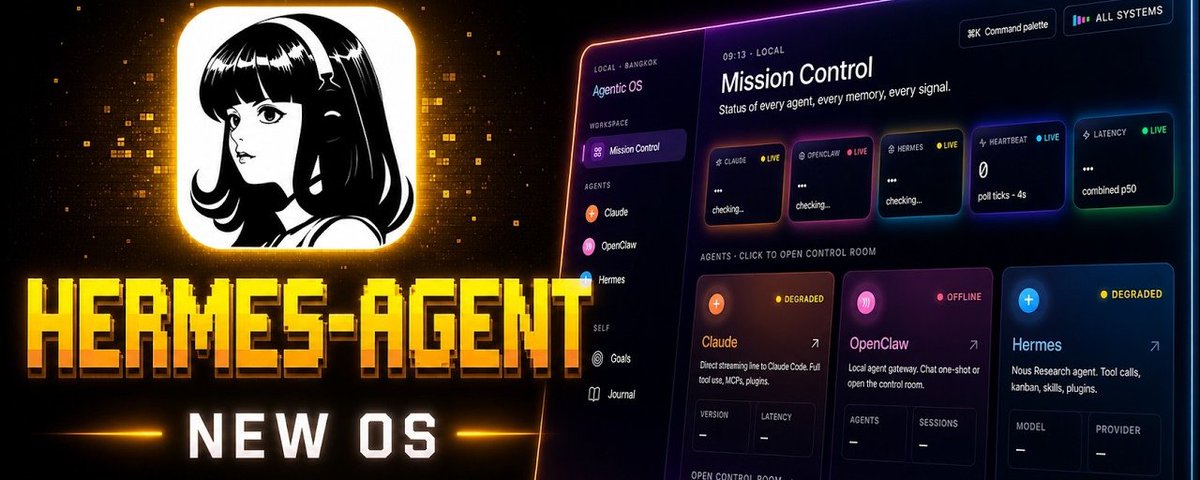
Hermes Agent Claude is the easiest way to understand what a real local agent OS can become when your tools stop acting like separate apps.
Most AI setups feel messy because Claude sits in one place, Hermes sits somewhere else, OpenClaw sits in another window, and your memory is scattered across chats.
The better move is to connect everything into one local mission control, and the AI Profit Boardroom is where you can learn these workflows step by step.
Watch the video below:
> **Julian Goldie SEO@JulianGoldieSEO**: [原文链接](https://x.com/JulianGoldieSEO/status/2055870717280092441)
>
> Your AI agents are still working like separate apps.
> Agent OS turns them into one connected machine.
> Build it like this:
> → Claude = intelligence.
> → OpenClaw = execution.
> → Hermes = research.
> → Obsidian = memory.
> → Dashboard = mission control.
> Now your agents can
>
> 
Want to make money and save time with AI? Get AI Coaching, Support & Courses
👉 https://www.skool.com/ai-profit-lab-7462/about
## Hermes Agent Claude Turns Separate Agents Into One OS
Hermes Agent Claude works best when you stop treating AI like a single chatbot and start treating it like an operating system.
A normal computer needs an operating system because apps need one place to share information, run tasks, and stay organized.
AI agents need the same thing.
Without that layer, you end up jumping between Claude, Hermes, OpenClaw, notes, prompts, terminals, dashboards, and random browser tabs.
That is where the local agent OS idea becomes useful.
Instead of forcing every agent to work alone, you build one command center where each tool has a job.
Claude handles thinking, planning, writing, and building.
Hermes handles research, orchestration, skills, plugins, and multi-step workflows.
OpenClaw or OpenClaude can handle execution, local routing, sessions, and computer-use style tasks.
Obsidian becomes the memory layer that stores goals, journals, decisions, and context your agents can use later.
## A Local Agent OS Makes Hermes Agent Claude Easier To Use
Hermes Agent Claude becomes much more practical when it is not trapped inside a terminal.
Most people do not want to manage agents through command lines, config files, and scattered logs.
They want a clean dashboard where they can click an agent, see the status, open a chat, review history, and understand what is happening.
That is the real value of a mission control dashboard.
It hides the messy technical layer underneath a simple interface.
You can see which agents are online, which sessions are active, which tools are connected, and what work has already happened.
That matters because AI agents can get confusing fast when you run more than one at the same time.
One agent might be researching.
Another agent might be building.
Another agent might be using tools or checking files.
A local OS gives you one screen to manage all of that without feeling like you are babysitting a machine.
## Hermes Agent Claude Mission Control Gives Agents Memory
Hermes Agent Claude becomes far more powerful when it connects to memory instead of starting from zero every time.
The biggest weakness of normal AI usage is that every session feels temporary.
You explain your business once, then you explain it again later.
You share your goals once, then another tool forgets them.
You give context to Claude, but Hermes may not have that same context.
A local agent OS solves this by connecting your agents to an Obsidian-based memory system.
That memory can store goals, journals, daily notes, tasks, decisions, project details, team context, and past conversations.
Every chat can be logged into the vault.
Every useful insight can become part of the system.
Over time, Hermes Agent Claude stops acting like a fresh assistant and starts acting like a system that understands what you are building.
## Obsidian Makes Hermes Agent Claude More Personal
Obsidian is the self layer inside this Hermes Agent Claude setup.
That may sound small, but it is probably the biggest unlock.
Most people focus on the newest model, the newest tool, or the newest agent update.
Those things help, but they do not matter much if the AI has no memory of you.
Obsidian gives your agents a second brain.
It can hold your goals, your projects, your workflows, your notes, your lessons, your content ideas, and your operating style.
When Claude or Hermes can search that vault, the output becomes more specific.
The agent can suggest automations based on what you actually do.
It can connect today’s work to yesterday’s decision.
That is how Hermes Agent Claude moves from generic answers into useful execution.
## The Hermes Agent Claude Stack Has Four Layers
Hermes Agent Claude works best when every layer has a clear role.
Claude is the intelligence layer.
That is where planning, reasoning, writing, coding, and interface building happen.
OpenClaw or OpenClaude can act as the execution layer.
That layer helps route tasks, manage sessions, and connect local agent actions together.
Hermes becomes the research and orchestration layer.
It can run tool calls, use skills, handle plugins, work through task lists, and coordinate multi-step workflows.
Obsidian becomes the self layer.
That layer gives the whole system memory, identity, goals, and long-term context.
Together, this turns Hermes Agent Claude from a tool combo into a working agent OS.
## Hermes Agent Claude Can Build The Dashboard Fast
Hermes Agent Claude does not require you to hand-code everything from scratch.
The dashboard can be built by explaining what you want to Claude in plain language.
You can ask for a local mission control dashboard that connects Claude, Hermes, OpenClaw, chat history, agent status, memory, goals, journals, skills, plugins, and analytics.
Claude can then help build the interface using tools like Next.js and Tailwind.
The important part is not the framework.
The important part is the structure.
You want a local dashboard that feels like a website but runs on your own machine.
You want agent chats in one place.
You want session history in one place.
You want your memory layer connected instead of hidden in another app.
That is how the system becomes useful instead of just looking impressive.
## Local-First Hermes Agent Claude Feels More Private
Hermes Agent Claude makes more sense as a local-first setup because memory is sensitive.
If your agent OS contains your business notes, goals, journals, conversations, team details, and operating habits, you do not want to casually throw all of that into a random cloud workflow.
Local hosting gives you more control.
Your sessions stay closer to your machine.
Your vault stays closer to your machine.
Your agent dashboard can connect to local tools without forcing everything through another platform.
This does not mean cloud setups are always bad.
It means a personal agent OS is different from a normal SaaS tool.
The more context your system stores, the more important control becomes.
For this kind of workflow, Hermes Agent Claude feels much stronger when the core setup is local.
## Hermes Agent Claude Helps You Become The Operator
Hermes Agent Claude changes your role from task worker to system operator.
That is the real mindset shift.
Instead of asking one AI tool to do one task, you design a system that can handle entire workflows.
You set the direction.
Claude plans and builds.
Hermes researches and orchestrates.
OpenClaw executes and connects local actions.
Obsidian keeps the memory alive.
Then you review the results, improve the system, and scale what works.
That is very different from opening a chatbot whenever you need help.
Inside the AI Profit Boardroom, you can learn practical AI workflows like this without making the setup more complicated than it needs to be.
## A Hermes Agent Claude Dashboard Can Track Everything
Hermes Agent Claude becomes easier to trust when the dashboard shows what is happening.
You want visibility.
You want to see sessions, tool calls, token usage, models, peak activity, agent status, goals, and notable conversations.
Analytics are useful because they show how your agents are actually being used.
A session history is useful because you can review what happened instead of guessing.
A goals section is useful because your agents can understand what matters right now.
A journal section is useful because it gives the system daily context.
A Kanban section is useful because agent tasks can become visible instead of disappearing into chat.
This is why the OS layer matters.
It turns invisible agent activity into something you can manage.
## Hermes Agent Claude Is The Start Of A Real AI System
Hermes Agent Claude is not just about making a nice dashboard.
The bigger idea is building a system that compounds.
A normal AI chat does not improve much because you open it, use it, close it, and start again later.
An agent OS gets stronger because it keeps memory, tracks goals, stores sessions, and connects tools.
Day one might be a simple dashboard.
Day thirty could be a full operating layer for research, SEO, content, automation, task management, client work, and daily planning.
That is the difference between using AI tools and running an AI system.
One gives you answers.
The other gives you leverage.
The AI Profit Boardroom gives you a place to learn workflows like this, especially if you want practical AI automation without getting buried in random tools.
## Frequently Asked Questions About Hermes Agent Claude
1. What Is Hermes Agent Claude?
Hermes Agent Claude is a workflow where Claude, Hermes, and other agents work together inside a local mission control style dashboard.
2. Why Build A Local Agent OS?
A local agent OS keeps your agents, memory, goals, chats, and workflows organized in one place instead of scattered across separate tools.
3. Does Hermes Agent Claude Need Obsidian?
Obsidian is not required, but it makes the setup much stronger because it gives your agents long-term memory and personal context.
4. Is Hermes Agent Claude Only For Developers?
No, the goal is to make agent control easier through a dashboard, so you can manage workflows without living inside the terminal.
5. Can Hermes Agent Claude Work With Other Agents?
Yes, the same mission control idea can be expanded to other agents if they can connect through APIs, local tools, bridges, plugins, or MCP-style workflows.
## 相关链接
- [Julian Goldie SEO](https://x.com/JulianGoldieSEO)
- [@JulianGoldieSEO](https://x.com/JulianGoldieSEO)
- [341](https://x.com/JulianGoldieSEO/status/2055884006621876562/analytics)
- [AI Profit Boardroom](https://www.skool.com/ai-profit-lab-7462/about)
- [218](https://x.com/JulianGoldieSEO/status/2055870717280092441/analytics)
- [https://www.skool.com/ai-profit-lab-7462/about](https://www.skool.com/ai-profit-lab-7462/about)
- [AI Profit Boardroom](https://www.skool.com/ai-profit-lab-7462/about)
- [AI Profit Boardroom](https://www.skool.com/ai-profit-lab-7462/about)
- [Upgrade to Premium](https://x.com/i/premium_sign_up)
- [1:31 PM · May 17, 2026](https://x.com/JulianGoldieSEO/status/2055884006621876562)
- [341 Views](https://x.com/JulianGoldieSEO/status/2055884006621876562/analytics)
---
*导出时间: 2026/5/17 15:52:13*
---
## 中文翻译
# 如何使用 Hermes Agent Claude 构建本地 Agent OS
**作者**: Julian Goldie SEO
**日期**: 2026-05-17T04:39:09.000Z
**来源**: [https://x.com/JulianGoldieSEO/status/2055884006621876562](https://x.com/JulianGoldieSEO/status/2055884006621876562)
---

Hermes Agent Claude 是理解“当你的工具不再像独立应用那样运作时,真正的本地 Agent OS 能成为什么样子”的最简单方式。
大多数 AI 设置显得杂乱无章,因为 Claude 待在一个地方,Hermes 待在另一个地方,OpenClaw 在另一个窗口,而你的记忆则分散在各个聊天记录中。
更好的做法是将所有内容连接到一个本地任务控制中心,而在 AI Profit Boardroom,你可以一步步学习这些工作流程。
观看下面的视频:
> **Julian Goldie SEO@JulianGoldieSEO**: [原文链接](https://x.com/JulianGoldieSEO/status/2055870717280092441)
>
> 你的 AI 代理 仍然像独立的应用程序一样工作。
> Agent OS 将它们变成了一台互联的机器。
> 像这样构建它:
> → Claude = 智慧。
> → OpenClaw = 执行。
> → Hermes = 研究。
> → Obsidian = 记忆。
> → Dashboard = 任务控制。
> 现在你的代理可以
>
> 
想利用 AI 赚钱并节省时间?获取 AI 辅导、支持与课程
👉 https://www.skool.com/ai-profit-lab-7462/about
## Hermes Agent Claude 将分离的 Agent 变成一个 OS
当你不再将 AI 视为单一的聊天机器人,而是开始将其视为一个操作系统时,Hermes Agent Claude 才能发挥最大作用。
普通的计算机需要操作系统,因为应用需要一个地方来共享信息、运行任务并保持井井有条。
AI 代理也需要同样的东西。
如果没有那一层,你最终不得不在 Claude、Hermes、OpenClaw、笔记、提示词、终端、仪表板和随机的浏览器标签之间来回切换。
这就是本地 Agent OS 概念变得有用的地方。
你不再强迫每个代理单独工作,而是构建一个指挥中心,让每个工具都有各自的职责。
Claude 处理思考、规划、写作和构建。
Hermes 处理研究、编排、技能、插件和多步工作流程。
OpenClaw 或 OpenClaude 可以处理执行、本地路由、会话和计算机使用风格的任务。
Obsidian 成为记忆层,存储目标、日志、决策和上下文,供你的代理日后使用。
## 本地 Agent OS 让 Hermes Agent Claude 更易于使用
当 Hermes Agent Claude 不被困在终端内部时,它会变得更加实用。
大多数人不想通过命令行、配置文件和分散的日志来管理代理。
他们想要一个简洁的仪表板,可以在其中点击代理、查看状态、打开聊天、查看历史记录并了解正在发生的事情。
这就是任务控制仪表板的真正价值所在。
它在简单的界面下隐藏了杂乱的技术层。
你可以看到哪些代理在线,哪些会话处于活动状态,连接了哪些工具,以及已经完成了哪些工作。
这一点很重要,因为当你同时运行多个代理时,AI 代理可能会很快让人感到困惑。
一个代理可能正在进行研究。
另一个代理可能正在进行构建。
还有一个代理可能正在使用工具或检查文件。
本地 OS 为你提供一个屏幕来管理所有这些,而感觉不像是在看管一台机器。
## Hermes Agent Claude 任务控制赋予 Agent 记忆
当 Hermes Agent Claude 连接到记忆而不是每次都从零开始时,它会变得强大得多。
普通 AI 使用的最大弱点在于,每个会话都感觉很短暂。
你解释了一次你的业务,稍后又得解释一遍。
你分享了一次你的目标,另一个工具却忘记了它们。
你向 Claude 提供了上下文,但 Hermes 可能没有同样的上下文。
本地 Agent OS 通过将你的代理连接到基于 Obsidian 的记忆系统来解决这个问题。
该记忆可以存储目标、日志、每日笔记、任务、决策、项目详情、团队上下文和过去的对话。
每次聊天都可以记录到 Vault(库)中。
每一个有用的见解都可以成为系统的一部分。
随着时间的推移,Hermes Agent Claude 不再像一个新来的助手,而是开始像一个理解你正在构建内容的系统。
## Obsidian 让 Hermes Agent Claude 更个性化
Obsidian 是这个 Hermes Agent Claude 设置中的“自我”层。
这听起来可能微不足道,但这可能是最大的解锁点。
大多数人关注最新的模型、最新的工具或最新的代理更新。
这些事情有帮助,但如果 AI 没有关于你的记忆,它们的意义就不大。
Obsidian 为你的代理提供了第二大脑。
它可以容纳你的目标、项目、工作流程、笔记、经验教训、内容想法和你的操作风格。
当 Claude 或 Hermes 可以搜索该库时,输出就会变得更加具体。
代理可以根据你的实际操作建议自动化。
它可以将今天的工作与昨天的决策联系起来。
这就是 Hermes Agent Claude 从通用答案转向有用执行的方式。
## Hermes Agent Claude 堆栈有四个层
当每一层都有明确的角色时,Hermes Agent Claude 效果最好。
Claude 是智能层。
那是规划、推理、写作、编码和界面构建发生的地方。
OpenClaw 或 OpenClaude 可以充当执行层。
该层有助于路由任务、管理会话并将本地代理操作连接在一起。
Hermes 成为研究和编排层。
它可以运行工具调用、使用技能、处理插件、处理任务列表以及协调多步工作流程。
Obsidian 成为自我层。
该层为整个系统提供记忆、身份、目标和长期上下文。
总之,这将 Hermes Agent Claude 从工具组合变成了一个可工作的 Agent OS。
## Hermes Agent Claude 可以快速构建仪表板
Hermes Agent Claude 不要求你从头开始手工编写所有内容。
你可以用通俗的语言向 Claude 解释你想要什么,从而构建仪表板。
你可以要求一个本地任务控制仪表板,连接 Claude、Hermes、OpenClaw、聊天历史、代理状态、记忆、目标、日志、技能、插件和分析。
然后,Claude 可以帮助使用 Next.js 和 Tailwind 等工具构建界面。
重要的部分不是框架。
重要的部分是结构。
你想要一个感觉像网站但在你自己的机器上运行的本地仪表板。
你希望代理聊天集中在一个地方。
你希望会话历史集中在一个地方。
你希望你的记忆层已连接,而不是隐藏在另一个应用中。
这就是系统变得有用的方式,而不是仅仅看起来令人印象深刻。
## 本地优先的 Hermes Agent Claude 感觉更私密
Hermes Agent Claude 作为本地优先设置更有意义,因为记忆是敏感的。
如果你的代理 OS 包含你的业务笔记、目标、日志、对话、团队细节和操作习惯,你不会想随意将所有这些扔进某个随机云工作流中。
本地托管给你更多的控制权。
你的会话更靠近你的机器。
你的库更靠近你的机器。
你的代理仪表板可以连接到本地工具,而无需通过另一个平台强制传输所有内容。
这并不意味着云设置总是不好的。
这意味着个人代理 OS 不同于普通的 SaaS 工具。
你的系统存储的上下文越多,控制就越重要。
对于这种类型的工作流,当核心设置是本地时,Hermes Agent Claude 感觉要强大得多。
## Hermes Agent Claude 帮助你成为操作员
Hermes Agent Claude 将你的角色从任务执行者转变为系统操作员。
这才是真正的思维转变。
你不是让一个 AI 工具做一项任务,而是设计一个可以处理整个工作流程的系统。
你设定方向。
Claude 进行规划和构建。
Hermes 进行研究和编排。
OpenClaw 执行并连接本地操作。
Obsidian 保持记忆鲜活。
然后你审查结果,改进系统,并扩展有效的方法。
这与每当需要帮助时就打开聊天机器人非常不同。
在 AI Profit Boardroom 内部,你可以学习像这样的实用 AI 工作流程,而不会使设置变得过于复杂。
## Hermes Agent Claude 仪表板可以跟踪所有内容
当仪表板显示正在发生的事情时,Hermes Agent Claude 变得更容易信任。
你想要可见性。
你希望看到会话、工具调用、Token 使用量、模型、峰值活动、代理状态、目标和重要对话。
分析很有用,因为它们显示了你的代理实际是如何被使用的。
会话历史很有用,因为你可以回顾发生了什么,而不是猜测。
目标部分很有用,因为你的代理可以理解现在什么很重要。
日志部分很有用,因为它给系统提供了日常上下文。
看板部分很有用,因为代理任务可以变得可见,而不是消失在聊天中。
这就是 OS 层很重要的原因。
它将不可见的代理活动转化为你可以管理的东西。
## Hermes Agent Claude 是真正 AI 系统的开始
Hermes Agent Claude 不仅仅是为了制作一个漂亮的仪表板。
更大的想法是建立一个能产生复利效应的系统。
普通的 AI 聊天不会有太大改善,因为你打开它,使用它,关闭它,稍后再重新开始。
代理 OS 会变得更强,因为它保留记忆、跟踪目标、存储会话并连接工具。
第一天可能只是一个简单的仪表板。
第三十天可能是一个用于研究、SEO、内容、自动化、任务管理、客户工作和日常规划的完整操作层。
这就是使用 AI 工具和运行 AI 系统之间的区别。
一个给你答案。
另一个给你杠杆。
AI Profit Boardroom 为你提供了一个学习此类工作流程的地方,特别是如果你想要实用的 AI 自动化而不想被随机工具所淹没。
## 关于 Hermes Agent Claude 的常见问题
1. 什么是 Hermes Agent Claude?
Hermes Agent Claude 是一种工作流程,其中 Claude、Hermes 和其他代理在本地任务控制风格的仪表板内协同工作。
2. 为什么要构建本地 Agent OS?
本地 Agent OS 将你的代理、记忆、目标、聊天和工作流程集中在一个地方进行组织,而不是分散在单独的工具中。
3. Hermes Agent Claude 需要 Obsidian 吗?
Obsidian 不是必需的,但它使设置变得更强大,因为它为你的代理提供了长期记忆和个人上下文。
4. Hermes Agent Claude 仅适用于开发者吗?
不,目标是通过仪表板让代理控制变得更容易,因此你无需生活在终端中即可管理工作流程。
5. Hermes Agent Claude 可以与其他 Agent 一起使用吗?
可以,如果其他代理可以通过 API、本地工具、桥接器、插件或 MCP 风格的工作流程连接,那么同样的任务控制概念可以扩展到它们。
## 相关链接
- [Julian Goldie SEO](https://x.com/JulianGoldieSEO)
- [@JulianGoldieSEO](https://x.com/JulianGoldieSEO)
- [341](https://x.com/JulianGoldieSEO/status/2055884006621876562/analytics)
- [AI Profit Boardroom](https://www.skool.com/ai-profit-lab-7462/about)
- [218](https://x.com/JulianGoldieSEO/status/2055870717280092441/analytics)
- [https://www.skool.com/ai-profit-lab-7462/about](https://www.skool.com/ai-profit-lab-7462/about)
- [AI Profit Boardroom](https://www.skool.com/ai-profit-lab-7462/about)
- [AI Profit Boardroom](https://www.skool.com/ai-profit-lab-7462/about)
- [升级到 Premium](https://x.com/i/premium_sign_up)
- [下午 1:31 · 2026年5月17日](https://x.com/JulianGoldieSEO/status/2055884006621876562)
- [341 次观看](https://x.com/JulianGoldieSEO/status/2055884006621876562/analytics)
---
*导出时间: 2026/5/17 15:52:13*