# How to Build an Opus 5 + Obsidian Research System That Replaces Hours of Manual Reading Every Week
**作者**: CyrilXBT
**日期**: 2026-07-29T03:19:18.000Z
**来源**: [https://x.com/cyrilXBT/status/2082304935547314254](https://x.com/cyrilXBT/status/2082304935547314254)
---
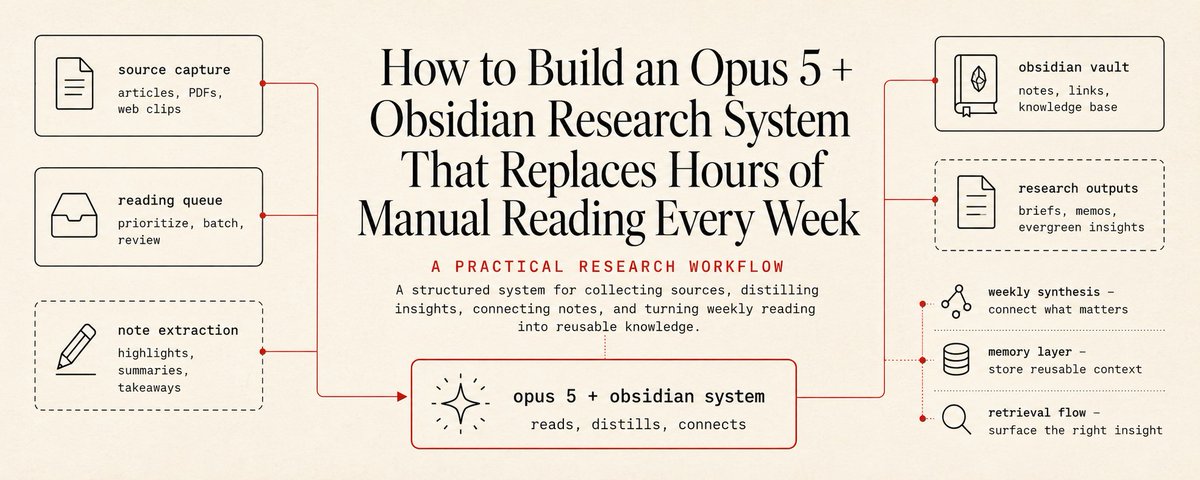
Most research work is not thinking. It is reading, extracting, and cross-referencing, done manually, one source at a time, and it eats the hours that should go to the actual thinking.
Opus 5 changes the math on this specifically because of what it is built for. Anthropic launched it priced identically to Opus 4.8, $5 input and $25 output per million tokens, while more than doubling Opus 4.8's score on Frontier-Bench v0.1. It is explicitly not positioned as Anthropic's smartest model, that is still Fable 5, it is positioned as the model built for daily use, where efficiency compounds across thousands of calls in a way a single benchmark headline never captures. Harvey, the legal AI company, independently reported matching Opus 4.8's max-reasoning output quality while using 26% fewer tokens on average.
That efficiency profile is exactly what a research pipeline needs. You are not running one deep, expensive query. You are running dozens of extraction and synthesis passes across a growing body of sources, every single week, and the cost per pass compounds fast if you are not using a model built for volume.
This is the complete system. Obsidian as the permanent store, Opus 5 as the processing engine, and a specific pipeline that turns raw reading material into linked, queryable knowledge automatically, so the hours you used to spend manually extracting and cross-referencing get returned to you.
## Why Opus 5 Specifically Fits This Job
Before the build, it is worth being precise about why this system uses Opus 5 rather than Fable 5, since picking the wrong model for this specific job is the most common way people overspend on a system like this.
A research pipeline that ingests sources weekly runs a large number of individual model calls, extraction on each new source, cross-referencing against your existing notes, periodic synthesis passes, digest generation. This is volume work, not single-shot depth work. Opus 5's entire positioning is built around exactly this profile, more than double Opus 4.8's Frontier-Bench score at the same price, and independently verified token efficiency gains from Harvey specifically on repeated, similar tasks.
Fable 5 remains the better choice for the genuinely hardest single research questions, a subtle, high-stakes synthesis where getting a nuanced point wrong has real consequences, and where its higher SWE-Bench-adjacent reasoning depth is worth the roughly 2x higher price per token. For the routine, repeated work of building and maintaining a research system, weekly ingestion, ongoing extraction, digest generation, Opus 5's efficiency-first design is the correct default, with Fable 5 reserved for the occasional deep-dive question the system surfaces as worth extra scrutiny.
## The Foundation: Obsidian As Permanent Storage
The system needs a place to store knowledge that survives forever, is fully yours, and never depends on any single model or provider. Plain markdown files in an Obsidian vault do exactly this. If a better model exists next year, you point it at the same folder and nothing else changes.
The structure that works for a research system specifically, building on the general raw and wiki pattern:
A raw folder, for source material exactly as ingested, PDFs, article text, video transcripts, unprocessed.
A wiki folder, for the processed, linked, permanent version of your knowledge, organized by topic rather than by source.
A questions folder, specific to research systems, holding open questions your reading has surfaced that you have not yet resolved, so nothing genuinely important gets lost in the processing.
A digests folder, holding the weekly summary Opus 5 generates, timestamped, so you can look back at what mattered in any given week without re-reading everything.
A single CLAUDE.md file at the root defining exactly how this system should behave, which the next section covers in detail.
## The CLAUDE.md That Runs The System
This is the single highest-leverage file in the entire setup, since it is what Opus 5 reads automatically at the start of every session, meaning you write your instructions once instead of re-explaining the system every time you use it.
RESEARCH SYSTEM PROTOCOL
This vault is a research system. Structure:
/raw - source material exactly as ingested, never edited
/wiki - processed, linked knowledge organized by topic
/questions - open questions not yet resolved
/digests - weekly summaries, timestamped
When a new source is dropped into /raw:
1. Extract the specific, genuinely new claims and findings, not a
summary of the whole document.
2. Check /wiki for existing notes on the same topic. Extend an
existing note rather than creating a duplicate if the topic
already has one.
3. Link every new claim to related existing notes using [[wikilinks]].
4. If a claim contradicts something already in /wiki, do not silently
overwrite it. Flag the contradiction explicitly in both notes.
5. If a source raises a genuine open question you cannot resolve
from other material already in the vault, add it to /questions
rather than guessing at an answer.
When asked to synthesize or generate a digest:
Pull from /wiki, not directly from /raw. The wiki is the processed,
trustworthy layer. Raw sources may contain claims that were later
found to be wrong or superseded, which is why step 4 above exists.
Before reporting any extraction as complete, confirm you actually
checked /wiki for existing related notes rather than assuming this
is entirely new material.
This single file is what makes the difference between a folder of disconnected notes and an actual system. Every instruction in it exists to prevent a specific, real failure mode, duplicate notes, silently overwritten contradictions, unresolved questions quietly dropped, that would otherwise accumulate invisibly over months of use.
## The Ingestion Pipeline
With the vault structured and the protocol written, here is the actual weekly workflow.
Drop any source into /raw as you encounter it during the week, an article you read, a research paper, a podcast transcript, a video transcript, a competitor's blog post. This should take seconds, not minutes, the entire point is removing friction from capture so you actually do it consistently.
Ingest the new files in /raw that have not been processed yet.
For each one, extract genuinely new claims, check /wiki for related
existing notes, extend or create notes as appropriate, and flag any
contradictions with what is already recorded. Add unresolved
questions to /questions rather than guessing.
Run this on whatever cadence fits your actual reading pattern, daily if you read constantly, every few days if your input is more sporadic. The point is that processing happens close to when you actually captured the source, while decomposing a batch of ten sources at once into individual extraction and cross-reference passes is exactly the kind of repeated, similar-shaped work Opus 5's efficiency profile is built for.
## The Weekly Digest, Automated
This is where the actual time savings show up most visibly, and it is worth setting up as a scheduled task rather than something you remember to run manually, since the entire point of the system is removing yourself from the loop for the mechanical parts.
Generate this week's research digest. Pull from /wiki, focused
specifically on what was added or updated in the last 7 days, not
the entire vault's history.
Structure:
1. The 3 to 5 most significant new findings this week, with links
to the full notes in /wiki.
2. Any contradictions flagged this week between new material and
existing notes, since these deserve your direct attention.
3. Open questions added to /questions this week that remain
unresolved.
4. One line noting any topic that received unusually heavy activity
this week, since a topic accumulating many related notes quickly
is often worth deeper, deliberate attention rather than passive
accumulation.
Save the result to /digests with this week's date. Keep the whole
digest under 500 words. This is a pointer to the full notes, not a
replacement for reading them.
Schedule this to run automatically at the start of each week, so a short, structured summary of everything that mattered is waiting for you before you have opened a single note yourself. This is the direct mechanism by which the system replaces hours of manual reading, you are no longer re-reading a week's worth of raw material to remember what you learned, you are reading a 500-word pointer that took you two minutes instead of the two hours the equivalent manual review would have cost.
## Querying Across Everything, Not Just What You Remember
The other major time savings, separate from the digest, is the ability to ask a genuine question across your entire accumulated knowledge base rather than trying to remember which specific note has the answer.
Based on everything in /wiki, what have I learned about [specific
topic]? Cite the specific notes each claim comes from. If sources
in the vault disagree with each other on this topic, say so
explicitly rather than picking one and presenting it as consensus.
This is the payoff that compounds the longest the system runs. Month one, your wiki is thin, and this kind of query returns a handful of notes. Month six, with dozens of sources processed and cross-linked, the same query surfaces genuine connections you would never have made manually, an idea from a paper you read in week two connecting directly to something from a completely different source in week twenty, because both got filed under the same underlying topic and linked accordingly.
## Handling Contradictions Honestly
A specific, underappreciated value of this system over simply re-reading your own notes from memory is that it actively surfaces when your own understanding of something has changed over time, rather than letting an outdated belief sit unchallenged simply because you forgot you ever held it.
When the ingestion protocol flags a contradiction, between what a new source says and what an existing note claims, resist the instinct to have the system just pick whichever seems more recent or more authoritative and quietly resolve it for you. The value of surfacing a contradiction is that it forces an actual decision from you, was the earlier source wrong, has the underlying reality genuinely changed, or is this a case where both are true depending on context that needs to be added to the note. Automating that judgment away defeats the purpose of building a system that makes your own thinking more rigorous over time.
## A Worked Example Across One Month
To make the compounding effect concrete, here is roughly how this plays out over a real month of use.
Week one, you drop in six articles related to a project you are researching. The ingestion pass creates eight new notes in /wiki, since some articles touch multiple distinct topics, all linked to each other where a genuine relationship exists. The digest is short, since there is not much prior material to cross-reference against yet.
Week two, you add four more sources. Two of them extend existing notes from week one rather than creating new ones, since the ingestion protocol correctly identified the topic overlap. One flags a contradiction, a claim from a week two source directly disputes something a week one source stated confidently. The digest surfaces this contradiction prominently, and reviewing it, you realize the week one source was working from outdated data. You update that note directly, noting the correction and why.
Week three and four continue this pattern, and by the end of the month, a query across the full topic returns a synthesis that traces the actual evolution of your understanding, including the correction, not just a static snapshot as if you had known the right answer from day one.
This is the actual value proposition stated concretely. Not that the system does your thinking for you, but that it removes the mechanical overhead, extraction, cross-referencing, remembering what you already knew, that used to compete with your actual thinking time every single week.
## Common Mistakes That Undermine This System
A few specific mistakes show up repeatedly for people setting this up, worth knowing in advance.
Skipping the CLAUDE.md protocol and just dropping files in raw hoping Opus 5 figures out the right behavior. Without the explicit instructions, particularly the check-before-creating-duplicate rule and the flag-don't-silently-overwrite rule for contradictions, the system degrades into exactly the unstructured pile of AI-generated notes it was built to avoid.
Running the digest against the entire vault instead of the specific week's activity. This produces a digest that grows longer and less useful every single week, since it is re-summarizing material you have already read and processed many times over, rather than surfacing only what is genuinely new.
Treating Opus 5's synthesis as automatically correct rather than as a starting point. The model is doing real cognitive work here, extraction and cross-referencing across a growing knowledge base, and like any cognitive work, it benefits from your own review, particularly on the contradictions it flags, which are exactly the moments where your own judgment adds the most value.
Using Fable 5 for the routine weekly processing out of habit, assuming the more expensive model is always the safer choice. For the volume of repeated, similar-shaped extraction and synthesis work this system generates weekly, Opus 5's efficiency profile is the better fit, and the cost difference compounds meaningfully over months of continuous use. Reserve Fable 5 specifically for the rare, genuinely hard synthesis question the system itself surfaces as worth extra scrutiny, not for the routine ingestion pipeline.
## Connecting The Vault Directly Instead Of Copy-Pasting
Everything above works if you manually open Claude and paste in file contents, but the actual friction-free version of this system connects Opus 5 directly to your Obsidian vault, so ingestion and querying happen without any copy-pasting at all.
The practical path here uses Obsidian's Local REST API plugin, enabled in Obsidian's community plugin settings, which exposes your vault over a local API endpoint with an authentication key. Claude Code or a Claude Desktop MCP connection can then read and write files in your vault directly, meaning the ingestion prompts from earlier in this article run against your actual vault, creating and editing real notes, rather than you manually copying content back and forth between a chat window and your notes.
Set this up once. In Obsidian, install and enable the Local REST API plugin, copy the API key it generates. In Claude Code, configure an MCP connection pointing at your vault using that key. Test it by asking Claude to list the files in your /raw folder, if it returns an accurate list, the connection is live.
Once this is working, the entire ingestion and digest pipeline from earlier becomes something you trigger with a single message rather than a manual copy-paste process, and it is also what makes scheduling genuinely automatic, since a scheduled task can call the same MCP connection without you present at all.
## Scaling To Multiple Research Topics
Everything above assumes one research topic in one vault. Most people running this seriously end up tracking several distinct areas at once, a specific project, an industry you follow generally, a longer-term interest unrelated to either. Mixing these into one undifferentiated wiki creates exactly the kind of noise the system was built to prevent.
The fix mirrors the same scoping discipline that applies to Claude Projects generally. Give each genuinely distinct research topic its own subfolder structure, or its own separate vault entirely if the topics are large and unrelated enough that cross-contamination would actively confuse synthesis, a claim about one industry getting incorrectly cross-referenced against an unrelated project simply because both live in the same undifferentiated /wiki folder.
MULTI-TOPIC SCOPE
This vault covers multiple research areas, each in its own top-level
folder under /wiki: /wiki/topic-a, /wiki/topic-b, etc.
When ingesting a new source, first determine which topic it belongs
to. If it genuinely spans two topics, note the cross-topic connection
explicitly rather than filing it ambiguously in one folder without
explanation.
Digests should be generated per topic, not as one combined summary,
unless explicitly asked to synthesize across topics.
This structure lets each topic compound independently, its own wiki, its own coherent set of cross-references, while still allowing you to explicitly ask for cross-topic synthesis when a genuine connection between two areas is actually worth surfacing, rather than having every note implicitly competing with unrelated material for relevance in a single, undifferentiated pile.
The practical rule for when to split into separate vaults entirely versus subfolders within one vault: if you would genuinely never want a query on one topic to accidentally surface unrelated material from the other, separate vaults are worth the minor overhead of switching between them. If some cross-pollination between topics is actually valuable, a general industry trend informing a specific project, subfolders within one vault preserve that connective tissue while the explicit topic-scoping instruction above prevents actual confusion during routine ingestion.
## Measuring Whether This Is Actually Saving You Time
A system like this can feel productive without actually being measured against the thing it was built to replace, and it is worth running an honest check periodically rather than assuming the time savings are real just because the system exists and runs on schedule.
For two or three weeks after setup, track roughly how long your Monday review used to take under your old manual process, re-reading everything you saved, trying to remember what connected to what, searching for a specific fact you knew you had read somewhere. Compare that honestly against how long it now takes to read the generated digest and follow up on anything it flagged as needing your attention.
The comparison that actually matters is not raw time saved on the digest itself, since a 500-word summary obviously reads faster than a week of raw sources. It is whether the digest is actually surfacing what mattered, meaning you are not separately discovering, days later, that something significant got buried in the raw material and never made it into a note or a digest at all. If that is happening regularly, the ingestion protocol's extraction step needs tightening, not necessarily more of your manual reading time added back in as a workaround.
The other honest metric worth tracking is whether the querying capability from earlier is actually getting used. A system that generates a clean weekly digest but that you never actually query for cross-referenced answers is only delivering half its intended value, the passive summarization half, without the active, "what have I actually learned about this across every source I have ever fed it" half that is where the real compounding value shows up over months of use. If you notice you are not querying it, that is often a sign the wiki has not yet accumulated enough cross-linked material to make querying feel worthwhile yet, which is normal in the first month or two, or it is a sign you have simply fallen out of the habit of asking, which is worth deliberately correcting since it is where a meaningful share of the system's actual value lives.
## Setting This Up This Week
Do not try to build the full pipeline in one sitting. Build it in the order that lets each piece prove itself before you add the next.
Week one, just build the vault structure and the CLAUDE.md file, then manually run the ingestion prompt on whatever you are already reading. Get comfortable with the extraction quality before automating anything.
Week two, add the weekly digest generation, run it manually at first rather than on a schedule, so you can verify it is actually pulling from the right week's activity and staying appropriately concise.
Week three, once both pieces are working reliably, schedule the ingestion and the digest to run automatically, so the system genuinely runs without you remembering to trigger it.
By week four or five, you should notice the actual shift this system is built to produce. Monday mornings that used to start with trying to remember what you read and learned the previous week now start with a two-minute digest that already did that remembering for you, and the hours that used to go to manually re-reading and cross-referencing your own research are available for the part of research that actually needs a human, deciding what matters and why.
Follow @cyrilXBT for the exact CLAUDE.md templates and Obsidian vault setups behind everything in this article.
## 相关链接
- [CyrilXBT](https://x.com/cyrilXBT)
- [@cyrilXBT](https://x.com/cyrilXBT)
- [6.2K](https://x.com/cyrilXBT/status/2082304935547314254/analytics)
- [@cyrilXBT](https://x.com/@cyrilXBT)
- [Upgrade to Premium](https://x.com/i/premium_sign_up)
- [11:19 AM · Jul 29, 2026](https://x.com/cyrilXBT/status/2082304935547314254)
- [6,223 Views](https://x.com/cyrilXBT/status/2082304935547314254/analytics)
- [View quotes](https://x.com/cyrilXBT/status/2082304935547314254/quotes)
---
*导出时间: 2026/7/29 13:38:11*
---
## 中文翻译
# 如何构建一个每周替代数小时手动阅读的 Opus 5 + Obsidian 研究系统
**作者**: CyrilXBT
**日期**: 2026-07-29T03:19:18.000Z
**来源**: [https://x.com/cyrilXBT/status/2082304935547314254](https://x.com/cyrilXBT/status/2082304935547314254)
---

大多数研究工作并不是思考。它是阅读、提取和交叉引用,而且全是手动完成的,一次处理一个来源,这吞噬了本应用于实际思考的时间。
Opus 5 改变了这一计算方式,正是因为它的定位。Anthropic 发布它的定价与 Opus 4.8 持平,每百万 tokens 输入 5 美元,输出 25 美元,同时其在 Frontier-Bench v0.1 上的得分比 Opus 4.8 翻了一倍多。它明确不定位为 Anthropic 最智能的模型,那个称号仍属于 Fable 5;它的定位是专为日常使用构建的模型,其效率在数千次调用中累积,这种效应是单一基准测试标题所无法捕捉的。法律 AI 公司 Harvey 独立报告称,在使用平均减少 26% 的 tokens 的情况下,实现了与 Opus 4.8 相当的最大推理输出质量。
这种效率特征正是研究流水线所需要的。你不是运行一个深层、昂贵的查询。你是每周在日益增长的来源主体上运行数十次提取和综合 passes,如果不使用为大规模调用构建的模型,每次 pass 的成本会迅速累积。
这就是完整的系统。Obsidian 作为永久存储,Opus 5 作为处理引擎,以及一个特定的流水线,自动将原始阅读材料转化为可链接、可查询的知识,这样你过去用于手动提取和交叉引用的小时数就会归还给你。
## 为什么 Opus 5 特别适合这项工作
在构建之前,值得精确地说明为什么这个系统使用 Opus 5 而不是 Fable 5,因为针对这项特定工作选择错误的模型是人们在这种系统上超支的最常见原因。
一个每周摄入来源的研究流水线会运行大量单独的模型调用,包括对每个新来源的提取、与现有笔记的交叉引用、定期的综合 passes、以及摘要生成。这是批量工作,而不是单次深层工作。Opus 5 的整个定位正是围绕这一特征构建的,在价格相同的情况下,Frontier-Bench 得分是 Opus 4.8 的两倍多,并且 Harvey 独立验证了在重复、相似任务上的 token 效率提升。
Fable 5 仍然是处理真正最困难的单一研究问题的更好选择,例如那些微妙、高风险的综合,在这种任务中,一个细微观点的错误会带来真正的后果,而且其更高的 SWE-Bench-adjacent 推理深度值得每 token 大约高出 2 倍的价格。对于构建和维护研究系统的常规、重复工作——每周摄入、持续提取、摘要生成——Opus 5 的效率优先设计是正确的默认选择,而 Fable 5 则保留给那些系统识别出的值得额外审查的偶尔的深度挖掘问题。
## 基础:Obsidian 作为永久存储
系统需要一个能够永久存储知识、完全属于你、且不依赖任何单一模型或提供商的地方。Obsidian vault 中的纯 markdown 文件正是如此。如果明年有更好的模型出现,你只需将其指向同一个文件夹,其他一切都不必改变。
特别适合研究系统的结构,建立在通用的 raw 和 wiki 模式之上:
一个 raw 文件夹,用于存放按摄入时原样的来源材料,如 PDF、文章文本、视频逐字稿、未处理的内容。
一个 wiki 文件夹,用于存放经过处理、已链接的永久知识版本,按主题而非来源组织。
一个 questions 文件夹,专为研究系统设计,存放你的阅读中浮现出的尚未解决的开放性问题,这样没有任何真正重要的信息会在处理过程中丢失。
一个 digests 文件夹,存放 Opus 5 生成的带时间戳的每周摘要,这样你可以回顾任何特定周内的重要事项,而无需重读所有内容。
根目录下有一个单一的 CLAUDE.md 文件,明确定义了该系统的行为方式,下一节将详细介绍。
## 运行系统的 CLAUDE.md
这是整个设置中杠杆率最高的文件,因为 Opus 5 在每次会话开始时会自动读取它,这意味着你只需编写一次指令,而不必每次使用时都重新解释系统。
RESEARCH SYSTEM PROTOCOL(研究系统协议)
This vault is a research system. Structure:(此 vault 是一个研究系统。结构:)
/raw - source material exactly as ingested, never edited(/raw - 按摄入时原样的来源材料,永不编辑)
/wiki - processed, linked knowledge organized by topic(/wiki - 按主题组织的、经过处理的链接知识)
/questions - open questions not yet resolved(/questions - 尚未解决的开放性问题)
/digests - weekly summaries, timestamped(/digests - 每周摘要,带时间戳)
When a new source is dropped into /raw:(当新来源被放入 /raw 时:)
1. Extract the specific, genuinely new claims and findings, not a(1. 提取具体的、真正新的声明和发现,而不是)
summary of the whole document.(整篇文档的摘要。)
2. Check /wiki for existing notes on the same topic. Extend an(2. 检查 /wiki 中关于同一主题的现有笔记。如果主题)
existing note rather than creating a duplicate if the topic(已存在,则扩展现有笔记而不是创建重复项。)
already has one.
3. Link every new claim to related existing notes using [[wikilinks]].(3. 使用 [[wikilinks]] 将每个新声明链接到相关的现有笔记。)
4. If a claim contradicts something already in /wiki, do not silently(4. 如果声明与 /wiki 中已有的内容相矛盾,不要无声)
overwrite it. Flag the contradiction explicitly in both notes.(地覆盖它。在两个笔记中明确标记矛盾。)
5. If a source raises a genuine open question you cannot resolve(5. 如果来源提出了一个真正的开放性问题,而你无法从)
from other material already in the vault, add it to /questions(vault 中已有的其他材料中解决,请将其添加到 /questions)
rather than guessing at an answer.(而不是猜测答案。)
When asked to synthesize or generate a digest:(当被要求综合或生成摘要时:)
Pull from /wiki, not directly from /raw. The wiki is the processed,(从 /wiki 提取,而不是直接从 /raw。Wiki 是经过处理的、)
trustworthy layer. Raw sources may contain claims that were later(可信的层级。原始来源可能包含后来被发现错误或)
found to be wrong or superseded, which is why step 4 above exists.(被取代的声明,这就是上述第 4 步存在的原因。)
Before reporting any extraction as complete, confirm you actually(在报告任何提取完成之前,确认你实际上)
checked /wiki for existing related notes rather than assuming this(检查了 /wiki 中相关的现有笔记,而不是假设)
is entirely new material.(这是全新的材料。)
这个单一文件正是让一堆互不相连的笔记与一个真正的系统区别开来的原因。其中的每一条指令都是为了防止特定的、真实的失败模式,例如重复笔记、被无声覆盖的矛盾、被悄然丢弃的未解决问题,否则这些错误会在数月的使用中无形地累积。
## 摄入流水线
随着 vault 结构的搭建和协议的编写,以下是实际的每周工作流。
当你在本周遇到任何来源时——一篇你读过的文章、一篇研究论文、一段播客逐字稿、一段视频逐字稿、一篇竞争对手的博客文章——将其放入 /raw。这应该只需要几秒钟,而不是几分钟,整个重点在于消除捕捉时的摩擦,这样你才能真正做到持续进行。
处理 /raw 中尚未处理的新文件。
对于每个文件,提取真正新的声明,检查 /wiki 中相关的现有笔记,适当地扩展或创建笔记,并标记任何与已记录内容相矛盾的地方。将未解决的问题添加到 /questions,而不是猜测。
按照适合你实际阅读模式的频率运行此操作,如果你不断阅读则每天一次,如果你的输入较为零散则每隔几天一次。关键在于处理发生在你实际捕捉到来源之后不久,而将一批十个来源一次性分解为单独的提取和交叉引用 passes,正是 Opus 5 的效率特征所擅长的那种重复的、形状相似的工作。
## 每周摘要,自动化
这是实际的时间节省最明显的地方,值得将其设置为计划任务,而不是靠记忆手动运行,因为系统的全部意义就是让你从机械环节中抽身。
生成本周的研究摘要。从 /wiki 提取,专门关注过去 7 天内添加或更新的内容,而不是整个 vault 的历史记录。
结构:
1. 本周 3 到 5 个最重要的新发现,附上 /wiki 中完整笔记的链接。
2. 本周在新材料和现有笔记之间标记的任何矛盾,因为这些值得你直接关注。
3. 本周添加到 /questions 中仍未解决的开放性问题。
4. 一行注释,注明本周任何异常活跃的主题,因为一个主题迅速积累许多相关笔记往往值得更深入、更审慎的关注,而不是被动积累。
将结果以本周的日期保存到 /digests。将整个摘要控制在 500 字以内。这是一个指向完整笔记的指针,而不是阅读它们的替代品。
将此设置为每周初自动运行,这样在你亲自打开任何笔记之前,一份简短、结构化的重要事项摘要就已经在等待你了。这就是系统替代数小时手动阅读的直接机制,你不再需要重读一周的原始材料来记住你学到了什么,你阅读的是一份 500 字的指针,这需要你两分钟,而不是同等手动审查所需的两个小时。
## 查询所有内容,而不仅仅是你记得的内容
除摘要外,另一个主要的节省时间的地方是能够针对你整个累积的知识库提出一个真正的问题,而不是试图记住哪个特定笔记有答案。
根据 /wiki 中的所有内容,关于 [特定主题] 我学到了什么?引用每个声明所来自的具体笔记。如果 vault 中的来源在该主题上彼此不一致,请明确说明,而不是选择其中一个并将其呈现为共识。
这是随着系统运行时间最长而回报最大的部分。第一个月,你的 wiki 很单薄,这种查询只返回少数几个笔记。到了第六个月,随着处理和交叉链接了数十个来源,同样的查询会浮现出你永远无法手动建立的真正联系,例如你在第二周读过的一篇论文中的想法与第二十周完全不同的来源中的内容直接相关,因为两者都被归类在同一个潜在主题下并相应地进行了链接。
## 诚实地处理矛盾
这个系统相比于简单地凭记忆重读自己的笔记,一个特定的、被低估的价值在于,它会主动揭示你对某事的理解随时间发生了变化,而不是让过时的信念仅仅因为你忘记了曾经持有它而未受挑战地存在。
当摄入协议标记出矛盾时——即新来源所说的内容与现有笔记的声明相冲突——请克制住那种让系统直接选择看起来更新或更具权威性的一方并为你悄然解决它的本能。揭示矛盾的价值在于它迫使你做出一个真正的决定:是之前的来源错了?是底层的现实真的发生了变化?还是这是一个取决于上下文的情况,两种说法都是真的,需要将上下文添加到笔记中?将这种判断自动化会破坏建立一个能让你的思维随时间变得更加严谨的系统的目的。
## 一个月内的实际案例
为了使复利效应具体化,以下是实际使用一个月的大致情况。
第一周,你放入了六篇与你正在研究的项目相关的文章。摄入 pass 在 /wiki 中创建了八个新笔记,因为一些文章涉及多个不同的主题,所有存在真正关系的笔记都彼此链接了。摘要很短,因为没有太多的现有材料可供交叉引用。
第二周,你添加了四个更多的来源。其中两个扩展了第一周的现有笔记而不是创建新笔记,因为摄入协议正确识别了主题重叠。一个标记了矛盾,第二周来源中的声明直接反驳了第一周来源自信陈述的内容。摘要突出显示了这一矛盾,在审查时,你意识到第一周的来源使用的是过时的数据。你直接更新了该笔记,记录了更正及其原因。
第三周和第四周继续这种模式,到月底,针对整个主题的查询返回了一个综合,追溯了你理解的实际演变过程,包括更正,而不仅仅是一个静态快照,就好像你从一开始就知道正确答案一样。
这就是具体陈述的实际价值主张。不是系统替你思考,而是它消除了机械性开销——提取、交叉引用、记住你已经知道的内容——这些开销过去每周都在与你的实际思考时间竞争。
## 破坏此系统的常见错误
在设置此系统时,一些特定的错误反复出现,值得提前了解。
跳过 CLAUDE.md 协议,只是将文件放入 raw 并希望 Opus 5 能弄清楚正确的行为。如果没有明确的指令,特别是“在创建重复项之前检查”规则和对于矛盾的“标记但不无声覆盖”规则,系统就会退化为它原本旨在避免的那种非结构化的 AI 生成笔记堆。
针对整个 vault 运行摘要,而不是针对特定周的活动。这产生的摘要每周都会变得越来越长且越来越无用,因为它是在重新总结你已经多次阅读和处理过的材料,而不是只浮现出真正新的内容。
将 Opus 5 的综合视为自动正确,而不是作为起点。模型在这里做的是真正的认知工作,在一个日益增长的知识库中进行提取和交叉引用,就像任何认知工作一样,它受益于你自己的审查,特别是对于它标记的矛盾,这些正是你自己的判断能增加最大价值的时刻。
出于习惯在常规每周处理中使用 Fable 5,假设更昂贵的模型总是更安全的选择。对于此系统每周产生的大量重复、形状相似的提取和综合工作,Opus 5 的效率特征是更合适的选择,而且在数月的持续使用中,成本差异会显著累积。将 Fable 5 专门保留给系统自己浮现出的值得额外审查的罕见、真正困难的综合问题,而不是用于常规的摄入流水线。
## 直接连接 Vault 而不是复制粘贴
如果你手动打开 Claude 并粘贴文件内容,上述所有内容都有效,但该系统的真正无摩擦版本是将 Opus 5 直接连接到你的 Obsidian vault,这样摄入和查询完全不需要任何复制粘贴。
这里的实用路径使用 Obsidian 的 Local REST API 插件,在 Obsidian 的社区插件设置中启用,该插件通过本地 API 端点和身份验证密钥暴露你的 vault。Claude Code 或 Claude Desktop MCP 连接随后可以直接读取和写入你 vault 中的文件,这意味着本文前面的摄入提示是针对你的实际 vault 运行的,创建和编辑真实的笔记,而不是你自己在聊天窗口和笔记之间手动来回复制内容。
一次性设置好。在 Obsidian 中,安装并启用 Local REST API 插件,复制它生成的 API 密钥。在 Claude Code 中,配置一个指向你的 vault 的 MCP 连接,使用该密钥。通过询问 Claude 列出 /raw 文件夹中的文件来测试它,如果它返回准确的列表,连接就通了。
一旦这开始工作,前面提到的整个摄入和摘要流水线就变成了你只需一条消息即可触发的东西,而不是手动复制粘贴的过程,这也是实现真正自动化的原因,因为计划任务可以在你不在场的情况下调用同一个 MCP 连接。
## 扩展到多个研究主题
以上所有内容假设在一个 vault 中有一个研究主题。大多数认真运行此系统的人最终会同时跟踪几个不同的领域,一个特定的项目、一个你通常关注的行业、一个与两者无关的长期兴趣。将这些混合到一个未区分的 wiki 中,恰恰会产生系统旨在避免的那种噪音。
解决方法反映了同样适用于 Claude Projects 的一般范围纪律。给每个真正不同的研究主题自己的子文件夹结构,或者如果主题足够大且不相关,以至于交叉污染会主动混淆综合,则给它自己的单独 vault,例如关于一个行业的声明仅仅因为两者都存在于同一个未区分的 /wiki 文件夹中而被错误地与不相关的项目进行交叉引用。
MULTI-TOPIC SCOPE(多主题范围)
This vault covers multiple research areas, each in its own top-level(此 vault 涵盖多个研究领域,每个都在 /wiki 下的自己的顶级)
folder under /wiki: /wiki/topic-a, /wiki/topic-b, etc.(文件夹中:/wiki/topic-a, /wiki/topic-b 等。)
When ingesting a new source, first determine which topic it belongs(在摄入新来源时,首先确定它属于哪个主题。如果它确实)
to. If it genuinely spans two topics, note the cross-topic connection(跨越两个主题,请明确记录跨主题连接,而不是在没有)
explicitly rather than filing it ambiguously in one folder without(解释的情况下模糊地归档在一个文件夹中。)
explanation.
Digests should be generated per topic, not as one combined summary,(摘要应按主题生成,而不是作为一个组合摘要,)
unless explicitly asked to synthesize across topics.(除非明确要求跨主题综合。)
这种结构让每个主题独立累积,拥有自己的 wiki 和自己的一套连贯的交叉引用,同时仍然允许你在两个领域之间真正的连接实际上值得浮现时,明确要求跨主题综合,而不是让每条笔记在一个单一的、未区分的堆中与不相关的材料隐式竞争相关性。
关于何时完全拆分为单独的 vault 与一个 vault 中的子文件夹的实用规则:如果你真的不希望对一个主题的查询意外浮现来自另一个主题的不相关材料,那么单独 vault 值得在切换之间的微小开销。如果主题之间的一些交叉授粉实际上是有价值的,例如一般行业趋势 informing 特定项目,那么一个 vault 中的子文件夹保留了这种连接组织,而上述明确的主题范围指令可以防止常规摄入期间的实际混淆。
## 衡量这实际上是否为你节省了时间
这样的系统可能会让人感觉富有成效,而没有针对它旨在替代的事物进行实际衡量,值得定期进行诚实的检查,而不是仅仅因为系统存在并按计划运行就假设时间节省是真实的。
在设置后的两三周内,大致跟踪你在旧的手动流程下周一回顾需要多长时间,重读你保存的所有内容,试图记住什么连接到什么,搜索某个你知道你在某处读过的事实。诚实地将其与你现在阅读生成的摘要并跟进它标记的任何需要你关注的事情所需的时间进行比较。
真正重要的比较不是摘要本身节省的原始时间,因为 500 字的摘要显然比一周的原始来源读得更快。关键是摘要是否实际上浮现了重要的事项,这意味着你不是在几天后才发现,某些重要的事情被埋在原始材料中,从未进入笔记或摘要。如果这种情况经常发生,那么摄入协议的提取步骤需要收紧,而不一定是通过添加更多你的手动阅读时间作为变通方法。
另一个值得跟踪的诚实指标是前面提到的查询能力是否实际被使用。一个能生成干净的每周摘要但你从未实际查询交叉引用答案的系统,只提供了其预期价值的一半,即被动摘要的一半,而没有主动的“从我喂给它的每个来源中,关于这一点我实际学到了什么”的一半,而这正是数月使用中真正的复利价值所在。如果你注意到你没有查询它,这通常标志着 wiki 尚未累积足够的交叉链接材料以使查询感觉值得,这在第一个月或两个月是正常的,或者这标志着你只是养成了提问的习惯,这值得刻意纠正,因为这是系统实际价值的重要部分所在。
## 本周设置此系统
不要试图一次性构建完整的流水线。按照能让每个部分在添加下一个之前证明自己的顺序来构建它。
第一周,只构建 vault 结构和 CLAUDE.md 文件,然后对你已经在阅读的内容手动运行摄入提示。在自动化任何内容之前,先熟悉提取质量。
第二周,添加每周摘要生成,起初手动运行而不是按计划运行,这样你可以验证它实际上是拉动正确周的活动并保持适当的简洁。
第三周,一旦这两个部分都可靠地工作,将摄入和摘要安排为自动运行,这样系统就真正在运行,而无需你记得触发它。
到第四或第五周,你应该注意到该系统旨在产生的实际转变。周一早晨过去常常以试图记住你上周读到了和学到了什么开始,现在则以一份两分钟的摘要开始,它已经为你完成了记忆工作。过去用于手动重读和交叉引用你自己研究的小时数,现在可用于研究中真正需要人的部分,即决定什么重要以及为什么。
关注 @cyrilXBT 以获取本文背后所有内容的确切 CLAUDE.md 模板和 Obsidian vault 设置。
## 相关链接
- [CyrilXBT](https://x.com/cyrilXBT)
- [@cyrilXBT](https://x.com/cyrilXBT)
- [6.2K](https://x.com/cyrilXBT/status/2082304935547314254/analytics)
- [@cyrilXBT](https://x.com/@cyrilXBT)
- [Upgrade to Premium](https://x.com/i/premium_sign_up)
- [11:19 AM · Jul 29, 2026](https://x.com/cyrilXBT/status/2082304935547314254)
- [6,223 Views](https://x.com/cyrilXBT/status/2082304935547314254/analytics)
- [View quotes](https://x.com/cyrilXBT/status/2082304935547314254/quotes)
---
*导出时间: 2026/7/29 13:38:11*