# How to crack any job in the world
**作者**: Prakarsh | Blockchain Balak
**日期**: 2026-05-25T11:49:05.000Z
**来源**: [https://x.com/blockchainbalak/status/2058878015279644883](https://x.com/blockchainbalak/status/2058878015279644883)
---

## First, change how you see the game
Most people treat job hunting like a queue. You wait your turn. You submit the form. Someone on the other side decides if you are good enough.
That model is not wrong. It is just weak. It puts all the power on the other side and leaves you passive.
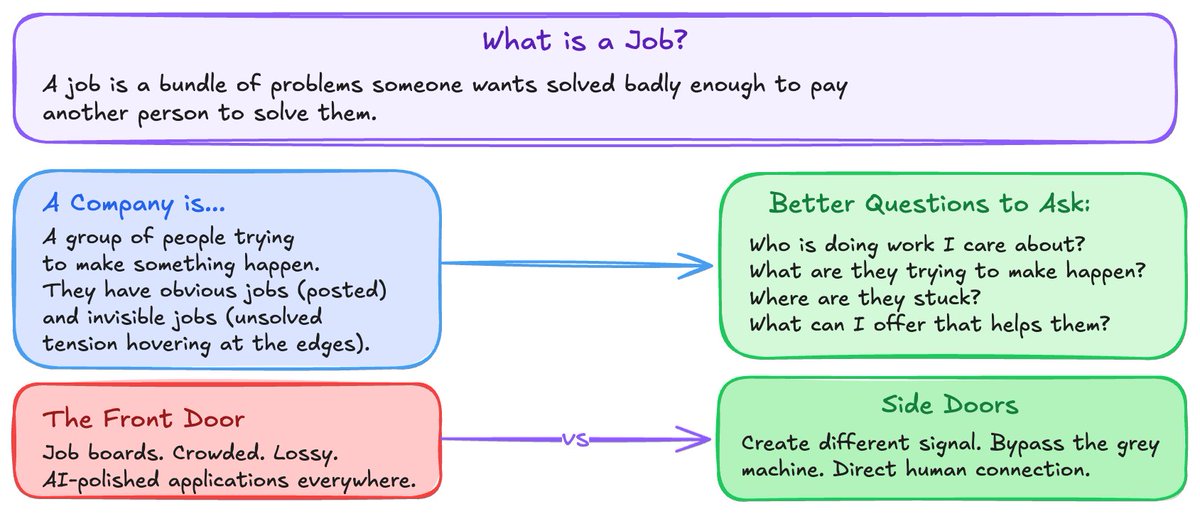
Here is the reframe that changes everything: a job is not a thing that exists until someone makes it. It is a bundle of problems a person or team needs solved badly enough to pay someone to solve them. Your job is to find that bundle before it becomes a job posting, and show up as the answer.
> Stop asking what roles are open. Start asking who is stuck and what you can do about it.
That one shift moves you from applicant to problem solver. And problem solvers get hired faster than applicants almost every time.
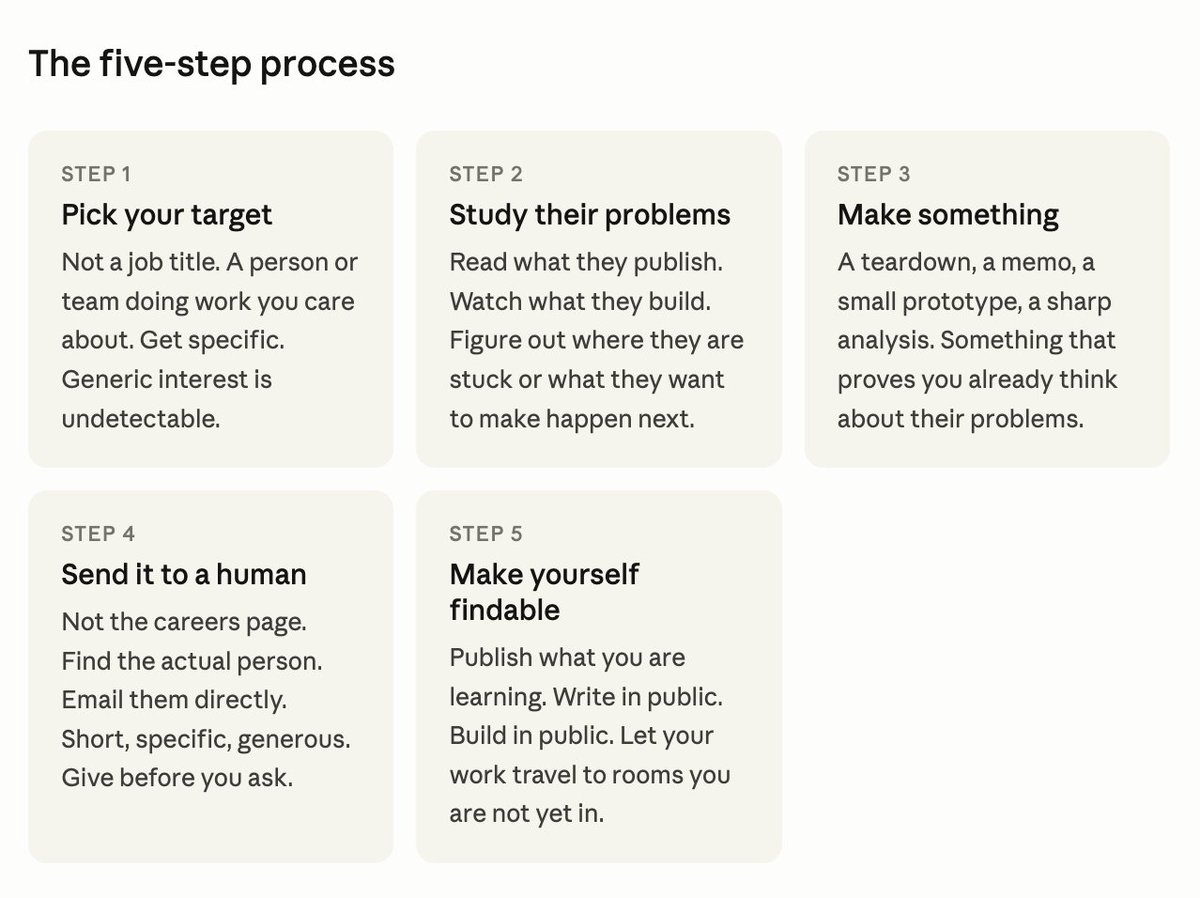
the five step process I applied
## The two moves that actually work
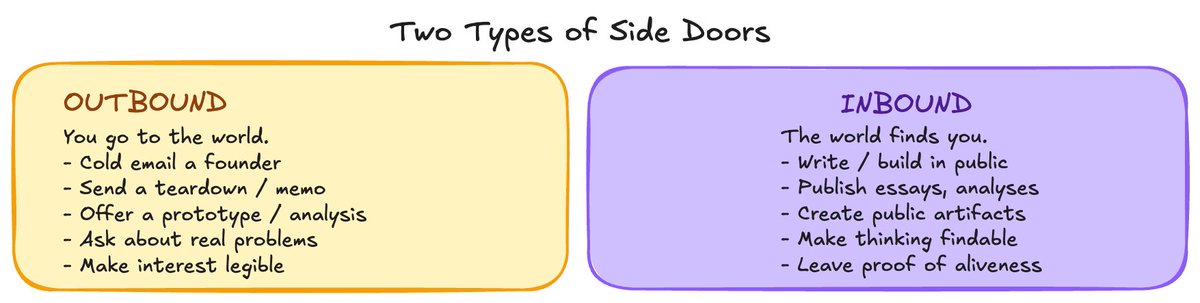
Every side door fits into one of two categories. You should be running both in parallel.
Move 1 / outbound
You go to the world
You find the person. You study them. You send something useful before you ask for anything. A cold email to a founder that contains a real idea. A teardown of their product with a specific observation. A memo on a growth gap they have not publicly addressed. This is not spraying your resume into inboxes. This is picking one human, doing the work, and making your interest impossible to ignore.
Move 2 / inbound
The world finds you
You publish. You build. You document what you are learning in a form other people can find. Essays. Analyses. Guides. Tools. Public artifacts that show how you think. The goal is not followers. The goal is becoming visible to the specific kind of person who cares about the same problems you do. Ethan published an AI research guide from his bedroom. A stranger from Australia found it on Discord and asked him to co-found Leonardo.ai. His obsession traveled ahead of him.
## How to write a cold outreach that gets a reply
Most cold emails fail for one reason: they are about the sender. The person reading it does not care about your resume. They care about their problems. Here is the structure that works.
1. Open with something specific you noticed about their work. Not generic praise. A real observation that required you to actually pay attention.
2. Give them something. A sharp take. A short analysis. A thing you made. Make the value of opening your email higher than the cost of reading it.
3. Tell them what you are trying to do. One sentence. Not a job title. What you want to make happen and why their world is where you want to do it.
4. Ask for something small. A fifteen-minute call. A reaction to the thing you sent. Not a job. Not a big favor. Something easy to say yes to.
5. Keep it short. If it takes more than ninety seconds to read, it is too long. Respect their time. It signals you understand how busy people actually are.
> The worst version of outreach is entitlement disguised as boldness. The best version is attentive. It proves you noticed something real.
## What to publish and where
You do not need a big platform. You need a consistent artifact trail. Here is what actually moves the needle.
Best formats
Things that travel well
Sharp essays on a specific problem in your field. Breakdowns of how something works that most people handwave. Public analyses of companies or products you find interesting. Guides that teach something you learned the hard way. Small tools, datasets, or templates other people can use. The format matters less than the specificity. A focused 600-word piece on one real insight beats a sprawling 3,000-word overview every time.
Where to put it
Distribution is the product
LinkedIn for professional reach. Substack or a personal site for longer pieces that live permanently. X or Twitter for real-time thinking and fast feedback. GitHub for anything technical. The goal is that when someone searches your name or your area of expertise, they find evidence of how you think. Not a resume. Proof of aliveness.

## The thing most people get wrong
They wait for clarity before they act.
They want the perfectly scoped role to appear before they move. They want to know it will work before they try. That is not how this works. The clarity comes from moving, not from waiting.
Most doors will not open. Most emails will not get a reply. Most things you publish will not find the right person immediately. That is fine. The process is not wasted when it does not immediately convert. You are learning which parts of the world respond to your particular frequency. You are finding your people by making your signal stronger.
What you are really doing is compressing the time between having the right skills and being in the right room. The job board puts that time on the company's schedule. Side doors put it on yours.
The formula, distilled
S Specificity. You actually looked. You studied the person, the company, the problem. You are not spraying need.
P Proof. You show, not tell. Something small and real that makes it easier for someone to imagine working with you.
G Generosity. You give before you ask. The ask comes last, after you have already created value.

Specificity plus proof plus generosity equals signal in the noise. All it takes is one person who sees the signal and has the problem you can solve.
> Audacity is a practical skill. If you want an unusual outcome, you have to move unusually. You do not need permission to notice where you might be useful. You do not need an open role to reach out to someone whose work you have actually studied. You do not need a big audience to start publishing what you know. Start with one person. Make one thing. Send one email. The door you are looking for is usually a door that does not yet have a sign on it.
## 相关链接
- [Prakarsh | Blockchain Balak](https://x.com/blockchainbalak)
- [@blockchainbalak](https://x.com/blockchainbalak)
- [14K](https://x.com/blockchainbalak/status/2058878015279644883/analytics)
- [Leonardo.ai](https://leonardo.ai/)
- [Upgrade to Premium](https://x.com/i/premium_sign_up)
- [7:49 PM · May 25, 2026](https://x.com/blockchainbalak/status/2058878015279644883)
- [14.9K Views](https://x.com/blockchainbalak/status/2058878015279644883/analytics)
- [View quotes](https://x.com/blockchainbalak/status/2058878015279644883/quotes)
---
*导出时间: 2026/5/26 09:25:41*
---
## 中文翻译
# 如何拿下世界上任何一份工作
**作者**: Prakarsh | Blockchain Balak
**日期**: 2026-05-25T11:49:05.000Z
**来源**: [https://x.com/blockchainbalak/status/2058878015279644883](https://x.com/blockchainbalak/status/2058878015279644883)
---

## 首先,改变你看待这场游戏的方式
大多数人把求职看作排队。你等着轮到你。你提交表格。另一端的某个人决定你是否足够优秀。
这个模式并没有错,只是太弱了。它把所有的权力都交给了对方,让你处于被动地位。

这是一个能改变一切的重构视角:在工作被创造出来之前,它并不是客观存在的。它只是一个人或团队急需解决、并愿意付费让人解决的一揽子问题。你的任务是在它变成招聘启事之前找到这包问题,并作为解决方案出现。
> 别再问有哪些职位空缺。开始问谁陷入了困境,以及你能为此做些什么。
仅此一个转变,就能让你从申请者变成问题解决者。而问题解决者几乎总是比申请者更快被录用。

我应用的五步流程
## 两个真正有效的招数
每一扇“侧门”都属于以下两类之一。你应该并行推进这两者。
招数 1 / 主动出击
你走向世界
你找到那个人。你研究他们。你在提出任何要求之前先发送有用的东西。一封包含真实想法的冷邮件给创始人。一份针对其产品的拆解,附上具体的观察。一份关于他们尚未公开解决的增长缺点的备忘录。这不是把你的简历像喷雾一样撒进收件箱。这是挑选一个具体的人,做好功课,让你的存在感无法被忽视。
招数 2 / 吸引进来
让世界找到你
你发表内容。你构建产品。你记录你学到的东西,以便他人能找到。文章。分析。指南。工具。展示你如何思考的公开成果。目标不是粉丝。目标是让那些关心和你同样问题的人看到你。Ethan 在他的卧室里发表了一份 AI 研究指南。一个来自澳大利亚的陌生人在 Discord 上找到了它,并邀请他联合创立了 Leonardo.ai。他的痴迷走在了他的前面。

## 如何写出能得到回复的冷邮件
大多数冷邮件失败的原因只有一个:它们是关于发件人的。读邮件的人并不在乎你的简历。他们在乎的是他们的问题。这里有一个有效的结构。
1. 以你对他们工作的具体观察作为开头。不要是泛泛的赞美。一个需要你真正留意的真实观察。
2. 给他们一些东西。一个犀利的观点。一个简短的分析。你做的东西。让打开你邮件的价值高于阅读它的成本。
3. 告诉他们你想做什么。一句话。不是职位名称。你想实现什么,以及为什么他们的世界是你想要实现它的地方。
4. 提出一个小要求。十五分钟的通话。对你发送的东西给个反馈。不是要工作。不是帮大忙。一个容易答应的小事。
5. 保持简短。如果阅读超过九十秒,那就太长了。尊重他们的时间。这表明你理解忙碌的人实际上有多忙。
> 最糟糕的接触方式是伪装成大胆的 entitlement(理所当然)。最好的方式是用心。它证明了你注意到了真实的东西。
## 发表什么以及在哪里发表
你不需要大平台。你需要一条持续的作品痕迹。以下是真正能起作用的东西。
最佳格式
易于传播的内容
针对你所在领域具体问题的犀利文章。对大多数人一笔带过的工作原理的拆解。你感兴趣的公司或产品的公开分析。教授你通过艰难教训学到的东西的指南。其他人可以使用的小工具、数据集或模板。格式不如具体性重要。一篇聚焦于一个真实洞察的 600 字短文,每次都能胜过一篇散漫的 3000 字概览。
放在哪里
分发即产品
LinkedIn 用于职业触达。Substack 或个人网站用于长久存在的长文。X 或 Twitter 用于实时思考和快速反馈。GitHub 用于任何技术相关的东西。目标是当有人搜索你的名字或你的专业领域时,他们能找到你如何思考的证据。不是简历。是活着的证明。

## 大多数人做错的地方
他们在行动之前等待清晰度。
他们希望完美界定好的职位出现后再行动。他们想在尝试之前知道这会成功。但这不是运作的方式。清晰来自于行动,而不是等待。
大多数门不会打开。大多数邮件不会得到回复。你发表的大多数东西不会立刻找到对的人。这没关系。如果没有立即转化,这个过程并没有被浪费。你正在学习世界的哪些部分会回应你特有的频率。你通过加强你的信号来寻找你的人。
你实际上在做的是压缩拥有正确技能和进入正确房间之间的时间。招聘公告把这段时间交给了公司的日程表。侧门把它交给了你。
提炼出的公式
S Specificity(具体性)。你真的看了。你研究了这个人、公司、问题。你不是在撒网乞求。
P Proof(证明)。你展示,而不只是讲述。一些微小而真实的东西,让人更容易想象和你一起工作。
G Generosity(慷慨)。你在索取之前先给予。请求放在最后,在你已经创造了价值之后。

具体性加上证明加上慷慨等于噪音中的信号。只需要一个人看到信号,并且拥有你能解决的问题。
> 大胆是一种实用技能。如果你想要不寻常的结果,你就必须以不寻常的方式行动。你不需要许可去注意到你在哪里可能有用。你不需要一个空缺职位去联系一个你真正研究过其工作的人。你不需要庞大的受众就开始发表你知道的东西。从一个人开始。做一件东西。发一封邮件。你在寻找的门通常是一扇还没有招牌的门。
## 相关链接
- [Prakarsh | Blockchain Balak](https://x.com/blockchainbalak)
- [@blockchainbalak](https://x.com/blockchainbalak)
- [14K](https://x.com/blockchainbalak/status/2058878015279644883/analytics)
- [Leonardo.ai](https://leonardo.ai/)
- [升级到 Premium](https://x.com/i/premium_sign_up)
- [2026年5月25日 下午7:49](https://x.com/blockchainbalak/status/2058878015279644883)
- [1.49万次观看](https://x.com/blockchainbalak/status/2058878015279644883/analytics)
- [查看引用](https://x.com/blockchainbalak/status/2058878015279644883/quotes)
---
*导出时间: 2026/5/26 09:25:41*