# How to become the AI-native hire every company wants
**作者**: anita · vellum.ai
**日期**: 2026-05-29T17:00:02.000Z
**来源**: [https://x.com/anitakirkovska/status/2060405820077338706](https://x.com/anitakirkovska/status/2060405820077338706)
---

It's 2026, and we have AI agents that can produce entry-level work at a much lower cost than a human employee.
ClickUp, Webflow, and Wix have started trading headcount for AI leverage. They’re looking for AI-native workers who can use AI to move faster, do more, and make the whole team better.
Here’s how to become one.
## AI org restructuring is here
In the "Intelligence Curse" blog, the authors outlined three ways companies may adapt their workforce in response to AI:
1. Do nothing, out of inertia
2. Fire most entry-level and white-collar jobs, to maximize benefits
3. Freeze all hiring initiatives
Here’s what I’m seeing right now: ClickUp, let go 22% of their workers, and introduced new $1M salary bands to attract agentic-native hires. Wix, Webflow, Meta all followed suit this week. They’re all flattening their org, and firing most entry-level and white-collar hires.
Here's the devastating part.
Many others will do the same.
All of them want to become more competitive, and create new budgets for AI power and agent-native hires.
## Exhibit A: The ClickUp layoff and the search for AI talent
Let' at what the CEO of ClickUp announced:
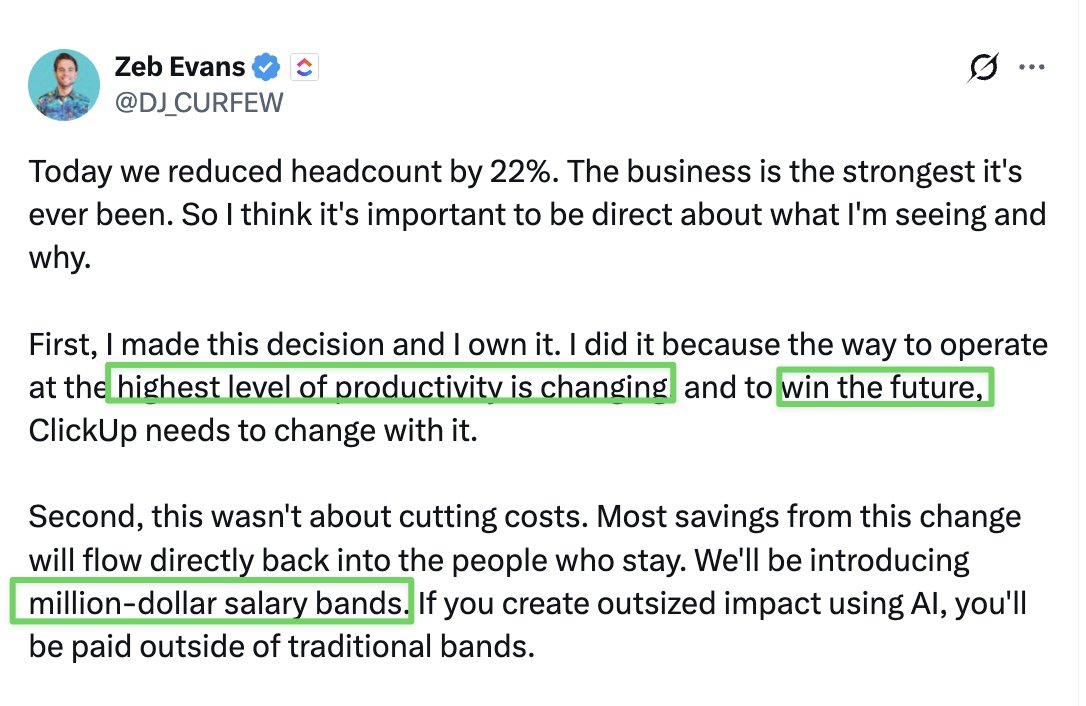
The motivations of it are very clear and can be summarized in three buckets:
- Create a budget to fund AI infra + hire high-leverage talent
- Attract the best agent-native talent on the market, faster ($1M salary bands)
- Become the first company in their vertical who's going to diabolically grow based on AI restructuring + enhanced productivity
Here are some highlighted quotes from the announcement with a bit of explanation:
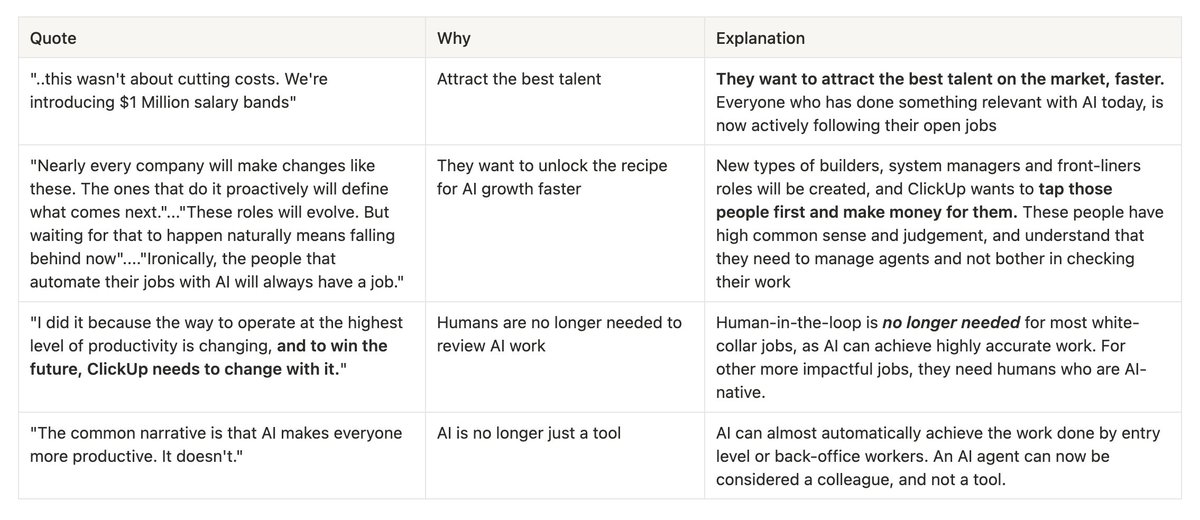
In this reality, you either get replaced by AI, or you become someone who manages AI.
## Most people are not scaling with AI
The hard part about this moment is that “just using AI” is already becoming table stakes. Most of you are using ChatGPT, Claude, Cursor, Perplexity, or some version of an AI tool at work.
But that does not automatically make you AI-native and it definitely doesn’t make you productive. If anything, it make you less productive.
In a lot of cases, it just means you’re are doing the same job with more tabs open. You ask ChatGPT for a draft, copy it into a doc, ask for a summary, paste it into Slack, maybe use another tool for research, then another one for editing.
You end up in “Brain Fry”, and you start to work more and achieve less.
Here’s what most of you think makes you AI-native:
- "Knows how to prompt" - prompting is so easy today
- "Comfortable with ChatGPT" - that’s cool, my mom too
- "Uses AI tools daily” - what does this mean? can you prove you’re more productive?
And here’s what shows a good signal that you actually are:
- You can show a running setup for your agents, Claude Code/Codex, your Cursor setup
- You can show judgement in real-time on how you’d adjust a given AI output
- You can name three things you stopped letting AI do and why
- You have a list of skill.md files that your agents are running on (more on this below)
The underlying reasoning behind every signal above👆🏻:
(1) You've spent real time building a system around AI for your work
(2) You know what to scale and when
Sadly, most are too lazy to do (1).
## How to become truly AI-native
You can wait for your company to build its central AI brain and hand you leverage. Or you can start building your own agentic skills that amplify how you work. If you want to become a high-leverage hire, I always advise you do #2.
[Disclaimer] I work at Vellum, so I’m obviously biased here. I think about this stuff a lot because it’s tied to what we’re building. But I do think the following is how you actually build leverage with AI on your own terms.
## My framework to building high-leverage
There's a formula, and it starts with accepting this: you can't wait for your company to build the infrastructure that makes you valuable in an AI-flat org. You have to build it yourself, prove it works, and become indefensible before they restructure and leave you behind.
And the only thing you need to optimize + personalize: The skills md files that explain to your agent how your tasks should be done.
It’s that simple.
You should build skills (basic md files) that transfer the task + criteria + taste into the agent's context. Over time, the agent should learn to replicate not just what you do, but how you do it.
Here’s my system:
1. Choose one task you do often
A weekly competitor report, content brief, customer follow up, CRM clean up. It’s very important to pick something where you already know what good looks like, but the work is repetitive enough that it should not fully depend on you every time.
1. Choose an agent/assistant
Now, it’s time to choose your “fighter”. You have two categories: platforms where you borrow their agent (Claude Cowork, Codex), or platforms where you build and own your agent (OpenClaw, Hermes, Vellum).
Both will be very useful if you have great skills.
The latter option will help you optimize those skills over time. For example, at Vellum we’ve built a way for your skills to evolve as you work with your personal AI assistant.
1. Write a great skill
An assistant skill is just a Markdown file that tells your assistant how to complete a specific task successfully. You can learn how to write great skills here.
> It’s very important that you participate in writing the first version of the skill‼️
Because remember, you’re the one with the domain expertise. People who give this task to AI, will almost definitely fail and will get into a much worse “brain fry” condition.
In most technical-forward skills you might need to add some spec on APIs, CLI commands etc - your assistant can be useful in adding those. Every other rule, preference and behavior should be defined by you. Don’t be lazy.
1. Hand the skill to your agent and see how it does
The first output won’t be great and that’s totally fine. The goal is to have the assistant make mistakes, and learn from them. So it can do better over time.
At this step, your involvement is higher, because you’ll be checking the results, improving the skill, and giving feedback. The feedback you give here is the most important thing you can do.
1. Rinse and repeat
With a good assistant, it’s built-in procedural memory should help improve these skills based on the interactions over time. So every time you use a skill, review the work, and give feedback, the assistant has a chance to do it better the next time.
Once the assistant is able to do one task well, then you move to another. Then rinse and repeat.
This is the complete formula for becoming the AI-hire every company is desperate for:
1. Pick a good assistant
2. Find a repeatable task where you know what good looks like
3. Write the skill.md file
4. Give it to your assistant
5. Let it do the work
6. Review and give feedback
7. Have the assistant improve the skill
8. Repeat until it is good enough to trust
9. Move to the next task
That is what becoming agent-native looks like in practice.
You own the domain expertise and you “teach” your personal AI / assistant of how things should be done. An assistant with good memory should know how to learn from it’s mistakes, learn about your preferences and become 100x better at finishing tasks.
At that point you’ve built leverage on the market that no one else has even start to think of.
We built Vellum to give you the highest advantage on earth: time.
Now go out there and follow this formula to become the hire every company wants!
## 相关链接
- [Khairallah AL-Awady reposted](https://x.com/eng_khairallah1)
- [anita · vellum.ai](https://x.com/anitakirkovska)
- [@anitakirkovska](https://x.com/anitakirkovska)
- [14K](https://x.com/anitakirkovska/status/2060405820077338706/analytics)
- ["Intelligence Curse" blog](https://intelligence-curse.ai/pyramid/)
- [followed suit this week.](https://layoffhedge.com/)
- [announced](https://x.com/DJ_CURFEW/status/2057522382315929802)
- [Brain Fry](https://hbr.org/2026/03/when-using-ai-leads-to-brain-fry)
- [skill.md](http://skill.md/)
- [build its central AI brain](https://x.com/sebgoddijn/status/2042285915435937816)
- [Cowork](https://claude.com/product/cowork)
- [Codex](https://openai.com/codex/)
- [OpenClaw](https://openclaw.ai/)
- [Hermes](https://hermes-agent.nousresearch.com/)
- [Vellum](https://www.vellum.ai/)
- [Vellum](https://www.vellum.ai/)
- [here](https://platform.claude.com/docs/en/agents-and-tools/agent-skills/best-practices)
- [skill.](http://skill.md/)
- [Vellum](https://www.vellum.ai/)
- [Upgrade to Premium](https://x.com/i/premium_sign_up)
- [1:00 AM · May 30, 2026](https://x.com/anitakirkovska/status/2060405820077338706)
- [14.6K Views](https://x.com/anitakirkovska/status/2060405820077338706/analytics)
- [View quotes](https://x.com/anitakirkovska/status/2060405820077338706/quotes)
---
*导出时间: 2026/5/30 10:31:05*
---
## 中文翻译
# 如何成为每家公司都想要的 AI 原生人才
**作者**: anita · vellum.ai
**日期**: 2026-05-29T17:00:02.000Z
**来源**: [https://x.com/anitakirkovska/status/2060405820077338706](https://x.com/anitakirkovska/status/2060405820077338706)
---

现在是 2026 年,我们拥有的 AI 智能体能够以比人类员工低得多的成本产出入门级的工作成果。
ClickUp、Webflow 和 Wix 已开始用 AI 杠杆来换取人力(裁员)。他们正在寻找 AI 原生人才,这些人能利用 AI 更快地行动、做更多的事情,并让整个团队变得更好。
以下是成为这类人才的方法。
## AI 组织架构重组已来
在“智力诅咒” 这篇博客中,作者概述了公司为了应对 AI 可能调整劳动力的三种方式:
1. 什么都不做,出于惯性
2. 裁掉大部分入门级和白领工作,以实现利益最大化
3. 冻结所有招聘计划
以下是我目前看到的现状:ClickUp 裁掉了 22% 的员工,并推出了新的 100 万美元薪资等级来吸引擅长使用智能体的人才。Wix、Webflow 和 Meta 本周都纷纷效仿。他们都在扁平化组织架构,并解雇大部分入门级和白领员工。
可怕的部分在于。
许多其他公司也会这么做。
它们都希望变得更具竞争力,并为 AI 能力和擅长使用智能体的人才创造新的预算。
## 案例 A:ClickUp 的裁员与对 AI 人才的搜寻
让我们来看看 ClickUp CEO 的声明:

其动机非常明确,可以总结为三点:
- 创建预算来资助 AI 基础设施 + 招聘高杠杆人才
- 更快地吸引市场上最优秀的智能体原生人才(100 万美元薪资)
- 成为其垂直领域中首家基于 AI 重组 + 提升生产力从而实现爆发式增长的公司
以下是声明中的一些重点引用及解释:

在这种现实下,你要么被 AI 取代,要么成为管理 AI 的人。
## 大多数人并没有随着 AI 扩展能力
这一刻最困难的部分在于,“仅仅使用 AI”正在成为基本门槛。你们大多数人都在工作中使用 ChatGPT、Claude、Cursor、Perplexity 或某种版本的 AI 工具。
但这并不能自动让你成为 AI 原生人才,也肯定不能让你变得高效。如果说有什么影响的话,这反而让你效率更低。
在很多情况下,这只是意味着你做着同样的工作,只是打开了更多的标签页。你向 ChatGPT 询问草稿,复制到文档里,要求总结,粘贴到 Slack 里,也许用另一个工具做调研,再用另一个工具编辑。
最终你会陷入“大脑过载”,开始工作得越多,成果却越少。
以下是大多数人认为让你成为 AI 原生能力的特征:
- “懂得如何写提示词” —— 如今提示词太简单了
- “熟悉 ChatGPT” —— 那很不错,我妈也是
- “每天使用 AI 工具” —— 这意味着什么?你能证明你更高效吗?
而以下特征才是你真正具备 AI 原生能力的良好信号:
- 你能展示你的智能体运行配置、Claude Code/Codex 以及你的 Cursor 设置
- 你能实时展示你如何调整给定 AI 输出的判断力
- 你能列出三件你不再让 AI 做的事情及其原因
- 你拥有一份你的智能体正在运行的 skill.md 文件列表(下文详述)
上述每个信号背后潜在的理由👆🏻:
(1) 你花了实实在在的时间围绕 AI 为你的工作构建了一套系统
(2) 你知道该扩展什么以及何时扩展
可悲的是,大多数人都懒得去做 (1)。
## 如何成为真正的 AI 原生人才
你可以等待公司建立其中央 AI 大脑并赋予你杠杆。或者你可以开始构建你自己的智能体技能,从而放大你的工作方式。如果你想成为一名高杠杆价值的受聘者,我总是建议你选择 #2。
[免责声明] 我在 Vellum 工作,所以我在这里显然有偏见。我经常思考这些问题,因为它与我们要构建的产品息息相关。但我确实认为,以下是你可以按照自己的条件真正利用 AI 构建杠杆的方法。
## 我构建高杠杆能力的框架
这里有一个公式,它始于接受这一点:你不能等待公司建立基础设施,从而让你在 AI 扁平化组织中变得有价值。你必须自己构建它,证明它有效,并在公司重组把你甩在身后之前让自己变得不可或缺。
唯一需要你优化和个性化的东西是:那些向你的智能体解释如何完成任务的 skills md 文件。
就这么简单。
你应该构建技能(基本的 md 文件),将任务 + 标准 + 品味传递给智能体的上下文中。随着时间的推移,智能体应该学会不仅复制你做什么,还要复制你是怎么做的。
以下是我的系统:
1. 选择一件你经常做的任务
一份每周竞争对手报告、内容简报、客户跟进、CRM 清理。非常重要的一点是,要选择一件你已经知道“好”是什么样子的任务,但工作又要足够重复,不需要每次都完全依赖你。
1. 选择一个智能体/助手
现在,是时候选择你的“战士”了。你有两类选择:借给你智能体的平台,或者你可以构建并拥有智能体的平台(OpenClaw, Hermes, Vellum)。
如果你有优秀的技能,这两者都会非常有用。
后者选项会帮助你随着时间的推移优化那些技能。例如,在 Vellum,我们已经构建了一种机制,让你的技能随着你与个人 AI 助手的共事而进化。
1. 编写优秀的技能
助手技能只是一个 Markdown 文件,它告诉你的助手如何成功完成特定任务。你可以在这里学习如何编写优秀的技能。
> 非常重要的是你要参与编写技能的第一个版本‼️
因为请记住,你是拥有领域专业知识的人。那些把这个任务交给 AI 的人几乎肯定会失败,并且会陷入更糟糕的“大脑过载”状态。
在大多数技术向的技能中,你可能需要添加一些关于 API、CLI 命令等的规范 —— 你的助手可以帮你添加这些。除此之外,每一条规则、偏好和行为都应该由你定义。别偷懒。
1. 将技能交给智能体并观察表现
第一个输出不会很完美,这完全没问题。目标是让助手犯错,并从中学习。这样它随着时间的推移做得更好。
在这一步,你的参与度很高,因为你需要检查结果、改进技能并给予反馈。你在这里给出的反馈是你能做的最重要的事情。
1. 重复此过程
拥有一个好的助手,它内置的程序记忆应该有助于基于随时间推移的互动来改进这些技能。所以每当你使用一个技能、审查工作并给予反馈时,助手就有机会在下一次做得更好。
一旦助手能够很好地完成一项任务,你就转移到另一项。然后反复重复。
这就是成为每家公司都渴望的 AI 人才的完整公式:
1. 选择一个好的助手
2. 找到一个你知道“好”是什么样子的重复性任务
3. 编写 skill.md 文件
4. 把它交给你的助手
5. 让它去工作
6. 审查并给予反馈
7. 让助手改进技能
8. 重复直到它足以被信任
9. 移动到下一个任务
这就是在实践中成为智能体原生人才的样子。
你拥有领域专业知识,你“教导”你的个人 AI/助手事情应该如何做。一个拥有良好记忆的助手应该知道如何从错误中学习,了解你的偏好,并在完成任务方面变得强 100 倍。
到那时,你已经构建了市场上甚至其他人还没开始想过的杠杆。
我们构建 Vellum 是为了给你地球上最高的优势:时间。
现在就去按照这个公式行动,成为每家公司都想雇用的人才吧!