# How to Use Claude Skills to Automate Any Workflow (Full Course)
**作者**: Khairallah AL-Awady
**日期**: 2026-05-11T09:28:40.000Z
**来源**: [https://x.com/eng_khairallah1/status/2053769247822914031](https://x.com/eng_khairallah1/status/2053769247822914031)
---
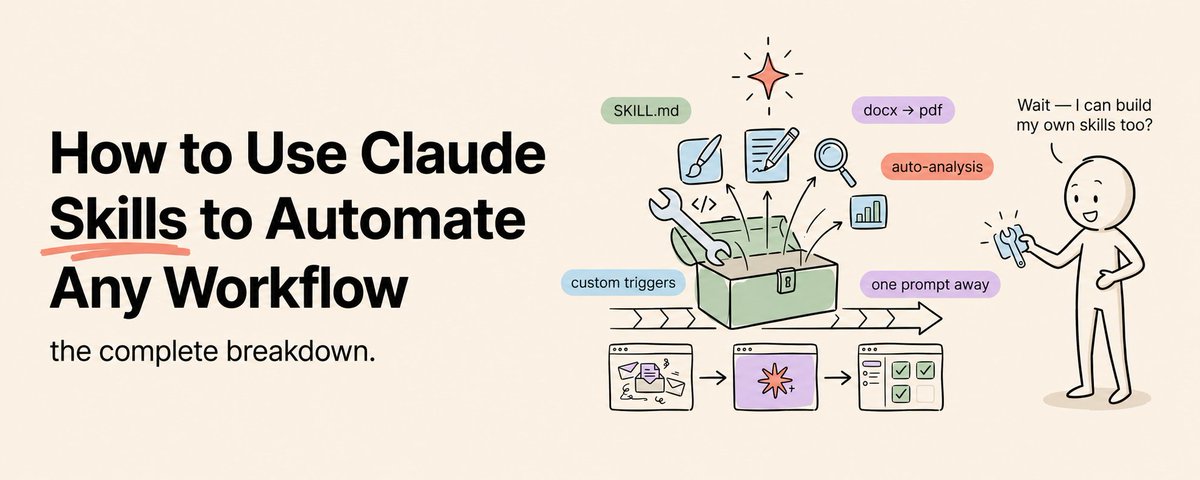
I have combined everything I know about Claude Skills into one article.
Bookmark & Save this :)
After reading this you will understand Claude Skills better than 99 percent of users. You will have built and deployed at least one custom skill. And you will have a repeatable system for automating any workflow in any industry.
That is not hyperbole. This is the complete playbook.
## What Claude Skills Actually Are (And Why Most People Are Using Them Wrong)
A Claude Skill is a permanent instruction file that lives on your computer and tells Claude exactly how to perform a specific task. Every single time. Without you re-explaining it.
Most people hear that and think "oh, so it is like a saved prompt."
No. A saved prompt is a starting point for a conversation. A Skill is a trained employee.
A saved prompt says "here is how to start." A Skill says "here is exactly how to do this job from start to finish, here is what good output looks like, here is what to do when things go wrong, here are the tools you need, and here is the format to deliver results in."
The difference in output quality is enormous.
When you give Claude a one-off prompt, you get one-off quality. Inconsistent. Sometimes great, sometimes mediocre. Different every time because you phrase things slightly differently every time.
When you activate a Skill, you get standardized quality. The same process, the same standards, the same output format, every single time. That is the difference between having an intern and having a trained professional.
Why Skills Are the Most Underleveraged Feature in AI Right Now
There are over 80,000 community Skills available right now. The marketplace is growing by thousands every week. Anthropic has published official Skills for PDFs, Word docs, presentations, spreadsheets, and design.
And most people have never installed a single one.
The reason is simple. Nobody has explained how to use them properly. Most guides show you how to install a Skill and stop there. That is like showing someone how to hire an employee and never teaching them how to manage one.
This article covers the full lifecycle. How to find the right Skills. How to install them. How to build custom ones from scratch. How to test and refine them. How to deploy them into real workflows. And how to build a complete library of Skills that automates your entire operation.
## Phase 1: Install Your First Skill in Five Minutes
Where Skills Live
Skills are just folders on your computer. Inside each folder is a file called SKILL.md. That file contains the instructions that tell Claude how to do the job.
For Claude Code they live in your project directory at .claude/skills/ or globally at ~/.claude/skills/.
For Claude Desktop with Cowork they work through the desktop interface.
That is it. No complex installation. No dependencies. No configuration files. A folder with a text file.
What to Do in Phase 1
- Browse skillsmp.com or github.com/anthropics/skills and find a Skill relevant to your work
- Install it following the instructions in the repository
- Run it on a real task you normally do manually
- Compare the output quality and speed to your usual prompting approach
- If the output is not perfect, note what needs improvement
## Phase 2: Build Your First Custom Skill From Scratch
The Three-Question Test
Before you build, answer three questions.
What does this Skill do? Be brutally specific. Not "help with emails." Instead: "Draft professional follow-up emails to prospects who attended our webinar, reference the specific session they attended, include one relevant case study, and end with a clear call to action for a 15-minute demo call."
When should it activate? What would you actually type to trigger it? "Write a follow-up email." "Draft a webinar follow-up." "Create a prospect email." List at least five trigger phrases.
What does perfect output look like? Do not describe it abstractly. Show an actual example. Paste in a real email you wrote that was excellent. That example is worth more than 50 lines of instructions.
Write the SKILL.md
Your SKILL.md file has two sections.
The YAML frontmatter at the top between --- markers. This contains the name in kebab-case and the description, an aggressive, specific paragraph listing every trigger phrase and clearly stating when the Skill should and should not activate.
The instructions below the frontmatter. This is your workflow written in plain English. Step by step. Sequential. Each step is one clear action. Include examples of input and output. Include edge cases and how to handle them. Include your quality standards.
Keep the entire file under 500 lines. Vague language like "format nicely" or "handle appropriately" is banned. Every instruction must be specific and testable.
What to Do in Phase 2
- Pick the task you repeat most often and answer the three-question test
- Write the YAML frontmatter with aggressive trigger descriptions
- Write the instructions as a step-by-step workflow with concrete examples
- Save the SKILL.md file in the correct Skills directory
- Run the Skill on a real task and save the output for review
## Phase 3: Test, Refine, and Make It Production-Grade
The Three-Scenario Test
Run your Skill against three scenarios.
The happy path. A normal, straightforward input that represents 80 percent of your use cases.
The edge case. A weird, unusual, or incomplete input that tests the boundaries. Missing data. Unusual formatting. Conflicting information.
The stress test. The biggest, messiest, most complex version of the task. This reveals whether your Skill scales or whether it only works on simple inputs.
If your Skill passes all three scenarios with output you would be comfortable showing to a client, it is production-grade. If it fails any scenario, the failure tells you exactly what instruction to add.
The Weekly Refinement Cycle
Every time you use a Skill and the output is not quite right, update the SKILL.md immediately. After one month of refinement, your Skill will produce output that is indistinguishable from work done by a trained human professional.
What to Do in Phase 3
- Run your Skill against the three scenarios: happy path, edge case, stress test
- For each failure, add the specific instruction or example that would have fixed it
- Run all three scenarios again and confirm the fixes work
- Set a calendar reminder to review and refine your Skill every Friday for the first month
## Phase 4: Build a Complete Skill Library for Your Industry
One Skill Is a Tool. Ten Skills Is a Workforce.
Build a Skill for every recurring task in your workflow. Content creation Skill. Research Skill. Email drafting Skill. Data analysis Skill. Meeting prep Skill. Report generation Skill. Client communication Skill. Competitive analysis Skill.
Within a month you can have ten production-grade Skills running. Within three months you can have a complete library covering every major workflow in your role.
Industry-Specific Skill Ideas
For real estate: Property listing writer. Market analysis generator. Client follow-up drafter. Comparable sales researcher. Open house prep briefer.
For marketing: Campaign brief generator. Ad copy writer. Analytics report compiler. Content calendar planner. A/B test analyzer.
For finance: Expense report processor. Invoice analyzer. Budget variance explainer. Client portfolio summarizer. Regulatory compliance checker.
For consulting: Proposal drafter. Discovery call prepper. Deliverable formatter. Status report generator. Engagement summary writer.
For e-commerce: Product description writer. Customer review analyzer. Inventory report generator. Competitor pricing tracker. Return analysis compiler.
The pattern is universal. Identify the tasks. Build the Skills. Refine them. Let Claude handle the execution while you handle the strategy.
What to Do in Phase 4
- List every recurring task in your current workflow
- Prioritize them by frequency and time consumed
- Build one new Skill per week starting with the highest-priority task
- Maintain a master document tracking all your Skills, their status, and their last refinement date
- Share your best Skills publicly
## The Bottom Line
One Skill that saves 30 minutes per week saves 26 hours per year. Ten Skills saving 30 minutes each saves 260 hours per year. That is six and a half full work weeks returned to you annually.
Most people will keep typing the same instructions into Claude every single day.
The ones who build a Skill library will be running a completely different operation within 60 days.
If you found this useful, follow me @eng_khairallah1 for more AI content like this. I post breakdowns, courses, and tools every week.
hope this was useful for you, Khairallah ❤️
## 相关链接
- [Khairallah AL-Awady](https://x.com/eng_khairallah1)
- [@eng_khairallah1](https://x.com/eng_khairallah1)
- [371K](https://x.com/eng_khairallah1/status/2053769247822914031/analytics)
- [SKILL.md](http://skill.md/)
- [skillsmp.com](http://skillsmp.com/)
- [github.com/anthropics/skills](http://github.com/anthropics/skills)
- [SKILL.md](http://skill.md/)
- [SKILL.md](http://skill.md/)
- [SKILL.md](http://skill.md/)
- [SKILL.md](http://skill.md/)
- [@eng_khairallah1](https://x.com/@eng_khairallah1)
- [Upgrade to Premium](https://x.com/i/premium_sign_up)
- [5:28 PM · May 11, 2026](https://x.com/eng_khairallah1/status/2053769247822914031)
- [371.5K Views](https://x.com/eng_khairallah1/status/2053769247822914031/analytics)
- [View quotes](https://x.com/eng_khairallah1/status/2053769247822914031/quotes)
---
*导出时间: 2026/5/12 09:28:38*
---
## 中文翻译
# 如何利用 Claude 技能自动化任何工作流(完整教程)
**作者**: Khairallah AL-Awady
**日期**: 2026-05-11T09:28:40.000Z
**来源**: [https://x.com/eng_khairallah1/status/2053769247822914031](https://x.com/eng_khairallah1/status/2053769247822914031)
---

我将我所知关于 Claude 技能的一切整合到了一篇文章中。
收藏并保存这篇 :)
读完后,你对 Claude 技能的理解将超过 99% 的用户。你将构建并部署至少一个自定义技能。并且,你将拥有一套可重复的系统,用于自动化任何行业中的任何工作流。
这并非夸张。这是完整的行动指南。
## Claude 技能到底是什么(以及为什么大多数人用错了)
Claude 技能是一个存储在你计算机上的永久性指令文件,它告诉 Claude 如何精确地执行特定任务。每一次。无需你重新解释。
大多数人听到这个会想:“哦,所以它就像一个保存的提示词(prompt)。”
不。保存的提示词是对话的起点。而技能则是一名受过训练的员工。
保存的提示词说:“这是如何开始。”技能说:“这是从头到尾完成这项工作的确切方法,这是优秀产出的样子,这是出问题时该怎么做,这是你需要用到的工具,这是交付结果所需的格式。”
产出质量的差异是巨大的。
当你给 Claude 一个一次性提示词时,你得到的是一次性质量。不稳定。有时很棒,有时平庸。每次都不同,因为你每次的措辞都略有不同。
当你激活一个技能时,你得到的是标准化质量。每一次都是相同的流程、相同的标准、相同的输出格式。这就是实习生和受过训练的专业人士之间的区别。
为什么技能是当前 AI 中利用率最低的功能
目前有超过 80,000 个社区技能可用。市场每周增长数千个。Anthropic 已经针对 PDF、Word 文档、演示文稿、电子表格和设计发布了官方技能。
而大多数人从未安装过哪怕一个。
原因很简单。没有人解释过如何正确使用它们。大多数指南只教你如何安装技能,然后就止步于此。这就像教某人如何雇佣员工,却从未教他们如何管理员工。
这篇文章涵盖了完整的生命周期。如何找到合适的技能。如何安装它们。如何从头开始构建自定义技能。如何测试和完善它们。如何将它们部署到实际工作流中。以及如何建立一个完整的技能库来自动化你的整个运营。
## 第一阶段:五分钟内安装你的第一个技能
技能的存储位置
技能只是你计算机上的文件夹。在每个文件夹内部是一个名为 SKILL.md 的文件。该文件包含指示 Claude 如何完成工作的指令。
对于 Claude Code,它们位于你项目目录的 .claude/skills/ 或全局的 ~/.claude/skills/。
对于带有 Cowork 的 Claude Desktop,它们通过桌面界面工作。
就这样。没有复杂的安装。没有依赖项。没有配置文件。只有一个包含文本文件的文件夹。
第一阶段要做的事
- 浏览 skillsmp.com 或 github.com/anthropics/skills 并找到与你工作相关的技能
- 按照仓库中的说明进行安装
- 在一个你通常手动完成的真实任务上运行它
- 将其输出质量和速度与你通常的提示词方法进行比较
- 如果输出不完美,记下需要改进的地方
## 第二阶段:从头开始构建你的第一个自定义技能
三问测试
在构建之前,回答三个问题。
这个技能是做什么的?要极其具体。不要写“帮忙处理邮件”。而要写:“为参加了我们网络研讨会的潜在客户起草专业的跟进邮件,引用他们参加的具体会议,包含一个相关的案例研究,并以清晰的行动号召结尾,预约 15 分钟的演示通话。”
它应该何时激活?你实际会输入什么来触发它?“写一封跟进邮件。”“起草一个网络研讨会跟进。”“创建一封潜在客户邮件。”列出至少五个触发短语。
完美的输出是什么样的?不要抽象地描述它。展示一个实际的例子。粘贴一封你写过的真正优秀的邮件。那个例子比 50 行指令更有价值。
编写 SKILL.md
你的 SKILL.md 文件有两个部分。
位于顶部 --- 标记之间的 YAML 前置数据。它包含短横线命名法的名称和描述,一段激进、具体的段落,列出每个触发短语并明确说明技能何时应该以及不应该激活。
前置数据下方的指令。这是用平实英语编写的工作流。一步步。顺序进行。每一步都是一个清晰的行动。包括输入和输出的例子。包括边缘情况以及如何处理它们。包括你的质量标准。
保持整个文件在 500 行以内。禁止使用“格式美观”或“适当处理”等模糊语言。每一条指令都必须具体且可测试。
第二阶段要做的事
- 选择你最常重复的任务,并回答三问测试
- 编写包含激进触发描述的 YAML 前置数据
- 将指令编写为带有具体示例的分步工作流
- 将 SKILL.md 文件保存在正确的技能目录中
- 在真实任务上运行该技能并保存输出以供审查
## 第三阶段:测试、完善并使其达到生产级
三种场景测试
在三种场景下运行你的技能。
理想路径。代表你 80% 用例的正常、直接的输入。
边缘情况。奇怪、不寻常或不完整的输入,用于测试边界。缺失数据。格式异常。信息冲突。
压力测试。最大、最乱、最复杂的任务版本。这揭示了你的技能是否具有扩展性,还是只适用于简单输入。
如果你的技能在所有三种场景下都能通过,并且输出让你愿意展示给客户,那就是生产级的。如果它在任何场景下失败,失败会准确告诉你需要添加哪条指令。
每周完善周期
每当你使用一个技能且输出不完全正确时,立即更新 SKILL.md。经过一个月的完善,你的技能将产生与受过训练的人类专业人士的工作无法区分的输出。
第三阶段要做的事
- 在三种场景下运行你的技能:理想路径、边缘情况、压力测试
- 对于每次失败,添加本该修复它的具体指令或示例
- 再次运行所有三种场景并确认修复有效
- 设置日历提醒,在第一个月每周五审查和完善你的技能
## 第四阶段:为你的行业建立完整的技能库
一个技能是工具。十个技能是劳动力。
为你工作流中的每个重复性任务构建一个技能。内容创作技能。研究技能。邮件起草技能。数据分析技能。会议准备技能。报告生成技能。客户沟通技能。竞争分析技能。
在一个月内,你就可以拥有十个运行中的生产级技能。在三个月内,你就可以拥有一个涵盖你角色中每个主要工作流的完整库。
特定行业的技能构想
对于房地产:房产列表撰写人。市场分析生成器。客户跟进起草人。可比销售研究员。开放日准备简报员。
对于市场营销:活动简报生成器。广告文案撰稿人。分析报告汇编者。内容日历规划师。A/B 测试分析师。
对于金融:费用报告处理员。发票分析员。预算差异解释员。客户投资组合摘要员。监管合规检查员。
对于咨询:提案起草人。探索会议准备员。交付成果格式化员。状态报告生成员。参与总结撰写人。
对于电子商务:产品描述撰写人。客户评论分析员。库存报告生成员。竞争对手价格追踪员。退货分析汇编员。
这个模式是通用的。识别任务。构建技能。完善它们。让 Claude 处理执行,而你处理策略。
第四阶段要做的事
- 列出你当前工作流中的每个重复性任务
- 按频率和耗时对它们进行优先级排序
- 每周构建一个新技能,从最高优先级的任务开始
- 维护一个主文档,跟踪你所有的技能、它们的状态和最后完善日期
- 公开分享你最好的技能
## 结论
一个每周节省 30 分钟的技能每年能节省 26 小时。十个各节省 30 分钟的技能每年节省 260 小时。这意味着每年为你找回六个半的完整工作周。
大多数人会继续每天向 Claude 输入相同的指令。
那些构建了技能库的人,将在 60 天内运行完全不同的运营。
如果你觉得这很有用,请在 X 上关注我 @eng_khairallah1 以获取更多此类 AI 内容。我每周都会发布拆解、教程和工具。
希望这对你有用,Khairallah ❤️
## 相关链接
- [Khairallah AL-Awady](https://x.com/eng_khairallah1)
- [@eng_khairallah1](https://x.com/eng_khairallah1)
- [371K](https://x.com/eng_khairallah1/status/2053769247822914031/analytics)
- [SKILL.md](http://skill.md/)
- [skillsmp.com](http://skillsmp.com/)
- [github.com/anthropics/skills](http://github.com/anthropics/skills/)
- [SKILL.md](http://skill.md/)
- [SKILL.md](http://skill.md/)
- [SKILL.md](http://skill.md/)
- [SKILL.md](http://skill.md/)
- [@eng_khairallah1](https://x.com/@eng_khairallah1)
- [升级到 Premium](https://x.com/i/premium_sign_up)
- [2026年5月11日 下午5:28](https://x.com/eng_khairallah1/status/2053769247822914031)
- [37.1万次观看](https://x.com/eng_khairallah1/status/2053769247822914031/analytics)
- [查看引用](https://x.com/eng_khairallah1/status/2053769247822914031/quotes)
---
*导出时间: 2026/5/12 09:28:38*