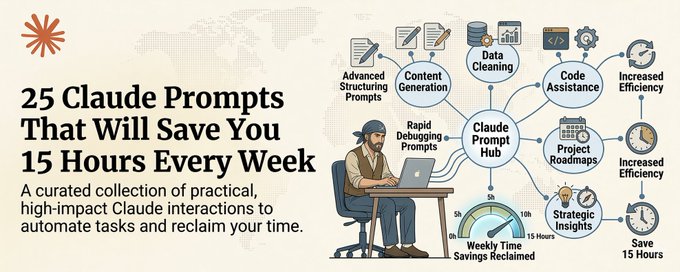
# 25 Claude Prompts That Will Save You 15 Hours Every Week
**作者**: Khairallah AL-Awady
**日期**: 2026-04-14T09:09:55.000Z
**来源**: [https://x.com/eng_khairallah1/status/2043980058378002592](https://x.com/eng_khairallah1/status/2043980058378002592)
---
## Introduction
I spent 6 months testing prompts daily. These 25 are the only ones I still use.
Save this :)
Most prompt lists are full of gimmicks. "Act as a pirate and explain quantum physics." Cool party trick. Zero practical value.
These are different. Every prompt on this list solves a real problem that costs you real time every single week. Copy them. Paste them. Get your hours back.
## Writing & Content (1-7)
### 01. The First Draft Killer
I need a first draft of [TYPE: blog post / newsletter / article] about [TOPIC].
Audience: [WHO THEY ARE]
Tone: [SPECIFIC TONE — e.g., direct and slightly irreverent]
Length: [WORD COUNT]
Does NOT sound like: generic AI, corporate jargon, LinkedIn influencer
Does NOT include: filler phrases, unnecessary caveats, "in today's fast-paced world"
Here is an example of my writing style:
[PASTE YOUR BEST PREVIOUS PIECE]
Match the voice and energy of the example. Write a complete first draft.
Why it works: The negative constraints kill the AI smell. The example teaches Claude your voice better than any description ever could. This single prompt replaced 90 minutes of staring at a blank page.
### 02. The Thread Expander
Turn this idea into a 10-post X/Twitter thread:
[PASTE YOUR IDEA OR HOT TAKE]
Rules:
- Post 1 must be a hook that creates curiosity or makes a bold claim
- Each post should be 1-3 sentences max
- Include specific examples and numbers, not vague claims
- Post 10 must include a clear call to action
- No hashtags. No emojis unless absolutely necessary
- Does NOT sound like: a motivational speaker or LinkedIn guru
Why it works: The structure constraint forces a logical narrative. The negative constraints keep it from sounding like every other AI thread on the timeline.
### 03. The Content Repurposer
I have one piece of long-form content. Repurpose it into multiple formats.
Original content:
[PASTE YOUR ARTICLE / NEWSLETTER / TRANSCRIPT]
Create:
1. 5 standalone tweets (each should work on its own, not just be a quote from the article)
2. 2 LinkedIn posts (professional but not boring, max 200 words each)
3. 3 Instagram caption options (casual, conversational, under 150 words)
4. 1 email teaser to drive traffic to the original piece (under 100 words, curiosity-driven subject line)
Keep my voice consistent across all formats. Adapt length and tone to each platform but the core message stays the same.
Why it works: One hour of writing becomes an entire week of content across 4 platforms. The "standalone" instruction prevents lazy extraction where every tweet is just a sentence ripped from the article.
### 04. The Headline Machine
Generate 20 headline variations for this topic: [TOPIC]
Use these frameworks (at least 2 headlines per framework):
- Curiosity gap: "Why X does Y (and what it means for Z)"
- Specific numbers: "7 ways to..." or "I tested 200 tools and..."
- How-to: "How to X without Y"
- Contrarian: "X is wrong. Here's why."
- Social proof: "How I / we achieved X"
- "I want to" format: "I want to [aspirational goal] (full course)"
Rank your top 5 picks and explain why each one would stop someone mid-scroll.
Why it works: Most people write one headline and hope for the best. This generates 20 options across proven frameworks and forces Claude to evaluate which ones are actually scroll-stopping.
### 05. The Email Sequence Writer
Write a 5-email welcome sequence for [PRODUCT/SERVICE].
Target audience: [WHO]
Main pain point: [THEIR BIGGEST PROBLEM]
Goal of the sequence: [WHAT YOU WANT THEM TO DO BY EMAIL 5]
For each email provide:
- Subject line (under 50 characters, curiosity-driven)
- Preview text (under 90 characters)
- Body (under 200 words, conversational, one clear CTA)
- Send timing (days after signup)
- A/B subject line variation
Rules:
- Email 1 delivers immediate value, no selling
- Email 2 tells a story that connects to their pain point
- Email 3 introduces the solution subtly
- Email 4 provides social proof or a case study
- Email 5 makes the direct ask with urgency
Each email should feel like it came from a person, not a marketing department.
Why it works: This single prompt replaces what a copywriter charges $500 to $2,000 to produce. The structure ensures each email serves a strategic purpose rather than just filling an inbox.
### 06. The SEO Content Brief
Create a complete content brief for a blog post targeting the keyword: [KEYWORD]
Include:
1. Recommended title (include target keyword naturally)
2. Meta description (under 155 characters, includes keyword)
3. Suggested URL slug
4. Target word count
5. Article outline with H2 and H3 headings
6. 5 related keywords to include naturally throughout
7. 3 internal linking opportunities (suggest anchor text and where to link)
8. 2 external source suggestions for credibility
9. Featured snippet opportunity (format the section most likely to win a snippet)
The brief should be detailed enough that any writer could produce the article without additional research.
Why it works: This turns a 2-hour research and planning session into a 2-minute prompt. The featured snippet section alone is worth the effort because most writers never optimize for it.
### 07. The Voice Cloner
Analyze the following writing samples and extract my writing voice:
[PASTE 2-3 OF YOUR BEST PIECES]
Create a "Voice Profile" that includes:
- Sentence length patterns (short, medium, long, or mixed)
- Vocabulary level (simple, technical, academic)
- Tone qualities (list 5 adjectives)
- Structural habits (paragraph length, use of subheadings, lists vs prose)
- Phrases or patterns I use frequently
- Things I never do (formal vs casual markers)
- Energy level (calm, intense, urgent, conversational)
Then write a 200-word sample paragraph about [ANY TOPIC] using this exact voice profile. I will compare it to my actual writing to verify accuracy.
Why it works: Run this once and save the output as a context file. Every future prompt gets your voice right the first time instead of sounding like every other AI output on the internet.
## Research & Analysis (8-14) 🔍
### 08. The Meeting Prep Brief
I have a meeting with [PERSON NAME] from [COMPANY] in [TIME].
Research and create a one-page brief covering:
1. Their background (role, career highlights, relevant experience)
2. Their company (what they do, recent news, current challenges)
3. Any recent public statements, articles, or social posts from them
4. 3 talking points that would be relevant to our meeting topic: [TOPIC]
5. 3 smart questions to ask them
6. 1 potential common ground or shared interest to build rapport
Format as a scannable document I can read in 5 minutes before the call.
Why it works: This replaced 30 minutes of LinkedIn stalking and Google searching before every meeting. The "common ground" section alone has opened more doors than any other prep step.
### 09. The Decision Matrix
I need to make a decision about [DECISION].
My options are:
1. [OPTION A]
2. [OPTION B]
3. [OPTION C — optional]
My priorities (ranked):
1. [MOST IMPORTANT FACTOR]
2. [SECOND MOST IMPORTANT]
3. [THIRD MOST IMPORTANT]
For each option:
- Score it 1-10 on each priority factor
- List the top 2 risks
- List the top 2 advantages
- Identify what I would need to be true for this option to be the best choice
Then give me your recommended option with reasoning in 3 sentences.
Do NOT hedge. Pick one and defend it.
Why it works: The "do not hedge" instruction is everything. Without it, Claude gives you a balanced analysis that helps nobody. With it, you get a clear recommendation you can either follow or argue against.
### 10. The Competitor Breakdown
Analyze [COMPETITOR NAME / URL] as if you were a competitive intelligence analyst.
Cover:
1. What they sell and to whom (be specific about segments)
2. Their pricing model and approximate price points
3. Their positioning (how they describe themselves vs how the market sees them)
4. Their strongest feature or differentiator
5. Their biggest weakness or gap
6. Recent moves (product launches, hires, partnerships, funding)
7. What they do better than us: [YOUR COMPANY/PRODUCT]
8. What we do better than them
End with: 3 strategic opportunities we could exploit based on their weaknesses.
Use only factual information. If you are not confident about a claim, flag it as unverified.
Why it works: This replaces a full afternoon of competitive research
---
## 中文翻译
# 25 个能让你每周节省 15 小时的 Claude 提示词
**作者**: Khairallah AL-Awady
**日期**: 2026-04-14T09:09:55.000Z
**来源**: [https://x.com/eng_khairallah1/status/2043980058378002592](https://x.com/eng_khairallah1/status/2043980058378002592)
---

## 前言
我花了 6 个月时间,每天测试提示词。这 25 个是我唯一保留下来还在用的。
赶紧收藏吧 :)
大多数提示词列表里都充满了噱头。“像个海盗那样解释量子物理。”这倒是个不错的派对把戏,但没有任何实用价值。
这些不一样。列表中的每一个提示词都能解决一个真实的问题,一个每周都在实实在在浪费你时间的问题。复制它们。粘贴它们。把你的时间夺回来。
## 写作与内容 (1-7)
### 01. 初稿终结者
我需要一篇关于 [TOPIC] 的 [TYPE: 博文 / 通讯 / 文章] 的初稿。
受众:[WHO THEY ARE]
语气:[SPECIFIC TONE — 例如:直接且略带反讽]
篇幅:[WORD COUNT]
**绝不能**听起来像:通用的 AI、企业行话、领英网红
**绝不能**包含:填充词、不必要的限定词、“在当今快节奏的世界里”
这里有一个我过往写作风格的例子:
[PASTE YOUR BEST PREVIOUS PIECE]
匹配例子的语调和能量。写一份完整的初稿。
**为什么有效**:否定约束能消除 AI 的味道。例子比任何描述都能更有效地教会 Claude 你的语调。这一个提示词替代了盯着空白屏幕发呆的 90 分钟。
### 02. 推文串生成器
将这个点子变成一条包含 10 个推文的 X/Twitter 串:
[PASTE YOUR IDEA OR HOT TAKE]
规则:
- 第 1 条推文必须是一个能制造好奇心或提出大胆论点的钩子
- 每条推文最多 1-3 句话
- 包含具体的例子和数字,而不是模糊的宣称
- 第 10 条推文必须包含明确的行动号召
- 不要标签。除非绝对必要,否则不要表情符号
- **绝不能**听起来像:励志演说家或领英大师
**为什么有效**:结构约束强制了逻辑叙事。否定约束防止了它听起来像时间线上其他千篇一律的 AI 生成串。
### 03. 内容改编器
我有一篇长篇内容。请将其改编为多种格式。
原始内容:
[PASTE YOUR ARTICLE / NEWSLETTER / TRANSCRIPT]
创建:
1. 5 条独立的推文(每条都能独立成立,而不仅仅是文章引用)
2. 2 篇领英帖子(专业但不枯燥,每篇最多 200 字)
3. 3 个 Instagram 文案选项(随意、对话式,150 字以内)
4. 1 个为原内容引流的邮件预告(100 字以内,基于好奇心的标题)
在所有格式中保持我的语调一致。根据平台调整篇幅和语气,但核心信息保持不变。
**为什么有效**:一小时的写作变成了覆盖 4 个平台的一整周内容。“独立”的指令防止了偷懒的提取,即避免每条推文都只是从文章中生硬摘录的一句话。
### 04. 标题生成机
针对这个主题生成 20 个标题变体:[TOPIC]
使用以下框架(每个框架至少 2 个标题):
- 好奇心缺口:“为什么 X 会做 Y(这对 Z 意味着什么)”
- 具体数字:“7 种方法……”或“我测试了 200 个工具……”
- 如何做:“如何在没有 Y 的情况下实现 X”
- 反直觉:“X 是错的。原因如下。”
- 社会证明:“我是 / 我们如何实现了 X”
- “我想要”格式:“我想要 [aspirational goal](完整教程)”
对你选出的前 5 名进行排名,并解释为什么每一个都能让人在滑动时停下来。
**为什么有效**:大多数人写一个标题,然后听天由命。这会根据经过验证的框架生成 20 个选项,并强制 Claude 评估哪些真正能让人停下滑动的手指。
### 05. 邮件序列写手
为 [PRODUCT/SERVICE] 写一个包含 5 封邮件的欢迎序列。
目标受众:[WHO]
主要痛点:[THEIR BIGGEST PROBLEM]
序列目标:[WHAT YOU WANT THEM TO DO BY EMAIL 5]
对于每封邮件,提供:
- 主题行(50 字符以内,基于好奇心)
- 预览文本(90 字符以内)
- 正文(200 字以内,对话式,一个明确的 CTA)
- 发送时间(注册后的天数)
- A/B 测试主题行变体
规则:
- 邮件 1 提供即时价值,不推销
- 邮件 2 讲一个与他们的痛点相关的故事
- 邮件 3 微妙地介绍解决方案
- 邮件 4 提供社会证明或案例研究
- 邮件 5 带有紧迫感地直接提出请求
每封邮件都应感觉像是来自一个人,而不是市场部。
**为什么有效**:这单个提示词替代了文案撰稿人收费 500 到 2000 美元才能产出的内容。该结构确保每封邮件都服务于战略目的,而不仅仅是塞满收件箱。
### 06. SEO 内容简报
针对关键词:[KEYWORD] 创建一份完整的博文内容简报。
包括:
1. 推荐标题(自然包含目标关键词)
2. Meta 描述(155 字符以内,包含关键词)
3. 建议 URL slug
4. 目标字数
5. 包含 H2 和 H3 标题的文章大纲
6. 5 个需自然包含的相关关键词
7. 3 个内部链接机会(建议锚文本和链接位置)
8. 2 个用于建立可信度的外部来源建议
9. 精选摘要机会(格式化最有可能赢得摘要的部分)
简报应足够详细,以便任何撰稿人无需额外研究即可写出文章。
**为什么有效**:这将 2 小时的研究和规划工作变成了一个 2 分钟的提示词。仅“精选摘要”部分就值得付出努力,因为大多数撰稿人从未为此进行过优化。
### 07. 语调克隆器
分析以下写作样本并提取我的写作语调:
[PASTE 2-3 OF YOUR BEST PIECES]
创建一个“语调档案”,包括:
- 句子长度模式(短、中、长或混合)
- 词汇水平(简单、技术、学术)
- 语气特质(列出 5 个形容词)
- 结构习惯(段落长度、使用子标题、列表与散文)
- 我经常使用的短语或模式
- 我从不做的事(正式与非正式标记)
- 能量水平(冷静、强烈、紧急、对话式)
然后使用这个确切的语调档案写一个关于 [ANY TOPIC] 的 200 字样本段落。我将将其与我的实际写作进行比较以验证准确性。
**为什么有效**:运行一次并将输出保存为上下文文件。未来的每一个提示词都能一次就搞定你的语调,而不是听起来像互联网上其他千篇一律的 AI 输出。
## 研究与分析 (8-14) 🔍
### 08. 会议准备简报
[TIME] 后,我要与 [COMPANY] 的 [PERSON NAME] 开会。
请研究并创建一份一页的简报,涵盖:
1. 他们的背景(职位、职业亮点、相关经验)
2. 他们的公司(业务范围、近期新闻、当前挑战)
3. 他们最近的任何公开声明、文章或社交媒体帖子
4. 3 个与我们会议主题相关的谈话要点:[TOPIC]
5. 3 个可以问他们的高明问题
6. 1 个潜在的共同点或共同兴趣以建立融洽关系
格式化为一份可在通话前 5 分钟阅读的可扫描文档。
**为什么有效**:这替代了每次会议前 30 分钟的领英挖掘和谷歌搜索。仅“共同点”部分就比任何其他准备步骤都更能打开机会之门。
### 09. 决策矩阵
我需要针对 [DECISION] 做出决定。
我的选项是:
1. [OPTION A]
2. [OPTION B]
3. [OPTION C — optional]
我的优先级(排名):
1. [MOST IMPORTANT FACTOR]
2. [SECOND MOST IMPORTANT]
3. [THIRD MOST IMPORTANT]
对于每个选项:
- 按每个优先级因素进行 1-10 分评分
- 列出前 2 大风险
- 列出前 2 大优势
- 确定需要具备哪些条件,该选项才能成为最佳选择
然后给我你推荐的选项,并用 3 句话说明理由。
**不要**含糊其辞。选一个并捍卫它。
**为什么有效**:“不要含糊其辞”的指令是关键。没有它,Claude 会给你一个毫无用处的平衡分析。有了它,你会得到一个明确建议,你可以选择遵循或反驳。
### 10. 竞争对手剖析
作为一名竞争情报