从零到 AI 工程师的 4 个月速成路径 ✍ AI Guides🕐 2026-07-08📦 54.0 KB 🟢 已读 𝕏 文章列表 本文指出 AI 工程是当前增长最快的高薪职位之一,且学历门槛正在降低。文章为转行者规划了一条为期 4 个月的高效学习路径,强调跳过繁重的数学理论,专注于 API 调用、Prompt 设计和 RAG 等工程落地技能,并分析了常见的转型误区与市场机遇。 AI工程师职业发展学习路径LLM转行教程RAGAPI提示工程职场指南 # You can go from zero to hireable AI engineer in 4 months. Here's the exact path. **作者**: AI Guides **日期**: 2026-07-07T16:32:16.000Z **来源**: [https://x.com/free_ai_guides/status/2074531958600638877](https://x.com/free_ai_guides/status/2074531958600638877) --- 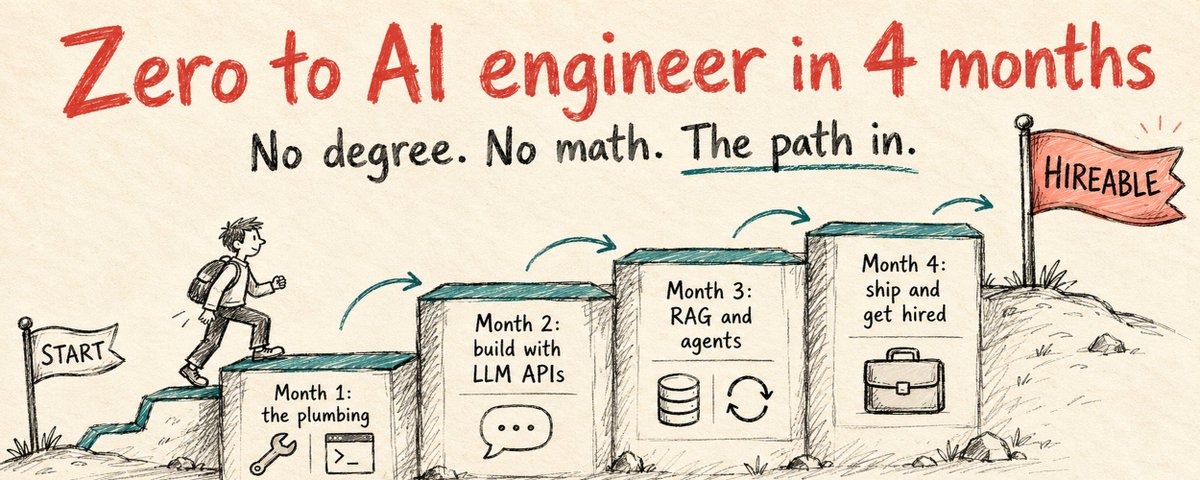 AI engineering is one of the best-paid, fastest-growing jobs in tech right now. And the door to it just got wider than it's ever been. Most guides get this wrong. They hand you a wall of theory, tell you to master linear algebra and neural network math, and lose you by week two. Or they bury you in 80 links with no order and no verdict, so you spend more time deciding what to study than actually studying. 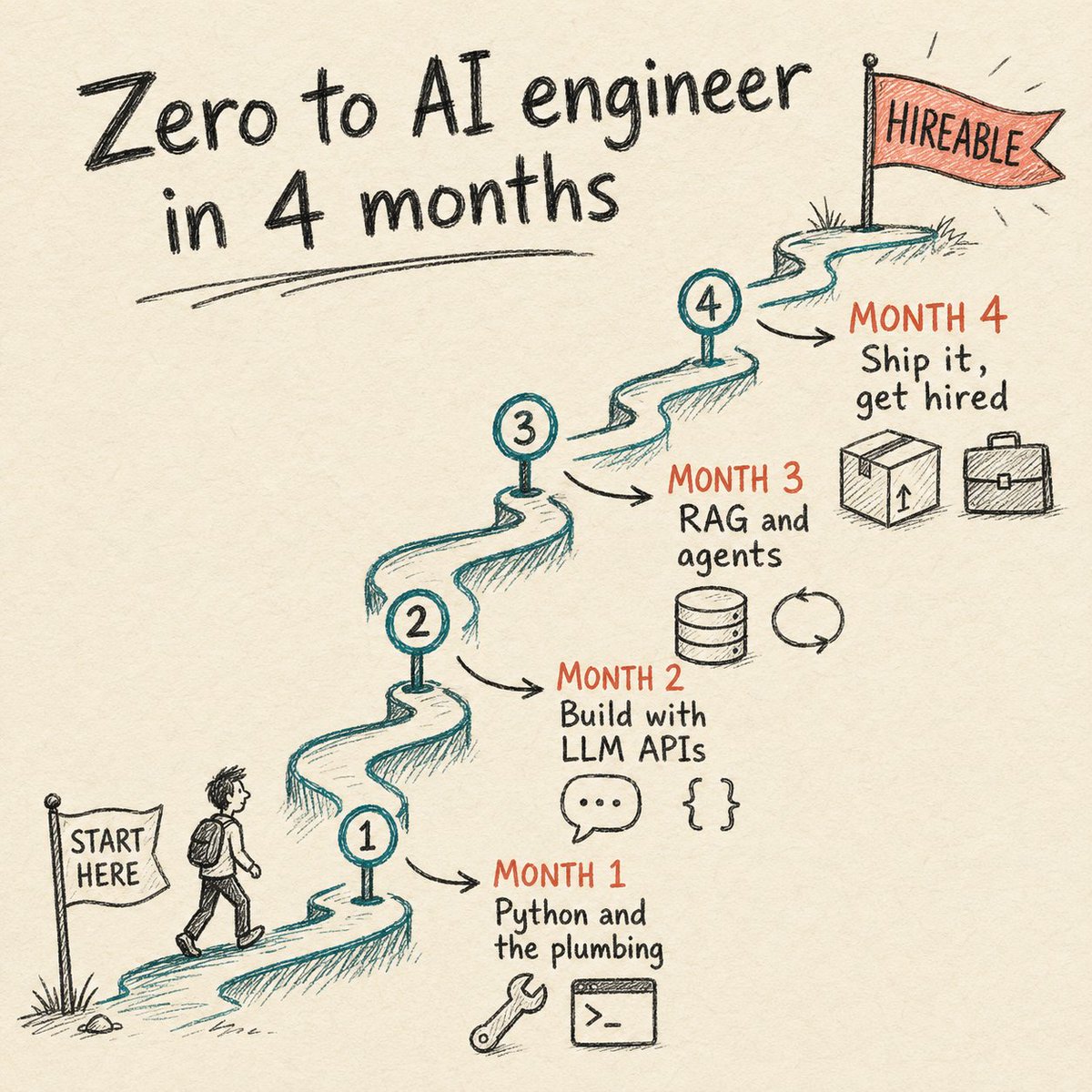 I read through the popular roadmaps, tested the tools they recommend, and built the version I'd hand to a friend who's switching careers and has real work to do. No math degree. No 4-year plan. Four focused months, one clear pick per skill, real prompts you can copy, and the mistakes that quietly kill most career switches before they start. Here's why I think the timing matters, then the full path. ## Why the door is open (and I can prove it) You've probably been told AI is going to take jobs. Here's the part that gets less airtime: it's creating a specific, well-paid category of job faster than almost anything else in the market, and the usual gatekeeper is falling away. 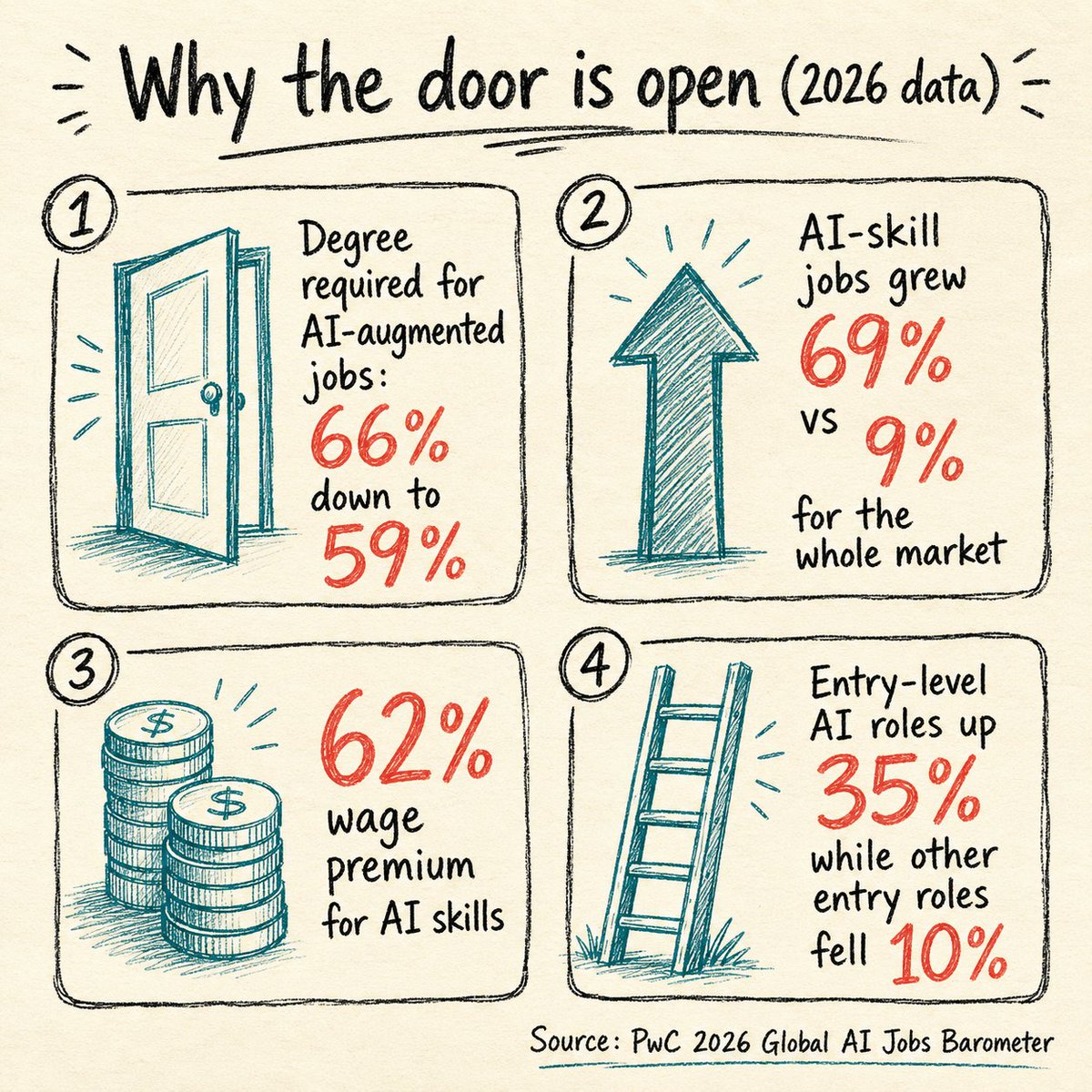 PwC's 2026 Global AI Jobs Barometer analyzed over a billion job ads across six continents. Three findings matter for anyone thinking about a switch. First, jobs that require AI skills are growing about eight times faster than the overall market. AI-skill roles grew 69% while the total jobs market grew 9%. That's not a rounding error. That's a category pulling away from everything around it. Second, the pay premium is real and rising. Workers with AI skills command a 62% wage premium over comparable roles without them, up from 57% the year before. Companies are paying more, not less, for people who can actually build with these tools. 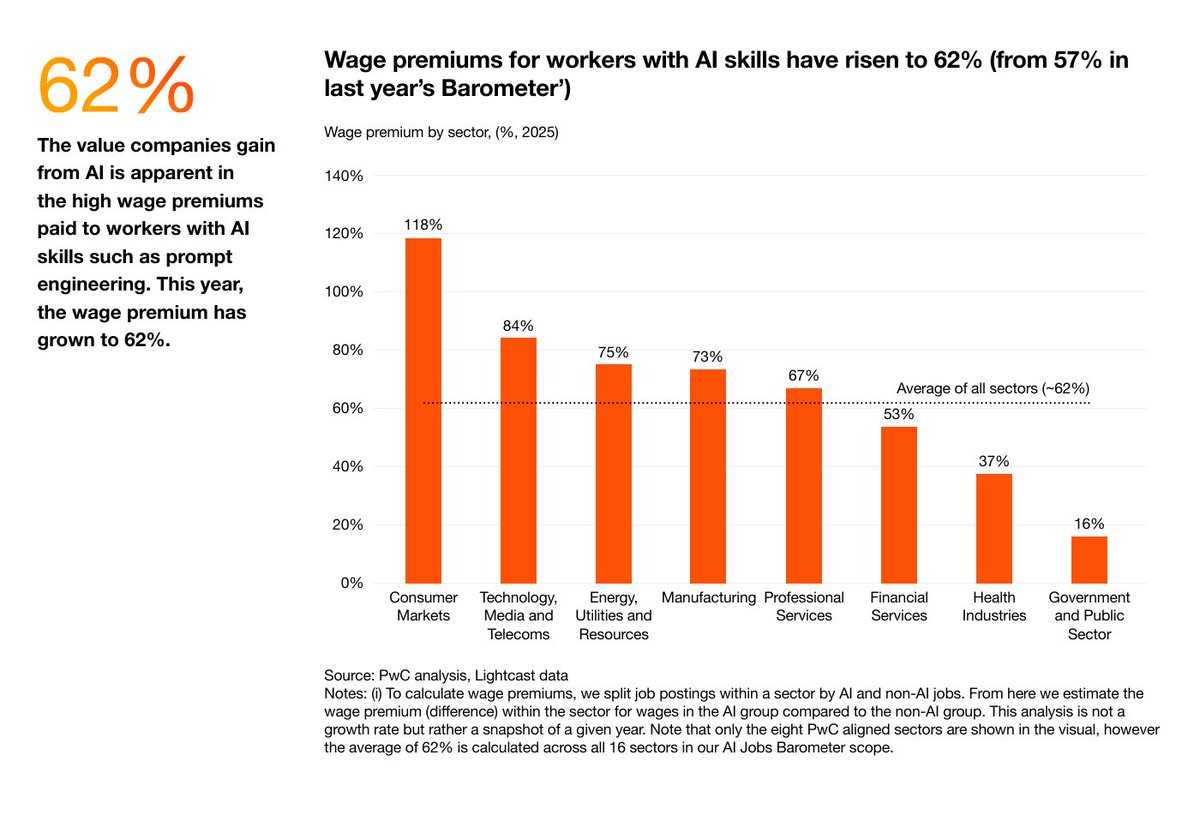 Third, and this is the one that changes the math for career switchers: the degree requirement is falling, and it's falling fastest for exactly these roles. PwC found that the share of AI-augmented jobs requiring a degree dropped from 66% to 59% between 2019 and 2024. For jobs where AI automates parts of the work, it fell further, from 53% to 44%. Employers are dropping the credential filter faster in AI-exposed work than anywhere else. There's one more number worth sitting with. In the US, entry-level roles most exposed to AI grew 35% since 2019. Over the same period, other entry-level roles declined 10%. The bottom rung of the AI ladder is getting wider while the rest of the entry-level market shrinks. Now the honest counterweight, because I'm not here to sell you a fantasy. PwC also found that AI-exposed entry-level roles increasingly ask for skills that used to be reserved for senior people: judgment, communication, the ability to own an outcome instead of a task. The bar isn't lower across the board. It moved. It's less "do you have the credential" and more "can you actually make this work and explain why it works." Read that as bad news if you're a fresh graduate with no work history. Read it as good news if you're switching from another career, because you already have the thing they're now asking for. You've shipped things. You've dealt with stakeholders. You've owned outcomes under pressure. A 22-year-old with a CS degree usually hasn't. If you pair your existing judgment with the technical skills in this guide, you're not behind the new grads. On the axis employers care most about, you're ahead of them. That's the switcher's edge, and almost no roadmap tells you about it. Keep it in your back pocket for the whole four months. It's the reason this is realistic for you specifically. A quick word on the money, because you'll want the real numbers before you commit four months. I'll give the full breakdown at the end with sources, but the short version: as of mid-2026, Glassdoor puts the average US AI engineer salary at around $143,500, with a typical range of roughly $115,000 to $181,000. Senior roles run much higher. Recruiters placing people in production AI work report mid-level base salaries clustering between $155,000 and $200,000. These aren't hype figures pulled from a hype thread. They're current, and I'll show you where each one comes from. ## What an AI engineer actually does (the 60-second version) Before the plan, let's kill the biggest source of intimidation, because it stops more people than any technical hurdle. When most people hear "AI engineer," they picture someone in a lab training a giant model from scratch, surrounded by GPUs and math they'll never understand. That's a different job. It's called a research scientist or an ML researcher, there are relatively few of them, and it usually does require the advanced degrees. 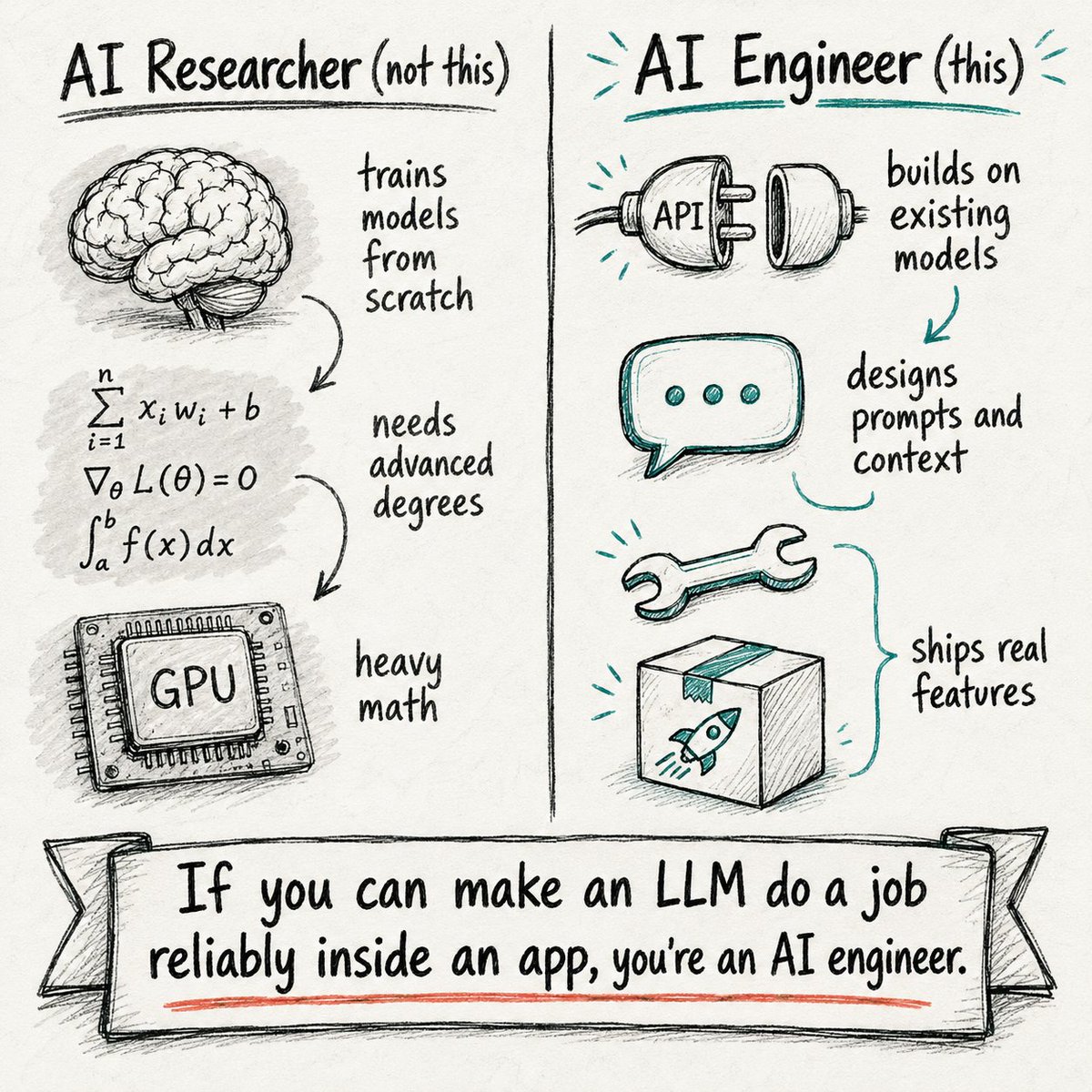 The AI engineer job that's growing eight times faster than the market is a different thing entirely. You build products and features on top of models that already exist. You take Claude, or GPT, or an open-source model, and you make it do a specific, reliable job inside a real application. In practice, that means you connect to model APIs, design the prompts and the context you feed them, get structured data back out, wire the model up to tools and databases, make it retrieve the right information, handle everything that can go wrong, and deploy it so real people can use it. It sits between software engineering, product work, and applied AI. You're a builder, not a researcher. Here's the one-line test I'd use. If you can make an LLM do a specific job reliably inside an app, and you understand enough to fix it when it breaks, you're an AI engineer. That's the whole thing. Everything in this guide is aimed at getting you to that sentence being true about you. You do not need to know how a transformer works internally. You do not need calculus. You do not need to be able to derive backpropagation. You need to be a competent builder who understands how to work with these models in the real world. That's a learnable skill, and four focused months is enough to get functional at it. ## Read this before Month 1: the 4 mistakes that kill career switches I'm putting this before the roadmap on purpose. Most guides bury the mistakes at the end, but the mistakes that end a career switch happen in week two, not month three. If you only remember one section of this guide, make it this one. I've watched people, including an earlier version of me, make every one of these. None of them are about intelligence. They're about strategy. Fix the strategy and the four months actually work. Mistake 1: Starting with theory and math. You get excited, you want to do this right, so you go find a machine learning course and start with linear algebra, gradient descent, and the math behind neural networks. Three weeks later you've watched a lot of lectures, you can't build anything, and you feel like an impostor. So you quit. The fix: skip it. For the job you're targeting, you don't need to derive the math. You need to build. You'll pick up the concepts you actually need as you hit them in real projects, and they'll stick because they'll be attached to something you built. Theory-first is the single most common reason smart people wash out of this. Don't start there. Mistake 2: Watching tutorials instead of building. This one's sneaky because it feels like progress. You watch a four-hour Python course, nod along, feel like you learned something. You didn't. You watched someone else learn something. The moment you open a blank file, none of it is there. 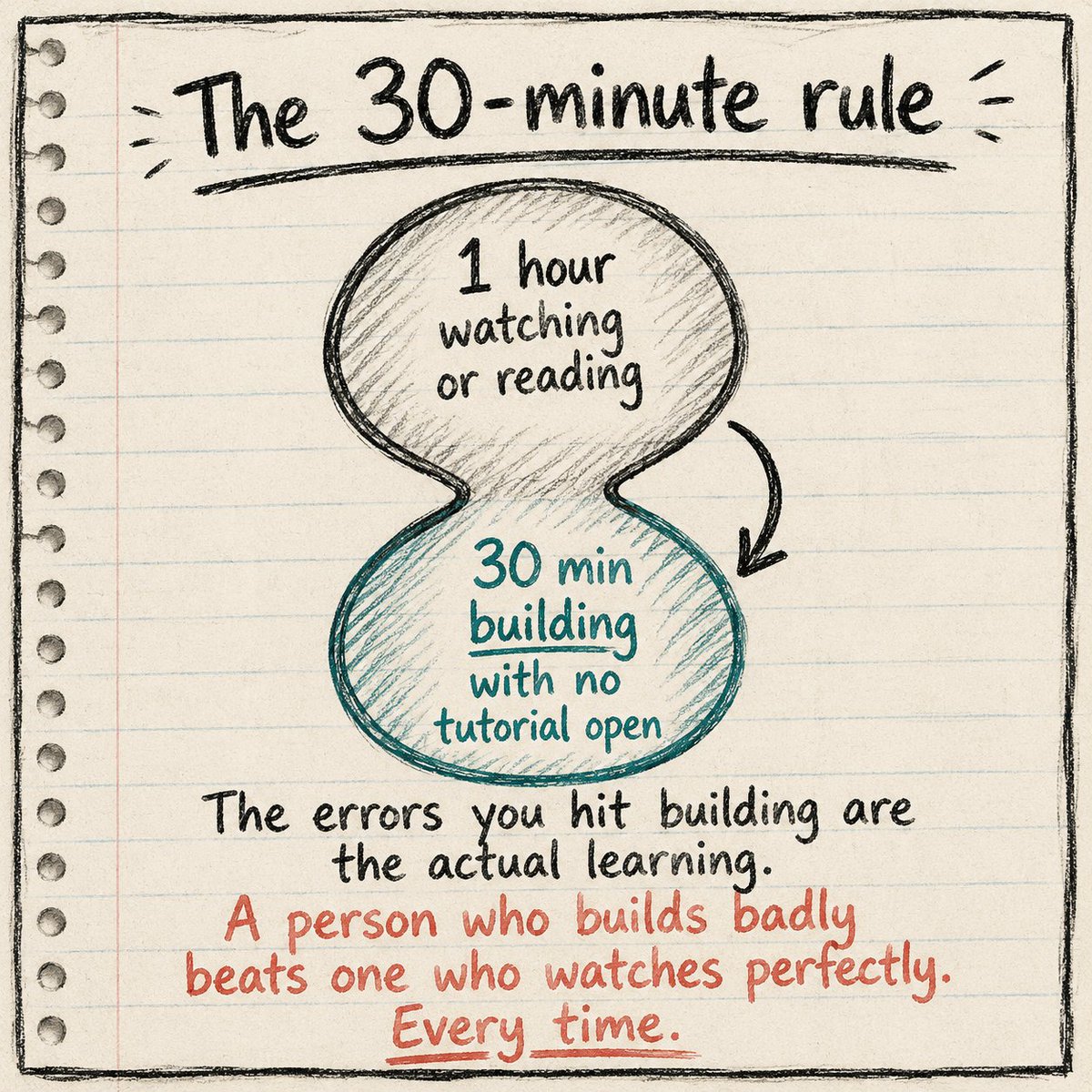 The fix: the 30-minute rule. For every hour you spend watching or reading, spend at least 30 minutes building something with no tutorial open. Type the examples yourself. Break them. Change them. Get errors and fix them. The errors are the learning. A person who builds badly for four months beats a person who watches perfectly for four months, every single time. Employers can see the difference in ten seconds of looking at your GitHub. Mistake 3: Learning tools instead of skills. You hear that LangChain is the thing, so you go deep on LangChain. Six months later the field has moved, everyone's on something else, and your LangChain knowledge feels wasted. So you chase the new tool. Then that one changes too. You're always behind because you're optimizing for the wrong layer. The fix: learn the skill under the tool. The skill of writing a prompt that produces reliable output doesn't expire when a framework updates. The skill of getting structured data from a model, or evaluating whether your system actually works, or deciding when a task needs an agent versus a single call, those transfer across every tool that will ever exist. Learn tools as a way to practice skills, not as the goal. This guide is organized around skills for exactly this reason. Mistake 4: Waiting until you feel ready to build in public. You decide you'll start sharing your work, applying for roles, or offering freelance services once you're "ready." You will never feel ready. Ready is a feeling that arrives after you start, not before. Meanwhile the people getting hired and getting clients are the ones who started sharing rough work months before they felt qualified. The fix: start building in public in Month 1. Post the small thing you made. Write up what you learned. Put every project on GitHub the day you finish it, even the ugly ones. The gap between "I'm learning" and "I'm building visibly" is where most switchers get stuck for a year. Close it early. Nobody is watching closely enough for your early work to embarrass you, and the compounding starts the day you begin. Keep these four in view the whole way through. The roadmap below is designed to avoid all of them by default: skill-first, build-first, tool-agnostic, public from day one. 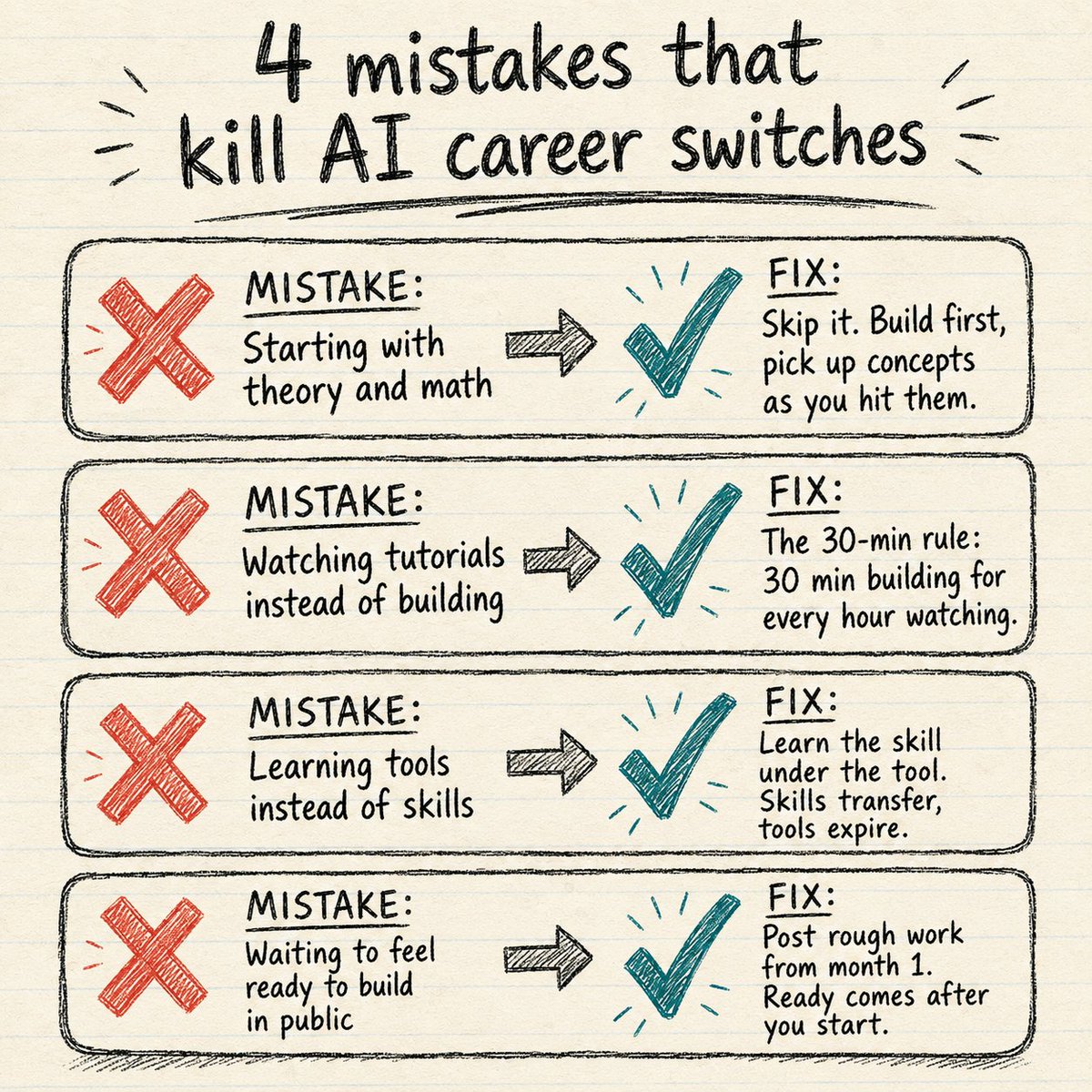 ## Month 1: Python and the plumbing Your goal this month: become a functional Python developer who can call an API, manage a small project, and stop Googling basic syntax. Not an expert. Functional. Everything in Months 2 through 4 assumes you can write clean Python and work in a terminal. This is the foundation, and rushing it will hurt you later. Here's the thing to internalize before you start: AI engineering is software engineering first. The AI part sits on top of a normal software stack. If the stack underneath is shaky, the AI part never gets reliable. So Month 1 is about getting comfortable enough with the basics that they stop being in your way. I'll give you one primary pick per skill, with a clear verdict on why. I'm deliberately not handing you five options per topic. Choice is the enemy of momentum. Pick the one I point at, and only branch out if it genuinely isn't working for you. 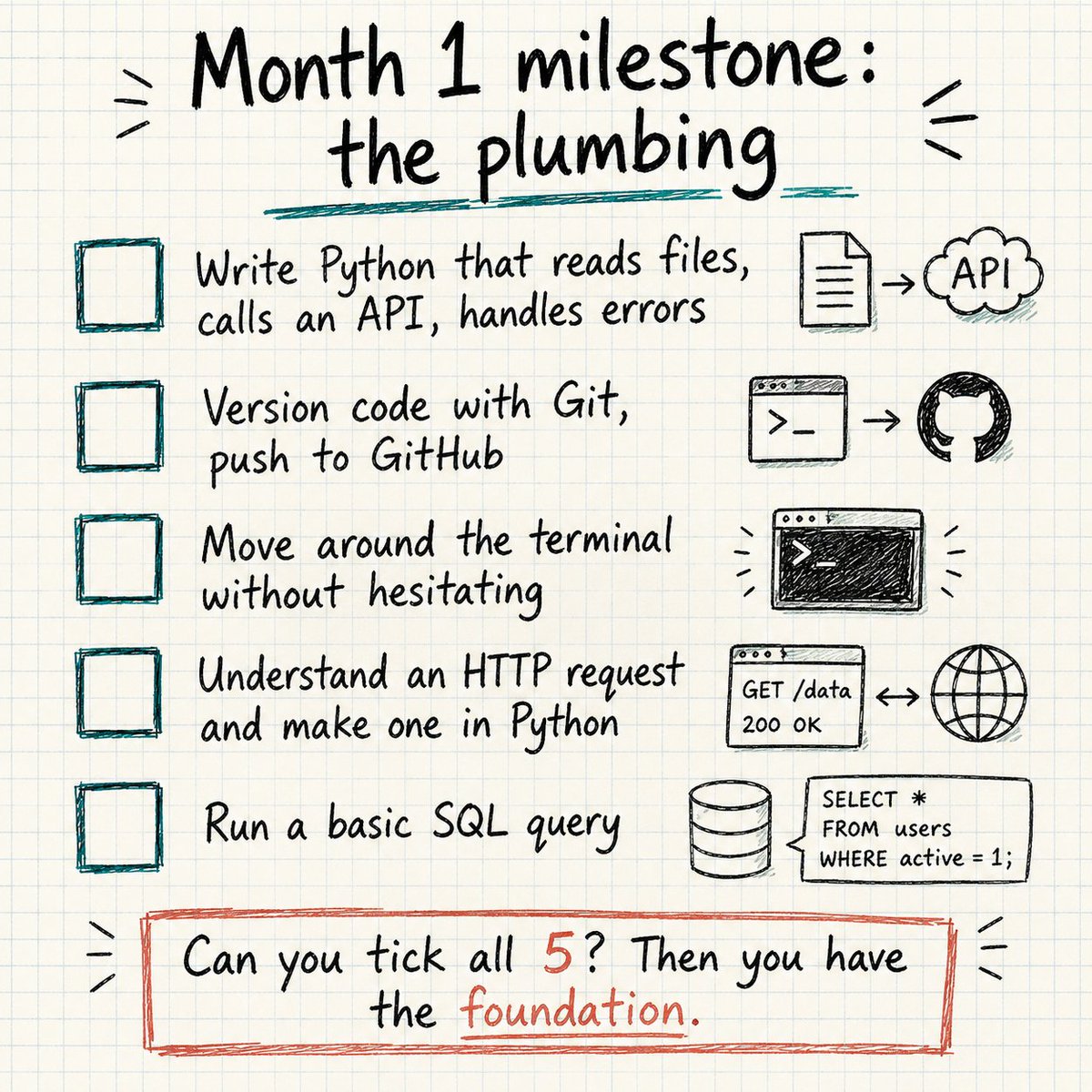 Python Python is the language of this entire field. Almost every library, API, tutorial, and job you'll touch over the next four months is in Python. You learn it, and everything else gets easier. My pick: CS50P, Harvard's Introduction to Programming with Python. Free, rigorous, and it forces you to actually solve problems instead of watching someone else solve them. The problem sets are the whole value. It's more demanding than a gentle YouTube course, and that's the point. You want the version that makes you struggle a little, because the struggle is where the skill forms. Find it at cs50.harvard.edu/python. If CS50P feels too steep as an absolute beginner, the freeCodeCamp Python course on YouTube is a softer on-ramp, but treat it as a warm-up, not the main event. Come back to CS50P once you're not scared of a blank file. What to actually focus on, in rough order: variables and data types, loops and conditionals, functions, then the collection types (lists, dictionaries, sets, tuples). Then file handling and reading and writing JSON, which you'll use constantly with AI APIs. Then just enough classes and object-oriented basics to read other people's code without panic. Then error handling with try and except. Finally, virtual environments and pip, so you can install packages without breaking your system. Don't try to memorize any of this. Understand it well enough to look it up fast, and build with it until it sticks. Your Month 1 build target for Python: a small command-line tool that does something real. An expense tracker that reads and writes to a JSON file is a good one. Or a script that calls a free public API and prints the results in a clean format. Something with maybe 60 to 100 lines of your own code. It doesn't matter if it's ugly. It matters that you wrote it. ## Learning with AI from day one This is where I'd do something the old roadmaps don't: use AI to learn AI, starting in week one. You have access to the best patient tutor ever built, and it costs nothing on the free tiers. When you hit an error you don't understand, don't spend 40 minutes on a forum. Paste it into Claude or ChatGPT and ask it to explain the error in plain English and walk you toward the fix without just handing you the answer. Here's a copy-paste prompt I'd set up on day one. Save it. This is the first of several artifacts in this guide worth bookmarking. Prompt: Your Python learning partner (Framework: FAG Learning Partner, by AI Guides) ``` Your job: act as my patient Python tutor while I learn to code as a career switcher. Context about me: - I am learning Python to become an AI engineer. - I am a complete beginner at coding but not at working hard. - I learn best by doing, not by being handed answers. What to do: - When I paste an error, explain in plain English what it means and what is likely causing it. Do not just give me the fixed code. - Point me toward the fix with a hint first. Only show the full solution if I ask twice. - When I share code I wrote, tell me one thing that works and one thing I could improve. Keep it to those two. - After I get something working, ask me one short question that checks whether I actually understood it. Rules: - No jargon without a one-line plain-English definition next to it. - Assume I want to learn, not just pass. Slightly slower is fine. - If I am about to build a bad habit, say so directly and kindly. Output: conversational, short, one concept at a time. ``` 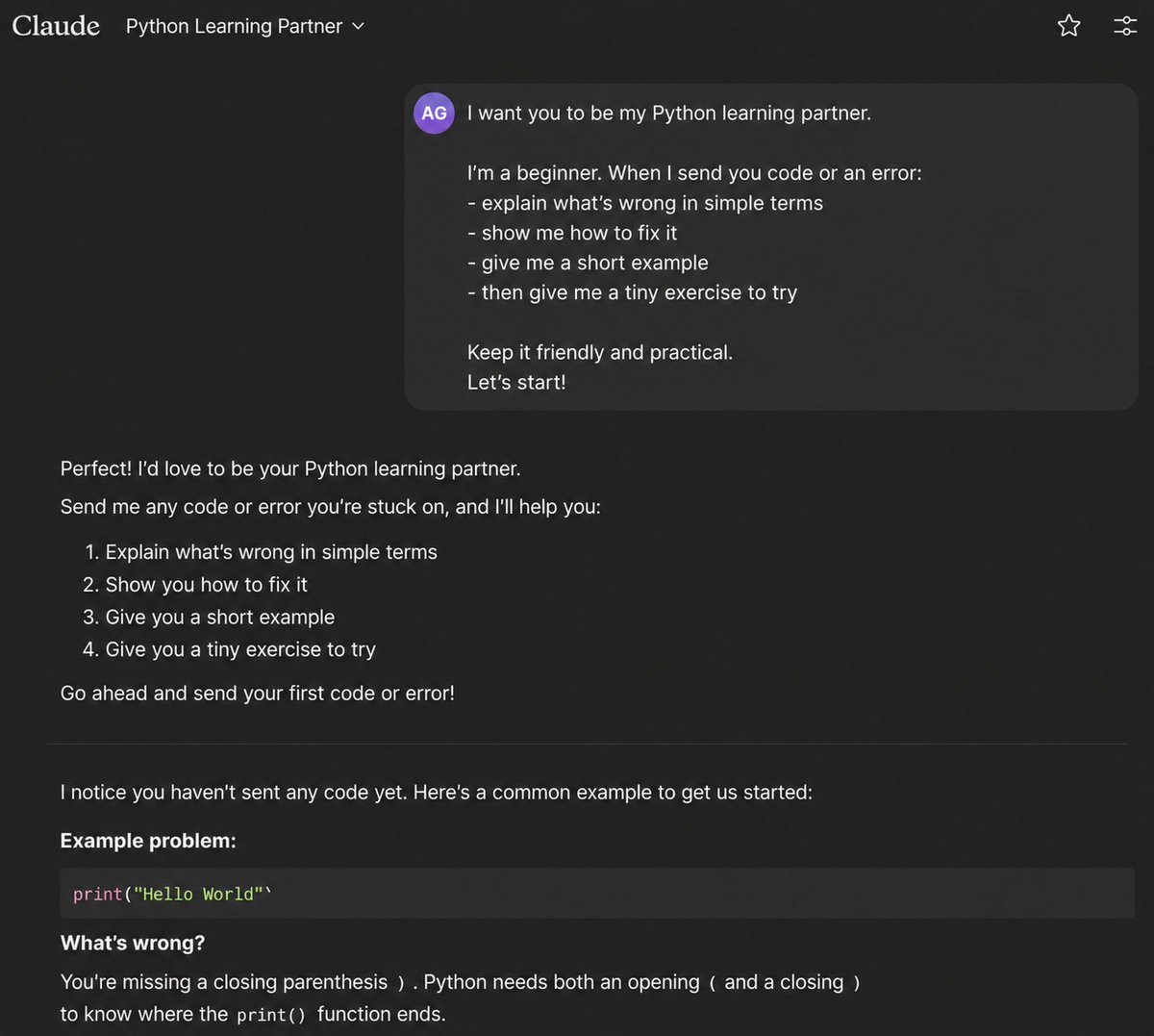 Use that every day this month. It turns the frustrating parts of learning to code into a conversation instead of a wall. It also gets you fluent at prompting, which is the core skill of Month 2, before you even know that's what's happening. One caution so you don't build the wrong habit: use the AI to understand and unblock, not to write the whole thing for you. If you let it write your code while you watch, you're back to Mistake 2. Make it explain. You type. Git and GitHub Git is how developers save, version, and share code. GitHub is where your work lives in public and becomes a portfolio. You'll use both constantly, and for a career switcher, GitHub is the closest thing you have to a resume until you have one. My pick: GitHub Skills. Free, interactive, and built by GitHub inside GitHub itself, so you learn the tool by using it. Start there rather than reading about Git in the abstract. Find it at skills.github.com. If the branching and merging model confuses you, and it confuses everyone at first, the Learn Git Branching visual tool makes it click by letting you see the branches move. What to focus on: the core loop of init, add, commit, push, and pull. Then branching and merging. Then what a .gitignore file does and why you never commit secrets or API keys to a public repo, which matters enormously once you're working with paid APIs. Then how to write a basic README, because your READMEs are going to do real work in your job search later. The habit to build this month: every project you touch, even a 20-line script, goes in a GitHub repo the day you make it. This is Mistake 4's fix in practice. You're building in public, quietly, from the start. By Month 4 you'll have a trail of work instead of a blank profile. The terminal You'll run scripts, install packages, and manage projects from the command line constantly. Being slow or scared in the terminal is a real drag on everything else, and it's an easy thing to fix. My pick: a short beginner terminal course to cover the basics, then just live in it. The MIT "Missing Semester" materials go deeper if you want them, but for Month 1 you only need navigation and running things. Learn cd, ls, pwd, mkdir, and rm for moving around and managing files. Learn cat and grep for reading and searching. Learn how to run a Python script from the terminal and how to set an environment variable, which you'll need the moment you're handling API keys. You don't need to become a shell wizard. You need to stop hesitating. A week of using the terminal for everything, even things you'd normally do with a mouse, gets you there. APIs, JSON, and HTTP This is the bridge to Month 2. From the first day of building with LLMs, you'll be making API calls, which means you need to understand how web APIs work before you touch OpenAI's or Anthropic's tools. My pick: the MDN Web Docs HTTP overview for the concepts, plus the Python requests library documentation for doing it in code. MDN explains how requests and responses work more clearly than anything else that's free. Then requests shows you how to make those calls in Python in a few lines. What to focus on: what GET and POST requests are and how to make them in Python. Reading and writing JSON, which is the format every AI API speaks. HTTP status codes and what the common ones mean, especially 200 for success, 401 for a bad API key, 429 for rate limiting, and 500 for a server error, because you'll see all of these constantly. What an API key is and how basic authentication works. And a light introduction to what async and await do in Python, which you'll need when you start streaming responses from models later. Don't go deep on async now. Just know it exists and roughly what problem it solves. Your build target here: a Python script that calls a free public API, one that needs no key like the Open-Meteo weather API, and prints the result as clean formatted output. This is a tiny version of exactly what you'll do all through Month 2, just without the AI part yet. A quick note on SQL You don't need to be a data person, but you'll regularly need to look at and query data, and basic SQL saves you constantly. My pick is SQLBolt, which is free, interactive, and teaches you the core of SQL in about 20 short in-browser lessons. Find it at sqlbolt.com. Focus on SELECT, WHERE, GROUP BY, JOIN, and ORDER BY. That's enough for now. You can go deeper the moment a project demands it. Month 1 milestone By the end of the month, you should be able to write a Python program that reads and writes files, calls an API, and handles its own errors without crashing. You should version that code with Git and have it live in a GitHub repo. You should move around the terminal without hesitating. You should understand what an HTTP request is and make one in Python. And you should be able to run a basic SQL query. If you can do those things, you have the foundation. Most people who quit never get here, and getting here is genuinely the hardest part because it's the least exciting. It gets more fun from Month 2 on, because from here you're building with AI. ## Month 2: Build with LLM APIs Your goal this month: build real AI-powered features using model APIs. 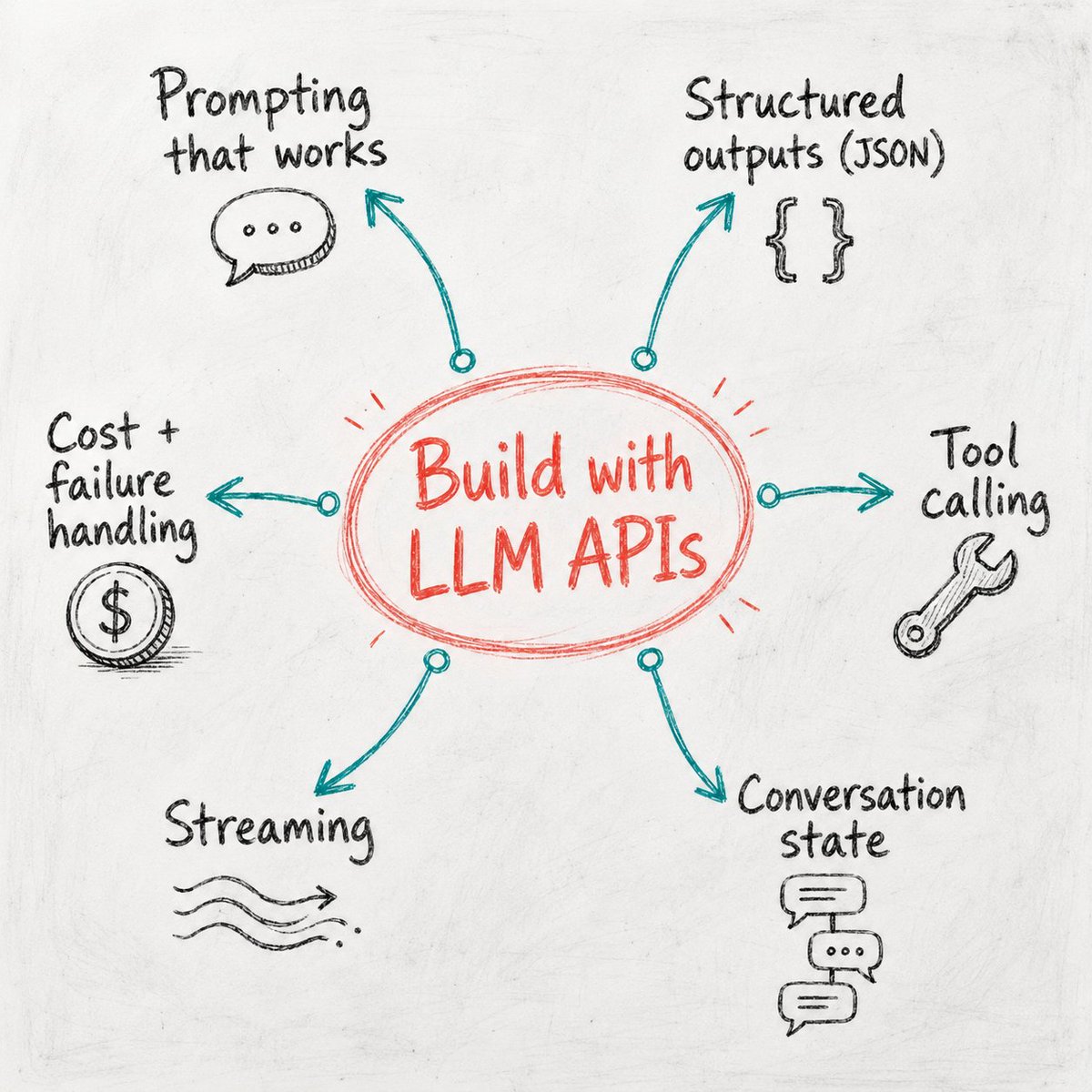 By the end, you should be comfortable writing prompts that produce reliable output, getting structured data back from a model, making the model call your own functions, managing a conversation, and handling everything that can break. This is the core of the whole job. Everything after this builds on it. This is the month where it starts to feel real. You stop doing setup and start making models do things. Take your time here. Depth in Month 2 pays off more than depth anywhere else in the guide. Prompting that actually works Prompting isn't asking a chatbot a question nicely. It's the skill of writing instructions that produce consistent, reliable output from a system that's fundamentally probabilistic. As an AI engineer, you'll spend more time here than you'd expect, and getting good at it is the highest-leverage thing you can do this month. My pick: Anthropic's interactive prompt engineering tutorial on GitHub. It's the most hands-on resource that exists, broken into chapters with real exercises you run against the Claude API. You practice writing and fixing prompts yourself instead of reading about it, which, if you remember Mistake 2, is the entire point. Find it in the anthropics/prompt-eng-interactive-tutorial repo. Once you've worked through it, Anthropic's and OpenAI's official prompt engineering docs are the reference you'll come back to. What to focus on: the difference between a system message and a user message, and why that difference matters. Why specificity beats politeness every time. Chain-of-thought prompting, where you ask the model to reason step by step before answering, which measurably improves results on anything with logic in it. Using examples inside your prompt, called few-shot prompting, to show the model the format you want. And developing a feel for how small wording changes produce large output changes, which only comes from doing it a lot. A build exercise that teaches this fast: take one real task, like summarizing a document or classifying a piece of feedback, and write five different prompts for it. Run all five. Compare the outputs side by side. You'll see immediately how much prompt design drives reliability, and that lesson sticks better than any lecture. Structured outputs In a real application, you almost never want a paragraph of text back from a model. You want structured data your code can parse, store, and use. Structured outputs solve this by forcing the model to return data that matches a schema you define. This is one of those skills that separates a demo from something that actually works inside software. My pick: the Instructor library for Python, backed by OpenAI's and Anthropic's official structured output docs. Instructor is the cleanest way to get structured data out of any major model using Pydantic, which is a Python library for defining the shape of your data. It works across providers with the same code and retries automatically when the model returns something malformed. It's close to what a lot of working engineers actually use, which makes it worth learning on real projects rather than a toy version. What to focus on: defining a Pydantic model that describes the data you want, passing that schema to the API, and handling the case where the model refuses or returns something unexpected. Understand the difference between true structured outputs, where the schema is enforced, and looser JSON mode, where it isn't guaranteed. Here's your second bookmarkable artifact, a prompt pattern for reliable structured extraction that works even before you add a library on top. Prompt: Structured data extraction (Framework: FAG Extractor, by AI Guides) ``` Your job: extract structured data from the text I provide and return it as clean JSON. What to do: - Read the input text carefully. - Pull out only the fields listed under Output below. - If a field is missing from the text, use null. Do not guess or invent. - Return only the JSON object. No explanation, no markdown, no preamble. Rules: - Every value must be traceable to something in the input text. - Dates in YYYY-MM-DD format. Numbers as numbers, not strings. - If the text is ambiguous, prefer null over a confident wrong answer. Output: a JSON object with these fields: { "field_one": string or null, "field_two": number or null, "field_three": list of strings or empty list } Input text: [PASTE THE TEXT HERE] ``` The tested-failure note, because I promised you the honest version: the first time you do this, the model will sometimes wrap the JSON in markdown code fences, or add a friendly sentence before it, and your parser will choke. That's normal. The fix is to strip code fences before parsing, and to be explicit in the prompt that you want only the JSON object, which the pattern above does. Once you've hit this once and handled it, you'll handle it forever. Your build target: a receipt or invoice parser. Feed it raw messy text like "Invoice 123, $45.99 for 3 widgets, due March 30" and get back a clean structured object with the invoice number, amount, item count, and due date. This is a genuinely useful little tool and a good portfolio piece. Tool calling Tool calling is what turns a text generator into something that can take actions: search the web, query a database, call your API, run code. It's one of the most important skills in this whole guide, and it's the foundation of everything in Month 3. The mental model that makes it click: the model doesn't run your functions. It looks at the conversation, decides a tool should be used, and returns a structured request naming the function and the arguments. Your code runs the function and hands the result back to the model. The model is the decision-maker. Your code is the hands. My pick: OpenAI's function calling guide and Anthropic's tool use docs, read together. The concepts are identical across both, the syntax differs slightly, and seeing both makes the underlying pattern obvious. Then work through a runnable notebook example, like the one in the OpenAI cookbook, so you see the full loop end to end instead of in pieces. What to focus on: describing your functions clearly in a schema, parsing the model's tool-call response, running the function and feeding the result back, and handling the case where the model decides no tool is needed. The quality of your tool descriptions matters more than beginners expect, which is a theme that comes back hard in Month 3. Your build target: a small assistant with three tools, like get_weather, calculate, and search_notes where search_notes just looks through a hardcoded dictionary. Wire them all up and watch the model decide which one to call based on what you ask. The moment you see it pick the right tool on its own, the concept lands permanently. Conversation state and streaming Two smaller but essential skills round out the month. Models have no memory between calls. A conversation is something you manage by sending the full message history with every request. Understanding this is fundamental, and it surprises almost everyone at first. My pick is OpenAI's and Anthropic's messages documentation. Focus on how the messages array is structured, why you append both the user's messages and the model's replies, what happens when you exceed the context window, and basic strategies for trimming old messages. Build a simple multi-turn terminal chatbot that keeps history and has a reset command. It's small and it teaches the concept completely. Streaming means showing the model's output as it's generated, word by word, instead of making the user wait for the whole thing. It makes apps feel dramatically faster. My pick is the official streaming docs from either provider, plus Simon Willison's clear write-up of how streaming works underneath. Focus on setting the stream option, iterating over the chunks, and assembling the full response from the pieces. For anything a real person will use, streaming is almost always the right call. Nobody wants to stare at a spinner for ten seconds. Cost, failure, and one security idea Three things that separate a hobby project from something you'd put in front of users. Cost and tokens: models charge per token, which is roughly three-quarters of a word. Input and output tokens are priced differently. Learn to estimate what a request will cost before you send it, keep the provider pricing pages bookmarked, and internalize one rule that saves real money: don't use the biggest, most expensive model for simple tasks. A cheaper model is often more than good enough, and the cost difference at scale is enormous. Failure handling: APIs fail. Rate limits get hit, requests time out, the model returns malformed output. Handling this gracefully is what makes something production-ready. Learn to catch rate-limit errors and retry with a growing delay between attempts, called exponential backoff. The Tenacity library in Python does this with a single decorator. Learn to validate the model's output before you trust it, and never let an unexpected response crash your whole app. Prompt injection, briefly: this is the top security risk in LLM apps. It happens when untrusted user input gets combined with your instructions, letting a user override or hijack what your system does. You don't need to become a security expert this month, but you need to know it exists before you ship anything. The OWASP guide on it is the authoritative reference. The core defenses: don't trust unvalidated model output to take consequential actions automatically, and give your tools the least access they need to do their job. Month 2 milestone By the end of the month, you should be able to write prompts that produce reliable output for a given task, get structured JSON out of a model with Pydantic and Instructor, wire up tool calling so a model can run your Python functions, stream a response in real time, manage multi-turn conversation history, estimate the token cost of a request before sending it, handle API errors and bad output without crashing, and explain what prompt injection is. 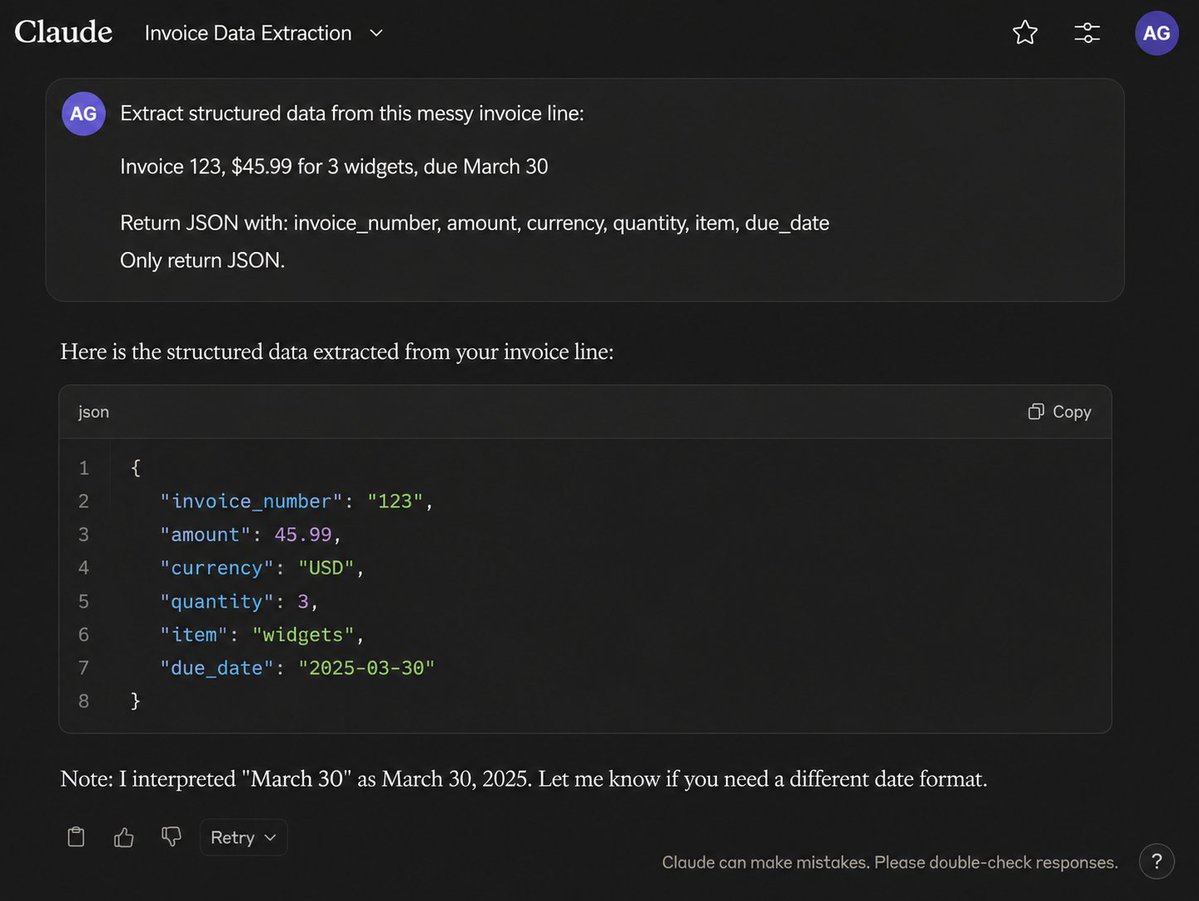 That's a real, employable skill set on its own. Plenty of paid AI features in production do exactly this and no more. But the next month is where you build the thing that actually gets you hired. 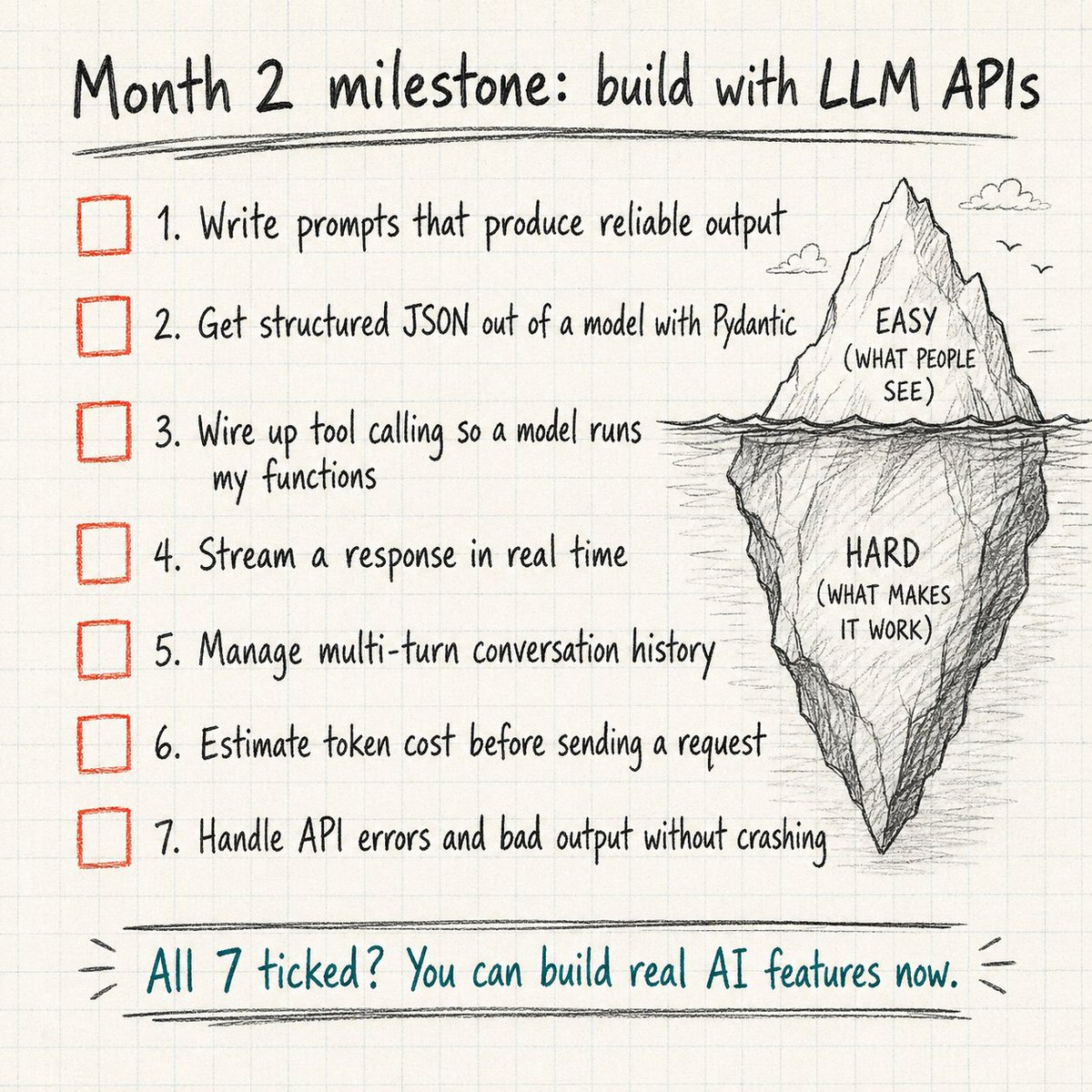 ## Month 3: RAG and agents, the skills that get you hired Your goal this month: build systems that let models answer from your documents instead of only their training data, and build systems that take multiple steps on their own. 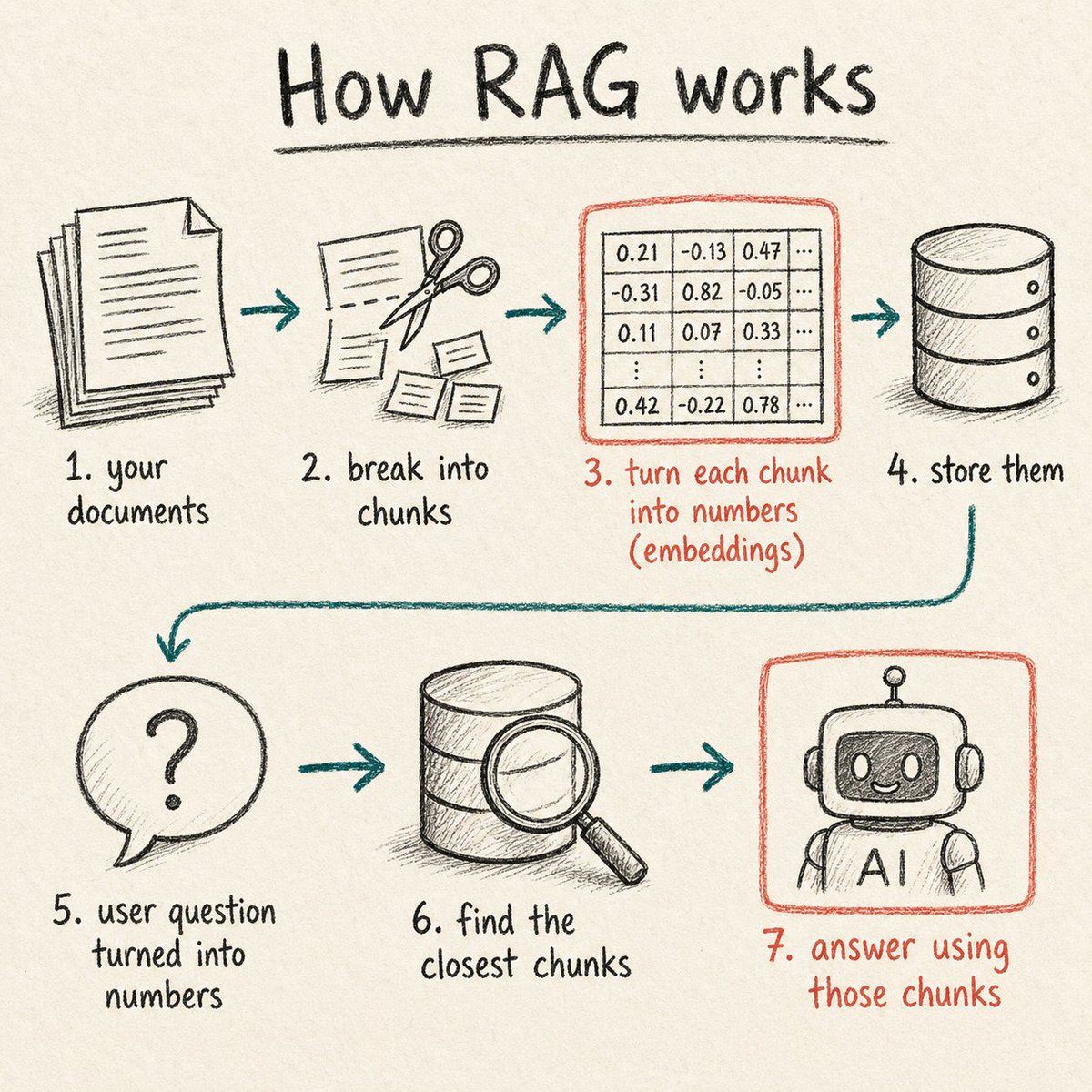 These two skills, retrieval and agents, are the most in-demand practical abilities in AI engineering right now. Almost every real company use case, from support bots to internal knowledge tools to document analysis, is built on them. I've compressed what a lot of roadmaps spread across two months into one, because you don't need to master every advanced variation to be employable. You need to build one solid retrieval system and one solid agent, understand why each piece is there, and be able to debug them when they break. That's the bar. Let's hit it. RAG, in plain English first RAG stands for retrieval-augmented generation. Strip the jargon and it's simple: you give the model a library to look things up in, so it doesn't have to have memorized everything, and so it can answer questions about your specific documents. The flow is: you take your documents, break them into chunks, convert each chunk into a list of numbers that captures its meaning, and store those. When a user asks a question, you convert their question into numbers the same way, find the chunks whose numbers are closest, and hand those chunks to the model along with the question. The model answers using what you gave it. That's RAG. Everything else is refinement. Let's build up the pieces. Embeddings An embedding is a piece of text turned into a long list of numbers that represents its meaning. The useful property: text that means similar things ends up with similar numbers, close together in this number-space. That closeness is what makes search-by-meaning possible, which is the engine under RAG. My pick for building the intuition: the Stack Overflow blog's intuitive introduction to text embeddings, which focuses on the mental model rather than the math, plus OpenAI's embeddings guide when you're ready to generate them in code. Focus on understanding what a vector is conceptually, why similar text produces similar vectors, and roughly how you measure the distance between two of them. You do not need the math behind how embeddings are produced. You need to know how to use them. A tiny build that teaches this completely: take 20 sentences on related topics, turn each into an embedding, and write a small function that, given a new sentence, returns the three most similar from your set. That's RAG in miniature. Once you've built this, the full version is just the same idea at scale. Chunking Your documents are too big to embed whole, so you break them into chunks before embedding. How you chunk directly controls how well your system finds the right information. Even a perfect retrieval setup fails if the underlying chunks are bad. My pick: start with LangChain's RecursiveCharacterTextSplitter, with a chunk size around 500 characters and an overlap around 50. That overlap matters, because it stops you losing meaning at the boundary where one chunk ends and the next begins. This is the sensible default that gives you a working baseline. The core trade-off to hold in your head: chunks too big lose precision, chunks too small lose context. Start with the default, then adjust based on what your retrieval is actually getting wrong. Vector databases Once you have embeddings, you need somewhere to store and search them fast. That's what a vector database does. My pick for learning: Chroma. It runs locally with no infrastructure to set up, which is exactly what you want while you're learning. You don't need managed cloud scale yet, and adding it early just gives you more to configure and break. Chroma lets you focus on the concepts. Find it at docs.trychroma.com. Learn to create a collection, insert embeddings along with metadata like the source and section, query by similarity to get the top matches, and filter by metadata at query time. You do not need to understand the indexing algorithms underneath. You need to use them. When you eventually need production scale, pgvector is the natural next step if your app already uses a Postgres database, and there are managed options when you want someone else to run it. But that's a Month 4 or on-the-job concern. For now, Chroma, locally, is enough. Making retrieval actually good Basic similarity search gets you a demo. A few refinements get you something that works reliably, and knowing these is what separates people who copied a tutorial from people who understand the system. Metadata filtering: tag every chunk with useful information when you store it, like the source file, the date, the section, or the category. Then filter on those at query time. This is the difference between a toy and a system where a user can ask "only show me results from the Q4 report" and actually get them. Reranking: your first search is fast but approximate. A reranker takes the top handful of results and re-scores them for true relevance to the question, which noticeably improves quality for a small speed cost. The pattern is: retrieve a broad set quickly, then rerank down to the best few. Cohere's reranking docs are the cleanest place to learn this, and it's often one line to add. Debugging retrieval, because most RAG failures are retrieval failures, not model failures. When your system gives a bad answer, the model usually isn't the problem. The retrieval handed it the wrong chunks. Learn the common failure modes: the question and the relevant chunk don't match in number-space even though the info is there (fixable by rewriting the query), the relevant info is split across two chunks (fixable with more overlap), or the right chunk exists but didn't make the top results (fixable by retrieving more, then reranking down). When an answer is wrong, check what got retrieved before you blame the model. This one habit will save you enormous frustration. Grounding and citations: a good RAG system doesn't just answer, it tells you where the answer came from, which builds trust and makes debugging far easier. Pass the source information for each chunk into your prompt, and instruct the model to cite it. Here's your third artifact, the grounding prompt that keeps a RAG system honest. This is the one I'd bookmark above all the others, because it's the difference between a system that makes things up and one you can trust. Prompt: Grounded RAG answering (Framework: FAG Grounding, by AI Guides) ``` Your job: answer the user's question using only the provided context. What to do: - Read the context chunks below. Each has a source label. - Answer the question using only information found in the context. - After each claim, cite the source label it came from, like [source: filename, p.3]. - If the context does not contain the answer, say exactly: "I don't have enough information in the provided documents to answer that." Rules: - Never use knowledge from outside the provided context. - Never guess. Never fill gaps with what sounds plausible. - If the context partly answers the question, answer that part and say clearly what is missing. Context: [PASTE RETRIEVED CHUNKS WITH SOURCE LABELS HERE] Question: [USER QUESTION HERE] ``` 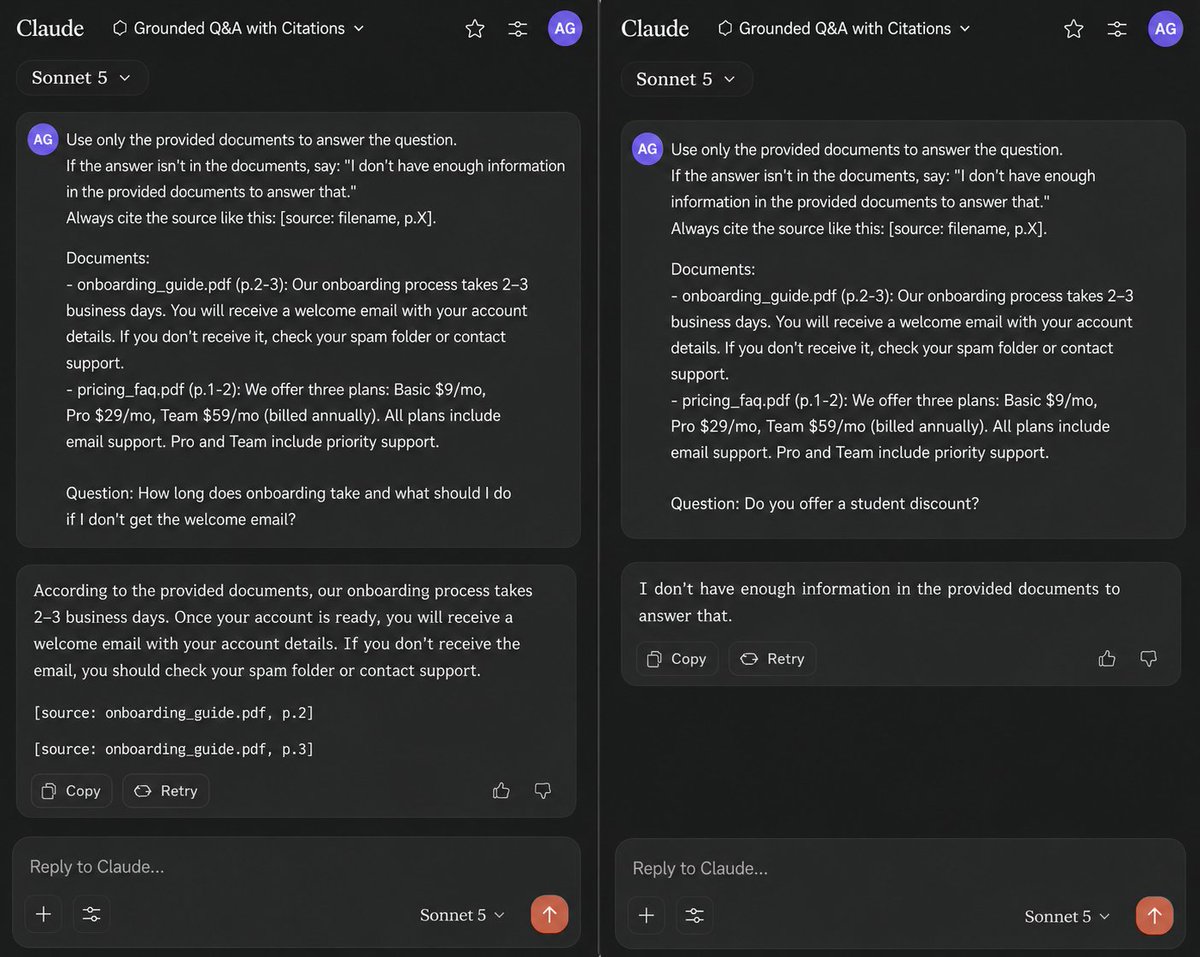 That "say exactly this when you don't know" instruction is doing heavy lifting. It's the single most effective way to cut hallucinations in a retrieval system, because it gives the model an approved way to admit ignorance instead of inventing an answer to seem helpful. Your RAG build Use a framework to tie this together rather than building every piece from scratch. My pick for a first RAG system is LlamaIndex, which is built search-first and gets you a working pipeline in a short amount of code. LangChain is the other major option and shines more for the multi-step agent work coming next, so you'll meet it in a moment. Your build target, and this is a real portfolio piece: a "chat with your documents" app. Ingest 10 to 20 PDFs or text files, your own notes or a set of product docs work well, build something that takes a question, retrieves the most relevant chunks with reranking, and returns a cited answer. Put a simple interface on it. This is the project that makes hiring managers take you seriously, because it's exactly the kind of thing companies are paying to have built right now. Agents Halfway through the month, shift to agents. An agent sounds like magic and is genuinely simple once you see it: it's a loop where the model repeatedly decides the next step, takes it using a tool, looks at the result, and decides again, until the task is done. The mental model: an agent is a while loop with a model making the branching decisions. The thinking happens in the prompt. The branching is the model choosing which tool to use. The doing is your code running that tool. Everything else is plumbing. Once that clicks, even complicated agent frameworks become readable. My pick, and I'd read this before writing a single line of agent code: Anthropic's "Building Effective Agents." It's the clearest writing on how agents work in practice, from the team that builds the models. Pair it with a hands-on framework course when you're ready to build, like the intro to LangGraph, which is the most widely used framework for orchestrating agents. What to focus on: the loop of perceive, decide, act, observe, and how it knows when to stop. What happens when a tool call fails inside the loop. How to write tool descriptions the model can actually use, because a vaguely described tool gets called wrong or ignored. And managing state, which is the shared memory that flows through the agent as it works. The single most valuable exercise this month: build a small agent from scratch with no framework at all, using just the model API directly. Give it three tools, a goal, and a loop. This teaches you what the frameworks are hiding, and it makes every framework you touch afterward make sense. Do this before you touch LangGraph. When not to use an agent This is one of the most overlooked skills in the field, and knowing it marks you as someone with judgment rather than someone chasing the shiny thing. Agents are exciting, and they're also slower, more expensive, less predictable, and harder to debug than simpler approaches. 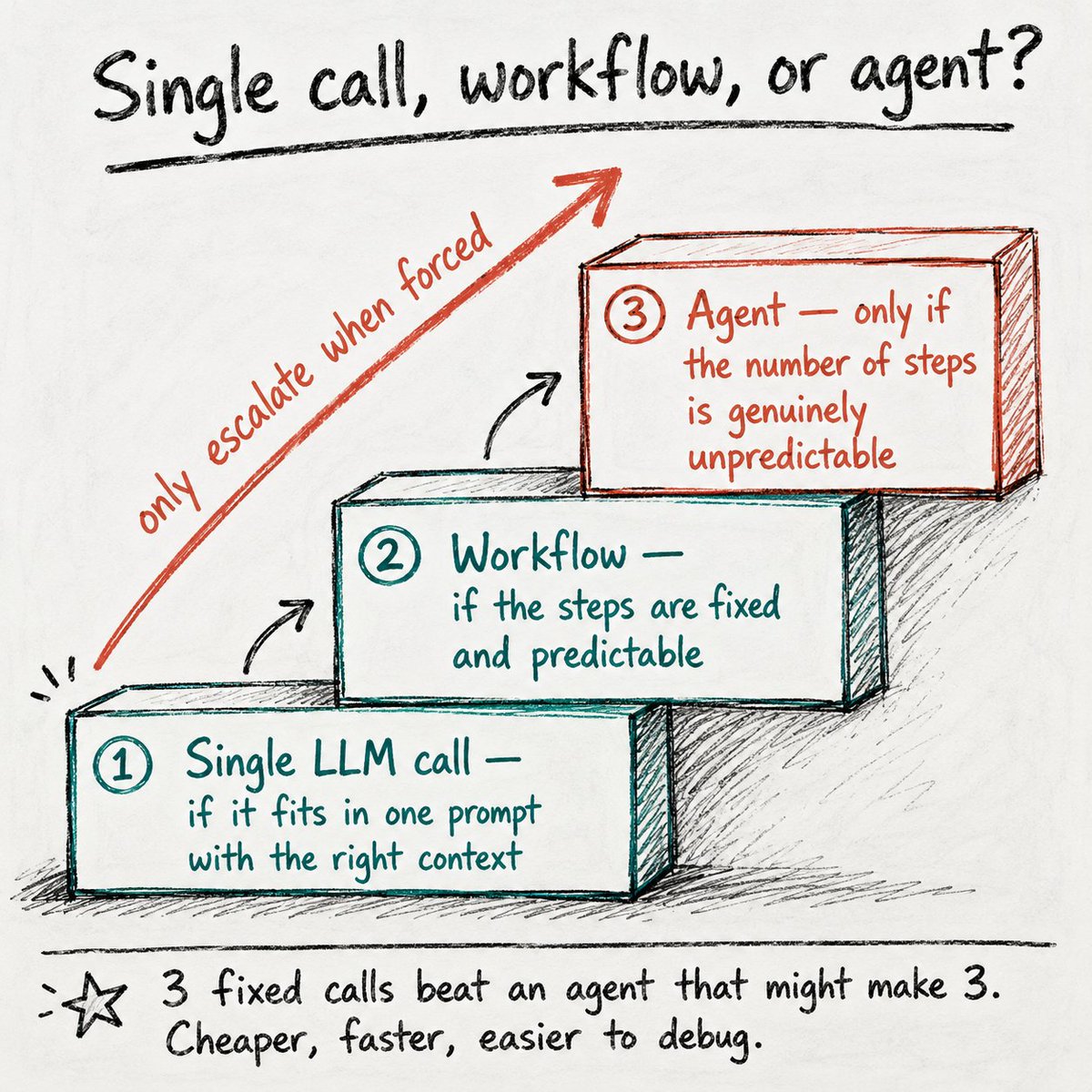 Reaching for the simplest thing that works is a sign you know what you're doing. The decision framework, worth memorizing: use a single model call if the task fits in one prompt with the right context. Use a fixed workflow, a chain of steps you define, if the steps are predictable. Use an agent only when the number of steps is genuinely unpredictable and needs the model to decide dynamically. A chain of three fixed calls will always be faster, cheaper, and easier to debug than an agent that might make three calls. Reserve agents for genuinely open-ended tasks. Between a single call and a full agent is a large, productive middle ground: workflows. Chaining, where one call's output feeds the next. Routing, where you classify the input and send it to a specialized handler. Parallelization, where you run several calls at once and combine them. Most real problems are best solved with a workflow, not an agent, and Anthropic's agents piece covers these patterns well. Evals, briefly but seriously You need to know whether your system actually works, not just whether it worked on the two examples you tried by hand. That's what evaluations are for. Build a small set of 20 to 30 representative inputs with expected outputs or a scoring rubric, and run your system against all of them whenever you change a prompt, swap a model, or adjust your retrieval. Tools like DeepEval for general use and Ragas for RAG specifically make this manageable. The mindset that matters more than the tool: every prompt change or model swap you make without running evals is a gamble. The people who ship reliable AI run evals constantly, and starting this habit now, even in a small way, puts you ahead of a lot of people already working in the field. Month 3 milestone By the end of the month, you should be able to explain what an embedding is and why similar text produces similar vectors, chunk a document sensibly, store and query embeddings in a vector database with metadata filtering, add reranking to improve results, debug a retrieval failure instead of blaming the model, build a complete RAG pipeline that returns grounded cited answers, implement an agent loop from scratch, decide correctly whether a task needs a single call, a workflow, or an agent, and run a basic eval to check your work. That's the employable core. If Months 1 through 3 are solid, you can build the things companies are hiring for. Month 4 is about proving it and getting paid. 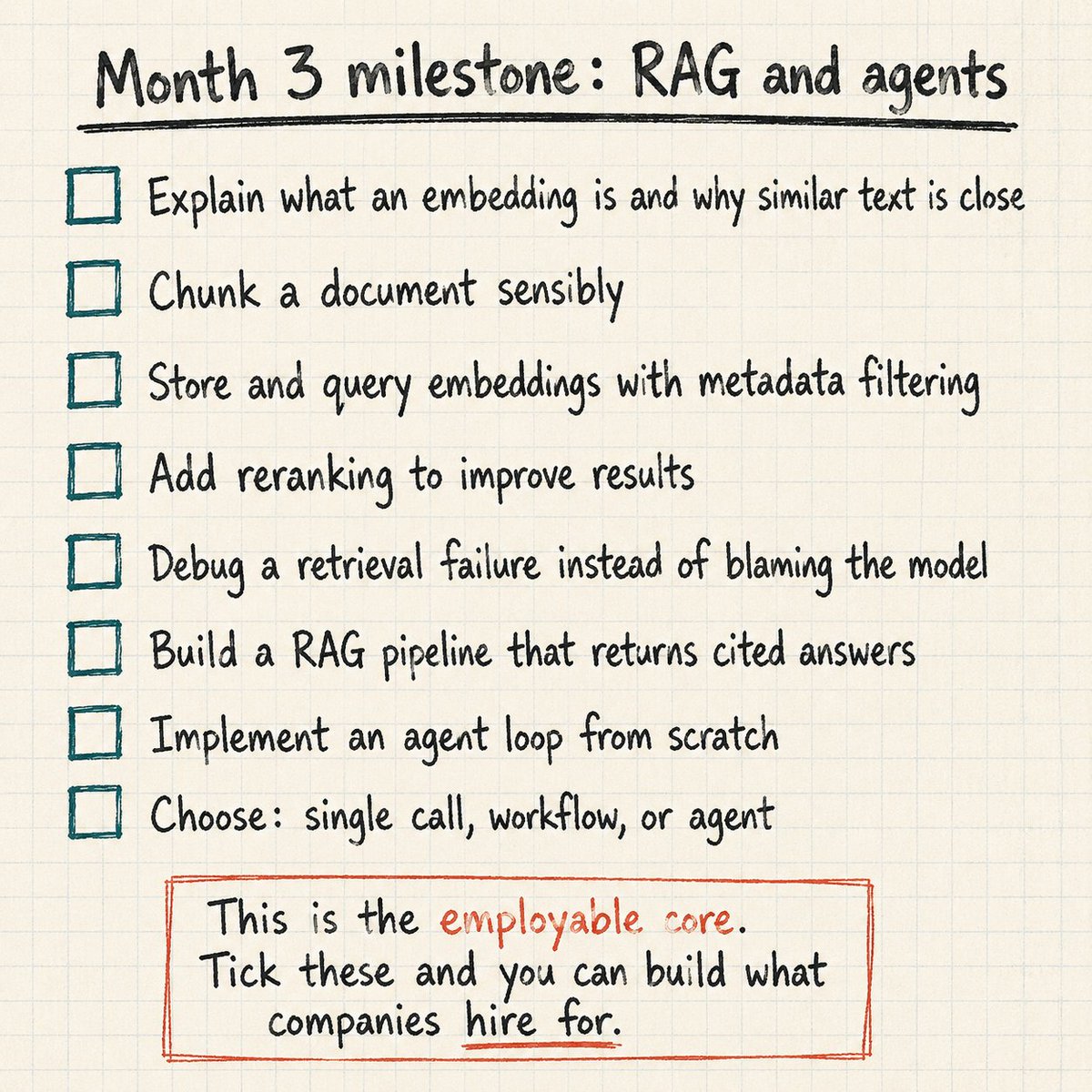 ## Month 4: Ship it, show it, get hired Your goal this month: take everything you've built and make it real, then turn it into a job or paid work. This is where most people stall. They can build a demo but can't ship something that survives real use, and they can't convert their skills into income. This month fixes both. It's shorter on new concepts and heavier on doing, because at this point doing is what matters. Enough deployment to be dangerous You don't need to become an infrastructure expert. You need to be able to put a working AI app somewhere real people can use it, without it falling over or bankrupting you. The minimum viable knowledge: learn enough Docker to package your app so it runs the same everywhere, which kills the "works on my machine" problem. Learn to deploy that container somewhere. And learn the cost and reliability basics that stop a bug from becoming a disaster: set hard spending limits on your API accounts, add caching so you're not paying for the same request twice, and add rate limiting so one user can't run up your bill. Docker's official getting-started guide covers the packaging. For the AI-specific cost side, the core moves are caching identical requests, using cheaper models where they're good enough, and setting a hard monthly spend cap so a runaway loop can't cost you $500 overnight. You also want basic observability, which is a fancy word for being able to see what your app is doing. LLM apps have a specific problem: the model can return a perfectly successful response that's also useless or wrong, and normal monitoring won't catch that. A tool like Langfuse traces every model call, showing you the prompt, the response, the token cost, and the latency, which makes debugging and cost control far easier. Set this up on one project so you understand the pattern. Don't over-invest here. One app, deployed properly, with cost controls and basic tracing, teaches you everything you need and gives you something real to show. Depth in deployment can come on the job. The part every other roadmap skips: turning projects into a job. You've built three real projects. Now make them work for you, because a great project nobody sees does nothing for your career. Your portfolio is three deployed projects, each with a README that does actual work. 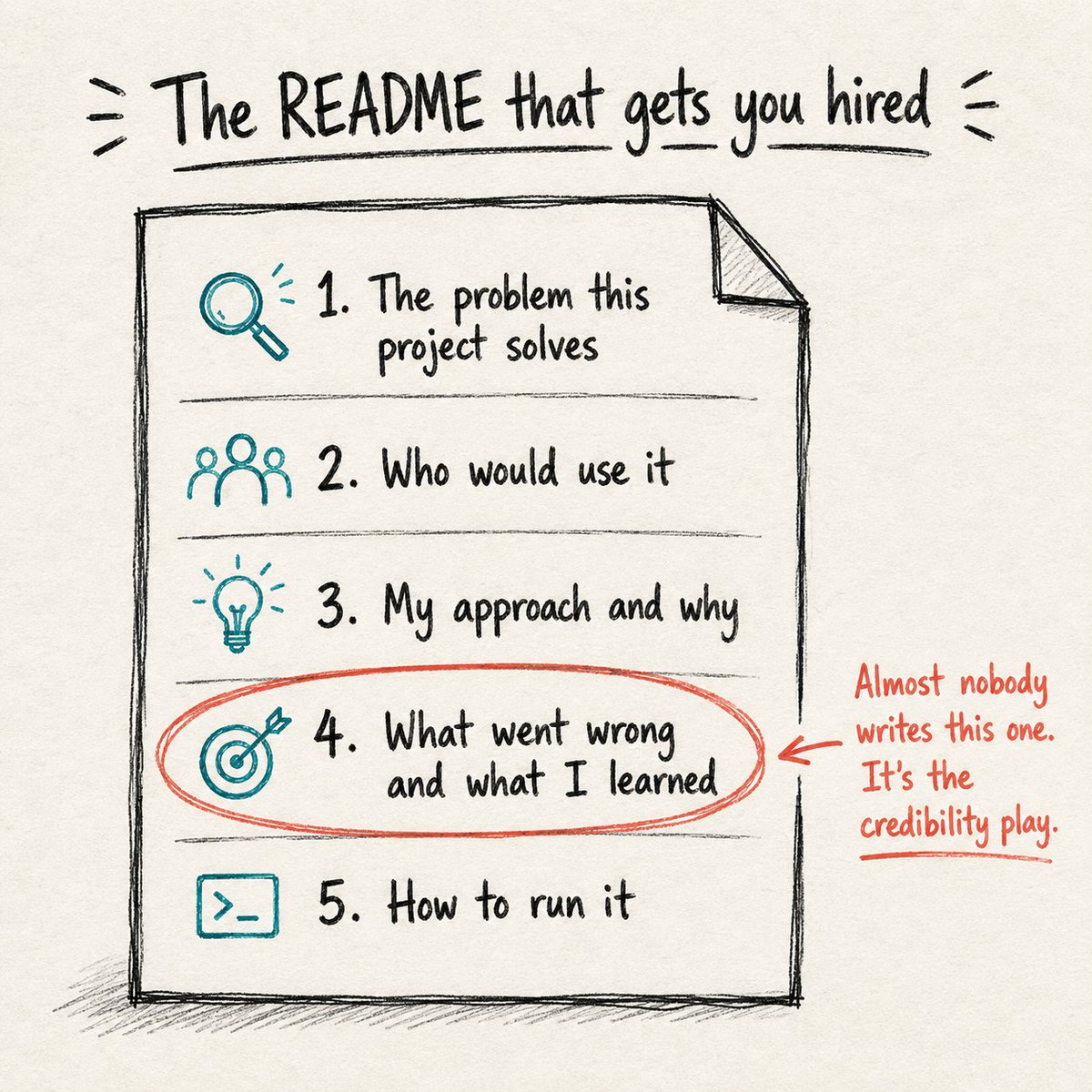 And here's the move almost nobody makes, the one that will set you apart: in each README, include a section on what went wrong and what you'd do differently. Most portfolios pretend everything worked perfectly, which reads as either dishonest or shallow. A README that says "here's where my first approach failed, here's what I learned, here's how I fixed it" signals exactly the judgment employers said they're now screening for. It's the switcher's edge from the intro, made visible. Nobody expects a career switcher to have a perfect project. They're impressed by one who clearly understands their own work deeply enough to critique it. Structure each README like this: the problem the project solves, who would use it, the approach you took and why, what went wrong and what you learned, and how to run it. Five sections. That's a better portfolio than most people with a CS degree have. The resume and profile move: you don't need to pretend you have years of experience. You need one clear line that says what you can do. Something like "I build production LLM applications: RAG systems, agents, and API integrations. Here are three I've shipped." Then link the projects. Your existing career is an asset, not something to hide. "Former [your field] who now builds AI systems" is a stronger story than "junior developer," because it comes with the domain knowledge and judgment that a pure junior lacks. If you're switching from finance, you understand finance problems an AI could solve. If you're switching from healthcare, same. Lean into it. Building in public as your pipeline: through this whole month, keep posting what you build and what you learn. The best opportunities I've seen come to people who were visible, not to people who quietly applied to 500 listings. Write up your projects. Share the mistake you fixed. The compounding is real, and by now you have real work to share, so it's easier than it was in Month 1. Pick a direction By Month 4 you can point your skills at whatever fits your goals. Three directions, pick one to go deeper on rather than spreading thin. The AI product engineer path, best if you want a startup job fast: you build AI-powered products real users touch. You already have most of this from Months 1 through 3. Go deeper on building complete, polished apps and on the product side, meaning how the app handles the model being wrong, how it shows loading states, how users give feedback. Ship two or three things people can actually try. The applied ML path, best if you want deeper technical roles: go beyond API calls into fine-tuning, when to fine-tune versus just prompt better, running open-source models locally with a tool like Ollama, and inference optimization. The decision framework to hold onto: start with prompting, add retrieval if the model needs your specific data, and only fine-tune when prompting and retrieval genuinely can't hit the quality you need. Fine-tuning is often reached for too early. The AI automation path, best if you want to earn from businesses immediately: focus on automating real business workflows, chaining AI across tools like email, CRMs, documents, and spreadsheets. Tools like n8n for visual workflows and LangGraph for the code-heavy ones. A sellable build here: a lead-qualification system that pulls in leads, uses a model to research and score each one, drafts personalized outreach, and logs everything. Businesses pay real money for exactly this. Month 4 milestone By the end of the month, you should have a deployed AI app with proper cost controls, three portfolio projects each with an honest README, a clear one-line pitch of what you build, a visible trail of work in public, and a chosen direction you're going deeper on. At that point you're not "someone learning AI." You're someone who ships AI systems, which is the thing the market is paying for. 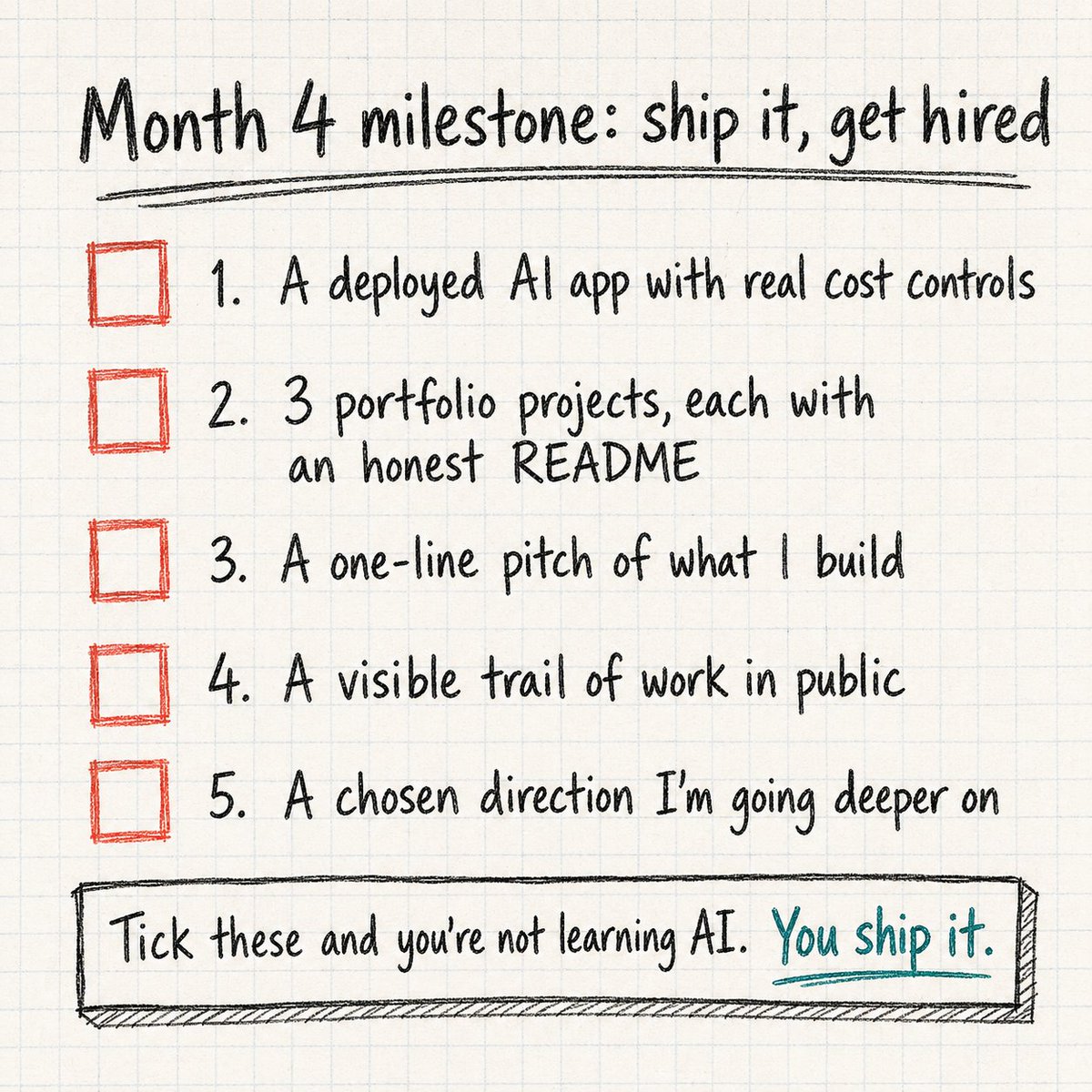 ## The honest part I told you at the start I wasn't going to sell you a fantasy, so here's the straight version before the money numbers. Four months of focused work makes you employable at a junior level or ready to take freelance work. It does not make you a senior engineer. Senior comes from years of shipping real things under real constraints, and no guide compresses that. What four months buys you is the ability to build, ship, and deploy AI systems that solve real problems, which is a genuinely valuable and genuinely hireable place to be. This assumes real work, roughly 15 to 20 hours a week, actually building and not just watching. If you can only give it 7 hours a week, this is an 8-month path, and that's completely fine. The timeline stretches, the destination doesn't change. What kills people isn't a slow pace. It's stopping. Consistency beats intensity here every time. And the whole thing rests on one behavior from the mistakes section: build, don't just watch. Every month has a project. Do the projects. A person who builds four rough projects in four months is employable. A person who watches four months of perfect tutorials is not. That's the entire game. The money, with sources Now the numbers you actually want, all current and all sourced, because loose salary claims are how these guides lose credibility. As of June 2026, Glassdoor puts the average US AI engineer salary at roughly $143,500, with a typical range of about $115,000 at the 25th percentile to $181,000 at the 75th, and top earners reported up to around $223,000. Senior AI engineers average around $285,000, with a typical range of roughly $221,000 to $375,000, which shows how steep the jump is once you have real experience. 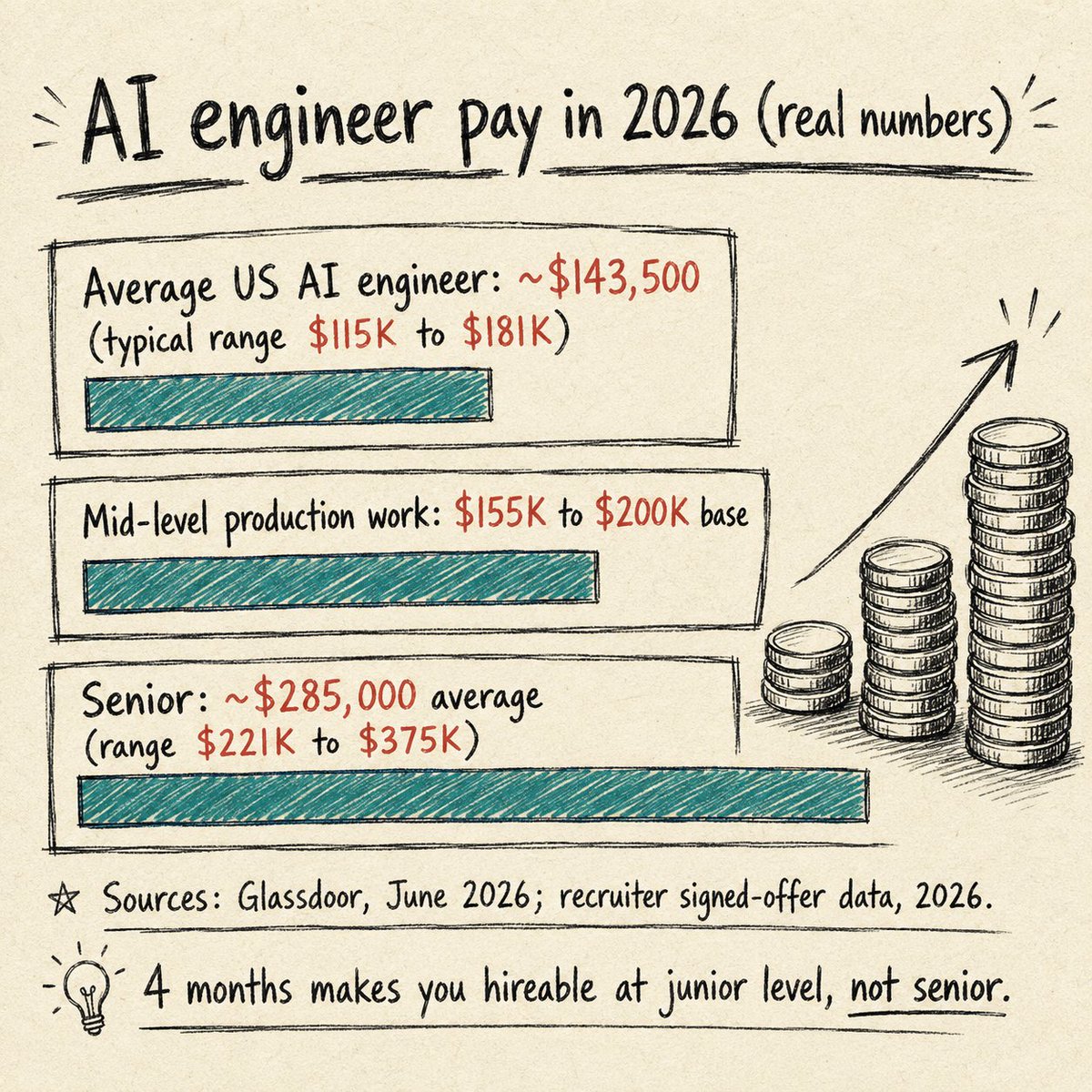 Those are Glassdoor's figures based on submitted salaries. Recruiters who place people in genuine production AI work report mid-level base salaries clustering between $155,000 and $200,000, based on signed offers rather than surveys, which lines up with the Glassdoor range and gives you a second independent read. And the broader market backdrop from PwC's 2026 Barometer, which I opened with: AI-skill jobs growing about eight times faster than the overall market, a 62% wage premium for AI skills, and degree requirements falling fastest in exactly these roles. Those aren't from a hype thread. They're from an analysis of over a billion job ads. Freelance and consulting numbers vary too much to quote precisely without misleading you, so I'll say only this: the rates for RAG implementation, agent building, and LLM integration are high, and a switcher with three solid deployed projects and a clear pitch can start charging for that work well before they'd land a full-time role. The projects are the proof. Build them and the earning options open up. ## Start this week Here's what I'd actually do, today, if I were you. Pick the Month 1 Python project, the little command-line tool. Open a code editor. Start CS50P's first problem set. Set up the learning-partner prompt so the AI tutors you through the frustrating parts. Make a GitHub repo and put your first ugly file in it. That's the whole first week. Don't wait until you feel ready, because ready comes after you start, not before. Don't map out all four months in perfect detail before you write a line of code, because the plan is already here and the planning is just a comfortable way to avoid starting. The gap between learning and building is where people lose a year. Close it this week. Four months of real work genuinely changes what's possible for you. The door is more open than it's been at any point before now, the credential barrier is falling, and the market is paying more for these skills than almost anything else in tech. You have the guide. The only variable left is whether you build. Save this and come back to it each month as you go. I'll keep it updated as tools and numbers change. Follow @free_ai_guides for the updates ❤️ ## 相关链接 - [AI Guides](https://x.com/free_ai_guides) - [@free_ai_guides](https://x.com/free_ai_guides) - [17K](https://x.com/free_ai_guides/status/2074531958600638877/analytics) - [cs50.harvard.edu/python](http://cs50.harvard.edu/python) - [skills.github.com](http://skills.github.com/) - [docs.trychroma.com](http://docs.trychroma.com/) - [@free_ai_guides](https://x.com/@free_ai_guides) - [Upgrade to Premium](https://x.com/i/premium_sign_up) - [12:32 AM · Jul 8, 2026](https://x.com/free_ai_guides/status/2074531958600638877) - [17K Views](https://x.com/free_ai_guides/status/2074531958600638877/analytics) - [View quotes](https://x.com/free_ai_guides/status/2074531958600638877/quotes) --- *导出时间: 2026/7/8 09:38:36* --- ## 中文翻译 # 你可以在4个月内从零起步成为受聘的AI工程师。以下是确切路径。 **作者**: AI Guides **日期**: 2026-07-07T16:32:16.000Z **来源**: [https://x.com/free_ai_guides/status/2074531958600638877](https://x.com/free_ai_guides/status/2074531958600638877) ---  AI工程是目前科技界薪资最高、增长最快的工作之一。而入门的大门现在比以往任何时候都更加敞开。 大多数指南都搞错了这一点。它们堆砌了一大堆理论,告诉你精通线性代数和神经网络数学,结果在第二周就让你望而却步。 或者它们扔给你80个杂乱无章的链接,让你在决定“学什么”上花费的时间比实际学习的时间还多。  我通读了流行的路线图,测试了它们推荐的工具,并构建了一个我会交给想转行、还有实际工作要做的朋友的版本。 不需要数学学位。不需要4年计划。 只有4个月的高效专注,每项技能一个明确的选择,可以复制粘贴的真实提示词,以及那些扼杀了大多数转行者在开始之前就失败的那些隐形错误。 先谈谈为什么时机很重要,然后是完整路径。 ## 为什么大门敞开(而且我可以证明) 你可能听说过AI会抢走工作。 以下是鲜少被提及的一面:它正在以比市场上几乎任何其他事物都快的速度,创造一个特定的、高薪的职位类别,而通常的守门人正在消失。  普华永道(PwC)2026年《全球AI就业晴雨表》分析了跨越六大洲的十亿多条招聘广告。对于任何考虑转行的人来说,有三项发现至关重要。 首先,需要AI技能的工作增长速度比整体市场快约8倍。AI技能职位增长了69%,而总就业市场仅增长了9%。 这并不是一个可以忽略的误差。这是一个正在与其他所有领域拉开距离的类别。 其次,薪资溢价是真实存在的,并且还在上涨。拥有AI技能的工人比没有这些技能的同类职位多获得62%的薪资溢价,高于前一年的57%。 公司正在为那些能够真正利用这些工具进行构建的人支付更高的薪水,而不是更低。  第三,这一点改变了转行者的计算方式:学位要求正在下降,而且在这些特定职位上下降得最快。 普华永道发现,在2019年至2024年间,需要AI辅助工作的职位中,要求学位的比例从66%下降到了59%。 对于AI自动完成部分工作的职位,这一比例下降得更多,从53%降至44%。在这些AI接触度高的工作中,雇主比在其他任何地方都更快地抛弃学历筛选。 还有一个值得深思的数字。在美国,受AI影响最大的入门级职位自2019年以来增长了35%。 在同一时期,其他入门级职位下降了10%。当其他入门级市场萎缩时,AI阶梯的最底层正在变得越来越宽。 现在说一些诚实的反面观点,因为我不是来这里向你兜售幻想的。 普华永道还发现,接触AI的入门级职位越来越要求那些过去只针对资深人员的技能:判断力、沟通能力,以及对结果负责而不是对任务负责的能力。 门槛并非全面降低。它转移了。它不再是“你有这个证书吗”,而是“你真的能把它做出来并解释为什么它有效吗”。 如果你是一个没有工作经历的新毕业生,这听起来像是个坏消息。如果你是从其他职业转行的,请将其视为好消息,因为你已经拥有他们现在所要求的东西。 你交付过产品。你处理过利益相关者的事务。你在压力下对结果负责过。 拥有计算机科学学位的22岁年轻人通常没有这些经历。如果你将现有的判断力与本指南中的技术技能结合起来,你并不会落后于新毕业生。 在雇主最关心的轴线上,你领先于他们。 这就是转行者的优势,几乎没有任何路线图会告诉你这一点。在这四个月里,要把这一点作为你的底牌。这就是为什么这对你来说是现实的。 最后简单谈谈钱,因为在投入四个月之前你会想要真实的数字。 我会在最后给出带有来源的完整细分,但简短版本是:截至2026年中期,Glassdoor显示美国AI工程师的平均薪资约为143,500美元,典型范围大约在115,000美元至181,000美元之间。 资深职位的薪资要高得多。负责生产级AI工作的人员安置中介报告称,中层级的基本薪资集中在155,000美元至200,000美元之间。 这些不是从炒作帖子中瞎编的数字。它们是当前的数据,我会向你展示每一个数字的来源。 ## AI工程师实际做什么(60秒版) 在开始计划之前,让我们先消除最大的畏难情绪,因为它比任何技术障碍都更能阻止人们前行。 当大多数人听到“AI工程师”时,他们想象的是一个在实验室里从头开始训练巨型模型的人,周围全是GPU和他们永远无法理解的数学。 那是另一份工作。它被称为研究科学家或ML研究员,这类职位相对较少,而且通常确实需要高级学位。  那个比市场增长快8倍的AI工程师职位完全是另一回事。 你在已经存在的模型之上构建产品和功能。你拿来Claude、GPT或开源模型,并让它在实际应用程序中完成一项特定的、可靠的工作。 实际上,这意味着你要连接模型API,设计你提供给它们的提示词和上下文,取回结构化数据,将模型连接到工具和数据库,使其检索正确的信息,处理所有可能出错的情况,并将其部署供真实用户使用。 它介于软件工程、产品工作和应用AI之间。你是构建者,而不是研究员。 这是我会用的一句话测试:如果你能让LLM在应用程序中可靠地完成一项特定工作,并且你懂得如何在它出问题时修复它,那么你就是一名AI工程师。这就是全部。 本指南中的所有内容都旨在让这句话对你而言成为现实。 你不需要知道Transformer内部是如何工作的。你不需要微积分。你不需要能够推导反向传播。 你需要成为一名合格的构建者,懂得如何在现实世界中与这些模型协作。 这是一项可习得的技能,四个月的高效专注足以让你上手。 ## 第1个月前必读:扼杀转行者的4个错误 我有意将这部分放在路线图之前。 大多数指南将错误放在最后,但结束转行生涯的错误发生在第二周,而不是第三个月。如果你只能记住本指南的一个部分,那就记住这个。 我看着很多人(包括早期的我)犯过这里的每一个错误。它们都与智力无关。 它们关乎策略。修正策略,这四个月才能真正起作用。 错误1:从理论和数学开始。 你很兴奋,你想把事情做对,于是你找了一门机器学习课程,开始学习线性代数、梯度下降和神经网络背后的数学。 三周后,你看了很多讲座,却什么都构建不出来,你觉得自己像个冒牌货。于是你退出了。 修正方法:跳过它。对于你的目标工作,你不需要推导数学。 你需要构建。 你会在实际项目中遇到概念时再去学习你真正需要的概念,而且它们会留存下来,因为它们与你构建的东西挂钩。 “理论优先”是聪明人在这行半途而废的最常见原因。别从那里开始。 错误2:看教程而不是动手构建。 这一点很隐蔽,因为它感觉像是进步。你看了四个小时的Python课程,点头附和,觉得自己学到了东西。其实你没有。 你看着别人学到了东西。当你打开一个空白文件的那一刻,什么都不在那里。  修正方法:30分钟法则。每花一小时观看或阅读,至少花30分钟不打开教程地构建一些东西。 亲自输入示例代码。弄坏它们。修改它们。遇到错误并修复它们。错误才是学习所在。 一个构建得很糟糕四个月的人,每次都能击败一个完美观看了四个月的人。 雇主看一眼你的GitHub,十秒钟就能看出差别。 错误3:学习工具而不是技能。 你听说LangChain是关键,于是你深钻LangChain。 六个月后,领域转移了,大家都在用别的东西,你的LangChain知识感觉白费了。于是你去追逐新工具。 然后那个工具也变了。你总是落后,因为你优化的层级错了。 修正方法:学习工具底下的技能。编写能产生可靠输出的提示词这项技能,不会因为框架更新而过期。 从模型获取结构化数据的技能,评估系统是否真正有效的技能,或者决定任务需要代理还是单次调用的技能,这些都是可以迁移到未来存在的任何工具上的。 将学习工具作为练习技能的一种方式,而不是目标。本指南之所以围绕技能组织,正是出于这个原因。 错误4:等到觉得自己准备好了才公开构建。 你决定一旦你“准备好了”,就开始分享你的作品,申请职位,或提供自由职业服务。 你永远不会觉得准备好了。准备好是一种开始后才有的感觉,而不是开始前就有的。 与此同时,那些被录用和获得客户的人,是那些在觉得自己合格前几个月就开始分享粗糙作品的人。 修正方法:在第1个月就开始公开构建。发布你做的小东西。写下你学到的东西。 在你完成项目的当天就把它放到GitHub上,哪怕是丑陋的。 “我在学习”和“我在可见地构建”之间的差距,是大多数转行者被困住一年的地方。尽早缩小它。 没人在足够密切地关注你,让你早期的作品显得尴尬,而且复利效应从你开始的第一天就开始了。 在整个过程中,牢记这四点。 下面的路线图设计就是为了默认避免所有这些错误:技能优先,构建优先,工具无关,从第一天就公开。  ## 第1个月:Python与管道工程 你这月的目标:成为一名合格的Python开发者,能够调用API,管理一个小项目,并停止Google搜索基本语法。 不是专家。是合格能用。 第2到4个月的所有内容都假设你能写出干净的Python并在终端中工作。这是基础,急于求成会在以后反噬你。 在开始之前要内化的一点:AI工程首先是软件工程。AI部分位于正常的软件栈之上。 如果底层的栈不稳,AI部分就永远无法可靠。所以第1个月是关于对基础知识足够熟练,让它们不再成为你的绊脚石。 我会为每项技能给出一个主要选择,并明确说明原因。我故意不每项给你五个选项。选择是动力的敌人。 选择我指出的那一个,只有当它真的不适合你时再另寻出路。  **Python** Python是整个领域的语言。未来四个月你接触的几乎每个库、API、教程和工作都是Python的。学会了它,其他一切都会更容易。 我的选择:CS50P,哈佛大学的Python编程入门。免费、严格,它强迫你真正解决问题,而不是看别人解决。 问题集是全部价值所在。它比温和的YouTube课程要求更高,这才是重点。 你想要那个让你稍微挣扎一下的版本,因为技能正是在挣扎中形成的。 在 cs50.harvard.edu/python 找到它。 如果作为绝对的初学者CS50P感觉太陡峭,YouTube上的freeCodeCamp Python课程是一个较温和的入口,但将其视为热身,而不是主菜。 在你不再害怕空白文件后再回到CS50P。 实际重点关注的顺序,大致如下:变量和数据类型,循环和条件语句,函数,然后是集合类型(列表、字典、集合、元组)。 然后是文件处理以及读写JSON,你在使用AI API时会经常用到这些。 然后是足够的类和面向对象基础,以便在阅读他人代码时不至于恐慌。 最后是使用try和except进行错误处理。 最后是虚拟环境和pip,这样你就可以安装包而不破坏你的系统。 不要试图死记硬背任何东西。理解到足以快速查阅的程度,然后通过使用构建直到它刻进脑子。 你第1个月Python的构建目标:一个能做实际事情的小型命令行工具。 一个读写JSON文件的费用追踪器是个不错的选择。或者一个调用免费公共API并以干净格式打印结果的脚本。 大约60到100行你自己的代码的东西。 它是否丑陋并不重要。重要的是你写了它。 ## 从第一天起用AI学习 这是我要做那些旧路线图没做的事:用AI来学习AI,从第一周开始。 你可以使用有史以来最好的耐心导师,而且在免费层级上不花一分钱。当你遇到无法理解的错误时,不要在论坛上花40分钟。 把它粘贴到Claude或ChatGPT中,让它用通俗的英语解释错误,并引导你找到修复方法,而不是直接给你答案。 这是我在第一天设置的一个复制粘贴提示词。保存它。 这是本指南中值得收藏的几个工具中的第一个。 提示词:你的Python学习伙伴 (框架:FAG学习伙伴,作者AI Guides) ``` 你的工作:在我为了转行而学习代码时,扮演我耐心的Python导师。 关于我的背景: - 我学习Python是为了成为一名AI工程师。 - 我在编码方面是绝对的初学者,但在努力工作方面不是。 - 我通过做来学习,而不是被直接给答案。 做什么: - 当我粘贴错误时,用通俗英语解释它的意思以及可能的原因。不要只给我修复后的代码。 - 首先用提示指向修复方向。只有当我问第二次时才显示完整解决方案。 - 当我分享我写的代码时,告诉我一个有效点和一个可以改进点。只限于这两点。 - 在我让某样东西工作后,问我一个简短的问题,检查我是否真的理解了。 规则: - 在使用没有一行通俗英语定义的术语。 - 假设我想学习,而不仅仅是过关。稍微慢一点没关系。 - 如果我即将养成一个坏习惯,请直接但友善地指出。 输出:对话式,简短,一次一个概念。 ```  这个月每天都使用它。它将学习代码的挫折部分转化为对话,而不是一堵墙。 它还能让你熟练于提示词编写,这是第2个月的核心技能,在你意识到之前就已经学会了。 一个警告,以免你养成错误的习惯:用AI来理解和解除障碍,而不是让它为你写出整个东西。 如果你让它写代码而你看,你就回到了错误2。 让它解释。你来打字。 **Git和GitHub** Git是开发者保存、版本控制和共享代码的方式。 GitHub是你的工作公开存在并成为作品集的地方。 你会经常使用两者,对于转行者来说,在你拥有简历之前,GitHub是最接近简历的东西。 我的选择:GitHub Skills。免费、互动,由GitHub在GitHub内部构建,所以你通过使用工具来学习工具。从那里开始,而不是阅读关于Git的文章。
2 2026年AI工程师全攻略(无CS学位) 本文阐述了在2026年如何无需计算机学位成为一名AI工程师。文章指出,当前的招聘市场更看重实际构建能力而非学历背景,并明确区分了AI工程师(系统集成与落地)与机器学习研究员(模型训练)的区别。作者提供了一套完整的学习路径(技术栈),包括Python、SQL、API集成、向量搜索、RAG及Agent框架等,并建议通过构建RAG应用、工具使用Agent及全栈部署产品这三个具体项目来证明能力,从而获得工作机会。 技术 › LLM ✍ CyrilXBT🕐 2026-07-06 AI工程师学习路径RAGAgent职业发展PythonAPI集成LLM技能提升项目管理
如 如何在6个月内从零成为AI工程师(2026版) 本文针对2026年的行业现状,驳斥了通过传统机器学习理论入行的误区,提出了6个月速成AI工程师的实战路线图。作者强调无需深奥数学,而应从Python和API调用起步。核心路径涵盖:深入掌握LLM原理与提示工程,精通RAG(检索增强生成)及语义分块、重排序等进阶技术,最终构建结合Agent与生产级思维的复杂AI系统。文章指出,唯有动手解决实际问题、构建高可用系统,而非单纯考取证书,才是成为合格AI工程师的关键。 技术 › LLM ✍ Suryansh Tiwari🕐 2026-04-28 AI工程师职业发展LLMRAGAgent学习路线PythonOpenAIClaude教程
零 零基础 4 个月成为可受雇 AI 工程师的路径 文章介绍了一条 4 个月从零基础成为 AI 工程师的学习路径。文章指出 AI 工程岗位增长迅速且薪资优厚,学位要求正在降低。作者强调职业转型者具备判断力和沟通能力的优势,并指出了初学者常犯的错误,如过早钻研理论、只看不练等。 技术 › LLM ✍ AI Guides🕐 2026-07-29 AI工程师职业发展学习路径LLM转型
2 2026年如何成为AI工程师(无需CS学位) 文章指出2026年AI工程师角色已分化为机器学习工程师和应用AI工程师。对于非CS学位求职者,后者是主要机会。文章详细列出了必备技能(Python、LLM行为、RAG系统、评估观测),并提出了三个能替代学历证明的实战项目建议。 技术 › LLM ✍ Harman🕐 2026-07-24 AI工程师职业发展RAGLLMAgentPrompt无学位
如 如何在 2026 年成为AI工程师 文章指出 2026 年 AI 工程师的门槛已变,不再看重学历,而是看重作品集与交付能力。作者拆解了 AI 工程师的三个核心能力:软件工程、LLM 使用及产品思维,并规划了一份为期 12 个月的六阶段实战路线图,涵盖 Python 基础、LLM API、RAG、Agent 系统开发、评估部署及求职准备。 技术 › LLM ✍ 路飞 AI 研究员🕐 2026-07-08 AI工程师职业发展学习路线RAGAgentLLMPythonPrompt实战指南求职
2 2026 年,如何成为一名 AI 工程师(不卡学历) 本文提供了 2026 年成为 AI 工程师的 12 个月路线图。作者区分了模型研究员与 AI 工程师,强调后者更看重实战能力而非高学历。路线图涵盖 Python 基础、大模型 API 调用、RAG 系统构建、Agent 开发以及 MLOps 评估与部署。通过完成三个核心项目(RAG 应用、多 Agent 系统、带监控的上线系统),建立能胜任工作的作品集,即使没有 CS 学位也能入行。 技术 › Agent ✍ 老白(每日 AI 干货)🕐 2026-07-02 AI工程师学习路线RAGLLMPython职业发展AgentMLOps编程实战教程
从 从零构建 LLM 架构并转化为高薪职业的指南 本文详细介绍了如何从零开始学习大语言模型(LLM)架构。内容涵盖了从掌握 Python 基础、理解神经网络和 Transformer 原理,到深入掌握 Tokenization、Embedding、Attention 机制及 RAG 技术等核心概念。文章还提供了具体的学习路线图,并探讨了通过自由职业、构建 SaaS 产品、远程工作及自动化代理等方式将 LLM 技能转化为高美元收入的职业路径。 技术 › LLM ✍ Shabnam Parveen🕐 2026-05-18 LLMTransformerRAG职业发展PythonDeepLearningAI工程创业教程SaaS
A AI 工程师学习路线图:从核心技能到生产实践 文章基于 2000 余份职位描述,规划了一条务实的 AI 工程师学习路径。重点指出 AI 工程并非从零训练模型,而是构建以 LLM 为核心的系统。核心技能包括 LLM 基础、RAG 检索增强、Agent 智能体、测试评估及监控部署。此外,文章还梳理了 Python、Web 开发、云原生及数据库等支撑性技能,并推荐了学习优先级与主流技术栈,旨在帮助开发者构建可靠、可落地的生产级 AI 系统。 技术 › AI工程 ✍ Luffytaro🕐 2026-04-27 AI工程师学习路线LLMRAGAgent职业发展PythonLangChain评估体系生产部署
如 如何成为一名机器学习工程师:完全指南 本文是一份详细的机器学习(ML)工程师学习路径指南。作者首先纠正了被动观看视频的学习误区,提出“两遍学习法”以建立深刻的技术理解。文章明确了ML工程师与数据科学家及研究员的区别,强调工程实现能力。随后,作者将学习路径分为两个阶段:第一阶段利用 3Blue1Brown 的视频构建数学直觉,涵盖神经网络、梯度下降、反向传播及 Transformer 架构;第二阶段(文中截断处未完)预告将通过 Andrej Karpathy 的课程来提升代码实现能力。 技术 › 机器学习 ✍ Arman Hezarkhani🕐 2026-01-21 机器学习学习路径神经网络Transformer深度学习职业发展LLM3Blue1BrownKarpathy教程
如 如何在6个月内成为代理AI工程师 本文提供了一个为期6个月的12阶段AI工程师学习路线图。文章首先阐述了代理工程师的核心是构建能自主决策的系统,而非编写固定逻辑。前两个阶段重点介绍了Python异步编程的基础(解决API调用阻塞问题)和LLM的基本原理(如上下文限制、成本控制和模型路由)。随后详细讲解了工具调用与结构化输出的实现方法,强调使用Pydantic验证数据及构建可恢复的Agent循环。 技术 › Agent ✍ Rahul🕐 2026-07-12 AIAgentLLMPython异步编程教程职业发展工具调用Pydantic学习路线
2 2026年非CS背景成为AI工程师的指南 文章指出,成为AI工程师无需计算机学位,作品集比文凭更重要。AI工程师是连接大模型与现实产品的构建者。文章提供了为期9个月的四阶段自学路径:掌握Python编程、精通LLM API(含工具调用)、构建RAG系统以及开发Agent。强调实战部署和解决实际问题的能力,而非深奥的数学研究。 技术 › LLM ✍ Khairallah AL-Awady🕐 2026-06-29 AI工程师学习路线PythonRAGAgentLLM API自学职业发展
2 2026年AI开发者从零到英雄的完整路线图 这是一份针对2026年AI开发者的完整学习指南。文章指出,成为AI开发者不再需要计算机学位,通过正确的路线图,个人即可构建AI应用和SaaS产品。指南分为十个阶段:首先理解AI生态系统的基本概念(AI、ML、LLM、Agent等);接着掌握Python基础、API调用及Git工具;然后通过现有AI工具(如OpenAI API、LangChain)快速动手实践;最后深入学习前端技术、提示工程、LLM原理(RAG、微调)及应用部署。文章强调“学习-构建-分享”的循环策略,并指出AI智能体、自动化及RAG系统是当前的高价值技能。 技术 › LLM ✍ Shabnam Parveen🕐 2026-05-23 AI开发学习路线图LLMAgentAutomationRAGPythonPrompt Engineering职业发展