2026年AI工程师全攻略(无CS学位) ✍ CyrilXBT🕐 2026-07-06📦 18.7 KB 🟢 已读 𝕏 文章列表 本文阐述了在2026年如何无需计算机学位成为一名AI工程师。文章指出,当前的招聘市场更看重实际构建能力而非学历背景,并明确区分了AI工程师(系统集成与落地)与机器学习研究员(模型训练)的区别。作者提供了一套完整的学习路径(技术栈),包括Python、SQL、API集成、向量搜索、RAG及Agent框架等,并建议通过构建RAG应用、工具使用Agent及全栈部署产品这三个具体项目来证明能力,从而获得工作机会。 AI工程师学习路径RAGAgent职业发展PythonAPI集成LLM技能提升项目管理 # How To Become An AI Engineer in 2026 (Without a CS Degree) - Full Course **作者**: CyrilXBT **日期**: 2026-07-06T01:22:17.000Z **来源**: [https://x.com/cyrilXBT/status/2073940565851361607](https://x.com/cyrilXBT/status/2073940565851361607) --- 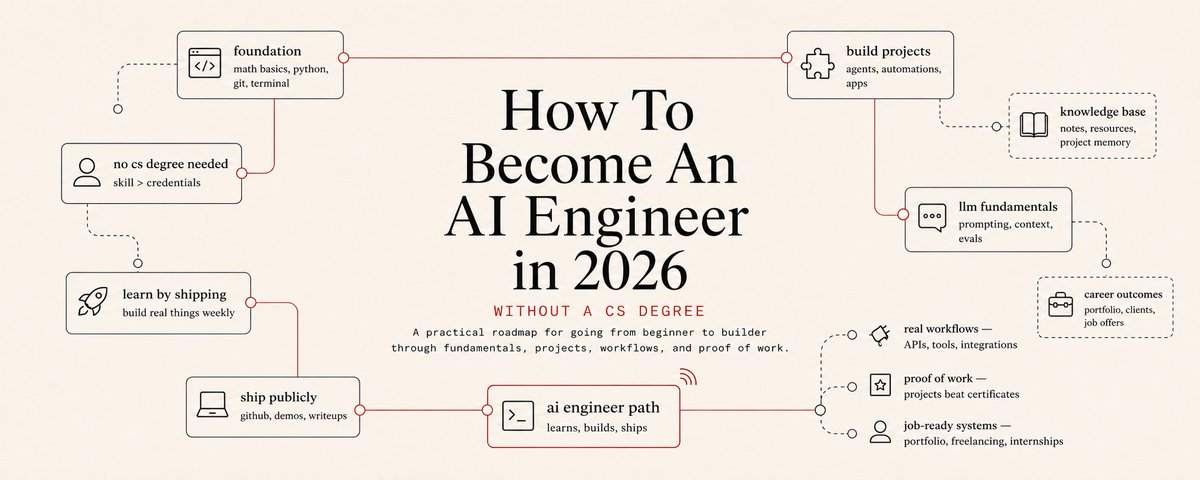 The CS degree is optional now. The skills are not. That sentence is going to make a lot of people angry, and most of them will be people who spent four years and a lot of money on a credential that the market is quietly repricing. I understand the anger. It does not change the reality. In 2026, companies hiring for AI engineering roles are looking at what you can build, not where you sat for lectures. I am not saying a CS degree is worthless. If you have one, it helps. What I am saying is that the degree stopped being the gate. The gate now is proof. Can you build something that works, explain why it works, and ship it where someone can actually see it. That is the whole test. This is the complete path to passing that test without a degree. No motivational fluff, no "just believe in yourself." A real stack, in order, with the exact projects that get you hired and the exact way to learn each piece using the tools already sitting on your laptop. ## Why The Old Path Is Broken The traditional path told you to get the degree, apply through the front door, and wait for permission. That path assumed the credential was the scarce thing. It is not anymore. Here is what actually happened. AI tools collapsed the distance between knowing a concept and building with it. Ten years ago, turning an idea into working software required years of accumulated syntax knowledge. Now the syntax is the cheap part. The scarce part is knowing WHAT to build, HOW to structure it, and WHY one approach beats another. Those are judgment skills, and judgment does not come from a diploma. It comes from building things, breaking them, and building them again. So the people getting hired right now are not the ones with the most impressive transcript. They are the ones with a public trail of things they built. A GitHub full of real projects. A demo someone can click. A thread explaining how they solved a hard problem. That trail is worth more than a degree because it proves the exact thing an employer actually needs to know, which is whether you can do the work. The mistake most people make is spending months preparing to be ready instead of building the trail. They take one more course, watch one more tutorial, wait until they feel qualified. That feeling never arrives. You do not become an AI engineer by finishing a curriculum. You become one by building AI systems, badly at first, then less badly, until the things you build actually work. ## What An AI Engineer Actually Is In 2026 Before the stack, get the definition right, because most people are aiming at the wrong target. An AI engineer is not a machine learning researcher. You are not training foundation models from scratch or publishing papers on new architectures. That is a different job, and it does require deep math and usually an advanced degree. An AI engineer BUILDS with models that already exist. You take Claude, GPT, or open models and you wire them into systems that do useful work. You connect them to data. You give them tools. You build the retrieval, the memory, the agent loops, and the guardrails that turn a raw model into a product. You are a systems builder whose most powerful component happens to be a language model. That distinction matters because it tells you what to actually learn. You do not need to understand backpropagation to be excellent at this job. You need to understand how to feed a model the right context, how to structure a multi step task so it does not fall apart, how to verify output, and how to deploy the whole thing so it runs reliably. Those are engineering skills, and every one of them is learnable without a degree. ## The Stack, In Order Learn these in sequence. Each one builds on the last. Skipping ahead is the most common way people stall out, because they try to build agents before they can handle data and then wonder why nothing works. 1. Python. Functions, classes, async. You do not need to be a Python wizard. You need to be fluent enough to read code, write scripts, and understand what an AI coding assistant produces for you. Async matters specifically because most AI work involves waiting on API calls, and blocking code will bottleneck everything you build. 2. SQL and data handling. Almost every real AI application touches data. You need to pull it, clean it, and shape it. SQL is the universal language for this and it has barely changed in decades, which means it is a safe, permanent skill to own. 3. Git, command line, and Linux basics. This is the environment every serious tool lives in. Claude Code runs in the terminal. Deployment happens on Linux servers. Version control is how you avoid losing work and how you collaborate. Nobody hires an AI engineer who cannot use a terminal. 4. REST APIs and LLM API integration. This is where AI engineering actually starts. You learn how to call a model programmatically, handle its responses, manage rate limits, and handle errors. Every AI product is fundamentally a series of well structured API calls. 5. Embeddings and vector search. This is how machines understand meaning instead of just matching keywords. You convert text into vectors, store them, and search by similarity. This is the foundation of every retrieval system and the concept most beginners skip and later regret skipping. 6. RAG, built end to end. Retrieval Augmented Generation. You give a model access to your own documents so it answers from real information instead of guessing. This is the single most in demand skill in applied AI right now because almost every company wants a system that can answer questions about their own data. 7. Agent frameworks and tool use. You move from a model that answers to a model that acts. It calls tools, executes multi step tasks, and does real work. This is the frontier, and being competent here separates you from the crowd still writing single prompts. 8. Deployment and basic MLOps. A project that only runs on your laptop is a hobby. You need to know how to get it running somewhere real, monitored, and reliable. This is the difference between "I built a demo" and "I shipped a product." 9. AI dev tools. Claude Code, Cursor, and the agentic tooling that makes you dramatically faster. Mastering these is not cheating. It is the actual job. An AI engineer who cannot use AI to build faster is like a carpenter who refuses power tools. ## The 3 Projects That Actually Get You Hired Nobody hires you for finishing courses. They hire you for proof. Build these three and you have proof that covers the entire stack. Project 1. A RAG application using your own data. Take a real body of documents. Your notes, a set of PDFs, a company's public docs, anything. Build a system that ingests them, embeds them, stores the vectors, and answers questions grounded only in that data. This single project proves retrieval, embeddings, chunking, and the ability to prevent hallucination. It is the most directly hireable thing you can build because it is exactly what companies want. Project 2. An AI agent that uses tools. Build an agent that does not just answer but acts. It calls at least two real tools, a search API, a calculator, a file writer, a calendar. It plans, executes, and handles the case where a tool fails. This proves you understand agent design, not just prompting, which is the skill most beginners never actually demonstrate. Project 3. A deployed, full stack AI product. Take one of the above and ship it. A real interface, a backend, deployed somewhere with a public URL a stranger can visit and use. This proves the thing employers worry about most, that you can ship past "works on my machine." A deployed project is worth ten local ones on a resume. Three projects. Full stack coverage. Public proof. That portfolio beats most degrees for this specific job. ## How To Actually Learn Each Piece Here is the part most guides skip. You do not need to buy a $500 course to learn any of this. You have the best tutor ever built sitting on your laptop. Use the model to teach you the skills you will use to build with the model. Use this prompt to turn Claude into a structured tutor for any skill in the stack: You are my coding tutor for [SKILL, e.g. embeddings and vector search]. I am learning to become an AI engineer and I have no CS degree. Teach me this in a build-first way, not theory-first. 1. Explain the core concept in plain language with one concrete analogy. 2. Give me the smallest possible working code example I can run today. 3. Give me one slightly harder exercise to do on my own. 4. After I share my attempt, critique it and point out what a senior engineer would do differently. Assume I learn by building and breaking things, not by reading. Wait for me to complete each step before moving to the next. That single prompt replaces most paid courses. It adapts to your level, answers your exact questions, and never moves on until you actually understand. For the projects, use Claude Code to scaffold and then force yourself to understand every line. Do not copy blindly. After it generates code, run this: Walk me through the code you just wrote line by line. For each section, explain what it does and why you chose this approach over the obvious alternative. Then point out the one part most likely to break in production and how I would fix it. This is how you build real understanding instead of a pile of code you cannot explain in an interview. The people who fail interviews are the ones who built projects they cannot actually explain. Do not be that person. ## How To Get Hired Without The Degree The portfolio is necessary but not sufficient. You also have to be visible, because nobody hires proof they cannot find. Build in public. Every project you build, write about. A thread on what you built, the hard part, how you solved it. This does two things. It creates a public trail that shows up when someone searches your name, and it forces you to understand your own work well enough to explain it. Employers increasingly find engineers through their public building, not through job boards. Contribute to open source. Find an AI project you use and fix something. A bug, a doc improvement, a small feature. A merged pull request to a real project is a credential no degree can give you. It proves you can work in someone else's codebase, which is most of the actual job. Reach out directly with proof, not requests. Do not send "I am looking for opportunities." Send "I built this thing that solves the exact problem your product has, here is the demo." Attach the proof. This converts because it demonstrates the skill in the act of asking for the job. Here is a template for that outreach: Subject: Built a [thing] that solves [specific problem you noticed] Hi [name], I noticed [specific, real observation about their product or problem]. I built a working prototype that addresses it: [link to live demo]. It uses [the specific technical approach], and here is the code: [repo link]. I am an AI engineer looking for my next role. If this is useful, I would love 15 minutes to walk you through how I would build it out properly. [Your name] That email works because it leads with proof and asks for almost nothing. It is the opposite of the generic application that gets ignored. Freelance your way in. If direct hiring is slow, take small paid projects. Build a RAG bot for a local business. Automate something for a small company. Paid work, even tiny paid work, is the strongest possible proof because someone valued it enough to pay. Three small paid projects on your profile changes how every future employer reads you. ## Picking A Specialization Once The Basics Click Once you have the stack and the three projects, a question shows up that nobody warns you about. AI engineering is broad, and trying to be great at all of it makes you mediocre at everything. The people who get hired fastest pick a lane. Here are the lanes actually hiring right now, and how to tell which fits you. RAG and knowledge systems. If you liked project one most, the retrieval work, the chunking, the grounding, this is your lane. Every company with internal documents wants someone who can build a system that answers questions about them accurately. This is the safest, most in demand specialization and the easiest to show proof for, because the use case is universal. Agentic systems. If project two lit you up, the tool use, the multi step execution, the orchestration, this is the frontier lane. It pays the most and has the least competition because it is the hardest to do well. The tradeoff is that the proof is harder to build and the field moves fast, so you have to keep learning constantly. AI product engineering. If you cared most about project three, the interface, the deployment, the making it real, you are a product engineer who happens to specialize in AI. This lane values shipping over cleverness, and it is where most of the actual jobs are, because most companies need someone who can turn AI capability into a thing users can actually use. Pick one based on which project you genuinely enjoyed, not which one sounds most impressive. Enjoyment is the only fuel that survives the boring middle stretch of getting good at something. The specialization you pick from interest, you will actually stick with. The one you pick from status, you will quit. Then go deep. Build three more projects in your chosen lane. Write about all of them. Become the person whose name comes up when someone needs that specific thing. Specialists get hired. Generalists get filtered. ## What The First 6 Months On The Job Actually Look Like It helps to know what you are aiming at, because the job is not what the tutorials imply. Most of your time will not be spent writing clever prompts. It will be spent on the unglamorous work that makes AI systems actually reliable. Handling the edge cases where the model does something weird. Building the evals that tell you whether a change made things better or worse. Wrangling data into a shape the system can use. Debugging why the agent worked in testing and failed in production. This is good news for someone without a degree, because none of it is theoretical. It is all practical engineering, learnable by doing, exactly the kind of thing your portfolio projects already trained you for. The person who built three real projects and debugged them when they broke is far more prepared for this than the person who aced a theory exam and never shipped anything. The engineers who thrive in the first six months are the ones who are comfortable with the system being imperfect and their job being to make it steadily less imperfect. If you built your projects properly, breaking them and fixing them, you already have that muscle. That is the whole reason the build-first path beats the credential-first path for this specific job. Tutorial hell. Watching endless tutorials feels like progress. It is not. It is consumption disguised as production. The rule is simple. For every hour of learning, build for two. If you are not building, you are not learning, you are just entertained. Waiting to feel ready. You will never feel ready. The people who make it start building before they feel qualified and get qualified by building. Ship the ugly first version. Improve it in public. Learning in the wrong order. Trying to build agents before you can handle data and APIs. The stack is sequenced for a reason. Respect the order and each piece clicks. Skip ahead and you build on sand. Building projects nobody can see. A brilliant project locked in a private repo does not exist as far as your career is concerned. Everything ships public. The point is the proof, and proof requires an audience. Copying code you cannot explain. The fastest way to fail an interview. If Claude wrote it, understand it before you claim it. Your ability to explain your own work is the entire test. ## Your 90 Day Plan You do not need years. You need a focused 90 days. Days 1 to 30. Foundations. Python fluency, SQL, git, command line, and your first API calls to a model. By day 30 you should be comfortable calling an LLM programmatically and handling the response. Build small. A script that summarizes a document. A tool that answers questions about a text file. Days 31 to 60. Project one and two. Build the RAG application. Then build the agent. Do not aim for perfect. Aim for working, then explainable. Write a thread about each when you finish. By day 60 you have two real projects and two public posts. Days 61 to 90. Deploy and get visible. Ship project three with a public URL. Start the outreach. Contribute one open source pull request. Post consistently about what you are building. By day 90 you have a portfolio, a public trail, and active conversations with people who might hire you. That is not a fantasy timeline. It is aggressive but real for someone who treats it seriously and builds every single day. The people who fail this timeline are the ones who spend it preparing instead of building. ## The Real Reason This Works Now The degree was always a proxy. Employers could not directly measure whether you could do the work, so they used the credential as a stand in. The degree said "this person can probably learn hard things and finish what they start." AI engineering broke that proxy, because now you can directly demonstrate the exact skill. A deployed RAG system is not a proxy for competence. It IS competence, made visible. When you can show the actual thing, the stand in for the thing stops mattering. That is the whole shift. Not that credentials became worthless, but that proof became directly available. And when proof is available, the people who provide it beat the people who only have the proxy. So stop waiting for permission. Stop preparing to be ready. Pick the first skill in the stack, open Claude, and build the smallest possible working thing today. Then build a slightly bigger thing tomorrow. In 90 days of that, you will have something no degree can give you, which is proof that you can actually do the job. The CS degree is optional now. The skills are not. Go build the proof. Follow @cyrilXBT for the full builds behind every project in this article, plus the exact prompts and stacks I use. ## 相关链接 - [CyrilXBT](https://x.com/cyrilXBT) - [@cyrilXBT](https://x.com/cyrilXBT) - [77K](https://x.com/cyrilXBT/status/2073940565851361607/analytics) - [@cyrilXBT](https://x.com/@cyrilXBT) - [Upgrade to Premium](https://x.com/i/premium_sign_up) - [9:22 AM · Jul 6, 2026](https://x.com/cyrilXBT/status/2073940565851361607) - [77.8K Views](https://x.com/cyrilXBT/status/2073940565851361607/analytics) - [View quotes](https://x.com/cyrilXBT/status/2073940565851361607/quotes) --- *导出时间: 2026/7/6 21:41:10* --- ## 中文翻译 # 如何在 2026 年成为一名 AI 工程师(无需计算机学位)- 完整指南 **作者**: CyrilXBT **日期**: 2026-07-06T01:22:17.000Z **来源**: [https://x.com/cyrilXBT/status/2073940565851361607](https://x.com/cyrilXBT/status/2073940565851361607) ---  现在,计算机学位是可选项。 但技能不是。 这句话会让很多人感到愤怒,其中大多数人花了四年时间和一大笔钱换取了一张学历,而市场正在悄悄重新评估它的价值。我理解这种愤怒。但这改变不了现实。在 2026 年,招聘 AI 工程师角色的公司看重的是你能构建什么,而不是你在哪里听课。 我不是说计算机学位毫无价值。如果你有,那会有帮助。我想说的是,学位已经不再是门槛了。现在的门槛是证明。你能否构建一个能运行的东西,解释它为什么能运行,并将其发布到一个别人真正能看到的地方。这就是全部的测试。 这是一条无需学位即可通过该测试的完整路径。没有励志的废话,没有“只要相信自己”。这是一个真实的技术栈,按顺序排列,包含那些能让你被录用的确切项目,以及利用你笔记本电脑上现有工具学习每个组件的确切方法。 ## 为什么老路子行不通了 传统的路径告诉你去拿学位,通过正门申请,然后等待许可。那条路径假设学历是稀缺资源。但现在不再是了。 实际情况是这样的。AI 工具缩短了掌握概念和利用其构建事物之间的距离。十年前,将一个想法转化为可运行的软件需要数年积累的语法知识。现在,语法是廉价的部分。稀缺的部分是知道构建**什么**,如何构建**结构**,以及**为什么**一种方法优于另一种。这些都是判断力技能,判断力不是文凭带来的。它来自于构建事物,搞坏它们,然后再构建。 因此,现在被录用的人不是那些成绩单最令人印象深刻的人。他们是那些拥有公开构建记录的人。一个满是真实项目的 GitHub。一个别人可以点击的演示。一个解释他们如何解决难题的推文。这条记录比学位更有价值,因为它证明了雇主真正需要知道的唯一一件事:你能否胜任工作。 大多数人犯的错误是花几个月的时间“准备就绪”,而不是构建记录。他们再上一门课,再看一个教程,等到他们觉得自己有资格了。那种感觉永远不会到来。你不是通过完成课程大纲成为 AI 工程师的。你是通过构建 AI 系统成为工程师的——起初很糟糕,然后不那么糟糕,直到你构建的东西真正能运行。 ## 2026 年 AI 工程师的实际定义 在介绍技术栈之前,先搞正确定义,因为大多数人都瞄准了错误的目标。 AI 工程师不是机器学习研究员。你不需要从头开始训练基础模型,也不需要发表关于新架构的论文。那是另一份工作,而且确实需要深厚的数学基础,通常还需要高级学位。 AI 工程师是**使用现有模型进行构建**的人。你使用 Claude、GPT 或开源模型,并将它们连接到能执行有用任务的系统中。你将它们连接到数据。你给它们提供工具。你构建检索、记忆、智能体循环和护栏,将原始模型转化为产品。你是一名系统构建者,而你最强大的组件恰好是一个语言模型。 这种区别很重要,因为它告诉了你真正需要学习什么。你不需要理解反向传播就能在这个工作中表现出色。你需要理解如何为模型提供正确的上下文,如何构建多步任务使其不会崩溃,如何验证输出,以及如何部署整个系统使其可靠运行。这些都是工程技能,每一项都可以在无学位的情况下学会。 ## 技术栈,按顺序排列 请按顺序学习这些。每一项都建立在前一项的基础上。跳步骤是人们停滞不前的最常见方式,因为他们试图在还不会处理数据的时候就去构建智能体,然后奇怪为什么什么都不起作用。 1. **Python**。函数、类、异步。你不需要成为 Python 向导。你需要足够流利地阅读代码、编写脚本,并理解 AI 编码助手为你生成的内容。异步特别重要,因为大多数 AI 工作涉及等待 API 调用,而阻塞代码会成为你构建的所有东西的瓶颈。 2. **SQL 和数据处理**。几乎每个真实的 AI 应用都会涉及数据。你需要提取、清洗和塑造数据。SQL 是这方面的通用语言,几十年来几乎没有变化,这意味着它是一项安全、永久性的技能。 3. **Git、命令行和 Linux 基础**。这是每个严肃工具生存的环境。Claude Code 在终端中运行。部署发生在 Linux 服务器上。版本控制是你避免丢失工作并进行协作的方式。没有人会雇佣一个不会使用终端的 AI 工程师。 4. **REST API 和 LLM API 集成**。这是 AI 工程真正开始的地方。你学习如何以编程方式调用模型,处理其响应,管理速率限制,以及处理错误。每个 AI 产品本质上都是一系列结构良好的 API 调用。 5. **嵌入和向量搜索**。这是机器理解意义而不仅仅是匹配关键词的方式。你将文本转换为向量,存储它们,并通过相似度进行搜索。这是每个检索系统的基础,也是大多数初学者跳过并后来后悔的概念。 6. **端到端构建 RAG**。检索增强生成。你让模型访问你自己的文档,以便它根据真实信息而不是猜测来回答。这是目前应用 AI 中需求量最大的单一技能,因为几乎每家公司都想要一个能回答有关其自身数据问题的系统。 7. **智能体框架和工具使用**。你从一个回答问题的模型转变为一个执行动作的模型。它调用工具,执行多步任务,并做实际的工作。这是前沿领域,在这里表现出众能让你与那些仍在编写单个提示词的人群区分开来。 8. **部署和基础 MLOps**。一个只能在你笔记本电脑上运行的项目只是一个爱好。你需要知道如何让它在某个真实的地方运行、被监控且可靠。这就是“我构建了一个演示”和“我发布了一个产品”之间的区别。 9. **AI 开发工具**。Claude Code、Cursor,以及能让你速度显著提升的智能体工具。精通这些不是作弊。这就是实际的工作。一个不会使用 AI 来更快构建的 AI 工程师,就像是一个拒绝使用电动工具的木匠。 ## 真正能让你被录用的 3 个项目 没有人因为你修完了课程而雇佣你。他们雇佣你是为了看证明。构建这三个项目,你就拥有了覆盖整个技术栈的证明。 **项目 1:使用你自己数据的 RAG 应用。** 找一批真实的文档。你的笔记、一组 PDF、某家公司的公开文档,什么都行。构建一个系统来摄取它们,嵌入它们,存储向量,并仅基于该数据回答问题。这单个项目证明了检索、嵌入、分块,以及防止幻觉的能力。这是你能构建的最直接可被雇佣的东西,因为这正是公司想要的。 **项目 2:一个使用工具的 AI 智能体。** 构建一个不仅仅是回答而是行动的智能体。它至少调用两个真实的工具,比如搜索 API、计算器、文件写入器、日历。它进行规划、执行,并处理工具失败的情况。这证明你理解智能体设计,而不仅仅是提示词工程,这是大多数初学者从未真正展示过的技能。 **项目 3:一个已部署的、全栈 AI 产品。** 拿上述项目之一并发布它。一个真实的界面,一个后端,部署在一个拥有公共 URL 的地方,陌生人可以访问并使用。这证明了雇主最担心的一件事,即你能越过“在我的机器上能跑”这一关。一个已部署的项目在简历上值十个本地项目。 三个项目。全栈覆盖。公开证明。对于这份特定的工作,该作品集胜过大多数学位。 ## 如何真正学习每一个组件 这是大多数指南跳过的部分。你不需要购买 500 美元的课程来学习其中的任何一项。你有史上最好的导师坐在你的笔记本电脑上。使用模型来教你那些你将用来构建系统的技能。 使用这个提示词将 Claude 变成技术栈中任何技能的结构化导师: ```text You are my coding tutor for [SKILL, e.g. embeddings and vector search]. I am learning to become an AI engineer and I have no CS degree. Teach me this in a build-first way, not theory-first. 1. Explain the core concept in plain language with one concrete analogy. 2. Give me the smallest possible working code example I can run today. 3. Give me one slightly harder exercise to do on my own. 4. After I share my attempt, critique it and point out what a senior engineer would do differently. Assume I learn by building and breaking things, not by reading. Wait for me to complete each step before moving to the next. ``` (你是我的 [技能,例如嵌入和向量搜索] 编程导师。我正在学习成为 AI 工程师,我没有计算机学位。请以构建优先而非理论优先的方式教我。1. 用通俗的语言和一个具体的类比解释核心概念。2. 给我今天可以运行的最小可行代码示例。3. 给我一个稍微难一点的练习让我自己做。4. 在我分享我的尝试后,批评它并指出高级工程师会有什么不同的做法。假设我是通过构建和搞坏东西来学习的,而不是通过阅读。在我完成每一步之前,不要进入下一步。) 这一个提示词就能替代大多数付费课程。它适应你的水平,回答你的确切问题,并且在你真正理解之前绝不会继续推进。 对于项目,使用 Claude Code 来搭建脚手架,然后强迫自己理解每一行代码。不要盲目复制。在它生成代码后,运行这个: ```text Walk me through the code you just wrote line by line. For each section, explain what it does and why you chose this approach over the obvious alternative. Then point out the one part most likely to break in production and how I would fix it. ``` (逐行带我浏览你刚才写的代码。对于每个部分,解释它的作用,以及你为什么选择这种方法而不是显而易见的替代方案。然后指出最可能在生产环境中崩溃的部分以及我将如何修复它。) 这就是你建立真正理解的方式,而不是一堆你在面试中无法解释的代码。面试失败的人就是那些构建了他们无法真正解释的项目的人。不要成为那样的人。 ## 如何在没有学位的情况下被录用 作品集是必要的,但还不够。你还需要可见,因为没有人会雇佣他们找不到的证明。 公开构建。你构建的每个项目,都要写出来。写一篇推文,讲你构建了什么,难点在哪里,你是如何解决的。这有两点作用。它创建了一个公开的记录,当有人搜索你的名字时就会显示出来;它还迫使你足够好地理解自己的工作,以便能够解释它。越来越多的雇主通过工程师的公开构建而不是招聘网站来找到他们。 为开源做贡献。找一个你使用的 AI 项目并修复一些东西。一个 bug,一个文档改进,一个小功能。向真实项目提交合并请求是任何学位都无法给你的凭证。它证明你可以在别人的代码库中工作,而这是实际工作的大部分内容。 带着证明直接联系,而不是请求。不要发送“我在寻找机会”。发送“我构建了这个东西,它解决了你的产品恰好有的具体问题,这是演示。”附上证明。这很有效,因为它在请求工作的同时展示了技能。 这是一个外联模板: 主题:构建了一个 [东西] 来解决 [你注意到的具体问题] 嗨 [姓名], 我注意到 [关于他们产品或问题的具体、真实的观察]。 我构建了一个解决该问题的工作原型:[现场演示链接]。 它使用了 [具体的技术方法],这是代码:[仓库链接]。 我是一名正在寻找下一份工作的 AI 工程师。如果这有用, 我很希望能花 15 分钟带您看看我如何正确地构建它。 [你的名字] 这封邮件有效,因为它以证明开头,而且几乎什么都不求。这与被忽略的通用申请恰恰相反。 通过自由职业进入。如果直接招聘很慢,就接一些小的付费项目。为当地企业构建一个 RAG 机器人。为一家小公司自动化一些事情。付费工作,即使是微不足道的付费工作,也是最强的证明,因为有人看重它到愿意付费。你的个人资料上有三个小的付费项目,会改变每个未来雇主对你的看法。 ## 基础掌握后选择专精方向 一旦你掌握了技术栈并完成了三个项目,就会出现一个没人警告过你的问题。AI 工程很宽泛,试图在所有方面都出色会让你在所有方面都平庸。最快被录用的人会选择一条赛道。 以下是真正在招聘的赛道,以及如何判断哪一个适合你。 **RAG 和知识系统**。如果你最喜欢项目一,即检索工作、分块、 grounding,这是你的赛道。每一个拥有内部文档的公司都想要一个能构建系统准确回答有关文档问题的人。这是最安全、需求最大的专业化方向,也是最容易展示证明的,因为用例是普遍的。 **智能体系统**。如果项目二让你兴奋,即工具使用、多步执行、编排,这是前沿赛道。它薪水最高,竞争最少,因为它最难做好。权衡之处在于证明更难构建,且该领域发展很快,所以你必须不断学习。 **AI 产品工程**。如果你最关心项目三,即界面、部署、把它变成现实,你是一个恰好专精于 AI 的产品工程师。这条赛道看重交付而不是耍小聪明,这也是大多数实际工作所在的地方,因为大多数公司需要有人能将 AI 能力转化为用户实际可以使用的东西。 根据你真正享受的项目来选择一个,而不是哪个听起来最令人印象深刻。享受是唯一的燃料,能在精通某事的枯燥中期阶段支撑你。你出于兴趣选择的专业化方向,你会坚持下去。你出于地位选择的,你会放弃。 然后深入下去。在你选择的赛道上再构建三个项目。把所有这些都写下来。成为那个当有人需要特定东西时名字就会被提起的人。专家被录用。通才被过滤。 ## 工作的前 6 个月实际上是什么样子的 知道你的目标是什么会有帮助,因为工作并不是教程暗示的那样。 你的大部分时间不会花在编写聪明的提示词上。你会花在那些让 AI 系统真正可靠的不起眼的工作上。处理模型做出奇怪反应的边缘情况。构建评估指标,告诉你更改是让情况变好还是变坏。将数据处理成系统可以使用的形状。调试为什么智能体在测试中有效而在生产中失败。 对于没有学位的人来说,这是个好消息,因为这些都不是理论。它们都是实践工程,可以通过做来学习,正是你的作品集项目已经训练过你的那种事情。构建了三个真实项目并在它们坏掉时进行调试的人,比那个理论考试拿 A 却从未发布过任何东西的人准备得更充分。 在头六个月里茁壮成长的工程师,是那些能够容忍系统不完美并且他们的工作是让它稳步变得不那么完美的人。如果你正确地构建了你的项目,搞坏它们并修复它们,你已经有了这种肌肉记忆。这就是为什么对于这份特定的工作,以构建为先的路径打败以学历为先的路径的全部原因。 **教程地狱**。观看无尽的教程感觉像是进步。其实不是。这是伪装成生产的消费。规则很简单。每学习一小时,就构建两小时。如果你不在构建,你就不是在学习,你只是在被娱乐。 **等待感觉准备好了**。你永远不会感觉准备好了。成功的人在觉得自己有资格之前就开始构建,并通过构建变得有资格。发布丑陋的初版。公开改进它。 **学习顺序错误**。试图在你会处理数据和 API 之前就构建智能体。技术栈按顺序排列是有原因的。尊重顺序,每一点都会豁然开朗。跳到前面,你就是在沙地上盖楼。 **构建没人看得到的项目**。一个锁在私人仓库里的精彩项目,就你的潜在雇主而言,并不存在。
如 如何在 2026 年成为AI工程师 文章指出 2026 年 AI 工程师的门槛已变,不再看重学历,而是看重作品集与交付能力。作者拆解了 AI 工程师的三个核心能力:软件工程、LLM 使用及产品思维,并规划了一份为期 12 个月的六阶段实战路线图,涵盖 Python 基础、LLM API、RAG、Agent 系统开发、评估部署及求职准备。 技术 › LLM ✍ 路飞 AI 研究员🕐 2026-07-08 AI工程师职业发展学习路线RAGAgentLLMPythonPrompt实战指南求职
2 2026 年,如何成为一名 AI 工程师(不卡学历) 本文提供了 2026 年成为 AI 工程师的 12 个月路线图。作者区分了模型研究员与 AI 工程师,强调后者更看重实战能力而非高学历。路线图涵盖 Python 基础、大模型 API 调用、RAG 系统构建、Agent 开发以及 MLOps 评估与部署。通过完成三个核心项目(RAG 应用、多 Agent 系统、带监控的上线系统),建立能胜任工作的作品集,即使没有 CS 学位也能入行。 技术 › Agent ✍ 老白(每日 AI 干货)🕐 2026-07-02 AI工程师学习路线RAGLLMPython职业发展AgentMLOps编程实战教程
如 如何在6个月内从零成为AI工程师(2026版) 本文针对2026年的行业现状,驳斥了通过传统机器学习理论入行的误区,提出了6个月速成AI工程师的实战路线图。作者强调无需深奥数学,而应从Python和API调用起步。核心路径涵盖:深入掌握LLM原理与提示工程,精通RAG(检索增强生成)及语义分块、重排序等进阶技术,最终构建结合Agent与生产级思维的复杂AI系统。文章指出,唯有动手解决实际问题、构建高可用系统,而非单纯考取证书,才是成为合格AI工程师的关键。 技术 › LLM ✍ Suryansh Tiwari🕐 2026-04-28 AI工程师职业发展LLMRAGAgent学习路线PythonOpenAIClaude教程
A AI 工程师学习路线图:从核心技能到生产实践 文章基于 2000 余份职位描述,规划了一条务实的 AI 工程师学习路径。重点指出 AI 工程并非从零训练模型,而是构建以 LLM 为核心的系统。核心技能包括 LLM 基础、RAG 检索增强、Agent 智能体、测试评估及监控部署。此外,文章还梳理了 Python、Web 开发、云原生及数据库等支撑性技能,并推荐了学习优先级与主流技术栈,旨在帮助开发者构建可靠、可落地的生产级 AI 系统。 技术 › AI工程 ✍ Luffytaro🕐 2026-04-27 AI工程师学习路线LLMRAGAgent职业发展PythonLangChain评估体系生产部署
2 2026年如何成为AI工程师(无需CS学位) 文章指出2026年AI工程师角色已分化为机器学习工程师和应用AI工程师。对于非CS学位求职者,后者是主要机会。文章详细列出了必备技能(Python、LLM行为、RAG系统、评估观测),并提出了三个能替代学历证明的实战项目建议。 技术 › LLM ✍ Harman🕐 2026-07-24 AI工程师职业发展RAGLLMAgentPrompt无学位
从 从零到 AI 工程师的 4 个月速成路径 本文指出 AI 工程是当前增长最快的高薪职位之一,且学历门槛正在降低。文章为转行者规划了一条为期 4 个月的高效学习路径,强调跳过繁重的数学理论,专注于 API 调用、Prompt 设计和 RAG 等工程落地技能,并分析了常见的转型误区与市场机遇。 技术 › LLM ✍ AI Guides🕐 2026-07-08 AI工程师职业发展学习路径LLM转行教程RAGAPI提示工程职场指南
2 2026年非CS背景成为AI工程师的指南 文章指出,成为AI工程师无需计算机学位,作品集比文凭更重要。AI工程师是连接大模型与现实产品的构建者。文章提供了为期9个月的四阶段自学路径:掌握Python编程、精通LLM API(含工具调用)、构建RAG系统以及开发Agent。强调实战部署和解决实际问题的能力,而非深奥的数学研究。 技术 › LLM ✍ Khairallah AL-Awady🕐 2026-06-29 AI工程师学习路线PythonRAGAgentLLM API自学职业发展
2 2026年AI开发者从零到英雄的完整路线图 这是一份针对2026年AI开发者的完整学习指南。文章指出,成为AI开发者不再需要计算机学位,通过正确的路线图,个人即可构建AI应用和SaaS产品。指南分为十个阶段:首先理解AI生态系统的基本概念(AI、ML、LLM、Agent等);接着掌握Python基础、API调用及Git工具;然后通过现有AI工具(如OpenAI API、LangChain)快速动手实践;最后深入学习前端技术、提示工程、LLM原理(RAG、微调)及应用部署。文章强调“学习-构建-分享”的循环策略,并指出AI智能体、自动化及RAG系统是当前的高价值技能。 技术 › LLM ✍ Shabnam Parveen🕐 2026-05-23 AI开发学习路线图LLMAgentAutomationRAGPythonPrompt Engineering职业发展
从 从零到 AI 工程师——没人真正讲清楚的路线图 本文为 AI 初学者提供了一份为期 14 周的实战路线图,旨在通过免费资源将新手培养成具备构建生产级 AI 系统能力的工程师。路线图包含六个阶段:环境搭建、AI 基础、机器学习基础、深度学习、现代 LLM 工程以及 Agent 与部署。文章强调动手实践,推荐了 OpenAI、Anthropic 官方教程及 GitHub 优质开源仓库,帮助学习者避开盲目刷证书的误区,真正掌握 AI 开发技能。 技术 › LLM ✍ 土豆本豆🕐 2026-05-18 AI工程师学习路线图LLMAgent深度学习RAGPython实战教程机器学习AI基础
零 零基础 4 个月成为可受雇 AI 工程师的路径 文章介绍了一条 4 个月从零基础成为 AI 工程师的学习路径。文章指出 AI 工程岗位增长迅速且薪资优厚,学位要求正在降低。作者强调职业转型者具备判断力和沟通能力的优势,并指出了初学者常犯的错误,如过早钻研理论、只看不练等。 技术 › LLM ✍ AI Guides🕐 2026-07-29 AI工程师职业发展学习路径LLM转型
H How to Become an LLM Engineer 本文是2026年成为LLM工程师的实用指南,涵盖核心技能(RAG、Agents、生产部署)、学习路线、推荐工具及项目构建建议,帮助读者系统掌握大模型应用开发与工程化能力。 技术 › LLM ✍ Swati Gupta🕐 2026-07-16 LLM工程师RAGAgent学习路线项目实战LangChainPython职业发展AI技能
如 如何在6个月内成为代理AI工程师 本文提供了一个为期6个月的12阶段AI工程师学习路线图。文章首先阐述了代理工程师的核心是构建能自主决策的系统,而非编写固定逻辑。前两个阶段重点介绍了Python异步编程的基础(解决API调用阻塞问题)和LLM的基本原理(如上下文限制、成本控制和模型路由)。随后详细讲解了工具调用与结构化输出的实现方法,强调使用Pydantic验证数据及构建可恢复的Agent循环。 技术 › Agent ✍ Rahul🕐 2026-07-12 AIAgentLLMPython异步编程教程职业发展工具调用Pydantic学习路线