零基础到可就业的 AI 工程师学习路线图 Jaydeep 2026-08-24 8.6 KB 33K 567 ☆ 收藏 𝕏 文章列表 本文提供了一份从零到可就业的 AI 工程师分阶段学习路线图,区别于单纯的技能清单,每个阶段都附带经过验证的优质课程、文档和书籍。路线涵盖六个阶段:软件工程基础(Python、API、Git)、LLM 工作原理(Karpathy 课程、3Blue1Brown)、提示工程与 API 掌握、RAG 检索增强生成(最具就业价值的技能)、Agent 与编排(LangGraph、MCP)、以及评估与生产部署。作者建议用 8-12 个月完成学习,并强调构建真实项目组合和公开写作是获得雇佣的关键。 AI工程师学习路线图RAGAgentLLM提示工程LangChainMCP职业发展机器学习 75 值得读 ▶ 资源清单具体且经过筛选,实用性强、时效性好,但深度和观点新颖性有限,属于精选版学习路线图而非原创分析。 # The Zero to Employable AI Engineering Roadmap **作者**: Jaydeep **日期**: 2026-08-24T13:46:04.000Z **来源**: [https://x.com/_jaydeepkarale/status/2091884749757546924](https://x.com/_jaydeepkarale/status/2091884749757546924) --- 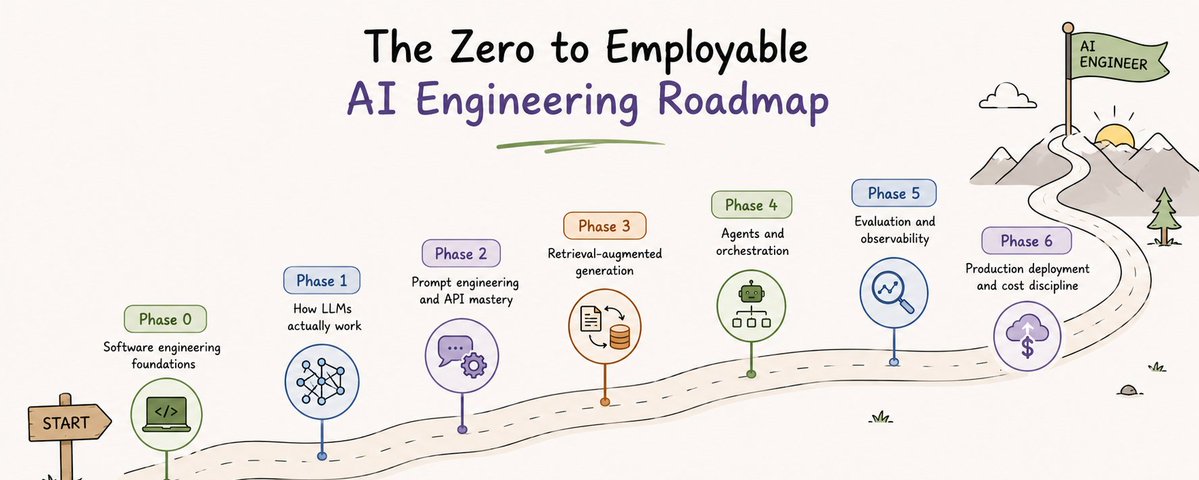 A phase-by-phase path into AI engineering, with the specific courses, docs, and books worth your time at each stage, not just a list of skills to Google later Most AI engineering roadmaps are skill lists dressed up as guidance. Learn RAG. Learn agents. Learn evals. Fine, but learn them where? The gap between naming a skill and knowing which resource actually teaches it well is where most self-taught paths stall out. This blog fixes that by attaching a small, vetted set of resources to every phase, the ones that keep showing up as genuinely recommended across independent 2026 course reviews, not just SEO-bait listicles. Plan on roughly eight to twelve months of consistent work if you are starting from a solid software engineering base, longer if Phase 0 is new to you too. ## Phase 0: Software engineering foundations Before any AI-specific learning, you need to already be someone who can build and ship an application. This is the phase people skip and then struggle in Phase 3 without knowing why. - Python fundamentals: freeCodeCamp's Complete Python Tutorial, still the most complete free option for getting fluent fast - Building and consuming REST APIs: FastAPI's official documentation, which doubles as one of the better practical API design tutorials available for free - Version control and collaboration: standard Git and GitHub workflow, non-negotiable for the portfolio you'll build later If you can already build and deploy a basic backend service, skip this phase entirely and move to Phase 1. ## Phase 1: How LLMs actually work You don't need to be able to derive backpropagation, but you need enough of a mental model of what a transformer is doing that prompting, context windows, and hallucination stop feeling like magic. - Andrej Karpathy's Neural Networks: Zero to Hero YouTube series, widely cited as the single best free deep learning resource available, because Karpathy builds everything from scratch on screen rather than waving at theory - 3Blue1Brown's neural network and transformer video series, for visual intuition on attention before you touch the math seriously - Stanford CS336, referenced repeatedly in 2026 self-study roadmaps as the strongest freely available course specifically on language modeling internals, if you want to go deeper than intuition ## Phase 2: Prompt engineering and API mastery This is the first genuinely AI-engineering-specific skill, and it's more rigorous than it looks from the outside. Treat it as a real discipline with failure modes, not a knack. - Anthropic Academy's API course, consistently ranked as the strongest structured path for going from zero to fluent with a frontier model's API, including tool use and structured output - The OpenAI Cookbook, a library of working, copy-pasteable examples rather than lecture content, best used alongside the Anthropic course rather than instead of it - [DeepLearning.AI](//DeepLearning.AI)'s short courses on prompting and structured outputs, Andrew Ng's platform now runs dozens of one-to-two-hour hands-on courses built with engineers from OpenAI and Anthropic directly, and the structured-output and prompting modules are the most relevant here ## Phase 3: Retrieval-augmented generation Multiple 2026 roadmap sources independently call RAG the single most employable skill in the field, since most enterprise AI deployments are RAG systems rather than novel model training. This is not optional depth, it is close to the center of the job. - [DeepLearning.AI](//DeepLearning.AI)'s "LangChain for LLM Application Development," built directly with the LangChain team and still the most cited free course for this specific skill - Chip Huyen's book "AI Engineering: Building Applications with Foundation Models," referenced across nearly every serious 2026 roadmap as the closest thing the field has to a canonical text, particularly strong on RAG architecture tradeoffs - Pinecone's Learning Center, vendor-produced but genuinely well written on chunking strategy, embedding choice, and retrieval evaluation, useful regardless of which vector database you end up using in practice Build something real here before moving on. A RAG chatbot over a domain you know well, legal documents, internal wikis, whatever you have real access to, is the standard portfolio piece for a reason. ## Phase 4: Agents and orchestration Once retrieval works, the next layer is giving a model the ability to take multiple steps, call tools, and decide what to do next rather than just answering once. - LangChain Academy, built and maintained directly by the LangChain team, covers LangGraph for stateful multi-step agents, multi-agent architectures, and is the most current free course specifically on this layer - The Model Context Protocol introduction tutorial on DataCamp, since MCP has become the standard way agents connect to external tools and data sources, and most 2026 job postings for AI engineer roles now name it explicitly - Read the ReAct paper's core idea, reason, act, observe, repeat, even if only as a blog explainer rather than the original paper, since nearly every agent framework you'll touch is built on this loop underneath ## Phase 5: Evaluation and observability This is the layer that separates someone who can demo an AI feature from someone who can be trusted to ship one. As open-source models become viable alternatives to proprietary APIs, being able to run systematic evals rather than eyeballing outputs in a chat window is what actually lets you defend a model choice with data. - LangSmith's evaluation documentation, for building eval sets and tracing what an agent actually did in production rather than what you assume it did - Langfuse, an open-source alternative worth knowing since not every team standardizes on LangChain's own tooling - [DeepLearning.AI](//DeepLearning.AI)'s evaluation-focused short courses, useful specifically for learning to distinguish a real regression from noise ## Phase 6: Production deployment and cost discipline The unglamorous middle that most courses skip and most interviews probe for anyway. - Full Stack Deep Learning, repeatedly recommended for teaching production discipline, monitoring, and the edge cases that a model-only education never covers - Docker and Kubernetes fundamentals, since serving the application layer around a model is standard backend infrastructure work, not a specialized AI skill - Set spending limits early and get comfortable routing cheap tasks to cheap models, cost management is a real interview topic, not an afterthought ## Building the portfolio that gets you hired None of the above matters to a hiring manager without evidence you built something. The roadmap sources converge on a similar project sequence. - A RAG chatbot over a real, non-generic dataset, not another PDF-question-answering demo copied from a tutorial - An agent that calls at least two real external tools or APIs and handles a multi-step task end to end - A small production concern solved visibly: an eval set you built, a cost dashboard, a tracing setup, anything that shows you thought past the happy path Write about what you build as you go. Several of the most consistently recommended resources in this space, including in the developer education work you're already doing, exist precisely because writing publicly about a build is itself a credibility signal that a finished project alone does not provide. ## The honest timeline Most sources converge on eight to twelve months for someone starting Phase 0 with genuine software engineering fluency already in hand, longer if that foundation still needs building. There is no shortcut that skips the building. Every resource on this list works, but only if you finish something with it rather than collecting course completions. ## 相关链接 - [Jaydeep](https://x.com/_jaydeepkarale) - [@_jaydeepkarale](https://x.com/_jaydeepkarale) - [682](https://x.com/_jaydeepkarale/status/2091884749757546924/analytics) - [DeepLearning.AI](https://deeplearning.ai/) - [DeepLearning.AI](https://deeplearning.ai/) - [DeepLearning.AI](https://deeplearning.ai/) - [Upgrade to Premium](https://x.com/i/premium_sign_up) - [9:46 PM · Aug 24, 2026](https://x.com/_jaydeepkarale/status/2091884749757546924) - [682 Views](https://x.com/_jaydeepkarale/status/2091884749757546924/analytics) - [View quotes](https://x.com/_jaydeepkarale/status/2091884749757546924/quotes) --- *导出时间: 2026/8/24 22:46:21* --- ## 中文翻译 # 从零到可就业的 AI 工程师路线图 **作者**: Jaydeep **日期**: 2026-08-24T13:46:04.000Z **来源**: [https://x.com/_jaydeepkarale/status/2091884749757546924](https://x.com/_jaydeepkarale/status/2091884749757546924) ---  一条分阶段进入 AI 工程领域的路径,每个阶段都附上值得你花时间的具体课程、文档和书籍,而不仅仅是一份之后再去 Google 的技能清单。 大多数 AI 工程路线图只是把技能清单包装成指导。学 RAG、学智能体、学评估。没问题,但去哪里学呢? 从说出一个技能的名字,到知道哪个资源真正能教好它,这个鸿沟正是大多数自学路径停滞不前的地方。这篇博客通过在每个阶段附上一小组经过筛选的资源来解决这个问题——这些资源是在 2026 年各种独立的课程评测中被反复真正推荐的,而不是靠 SEO 引流的清单体文章。 如果你已经有扎实的软件工程基础,预计需要大约八到十二个月的持续努力;如果第 0 阶段的内容对你来说也是全新的,那则需要更长时间。 ## 第 0 阶段:软件工程基础 在任何 AI 专门学习之前,你需要已经是一个能构建并上线应用程序的人。这正是人们常常跳过、然后在第 3 阶段莫名挣扎的那个阶段。 - Python 基础:freeCodeCamp 的 Complete Python Tutorial,至今仍是快速达到流利水平的最完整的免费选项 - 构建和使用 REST API:FastAPI 官方文档,同时也是免费可得的、较好的实用 API 设计教程之一 - 版本控制与协作:标准的 Git 和 GitHub 工作流,对于你之后要构建的作品集来说不可或缺 如果你已经能构建并部署一个基本的后端服务,可以完全跳过这个阶段,直接进入第 1 阶段。 ## 第 1 阶段:LLM 到底是如何工作的 你不需要会推导反向传播,但你需要对 transformer 在做什么有足够清晰的心智模型,从而让提示词、上下文窗口和幻觉不再感觉像魔法。 - Andrej Karpathy 的 Neural Networks: Zero to Hero YouTube 系列,被广泛认为是目前最好的免费深度学习资源,因为 Karpathy 在屏幕上从零构建一切,而不是对着理论空谈 - 3Blue1Brown 的神经网络和 transformer 视频系列,在正式接触数学之前建立对注意力机制的直观理解 - 斯坦福 CS336,在 2026 年的自学路线图中被反复引用,是专门讲授语言建模内部原理的最强的免费课程,适合想超越直觉、深入探究的人 ## 第 2 阶段:提示工程与 API 精通 这是第一个真正属于 AI 工程的专属技能,而且它比外行看起来要严谨得多。把它当作一门有失败模式的真正学科来对待,而不是一种小技巧。 - Anthropic Academy 的 API 课程,一直被评为从零到熟练掌握前沿模型 API 的最强结构化路径,包括工具使用和结构化输出 - OpenAI Cookbook,一个包含可直接复制使用的工作示例的库,而非讲义内容,最好与 Anthropic 的课程搭配使用,而不是替代它 - [DeepLearning.AI](//DeepLearning.AI) 关于提示和结构化输出的短课程,吴恩达的平台目前运行着数十门一到两小时的实战课程,由 OpenAI 和 Anthropic 的工程师直接参与制作,其中结构化输出和提示模块在这里最为相关 ## 第 3 阶段:检索增强生成 多份 2026 年路线图来源都独立地将 RAG 称为该领域最有利于就业的单一技能,因为大多数企业级 AI 部署都是 RAG 系统,而非新模型训练。这不是可有可无的进阶内容,它几乎就是这个工作的核心。 - [DeepLearning.AI](//DeepLearning.AI) 的 "LangChain for LLM Application Development",与 LangChain 团队直接合作开发,至今仍是这项具体技能中被引用最多的免费课程 - Chip Huyen 的书《AI Engineering: Building Applications with Foundation Models》,在几乎所有严肃的 2026 年路线图中都被引用,是该领域最接近经典教材的书,尤其在 RAG 架构权衡方面非常出色 - Pinecone 的 Learning Center,虽然是厂商出品,但在分块策略、嵌入选择和检索评估方面写得确实很好,无论你最终在实践中使用哪种向量数据库都很有用 在继续前进之前,先构建点真实的东西。在一个你熟悉的领域上构建 RAG 聊天机器人——法律文档、内部 wiki,任何你真正能接触到的东西——是标准的作品集项目,这是有原因的。 ## 第 4 阶段:智能体与编排 一旦检索跑通了,下一层就是赋予模型多步执行、调用工具、决定下一步做什么的能力,而不是只回答一次。 - LangChain Academy,由 LangChain 团队直接构建和维护,涵盖用于有状态多步智能体的 LangGraph、多智能体架构,是专门针对这一层最时新的免费课程 - DataCamp 上的 Model Context Protocol 入门教程,因为 MCP 已经成为智能体连接外部工具和数据源的标准方式,而且 2026 年大多数 AI 工程师岗位的招聘启事中都会明确提到它 - 阅读 ReAct 论文的核心思想——推理、行动、观察、重复——哪怕只是读博客解读而非原始论文也可以,因为你将接触的几乎所有智能体框架底层都建立在这个循环之上 ## 第 5 阶段:评估与可观测性 这一层区分了“能演示一个 AI 功能的人”和“能被信任上线一个 AI 功能的人”。随着开源模型成为专有 API 的可行替代方案,能够运行系统化评估、而不是在聊天窗口里目测输出,才是真正让你能用数据为模型选择辩护的能力。 - LangSmith 的评估文档,用于构建评估集,并追踪智能体在生产环境中实际做了什么,而不是你假设它做了什么 - Langfuse,一个值得了解的开源替代方案,因为并非每个团队都标准化使用 LangChain 自家的工具 - [DeepLearning.AI](//DeepLearning.AI) 以评估为主题的短课程,尤其有助于学会区分真正的性能退化和噪声 ## 第 6 阶段:生产部署与成本控制 这是大多数课程会跳过、而大多数面试却偏偏要考察的、不起眼的中间环节。 - Full Stack Deep Learning,被反复推荐用于教授生产纪律、监控,以及只学模型永远学不到的边缘情况 - Docker 和 Kubernetes 基础,因为围绕模型提供应用层服务属于标准的后端基础设施工作,不是什么专门的 AI 技能 - 尽早设置支出上限,并习惯于把廉价任务路由给廉价模型——成本管理是真实的面试话题,不是事后才想的事 ## 构建能让你被录用的作品集 如果没有证据表明你构建过东西,以上所有内容对招聘经理来说都毫无意义。各路线图来源在项目顺序上得出了相似的结论。 - 一个基于真实的、非通用数据集的 RAG 聊天机器人,而不是又一个从教程抄来的 PDF 问答演示 - 一个至少调用两个真实外部工具或 API、并能端到端处理多步任务的智能体 - 一个可见地解决的小型生产问题:你自己构建的评估集、一个成本仪表盘、一套追踪配置,任何能表明你思考过“顺利路径”之外情况的东西 边构建边写作。这个领域中一些被最持续推荐的资源——包括你已经在做的开发者教育工作——之所以存在,正是因为公开写作本身就是一个信号,是单纯一个完成的项目所无法提供的信誉背书。 ## 诚实的时间线 对于已经真正掌握软件工程流利度、从第 0 阶段开始的人,大多数来源都认为需要八到十二个月;如果基础还需要打,时间会更长。没有任何捷径可以跳过动手构建。这份清单上的每个资源都有效——前提是你用它做出了点东西,而不是攒了一堆课程结业证书。 ## 相关链接 - [Jaydeep](https://x.com/_jaydeepkarale) - [@_jaydeepkarale](https://x.com/_jaydeepkarale) - [682](https://x.com/_jaydeepkarale/status/2091884749757546924/analytics) - [DeepLearning.AI](https://deeplearning.ai/) - [DeepLearning.AI](https://deeplearning.ai/) - [DeepLearning.AI](https://deeplearning.ai/) - [Upgrade to Premium](https://x.com/i/premium_sign_up) - [9:46 PM · Aug 24, 2026](https://x.com/_jaydeepkarale/status/2091884749757546924) - [682 Views](https://x.com/_jaydeepkarale/status/2091884749757546924/analytics) - [View quotes](https://x.com/_jaydeepkarale/status/2091884749757546924/quotes) --- *导出时间: 2026/8/24 22:46:21*
S Software Engineer to AI Engineer: Best Move 2026 本文探讨软件工程师如何转型为AI工程师。作者指出AI工程师日常工作中约80%仍是传统软件工程,核心是将现有AI模型(如GPT、Claude)集成到真实产品中。软件工程师已具备编程、API、数据库、系统设计等基础,只需补齐六大AI专项技能:理解LLM工作原理、调用LLM API、保证输出可靠性(提示工程与结构化输出)、掌握RAG与向量数据库、学习编排与Agent、以及LLMOps生产化运维。作者建议通过构建作品集、在团队中主动承担AI功能、使用AI工具提升效率来加速转型,强调转型并非抛弃既有技能,而是在其上叠加AI层。 技术 › LLM Tech With Tim 2026-09-10 AI工程师职业转型LLMRAGAgentLLMOps提示工程软件工程职业发展
从 从零到 AI 工程师——没人真正讲清楚的路线图 本文为 AI 初学者提供了一份为期 14 周的实战路线图,旨在通过免费资源将新手培养成具备构建生产级 AI 系统能力的工程师。路线图包含六个阶段:环境搭建、AI 基础、机器学习基础、深度学习、现代 LLM 工程以及 Agent 与部署。文章强调动手实践,推荐了 OpenAI、Anthropic 官方教程及 GitHub 优质开源仓库,帮助学习者避开盲目刷证书的误区,真正掌握 AI 开发技能。 技术 › LLM 土豆本豆 2026-05-18 AI工程师学习路线图LLMAgent深度学习RAGPython实战教程机器学习AI基础
A AI 工程师学习路线图:从核心技能到生产实践 文章基于 2000 余份职位描述,规划了一条务实的 AI 工程师学习路径。重点指出 AI 工程并非从零训练模型,而是构建以 LLM 为核心的系统。核心技能包括 LLM 基础、RAG 检索增强、Agent 智能体、测试评估及监控部署。此外,文章还梳理了 Python、Web 开发、云原生及数据库等支撑性技能,并推荐了学习优先级与主流技术栈,旨在帮助开发者构建可靠、可落地的生产级 AI 系统。 技术 › AI工程 Luffytaro 2026-04-27 AI工程师学习路线LLMRAGAgent职业发展PythonLangChain评估体系生产部署
T The 2026 LLM Engineering Roadmap 本文提出了2026年LLM工程路线图,指出与LLM工作不只是提示词,生产级系统需要对LLM的工程化、部署和优化有深入理解。文章总结八大支柱:提示工程(将prompt当作代码管理)、RAG系统(嵌入、检索、重排)、上下文工程(管理上下文窗口中各类信息的取舍)、微调(LoRA/QLoRA等技术)、Agent(工具调用循环与编排、状态管理、重试逻辑),并为每个领域提供了大量免费开源学习资源,如Anthropic、OpenAI官方指南及多个GitHub教程仓库。 技术 › LLM Avi Chawla 2026-10-09 LLM提示工程RAG上下文工程微调Agent开源资源学习路线图
H How to Become an AI Engineer in 2026 本文是一份实用的指南,旨在帮助读者在2026年成为一名AI工程师。文章指出,传统的学习路径已不足以应对当前需求,AI工程师的角色已演变为构建可靠、可扩展的生产级AI系统。文章详细介绍了AI工程师的核心职责、所需技能(如Python、SQL、机器学习、LLM与Agent、数据工程、MLOps等),并提供了一个分四阶段的学习路径:基础、现代AI技能、生产与工程技能、专业化与作品集。此外,还列出了必备工具与框架(如LangChain、CrewAI、向量数据库等)以及建议的实战项目,帮助读者构建有竞争力的作品集。 技术 › LLM Swati Gupta 2026-08-15 AI工程师学习路径LLMAgentRAGMLOps技能工具项目职业发展
2 2026年AI工程师指南:四条职业路径解析 文章基于2026年AI工程师岗位数据分析,指出传统机器学习岗位仅占1.2%,而72.9%的工作涉及RAG、Agent等AI系统构建。文章详细拆解了LLM应用、AI平台、ML模型及研究四条职业路径的技能要求、实际工作内容与学习资源,强调AI工程师已演变为全栈角色。 技术 › LLM Yarchi 2026-08-06 AI工程师职业发展LLMRAGAgent学习路线全栈开发
1 12个月成为AI工程师的路径 本文介绍了如何在12个月内通过六个阶段的学习和实践,成为一名AI工程师。重点是掌握Python编程、模型API使用、构建RAG系统、开发Agent、评估和部署能力。强调通过实际项目作品集而非学历来证明能力。 技术 › LLM The AI Colony 2026-08-06 AI工程师PythonRAGAgentLLM职业发展编程API部署评估
2 2026年如何成为AI工程师(无需CS学位) 文章指出2026年AI工程师角色已分化为机器学习工程师和应用AI工程师。对于非CS学位求职者,后者是主要机会。文章详细列出了必备技能(Python、LLM行为、RAG系统、评估观测),并提出了三个能替代学历证明的实战项目建议。 技术 › LLM Harman 2026-07-24 AI工程师职业发展RAGLLMAgentPrompt无学位
如 如何在 2026 年成为AI工程师 文章指出 2026 年 AI 工程师的门槛已变,不再看重学历,而是看重作品集与交付能力。作者拆解了 AI 工程师的三个核心能力:软件工程、LLM 使用及产品思维,并规划了一份为期 12 个月的六阶段实战路线图,涵盖 Python 基础、LLM API、RAG、Agent 系统开发、评估部署及求职准备。 技术 › LLM 路飞 AI 研究员 2026-07-08 AI工程师职业发展学习路线RAGAgentLLMPythonPrompt实战指南求职
从 从零到 AI 工程师的 4 个月速成路径 本文指出 AI 工程是当前增长最快的高薪职位之一,且学历门槛正在降低。文章为转行者规划了一条为期 4 个月的高效学习路径,强调跳过繁重的数学理论,专注于 API 调用、Prompt 设计和 RAG 等工程落地技能,并分析了常见的转型误区与市场机遇。 技术 › LLM AI Guides 2026-07-08 AI工程师职业发展学习路径LLM转行教程RAGAPI提示工程职场指南
2 2026年AI工程师全攻略(无CS学位) 本文阐述了在2026年如何无需计算机学位成为一名AI工程师。文章指出,当前的招聘市场更看重实际构建能力而非学历背景,并明确区分了AI工程师(系统集成与落地)与机器学习研究员(模型训练)的区别。作者提供了一套完整的学习路径(技术栈),包括Python、SQL、API集成、向量搜索、RAG及Agent框架等,并建议通过构建RAG应用、工具使用Agent及全栈部署产品这三个具体项目来证明能力,从而获得工作机会。 技术 › LLM CyrilXBT 2026-07-06 AI工程师学习路径RAGAgent职业发展PythonAPI集成LLM技能提升项目管理
2 2026 年,如何成为一名 AI 工程师(不卡学历) 本文提供了 2026 年成为 AI 工程师的 12 个月路线图。作者区分了模型研究员与 AI 工程师,强调后者更看重实战能力而非高学历。路线图涵盖 Python 基础、大模型 API 调用、RAG 系统构建、Agent 开发以及 MLOps 评估与部署。通过完成三个核心项目(RAG 应用、多 Agent 系统、带监控的上线系统),建立能胜任工作的作品集,即使没有 CS 学位也能入行。 技术 › Agent 老白(每日 AI 干货) 2026-07-02 AI工程师学习路线RAGLLMPython职业发展AgentMLOps编程实战教程