# 40 Backend Concepts Every Engineer Should Know Before Next System Design Interview
**作者**: Tech Fusionist
**日期**: 2026-07-12T06:18:35.000Z
**来源**: [https://x.com/techyoutbe/status/2076189458869928324](https://x.com/techyoutbe/status/2076189458869928324)
---
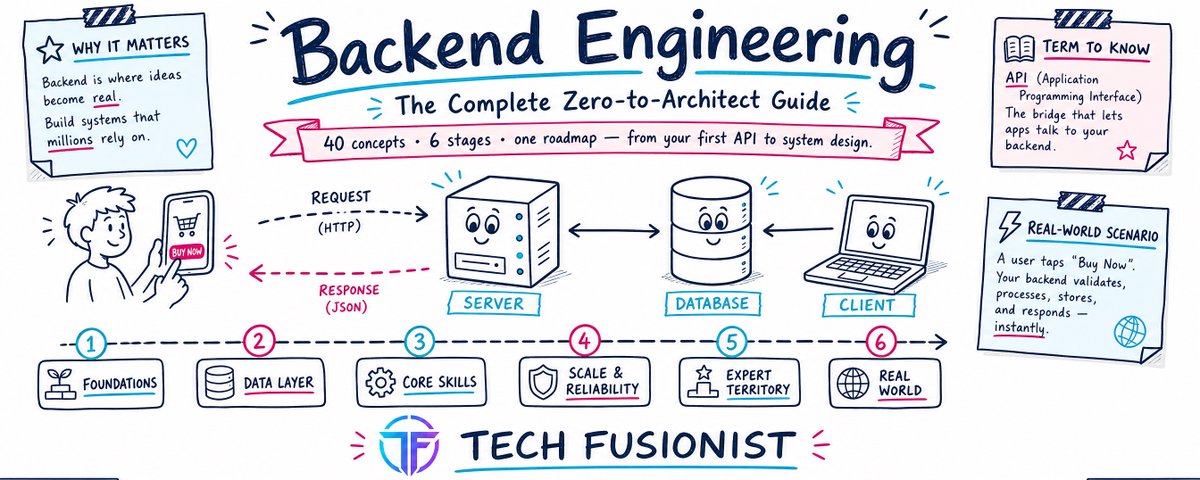
Every app you use follows the same simple journey.
You tap a button. A request travels across the internet. A server processes it. A database returns data. A response comes back to your screen.
Backend engineering is everything that happens in between.
Instead of learning 40 disconnected topics, think of backend as a journey with six stages. Master each stage, and you'll gradually move from building simple APIs to designing scalable systems.
## Stage 1: Learn How the Web Works
Everything starts with an HTTP request.
Understand how clients communicate with servers, what HTTP methods and status codes mean, how DNS, TCP, and TLS work, and how an API processes a request from start to finish.
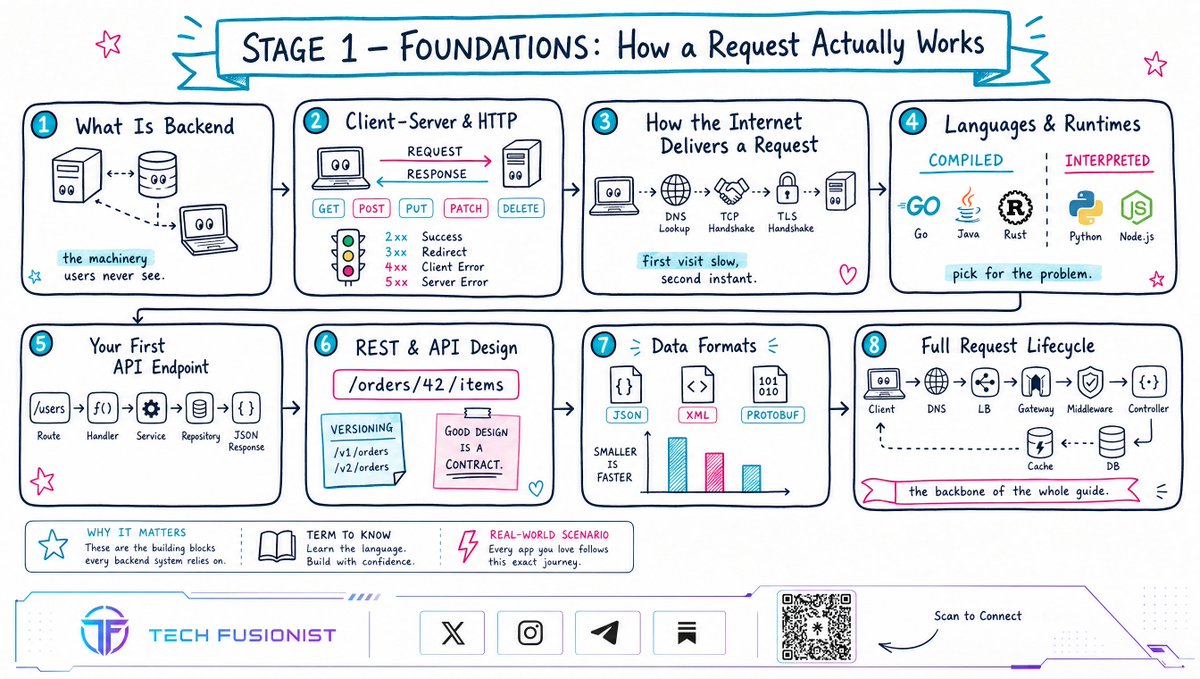
Once you understand one request lifecycle, every backend application becomes much easier to understand.
## Stage 2: Master Data
Your application is only as good as its data.
Learn SQL, database relationships, normalization, indexes, transactions, and when to use NoSQL databases like Redis or MongoDB.
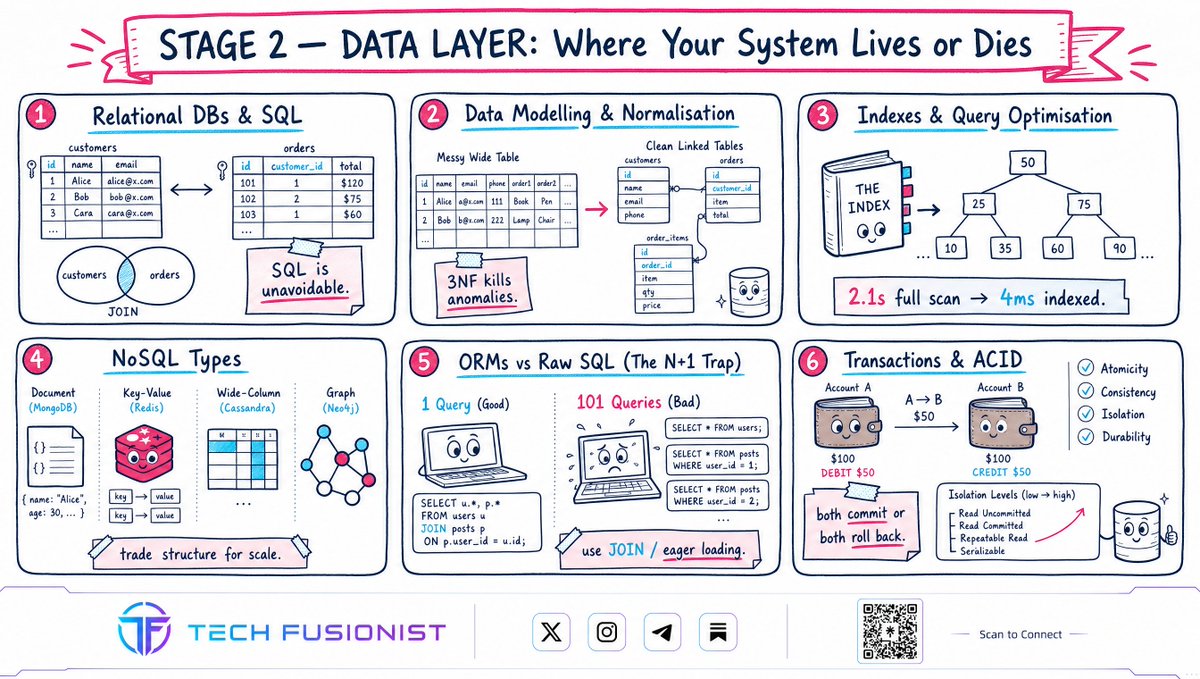
Good database design saves months of future headaches.
## Stage 3: Build Production-Ready Applications
Now it's time to build applications people can actually use.
Learn authentication, authorization, validation, layered architecture, caching, background jobs, file storage, and real-time communication.
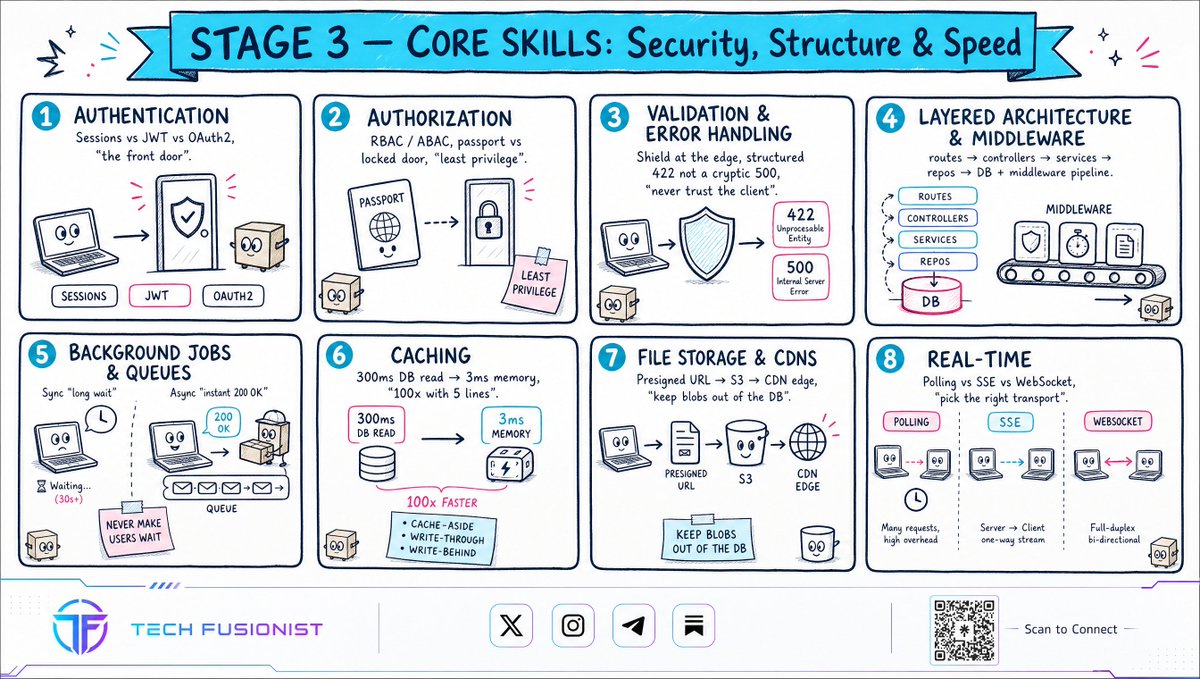
This is where projects start feeling like real products.
## Stage 4: Scale Your System
A project that works for 100 users may fail with 100,000.
Learn load balancing, horizontal scaling, caching strategies, message queues, API gateways, monitoring, logging, and resilience patterns.
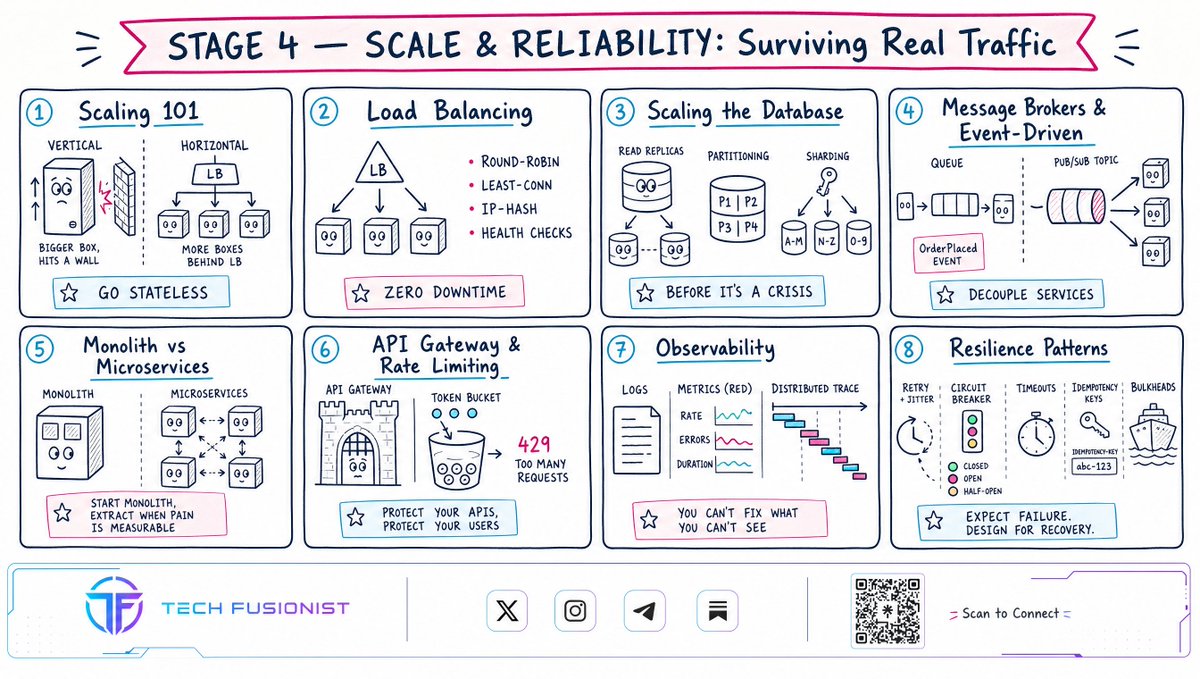
Your goal isn't just to build software - it's to keep it running.
## Stage 5: Think Like a Distributed Systems Engineer
As systems grow, every decision becomes a trade-off.
Understand CAP theorem, eventual consistency, distributed transactions, Saga pattern, optimistic locking, security best practices, performance optimization, and multi-tenancy.
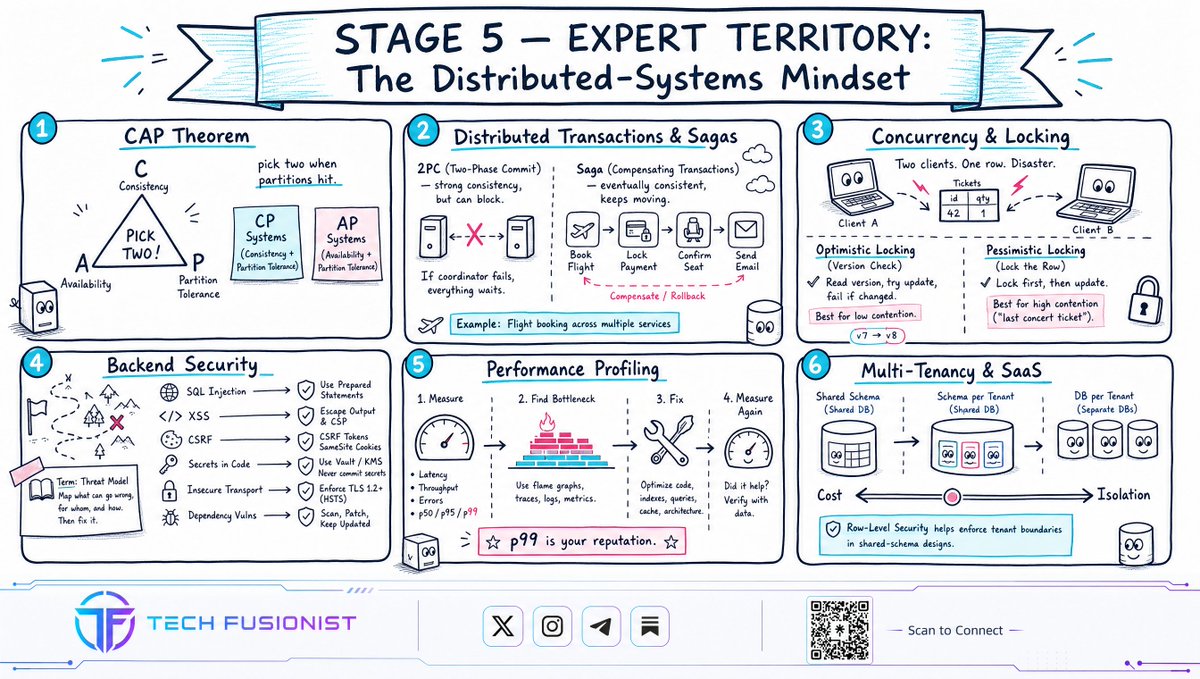
These are the concepts behind modern cloud applications.
## Stage 6: Become an Architect
Finally, learn how everything connects.
Understand CI/CD pipelines, deployment strategies, system design interviews, scalability patterns, and real-world production incidents.
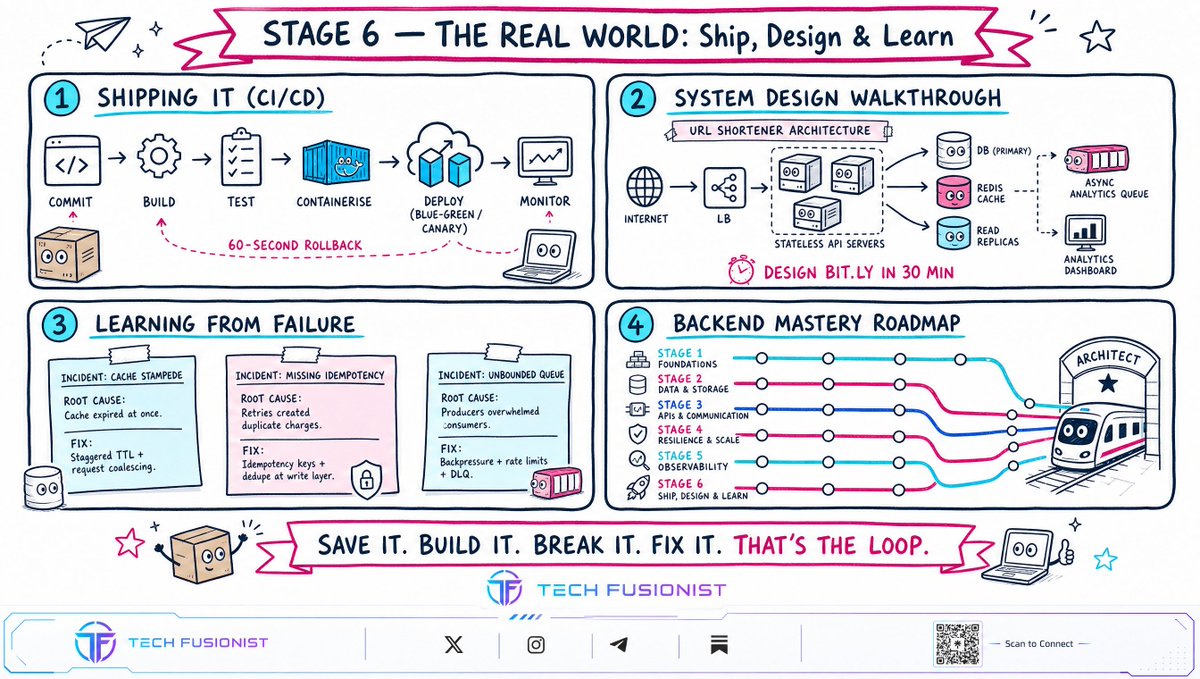
Architecture isn't about drawing boxes.
It's about making systems reliable, scalable, and easy to maintain.
## The Big Picture
Backend engineering isn't a collection of random technologies.
Each concept builds on the previous one:
- HTTP leads to APIs.
- APIs interact with databases.
- Databases power applications.
- Applications need security.
- Security and performance enable scale.
- Scale leads to distributed systems.
- Distributed systems lead to architecture.
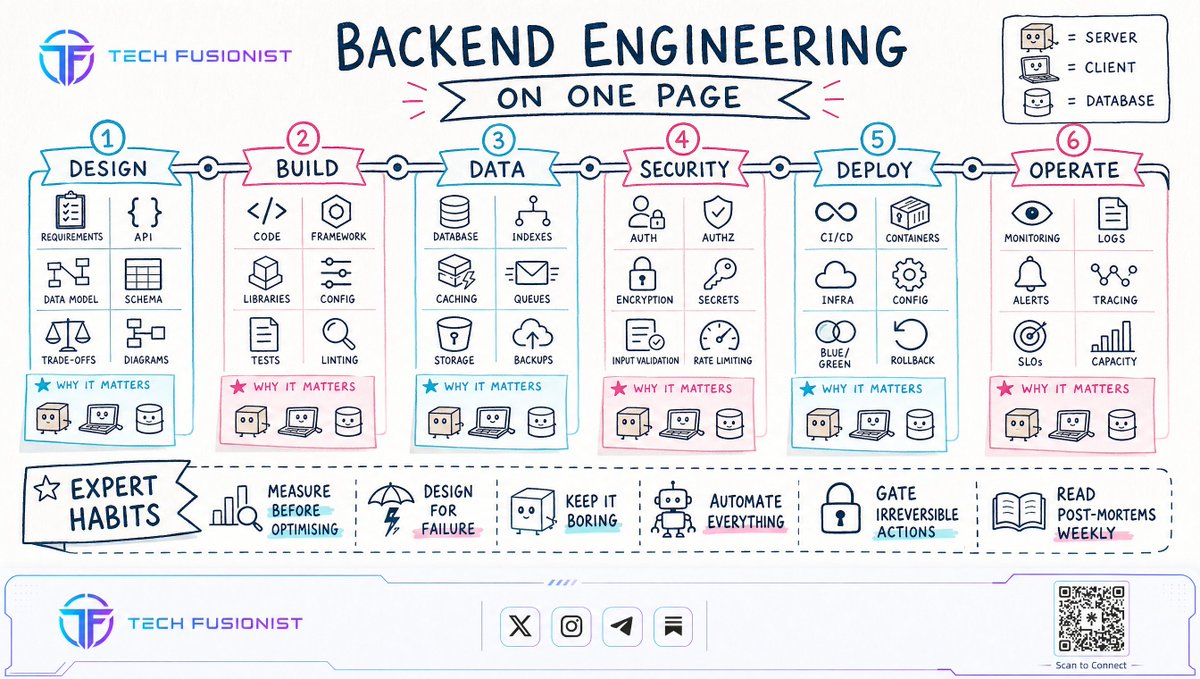
Learn them in order, build projects along the way, and you'll naturally grow from beginner to architect.
The goal isn't to memorize every concept.
The goal is to understand how they all fit together.
That's what makes a great backend engineer.
Found it helpful then, Like & share with your friend to through visualised content!
Follow Tech Fusionist on other platforms for more quick simplified visual content related to DevOps, Cloud, Linux, Kubernetes, and AI content. 🔗 Linktree:
https://linktr.ee/techfusionist
— Tech Fusionist
## 相关链接
- [Tech Fusionist](https://x.com/techyoutbe)
- [@techyoutbe](https://x.com/techyoutbe)
- [32K](https://x.com/techyoutbe/status/2076189458869928324/analytics)
- [https://linktr.ee/techfusionist](https://linktr.ee/techfusionist)
- [Upgrade to Premium](https://x.com/i/premium_sign_up)
- [2:18 PM · Jul 12, 2026](https://x.com/techyoutbe/status/2076189458869928324)
- [32.4K Views](https://x.com/techyoutbe/status/2076189458869928324/analytics)
- [View quotes](https://x.com/techyoutbe/status/2076189458869928324/quotes)
---
*导出时间: 2026/7/13 15:51:50*
---
## 中文翻译
# 工程师在下次系统设计面试前应该了解的 40 个后端概念
**作者**: Tech Fusionist
**日期**: 2026-07-12T06:18:35.000Z
**来源**: [https://x.com/techyoutbe/status/2076189458869928324](https://x.com/techyoutbe/status/2076189458869928324)
---

你使用的每一个应用程序都遵循同样的简单旅程。
你点击一个按钮。请求通过互联网传输。服务器处理它。数据库返回数据。响应回到你的屏幕。
后端工程就是发生在这一切之间的事情。
与其学习 40 个互不相关的主题,不如将后端看作一个包含六个阶段的旅程。掌握每个阶段,你将逐渐从构建简单的 API 进阶到设计可扩展的系统。
## 第一阶段:了解 Web 如何运作
一切都始于一个 HTTP 请求。
了解客户端如何与服务器通信、HTTP 方法和状态代码的含义、DNS、TCP 和 TLS 如何工作,以及 API 如何从始至终处理请求。

一旦你理解了一个请求的生命周期,理解任何后端应用程序都会变得容易得多。
## 第二阶段:掌握数据
应用程序的价值取决于其数据。
学习 SQL、数据库关系、规范化、索引、事务,以及何时使用 Redis 或 MongoDB 等 NoSQL 数据库。

良好的数据库设计能为你省去未来数月的麻烦。
## 第三阶段:构建生产级应用程序
现在是时候构建人们真正可以使用的应用程序了。
学习身份验证、授权、验证、分层架构、缓存、后台作业、文件存储和实时通信。

到了这里,项目开始感觉像真正的产品了。
## 第四阶段:扩展你的系统
一个能为 100 个用户提供服务的项目,在面对 100,000 个用户时可能会崩溃。
学习负载均衡、水平扩展、缓存策略、消息队列、API 网关、监控、日志记录和弹性模式。

你的目标不仅仅是构建软件——而是保持其运行。
## 第五阶段:像分布式系统工程师一样思考
随着系统的增长,每一个决定都成为一种权衡。
理解 CAP 定理、最终一致性、分布式事务、Saga 模式、乐观锁、安全最佳实践、性能优化和多租户。

这些概念正是现代云应用程序背后的支撑。
## 第六阶段:成为架构师
最后,学习所有事物是如何连接的。
理解 CI/CD 管道、部署策略、系统设计面试、可扩展性模式以及现实世界中的生产事故。

架构不仅仅是画框框。
它是关于让系统变得可靠、可扩展且易于维护。
## 全局视角
后端工程不是一堆随机技术的集合。
每一个概念都建立在前一个概念之上:
- HTTP 引向 API。
- API 与数据库交互。
- 数据库驱动应用程序。
- 应用程序需要安全性。
- 安全性和性能支持扩展。
- 扩展引向分布式系统。
- 分布式系统引向架构。

按顺序学习它们,在此过程中构建项目,你自然会从初学者成长为架构师。
目标不是死记硬背每一个概念。
目标是理解它们是如何结合在一起的。
这就是造就一名优秀后端工程师的关键。
如果你觉得有帮助,请点赞并分享给你的朋友,通过这些可视化的内容一起学习!
请在其他平台上关注 Tech Fusionist,获取更多关于 DevOps、Cloud、Linux、Kubernetes 和 AI 内容的快速简化可视化内容。🔗 Linktree:
https://linktr.ee/techfusionist
— Tech Fusionist
## 相关链接
- [Tech Fusionist](https://x.com/techyoutbe)
- [@techyoutbe](https://x.com/techyoutbe)
- [32K](https://x.com/techyoutbe/status/2076189458869928324/analytics)
- [https://linktr.ee/techfusionist](https://linktr.ee/techfusionist)
- [升级到 Premium](https://x.com/i/premium_sign_up)
- [2:18 PM · Jul 12, 2026](https://x.com/techyoutbe/status/2076189458869928324)
- [32.4K Views](https://x.com/techyoutbe/status/2076189458869928324/analytics)
- [View quotes](https://x.com/techyoutbe/status/2076189458869928324/quotes)
---
*导出时间: 2026/7/13 15:51:50*