# The writing habit that saved my brain (and my future)
**作者**: DAN KOE
**日期**: 2026-07-15T21:58:40.000Z
**来源**: [https://x.com/thedankoe/status/2077513202527773093](https://x.com/thedankoe/status/2077513202527773093)
---

If you don’t know what to learn, start writing.
Even if you don’t want to be a “writer.”
Writing teaches you how to think, how to learn any skill fast, and how to attract an audience that supports your work, which is absolutely needed if you want to build your own business, or just do any kind of independent creative/meaningful work.
In the age of AI, thinking, learning, and distribution (getting your value in front of other people so you actually have the chance of being paid) are timeless skills. Writing allows you to practice them all while building digital leverage as a byproduct.
I never thought I would be a writer.
I don’t even look the part. I’m a big dumb meathead who fell in love with deep ideas.
By all measures, writing, as a simple morning habit, has completely changed the course of my mind and life. It has helped me articulate my thoughts, calm my mind, find opportunities outside of the traditional job market, and is the single thing that fuels the success of my work and business.
In this letter, I want to show you my system for capturing ideas and writing content worth reading, but I also want to show you why this path is more viable than ever - and why it will transform how your brain interacts with reality.
Yes, it’s that deep.
Let’s begin.
## Old leverage VS new leverage: The secret to modern success
> The biggest leverage is no longer capital. The biggest leverage is enterprise — the ability to run a great business. And in particular, the biggest leverage is personal brand. Having a big audience. As soon as you’ve got people paying attention to you, you have this enormous form of leverage.
> – Daniel Priestley
The rules of wealth creation have fundamentally changed.
The assets that drove income in the Industrial Age (property, factories, machinery, physical goods) are being replaced by digital assets (audience, personal brand, IP, content, data, software) that are incredibly cheap to build, more scalable, harder to tax, and compound while you sleep.
The only requirement to building leverage for yourself in today’s world is a good idea and the confidence to post it on the internet.
The problem, and opportunity, is that most people are still conditioned by Industrial values. They somehow still believe that school → job → retire is the most certain, safe, and secure when that couldn’t be any further from the truth.
The same holds true when it comes to building leverage, and thus creating wealth, for your future.
Old leverage comes from physical, tangible assets.
A house, factory, Rolex, fleet of trucks, warehouse of inventory, gold. You buy them, then let them appreciate or generate income.
Old leverage is linear and local.
A factory can only produce so many units per day, and a house can only be rented to one tenant at a time.
Don’t get me wrong, leverage is leverage, and old leverage is still a great thing.
However, physical assets are going to be the first thing that governments find, tax, and seize if wages collapse, which is more likely today than yesterday because AI can swiftly do that, leading to governments expanding social safety nets.
Governments are much less likely to seize an email list of people who know who you are, a library of content, or a best-selling book.
New leverage comes from intangible, digital assets.
An audience, personal brand, IP, data, systems, software. These are the leverage of the newly rich. Media, data, and code. Content can be written once and be seen by millions of people. Software can be created once and serve millions of users.
> For most people, writing is the most accessible and practical form of leverage. You can learn to code, but if you cannot attract people to care about the product you built, then nobody will use or pay for it. Writing is the leverage that unlocks other forms of leverage.
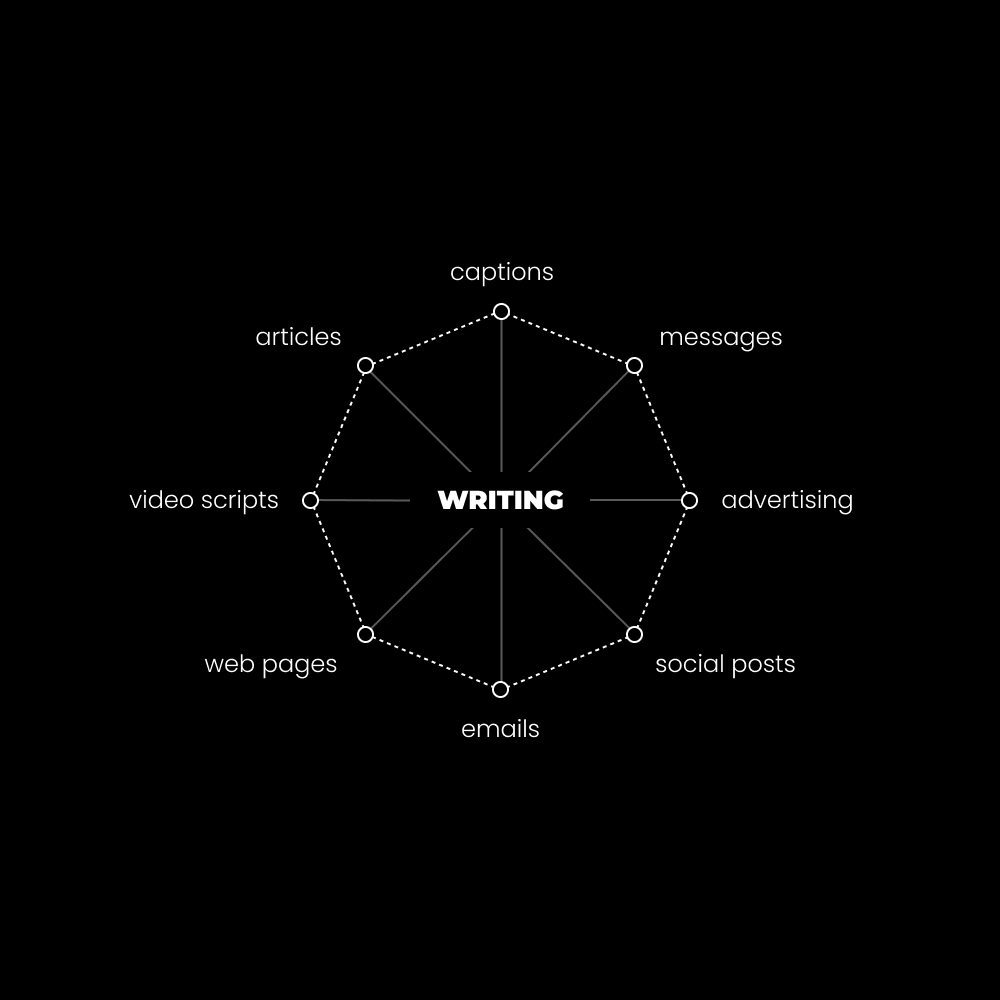
You will not see digital assets on a balance sheet, but they represent 90% of the S&P 500’s value.
Kim Kardashian, Taylor Swift, Ryan Reynolds, Mr. Beast, Elon Musk - all have massive audiences and personal brands.
But you probably don’t want anywhere near their level of fame, and that’s a great thing, because you don’t need millions of followers to make this work. With 6-12 months of focused effort, you can find yourself in a wildly different life than you are now.
Personally, I replaced my income around 5,000 followers (about 6 months in) because I actually took it seriously. My friend Randy, a fitness coach, was making $100k a month at around 10,000 followers, because he invested in education, studied marketing and sales, and implemented everything as if his life depended on it.
The point is that people drastically overestimate how much they need to win, because all they see is out-of-touch celebrities on their timeline.
That’s why we teach how to find what you want to talk about, create your ‘personal monopoly,’ and write high-impact content in our bootcamp. You still have time to join the next live call we’re doing.
But the benefits of writing stem far beyond that.
## How writing completely shifts your brain & life
> How do I know what I think until I see what I say?
> – E.M. Forster
It’s hard to explain... but the act of writing is much deeper than putting pen to paper.
It shifts your mind to see the world in a more meaningful way.
Conversations become a source of inspiration. Your thoughts become filled with ideas you’re wrestling to understand. You notice more detail in life rather than living on the stressful surface.
In my eyes, there are 4 key benefits to writing:
1) Writing rewires how you think
The core mechanism here is forced linearity.
Which is a fancy way of saying that you can feel like you understand something in your head, but writing forces you to collapse it into a single stream.
Thinking without writing is like walking through a forest where you can see every direction, while writing itself is like driving on a road through the disorienting mess. You have to decide where you’re going, which turns you’re going to take, whether or not you want to take the scenic route, and how to navigate back if you get lost.
In other words, writing is the apparatus for thinking. It’s the gym where your mind is built.
You may think you understand the feelings, counterarguments, memories, or half-formed analogies in your head, and even your values and beliefs, but unless you write them out, I can almost guarantee you don’t.
2) Writing increases pattern recognition
There are a few layers to this.
The first is that by writing regularly, you build an external record of your thinking. You are able to quickly reference what you’ve written in the past as a way or articulating your current thoughts better. It helps you think with clarity.
The second layer is similar to the “photographer’s eye.” After a few years of serious practice, you start to see frames and compositions in everyday life. The world doesn’t look the same, it has another layer of depth.
With writing, you start noticing structure in an argument, a metaphor in a mundane moment, or the narrative arc of your average day. Writing trains a specific kind of attention that bleeds into everything.
The third layer is that you notice ideas you normally wouldn’t have.
When I have a newsletter planned for the week, or just know that I need to write a tweet today, my mind will naturally help me notice ideas that help achieve those goals.
It’s the concept of psycho-cybernetics - that your mind is like a heat seeking missile towards it’s goals, and will help you notice the tools you need to achieve them (the problem is that people don’t actually have conscious goals they care about, they have unconscious goals assigned to them, and since their path is planned for them, they don’t have to do much aside from show up to school and work, so they are missing this layer of life).
3) Writing helps you articulate your thoughts
Most people walk around believing they understand things they don’t.
Not because they’re dumb, but because they’ve never been forced to externalize the thought and look at it. Writing is not only a tool to improve communication - thus improving most other areas of your life - but a tool to expose whether or not you actually know what you’re talking about.
That’s what most people are afraid of.
They don’t want to feel the struggle that comes from doing something meaningful. They want it to be easy. They want all the ideas to just come to their head immediately. They see writing as something that everyone knows how to do, so they don’t appreciate that it is a skill just like anything else, and takes effort to improve.
Which leads into the most important point.
4) Writing helps you learn faster
The future belongs to those who can learn the fastest.
And unfortunately, most people stop learning after they graduate high school, and it shows.
You must learn in order to achieve a goal, so if you want to achieve any goal outside of the three society planted in your head at birth, then you must self-educate, and if you want to enhance that process, you must write.
Writing is both a form of teaching and understanding.
In learning science, there’s the “protégé effect,” which shows that students who teach material retain it better than students who merely study it.
> The cognitive load required to figure out how to explain something to someone else forces deeper processing, better organization, and identification of gaps in knowledge.
I learned more in my first 6 months of writing online than I ever did in school. I’m exaggerating, but what I mean is that I learned much more about the things I care about. I could feel my mind changing shape, and I was closer to being like the thinkers that I admired as I was growing up. My younger self thought my brain was just too dumb to speak intelligently. Turns out, I just didn’t practice.
Last, writing demands that you understand.
You read something.
You feel like you get it.
You try to write about it.
You realize you can’t.
Most people think it’s because they aren’t “qualified” to write about the topic, which is bullsh*t. You can write about an idea just like any other person on planet Earth can. You’re just creating invisible gatekeepers out of fear of putting your ideas in front of other people.
But now you know exactly where your understanding breaks.
That’s when you go back and learn. You research. Then you continue writing.
## The writing system I use to generate ideas people can't help but read
I’ve never been the most organized person.
I’ve tried the second brain apps. I’ve tried doing everything inside of AI.
But I always found myself going back to jotting down ideas in a long-running note. Of course, ideas would get lost all the time, but I don’t see that as a problem. If you need to remember it, it’s not important, and if it’s important, you will remember it.
I’ve found that great writing (or content) that actually gains traction and doesn’t disappear into a black hole of nobody caring about your work boils down to a few things:
- You need ONE topic or theme for the week
- You need a place to quickly jot down ideas
- You need a way to capture inspiration (social posts, YouTube videos, Substack articles, etc)
- You need to understand how to package the hook or title so that people actually want to read it
- You need to effectively pull from your ideas, inspiration, and research while you are actually writing or creating
This is what that looks like in the form of a system.
It may seem complex, but we’ll recap at the end in a simple way.
1) How To Pick What To Write About
I don’t care about niching down.
You are not an animal that dies when they get put in a different niche or environment, like a lion in Alaska.
You are a human who learns, builds, and adapts so that they can thrive in any niche.
I operate by two principles when picking a topic:
- Is it something that I find important or worth sharing? Because by simply filtering an idea through my perspective and not overthinking myself to death, it becomes unique. I have a specific identity, and I’m probably not going to speak to soccer moms in their 40s no matter how hard I try. By just talking about what I find worth sharing, it will attract the people I can impact the most.
- Is it packaged or framed in a way that grabs attention? Because as a writer, that’s what you do. You grab attention, otherwise your writing doesn’t get read. The way you do that in today’s world is by studying what’s working on social media and applying the structure and principles to your hook, title, etc.
This is social media growth in a nutshell.
Many people want to feel like they’re a super creative writer, and they want to be super authentic bro, so they don’t package their ideas in a way that the market actually wants, so they never get traction on their work. In other words, they never get paid, because it feels icky to them, so they continue working on someone else’s dreams so their boss can get paid. They want to impact people so badly yet refuse to do the one thing that allows that. They see it as sacrificing a part of their identity rather than acquiring a skill that increases their usefulness.
The simplest way to do this is as follows:
Before you write, research what’s working on social media.
Because that shows you what the market is already paying attention to.
You can do this just by scrolling social media and saving posts that are doing well, or you can use a research tool for it that pulls all top-performing posts into one place.
As an example, this letter is titled “The writing system that saved my brain (and my future).”
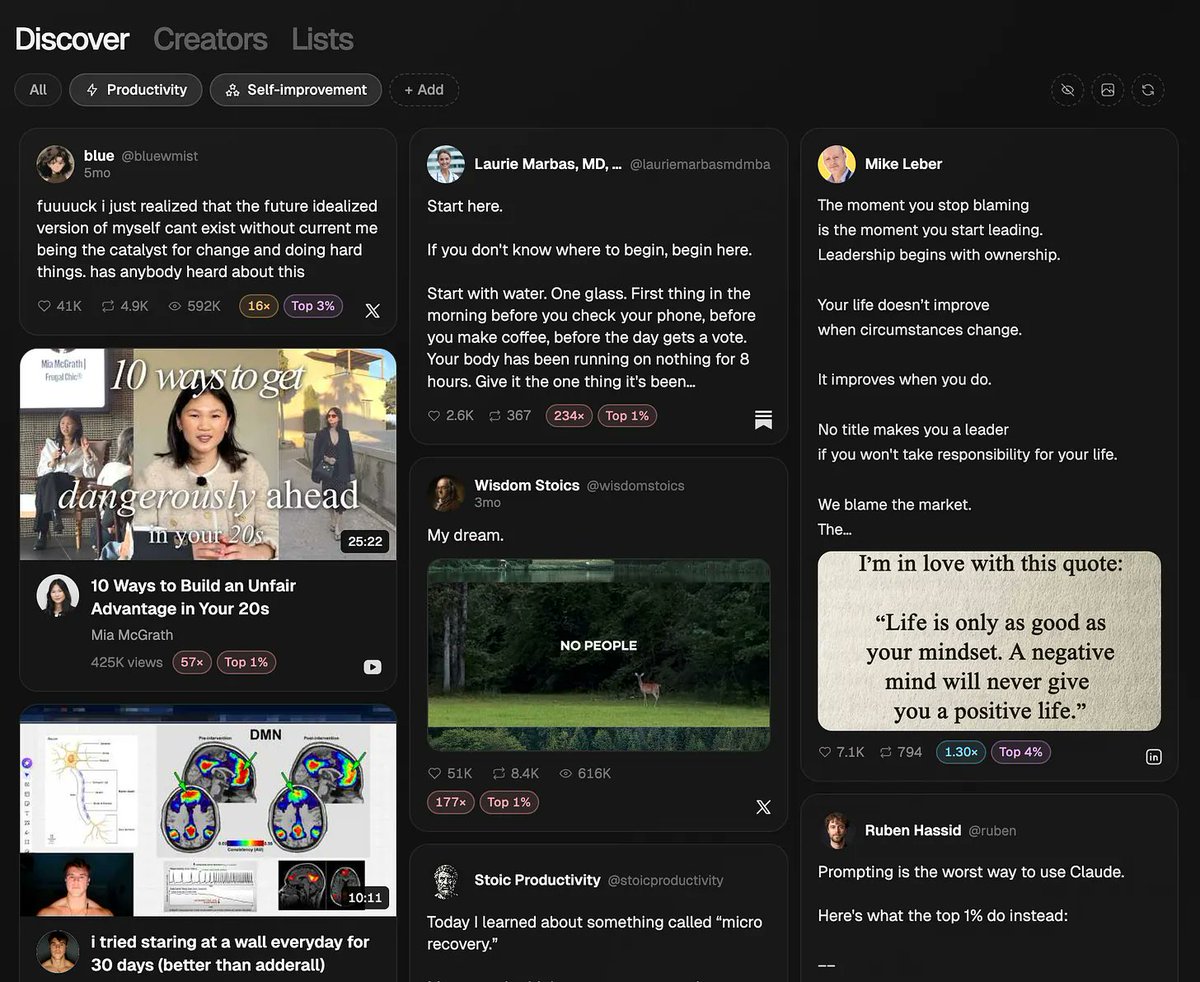
I had previously seen this post in the Discover feed of Eden and saved it to one of my boards, it’s called “The Notebook System That Saved My Brain.”
In other words, I saw what people already signaled that they wanted, took the topic I wanted to write about, and merged the two together. This is when you use a research / inspiration library tool like Eden, or you can scroll social media manually and attempt to find high-performing posts.
2) Create One Project For The Entire Week
I post one newsletter a week on Substack.
That long-form piece gets posted to X articles, turns into a soft YouTube script, and the YouTube video gets uploaded to all podcast platforms.
I’ve tried twice a week, but my brain operates better when it has time to think and gather inspiration around one topic.
My entire week revolves around the topic. When I read a book, ideas stick out that fit the topic. When I listen to a video on YouTube, the same happens. Ideas come to mind for that topic.
Those idea become research for the topic I’m writing about, and the newsletter becomes the source of social posts for all platforms.
In other words, I write one piece a week, and it becomes content for all platforms. This has drastically improved my thinking, because it isn’t scattered all the time.
This is my entire idea capture and content system.
What do you actually do here?
Create one place a week to save ideas to.
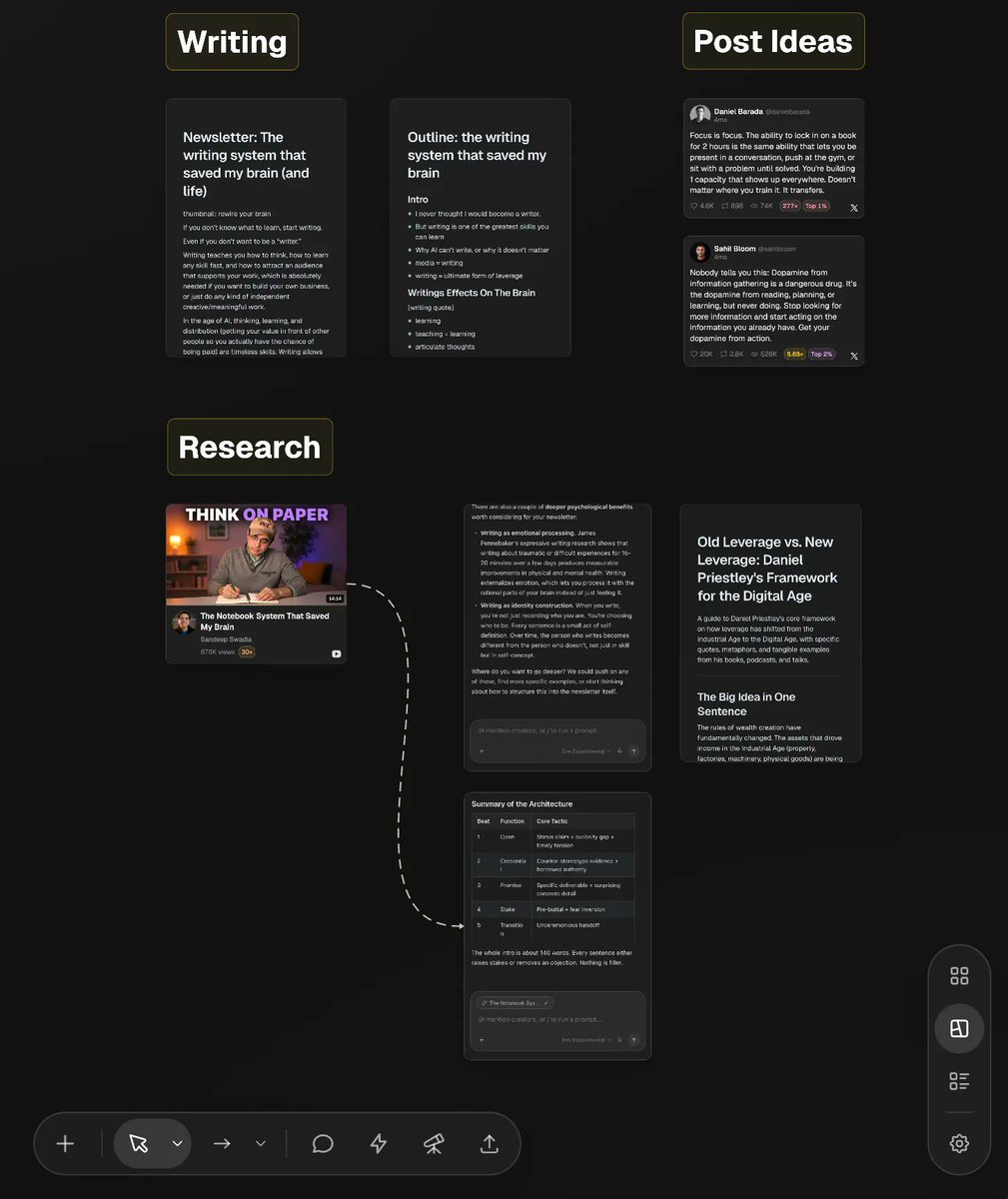
I create one board in Eden (which I talk about a lot because it’s the only app that can do all of this in one place), and that’s where I jot down ideas, paste social links, add articles and videos, and even upload books as PDFs so I can ask AI to pull ideas out of them so I don’t have to go searching manually for them, or even worry about highlighting them.
I’m writing this, right now, in that board.
With all ideas and inspiration in one place, it makes it easy to have this open as I write, or just create a chat and connect a post, PDF, or link to it to pull the idea out of it.
If I post ideas when I’m away from my computer, I just save them to the board on mobile, like a YouTube video I watched, and then I can chat with it to get the idea I wanted out of it.
Note: I do have multiple boards called “Favorite Ideas,” “Validated Ideas,” and “Personal Ideas.”
I save posts I love to favorite ideas.
I save posts that have gone viral to validated ideas.
I save personal notes or thoughts to personal ideas.
A mix of all of these creates a great piece of writing (yes, your favorite writers research, save inspiration like their lives depend on it, and mash it together to write their pieces).
I can chat with any of those to give me headline variations, angles, or post ideas that I can then pop into the scheduler.
3) Outline, Write, and Repurpose
I am not going to go into the actual writing process. That would take an entire bootcamp to go over.
However, someone broke down my best newsletters and turned it into a prompt that helps you outline your own in an engaging way. It will ask about what you want to write, then help you gather ideas that can go into the outline.
As mentioned, here’s what I do:
- I create a board or place to save posts, ideas, and videos (this is the research portion of my writing)
- I create an outline document to start organizing the ideas
- I have all of that open next to me while I write
- I post that as a Substack and X article
- I block out an hour 1 day a week to record that as a YouTube video
- That YouTube video goes to all podcast platforms
- I use the article to generate post ideas throughout the week
- I promote my Substack a few times a week under my other content so it grows
That’s the entire system.
Walking, reading, and about 60 minutes a day of writing forms the foundation for some of the most future-proof skills: learning, thinking, and earning (independently).
I’ll leave it at that, and am happy to expand more on this in future articles.
– Dan
If you want these letters sent directly to you, so you don't miss them if the algorithm doesn't show you them, join the list here - here's another article you can read as well.
## 相关链接
- [DAN KOE](https://x.com/thedankoe)
- [@thedankoe](https://x.com/thedankoe)
- [78K](https://x.com/thedankoe/status/2077513202527773093/analytics)
- [write high-impact content in our bootcamp.](https://eden.so/bootcamp)
- [inspiration library tool like Eden](https://eden.so/)
- [bootcamp](https://eden.so/bootcamp)
- [prompt that helps you outline your own in an engaging way](https://app.eden.so/w/dan-s-workspace/prompts/3a15e1ef-3026-4f55-94ed-8f134448de6f)
- [here's another article you can read as well.](https://letters.thedankoe.com/p/the-most-profitable-skill-of-the?r=of0ip&utm_campaign=post&utm_medium=web)
- [Upgrade to Premium](https://x.com/i/premium_sign_up)
- [5:58 AM · Jul 16, 2026](https://x.com/thedankoe/status/2077513202527773093)
- [78.3K Views](https://x.com/thedankoe/status/2077513202527773093/analytics)
- [View quotes](https://x.com/thedankoe/status/2077513202527773093/quotes)
---
*导出时间: 2026/7/16 08:49:13*
---
## 中文翻译
# 拯救我大脑(以及未来)的写作习惯
**作者**: DAN KOE
**日期**: 2026-07-15T21:58:40.000Z
**来源**: [https://x.com/thedankoe/status/2077513202527773093](https://x.com/thedankoe/status/2077513202527773093)
---

如果你不知道该学什么,那就开始写作吧。
即使你并不想成为一名“作家”。
写作会教会你如何思考,如何快速习得任何技能,以及如何吸引支持你工作的受众——如果你想建立自己的事业,或者只是从事任何类型的独立创造性/有意义的工作,这绝对是必不可少的。
在人工智能时代,思考、学习和分发(让你的价值展现在他人面前,这样你实际上才有机会获得回报)是永恒的技能。写作让你能够练习所有这些技能,同时作为副产品建立数字杠杆。
我从没想过自己会成为一名作家。
我甚至看起来都不像。我只是一个迷恋深层思想的傻大个。
无论如何衡量,作为一种简单的晨间习惯,写作已经彻底改变了我的人生和心智轨迹。它帮助我阐明了思想,平复了内心,在传统就业市场之外找到了机会,并且是推动我的工作和事业成功的唯一动力。
在这封信中,我想向你展示我捕捉想法和撰写值得一读的内容的系统,但我也想向你展示为什么这条路比以往任何时候都更可行——以及为什么它将改变你的大脑与现实互动的方式。
是的,它有这么深。
让我们开始吧。
## 旧杠杆与新杠杆:现代成功的秘密
> 最大的杠杆不再是资本。最大的杠杆是企业——经营伟大企业的能力。特别是,最大的杠杆是个人的品牌。拥有庞大的受众。一旦有人开始关注你,你就拥有了一种巨大的杠杆形式。
> – Daniel Priestley
财富创造的规则已经发生了根本性的变化。
在工业时代推动收入的资产(房产、工厂、机器、实物商品)正在被数字资产(受众、个人品牌、知识产权、内容、数据、软件)所取代,后者构建成本极低、可扩展性更强、更难征税,而且在你睡觉时也能复利增长。
在当今世界为自己建立杠杆的唯一要求是一个好的想法,以及将其发布到互联网上的信心。
问题所在(也是机会所在)是,大多数人的观念仍然受到工业价值观的制约。他们不知何故仍然相信上学→工作→退休这条路径是最确定、最安全和最有保障的,但这与事实大相径庭。
在为你的未来建立杠杆,进而创造财富方面,情况也是如此。
旧杠杆来自有形的实物资产。
房子、工厂、劳力士、卡车车队、库存仓库、黄金。你买下它们,然后让它们增值或产生收入。
旧杠杆是线性的和局部的。
一个工厂每天只能生产一定数量的单位,一栋房子一次只能租给一个租户。
别误会我,杠杆就是杠杆,旧杠杆仍然是一件好事。
然而,如果工资崩溃(这比昨天更有可能发生,因为人工智能可以迅速做到这一点,导致政府扩大社会安全网),实物资产将是政府首先发现、征税和扣押的对象。
政府不太可能扣押一个认识你的电子邮件列表、一个内容库或一本畅销书。
新杠杆来自无形的数字资产。
受众、个人品牌、知识产权、数据、系统、软件。这些是新富阶层的杠杆。媒体、数据和代码。内容可以只写一次却被数百万人看到。软件可以只创建一次却为数百万用户服务。
> 对大多数人来说,写作是最容易获得和最实用的杠杆形式。你可以学习编程,但如果你无法吸引人们关心你构建的产品,那么就没有人会使用或为它付费。写作是解锁其他形式杠杆的杠杆。

你在资产负债表上看不到数字资产,但它们代表了标普500指数价值的90%。
金·卡戴珊、泰勒·斯威夫特、瑞安·雷诺兹、MrBeast、埃隆·马斯克——他们都拥有庞大的受众和个人品牌。
但你可能不想达到他们那种程度的名气,这其实是件好事,因为你不需要数百万粉丝也能让这一切行得通。通过6-12个月的专注努力,你会发现自己过着与现在截然不同的生活。
就我个人而言,我在大约5000名粉丝时(大约6个月后)就取代了我的收入,因为我是真的认真对待这件事。我的朋友Randy,一名健身教练,在大约10000名粉丝时月入10万美元,因为他投资于教育,学习营销和销售,并仿佛生命取决于此般实施了一切。
关键在于,人们大大高估了获胜所需的条件,因为他们只看到了时间线上那些不食人间烟火的明星。
这就是为什么我们在训练营中教导如何找到你想谈论的内容,创建你的“个人垄断”,并撰写高影响力的内容。你仍然有时间参加我们要进行的下一次直播。
但写作的好处远不止于此。
## 写作如何彻底改变你的大脑与生活
> 除非我看到我说了什么,否则我怎么知道我在想什么?
> – E.M. Forster
这很难解释……但写作的行为远不仅仅是把笔放在纸上。
它改变了你的心智,让你以更有意义的方式看待世界。
对话变成了灵感的来源。你的思想充满了你努力想要理解的想法。你注意到了生活中更多的细节,而不是生活在充满压力的表面。
在我看来,写作有4个关键好处:
1) 写作重塑你的思维方式
这里的核心机制是“强制的线性化”。
这是一种花哨的说法,意思是你在脑海里可能觉得理解了某件事,但写作强迫你将其坍缩成单一的流。
不写作的思考就像在森林里漫步,你可以看到每个方向,而写作本身就像驾车穿越这片令人困惑的混乱。你必须决定你要去哪里,要转哪个弯,是否想走风景优美的路线,以及如果迷路了如何导航回来。
换句话说,写作是思考的装置。它是构建心智的健身房。
你可能认为你理解你脑海中的感受、反驳观点、记忆或半成形的比喻,甚至你的价值观和信仰,但除非你把它们写出来,我几乎可以保证你并不理解。
2) 写作提高模式识别能力
这有几个层面。
第一,通过定期写作,你建立了一个思维的外部记录。你能够快速参考你过去写下的内容,作为一种更好地表达当前想法的方式。它帮助你清晰地思考。
第二个层面类似于“摄影师的眼光”。经过几年的认真练习,你开始在日常生活中看到取景框和构图。世界看起来不一样了,它有了另一层深度。
通过写作,你开始注意到论点中的结构,平凡时刻中的隐喻,或者你平凡一天的叙事弧线。写作训练了一种特定的注意力,这种注意力会渗透到一切事物中。
第三个层面是你注意到了通常不会有的想法。
当我计划好这一周的通讯,或者只是知道今天需要发一条推文时,我的大脑会自然地帮助我注意到有助于实现这些目标的想法。
这就是心理控制论的概念——你的大脑就像一枚追逐目标的热寻导弹,它会帮助你注意到实现目标所需的工具(问题在于,人们实际上并没有他们真正在乎的有意识目标,他们拥有的是被分配给他们的无意识目标,而且由于他们的道路是被规划好的,除了上学和工作,他们不需要做太多事情,所以他们错过了生活这一层面)。
3) 写作帮助你阐明思想
大多数人到处走动,相信自己理解了他们并不理解的事物。
这不是因为他们笨,而是因为他们从未被迫外化思想并审视它。写作不仅是改善沟通的工具——从而改善你生活中大多数其他领域——而且是暴露你是否真的知道自己在说什么的工具。
这就是大多数人害怕的事情。
他们不想感受到做有意义的事情所带来的挣扎。他们希望这很容易。他们希望所有的想法都能立刻出现在脑海中。他们认为写作是每个人都知道怎么做的事情,所以他们不欣赏这也是一种像其他任何事情一样的技能,需要努力才能提高。
这就引出了最重要的一点。
4) 写作帮助你学得更快
未来属于那些学得最快的人。
不幸的是,大多数人高中毕业后就停止了学习,这很明显。
你必须学习才能实现目标,所以如果你想实现出生时社会植入你脑海中的三个目标之外的任何目标,那么你必须自我教育,如果你想增强这个过程,你必须写作。
写作既是教学的形式,也是理解的形式。
在学习教育学中,有“弟子效应”,它表明教授材料的学生比仅仅学习材料的学生能更好地保留材料。
> 弄清楚如何向他人解释某事所需的认知负荷,会迫使进行更深层的处理、更好的组织以及识别知识中的空白。
我在网上写作的头6个月里学到的东西比我在学校学到的都要多。虽然有点夸张,但我的意思是,我学到了更多关于我关心的事情的知识。我能感觉到我的思维在发生改变,我越来越接近我成长过程中崇拜的思想家。年轻时的我以为我的大脑太笨了,无法说出有智慧的话。结果证明,我只是没有练习。
最后,写作要求你必须理解。
你读了一些东西。
你觉得自己懂了。
你试着把它写下来。
你意识到你做不到。
大多数人认为这是因为他们没有“资格”写这个话题,这纯属胡扯。你可以像地球上的任何其他人一样写一个想法。你只是因为害怕把想法展示给别人面前而制造了无形的守门人。
但现在你确切地知道你的理解在哪里断裂了。
这时你回去重新学习。你做研究。然后你继续写作。
## 我用来生成让人忍不住阅读的内容的写作系统
我从不是最有条理的人。
我试过“第二大脑”应用。我试过在人工智能里做所有事情。
但我发现自己总是回到在一个持续更新的笔记上草草记下想法。当然,想法总是会丢失,但我不认为这是个问题。如果你需要记住它,那它就不重要;如果它重要,你会记住它。
我发现,真正获得吸引力并且不会消失在无人问津的黑洞中的伟大写作(或内容),归根结底在于以下几点:
- 你需要为本周设定**一个**主题或话题
- 你需要一个地方快速记下想法
- 你需要一种捕捉灵感的方法(社交媒体帖子、YouTube视频、Substack文章等)
- 你需要理解如何包装钩子或标题,让人们真正想读它
- 你需要在实际写作或创作时,有效地从你的想法、灵感和研究中提取素材
这就是作为一个系统的样子。
它可能看起来很复杂,但我们最后会用简单的方式总结一下。
1) 如何选择写什么
我不在乎细分领域。
你不是一只被放在不同细分领域或环境就会死的动物,就像阿拉斯加的狮子一样。
你是一个学习、建设和适应的人类,这样你就能在任何细分领域茁壮成长。
我在选择话题时遵循两个原则:
- 这是我认为重要或值得分享的事情吗?因为仅仅通过我的视角过滤一个想法,并且不过度思考,它就会变得独特。我有一个特定的身份,无论我怎么努力,我都不太可能和40多岁的足球妈妈对话。通过只谈论我认为值得分享的事情,它会吸引我能产生最大影响的人。
- 它是否以一种能抓住注意力的方式进行了包装或构架?因为作为作家,这就是你要做的。你抓住注意力,否则你的写作就不会被阅读。在当今世界,做到这一点的方法是研究社交媒体上什么有效,并将结构和原则应用到你的钩子、标题等上。
简而言之,这就是社交媒体增长之道。
许多人想感觉自己是个超级有创意的作家,他们想超级真实(bro),所以他们不把想法包装成市场真正想要的方式,所以他们的工作从未获得吸引力。换句话说,他们从未得到报酬,因为这让他们感觉糟糕,所以他们继续为别人的梦想工作,让老板赚钱。他们非常想要影响人们,却拒绝做允许他们这样做的唯一一件事。他们将此视为牺牲自己身份的一部分,而不是获得一项增加自己实用性的技能。
最简单的方法如下:
在写作之前,研究社交媒体上什么有效。
因为这向你展示了市场已经在关注什么。
你可以通过浏览社交媒体并保存表现良好的帖子来做到这一点,或者你可以使用一个研究工具,将所有表现最好的帖子汇总到一个地方。
举个例子,这封信的标题是“拯救我大脑(以及未来)的写作系统”。

我之前在Eden的发现信息流中看到了这个帖子,并将其保存到了我的一个板子里,它叫“拯救我大脑的笔记本系统”。
换句话说,我看到了人们已经发出的信号表明他们想要什么,拿起了我想写的主题,然后将两者合并。这就是当你使用像Eden这样的研究/灵感库工具,或者你可以手动浏览社交媒体并尝试找到高表现帖子的时候。
2) 为整周创建一个项目
我每周在Substack上发布一篇通讯。
这篇长篇文章会被发布到X文章上,变成一个简短的YouTube脚本,而YouTube视频会被上传到所有播客平台。
我试过一周两次,但我的大脑在有时间为一个主题思考和收集灵感时运作得更好。
我的一整周都围绕着这个主题展开。当我读一本书时,符合主题的想法会突显出来。当我在YouTube上听视频时,也会发生同样的情况。针对这个主题的想法会浮现在脑海中。
那些想法变成了我正在写作的主题的研究,而通讯成为了所有平台社交帖子的来源。
换句话说,我每周写一篇文章,它变成了所有平台的内容。这极大地提高了我的思考能力,因为它不再总是分散的。
这就是我整个的想法捕捉和内容系统。
你在这里实际上做什么?
每周创建一个地方来保存想法。

我在Eden创建一个板子(我经常谈到它,因为它是唯一可以在一个地方做所有这些事情的应用),这就是我记下想法、粘贴社交链接、添加文章和视频,甚至上传书籍为PDF的地方,这样我就可以让人工智能从中提取想法,而我不必手动搜索它们,甚至不用担心高亮它们。
我现在正在写这个, ri