如何真正记住你读过的内容 ✍ DAN KOE🕐 2026-07-27📦 24.3 KB 🟢 已读 𝕏 文章列表 文章探讨了为何试图记住所有阅读内容是错误的,指出学习应通过设定有意义目标和项目驱动,而非单纯记忆。作者强调理解比记忆更重要,并分享了快速学习的实际步骤。 学习记忆目标设定方法论阅读自我提升 # How to remember everything you read (stop trying) **作者**: DAN KOE **日期**: 2026-07-26T16:25:51.000Z **来源**: [https://x.com/thedankoe/status/2081415714636996844](https://x.com/thedankoe/status/2081415714636996844) --- 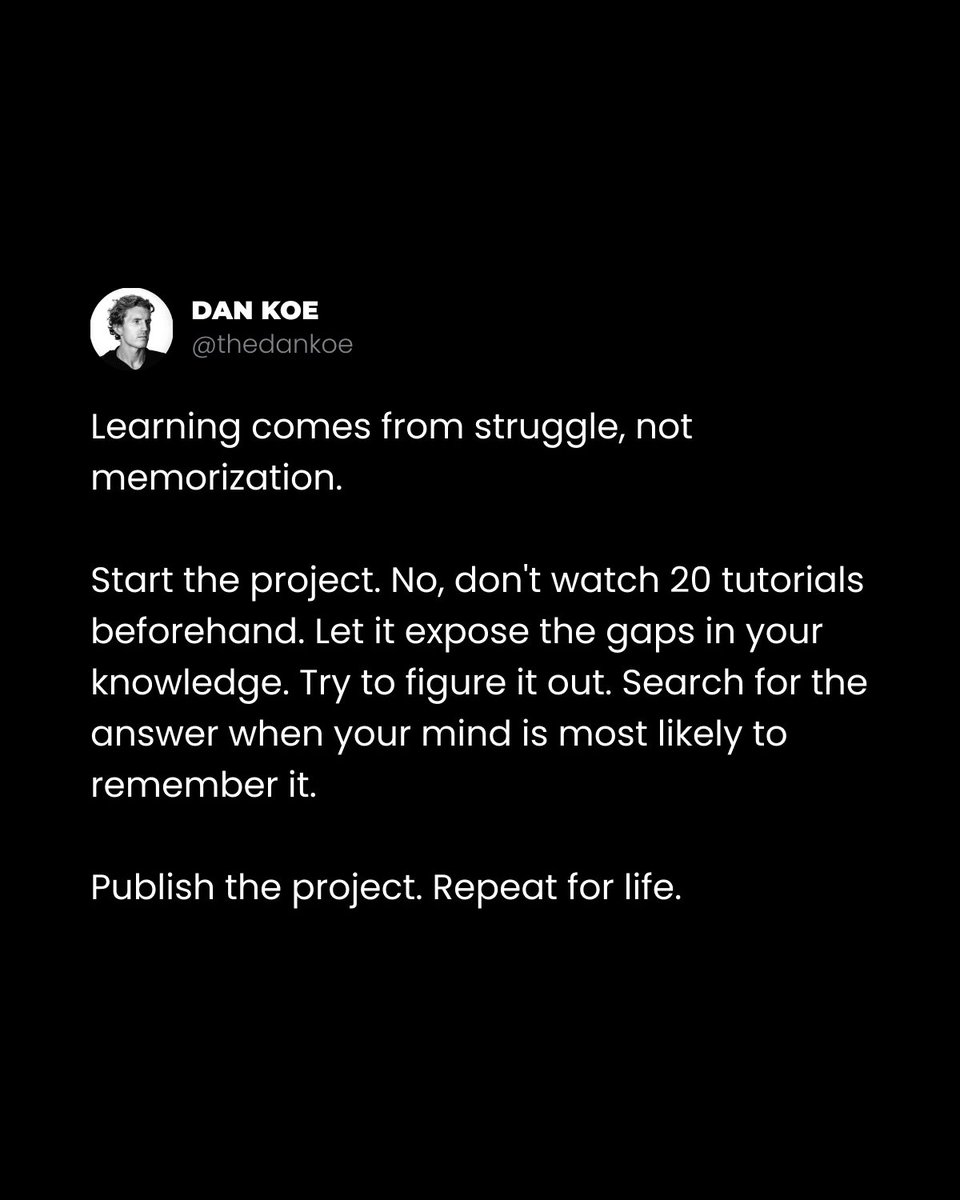 > If you need to remember it, it’s not important. If it’s important, you will remember it. For some reason, it’s become an obsession to remember everything you read. There are hundreds of videos about it with millions of views. People feel like if they don’t retain the knowledge from what they read, they're a failure, or they wasted your time, when that’s not the point of reading at all. Why would you want to memorize every word of a book in the first place? I know why. You want to sound smart. It’s an unconscious status symbol for you. You want to impress others with your articulation and intelligence, but you don’t realize that sounding smart comes from understanding, not memorization, and understanding requires a much different approach to learning. It also doesn’t help that schools tested you on your ability to memorize. You studied for hours just so you could pencil in the right answer. That’s not how life works. I get it. You want to acquire knowledge so that you can make better decisions and work yourself into a more advantageous life situation with more money and power so you don't have to worry about your day-to-day survival. Everyone wants that, but memorizing facts is the least effective way to get there. That’s what we’ll talk about first - how to acquire knowledge in a way that actually sticks, so you can create a better future for yourself. Then, we’ll talk about why your note-taking system, bookmarks, and even your precious “second brain” (the sex doll for mental masturbators) are largely useless. Skip to the rest of the article if you're allergic to self-promotion: Speaking of second brain, we just added Library, Reader, and Highlights to Eden. Now, not only can you research creators’ top content and find your next viral topic (and schedule posts to be published), but you can build an interconnected library of posts, links, and ideas that Eden organizes for you - and allows you to search based on meaning rather than just keywords. And, you can save any Substack article, X article, or YouTube video, read the transcript, and highlight so you never lose an idea. We haven't fully started blasting Eden in public yet, but our users have been vocal about how much of a game-changer it is for creatives and creators. Get 4 months and the Creator Bootcamp free (normally $499) here. ## How to actually learn anything fast  Most people have no idea how to learn. Because most people have no idea what the learning process is. The reason most learning fails is that there is no negative feedback loop. Think of it like this. If you don’t have the goal of getting in shape (and I’m talking a deep intrinsically generated goal not a superficial goal you’re pursuing to fit in, like a new years resolution) then a night of heavy drinking and partying won’t register as a problem (negative feedback), because it doesn’t impact your non-existent goal of performing on your morning run or gym session the next day. You can go to work just fine with a hangover because you don’t give a shit about how well you do at your job. Learning is a cybernetic process. Cybernetics sounds like something relating to cyborgs, but it stems from the Greek word kybernētēs, meaning steersman or helmsman. The person who steers the ship. The word “cybernetics” was chosen because the helmsman is the perfect image of a feedback system. The helmsman doesn’t just point the ship in a direction once, he constantly reads the current state (wind, waves, heading), compares it against the intended course, and adjusts. In other words, the process of trial and error, and so few people have the direction that allows them to notice errors in their life. Cybernetics illustrates the properties of intelligent systems. 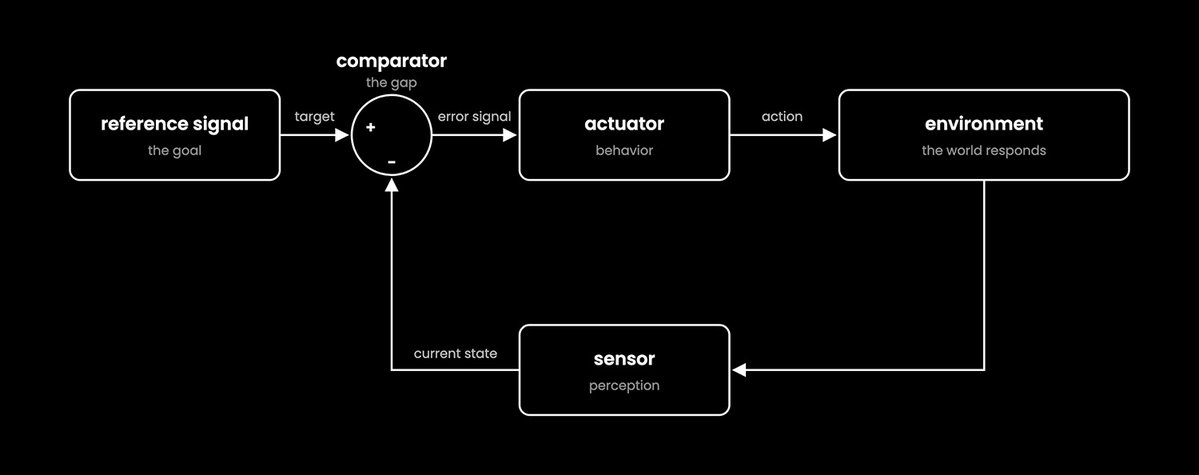 1. Reference signal (the goal) – The system holds a target state. 2. Sensor (perception) – The system reads its current state. 3. Comparator (the gap) – The system computes the difference between target and current state. The difference is the error signal. 4. Actuator (behavior) – The system acts to reduce the error. Like how a thermostat turns on the heat when it gets too cold, or how your pancreas releases insulin when blood sugar rises. That exposes the issue nicely. When most people try to learn something new, they focus on content. They hoard material and try to absorb it with spaced repetition, flashcards, courses, and learning the fundamentals. They assume learning is an input process. In reality, learning is an output process, because output demands input. A goal creates the error signal. The error signal creates the filter. The filter creates relevance (most people fill their mind with noise and things they will never use). The relevance creates retention. A person who has been conditioned their entire life to have the nearly unconscious goal of going to school and getting a job will naturally learn and behave in that direction. The destiny they were assigned will inevitably come true. The person who is deeply conditioned to go down the default path will not even notice money-making opportunities outside of a job, because their brain is filtering it out. The big life goals they were assigned at birth dictate their behavior and learning. They are a puppet of someone else’s ideals. They are not in control of their life. But if you consciously create your own frame, by knowing exactly what you don’t want out of life and comparing it to an evolving vision of what you do want out of life, you are only then able to sense when you are off track, notice the error, correct the direction you are heading, and learn as a byproduct. Makes sense, but what do you actually do? Step 1) Become obsessed with a meaningful goal. The way you become obsessed is to look at your current actions and realize where your life will end up if you don’t change. For most people, that outcome is not pretty. Sit with that image, let it fill you with potent emotion, and redirect that emotional energy toward a better direction for your life. Only then can you actually align the goals you pursue with the aim of your future. Only then does a useful learning process start, the opposite of schooling, where your learning is determined by the direction and goals society sets for you. Being extreme changes your brain and enhances neuroplasticity. In my eyes, you’re better off making an extreme change than making a lot of small changes. Burn the boats. Change your life. 2) Don’t start learning. The life you want lies at the end of a series of meaningful projects. Your mind is to be treated as a project. As is your body, relationships, and financial situation. A project is simply a structured set of goals and milestones. A project creates a frame for your learning (by filtering unimportant noise). Anything that does not directly move the project forward is not worth learning (right now), because you won’t retain it anyway. In other words, when you want to learn something new, don’t start learning, take the first step toward the goal instead. 3) Seek specific knowledge. > I ultimately think that everyone should be figuring out what it is that they uniquely do best—that aligns with who they are fundamentally, and that gives them authenticity, that brings them specific knowledge, that gives them competitive advantage, that makes them irreplaceable. And they should just lean into that. And sometimes you don’t know what that is until you do it. > – Naval Schools teach general knowledge, or knowledge required to do a job. They do not teach how to navigate your own path. They narrow you into one area of study, which by nature does not prepare you to direct your own work through the path of entrepreneurship - or simply doing what you want to do. Self-education is the process of learning what’s necessary to achieve self-generated goals. Again, no hoarding general knowledge to feel like you’re learning. As an example, let’s say I want to learn After Effects - the animation software. It would be stupid to go and watch a bunch of general After Effects tutorials and learn every little thing about the software. Instead, you need a vision for the project you want to build. You start the project with the knowledge you have, and if you don’t have knowledge, then you find a specific tutorial that is as similar to the project you want to create as it can be. Now, since you have a filter (what you want to create), most of the tutorial will be useless, but you will find one little technique that allows you to at least start the project. You apply that and then repeat until you’ve stacked so many techniques that when you go to create your next project, then the next, it becomes easier and easier. Same with learning the guitar or an instrument. You don’t go and study music theory. You choose a song you want to play. Then you learn the first chord of the song. Then the second. Then the third. And eventually you learn to tune it a specific way, and you pick up little hacks that allow you to play better. After learning a few songs, you feel as if you could then create your own simple song. That is how you learn. ## The Second Subconscious (Delete Your Note-Taking System) I’ve tried all the systems before, and I loved them. I started with Roam Research, and it completely changed how I write. I built a knowledge base of potent ideas, and pulled from those every time I sat down to put words on a screen. A few years ago, I even built Kortex, which wasn’t meant to be second-brain software, but that’s what it ended up being before it inevitably failed. Well, it didn’t really fail, but it painfully evolved into Eden, which has become the best tool on the market to find what’s trending on social media (for creators), and capture ideas from anywhere (for creatives). So, I’m not here to say that second brains are useless. I simply think they’re misused. You bookmark and take notes just for them to never be seen again. You quite literally wasted your time thinking you were learning when you could have been actually learning, as we discussed. In the past, people didn’t have a popularized “second brain” that markets well. They had a commonplace book. Marcus Aurelius’ book, Meditations, is essentially a private commonplace book with notes to himself and digested philosophy. It was never meant to be published. Leonardo da Vinci filled thousands of notebook pages with sketches, observations, questions, and borrowed ideas. Mark Twain, H.P. Lovecraft, Thomas Jefferson, Ronald Reagan, Montaigne, Rick Rubin, and many more each had some variation of this. But there is one major difference between the everyday second brain stan and them. Their collection of ideas were fuel for their creations. Their inventions, writing, and music would not be what they are today, and I would go as far as saying you wouldn’t even know who those famous people are if they didn’t have some variation of a commonplace book. When you create something, your subconscious spits out relevant ideas that contribute to the quality of the creation, but it’s still limited in processing power, and sometimes it decides to not help you at all, leaving you in a creative rut. A metaphor that Seneca used was to gather pollen from many flowers, then digest it into your own honey. In modern terms, steal like an artist. This is the antidote to writers block. You don’t have ideas for your writing, content, or videos because you don’t have a repository of ideas to pull from. Every single thing I’ve written in this letter is from articles, videos, social posts, random ideas, and highlights I’ve saved before. I think you get it, but how do we actually build this? How do we create a digital commonplace book, or second subconscious, that we can build throughout our lives that doesn’t turn into a cluttered note-taking app where your ideas go to die? Step 1) Choose The Right Software, Or Create Your Own AI System > Don’t get breathless about how “smart” AI is. It’s dumber than a sack of wet hammers. > Leverage, instead, its ability to do rapid input and output for simple tasks on large datasets. > – Devon Eriksen Most note-taking and “second brain” software still require manual upkeep. Some of them have an AI chat tacked on, which is absolutely useful, but they’re missing the most useful application of them all: making it so your ideas don’t disappear into the void - because your creative work depends on your ability to resurface them. You have 2 options here. Our goal is to have somewhere to drop ideas and easily be able to resurface the right ones for our project. - Option 1 - Use a combination like Claude Code + Obsidian to store your knowledge in one place and retrieve ideas with AI - Option 2 - Use a software like MyMind or Eden, which auto-tags, categorizes, and embeds your knowledge in “meaning space” so it can connect seemingly unrelated ideas to birth novel insights There are plenty of tutorials on the internet for option 1. It’s very popular right now because people swapped their precious collection of Notion templates for a collection of Claude skills (a fad that will fade as they all do), but here’s the 80/20 of how to do it yourself: 1. Download Obsidian and Claude 2. Open Claude Code or Claude Cowork and select your Obsidian vault folder on your computer as the folder you’re working in 3. Create a “save an idea” skill - ask claude to create a skill that creates a note in an inbox folder with a clear title 4. Create a “process my inbox” skill - ask claude to create a skill that goes through your inbox folder, add tags, move it to the right folder, and add backlinks to other related notes within the vault 5. Ask Claude to help you define your taxonomy so it knows what tags/categories to use That allows you to capture ideas, notes, and knowledge into a time-tested note-taking tool. Then, you can ask Claude at anytime to “Search my vault for everything related to [idea I’m writing about].” That works for finding most ideas, but good writing and creative work come from novel connections, not keyword search or the AI brainstorming synonyms to find related matches. If you don’t want to do all of that manually, then you can use a software like MyMind, which allows you to save any link or idea to one big and searchable library. Eden does the same thing (you can capture anything fast into your library), but takes it a step further. When you save a link, like a Substack article or YouTube video, it transcribes it, and allows you to highlight it. Plus, you can integrate with Kindle to pull all previous highlights in - which are potent creative fuel. The way MyMind and Eden differ from Obsidian and Claude is that everything you add to your library is automatically tagged, categorized, and embedded. So you can do the same search that Claude allows you to do, without wasting precious AI usage (Eden also has an MCP if you do want to build and access your knowledge base with Claude.) Plus, if you’re a writer or creator, Eden has an outlier search feed where you can find what social posts are performing in your niche and save them straight to your library. I am not entirely sure if MyMind does this, but with Eden, it also differs in that it can search based on meaning. Obsidian can show you “what’s related,” Eden can show you “what’s nearby” because each idea is embedded with ~1500 numbers that act as GPS coordinates for an idea. They can be found even if they share zero of the same words. This is what allows you to just drop an idea in and forget about it, because you know you will find it exactly when you need it. 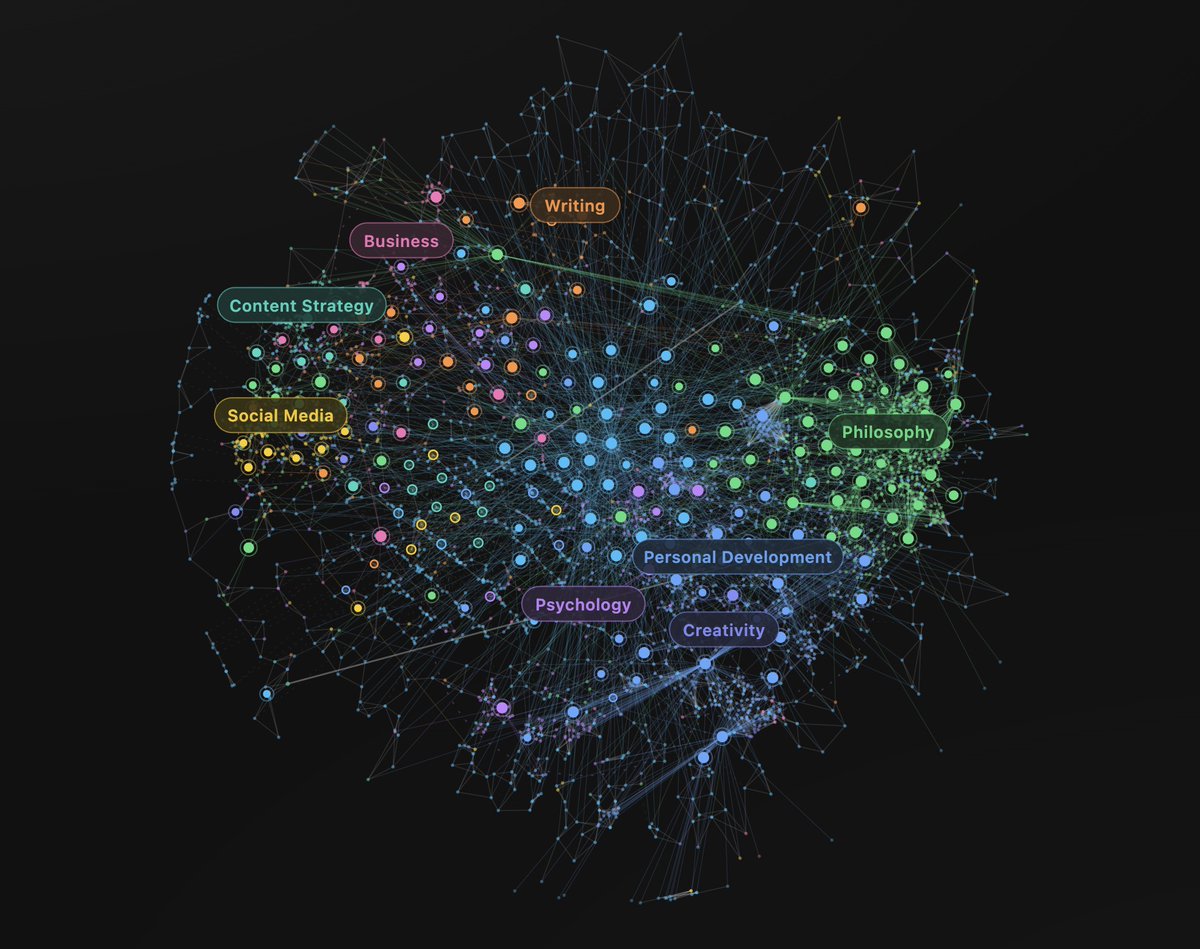 It can pull up novel connections without re-searching through your entire knowledge base every time, costing hundreds of thousands of AI tokens. You probably don’t want to maintain a vector database, an embedding API, indexing scripts, re-embedding when notes change, keeping the index in sync when files are renamed or deleted, and caching so you don’t re-pay for unchanged content. All of the tools do this for free, but if you want a true “second subconscious” that you can research while writing, creating, or building projects - Eden may be worth trying out. Step 2) Capture The Ideas That Best Represent Your Ideal Mind Now that you have a place to drop ideas without worrying about organization (because you only organize things if you want to find them later, which we just solved), you don’t just dump everything in their. When AI can create anything, curation matters more than ever. You need a curated space for ideas that spark inspiration. The opposite of an endless fire hose of noise we call a social media feed. As a writer, creator, or someone trying to do independent work (meaning you need to build an audience by attracting them to the ideas you put out), people don’t follow you for your content anymore. There’s Google, AI, and plenty of information that can be found at the click of a button. They follow you for your point of view. Your opinion. Your interpretation. Your personality. Your story. And all of those things are downstream of the ideas that compose your worldview. The ideas you use to make sense of the world. As an example, when I get into a conversation about the nature of reality, my mind jumps to ideas about history, integral theory, spiral dynamics, and more - because I’ve deemed these the most useful lens from which I can view that conversation from. It makes the most sense out of the other ideas I’ve heard that tend to fall flat. Those are the ideas you capture. You curate a large set of knowledge that would best represent your ideal mind. Because that’s what your fancy note-taking system was meant to be, right? You just never got around to solidifying those ideas as a part of yourself, usually through the act of thinking, writing, and sharing in public so that you can receive feedback from the market and let the best ideas win. How do you do this? You read more books. You let your curiosity guide you. You reject doomscrolling and embrace curated lists of authors and thinkers who are dedicated to producing good ideas. You make time for “research,” because as a writer or creator, that’s 80% of your job. The rest of your job is just synthesizing that “research” into something that’s beneficial to other people. Step 3) Build Your Ideal Mind Through The Act Of Creation Let’s close the loop. We have the system for capturing and retrieving knowledge. But now we need the project to apply it too so that it doesn’t go to waste. And, we still aren’t capturing specific knowledge because we don’t have a reason to learn. We aren’t giving our mind the frame from which it can effectively signal that ideas are important enough to capture, as we discussed. That’s the entire goal we’re after, right? We want to be smarter. We want to retain and remember what we learn. We want to sound articulate. For superficial reasons, maybe, but also because the outcome of our lives depend on the decisions that we make, and our level of smartness and ability to articulate our own value absolutely contribute positively to that. I can’t tell you what to create. But if you’re interested in writing, I can give you a part of my process that recently helped someone else. For something like writing a Substack article, YouTube script, or X article, here’s what I would do: 1) Choose a topic. Obviously. The best topics are the ones that lie at the intersection of performance and excitement. Performance = topics that have already proven to do well. You find these by saving social posts that have gone viral, or using a research tool that allows you to find outlier content and study creator’s top posts. (This article I’m writing now is based on “How to remember everything you read,” a topic that has gone viral more times than I can count, but I applied my own contrarian perspective to it). Excitement = topics and ideas that you want to explore more out of curiosity. Your job is to pair the topic you want to write about (that probably wouldn’t do well on social media) with a topic that has already proven do well, so that you can write about what you want and increase it’s potential to actually gain traction. That’s where most beginners fail. 2) Braindump → Outline → Draft Don’t start writing yet. Writer’s don’t just open one page and then expect all of the ideas to linearly fall into place. Start with a braindump. Write down all potential ideas that could fit under the topic you’re writing. Look through your notes, ideas, and links and add them inside it too. Then, start to add some structure with an outline. Take all the ideas in your braindump and try to fit them into a general storytelling framework: Problem → Insight → Solution. Organize ideas under each of those sections in the outline. Then, have your outline, ideas, and library of knowledge open and ready to pull from as you string together the ideas in the form of an actual draft. 3) Use AI to remove friction, not write for you. I’ll write about my thoughts on AI writing in a future letter, but when I say “don’t use AI for writing,” I’m actually saying “don’t use AI to articulate your own beliefs and opinions.” Now that Substack has their AI writing estimator, people are going to start pointing out how certain accounts use AI in their writing. I’ve had a few point out that some of my articles have AI writing in them. Don’t be dense. Yes, I copy paste straight from AI when providing pure information - like explanations of Greuter’s 9 stages of ego development, the same information you’d get from a Google search. I’m not going to waste my breath trying to rewrite it in my own words, because that doesn’t need to happen. It’s a disservice to myself and the reader. I think there is value in struggling to articulate your own thoughts and beliefs, which is something the anti-AI people can’t seem to do very well as they are kept narrow minded by their new religion. When I say “use AI to remove friction,” I am talking about using it like you would a course or mentor or editor while you are learning the skill. If you don’t know how to structure your article, ask for a list of structures that your ideas could fit into. If you don’t know what to write next, ask for a few directions the article can go. If you don’t understand something, research it, like any writer would in the past with a less efficient method of scouring through the internet for the right information. All in all, I trust that you have a brain. You are ultimately the one who decides what gets published. If it doesn’t represent the values, ideas, and beliefs you want it to, then refine it until it does. I’ll leave it at that, because I have much more to say that I’ll save for another letter. – Dan If you want to write but don’t know where to start, what to write about, or anything about how to grow on social media, consider joining the bootcamp here. ## 相关链接 - [DAN KOE](https://x.com/thedankoe) - [@thedankoe](https://x.com/thedankoe) - [145K](https://x.com/thedankoe/status/2081415714636996844/analytics) - [Get 4 months and the Creator Bootcamp free (normally $499) here.](https://eden.so/?utm_source=thedankoe&utm_medium=social&utm_campaign=social_evergreen&utm_content=x_article) - [Eden may be worth trying out](https://eden.so/?utm_source=thedankoe&utm_medium=social&utm_campaign=social_evergreen&utm_content=x_article) - [research tool](https://eden.so/) - [consider joining the bootcamp here.](https://eden.so/bootcamp/?utm_source=thedankoe&utm_medium=social&utm_campaign=bootcamp_evergreen&utm_content=x_article) - [Upgrade to Premium](https://x.com/i/premium_sign_up) - [12:25 AM · Jul 27, 2026](https://x.com/thedankoe/status/2081415714636996844) - [145.4K Views](https://x.com/thedankoe/status/2081415714636996844/analytics) - [View quotes](https://x.com/thedankoe/status/2081415714636996844/quotes) --- *导出时间: 2026/7/27 08:56:14* --- ## 中文翻译 # 如何记住你读的所有内容(别再费劲了) **作者**: DAN KOE **日期**: 2026-07-26T16:25:51.000Z **来源**: [https://x.com/thedankoe/status/2081415714636996844](https://x.com/thedankoe/status/2081415714636996844) ---  > 如果你需要刻意去记,那它就不重要。如果它真的重要,你自然会记住。 不知为何,记住读过的所有内容变成了一种执念。以此为题的视频有成百上千个,观看量高达数百万。 人们觉得,如果记不住阅读所得的知识,就是自己失败,或者是浪费了时间,但这根本不是阅读的意义所在。 你到底为什么想要把一本书的每个字都背下来? 我知道为什么。 你想让自己听起来很聪明。 这对你来说是一种潜意识里的地位象征。 你想用你的口才和智慧打动别人,但你没意识到,让人听起来聪明源于理解,而非死记硬背,而理解需要一种完全不同的学习方法。学校考你记忆力这一点也没帮上什么忙。你学习数小时,只是为了能在试卷上填上正确答案。生活根本不是这样运作的。 我懂你。 你想获取知识,以便做出更好的决策,并让自己进入拥有更多金钱和权力的更有利的生活境地,这样你就不用为日常的生计发愁。每个人都想要这样,但死记硬背事实是达成这一目标最无效的方式。 这就是我们要首先谈论的——如何以一种真正能留存的方式获取知识,从而为你创造更美好的未来。 然后,我们会谈谈为什么你的笔记系统、书签,甚至你珍视的“第二大脑”(那是给意淫者的充气娃娃)基本都没什么用。 如果你反感自我推销,可以直接跳到文章的其余部分: 说到第二大脑,我们刚刚给 Eden 添加了 Library(文库)、Reader(阅读器)和 Highlights(高亮)功能。现在,你不仅可以研究创作者的顶级内容并找到你的下一个病毒式传播话题(并安排发布时间),还可以建立一个帖子、链接和想法相互连接的文库,由 Eden 为你整理——并允许你基于意义而不仅仅是关键词进行搜索。 此外,你可以保存任何 Substack 文章、X 文章或 YouTube 视频,阅读转录稿并进行高亮,这样你就永远不会丢失一个想法。 我们还没有完全开始公开推广 Eden,但我们的用户一直在直言不讳地表示,这对创意人士和创作者来说是多么颠覆性的工具。 在此处获取 4 个月免费使用权和创作者训练营(通常价值 499 美元)。 ## 如何真正快速学会任何东西  大多数人根本不知道如何学习。 因为大多数人根本不知道学习过程是什么。 大多数学习失败的原因在于没有负反馈循环。 可以这样想。 如果你没有健身的目标(我说的是内心深处产生的内在目标,而不是为了合群而追求的肤浅目标,比如新年决心),那么一夜的豪饮狂欢就不会被登记为问题(负反馈),因为它不会影响你并不存在的第二天晨跑或健身房训练的目标。你带着宿醉去上班也完全没问题,因为你根本不在乎你工作做得有多好。 学习是一个控制论过程。 控制论听起来像是与赛博格有关的东西,但它源于希腊单词 kybernētēs,意为舵手或领航员。那个掌舵的人。 选择“控制论”这个词是因为舵手是反馈系统的完美形象。舵手不只是把船指向一个方向一次,他不断地读取当前状态(风、浪、航向),将其与预定航线进行比较,并进行调整。换句话说,就是试错的过程,而很少有人拥有能让他们注意到生活中错误的明确方向。 控制论阐明了智能系统的属性。  1. 参考信号(目标)——系统保持一个目标状态。 2. 传感器(感知)——系统读取其当前状态。 3. 比较器(差距)——系统计算目标状态与当前状态之间的差异。这种差异就是误差信号。 4. 执行器(行为)——系统采取行动以减少误差。 就像恒温器在太冷时开启加热,或者你的胰腺在血糖升高时释放胰岛素一样。 这很好地暴露了问题所在。 当大多数人试图学习新东西时,他们专注于内容。他们囤积资料,试图通过间隔重复、抽认卡、课程和学习基础知识来吸收它们。他们假设学习是一个输入过程。 实际上,学习是一个输出过程,因为输出需要输入。 目标产生误差信号。 误差信号产生过滤器。 过滤器产生相关性(大多数人的头脑里充斥着噪音和他们永远不会使用的东西)。 相关性产生留存。 一个一生都被 conditioned(条件反射)设定了上学和找工作这一几乎潜意识的潜意识目标的人,自然会朝着那个方向学习和行为。他们被分配的命运不可避免地会成真。 那个被深度条件反射去走默认路径的人,甚至不会注意到工作之外的赚钱机会,因为他们的大脑把它过滤掉了。他们出生时被设定的人生宏大目标主导了他们的行为和学习。他们是别人理想的傀儡。他们无法掌控自己的生活。 但是,如果你通过确切地知道你不想要从生活中得到什么,并将其与你想要从生活中得到什么不断演变的愿景进行比较,从而有意识地创建你自己的框架,只有那时你才能感觉到你何时偏离了轨道,注意到错误,纠正你前进的方向,并将学习作为一个副产品。 有道理,但你实际上要做什么? 第一步)沉迷于一个有意义的目标。 你变得沉迷的方式是审视你当前的行为,并意识到如果你不改变,你的生活最终会走向何方。 对大多数人来说,那个结果并不美好。 静下心来面对那个画面,让那种强烈的情绪充满你,并将这种情绪能量重定向到你生活的更好方向。 只有那时,你才能真正将你追求的目标与你未来的目标保持一致。只有那时,一个有用的学习过程才开始,这与学校相反,学校里你的学习是由社会为你设定的方向和目标决定的。 极端的改变会改变你的大脑并增强神经可塑性。在我看来,你最好做出极端的改变,而不是做很多微小的改变。 破釜沉舟。改变你的生活。 2)不要开始学习。 你想要的生活位于一系列有意义的项目尽头。 你的头脑应该被视为一个项目。你的身体、人际关系和财务状况也是如此。项目只是一组结构化的目标和里程碑。项目为你的学习创建了一个框架(通过过滤不重要的噪音)。任何不能直接推动项目前进的事情都不值得学习(现在),因为反正你也记不住。 换句话说,当你想学习新东西时,不要开始学习,而是朝着目标迈出第一步。 3)寻求特定知识。 > 我最终认为每个人都应该弄清楚自己独特地做得最好的事情是什么——这要与他们的根本特质保持一致,这能给他们带来真实性,带给他们特定知识,给他们竞争优势,让他们变得不可替代。他们应该以此为重心。有时,直到你做了,你才知道那是什么。 > – Naval 学校教授通用知识,或者是做一份工作所需的知识。 它们不教授如何驾驭你自己的道路。它们把你缩小到一个研究领域,这本质上不能为你通过创业道路指导自己的工作做好准备——或者仅仅是做你想做的事。 自学是学习实现自我设定目标所必需内容的过程。同样,不要囤积通用知识来让自己感觉像是在学习。 举个例子,假设我想学习 After Effects——那个动画软件。 去观看一堆通用的 After Effects 教程并学习关于软件的每一个小细节是很愚蠢的。 相反,你需要对你想要构建的项目有一个愿景。 你用你现有的知识开始项目,如果你没有知识,那么你就找一个与你想要创建的项目尽可能相似的特定教程。 现在,既然你有一个过滤器(你想要创建什么),教程的大部分内容都会是无用的,但你会发现一个小技巧,让你至少可以开始项目。 你应用它,然后重复,直到你堆叠了足够多的技巧,当你去创建你的下一个项目,然后是再下一个时,它会变得越来越容易。 学习吉他或乐器也是一样。 你不去研究乐理。 你选择一首你想弹的歌。 然后你学习这首歌的第一个和弦。然后是第二个。然后是第三个。最终你学会了以特定方式调音,你会学到一些让你弹得更好的小窍门。 学会了几首歌后,你会觉得你可以创作自己的简单歌曲了。 这才是你学习的方式。 ## 第二潜意识(删除你的笔记系统) 以前我试过所有的系统,我很喜欢它们。我从 Roam Research 开始,它彻底改变了我的写作方式。我建立了一个充满强有力想法的知识库,每次我坐下来在屏幕上写字时都会从中提取灵感。 几年前,我甚至构建了 Kortex,它本来不打算成为第二大脑软件,但在它不可避免地失败之前,它最终变成了那样。好吧,它并没有真正失败,但它痛苦地进化成了 Eden,这已成为市场上寻找社交媒体热门趋势(针对创作者)和从任何地方捕捉想法(针对创意人士)的最佳工具。 所以,我并不是在这里说第二大脑没用。 我只是认为它们被误用了。 你添加书签和做笔记,结果它们再也没被看过。你真的浪费了时间以为自己在学习,而实际上你本可以真正学习,正如我们讨论过的那样。 在过去,人们没有一个营销得当的流行“第二大脑”。他们有一本“记事本”。 马可·奥勒留的书,《沉思录》,本质上是一本私人的记事本,里面有给他的笔记和消化的哲学。它从未打算出版。 列奥纳多·达·芬奇在他的数千页笔记本上填满了草图、观察、问题和借用的想法。 马克·吐温、H.P. 洛夫克拉夫特、托马斯·杰斐逊、罗纳德·里根、蒙田、里克·鲁宾等每个人都有这种东西的某种变体。 但是,日常的第二大脑狂热者和他们之间有一个主要的区别。 他们收集的想法是他们创作的燃料。 他们的发明、写作和音乐不会是今天的样子,我甚至可以说,如果他们没有某种形式的记事本,你甚至不会知道那些著名人物是谁。 当你创造东西时,你的潜意识会吐出有助于创造质量的相关想法,但它的处理能力仍然有限,有时它决定根本不帮你,让你陷入创意瓶颈。 塞内卡使用的一个隐喻是从许多花朵中采集花粉,然后将其消化成你自己的蜂蜜。 用现代术语来说,就是像艺术家一样偷师。 这是写作障碍的解毒剂。你没有写作、内容或视频的想法,是因为你没有可以提取的想法库。我在这封信里写的每一句话都来自我以前保存的文章、视频、社交媒体帖子、随机想法和高亮。 我想你明白了,但我们实际上如何建立这个? 我们如何创建一个数字记事本,或第二潜意识,我们可以在一生中构建它,而它不会变成一个杂乱的笔记应用程序,让你的想法在那里消亡? 步骤 1)选择正确的软件,或创建你自己的 AI 系统 > 不要对 AI 有多“聪明”感到喘不过气。它比一袋子湿锤子还笨。 > 相反,要利用它在大型数据集上对简单任务进行快速输入和输出的能力。 > – Devon Eriksen 大多数笔记和“第二大脑”软件仍然需要手动维护。 其中一些附加了 AI 聊天功能,这绝对有用,但它们错过了最有用的应用:让你的想法不会消失在虚空中——因为你的创意工作取决于你重新提取它们的能力。 你有两个选择。 我们的目标是有一个地方可以放下想法,并能够轻松地为我们的项目重新提取正确的想法。 - 选项 1 - 使用像 Claude Code + Obsidian 这样的组合,将你的知识存储在一个地方,并使用 AI 检索想法 - 选项 2 - 使用像 MyMind 或 Eden 这样的软件,它会自动标记、分类,并将你的知识嵌入“意义空间”,以便它可以将看似无关的想法联系起来,产生新颖的见解 互联网上有很多关于选项 1 的教程。它现在非常受欢迎,因为人们用珍贵的 Notion 模板集合交换了 Claude 技能集合(像所有风潮一样,这也会消退),但这是你自己动手做的 80/20 法则: 1. 下载 Obsidian 和 Claude 2. 打开 Claude Code 或 Claude Cowork 并选择你计算机上的 Obsidian vault 文件夹作为你工作的文件夹 3. 创建一个“保存想法”技能——要求 claude 创建一个技能,在收件箱文件夹中创建一个带有清晰标题的笔记 4. 创建一个“处理我的收件箱”技能——要求 claude 创建一个技能,遍历你的收件箱文件夹,添加标签,将其移动到正确的文件夹,并向库中的其他相关笔记添加反向链接 5. 要求 Claude 帮助你定义你的分类法,以便它知道要使用什么标签/类别 这允许你将想法、笔记和知识捕捉到一个经过时间考验的笔记工具中。 然后,你可以随时询问 Claude “在我的库中搜索与 [我正在写的想法] 相关的所有内容”。 这对于找到大多数想法很有用,但好的写作和创意工作来自于新颖的联系,而不是关键词搜索或 AI 头脑风暴同义词以找到相关匹配。 如果你不想手动做所有这些,那么你可以使用像 MyMind 这样的软件,它允许你将任何链接或想法保存到一个巨大且可搜索的文库中。 Eden 做同样的事情(你可以快速将任何东西捕捉到你的文库中),但它更进了一步。当你保存链接(如 Substack 文章或 YouTube 视频)时,它会转录它,并允许你对其进行高亮处理。此外,你可以与 Kindle 集成,将以前的所有高亮拉入——这些都是强大的创意燃料。 MyMind 和 Eden 与 Obsidian 和 Claude 的不同之处在于,你添加到文库的所有内容都会自动标记、分类和嵌入。所以你可以执行 Claude 允许你做的相同搜索,而无需浪费宝贵的 AI 使用量(如果你想使用 Claude 构建和访问你的知识库,Eden 也有 MCP)。此外,如果你是作家或创作者,Eden 有一个异常值搜索信息流,你可以在其中找到社交帖子在你的利基市场中表现如何,并将它们直接保存到你的文库。 我不完全确定 MyMind 是否这样做,但 Eden 的不同之处还在于它可以基于意义进行搜索。 Obsidian 可以向你展示“相关内容”,Eden 可以向你展示“附近的内容”,因为每个想法都嵌入了约 1500 个数字,作为想法的 GPS 坐标。即使它们不共享任何相同的单词,也能找到它们。这就是为什么你可以放下一个想法然后忘记它的原因,因为你知道当你需要它时你会准确找到它。  它可以提出新颖的联系,而无需每次都重新搜索你的整个知识库,消耗数十万个 AI token。 你可能不想维护向量数据库、嵌入 API、索引脚本、笔记更改时重新嵌入、文件重命名或删除时保持索引同步以及缓存,这样你就不必为未更改的内容重新付费。 所有这些工具都免费提供此功能,但如果你想要一个真正的“第二潜意识”,你可以在写作、创作或构建项目时进行研究——Eden 可能值得一试。 步骤 2)捕捉最能代表你理想头脑的想法 现在你有一个地方可以放下想法而不用担心组织(因为你只有在以后想找到它们时才组织东西,我们刚刚解决了这个问题),你不要把所有东西都倒在那里。 当 AI 可以创造任何东西时,策展比以往任何时候都重要。 你需要一个策展的空间来存放能激发灵感的想法。这与我们称之为社交媒体信息流的无限噪音消防水管相反。 作为作家、创作者,或试图做独立工作的人(意味着你需要通过吸引人们到你提出的想法来建立受众),人们不再因为你的内容而关注你。 有 Google、AI,还有大量可以通过点击按钮找到的信息。 他们因为你的观点而关注你。你的意见。你的解读。你的个性。你的故事。所有这些都是构成你世界观的想法的下游。你用来理解世界的想法。 例如,当我进入关于现实本质的对话时,我的头脑会跳转到关于历史、整合理论、螺旋动力学等的想法——因为我认为这些是观察该对话最有用的视角。这比我听到的其他往往站不住脚的想法更有道理。 那些就是你要捕捉的想法。 你策展大量的知识,以最好地代表你理想的头脑。 因为你花哨的笔记系统本来就是为了这个,对吧? 你只是从来没有来得及把这些想法巩固为你自己的一部分,通常通过思考、写作和公开分享的行为,这样你就可以从市场获得反馈,让最好的想法胜出。 你怎么做这个? 你读更多的书。你让你的好奇心引导你。你拒绝末日刷屏,拥抱致力于产生好想法的作者和思想家的策展列表。你为“研究”腾出时间,因为作为作家或创作者,这是你工作的 80%。 你工作的其余部分只是将那个“研究”综合成对其他人有益的东西。 步骤 3)通过创造的行为构建你理想的头脑 让我们闭环。 我们有捕获和检索知识的系统。 但现在我们需要应用它的项目,这样它就不会浪费。 而且,我们仍然没有捕获特定知识,因为我们没有学习的理由。我们没有给我们的头脑提供框架,让它能够有效地表明想法足够重要以至于可以捕获,正如我们讨论过的。 这就是我们要追求的全部目标,对吧? 我们想变得更聪明。我们想保留并记住我们学到的东西。我们想听起来口齿伶俐。也许是出于肤浅的原因,但也因为我们生活的结果取决于我们做出的决定,我们的聪明程度和表达我们自己价值的能力绝对对此有积极贡献。 我不能告诉你该创造什么。 但如果你对写作感兴趣,我可以给你我流程的一部分,这部分最近帮助了别人。 对于写 Substack 文章、YouTube 脚本或 X 文章之类的事情,我会这样做: 1)选择一个主题。 显然。 最好的主题是那些位于表现和兴奋交集的主题。 表现 = 已经证明表现良好的主题。 你可以通过保存已经疯传的社交帖子,或使用允许你找到异常值内容并研究创作者顶级帖子的研究工具来找到这些。 (我现在写的这篇文章是基于“如何记住你读的所有内容”,这个话题疯传的次数多到数不清,但我对此应用了我自己的逆向视角)。 兴奋 = 出于好奇心想要探索更多的主题和想法。 你的工作是将你想写的主题(可能在社交媒体上表现不佳)与已经证明表现良好的主题配对,这样你可以写你想写的东西并增加它实际上获得吸引力的潜力。 这就是大多数初学者失败的地方。 2)头脑倾倒 → 大纲 → 草稿 还不要开始写作。 作家不是只打开一页然后就期望所有想法线性地各就各位。 从头脑倾倒开始。写下所有可能适合你正在写的主题的潜在想法。浏览你的笔记、想法和链接,并将它们也添加进去。 然后,开始用大纲添加一些结构。把你头脑倾倒中的所有想法放进去,并尝试将它们适合一个通用的讲故事框架:问题 → 洞察 → 解决方案。 在大纲中的每个部分下组织想法。 然后,让你的大纲、想法和知识文库打开并准备好提取,当你以实际草稿的形式将这些想法串联起来时。 3)使用 AI 来消除摩擦,而不是替你写作。 我会在未来的信中写下我对 AI 写作的想法,但当我说“不要使用 AI 写作”时,我实际上是在说“不要使用 AI 来表达你自己的信念和意见”。 既然 Substack 有了他们的 AI 写作估计器,人们将开始指出某些账户如何在他们的写作中使用 AI。有几个人指出我的一些文章中有 AI 写作。 别犯傻。 是的,当我提供纯信息时——比如 Gruter 的自我发展 9 个阶段的解释,也就是你从 Google 搜索得到的相同信息——我会直接从 AI 复制粘贴。我不会浪费我的呼吸试图用自己的话重写它,因为不需要这样做。这对我自己和读者都是一种伤害。 我认为努力表达你自己的想法和信念是有价值的,这是反 AI 的人似乎不太能做到的,因为他们被他们的新宗教束缚了思想。 当我说“使用 AI 来消除摩擦”时,我指的是像你在学习技能时使用课程或导师或编辑那样使用它。 如果你不知道如何构建你的文章,请一份你的想法可以适应的结构列表。 如果你不知道下一步写什么,询问文章可以走的几个方向。 如果你不理解某件事,研究它,就像过去的任何作家会做的那样,使用一种在互联网上搜索正确信息的效率较低的方法。 总而言之,我相信你有一个大脑。 你最终是决定发布什么内容的人。 如果它不能代表你想要它代表的价值、想法和信念,那么完善它直到它确实代表为止。 我就说到这里,因为我还有更多要说,会留到下一封信。 – Dan 如果你想写作但不知道从哪里开始,写什么,或者关于如何在社交媒体上成长的任何事情,考虑在这里加入训练营。 ## 相关链接 - [DAN KOE](https://x.com/thedankoe) - [@thedankoe](https://x.com/thedankoe) - [145K](https://x.com/thedankoe/status/2081415714636996844/analytics) - [在此处获取 4 个月免费使用权和创作者训练营(通常价值 499 美元)。](https://eden.so/?utm_source=thedankoe&utm_medium=social&utm_campaign=social_evergreen&utm_content=x_article) - [Eden 可能值得一试](https://eden.so/?utm_source=thedankoe&utm_medium=social&utm_campaign=social_evergreen&utm_content=x_article) - [研究工具](https://eden.so/) - [考虑在这里加入训练营。](https://eden.so/bootcamp/?utm_source=thedankoe&utm_medium=social&utm_campaign=bootcamp_evergreen&utm_content=x_article) - [升级到 Premium](https://x.com/i/premium_sign_up) - [12:25 AM · Jul 27, 2026](https://x.com/thedankoe/status/2081415714636996844) - [145.4K Views](https://x.com/thedankoe/status/2081415714636996844/analytics) - [查看引用](https://x.com/thedankoe/status/2081415714636996844/quotes) --- *导出时间: 2026/7/27 08:56:14*
9 9 harsh truths that will make you a better writer 文章分享了九个残酷但真实的写作建议,帮助读者克服写作障碍。核心观点包括:读者只关心写作对他们的价值、完美主义是恐惧反馈的表现、从个人经验出发、不需要完美的笔记系统、现在就是开始的最佳时机等。鼓励立即行动,通过持续练习提升写作技能。 读书 › 方法论 ✍ Dickie Bush🕐 2026-07-30 写作自我提升方法论行动力个人成长内容创作写作技巧心态调整procrastinationaudience building
如 如何从任何逆境中翻盘(博弈论视角) 文章运用博弈论原理,分析了如何在失败后实现翻盘。核心观点包括:首要目标是存活而非立即回本;落后时应增加变数而非盲目努力;重建速度无法与崩溃速度相提并论。文章强调策略重于模糊哲学,主张通过改变策略而非加大投入来实现逆袭。 读书 › 方法论 ✍ Incentivising🕐 2026-07-27 博弈论策略翻盘方法论决策风险管理逆向思维心理学自我提升策略思维
Z Z-Library倒了?这10个免费电子书网站正在接管我的硬盘 针对Z-Library被封禁后的书荒问题,文章推荐了10个高质量的免费电子书替代网站,包括Project Gutenberg、Internet Archive、Anna's Archive等。内容涵盖公版经典、学术文献、商业教材及杂志,提供了针对不同需求的资源获取组合,旨在通过构建个人“护城河”提升认知杠杆。 读书 › 工具 ✍ 华尔街财经 | WS × AI Era🕐 2026-05-07 电子书资源推荐Z-Library知识管理学习效率工具免费资源阅读PDF杂志
普 普通人0成本创业,从写作开始 文章阐述了普通人如何利用写作作为切入点,在微信、X等平台生态中积累影响力。作者指出,通过持续输出细分领域内容、解决用户问题,可建立个人品牌和信任,最终实现低成本的副业变现与个人成长。 职场 › 职业发展 ✍ 蜗牛King🕐 2026-05-02 个人IP副业写作内容创业影响力方法论职业规划自我提升
A AI能秒读一本书,我们为什么还要花上几周? 作者反思了长期依赖AI进行“高效阅读”的弊端,发现虽然获取了信息和结论,却丧失了深度阅读时的情感共鸣与思考过程。文章指出,阅读的价值在于“无用”的体验与自我陪伴。最终,作者将书分为“获取信息”与“陪伴自己”两类,决定在后者上拒绝AI加速,保留慢读的能力。 读书 › 方法论 ✍ brewcookie🕐 2026-04-28 AI阅读深度思考效率自我提升
四 四步深度读书法:从读完就忘到终身受益 本文介绍了一套融合认知神经科学与教育心理学的「四步深度读书法」。该方法旨在解决传统阅读留存率低(不足10%)的问题,通过构建认知框架、问题驱动阅读、动态抓取关键信息以及即时输出(费曼技巧)四个步骤,显著提升知识转化率。文章结合脑科学原理(如预测编码、生成效应)与实操工具,为不同类型的书籍提供了具体的阅读策略,旨在帮助读者实现从被动接收到主动掌握的转变。 读书 › 方法论 ✍ Vincent Logic🕐 2026-04-26 深度阅读认知科学费曼技巧知识管理学习效率读书笔记思维导图阅读方法自我提升方法论
提 提升思维的10本数学书籍(但鲜有人能读完) 文章推荐了10本能够重塑思维的数学书籍,这些书并非传统教材,而是需要主动参与的高强度思维训练。从探讨复杂系统的《哥德尔、埃舍尔、巴赫》到问题解决经典的《如何解题》,这些书籍涵盖了逻辑、证明、统计学等多个领域。虽然大多数读者因难度较大而半途而废,但坚持阅读并理解其中内容,将极大地提升读者在逻辑、模式识别及解决复杂问题方面的思维能力。 读书 › 方法论 ✍ Steve Burns🕐 2026-04-25 数学思维书单逻辑自我提升科普认知方法论GEB问题解决
兴 兴趣当然能当饭吃!只是大多数人不知道怎么吃。 文章指出大多数人的兴趣无法变现是因为它们属于“消费型兴趣”,即只会享受不会创造。要将兴趣转化为收入,需要将其转变为“生产型兴趣”,即通过兴趣帮助他人解决问题。作者提出了实现这一转变的三步法:从享受转向研究、从独享转向分享、从分享转向变现。 职场 › 职业发展 ✍ 汤光头🕐 2026-04-20 兴趣变现职业规划副业认知升级个人成长方法论价值创造自我提升
H How I Replaced Willpower With 6 Alarms (The Protocol) 本文介绍了一种通过设置6个闹钟作为“枢纽”来替代意志力的习惯养成协议。作者提出“多米诺习惯”的概念,即通过完成一个核心习惯来自动修正其他行为。利用“时间地标”效应,将一天划分为不同的阶段并设置闹钟提醒,从而降低认知负荷,外包时间管理,确保每天早起并保持高效状态。 生活 › 方法 ✍ Rian Doris🕐 2026-04-19 习惯养成时间管理自我提升意志力效率方法论闹钟生活优化Flow认知负荷
为 为什么你学了10年英语还开不了口?诺奖得主的理论揭示:大脑根本不想记单词 本文结合神经科学、认知心理学及二语习得理论,深入剖析了传统英语学习效率低下的根本原因。文章引用诺贝尔奖得主Herbert Simon的“组块化理论”和语言学家Stephen Krashen的“输入假说”,指出语言学习的本质是神经可塑性的重塑,而非单纯的词汇积累。作者提出了基于可理解输入(i+1)、模块化学习、高频输出及情绪管理的四步科学训练法,并给出了6-10个月实现流利交流的具体执行路径。 读书 › 方法论 ✍ Vincent Logic🕐 2026-04-16 英语学习神经科学方法论组块化理论Stephen Krashen认知心理学自我提升二语习得脑科学效率
如 如何在一天内重塑你的人生 文章探讨了为什么大多数人的新年决议和自我改变尝试会失败。作者指出,真正的改变不依赖于表面上的自律或 productivity 技巧,而是源于身份的根本转变。文中揭示了三个核心误区:试图改变行为而不改变身份、潜意识中的目标并非你以为的那样、以及潜意识里对成功的恐惧。文章旨在通过心理学和行为学的视角,引导读者进行深度的自我反思。 生活 › 方法论 ✍ Dan Koe🕐 2026-01-17 自我提升心理学行为改变个人成长目标设定身份认同深度思考生产力潜意识
如 如何在一天之内拯救你的人生 本文通过深度心理学视角(如目的论、身份认同、心智模型)分析了人们难以改变的根本原因,指出仅靠意志力无法实现长久的转变。作者提出了基于“控制论”的智力定义,并介绍了一套为期一天的深度反思方案,旨在帮助读者挖掘潜意识动机、打破身份锁定,从而重塑生活方式并实现跨越式成长。 读书 › 方法论 ✍ Franky (@frankyleon725)🕐 2026-01-17 自我提升心理学心智成长方法论人生规划控制论身份认同深度思考