# How to Hit 6 Figures MRR With a Consumer App in 6 Months. No Ads Required.
**作者**: Lucas Patiri
**日期**: 2026-07-13T17:56:51.000Z
**来源**: [https://x.com/lucaspatiri_/status/2076727573518725235](https://x.com/lucaspatiri_/status/2076727573518725235)
---
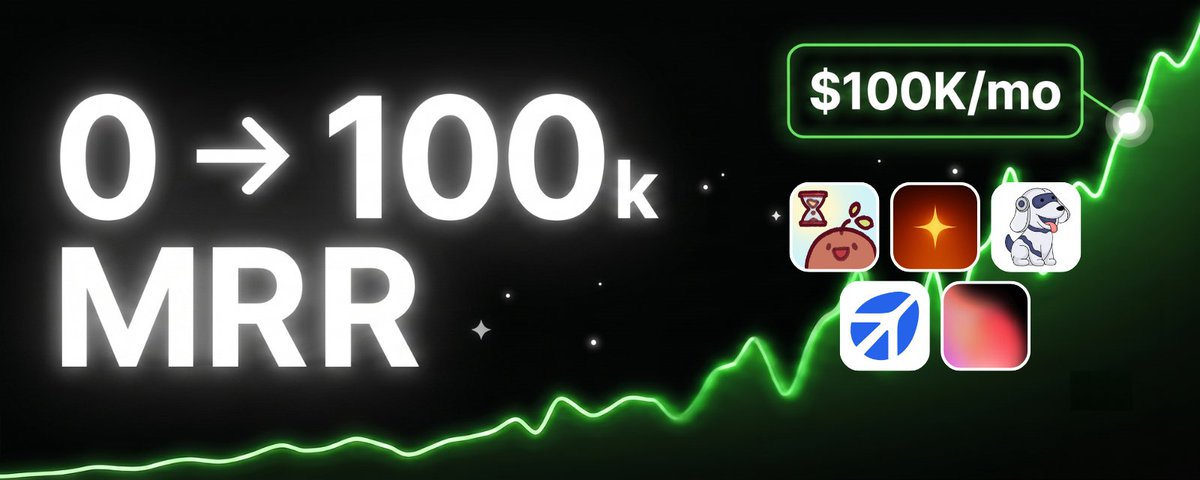
i've studied over 60 apps that scaled past $100K MRR using creator content instead of paid acquisition.
most of them look nothing alike. different categories. different budgets. but every single one proved the same thing: you don't need ads to build a real business on mobile.
here are 5 of the most interesting ones, broken down by exactly what they did, what they spent, and what happened.

# 1. Gleam: Dead App to $100K MRR in 30 Days
gleam is a social skills app. think "duolingo for conversations." before their UGC campaign, they had 30K downloads and were basically dead.
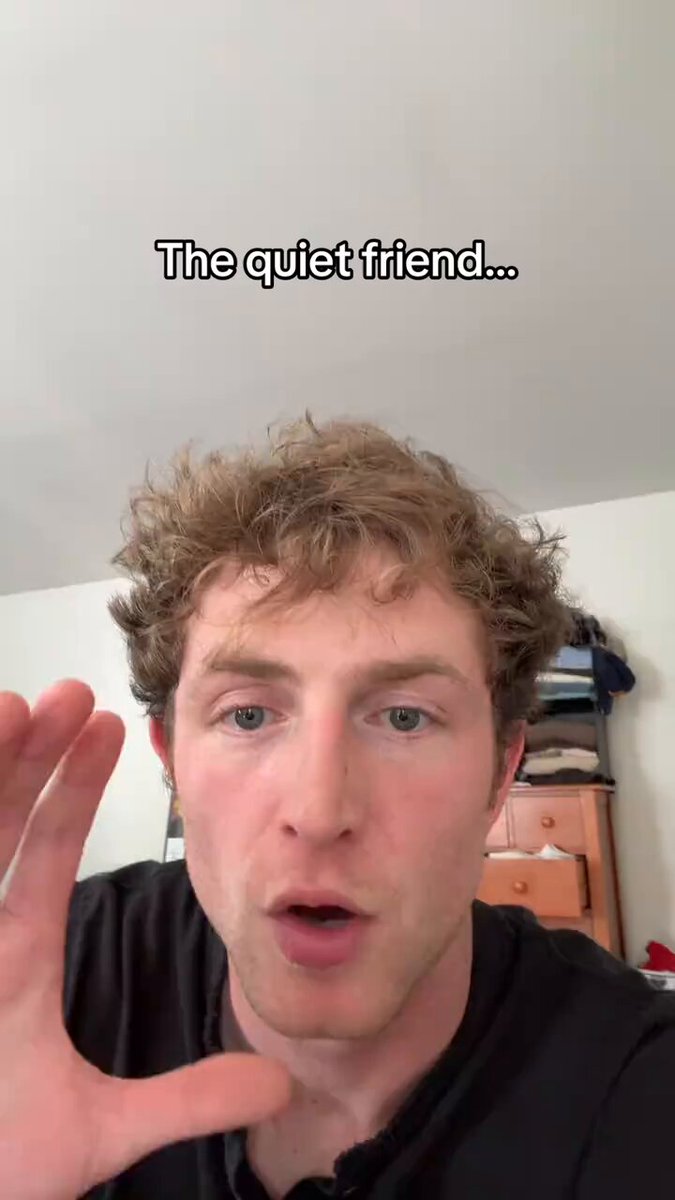
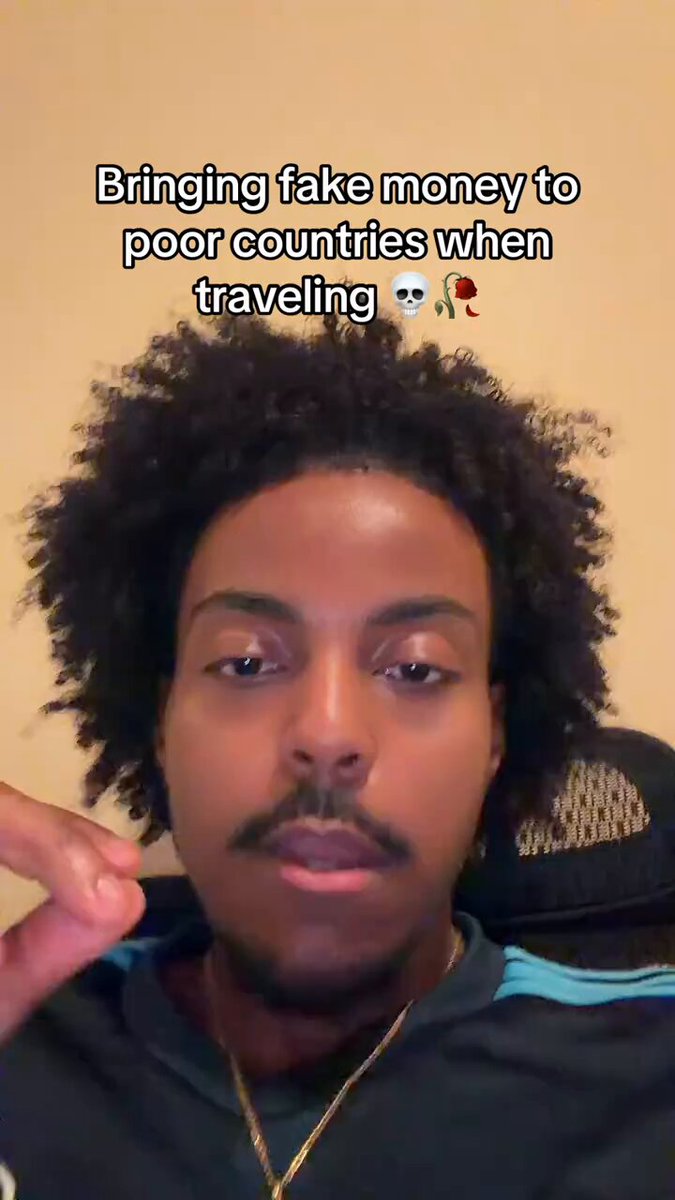
then they did something most agencies would call insane: they hired 7 creators and told them to make 10-minute tiktok videos (u can check an example below)
not 30-second hooks. not 60-second tutorials. 10-minute storytime videos where the creator tells a personal story about being socially awkward, and the app appears as the resolution, as the actual answer to their problem.
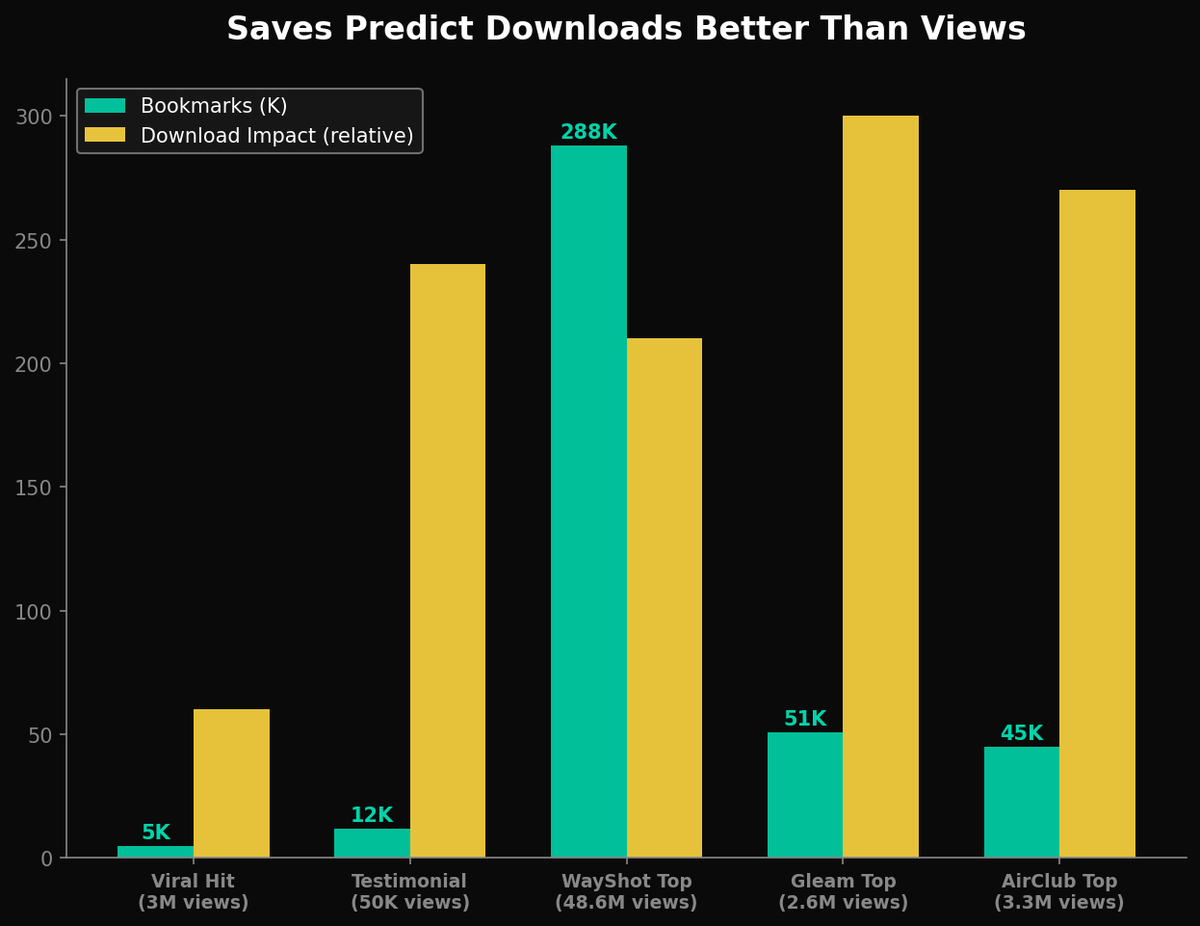
the lead creator, @squashwinz (255K followers), posted a video called "the quiet friend." it hit 2.6 million views and 51,000 bookmarks.
within 30 days, gleam went from 30K to 70K+ downloads. MRR crossed $100K from essentially zero.
the counterintuitive part: 10-minute videos on tiktok. everyone says short content wins. gleam proved that when the story is good enough, people will watch anything. the algorithm doesn't care about length. it cares about retention. and a good story retains better than a quick hook.
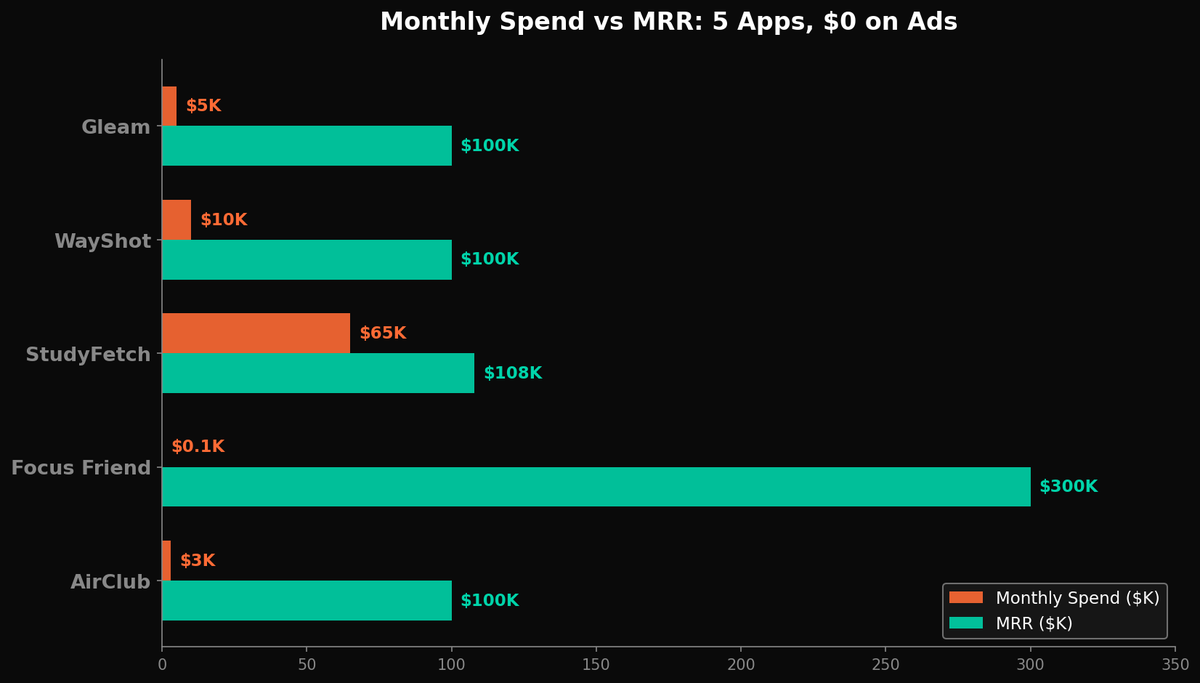
what they spent: 7 creators, standard micro-creator rates ($15-20/video).
what they got: $100K+ MRR. 40K+ new downloads. a 20x return in month one.
# 2. WayShot: 8 Accounts to $100K MRR and 500K Downloads/Month
wayshot is a photo editing app. 9 months old at the time of this analysis.
their entire operation runs on 8 creator accounts. that's it. no massive creator army. no 200-account network. 8 accounts posting consistently.
but their format strategy is what makes them interesting. they run a 3-format system:
format 1 (organic reach): relatable content that happens to show the app.
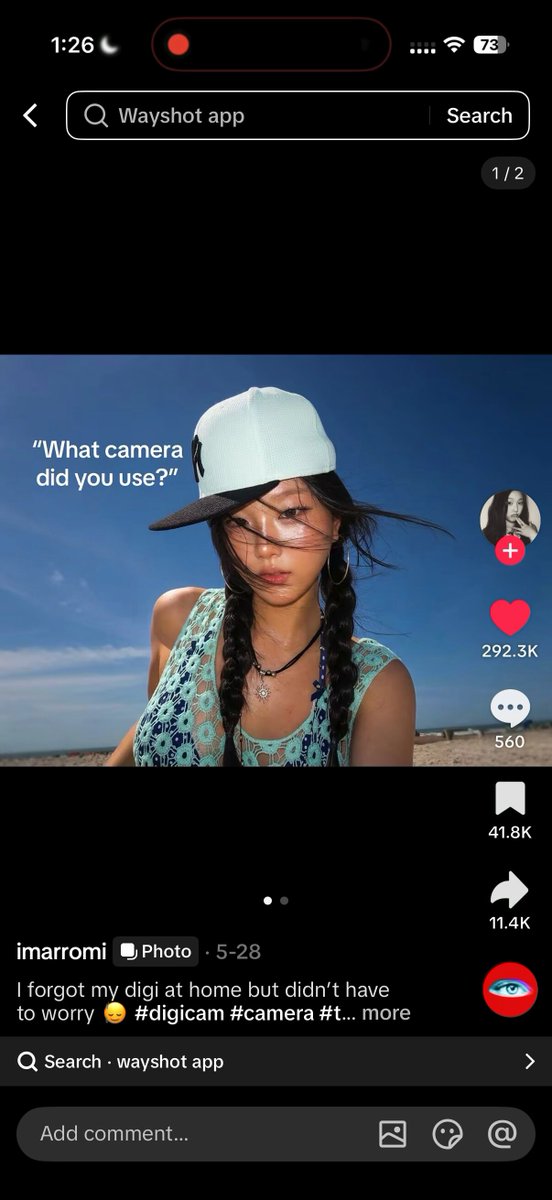
their top video hit 48.6 million views, 288K bookmarks, and 83K comments. the hook was "that friend who thinks everything is aesthetic." it's not even about the app. it's about a personality type. the app just appears naturally.
format 2 (product awareness): before/after comparisons.
but they flip the order. they show the "after" first (the beautiful photo), then the "before" (the original). this creates curiosity because the viewer wants to know how the transformation happened. peak performance: 7.5 million views, 75K bookmarks.
format 3 (aspirational saves): videos that make people save the post.
4 videos with 2M+ views each in april 2026 alone.
the insight here is the mix. format 1 gets them reach. format 2 teaches people what the app does. format 3 drives downloads because the viewer needs the app to get the result.
total views across 8 accounts: 150 million.
what they spent: 8 creators at micro rates. probably under $10K/month total.
what they got: $100K MRR, 500K+ downloads/month, and a format system they can run indefinitely.
# 3. StudyFetch: 225 Accounts, 150 Videos/Day, Approaching 1 Billion Views
studyfetch is the opposite of wayshot. where wayshot runs lean, studyfetch runs an army.
they're an AI study app (think flashcard generator on steroids). founded in january 2023. by mid-2026, they had:
· 995 million total views (approaching 1 billion)
· 8.3 million saves
· 1.9 million shares
· 225 active accounts (100+ on tiktok, 50+ on instagram, 1 youtube)
· 150+ videos published per day
· $108K MRR
their model is the ambassador program. each creator runs 2 accounts. they're not just posting for studyfetch, they ARE studyfetch on their platform.
their top ambassadors tell the story:
· studyfetchjeanne: 50M+ views
· chady: 35M+ views
· studyfetchlauren: 28M+ views
the format that works best for them is the "lecture-to-summary transformation." a creator films themselves looking overwhelmed by a lecture, then shows the app converting their notes into a study guide in seconds. it's a before/after, but the before is an emotion (stress) and the after is a result (clean summary).
this only works because they have 225 accounts creating variations. most individual videos get modest views. but when you post 150 videos per day, the hits find themselves. it's pure volume strategy, and the math works because their cost per video is minimal.
what they spent: base pay for 100+ creators at $15-20/video. total monthly spend probably $50-80K.
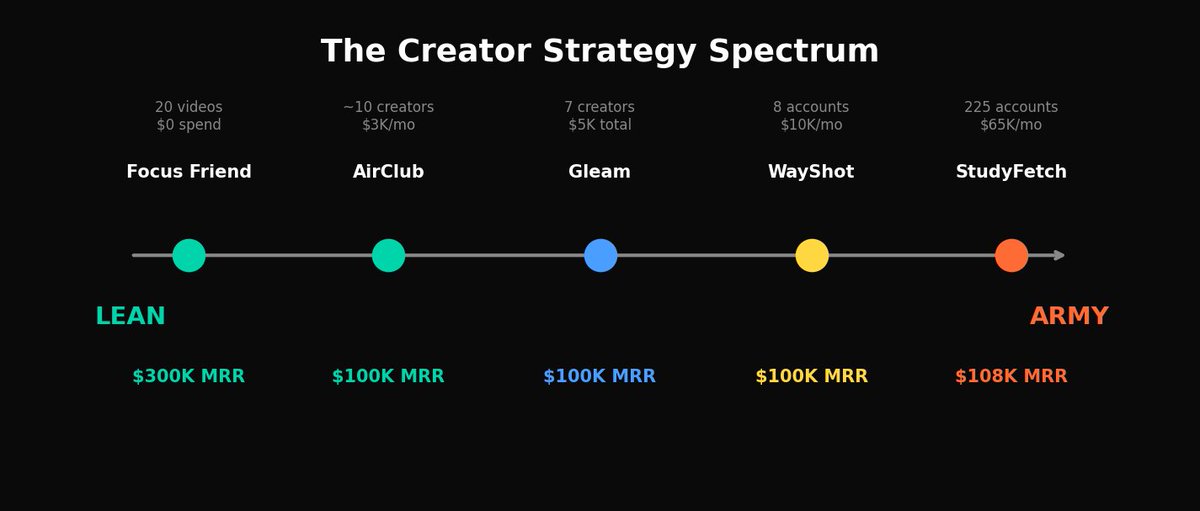
what they got: nearly 1 billion views, $108K MRR, and a machine that compounds every month.

# 4. Focus Friend: 20 Pieces of Content to #1 in the App Store
this one breaks every rule.
focus friend is a pomodoro timer app built by hank green (yes, that hank green. 12M+ followers across platforms). it launched and hit #1 in the app store within 72 hours.
the entire launch consisted of 20 pieces of content. that's not a typo. 20 total.
· 1 youtube video
· 5 youtube shorts
· 5 instagram reels
· 9 tiktoks
his first tiktok hit 2.3 million views. his youtube shorts combined for 5.8 million views.
but the real magic wasn't the content. it was what happened after.
the app has a gamified bean character. users loved it. they started making their own content about the bean. organic UGC flew without any creator program, any brief, any payment. the product itself was so share-worthy that the content flywheel spun on its own.
the viral comment that tells the whole story: "i didn't have to make an account to start." it got 20,500 likes. people were shocked that an app just... worked. no friction. no signup wall. just value.
focus friend hit $300K MRR.
now, most founders reading this will say "i'm not hank green." true. but the lesson isn't about having 12M followers. the lesson is:
- a great product creates its own content (the bean became a meme)
- removing friction is itself a marketing strategy (no account required became the viral moment)
- 20 pieces of content can outperform 20,000 if the product is right
price: $1.99/month or $29.99 lifetime. low price, high volume. the content did the rest.

# 5. AirClub: Reading Flight Deals Out Loud to $100K MRR
this is my favorite because it's the most boring.
airclub is a flight deals app. they hit $100K+ MRR in 10 months. their tiktok has 24 million views across 257 days.
their top video: 3.3 million views. the format? someone literally reads flight deals out loud. that's it. no transitions. no effects. no trending audio. a person looks at a screen and reads "new york to paris, $287 round trip, travel tuesday deal."
it sounds like it shouldn't work. but it works because:
bookmarkable content.
people save flight deal videos to check later. saves are the highest-weighted signal in the tiktok algorithm. when a video gets saved at high rates, the algorithm pushes it to more people who are likely to save it. it's a compounding loop.
different creators for different demographics.
they don't use one creator for everyone. they match creators to the traveler persona. a 22-year-old for backpacker deals. a 35-year-old for family vacation deals. each creator's audience self-selects into the right segment.
first-mover advantage in format.
nobody was doing content-led flight deals growth when airclub started. by the time competitors showed up, airclub had 10 months of algorithm training and audience trust.
what they spent: a handful of creators reading deals. total cost probably under $3K/month.
what they got: $100K+ MRR in 10 months, a format that's almost impossible to burn out (there are always new deals), and a moat built on consistency.
# The Pattern Across All 5
every one of these apps is different. a social skills app. a photo editor. a study tool. a timer. a flight deals aggregator.
but they share 4 things:
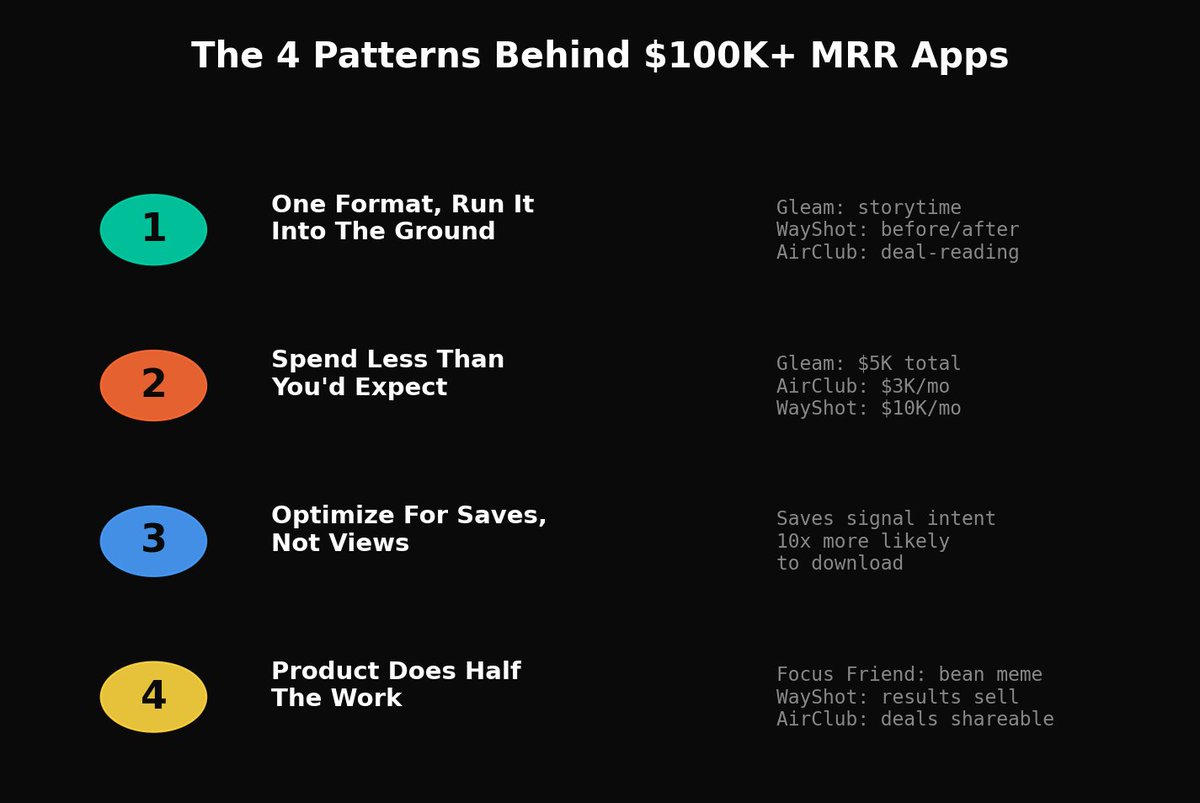
1. they found one format that worked and ran it into the ground.
gleam found storytime. wayshot found before/after. studyfetch found lecture transformations. focus friend found founder-led product demos. airclub found deal-reading. none of them tried to do 10 formats at once. they picked one, proved it, then scaled it.
2. they paid less than you'd expect.
gleam spent under . airclub spends under $3K/month. even studyfetch, with 225 accounts, runs on micro-creator rates. the total spend across all 5 is probably less than what one app spends on meta ads in a single month.
3. they optimized for saves, not views.
the videos that drove the most downloads weren't always the ones with the most views. they were the ones with the most bookmarks. saves signal intent. a person who saves a video about your app is 10x more likely to download it than someone who liked it and scrolled past.
4. the product did half the work.
gleam's app was the story resolution. wayshot's results made people want the app. focus friend's bean became a meme. airclub's deals were inherently shareable. when the product is interesting, the content almost writes itself. when the product isn't interesting, no amount of content strategy will save it.
# The Math That Should Make You Rethink Your Budget
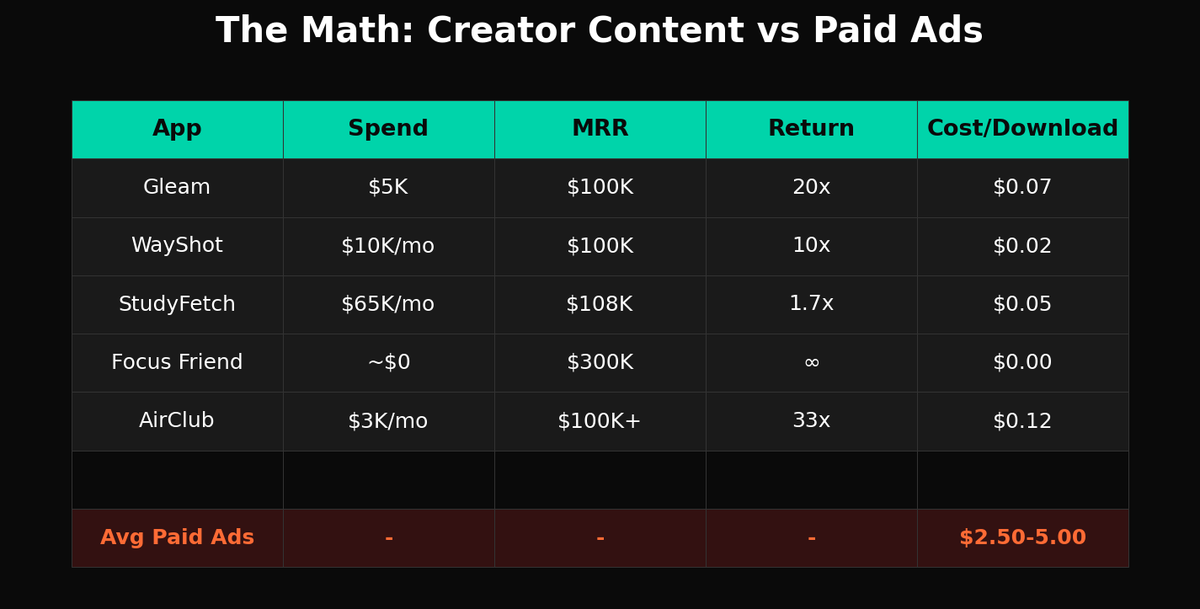
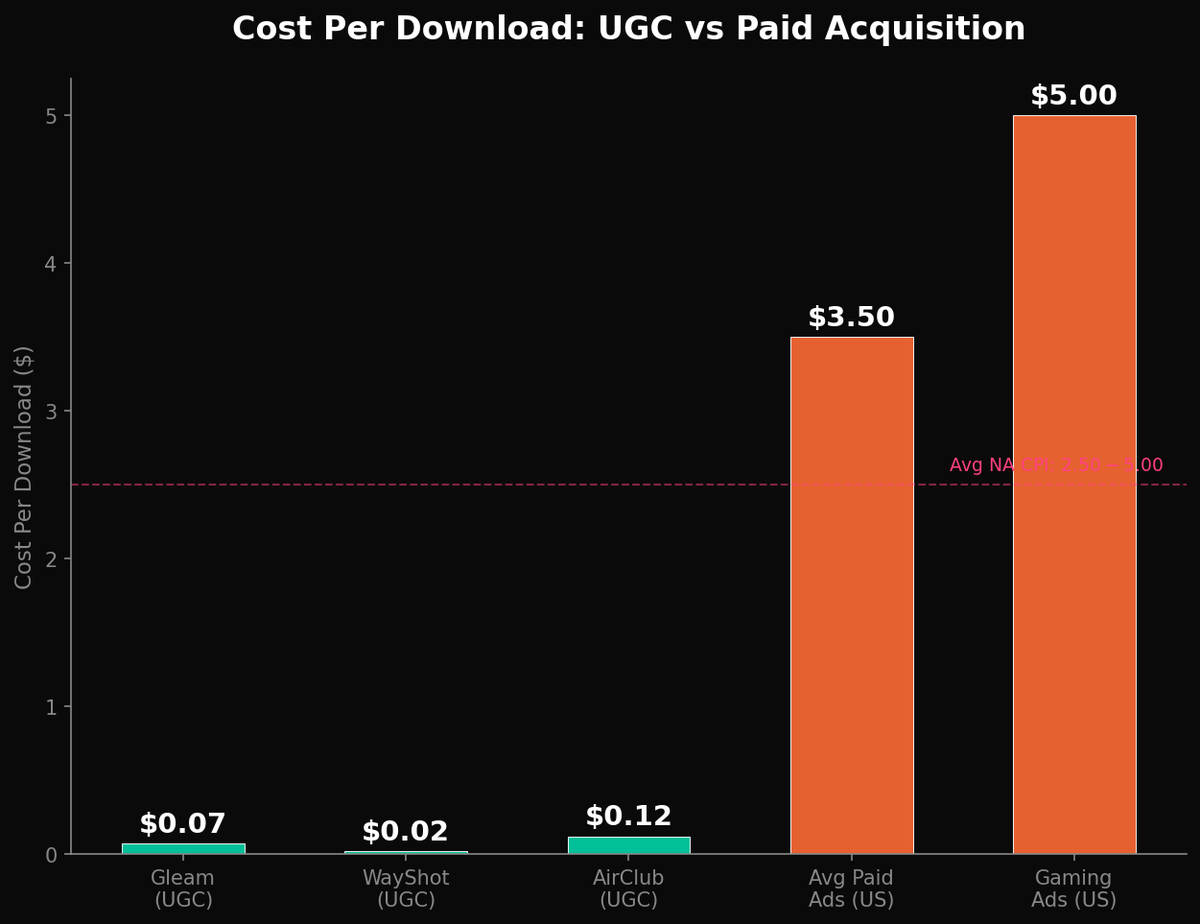
compare that to paid acquisition where the average CPI in north america is now $2.50-5.00 and rising 30% year over year.
one approach bleeds money every month. the other compounds.
i've worked with 40+ apps like these. the ones that win aren't the ones with the biggest budgets. they're the ones that find one format, one audience, and one creator type that clicks, and then they do it 1,000 times.
the playbook isn't complicated. it's just not what most people expect.
if you're an app founder spending more on ads than on creators, the math is working against you. we build these systems for a living. DM me if you want to see what it looks like for your app.
## 相关链接
- [Lucas Patiri](https://x.com/lucaspatiri_)
- [@lucaspatiri_](https://x.com/lucaspatiri_)
- [71K](https://x.com/lucaspatiri_/status/2076727573518725235/analytics)
- [@squashwinz](https://x.com/@squashwinz)
- [$100K+](https://x.com/search?q=%24100K%2B&src=cashtag_click)
- [$50-80K](https://x.com/search?q=%2450-80K&src=cashtag_click)
- [$100K+](https://x.com/search?q=%24100K%2B&src=cashtag_click)
- [$100K+](https://x.com/search?q=%24100K%2B&src=cashtag_click)
- [Upgrade to Premium](https://x.com/i/premium_sign_up)
- [1:56 AM · Jul 14, 2026](https://x.com/lucaspatiri_/status/2076727573518725235)
- [71.7K Views](https://x.com/lucaspatiri_/status/2076727573518725235/analytics)
- [View quotes](https://x.com/lucaspatiri_/status/2076727573518725235/quotes)
---
*导出时间: 2026/7/19 09:54:33*
---
## 中文翻译
# 如何在 6 个月内通过一款消费者应用实现 10 万美元月度经常性收入(MRR)。无需投放广告。
**作者**: Lucas Patiri
**日期**: 2026-07-13T17:56:51.000Z
**来源**: [https://x.com/lucaspatiri_/status/2076727573518725235](https://x.com/lucaspatiri_/status/2076727573518725235)
---

我研究了超过 60 款通过创作者内容而非付费投放实现了 10 万美元以上 MRR 的应用。
它们大多数看起来毫无相似之处。不同的品类。不同的预算。但每一款都证明了同样一件事:在移动端建立真正的业务,你不需要广告。
以下是其中 5 个最有趣的案例,我们将详细拆解它们具体做了什么、花费了多少,以及发生了什么。


# 1. Gleam:死寂 App 30 天内冲到 10 万美元 MRR
Gleam 是一款社交技能应用。你可以把它想象成“对话版多邻国”。在他们的 UGC(用户生成内容)活动之前,他们只有 3 万次下载,基本上处于“死亡”状态。
然后他们做了一件大多数代理机构都会觉得疯狂的事:他们雇佣了 7 位创作者,并让他们制作 10 分钟长的 TikTok 视频(你可以查看下面的示例)。
不是 30 秒的吸睛片段。也不是 60 秒的教程。是 10 分钟的“故事时间”视频,创作者在其中讲述自己社交尴尬的个人经历,而应用作为解决方案出现,作为他们问题的实际答案。
首席创作者 @squashwinz(25.5 万粉丝)发布了一个名为“那个安静的朋友”的视频。它获得了 260 万次观看和 5.1 万次收藏。
在 30 天内,Gleam 从 3 万次下载增长到 7 万+。MRR 从几乎为零突破了 10 万美元。
反直觉的部分在于:TikTok 上的 10 分钟视频。大家都说短视频才是赢家。Gleam 证明了只要故事足够好,人们什么都会看。算法不关心长度。它关心留存率。而一个好的故事比快速吸睛的片段更能留住人。
**他们花费了什么**:7 位创作者,标准的微型创作者费用(每条视频 15-20 美元)。
**他们获得了什么**:10 万美元+ MRR。4 万+ 新下载。第一个月 20 倍的回报。

# 2. WayShot:8 个账号实现 10 万美元 MRR 和 50 万月下载量
WayShot 是一款照片编辑应用。在进行分析时,它上线 9 个月。
他们的整个运营仅靠 8 个创作者账号。就是这样。没有庞大的创作者大军。没有 200 个账号的网络。只有 8 个账号在持续发布。
但他们的格式策略才是他们有趣之处。他们运行着一套三格式系统:
**格式 1(自然触达):** 碰巧展示了应用的相关性内容。
他们表现最好的视频获得了 4860 万次观看,28.8 万次收藏和 8.3 万条评论。吸引点是“那个觉得什么都很美学的朋友”。这甚至不是关于应用的。这是关于一种人格类型。应用只是自然地出现。
**格式 2(产品认知):** 前/后对比。
但他们反转了顺序。他们先展示“后”(漂亮的照片),然后展示“前”(原图)。这创造了好奇心,因为观众想知道转变是如何发生的。巅峰表现:750 万次观看,7.5 万次收藏。
**格式 3(愿望型收藏):** 让人们收藏这条视频的内容。
仅在 2026 年 4 月,就有 4 条视频各自获得了 200 万+ 的观看量。
这里的洞察在于这种混合。格式 1 为他们带来触达。格式 2 教会人们应用是做什么的。格式 3 驱动下载,因为观众需要这个应用才能获得结果。
8 个账号的总观看量:1.5 亿次。
**他们花费了什么**:8 位创作者,微型费率。总成本可能每月低于 1 万美元。
**他们获得了什么**:10 万美元 MRR,50 万+ 月下载量,以及一套可以无限运行的格式系统。

# 3. StudyFetch:225 个账号,150 条视频/天,接近 10 亿观看量
StudyFetch 与 WayShot 截然相反。WayShot 运营精益,而 StudyFetch 则运营着一支大军。
他们是一款 AI 学习应用(可以想象成强效版抽认卡生成器)。成立于 2023 年 1 月。到 2026 年中期,他们已经拥有:
· 9.95 亿次总观看量(接近 10 亿)
· 830 万次收藏
· 190 万次分享
· 225 个活跃账号(TikTok 上 100+,Instagram 上 50+,1 个 YouTube)
· 每天 150+ 条视频发布
· 10.8 万美元 MRR
他们的模式是大使计划。每位创作者运营 2 个账号。他们不只是为 StudyFetch 发帖,他们在平台上*就是* StudyFetch。
他们顶级大使的数据说明了这一切:
· studyfetchjeanne:5000 万+ 观看量
· chady:3500 万+ 观看量
· studyfetchlauren:2800 万+ 观看量
对他们来说最有效的格式是“讲座到摘要的转换”。创作者拍摄自己面对讲座感到不知所措的画面,然后展示应用在几秒钟内将他们的笔记转换为学习指南。这是一个前/后对比,但“前”是一种情绪(压力),“后”是一个结果(整洁的摘要)。
这之所以有效,仅仅是因为他们有 225 个账号在制作变体。大多数单个视频的观看量都很普通。但当你每天发布 150 条视频时,爆款自然会涌现。这是一种纯粹的体量策略,而且算得过来账,因为他们的单条视频成本极低。
**他们花费了什么**:100+ 位创作者的基础薪资,每条视频 15-20 美元。每月总支出可能在 5-8 万美元。

**他们获得了什么**:近 10 亿观看量,10.8 万美元 MRR,以及一台每月都在滚雪球的机器。

# 4. Focus Friend:20 条内容登上 App Store 榜首
这个案例打破了一切规则。
Focus Friend 是一款番茄钟计时器应用,由 Hank Green(没错,就是那个 Hank Green。全网 1200 万+ 粉丝)开发。它发布后,在 72 小时内登上了 App Store 榜首。
整个发布过程仅包含 20 条内容。这不是笔误。总共 20 条。
· 1 条 YouTube 视频
· 5 条 YouTube Shorts
· 5 条 Instagram Reels
· 9 条 TikTok
他的第一条 TikTok 获得了 230 万次观看。他的 YouTube Shorts 总共获得了 580 万次观看。
但真正的魔力不在于内容本身。而在于之后发生的事情。
这款应用有一个游戏化的豆子角色。用户们爱上了它。他们开始制作关于这个豆子的自己的内容。有机的 UGC 如潮水般涌现,没有任何创作者计划,没有任何简报,没有任何付款。产品本身太值得分享了,以至于内容飞轮自行旋转起来了。
那条说明整个故事的病毒式评论:“我不需要注册账号就可以开始。”它获得了 2.05 万个赞。人们很震惊,一个应用竟然……直接能用。没有摩擦。没有注册墙。只有价值。
Focus Friend 达到了 30 万美元 MRR。
现在,大多数读到这里创始人会说“我不是 Hank Green。”确实如此。但教训不在于拥有 1200 万粉丝。教训在于:
- 伟大的产品创造自己的内容(豆子成了一个梗)
- 移除摩擦本身就是一种营销策略(无需注册账号成了病毒式传播的时刻)
- 如果产品对路,20 条内容可以击败 2 万条内容
价格:1.99 美元/月或 29.99 美元终身买断。低价,高体量。剩下的由内容完成。

# 5. AirClub:通过大声朗读航班优惠实现 10 万美元 MRR
这是我最喜欢的一个,因为它最无聊。
AirClub 是一款航班优惠应用。他们在 10 个月内达到了 10 万美元+ MRR。他们的 TikTok 在 257 天内获得了 2400 万次观看。
他们表现最好的视频:330 万次观看。格式是什么?有人只是大声朗读航班优惠。就是这样。没有转场。没有特效。没有流行音频。一个人看着屏幕念道:“纽约到巴黎,287 美元往返,周二旅行优惠。”
听起来这不应该奏效。但它奏效是因为:
**值得收藏的内容。**
人们保存航班优惠视频以便稍后查看。收藏是 TikTok 算法中权重最高的信号。当一条视频以高比率被收藏时,算法会将其推给更多可能收藏它的人。这是一个复利循环。
**针对不同人群使用不同创作者。**
他们并不用一位创作者覆盖所有人。他们将创作者与旅行者画像匹配。22 岁的负责背包客优惠。35 岁的负责家庭度假优惠。每位创作者的受众都会自我选择进入正确的细分市场。
**格式上的先发优势。**
当 AirClub 开始时,没人做内容驱动的航班优惠增长。等到竞争对手出现时,AirClub 已经积累了 10 个月的算法训练和受众信任。

**他们花费了什么**:少数几位创作者朗读优惠。总成本可能每月低于 3000 美元。
**他们获得了什么**:10 个月内 10 万美元+ MRR,一种几乎不会枯竭的格式(总会有新优惠),以及建立在一致性上的护城河。

# 所有 5 个案例的共同模式
每一款应用都各不相同。社交技能应用。照片编辑器。学习工具。计时器。航班优惠聚合器。
但它们共享 4 点:

1. 他们找到了一种有效的格式并将其做到极致。
Gleam 找到了故事时间。WayShot 找到了前/后对比。StudyFetch 找到了讲座转换。Focus Friend 找到了创始人主导的产品演示。AirClub 找到了优惠朗读。他们没有试图同时做 10 种格式。他们选择了一种,验证了它,然后规模化。
2. 他们的花费比你预期的要少。
Gleam 花费低于 [数字,原文缺失]。AirClub 每月花费低于 3000 美元。即使是 StudyFetch,拥有 225 个账号,也是按微型创作者费率运行的。这 5 个案例的总花费可能还不如一款应用在 Meta 广告上一个月的花费。
3. 他们为收藏而非观看量进行优化。
驱动最多下载的视频不总是那些观看量最高的。它们是那些被收藏最多的。收藏代表意图。一个保存了关于你应用视频的人,比那些点赞并划走的人下载的可能性高 10 倍。

4. 产品承担了一半的工作。
Gleam 的应用是故事的结局。WayShot 的结果让人们想要这个应用。Focus Friend 的豆子成了一个梗。AirClub 的优惠本质上具有分享性。当产品有趣时,内容几乎自动生成。当产品无趣时,再多的内容策略也救不了它。
# 让你重新思考预算的数学

将其与付费获客相比,后者在北美的平均 CPI(单次安装成本)现在是 2.50-5.00 美元,且每年同比增长 30%。
一种方式每个月都在烧钱。另一种方式则是复利增长。
我与 40 多款这样的应用合作过。获胜的不是那些预算最大的。而是那些找到一种格式、一个受众、一种合拍的创作者类型,然后重复做 1000 次的。
这套剧本并不复杂。它只是不符合大多数人的预期。
如果你是一位在广告上花费比在创作者上还要多的应用创始人,数学逻辑正对你不利。我们要以此为生。如果你想看看这对你的应用来说是什么样子,请私信我。
## 相关链接
- [Lucas Patiri](https://x.com/lucaspatiri_)
- [@lucaspatiri_](https://x.com/lucaspatiri_)
- [71K](https://x.com/lucaspatiri_/status/2076727573518725235/analytics)
- [@squashwinz](https://x.com/@squashwinz)
- [$100K+](https://x.com/search?q=%24100K%2B&src=cashtag_click)
- [$50-80K](https://x.com/search?q=%2450-80K&src=cashtag_click)
- [$100K+](https://x.com/search?q=%24100K%2B&src=cashtag_click)
- [$100K+](https://x.com/search?q=%24100K%2B&src=cashtag_click)
- [Upgrade to Premium](https://x.com/i/premium_sign_up)
- [1:56 AM · Jul 14, 2026](https://x.com/lucaspatiri_/status/2076727573518725235)
- [71.7K Views](https://x.com/lucaspatiri_/status/2076727573518725235/analytics)
- [View quotes](https://x.com/lucaspatiri_/status/2076727573518725235/quotes)
---
*导出时间: 2026/7/19 09:54:33*